
How to Help Depression Without Meds: Steps That Work
What if the question isn't whether you can help depression without medication, but whether the level of support you've chosen matches how unwell you feel right now? Many people treat how to help depression without meds as a list of lifestyle tips. A safer approach is different. You choose a structured, non-medication plan, you match its intensity to your symptoms and daily functioning, and you set a review point where you'll change course if it's not working.
Match Support to Severity and Know When Self-Help Falls Short
If you have thoughts of suicide or self-harm, don't self-treat. Contact crisis support now. In the US, call or text 988, or call your local emergency number.
That safety rule comes before any discussion of therapy, exercise, or routines. Once you're safe, the core rule is simple. Non-medication care works best when its intensity matches severity, risk, daily functioning, and personal preference. A workbook that helps during a mild dip won't be enough when you can't get to work, eat regularly, or care for yourself.
Read Your Situation Honestly Before You Choose
Start by noticing what depression is doing to your day, not just how it feels in your head. Are you still showering, answering messages, and getting through work, even slowly? Or have you stopped most of that? If you're unsure what counts as a warning sign, reviewing common signs and symptoms of depression can help you name what you're tracking before you talk with a clinician.
The table below gives you a starting map. It isn't a diagnosis. It's a way to avoid two common mistakes, under-treating serious symptoms with tips alone, and assuming every low period needs the most intensive option available.
Non-medication support by symptom severity
Severity | What It Can Look Like | Options to Start With | Professional Contact |
|---|---|---|---|
Less severe | Mood and energy dips that still allow daily functioning | Guided self-help, behavioral activation, individual or group CBT | Clinician review if no improvement |
Mild to moderate, not improving | Symptoms persist for weeks despite self-help | Structured CBT or behavioral activation with a therapist, plus regular exercise | Regular professional sessions |
Moderate to severe | Daily functioning clearly impaired, persistent hopelessness | Therapy as the core, with exercise and routines as support | Regular professional monitoring; guided self-help alone may be insufficient |
Any severity with safety concerns | Thoughts of suicide or self-harm | Not a self-treatment situation | Urgent crisis or emergency support now |
What the Evidence Supports for Less Severe Depression
In 2022, England's National Institute for Health and Care Excellence guidance on depression in adults recognized guided self-help, behavioral activation (BA), and cognitive behavioral therapy (CBT) as effective options for less severe depression, with good evidence for both group and individual CBT and BA, as well as guided self-help. It also concluded that group CBT and group BA were likely to be among the most cost-effective treatments, on average, for less severe depression.
These aren't vague instructions to think positively. Behavioral activation helps you gradually reconnect with meaningful activities you've been avoiding. CBT works on patterns linking your thoughts, emotions, and behavior, so a harsh thought doesn't automatically lead to withdrawal for the rest of the day.
The same guidance lists group mindfulness or meditation, interpersonal psychotherapy, and group exercise as potentially effective alternatives when you don't want CBT or BA. It also cautions that guided self-help and group exercise may be insufficient as stand-alone choices for some people with severe depression, who may benefit from more frequent professional contact. That's the distinction that matters most when you're deciding how much support to arrange.
If you're exploring whole-person care alongside structured therapy, The Axelrad Clinic on depression offers useful context on treatment approaches you can discuss with your own provider. Use resources like that to prepare questions, not to replace an assessment of your severity and risk.
Signs Self-Help Needs a Licensed Clinician
Move beyond self-help when you notice a pattern, not just a bad day.
Symptoms persist or worsen: Low mood, loss of interest, or hopelessness continues for weeks despite consistent effort.
Functioning drops: Work, relationships, parenting, or basic self-care becomes clearly harder to manage.
Hopelessness doesn't lift: You can't imagine feeling better, even briefly after something positive happens.
Sleep or appetite changes last: You're sleeping far more or far less, or eating habits shift noticeably for weeks.
You withdraw further: You cancel repeatedly, stop replying, and spend most days isolated.
Practical rule: If there's no change after several weeks of consistent effort, move one row down the table and involve a clinician rather than trying harder at the same level.
Think of that table as directional, not permanent. Say you start with guided self-help because you're still functioning. Three weeks later you're missing work and skipping meals. You haven't failed. Your severity picture has changed, so your support should change with it.
Many readers get confused here because they equate asking for professional contact with giving up on a non-medication approach. It isn't. A clinician can deliver behavioral activation or CBT without medication, monitor safety, and help you decide whether the plan is strong enough. Support intensity and medication are separate decisions, and keeping them separate protects you from delaying care you need.
Choosing a Talking Therapy That Fits Your Life
The World Health Organization fact sheet on depression lists behavioral activation, cognitive behavioral therapy, interpersonal psychotherapy, and problem-solving therapy as evidence-based psychological treatments for depression that do not require medication. That's your starting shortlist. The harder question is which one fits your symptoms, schedule, and preferences well enough that you'll attend and practice between sessions.
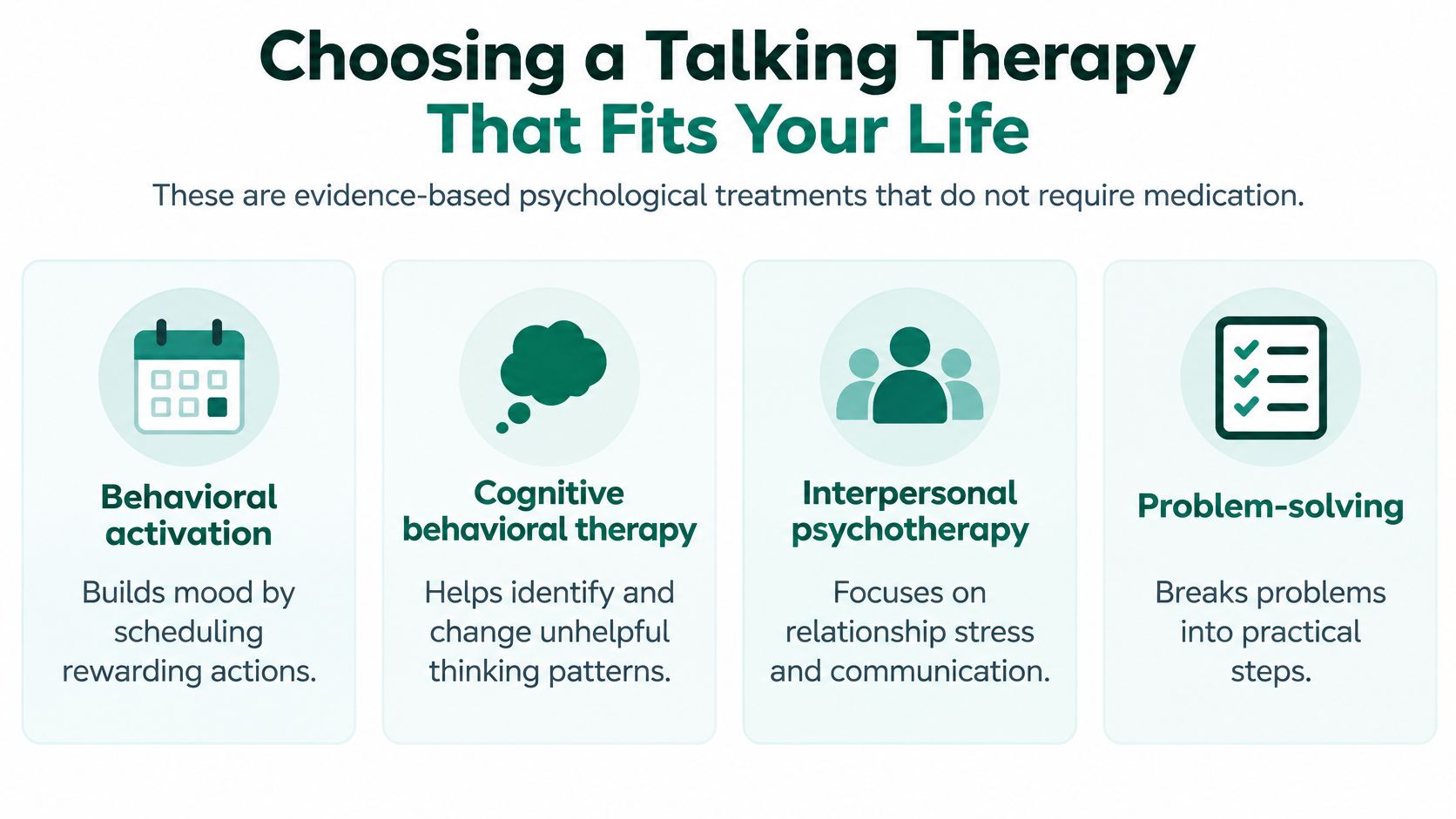
Caption: Four evidence-based talking therapies for depression that do not require medication, compared side by side.
Talking therapies compared for depression
Approach | Core Idea | Typical Format | Practical Note |
|---|---|---|---|
Behavioral activation | Rebuild contact with meaningful activities | Individual or group | Often a first choice for less severe depression |
Cognitive behavioral therapy | Links thoughts, emotions and behavior | Individual or group | Good evidence in both formats |
Interpersonal psychotherapy | Focuses on relationships and life changes | Individual sessions with a therapist | Listed by WHO and NIMH as evidence-based |
Problem-solving therapy | Breaks overwhelming problems into manageable steps | Individual sessions with a therapist | Listed by WHO as evidence-based |
Group mindfulness or meditation | Builds attention to the present moment | Group | NICE lists it when CBT or behavioral activation is not wanted |
Guided self-help | Structured program with light professional support | Guided, self-paced | May be insufficient alone for severe depression |
Format Matters as Much as Method
A therapy can be evidence-based and still be wrong for your life if you can't get there. A 2024 survey summarized in a review of guided and unguided psychological treatment formats found that people viewed face-to-face psychological care as the most effective option, while guided internet-based psychological treatment and videoconferencing were more acceptable for access and cost than self-guided apps or bibliotherapy.
That finding makes practical sense. If you're balancing shift work, caregiving, neurodivergence, or a long drive to the nearest office, guided online care may be the option you complete. An unguided app you abandon after four days helps less than a video program with a real person checking your progress. When you're weighing options, our guide to finding a good therapy fit can help you think through style, format, and comfort before you commit.
Our practice offers online counseling, in-person counseling, workshops, group therapy and workbooks, so format can be part of the conversation rather than an afterthought. Ask any provider you contact the same question. What formats do you offer, and which one do you recommend for my severity?
Group options deserve a fair look, too. Some people assume group means less personal and therefore weaker. For less severe depression, group CBT and group BA have strong standing, and hearing how others handle avoidance can normalize struggles you've been hiding. If groups feel overwhelming right now, say so. Preference is clinical information, not pickiness. You'll find three specific questions to bring to a first appointment later in this article, so you don't have to improvise that conversation when you're already tired.
How to Start Behavioral Activation in Four Weeks
Behavioral activation rests on a counterintuitive idea that confuses many readers at first. You don't wait until you feel motivated, then act. You act in small, planned ways, and mood often follows later. Depression narrows your life through avoidance and withdrawal. You skip the walk, decline the call, and put off the shower. Each skip brings short relief and a smaller, flatter day.
Behavioral activation reverses that loop gradually. It's goal-oriented and structured, focused on current problems, and designed to reduce avoidance by increasing behaviors associated with improved mood. The four steps below give you a four-week starting pathway. If your symptoms are moderate to severe, do this with a clinician rather than alone.
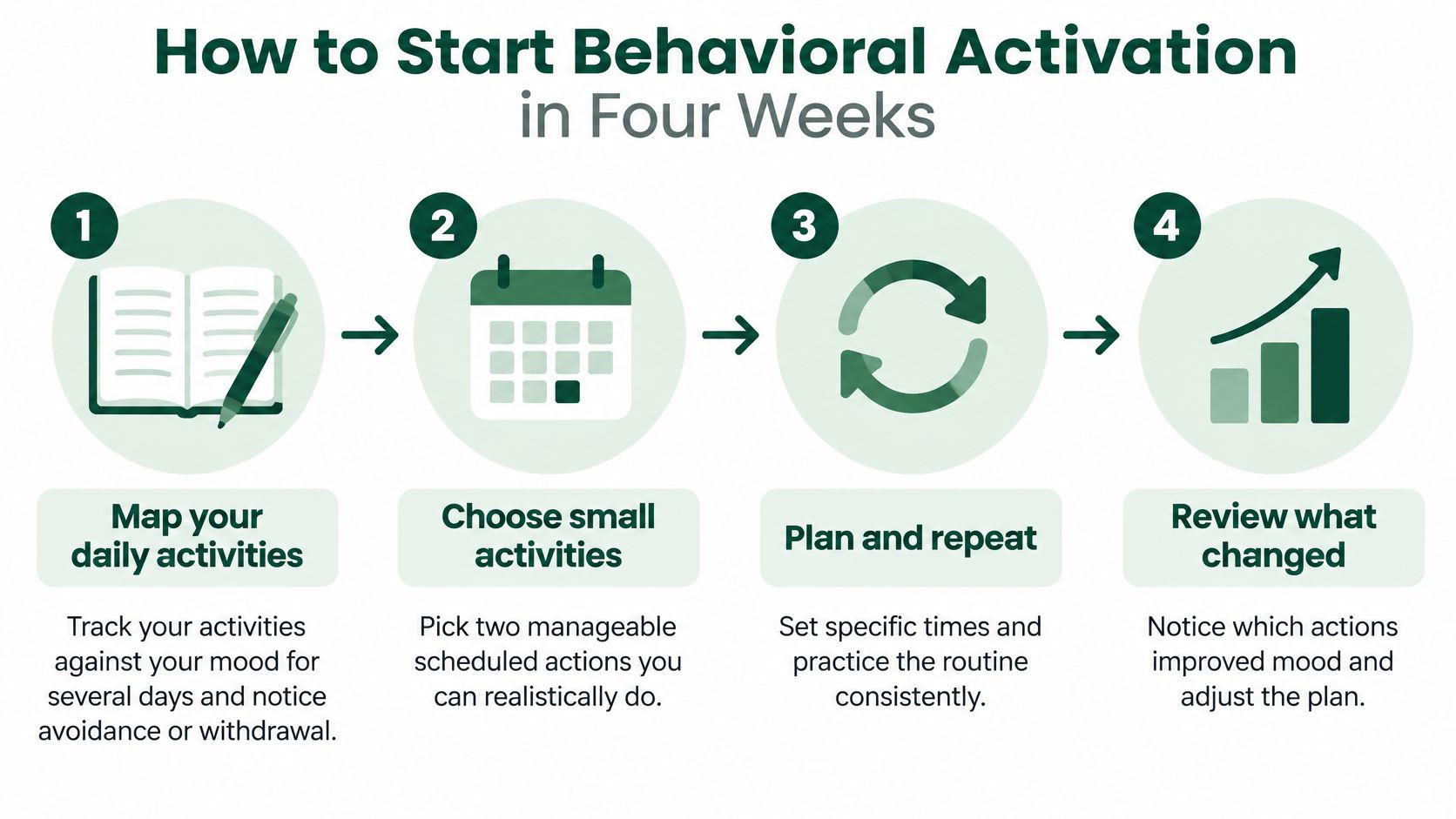
Caption: The four stages of behavioral activation are map your daily activities, choose small activities, plan and repeat, and review what changed.
The Four Steps
Map activities against mood for several days. Write down what you did each day, hour by hour if you can, and rate your mood beside it. You're looking for patterns, not judging yourself. You might notice that mornings spent scrolling in bed score lowest, while a short trip outside scores slightly higher, even if you dreaded going. Circle where avoidance or withdrawal shows up, such as cancelled plans, unanswered messages, or tasks you've postponed for a week. That map tells you where to intervene.
Choose small activities in two categories. Pick from routine and mastery first. Examples include showering, preparing a simple meal, or completing one defined work task. Then pick from pleasure and connection, such as walking outdoors or contacting a trusted person. You need both types. Mastery activities rebuild a sense of capability. Pleasure and connection activities rebuild reward and contact, which depression tends to strip away first. Start with two activities total if your energy is very low.
Schedule a specific time, smaller than feels necessary. Write "walk to the corner at 9 a.m." rather than "exercise more." Specific timing matters because vague intentions lose to low motivation every time. If a full meal feels impossible, schedule making toast and tea at noon. Shrinking the step isn't lowering your standards. It's matching the step to your current capacity so you can repeat it. Repeat the same small plan for several days before you expand it.
Review each week and increase difficulty gradually. Note what you completed, how mood shifted afterward, and what got in the way. Then adjust one variable. Add five minutes to the walk, invite someone to join you, or move a task to a time when you're less depleted. Don't overhaul everything because one day went badly. Behavioral consistency and gradual functional recovery are the targets, not a perfect streak.
Pitfalls That Make People Quit Early
Goals that are too large: Planning an hour at the gym after two inactive months usually ends in a missed day and harsh self-criticism. Halve the goal, then halve it again if needed.
Judging success only by immediate mood: You may complete the walk and still feel flat. That doesn't mean it failed. Mood change can lag behind behavior change by days or weeks.
Treating missed activities as failure: A missed activity is data. Was the time wrong, the step too big, or pain in the way? Adjust the plan instead of abandoning it.
If you complete a planned activity and feel nothing, count the completion. You're rebuilding a routine first. Feeling better is the slower result, not the entrance fee.
Say you're a caregiver who hasn't left the house for pleasure in weeks. Week one might be mapping only. Week two adds a shower before 10 a.m. and a text to a sibling on Tuesday. Week three adds a ten-minute walk after lunch on three days. Week four reviews which of those you did and builds from there. That pace can look slow from outside. From inside depression, it's often the first sustainable movement in months.
A standard individual course with a practitioner is often around 8 regular sessions, with more added when other conditions, complex social needs, or lingering symptoms are present. You don't need to memorize that number to start the self-monitoring steps, but it helps you set expectations. This is a course of treatment, not a single motivational weekend.
After four weeks, ask one check question. Are you completing more planned activities than when you started, even if mood is changing slowly? If yes, you're on the mechanism that drives improvement. If you're completing fewer activities and functioning worse, that's a signal to raise the level of professional support, not to blame your effort.
Movement, Sleep and Daily Habits That Count
Daily habits support recovery, but they don't replace assessment or therapy when symptoms are persistent or severe. Think of them as the scaffolding around your main treatment. They give your brain and body regular signals of time, energy, and contact, which depression disrupts.
For a concrete movement target, the National Institute of Mental Health publication on depression says 30 minutes of walking per day can boost mood. If 30 minutes feels out of reach today, a short walk still counts as a start. The point is regular movement you can repeat, not one exhausting session followed by three days in bed.
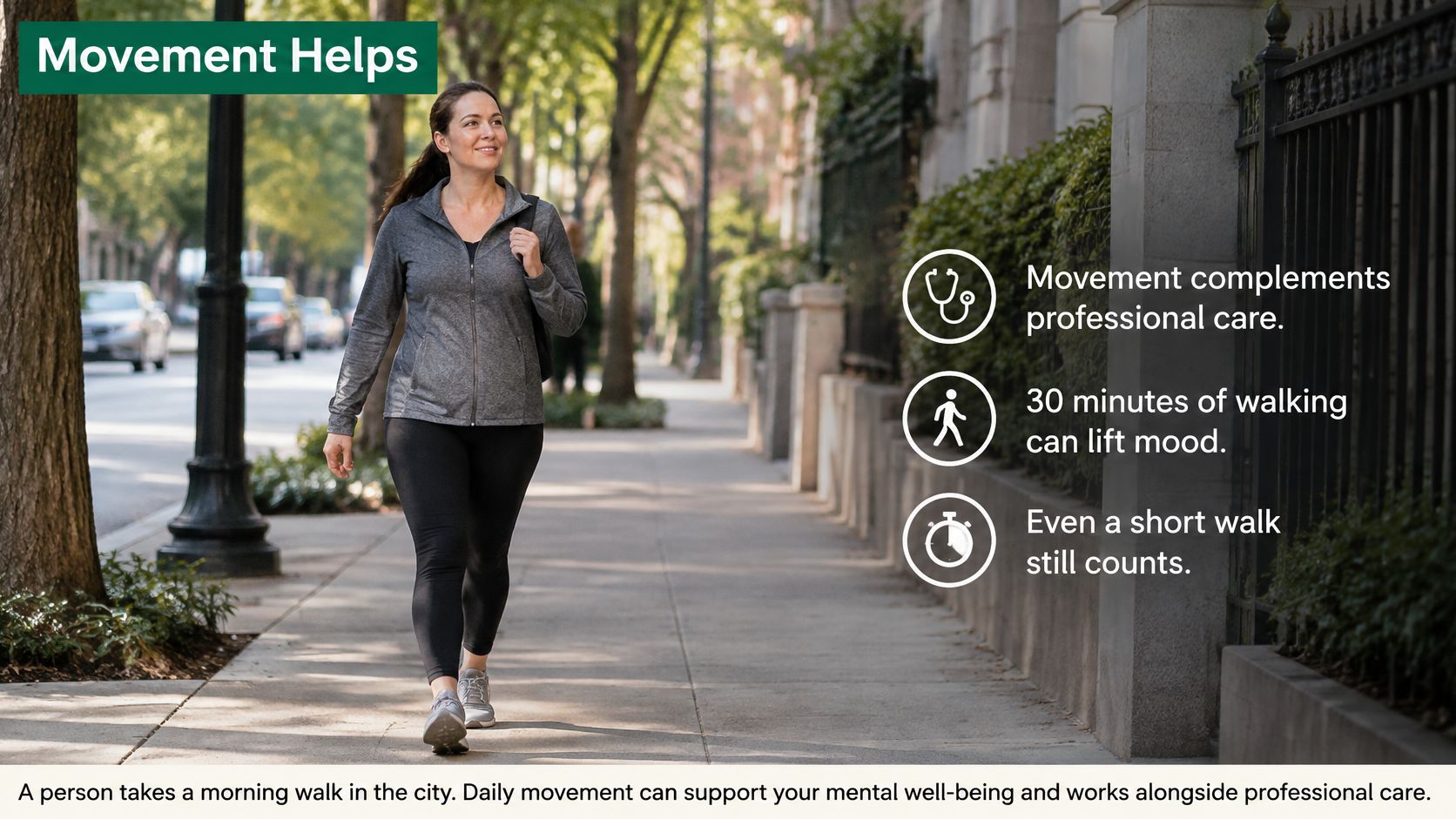
Caption: A daily routine with a short walk, a fixed bedtime and a call to someone you trust.
Daily habits that support mood, with targets
Habit | Practical Target | Source |
|---|---|---|
Walking | 30 minutes a day, or several short walks if that is all you can manage | NIMH |
Sleep and meals | Same times each day | WHO |
Alcohol | Reduce or avoid | WHO |
Illicit drugs | Avoid | WHO |
Make the Targets Fit a Real Day
Say you work a physically exhausting job and the idea of one long walk after your shift feels impossible. Split the target into three 10-minute walks, anchored to fixed points you already have. Walk after breakfast, after lunch, and after dinner. Anchoring beats relying on spare time, because spare time rarely appears when you're depressed.
Apply the same anchoring to sleep and meals. Pick a wake time you can hold on weekends too, eat your first meal within a predictable window, and keep bedtime steady even when sleep itself is broken. You're training rhythm first. Alcohol deserves honest attention here, since it can feel like it helps you fall asleep while fragmenting sleep and lowering next-day mood. Reducing or avoiding it removes one variable that's working against the rest of your plan.
Counseling sessions often include techniques such as breathing techniques, yoga, and mindfulness. Those practices can sit alongside walking and sleep routines, and you can explore specific mindfulness exercises for depression if you want guided starting points. There's no single prescribed dose given here for yoga or breathing work, so track them the same way you'd track any habit. Note whether mood, sleep, and functioning change over several weeks.
Keep a simple weekly habit log with four columns. Write the habit, how many days you did it, your average mood that week, and anything that blocked you. After three or four weeks, patterns become visible. You might see that walks help only when they're outside, or that late bedtimes precede your worst days. That log also gives a clinician useful information in minutes, instead of relying on your memory during a difficult appointment.
Enjoyable activities and social contact aren't repeated in this table because you've already scheduled them through behavioral activation. Keep them in that plan. Habits work best as a small, coordinated set, not as a long list of separate obligations competing for the same limited energy.
When Medication May Still Belong in the Plan
Preferring non-medication care is a legitimate, informed choice. It becomes a problem only when it hardens into a rule you can't revisit. There's an important difference between "I'd like to start without medication and review how it's going" and "I'll never take medication no matter what happens." The first protects your autonomy. The second can delay relief when symptoms deepen.
Non-drug care isn't superior for everyone, and medication isn't a failure of effort. For some people, exercise or CBT reduces symptoms well. For others, especially when depression is severe or functioning has collapsed, medication becomes part of a responsible plan. Your individual response, severity, safety, other health conditions, and access to care all shape that decision. No ranking applies to every person.
Barriers That Can Distort the Decision
People don't always get a clean choice. You might distrust the process because a previous provider rushed you. Your preferred psychological treatment might have a long waitlist, or nobody nearby offers it. You might struggle to take part in decisions when depression itself makes concentrating and speaking up harder. Naming those barriers matters, because a decision made from lack of access isn't the same as a decision made from informed preference.
Our overview of depression treatment for women discusses how life stage and health context can shape those choices, which is another reason a blanket rule rarely fits. What you need is a dated path you can follow even when motivation is low.
A Plain Four-Step Decision Path
Confirm current severity with a clinician. Get a clear picture of symptoms, functioning, and safety before you lock in a plan.
Ask what non-drug option matches that severity. Check whether it's available, who delivers it, and how soon you can start.
Agree a review date. Set it for after several weeks of consistent treatment, and decide in advance what improvement you'd expect to see.
Reconsider medication if the plan hasn't worked. Treat that as new information, not as proof your earlier choice was wrong.
A useful test: Could you explain to a trusted person what result would make you change your plan? If you can't name one, your preference may have become a rule.
Reconsider sooner if symptoms become severe, you can't manage daily functioning, or a clinician who knows your history recommends medication for safety reasons. You can also ask how medication and therapy might work together for a defined period, rather than treating it as an either-or choice. Many people find that framing easier to accept, because it keeps the skills and routines they're building while adding support they currently need.
Write your review date down where you'll see it. Depression distorts time, and "I'll reassess soon" easily becomes months of worsening symptoms. A date, a clinician, and a clear measure turn a vague preference into a plan you can trust.
Ask for the Approach You Want, Then Track Progress
You have the right to ask for options, including non-drug options, and to hear why a clinician recommends one path over another. That sounds obvious. In practice, many people leave appointments unsure what they were offered or why.
A survey reported in a 2025 review in Health Psychology and Behavioral Medicine found that 46% of respondents were not given treatment options, 32% did not feel well informed, and 24% felt their doctor did not understand them. Preparation helps you avoid becoming part of those numbers. Bringing written questions isn't confrontational. It's how you participate in a decision about your own care when depression makes thinking on the spot difficult.
Three Questions to Bring to a Clinician
Which non-drug approaches do you recommend for my severity? Ask specifically about behavioral activation, CBT, interpersonal therapy, an exercise plan, sleep treatment, or guided digital care, and ask which you'd start first and why.
How will we monitor progress? Ask what you'll both track, how often you'll review it, and whether you'll use a symptom questionnaire, a functioning goal, or your own weekly notes.
What result would prompt a change of plan? Ask what lack of progress, worsening, or safety signal would lead you to add sessions, switch approach, or discuss medication.
If you want help clarifying what improvement should look like before that conversation, setting explicit depression treatment goals gives you language for outcomes beyond "feel better," such as returning to work consistently or resuming one social activity each week. Specific goals make the third question much easier to answer.
A Tracking Method Simple Enough to Keep
Tracking fails when it's complicated. Use one weekly note, on paper or in your phone, with four lines.
Mood: Rate the week overall and note your lowest day.
Sleep: Record your usual bedtime, wake time, and whether sleep felt broken.
Activities completed: Count planned behavioral activation activities you did.
Safety signals: Note any thoughts of harming yourself, increased hopelessness, or days you couldn't manage basic care.
Review that note every two weeks, ideally with your clinician. Look for direction rather than perfection. Are completed activities rising? Is sleep steadier? Are low days less frequent, even if they still happen? If all four lines are flat or worsening after several weeks, you have clear evidence for changing intensity, and you don't have to rely on a vague feeling that nothing is working.
Bring the notes, even if they're messy. Four honest lines a week tell a clinician more than a polished summary you reconstructed in the waiting room.
Your practical next step is to book a first conversation with a licensed clinician, such as one at Be Your Best Self & Thrive Counseling, PLLC, and bring your tracking notes and three questions with you. Between sessions, the best way to contact the counselor is by phone or text message, and that route works for non-urgent questions about scheduling or homework. Urgent safety concerns shouldn't wait for a reply. Use crisis support or your local emergency number right away.
You don't need certainty before that first conversation. You need a severity-matched starting point, a way to measure change, and permission to revise the plan. That's what makes learning how to help depression without meds a responsible strategy rather than a test of willpower. Start with the level of support your current symptoms require, track what happens, and let the evidence from your own weeks guide the next decision.
If you're ready to build a non-medication plan that's matched to your severity and reviewed with a licensed clinician, our team at Be Your Best Self & Thrive Counseling, PLLC offers evidence-informed counseling for depression in St. Petersburg and online. Bring your questions and tracking notes to a first conversation, and we'll help you choose practical next steps that fit your life. Visit Be Your Best Self & Thrive Counseling, PLLC to explore fit and request your initial consultation.