
Setting Depression Treatment Goals That Actually Work
You may arrive at therapy with a simple wish: to feel like yourself again. Yet “feeling better” can mean very different things. It might mean getting out of bed without negotiating with yourself, answering a friend's message, concentrating at work, sleeping more steadily, or quieting the self-criticism that follows you into the kitchen. Effective depression treatment goals connect clinical measures with those ordinary, deeply personal signs of recovery.
What Depression Treatment Goals Really Mean
At a first appointment, a therapist might ask what recovery would look like beyond a lower sadness rating. A new client may describe wanting to make breakfast in the kitchen, stay present through a workday, and have enough emotional space to enjoy time with a partner. Those details give treatment a direction that “improve mood” cannot provide.
Depression treatment goals are concrete targets created collaboratively with a clinician. They describe what you want to change, how progress will be noticed, and when the plan will be reviewed. A goal might involve attending therapy consistently, practicing a skill, rebuilding a routine, or returning to an activity that matters to you.
A goal isn't the same as an intervention. Cognitive behavioral therapy, medication, behavioral activation, and sleep support are interventions, or methods used to help you move toward a goal. An outcome is the change those methods are intended to produce. For example, a clinician may use CBT to support the goal of challenging self-critical thoughts, then assess symptom change with the PHQ-9.
Why measurement belongs in a human plan
Measurement-based care uses validated scales to make subjective distress easier to track over time. The PHQ-9, GAD-7, Sheehan Disability Scale, and productivity measures can help a client and provider monitor symptoms, functioning, adverse effects, and adherence through repeated assessments. Guidance on measurement-based care describes response as a 50% or greater reduction in symptoms from baseline, while emphasizing that treatment should continue toward full remission rather than stopping at partial improvement (measurement-based care guidance).
That number doesn't replace your story. It adds another lens. You might have a lower PHQ-9 score and still be avoiding friends, struggling with basic care, or unable to resume work. A strong plan keeps both kinds of information visible.
Your goals should also remain editable. Depression changes, treatment effects become clearer, and priorities shift as energy returns. You and your provider can review the plan at each appointment rather than treating it like a rigid contract. If you want to explore how whole-person care can support this process, holistic approaches to depression can offer additional context.
The Four Core Goals Every Plan Should Include
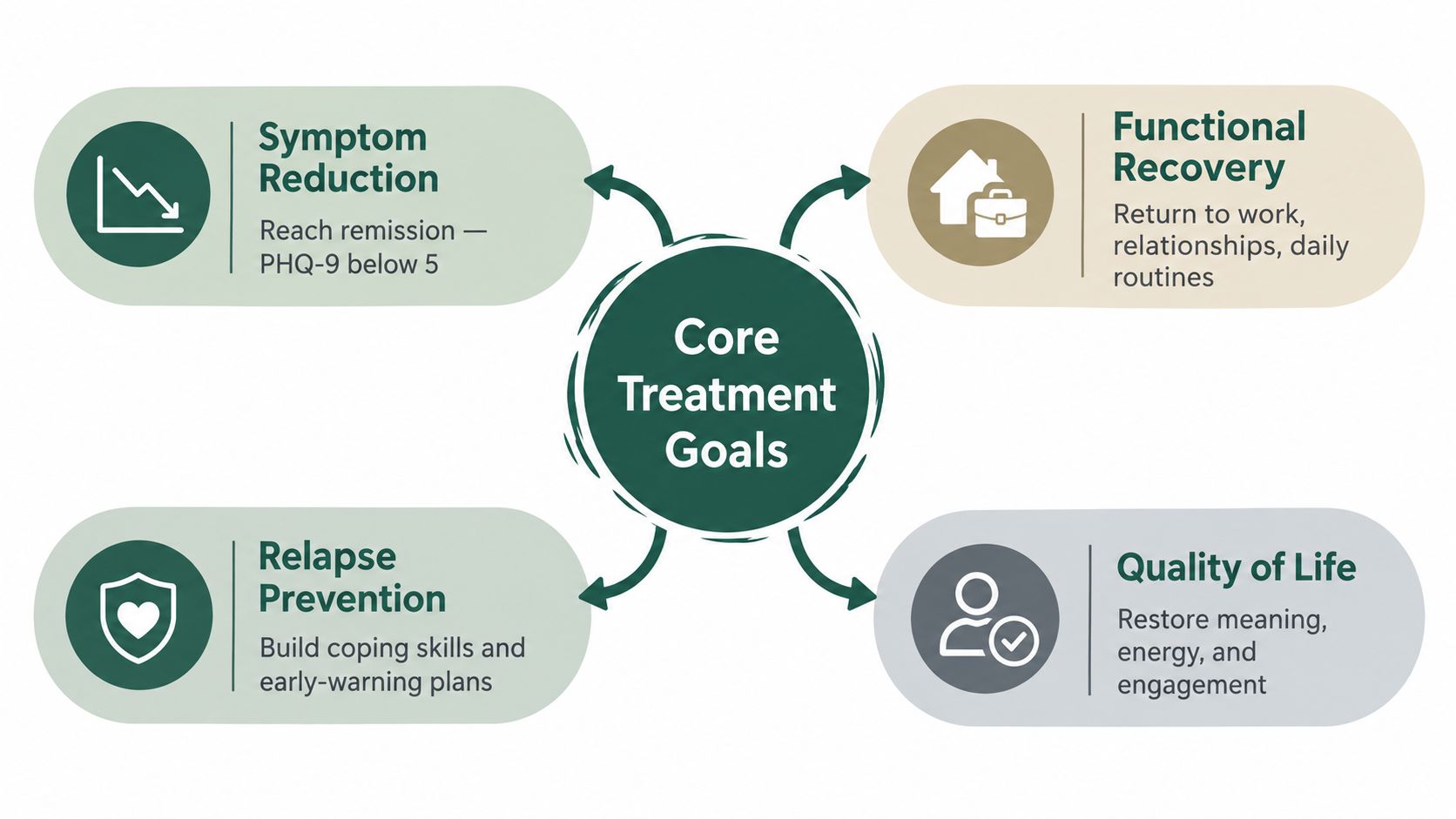
A complete plan should look beyond symptom relief. Clinical guidance commonly links depression treatment with remission, relapse prevention, and restoration of social and occupational functioning (depression clinical practice guideline). Use the four domains below to notice what your current plan includes and what it may be missing.
1. Symptom reduction toward remission
Remission means more than feeling somewhat better. The British Columbia guideline identifies an acute-treatment goal of remission with a PHQ-9 score below 5, alongside restored psychosocial functioning (British Columbia depression guideline). Your provider may also consider whether major depressive symptoms have been absent for a sustained period and whether daily life is becoming possible again.
A measurable objective could be: “Complete the PHQ-9 at agreed review points and discuss the trend with my provider.” The scale is a guide for decisions, not a grade that determines your worth.
2. Functional recovery
Functioning asks what you can do with your life, not only how you feel inside. Relevant targets may include returning to work responsibilities, preparing meals, maintaining personal care, reconnecting with loved ones, or keeping a regular sleep routine.
Choose a marker that reflects your circumstances. You might track completed work blocks, shared meals, social contact, or mornings when you follow a basic routine. Canadian treatment guidance also names full symptom remission and return to baseline functioning as acute-treatment goals (Canadian depression psychopharmacology guidance).
3. Relapse prevention
Depression can return, so a plan needs a maintenance layer. Discuss what continuation treatment may involve after remission, how long medication or therapy should continue, and which early signs deserve attention. Some guidance recommends continuation therapy for 6–12 months after full remission and maintenance treatment for at least 2 years in higher-risk cases (CMS depression quality measure documentation).
A practical objective could be a written early-warning plan that lists changes in sleep, withdrawal, hopelessness, or routine, plus the action you'll take and the person you'll contact.
4. Coping and self-management
Skills help protect progress between appointments and after acute treatment. Depending on your plan, these may include cognitive restructuring, behavioral activation, emotional regulation, problem-solving, or a personalized safety plan.
Practical rule: Every goal should answer two questions: “What will I do?” and “How will we know whether it's helping?”
For more guidance on making therapy targets concrete, see setting goals for therapy. A plan that includes all four domains can hold both immediate relief and a return to a meaningful life.
Writing SMART Goals You Can Actually Track
SMART goals turn a broad intention into a workable agreement. The framework stands for Specific, Measurable, Achievable, Relevant, and Time-bound.
Specific: Name the behavior, not only the desired feeling. “Attend CBT sessions” is clearer than “work on depression.”
Measurable: Add a count, frequency, score, or observable marker.
Achievable: Match the target to your current energy, health, access, and responsibilities.
Relevant: Connect the action to a value or life area you want to restore.
Time-bound: Set a review date so the goal doesn't drift indefinitely.
A therapy goal might be, “Attend eight CBT sessions in ten weeks and bring one question or example to each appointment.” A behavioral activation objective could be, “Complete an activity log four days each week and review it during the next appointment.” These targets describe actions while leaving room for your provider to adjust the pace.
Medication goals require medical collaboration. Rather than changing a prescription independently, you might agree to track adherence above 90 percent over one month, record side effects, and review the information with the prescriber. A lifestyle goal could be walking for 30 minutes five days per week, if that level is appropriate for your health. A mind-body-spirit goal might be journaling three gratitude entries weekly, provided the practice feels supportive rather than demanding.
Domain | Short-Term Goal (4-6 Weeks) | Long-Term Goal (3-6 Months) |
|---|---|---|
Therapy | Attend scheduled CBT sessions and complete a thought record each week | Use cognitive and behavioral skills during stressful situations with less avoidance |
Medication | Follow the prescribed plan, track side effects, and bring questions to the prescriber | Maintain a medication plan that supports remission and daily functioning |
Lifestyle | Keep a consistent sleep and movement routine that fits current capacity | Participate more reliably in work, relationships, and self-care |
Mind-body-spirit | Practice journaling, breathing, or values reflection on agreed days | Rebuild activities and relationships that provide meaning and connection |
If you enjoy structured personal planning, this new year goals guide can help you think about values and practical milestones, though mental health targets should still be reviewed with a qualified provider. Keeping clear records also helps connect your intentions to what happens in sessions, which is why therapy progress notes can be useful context for clinicians and clients.
Short-Term and Long-Term Goals Across Treatment Types
Short-term goals create traction. Long-term goals describe what that traction is meant to support. Confusing the two can make early treatment feel like failure, especially when a small routine change is already a meaningful achievement.
Treatment Type | Short-Term Goal (1-6 Weeks) | Long-Term Goal (3-12+ Months) |
|---|---|---|
Psychotherapy | Attend sessions, complete a behavioral activation activity, or use one thought record each week | Respond to difficult thoughts and relationship stress with greater flexibility and participation |
Medication | Take medication as prescribed, monitor side effects, and review response with the prescriber | Sustain symptom remission and functioning through an agreed continuation or maintenance plan |
Lifestyle | Work toward a consistent sleep window and record weekly movement | Maintain routines that support energy, self-care, work, and social roles |
Mind-body-spirit work | Practice breath awareness, values reflection, or grounding on scheduled days | Take regular values-aligned actions and re-engage with supportive community |
Psychotherapy
Early therapy targets often focus on attendance and practice. A person might bring one thought record to each session or schedule one manageable activity between appointments. Over time, the measure shifts from completing worksheets to using skills when criticism, conflict, or low motivation appears in daily life.
Medication
Medication goals need a prescriber's oversight. Short-term tracking can identify adherence, side effects, and changes that deserve review. A long-term goal isn't merely remaining on a medication. It may be maintaining remission and function while periodically reassessing benefits, risks, preferences, and the wider plan.
Lifestyle
Sleep and movement are often easier to measure as behaviors than as promises to “take better care of myself.” Start with a realistic sleep window or planned movement routine, then connect those habits to mornings, work, meals, and relationships. If a goal repeatedly fails, reduce its size rather than treating the difficulty as a character flaw.
Mind-body-spirit work
Breath practice, reflection, spiritual connection, or time in nature can complement clinical care when they fit your beliefs and needs. The long-term measure is not perfect calm. It may be taking more actions aligned with your values, tolerating emotion without withdrawing, or rejoining a community that matters to you.
Behavioral activation for depression offers a practical way to connect small planned actions with broader functional recovery. These treatment lanes work best as layers. Therapy can clarify barriers, medication can be reviewed medically, routines can support energy, and values-based practices can help recovery feel personally meaningful.
Beyond Symptom Scores What Recovery Really Looks Like
A PHQ-9 score below 5 can represent an important clinical milestone, but it doesn't describe every part of recovery. Symptom remission and functional recovery are related, yet they aren't identical. A person may report fewer depressive symptoms while still avoiding social contact, struggling to return to work, or feeling disconnected from activities that once mattered.
The gap deserves direct attention because functional recovery can lag behind symptom relief. Some patients may still experience residual symptoms or social withdrawal even after reaching remission, so a plan that tracks only a score can miss the practical work of rebuilding a life. Clinical guidance increasingly combines symptom remission with function, safety, quality of life, and recurrence prevention (Kaiser Permanente depression guideline).
Translate a personal aim into a target
Take one sentence that matters to you, such as “I want to enjoy parenting again.” Then translate it through four questions:
Domain: Is this about parenting, energy, connection, or daily functioning?
Behavior: What would you do differently if the goal began improving?
Tracking method: Would you record shared activities, time together, or your energy afterward?
Review window: When will you and your provider examine the pattern?
The result might be, “Schedule one low-pressure activity with my child each week, note my energy before and afterward, and review the record at the next appointment.” That target doesn't demand constant happiness. It creates a way to notice participation, connection, and depletion.
Other milestones may include returning to creative practice, answering messages, cooking a meal, or spending time with a partner without feeling entirely drained. Resources on post-traumatic growth may also help some people reflect on meaning and personal change, but growth should never be treated as a requirement or a substitute for care.
“Feeling less depressed” is a clinical direction. “Living well again” is a personal definition that deserves equal space in the plan.
Tracking Progress and Adjusting With Your Provider
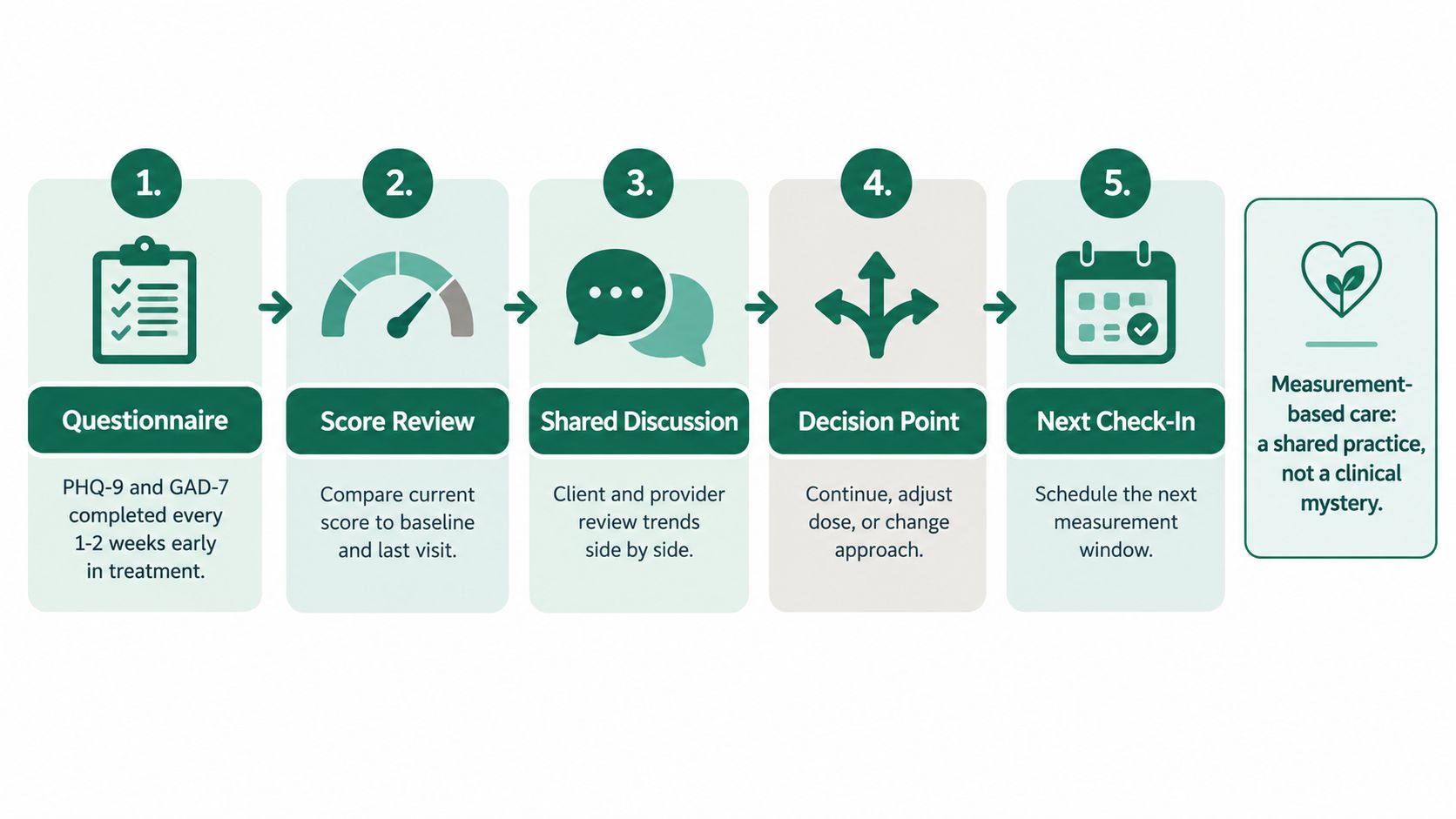
Measurement-based care works best as a shared conversation. You complete a tool such as the PHQ-9 or GAD-7, your provider reviews the pattern with you, and both of you connect the results to sleep, functioning, side effects, adherence, and lived experience. The aim isn't to turn therapy into a test.
Guidance recommends repeated symptom scales and follow-up every 2–4 weeks until remission or meaningful response is reached (depression clinical practice guideline). The exact cadence should be set with your provider, especially if symptoms are severe, changing quickly, or affecting safety.
Bring four pieces of information
Latest scores: Bring the PHQ-9 or GAD-7 result and note whether it rose, fell, or stayed similar.
Side-effect notes: Record what changed, when it began, and how it affects sleep, appetite, energy, or daily tasks.
One-sentence self-rating: Complete the sentence, “The biggest change in my life since our last appointment is…”
One specific question: Ask what the current pattern means and what decision the team will make if it continues.
A simple traffic-light metaphor can make the conversation easier. Green means the current plan appears useful and can continue. Yellow means you and your provider should review dose, session frequency, adherence, side effects, or the fit of an intervention. Red means the plan needs prompt clinical attention, which may involve a medication change, augmentation, referral, or safety response.
Use direct language when progress is partial
You can say, “I'm noticing some improvement, but I'm still unable to return to my normal responsibilities. What should we adjust?” You can also ask, “My symptoms have improved, yet I still feel withdrawn. Can we add a functioning goal?”
If you have concerns about safety, worsening symptoms, or medication effects, contact your provider promptly or use emergency and crisis resources available in your area. A score can support a decision, but urgent risk always deserves direct human attention.
A Realistic Twelve-Week Example Arc
Consider Maya, a fictional composite client beginning treatment with low energy, disrupted sleep, withdrawal, and a PHQ-9 score of 18. Her plan doesn't promise a particular outcome. It shows how a clinician and client might organize goals across phases while reviewing what happens.
Weeks 1 to 4 and stabilization
Maya attends weekly CBT sessions and works toward a 7-hour sleep routine. She tracks her PHQ-9, which moves from 18 to 14 in this fictional example, and chooses one pleasurable hobby to reintroduce without demanding that it feel enjoyable immediately.
The early wins are behavioral. She completes the sleep log, brings examples to therapy, and spends a short period on the hobby. Her provider uses the information to decide whether the initial approach is tolerable and relevant.
Weeks 5 to 8 and active change
The next phase focuses on functioning. Maya works toward returning to part-time work and schedules one call with a friend to rebuild connection. Her medication plan receives a clinical review, and bloodwork is used in the fictional scenario to explore changes associated with improved sleep architecture.
Her PHQ-9 moves from 14 to 9 in the composite timeline. That change matters, but the more personal marker is that she is participating in work and friendship again, even with limits.
Weeks 9 to 12 and consolidation
Maya and her provider practice identifying early warning signs and create a relapse-prevention plan. They discuss taper planning only as a prescriber-led decision, not as an automatic consequence of improvement. Her fictional PHQ-9 falls from 9 to 5 while check-ins become less frequent and functional goals remain active.
The point isn't that every person follows this sequence. Progress may pause, move unevenly, or require a different intervention. The composite shows how symptoms, routines, relationships, treatment decisions, and prevention planning can be discussed together.
Your Next Step Toward Goals That Fit Your Life
A useful plan doesn't ask you to choose between clinical evidence and personal meaning. It uses symptom measures to guide care while giving equal attention to work, relationships, routines, identity, safety, and the activities that make life feel like yours.
Keep these five principles nearby:
Define remission and functioning together. A lower PHQ-9 matters, and so does your ability to participate in daily life.
Write SMART goals across all four domains. Include symptoms, functioning, relapse prevention, and coping.
Separate time horizons. Let short-term goals build stability while long-term goals describe sustained participation and maintenance.
Track symptoms and function. Use validated tools alongside practical records of sleep, activity, work, relationships, and self-care.
Adjust collaboratively. A plan that needs revision isn't proof that you failed. It may be useful information about fit, timing, or support.
This week, schedule one appointment or message your provider with one prepared question, one personal value, and one measurable target you want to define together. You might say, “I want to reconnect with my family, and I'd like help turning that into a realistic weekly goal.” That conversation can give your treatment plan a clearer connection to the life you're working to reclaim.
Be Your Best Self & Thrive Counseling, PLLC offers individualized counseling for depression, anxiety, trauma, stress, relationships, and life transitions, using evidence-informed and whole-person care to connect symptom relief with meaningful daily functioning. Visit Be Your Best Self & Thrive Counseling, PLLC to explore services and schedule a free initial consultation about goals that fit your life.