
Anxiety Therapy Techniques: 10 Evidence-Informed Methods
A racing heart in the grocery store line. A week of worry that never quite switches off. A Sunday night spent rehearsing a Monday meeting that hasn't happened yet. Anxiety doesn't arrive in one shape, and the technique that helps at 2 a.m. is rarely the one that helps before a presentation. The body, the thoughts, and the daily routine each need a different response, which is why treating anxiety therapy techniques as a menu of interchangeable tricks tends to disappoint. The same breathing exercise that settles a panic spike can become a ritual that feeds it when it's used to escape every uncomfortable sensation.
This guide walks through 10 methods. For each one, I'll cover what it does, what it looks like in practice, the moment it fits best, and when a trained therapist should guide or adapt it. Anxiety tools work when they're matched to the pattern in front of you, not applied by default. If you want the physiological background first, the Cleverfy Beauty stress science explainer covers how sustained stress loads the body. Then come back here for the technique that fits the moment you're in.
1. Cognitive Behavioral Therapy (CBT)
When worry turns a small uncertainty into a worst-case prediction, CBT can help you examine the thought and change what you do next. It links thoughts, feelings, and behaviors. You learn to notice automatic thoughts, such as “they'll notice my hands shaking,” assess the evidence for them, and consider other explanations. You also work on behaviors that keep anxiety going, including avoidance. The National Institute of Mental Health describes CBT as a well-studied treatment for generalized anxiety disorder.
CBT has strong evidence across anxiety conditions, though results vary by condition and by person. The World Health Organization identifies CBT-based interventions, including exposure, as among the psychological treatments with the strongest evidence for anxiety disorders.
What the sessions look like
NICE guidance for generalized anxiety disorder describes individual CBT as 12 to 15 weekly sessions of 1 hour each, delivered by trained practitioners using treatment manuals, with fewer sessions if you recover sooner (NICE guidance on generalized anxiety disorder). In CBT, sessions usually include practice between appointments. A simple thought record can help you track the pattern:
Situation: What was happening?
Anxious thought: What did you predict?
Emotion rating: How strong was the anxiety?
Evidence check: What supports the prediction, and what points against it?
Small experiment: Try one manageable action you have been avoiding, then record what happened.
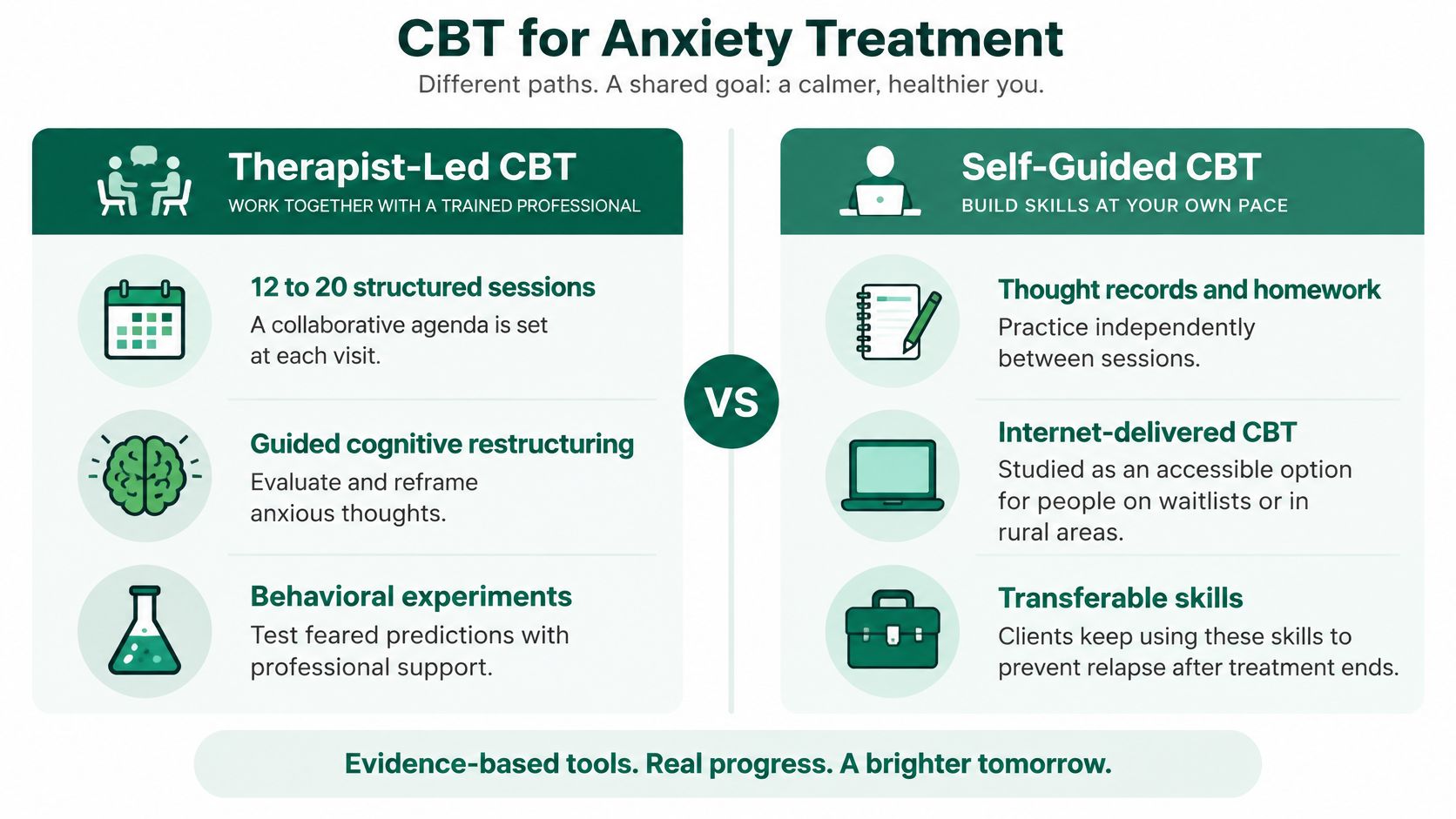
CBT may be less helpful when thought records become repeated attempts to get certainty. If each answered “what if?” leads to another, a therapist can help identify the reassurance loop and tailor the work. Examples of negative self-talk can help you spot the phrases that recur.
2. Exposure Therapy

You avoid the highway because the thought of driving there spikes your anxiety. Each time you take a longer route, the fear gets to make the decision again. Exposure therapy helps you approach feared situations gradually and learn from what happens, rather than relying on avoidance. The National Institute of Mental Health's overview of psychotherapy describes exposure as repeated contact with a feared trigger over time.
Exposure is used in approaches such as prolonged exposure for PTSD, exposure and response prevention (ERP) for OCD, and graded practice for specific fears. The aim is not to force yourself through distress. It is to choose a manageable step and stay with it long enough to learn whether your feared prediction comes true.
Building a hierarchy that actually works
Write down situations you avoid, then rate how distressing each feels from 0 to 100. Choose a step that feels challenging but manageable, rather than starting with the most frightening one. During practice, notice what you predict will happen and what happens. Anxiety does not need to fall by a set amount for the practice to be useful.
Safety behaviors can make an exposure feel easier while keeping the fear intact. Rehearsing every sentence, repeatedly checking your pulse, or making sure an escape route is available may prevent you from testing your prediction. A therapist can help you decide which behaviors to reduce, and when, without turning practice into an overwhelming test.
For social anxiety, NICE guidance describes the Heimberg protocol as 15 sixty-minute sessions and one 90-minute exposure session over about four months (NICE social anxiety recommendations). This example shows how exposure may be part of structured, therapist-guided treatment. The right pace and format depend on the person and the fear being treated.
Exposure needs professional guidance if it brings up dissociation, involves trauma, or is difficult to separate from ongoing danger. A therapist can tailor the steps for sensory needs or neurodivergence, and help you distinguish useful practice from pushing too hard. When avoidance is shrinking your daily life, that support can help you build a gradual plan.
3. Mindfulness-Based Stress Reduction (MBSR)
If your anxiety is a low hum that never fully stops, MBSR was built for that. It's an eight-week group program that teaches you to watch thoughts, emotions, and body sensations without immediately judging or fixing them. Core practices are the body scan, sitting meditation, gentle mindful movement, and informal awareness during daily tasks. Jon Kabat-Zinn developed it at the University of Massachusetts Medical School in 1979, and hospitals worldwide have adopted it since. For anxiety, the value is in lowering reactivity: the worry arrives, and you get a few seconds of choice before you follow it.
Where it fits and where it doesn't
MBSR suits chronic, grinding worry and the muscular tension that travels with it. It's a poor first choice during an acute panic spike, when attention needs somewhere concrete to land, not open awareness. If you're using recorded practices at home, this explanation of body scan meditation benefits walks through the format in more detail.
A short starter practice:
Ten minutes daily of body scan or breath awareness, at the same time each day.
Label the thought as "thinking" and return to the breath, without commentary.
Use routine tasks (dishes, walking, showering) as informal practice.
Expect wandering. Returning is the repetition that builds the skill.

An eight-week group with a teacher is a different intervention from a meditation app. The structure, the weekly check-in, and the group accountability carry a lot of the effect, and a therapist should tailor the practice when trauma, sensory sensitivity, or a history of dissociation makes closing your eyes and going inward feel unsafe. Music playlists can support a home practice, and this comparison of free yoga music platforms is a practical place to start if silence makes you restless.
4. Acceptance and Commitment Therapy (ACT)
ACT takes a different route. Instead of reducing anxiety before you act, it asks you to make room for anxiety and act anyway, guided by values. The six processes are acceptance, cognitive defusion, present-moment awareness, self-as-context, values, and committed action. Steven C. Hayes and colleagues developed the approach, and it's used in primary care, workplace wellness programs, and with veterans and military personnel. Self-help ACT workbooks are widely used between sessions, which is both the strength and the risk.
The defusion move is the one I teach most: turn "I'm going to fail this" into "I'm having the thought that I'll fail this." You're still aware of the prediction; you're no longer inside it.
The honest caveat
More coping skills don't automatically mean less anxiety. A 2025 review of 15 randomized studies covering 6,093 participants found only a small preventive effect from digital psychological and psychoeducational interventions, with high heterogeneity and very low certainty of evidence (2025 review of digital psychological interventions). The same review notes that a separate analysis of digital behavioral-activation programs found no significant anxiety improvement at either 3- or 6-month follow-up. Adding techniques isn't the same as changing how you relate to discomfort.
The trade-off: Acceptance isn't resignation. It's dropping the second struggle, the one where you fight the fact that you're already anxious.
Try this. Write down what matters in relationships, work, and health. Pick one action this week that moves toward a value, and take it with the anxiety present. A therapist helps when values work stalls because every uncomfortable feeling gets read as a stop signal.
5. Diaphragmatic Breathing
Anxiety changes breathing before you notice it: faster, higher in the chest, shallower. That pattern feeds dizziness, tingling, and the sense that you can't get enough air, which then raises the alarm. Diaphragmatic breathing, also called belly breathing or paced breathing, reverses the pattern deliberately. One hand on your chest, one on your belly, and you breathe so the lower hand moves more. Four seconds in, six seconds out, for two to five minutes.
The moment it's for
This is a spike tool, not a cure. It's most useful in the first minutes of a surge, before a hard conversation, or as a transition into exposure work. Clinicians often teach it before an exposure exercise so you have a way to tolerate the discomfort rather than flee it. It's least useful as a way to escape every uncomfortable sensation, because breathing on demand becomes a checking ritual.
The practical details that matter:
Practice when calm. A skill you only use in crisis is a skill you're learning in the worst conditions.
Longer exhale than inhale. Four in, six out works well for many.
Stop if you're dizzy. Return to normal breathing. Lightheadedness isn't progress.
Pair it with movement. A short walk plus slow breathing settles more than either alone.
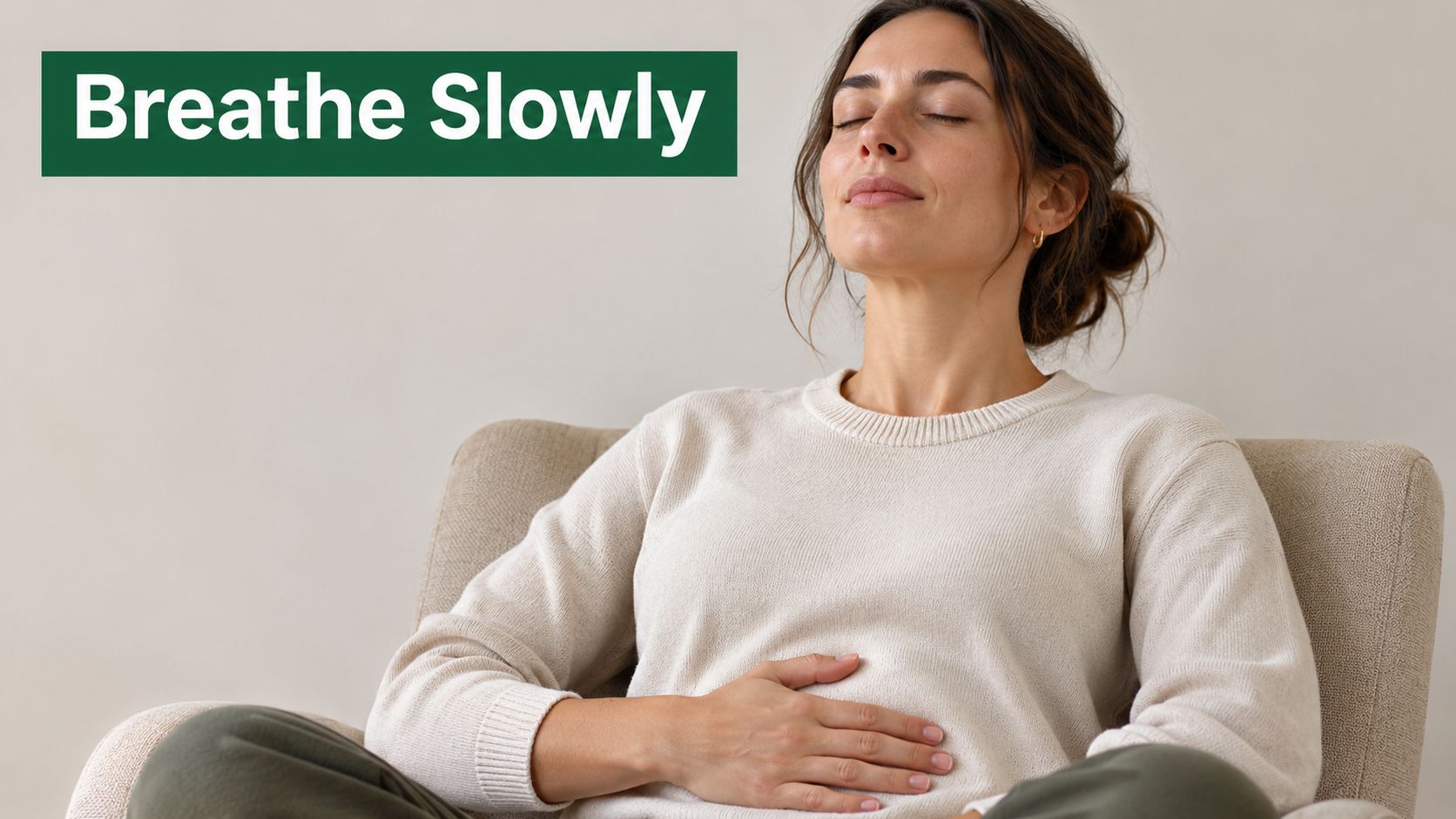
If you want the mechanism without the hype, heart rate variability and stress explains why paced breathing registers in the body. Slow breathing lowers arousal. It doesn't resolve the prediction that started it, so use it to get steady enough for the harder work. A therapist should guide this when panic attacks keep coming back despite practice, since the breathing is usually not the problem.
6. Progressive Muscle Relaxation (PMR)
Jaw tight, shoulders raised, back teeth touching? Progressive Muscle Relaxation (PMR) helps you notice tension by comparing it with release. Gently tense one muscle group for about five seconds, then let go and notice the difference. Work through the hands, arms, shoulders, face, jaw, chest, stomach, legs, and feet. This can help when body tension has become so familiar that you barely register it.
PMR is most useful for body-driven anxiety or as part of a wind-down before sleep. During a panic spike, a full sequence may demand too much attention. A shorter version using the hands, shoulders, and face can take about five minutes.
Tense gently. Use moderate effort; stop if you feel pain.
Notice the release. Pause for a full breath before moving on.
Keep the same sequence. A set order means less deciding.
Practice regularly. Repetition can make it easier to recognize tension and release it.
A guided program can provide structure, but research on computerized CBT programs for anxiety and depressive disorders does not measure relaxation modules specifically. In that meta-analysis, median completion was 80% among participants who started, and median satisfaction was 86% (meta-analysis of computerized CBT programs). Those figures describe the CBT programs, not PMR.
When to get help with it
If relaxation reliably triggers panic, discuss it with a therapist rather than forcing the exercise. For some people, especially those with trauma histories, closing the eyes or focusing inward can raise alarm. A therapist can help adapt the practice to feel manageable.
7. Eye Movement Desensitization and Reprocessing (EMDR)
EMDR is a structured trauma therapy that pairs brief recall of a distressing memory with bilateral stimulation, most often guided eye movements. The adaptive information processing model behind it proposes that stuck memories stay emotionally charged because they haven't been integrated, and that dual attention lets the brain reprocess them. It's best known for PTSD and is used in Veterans Affairs clinics and community mental health centers. For anxiety, it fits when anxiety has roots: a panic pattern that started after a specific event, or a phobia anchored in an old experience.
What to ask before you start
This is not a self-help technique. The eye movements aren't an ingredient you can replicate from a video. Ask any clinician you're considering three questions: what EMDR training they completed and whether they're certified, how they handle stabilization before memory work, and how they measure progress.
Stabilization first. Grounding and regulation skills before any memory processing.
Informed consent about the middle. Temporary increases in distress are common and expected.
Reevaluation. A clear 0 to 10 scale so progress is measured, not assumed.
Integration. EMDR works best inside a broader plan that includes CBT or mindfulness skills.
If a therapist offers EMDR in the first session with no assessment and no stabilization phase, that's a reason to slow down.
For anxiety without a trauma history, CBT and exposure usually get you there faster and with more evidence behind them. EMDR earns its place when the memory is doing the driving.
8. Distress Tolerance Skills from Dialectical Behavior Therapy (DBT)
DBT distress tolerance skills are for the minutes when you can't think your way out and the goal is not making things worse. TIPP is the best-known set: temperature change (cold water on the face, a cold pack), intense exercise, paced breathing, and paired muscle relaxation. STOP is the interrupt: stop, take a step back, observe, proceed mindfully. Neither resolves anxiety. Both buy enough time to choose your next move instead of reacting.
These fit high-arousal states: panic, rage, the urge to cancel everything and go home. Clinicians teach TIPP in crisis and emergency settings for exactly that reason. I add the same caveat every time: check with a doctor first if you have a heart condition or cold-shock sensitivity.
Keep a card with the STOP steps and rehearse it while calm.
Cold pack on the back of the neck for a brief, intense reset, when medically safe.
Walk, then breathe, rather than trying to sit still mid-spike.
Plan a self-soothe list in advance, such as a specific playlist, textures, or a warm shower.
Where the therapist matters
Guided digital CBT has strong evidence across generalized anxiety, panic, and social anxiety, generally outperforming waitlists, information-only controls, and online discussion groups, with effects typically maintained at follow-up (NCBI review of therapist-supported internet-based CBT). The same review is clear that therapist contact, symptom measurement, homework, and escalation procedures matter most for severe symptoms, comorbidity, and suicidality. Distress tolerance is a coaching skill. It's learned faster with someone checking your form. The window of tolerance explained framework is a useful way to see why your options narrow at high arousal and widen once you settle.
If you're using these skills to manage self-harm urges or suicidal thoughts, that's a signal for professional support now, not a self-guided module.
9. Mindful Self-Compassion (MSC)
Many people with anxiety are relentlessly self-critical, and that critic is often the loudest voice in the room at 3 a.m. MSC, an eight-week program developed by Kristin Neff and Christopher Germer, targets the voice directly. It combines mindfulness with three components: mindfulness, common humanity, and self-kindness. The aim isn't lower standards. It's responding to your own distress the way you'd respond to a friend's.
For anxiety, this matters because shame keeps the threat system running. When every anxious moment becomes evidence of personal failure, the anxiety has a second job.
The three-part practice
Mindfulness. Name what's here: "this is anxiety, and it's strong right now."
Common humanity. Anxiety is a human experience, not a personal defect.
Self-kindness. A hand on the heart and a sentence you'd say to someone you love.
A self-compassion break takes about a minute: acknowledge the difficulty, remind yourself it's shared, offer yourself something kind. The hard part is doing it without irony.
What the resistance means: If a kind sentence to yourself feels fake, that's information, not failure. It usually means the critical voice has had a long run without competition.
MSC is taught in clinics, universities, and workplaces, and group programs are used to support people with burnout and chronic stress. It doesn't replace exposure or CBT; it makes them easier to tolerate, especially for clients whose inner critic turns a setback into a verdict. A therapist should guide this work when self-criticism is tied to shame, childhood messages, or depression, where a solo workbook often slides into another performance to be graded.
10. Expressive Writing
A worry that stays in your head has no edges. Put it on paper for 15 minutes and it starts to have a shape. Expressive writing is structured journaling with a target: write about the deepest thoughts and feelings attached to a stressful experience for 15 to 20 minutes on consecutive days. James W. Pennebaker's research made the format known, and clinicians still assign it between sessions because it costs nothing and reaches material people won't say out loud. Write continuously, without editing, and aim for feelings and meaning rather than a timeline of events.
How to do it without turning it into rumination
Set a timer for 15 minutes and stop when it rings.
Write for depth, not volume. What does this situation mean about you, your future, your relationships?
Ground afterward. A short walk, cold water, or five slow breaths before you get on with the day.
Bring it to session. The page is a map for the conversation you haven't had yet.
Stop if it's flooding you. If writing leaves you raw for hours, do it with a therapist or wait.
The technique isn't a substitute for processing trauma, and it's the wrong tool for someone who uses journaling to rehearse catastrophe. If you notice the writing becoming a worry ritual, journaling for mental health covers how to keep it useful. That's the line a therapist helps you hold: writing to understand versus writing to reassure.
How the 10 Anxiety Therapy Techniques Compare
Item | Best For | Typical Format | Daily Practice Time | Therapist Needed |
|---|---|---|---|---|
Cognitive Behavioral Therapy (CBT) | Anxious thoughts and avoidance across anxiety disorders | Structured therapy, usually 12–20 sessions, with homework | Regular between-session practice; no set duration | Optional; therapist-led and self-guided formats are available |
Exposure Therapy | Phobias, panic, social anxiety, and OCD-related avoidance | Gradual, repeated exposure using a fear hierarchy | Regular exposure practice; no set duration | Recommended; use a therapist or structured program |
Mindfulness-Based Stress Reduction (MBSR) | Worry, stress, and physical tension | Eight-week group course with weekly sessions and a retreat | Typically 30–45 minutes | Instructor-led course; therapist not always required |
Acceptance and Commitment Therapy (ACT) | Acting on personal values despite anxiety | Therapy using mindfulness, acceptance, and values-based exercises | Ongoing practice; no set duration | Helpful; practitioners should have ACT training |
Diaphragmatic Breathing | Acute anxiety and physical symptoms such as tension | Slow belly breathing, practiced seated, lying down, or during activities | 2–5 minutes per practice | No |
Progressive Muscle Relaxation (PMR) | Muscle tension and body-based anxiety | Systematically tense and release muscle groups | About 5 minutes for a shortened version; full-session time varies | No |
Eye Movement Desensitization and Reprocessing (EMDR) | PTSD and anxiety linked to distressing memories | Structured eight-phase psychotherapy with bilateral stimulation | No daily practice specified | Yes; requires a trained clinician |
Distress Tolerance Skills from Dialectical Behavior Therapy (DBT) | Acute, high-intensity anxiety and distress | Brief skills such as TIPP, STOP, distraction, and self-soothing | Short, as-needed practice; no set duration | No for individual skills; full DBT typically involves specialized clinicians |
Mindful Self-Compassion (MSC) | Anxiety linked to self-criticism and shame | Eight-week group program with guided practices | Regular practice; no set duration | Facilitator-led program; therapist not always required |
Expressive Writing | Worry, rumination, and processing stressful experiences | Private, structured journaling | 15–20 minutes for 3–4 consecutive days | No |
Choosing a Technique and Getting Support That Fits
Start with your most frequent pattern, not the technique that sounded most interesting.
Sudden spikes (racing heart, dizziness, urgency): paced breathing, grounding, or TIPP. These are minutes-long tools.
Persistent worry and avoidance: CBT with exposure. This is the workhorse, and it's the one with the deepest evidence base.
Self-criticism or a past event driving it: ACT, MSC, or EMDR with a trained clinician.
Practice one method consistently for two to three weeks before you judge it. Track three things: how often the pattern shows up, how intense it gets, and what you did differently. If nothing moves in three weeks, the technique may be fine and the target wrong.
Durability is the part often underestimated. A 2025 meta-analysis of digital interventions for social anxiety, covering 21 randomized controlled trials and 4,196 participants, found a small-to-medium pooled post-treatment effect (Hedges g = 0.508), with gains diminishing at 3 to 6 months and no longer statistically significant at 12 months (2025 meta-analysis of digital interventions for social anxiety). Starting is easy. Keeping the improvement is a plan, not a mood: a written list of your early warning signs, two or three core practices, and the situations you're still avoiding.
The question isn't whether a technique lowers anxiety this week. It's whether you're less ruled by avoidance six months from now.
Get help when anxiety is costing you work, sleep, relationships, or things you'd otherwise do. A therapist's job isn't handing you a technique you could find in an app. It's assessing which pattern is driving the anxiety, sequencing the work, and adjusting when the standard protocol doesn't fit, which is common with trauma, ADHD, sensory sensitivity, and chronic stress.
Be Your Best Self & Thrive Counseling, PLLC offers integrated, mind-body-spirit anxiety support in St. Petersburg and Sarasota, Florida, with in-person and online options and a free initial consultation to see whether the fit is right.
Be Your Best Self & Thrive Counseling, PLLC pairs evidence-informed anxiety therapy, including CBT, exposure work, and DBT distress tolerance skills, with mind-body-spirit practices such as breathwork, mindfulness, and progressive muscle relaxation. Sessions are available in person in St. Petersburg and Sarasota or online, and every new client starts with a free consultation to talk through goals and fit. Visit Be Your Best Self & Thrive Counseling, PLLC to schedule that first conversation.