
Body Scan Meditation Benefits: A Science-Backed Guide 2026
You're answering emails, moving from one task to the next, and suddenly realize your shoulders have been tight for hours. Your jaw aches, your breathing feels shallow, and you can't remember the last time you noticed what your body was telling you. You may not feel “stressed” in your thoughts, yet your body has been carrying the message all day.
Body scan meditation benefits begin with a simple act of reconnection. By moving attention through the body with curiosity rather than judgment, you create space to notice tension, numbness, pain, restlessness, and ease. The practice won't erase every symptom or solve a mental health condition on its own, but it can become a grounded way to understand your nervous system and respond to yourself with greater care.
What Body Scan Meditation Actually Is
Maya finishes work and realizes she's been living entirely from the neck up. She's made decisions, answered messages, and handled difficult conversations, but she hasn't noticed that her stomach is clenched or that her feet have gone cold. When she finally lies down, her mind keeps racing because her body never had a chance to be heard.
A body scan meditation offers a structured way back in. You move your attention slowly through different regions, perhaps beginning with your toes and traveling upward, or starting at the crown of your head and moving down. At each area, you notice sensations such as warmth, pressure, tingling, tightness, heaviness, movement, or the absence of sensation.

Awareness instead of performance
The practice isn't about emptying your mind, achieving bliss, or forcing your body to relax. Think of attention as a gentle spotlight. You shine it on one area, observe what's present, and then let the light move on. If you find tension, you don't have to make it disappear. If you find nothing, that's also information.
This differs from breath meditation, where breathing usually serves as the primary anchor, and from progressive muscle relaxation, where you intentionally tense and release muscle groups. Body scanning emphasizes accurate, compassionate noticing. You're practicing contact with physical experience before deciding what it means or what you should do about it.
For readers who want to connect mindfulness with broader stress-care practices, the mindfulness-based stress reduction guide can offer useful context. You may also appreciate the Jenna Lapointe Premiere Education article, which explores mindfulness through a therapist's perspective.
A helpful starting point: You don't have to feel calm for a body scan to be worthwhile. Noticing that you feel overwhelmed is already a form of awareness.
How to Practice Body Scan Meditation
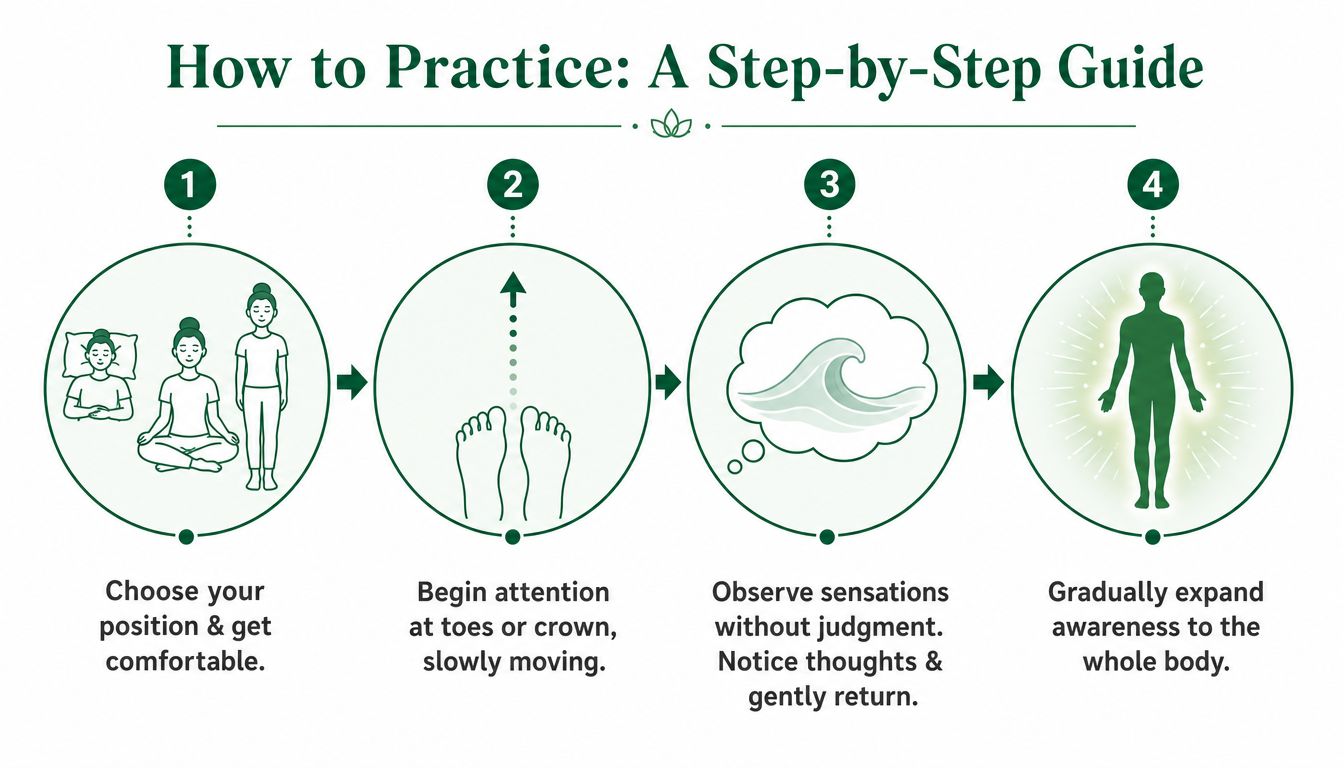
Choose a place where you can be reasonably uninterrupted. You can lie down, sit in a supportive chair, stand, or adapt the practice while walking. Lying down may feel soothing, while sitting or standing can help if you tend to fall asleep.
A simple practice sequence
Settle into your position. Let your hands rest comfortably. You can close your eyes or keep them softly open. Take a moment to feel the support beneath you.
Choose a direction. Begin at your toes and move upward, or start at the crown of your head and travel downward. There's no clinically required starting point. The value comes from moving slowly enough to notice.
Pause at each region. Spend several breaths with your feet, ankles, calves, knees, thighs, pelvis, abdomen, chest, hands, arms, shoulders, neck, face, and head. Notice pressure, temperature, contact, pulsing, discomfort, or blankness.
Return without criticism. Your mind will wander toward plans, memories, sounds, or worries. Notice that it wandered, then guide attention back to the body as gently as you'd redirect a child who lost sight of the path.
You can use this brief script:
“I'm noticing my feet. I don't need to change them. I'm aware of pressure, temperature, and movement. If my attention wanders, I can return with patience.”
Common beginner experiences
Falling asleep may mean you're tired, or it may mean the position is too comfortable for your current energy level. Try sitting, practicing earlier in the day, or keeping your eyes partly open. Restlessness often responds to noticing the urge to move before immediately acting on it.
Some body parts may feel blank or distant. Don't strain to manufacture sensation. Acknowledge, “I'm not noticing much here,” and continue. If you want a practice that deliberately contracts and releases muscles instead, compare body scanning with progressive muscle relaxation.
Evidence-Based Benefits of Body Scan Practice
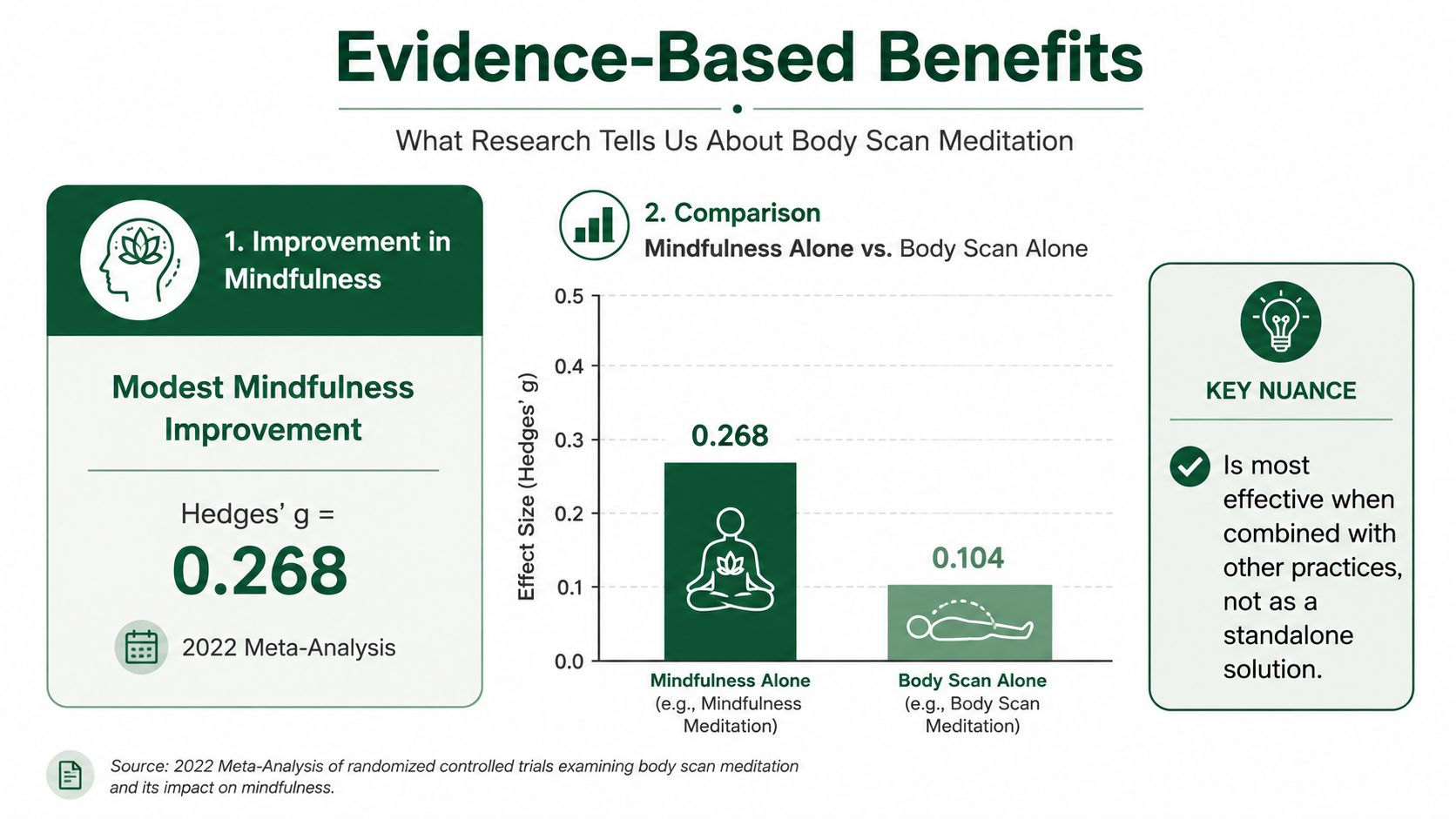
The most responsible discussion of body scan meditation benefits starts with limits. A 2022 systematic review and meta-analysis found that body scan meditation by itself produced only a small improvement in mindfulness compared with passive control, with Hedges' g = 0.268, a 95% confidence interval from 0.032 to 0.504, and p < .05. The authors concluded that a sole body scan wasn't strong enough to improve broader health-related outcomes, while also noting that the included studies were low quality and highly heterogeneous. Read the systematic review and meta-analysis.
That finding doesn't make the practice useless. It tells us how to place it accurately. A body scan may support awareness, self-regulation, and engagement with treatment, but it shouldn't be presented as a replacement for therapy, medical care, sleep treatment, or specialized pain management.
Where the evidence is more encouraging
Controlled pain research points to practical, immediate effects. In a 2014 randomized controlled study, 55 adult outpatients with chronic pain received either a 10-minute mindfulness-based body scan or a control reading intervention. The body scan produced significant immediate reductions in pain-related distress, p = 0.005, and in pain interfering with social relations, p = 0.036. Review the 2014 controlled study.
A later 2019 pilot randomized trial gave people with persistent pain a 15-minute mindfulness body-scan audio. Of 220 referred patients, 147 were randomized and 71 completed all assessments. The intervention group showed significant positive effects for perceived usefulness at one week, p = 0.044, and pain self-efficacy at one month, p = 0.039. The pattern is important: body scan appears more consistently connected with reduced distress and stronger coping confidence than with immediate elimination of pain intensity.
Research summarized in a major review also links body scanning with reductions in anxiety, improved psychological well-being, and physiological changes. One controlled study reported significantly greater increases in respiratory sinus arrhythmia during meditation than during other relaxing activities, suggesting that the practice can influence regulation processes rather than functioning only as a positive idea. Explore the review of mindfulness and health outcomes.
The Nervous System Science Behind the Benefits
Chronic stress can narrow attention toward danger, deadlines, and problems. If noticing your body has previously brought you close to fear, pain, shame, or traumatic memories, your mind may learn to stay “upstairs” in thoughts. That distance can offer short-term protection, but it may also make it harder to recognize early signs of overwhelm.
Body scanning gently rebuilds interoception, your ability to sense internal signals such as muscle tension, breathing changes, pressure, temperature, and heartbeat-related sensations. You can think of interoception as the body's internal dashboard. When stress keeps flashing warning lights, the dashboard may become difficult to read. A slow scan gives you time to distinguish a tight throat from the thought, “I'm in danger,” or a racing heart from the conclusion, “Something terrible is happening.”
Recalibrating the alarm system
Experimental research found that a brief body-scan practice reduced tactile misperceptions, lowered false alarms, and increased sensitivity during somatosensory decision tasks. In practical terms, this suggests that scanning may help people separate actual sensory information from threat-based interpretations. See the controlled study on body scanning and somatosensory processing.
This doesn't mean your sensations are imaginary. It means the nervous system can add urgency, danger, or intensity to otherwise neutral signals, especially when it has been under sustained strain. Body scan practice helps you collect information before reacting.
A therapist may use this skill to ask, “What are you noticing in your chest right now?” rather than immediately, “Why are you anxious?” That shift matters. It turns an overwhelming emotional experience into smaller, observable pieces that can be approached gradually. For related grounding ideas, see these nervous system regulation techniques.
Practical Applications for Common Challenges
The same practice can serve different purposes depending on how you guide your attention. You aren't trying to create one universal result. You're choosing a doorway that matches what your body needs today.
Match the scan to the challenge
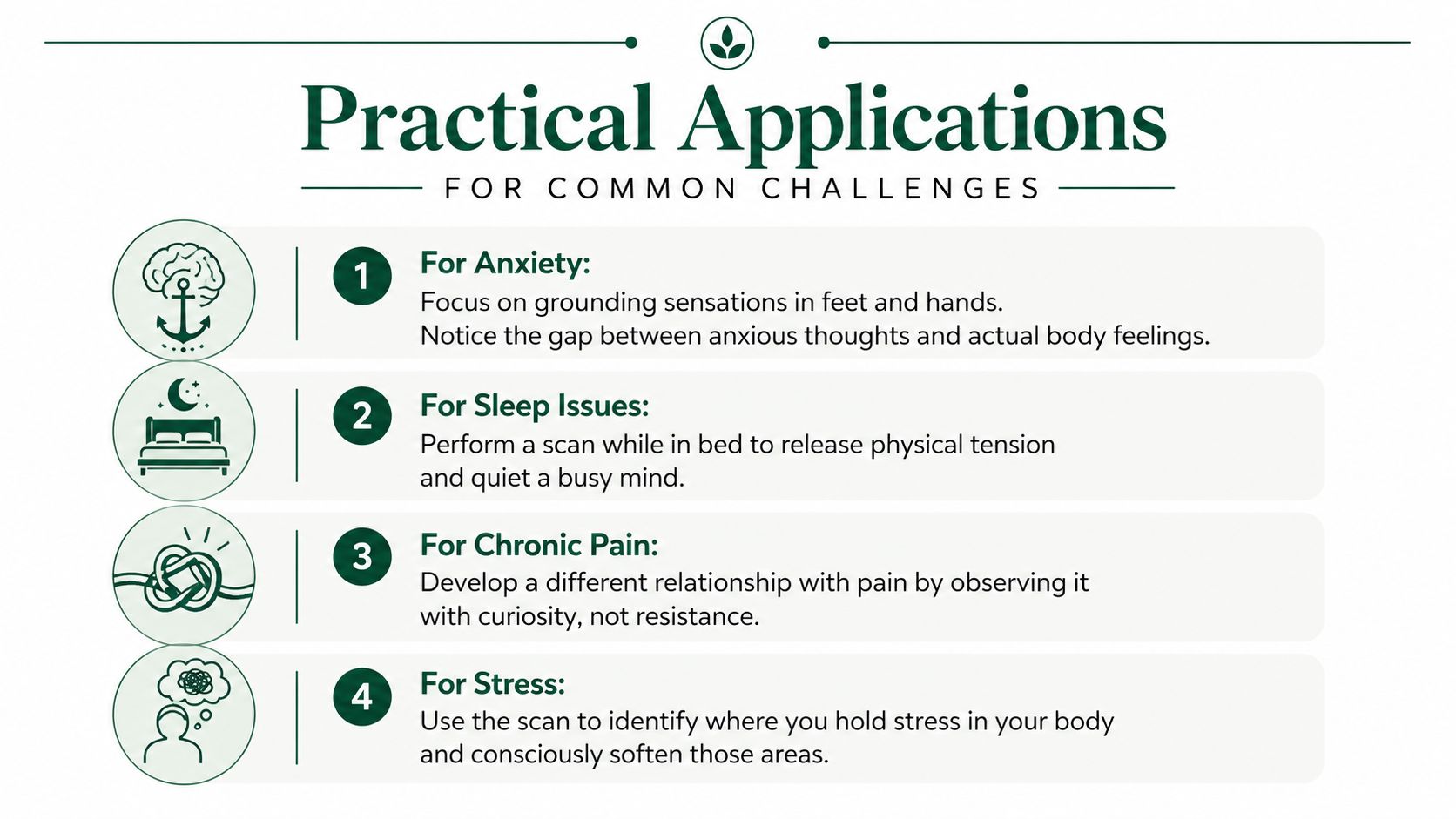
Anxiety: Start with your feet and hands. Notice contact with the floor, the chair, or your clothing. Then compare the physical sensation with the anxious story in your mind. You might say, “My thoughts predict danger, and my feet feel pressure against the ground.”
Chronic pain: Let the painful area be one sensation among many. Notice its edges, temperature, pulsing, or changing quality without demanding that it disappear. Controlled research found reductions in pain-related distress and social interference, even though these findings don't mean pain intensity will immediately vanish.
Sleep difficulties: Use a quiet scan as a transition ritual in bed. Move slowly through the body, noticing where the day has left tension. A simple phrase such as “I can soften what doesn't need to work right now” may help your attention move away from problem-solving.
Stress: Scan for the places where you brace, such as the jaw, shoulders, hands, abdomen, or forehead. On each exhale, invite those areas to loosen, but don't turn relaxation into another task you can fail.
Timing can support your intention. A morning scan may help you arrive in your body before the day accelerates. A midday practice can create a pause between demands, while an evening scan may help mark the shift toward rest. Begin with a length you can repeat consistently, then adjust according to your response rather than chasing an ideal session.
People who want broader lifestyle support can also explore these lifestyle changes that ease anxiety. For additional guidance on recognizing stress responses, see this resource on how to regulate your nervous system.
When Body Scan Meditation May Not Be Right
A body scan isn't automatically calming for everyone. If you're living with active trauma or post-traumatic stress, focusing inward can sometimes bring up flashbacks, panic, dissociation, or sensations that feel too intense to manage alone. A shorter practice, attention to external objects, or grounding through the room around you may be a safer starting point with professional support.
People with certain body image concerns or eating disorders may also need adaptation. Direct attention toward weight, shape, or specific body areas can intensify self-criticism. A therapist can help redesign the practice around neutral sensations, contact with supportive surfaces, movement, sound, or choice.
Troubleshooting without self-blame
If you don't feel anything, don't force attention or assume you're failing. Move toward simple contact points, such as your feet on the floor or your back against a chair. If you fall asleep repeatedly, practice sitting or choose a time when you're more alert.
Feeling worse after practice deserves attention, not dismissal. Pause the scan, orient to your surroundings, and speak with a qualified mental health professional if distress continues. Body scan meditation alone isn't sufficient treatment for clinical depression, severe anxiety disorders, or complex trauma, and it shouldn't replace medication management, psychotherapy, medical evaluation, or crisis support.
Safety comes first: A practice is only helpful when you can remain within a manageable range of experience. You're allowed to stop, open your eyes, move, or choose another grounding method.
Integrating Body Scan into Your Healing Journey
Body scan meditation works best as part of a larger mind-body approach. Therapy can help you understand patterns, relationships, beliefs, and memories, while body scanning can help you notice how those patterns appear physically. Together, these perspectives may make emotional work more concrete.
A therapist might invite you to identify the first sign of escalation in your body, such as a tightening chest or clenched hands. That information can support distress tolerance, emotional regulation, communication, and preparation for deeper trauma processing. If you're already in counseling, discuss the practice with your therapist so its pace and focus match your treatment goals.
Building a practice you can sustain
Start with a short daily session rather than waiting for a large block of free time. A guided recording can provide structure at first, especially if silence makes you uncertain about what to do. Afterward, write a few words about what you noticed, including whether the practice felt settling, neutral, activating, or difficult.
Consistency matters more than making every session long or profound. You might practice after waking, during a work break, or as part of your bedtime routine. If a particular body area feels overwhelming, return to neutral sensations or external grounding and bring that observation into therapy.
Body scan meditation also fits within broader somatic approaches that connect physical awareness with emotional healing. This overview of what somatic therapy is can help you understand how body-based attention may complement talk therapy.
The most balanced view of body scan meditation benefits is neither dismissal nor exaggerated promise. The evidence supports modest mindfulness gains, useful short-term changes in pain-related distress, improved coping confidence, and measurable sensory and physiological effects. The practice can help you notice yourself sooner, respond with more choice, and participate more fully in care, while still leaving room for therapy, medical treatment, relationships, rest, and practical life changes.
Be Your Best Self & Thrive Counseling, PLLC offers compassionate individual and couples counseling for anxiety, depression, trauma, stress, and life transitions, with evidence-informed mind-body practices that may include mindfulness and meditation. Visit Be Your Best Self & Thrive Counseling, PLLC to learn about counseling in St. Petersburg and the Tampa Bay area and explore a free initial consultation.