
Progressive Muscle Relaxation: A Complete How-To Guide
You know the feeling. You're lying in bed, or sitting in a meeting, and your shoulders have climbed toward your ears. Your jaw is tight, your breathing is shallow, and your mind keeps insisting that everything is fine while your body says otherwise.
That gap between what you think and what you feel is exactly where progressive muscle relaxation can help. It's a body-based skill developed by physician Edmund Jacobson in the early 1920s that teaches your nervous system to notice the difference between holding and releasing. If you want a gentle overview of how nervous-system work supports sleep, The Sleep Consultant on regulation is a useful companion read, and this guide to nervous system regulation can also help you connect the dots.
The basic idea is simple. You deliberately tense one muscle group, then let it soften completely. Over time, that repeated contrast helps your body recognize unconscious tension patterns and loosen them more quickly. It's not a cure, and it won't erase stress from your life, but it can become a reliable self-regulation skill for anxiety, sleep, and day-to-day stress. In a recent 2025 systematic review and meta-analysis, 31 randomized controlled trials with 2,277 patients found significant improvements in sleep quality and anxiety, including a PSQI mean difference of -3.79 and an anxiety SMD of -1.11 (PubMed).
What Progressive Muscle Relaxation Does for Your Nervous System
PMR targets physical tension directly, making it the stronger choice when stress shows up in the body. You can feel that most clearly on the nights when your muscles will not settle, your jaw stays locked, your breathing stays shallow, and your mind keeps insisting that you should be fine while your body says otherwise. Progressive muscle relaxation gives those places a clear instruction, tighten, then release, and notice what changes.
Why the tension and release pattern matters
The method works because the body learns through contrast. When you tense a muscle group for a few seconds and then fully let it go, you start to recognize what “held” feels like and what “released” feels like. That matters because many people do not notice their baseline tension until they compare it with a real release.
A 2024 systematic review synthesized 46 publications from 16 countries and included data on more than 3,402 adults. It found PMR reduced stress, anxiety, and depression, with 24 studies supporting stress reduction, 21 studies supporting anxiety reduction, and 11 studies supporting depression reduction (PMC). In practical terms, that means PMR has moved well beyond a niche self-help idea.
The body-based part is the point. For someone who carries stress as clenched shoulders, a tight belly, a jaw that never softens, or a sense of being braced for impact, PMR gives those patterns something concrete to respond to. It can also be adapted. Trauma survivors often do better with lighter tension, fewer muscle groups, or eyes open. People with neurodivergent sensory sensitivity may prefer a shorter script, a predictable sequence, or no breath counting at all. Chronic pain requires even more care, because strong squeezing can backfire if it triggers guarding or pain spikes.
Practical rule: If your body feels “on” all the time, PMR is usually more useful than trying to think your way into calm.
What you can expect, and what you shouldn't expect
The strongest evidence base is in stress, anxiety, and insomnia management, not cure claims. Major clinical resources treat PMR as a self-regulation skill that can be practiced daily or several times per week, often for about 15 minutes when a fuller session is possible (VA guide). That is a realistic frame. You are training a response, not chasing perfection.
For many clients, the payoff is less dramatic than “instant relaxation” and more useful than that. Sleep can feel less effortful. Anxiety can have less grip. Tension can show up earlier in the day, which gives you a chance to respond before it hardens into pain or shutdown. A broader discussion of body-based calming skills also fits well with The Sleep Consultant on regulation and this nervous-system regulation overview, especially if you are trying to build a personal routine rather than rely on willpower alone.
Full Progressive Muscle Relaxation Script and Sequence
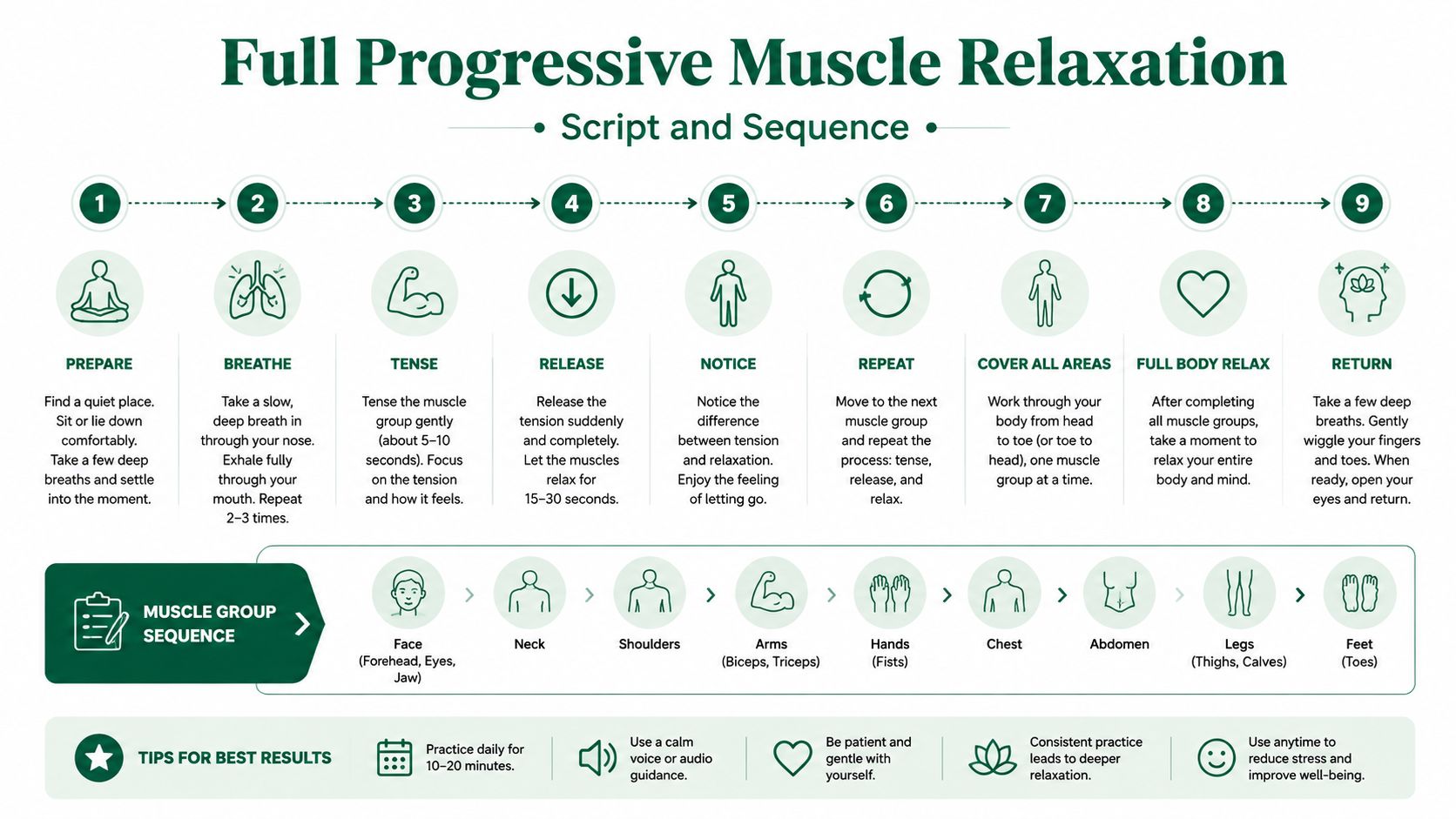
Settle first, then move through the body
Lie down or sit in a supported position. Take three deep breaths before you begin. Let your exhale be longer than your inhale if that feels comfortable, because the point is to arrive in the practice, not force anything.
Start with your feet. Inhale, then curl the toes and tense the feet for about 5 seconds. Exhale and let the muscles soften for 5 to 20 seconds. Notice the difference between effort and release, not just the sensation itself.
Move to your calves, then thighs, then hips and buttocks. With each group, inhale and contract, hold briefly, then exhale and let go. Keep the tension strong enough that you can clearly tell it's there, but not painful or cramping. If your body starts bracing in other areas, ease up.
Key point: The relaxation pause matters as much as the squeeze. Without the pause, you lose the contrast that teaches body awareness.
Continue upward with a steady rhythm
Shift to your abdomen and then your back. Many people accidentally tense the wrong muscles here, especially by arching the back or tightening the shoulders when they mean to isolate the core. That's a common example of accessory muscle substitution, and it blunts the practice because the target muscle never gets a clean signal.
Then move to your hands and arms. Clench your fists, bend the elbows slightly if that helps, and notice the effort in the forearms and biceps. Release and let the fingers uncurl fully. After that, lift and tense the shoulders, then relax them down and away from the ears.
Finish with the neck and face. Gently tense the neck without straining, then soften the jaw, mouth, eyes, forehead, and scalp. Some scripts repeat each muscle group 3 to 5 times, while others keep the full session around 15 minutes. The exact count matters less than keeping the pattern consistent, inhale, contract, exhale, release (HSS guide).
If you prefer to listen rather than read, you can record the sequence in your own voice and keep it simple. A fuller version like this is often easiest when practiced slowly at first, then repeated often enough that your body starts to recognize the rhythm on its own.
A Shortened Five Minute Version for Busy Days
Not every day gives you space for a full body scan and a longer unwind. A shorter version can still help if you need to reset before a hard conversation, during a work break, or as part of your wind-down before sleep. The goal is to keep the same logic, just with fewer stops along the way.
Group the body into larger zones
Use four rounds instead of many small ones. First, tense the lower body, meaning feet, calves, and thighs together. Next, focus on the core, including abdomen and back. Then work through the upper body, hands, arms, shoulders, and neck. Finish with the face.
Each round follows the same pattern. Inhale, contract for about 5 seconds, then exhale and release for a longer pause. The short version works best when you don't rush the release. If you do, you've basically turned PMR into a series of quick squeezes, which skips the part that teaches your body to settle.
Make it portable enough to repeat
A five-minute practice is especially useful in ordinary settings, not just a quiet bedroom. You can do it in a parked car, a closed office, or sitting on the edge of the bed before lights out. If you're building consistency, start with the short version rather than waiting for the perfect block of time.
Practice it when you're already calm. That's how your nervous system learns the sequence well enough to use it later when stress makes thinking harder.
If you want a broader reset strategy to pair with this abbreviated version, this stress-reduction guide can help you build a short routine around the practice. Clients often find that a shortened PMR round is easier to stick with than a longer one, and consistency matters more than intensity.
Adaptations for Trauma Survivors and Sensitive Nervous Systems
Standard PMR instructions assume your body feels safe enough to tense, scan, and release on cue. That assumption doesn't fit everyone. For trauma survivors, chronic pain patients, and many neurodivergent people, direct body focus can feel overstimulating, exposing, or even disorganizing.
Modify for safety, not for perfection
If a muscle group is painful, injured, or chronically guarded, skip it. You don't have to tense every area for the practice to count. For some people, especially those with hypervigilance, a shorter round with fewer body parts is more effective than a full sequence that pushes them outside their window of tolerance.
You can also substitute imagery-only relaxation for the contraction phase. Instead of physically tightening, imagine warmth, softness, or a gentle wave moving through the body. Keep your eyes open if closing them feels too vulnerable, and let a grounding object, like a mug, stone, or blanket, stay in your hand while you begin.
Keep choice at the center of the practice
The most important adaptation is permission. You can stop at any point. You can skip the face. You can stay with the hands and shoulders only. A partial practice is still a real practice.
For clients who want a trauma-informed framework, this overview of trauma-informed care pairs naturally with PMR because both prioritize pacing, choice, and bodily consent. That matters more than finishing a scripted sequence. VA materials also note that PMR is often paired with body-scan language and repeated practice, which can be helpful for some people and too much for others, so your adaptation should fit your nervous system, not override it (VA PDF).
If PMR makes you feel more agitated, numb, or trapped, don't push through. Try fewer muscle groups, a shorter time frame, or imagery only. For some sensitive systems, the safest version is the one that feels almost too small to matter, until it starts to.
How PMR Compares to Breathing Exercises and Mindfulness
PMR often gets compared with breathing exercises and mindfulness because all three can lower stress, but they ask different things of the body and attention. PMR gives physical tension a direct target, which helps when stress shows up as clenched shoulders, a tight jaw, a braced belly, or hands that will not unclench. Breathing work can be easier when the main problem is mental clutter, and mindfulness can help when you want to notice what is happening without immediately trying to change it.
Where PMR is stronger
PMR tends to fit people who feel restless, physical, or tightly braced under stress. It gives the body a clear task, which can be more useful than sitting still and trying to observe thoughts when the body already feels on guard. The trade-off is that PMR can feel slow or repetitive if you want the quickest possible calming tool.
Breathing exercises are often easier to use in public because they are discreet and do not require much setup. Mindfulness can broaden awareness, but some people find it frustrating when they are already anxious or flooded. Guided imagery sits between those approaches, since it can be soothing without asking for as much muscle work.
Where combination often makes more sense
Clinicians often pair PMR with breathing and imagery rather than treating it as a stand-alone fix. That usually fits real life better. A person with back tension might start with a few minutes of PMR, then move into slower breathing or a calming image. Someone with pain may skip the contraction phase and use imagery only on days when tightening the muscles feels like too much.
For readers who want another body-based option for a tight back, the MEDISTIK guide to yoga and back pain is a useful reminder that several physical approaches can support each other. PMR works best when you use it for what it does well, instead of forcing it to compete with every other calming method.
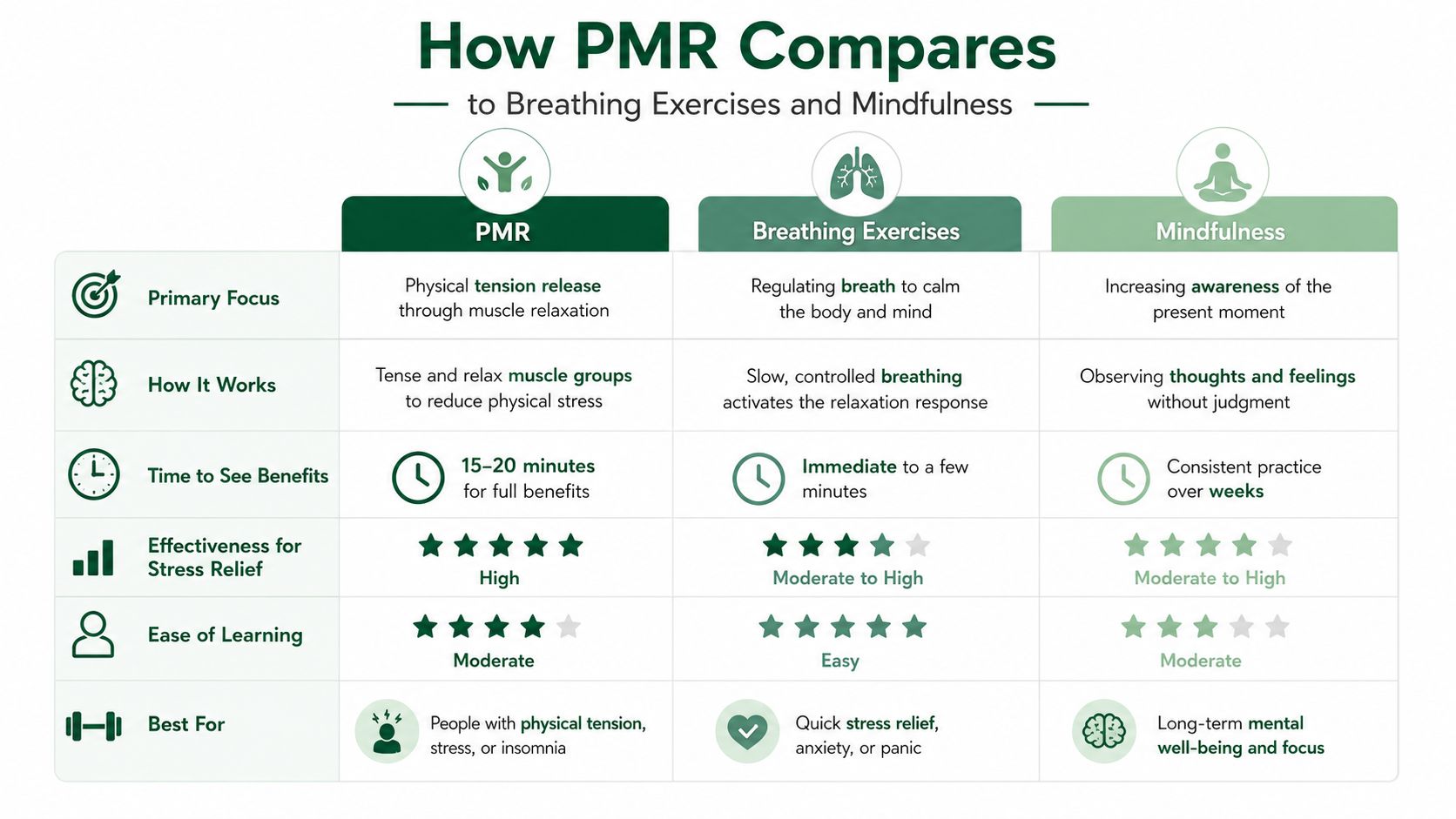
Mindfulness can complement either practice when it is part of a broader self-regulation plan, including mindfulness-based stress reduction. PMR gives the body something concrete to do. Breathing offers a quiet option for moments when you need something subtle. Mindfulness helps you notice patterns over time, which can make the other tools easier to use when your nervous system is already activated.
Building a Sustainable PMR Practice Into Your Routine
The best PMR routine is the one you'll consistently repeat. Start small, maybe three sessions per week with the shortened version, then add fuller sessions when the habit feels familiar. You're trying to make the sequence recognizable to your body, not turn relaxation into another task to perfect.
Tie the practice to an existing cue
Good anchor points are easy to remember. Try it before checking email in the morning, after lunch when your energy dips, or as a pre-sleep wind-down. If those times don't fit your life, attach the practice to another stable cue, like after brushing your teeth or after you close your laptop.
Track progress by noticing real-life changes, not by grading yourself. Maybe your shoulders drop faster after a stressful call. Maybe sleep comes a little more easily. Maybe you recover from a trigger with less spiraling. Those are meaningful signs that the skill is settling in.
Bring it into therapy when you need guidance
PMR can be especially useful in therapy when your body tends to brace without your awareness. A therapist can help you adjust the sequence, slow the pacing, or decide where to skip around pain and trauma triggers. That kind of individualized support is often the difference between a practice that feels generic and one that feels safe enough to keep using.
A sustainable plan doesn't ask for mastery. It asks for familiarity. The more often you practice, the more quickly your body can recognize the pathway from tension to release, and the less you'll have to rely on willpower when stress shows up.
If you're ready to make relaxation more practical, supportive therapy can help you adapt tools like PMR to your body, your history, and your daily stressors. Be Your Best Self & Thrive Counseling, PLLC offers trauma-informed, mind-body-spirit care that can help you build a calmer relationship with your nervous system, and you can visit Be Your Best Self & Thrive Counseling, PLLC to explore how that support might fit your needs.