
Blended Family Therapy: What It Is and How to Start
Ask adults in the United States whether they have a step-relative and 42% say yes, according to a Pew Research Center survey of 2,691 adults fielded in October 2010. That figure counts step-siblings, stepparents and stepchildren, and it describes a family structure still treated as an exception.
The parents who call a counselor usually aren't confused about whether they love each other. They're stuck on something narrower. Should the stepparent come to the first session? Does the nine-year-old have to be there? Is it a failure to start with just the two adults in the room?
Those questions have real answers, and the answers come from how blended households function. What the treatment is for, who sits in the room first, and which small routines change before anyone feels like a family.
What Blended Family Therapy Is and Who It Serves
Blended family therapy is counseling that treats a remarried or cohabiting household with children as a system. Stepparents, nonresident parents, half-siblings, former partners and the children themselves all shape how the household runs, so the work looks at the relationships between them rather than at one labeled patient.
Think of two rivers meeting. Each keeps its own current, its own temperature, its own sediment for a long time after the confluence, and a new channel forms only after the water has had seasons to work at the banks. A household that combines two family cultures behaves the same way. The wedding changes the address. It doesn't merge the currents.
The Structure Is Mainstream, Not Niche
A U.S. Census Bureau report found that almost 1 in 5 married-couple families with children had at least one stepchild living in the household in 1985, and by 2000 approximately 4.4 million children were stepchildren, compared with 2.1 million adopted children.
That second comparison is the one worth sitting with. Stepchildren outnumbered adopted children by more than two to one, which means the blended household has been a major American family form for decades, not a recent trend or a niche referral.
Because the structure is common, it carries predictable problems rather than random ones. Standard family assumptions, one roof, two parents, one set of rules, a shared history that predates the children, miss nearly everything that matters here.
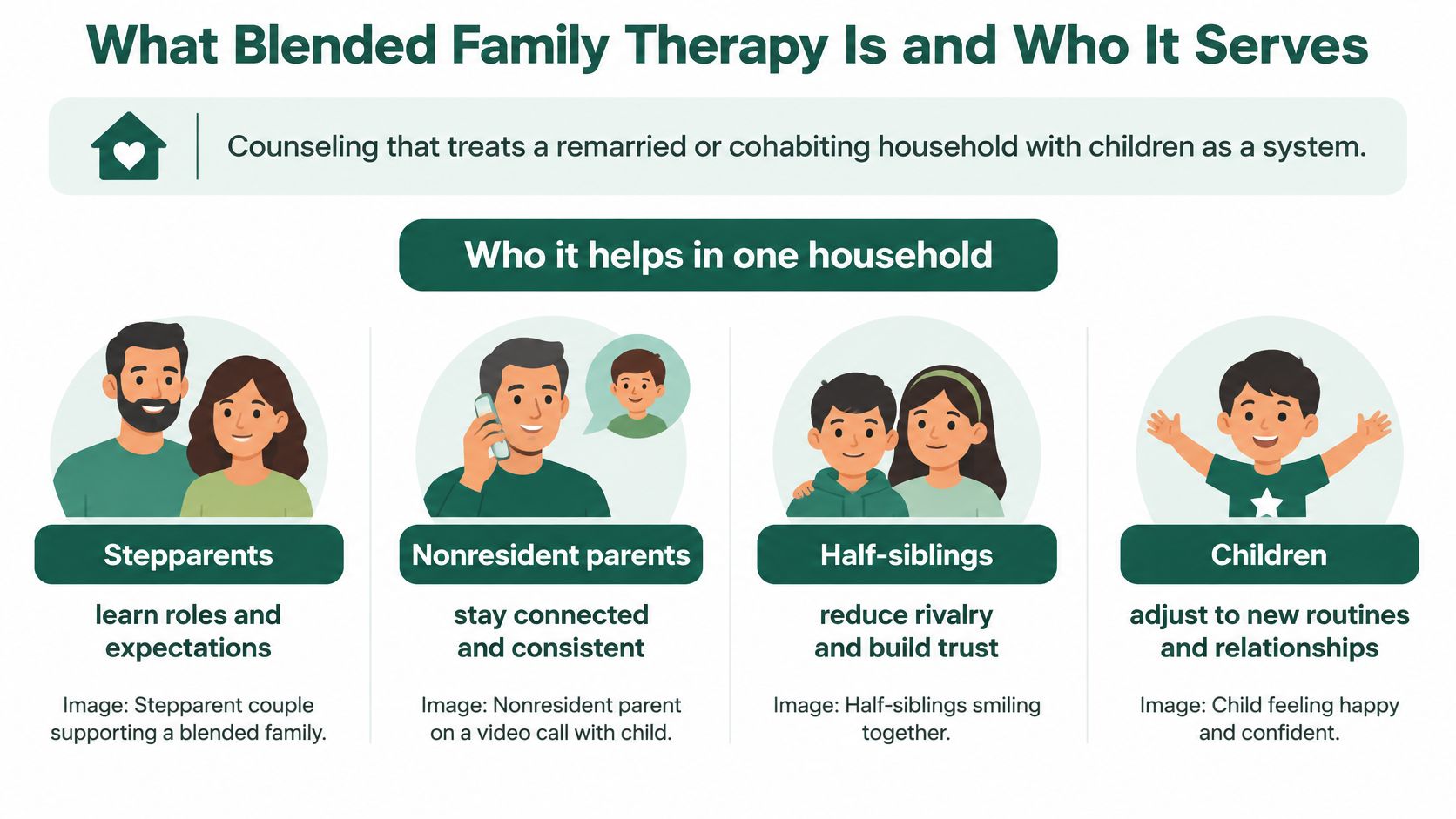
Caption: Blended family therapy treats the whole household as a system, including the adults and children who don't live there full time.
What the Nuclear-Family Template Misses
Blended households often run on two roofs, several adults with legitimate claims on a child, half-siblings with different grandparents, and a shared history that starts mid-story. An assessment that sounds like a first-family intake will miss the load-bearing details.
The child's relationships across households: what happens at the other home shapes behavior at this one, and a good intake asks about both.
The stepparent's role: whether they handle homework, bedtime, discipline or none of it yet, and who decided that.
Co-parenting arrangements: the schedule, the handoffs, and how much contact the adults have.
The timing of family formation: a household two months in is solving different problems than one eight years in.
Authority is usually the sticking point. A stepparent may manage bedtime every night and still lack standing to sign a school form, and the rules vary by state; guidance for Texas parents who remarry is a useful example of how a remarriage interacts with an existing custody order, which is the kind of constraint a treatment plan has to respect instead of argue with.
Loyalty conflicts deserve their own attention because they harden over time. When a child becomes a parent's confidant and the stepparent stays permanently outside the circle, the pattern is called enmeshment, and how enmeshed family systems form and loosen is worth reading if that description lands.
The concerns that bring people in are consistent: a remarriage transition nobody feels ready for, stepparenting friction, loyalty conflicts, custody handoffs that ruin the week, and tension between a child and a new partner that has started to look permanent.
Choosing Who Attends the First Session
The first clinical decision in blended family work isn't a technique. It's the guest list.
Stepfamilies aren't first families with extra members bolted on. Clinical literature on stepfamily therapy describes distinct vulnerabilities that can make traditional family-therapy techniques less effective, which is why an experienced therapist picks an entry point before inviting everyone into one room.
Entry point | Who attends | Best when | First goal |
|---|---|---|---|
Couple-only stabilization | Partners only | Conflict between partners drives household distress | Agree on a shared approach to conflict and decisions |
Parent coaching | Parents, and the stepparent when roles are set | Discipline or loyalty binds are central | Consistent routines and consequences across homes |
Child-focused support | The child, with parents involved separately | Symptoms appear in one young person | Reduce distress and clarify the child's role without forcing sides |
Coordinated family session | All household members, including a nonresident parent when appropriate | Basic safety and alliance exist | Shared rules, transitions and communication |
Should a Stepparent Attend the First Session
Usually yes, on one condition: the adults have agreed on what the stepparent's role is. Without that agreement, the first hour turns into a referendum on the stepparent, and the child's honest resentment lands on someone who came in hoping for validation. Prepare the stepparent for that possibility before the session, not during it.
How a Nonresident Parent Gets Involved
By phone or video, with written consent, and preferably on a predictable schedule. Hearing the other household's rules directly beats hearing a child's summary of them, and it prevents the argument that starts with "your mom lets you."
How to Keep a Child From Feeling Forced to Choose Sides
Give the child a separate meeting and a real voice in it, and never use them as the messenger between homes. Adolescents are reported to be the age group most likely to live in blended families, and they're also the most likely to refuse a room full of adults who all have opinions about them.
Practical rule: Attendance is a clinical decision, not a measure of commitment. A family that starts with two partners isn't behind a family that starts with everyone in the room.
That's why some work begins as couples work while the parenting plan takes shape. Our practice sees individuals and couples, so the adults can start there and widen the circle later. If you want to know what the first appointment involves, what happens in a first therapy session walks through the paperwork, the questions and the pacing.
Bring three things to intake: who lives in the home, who is involved but not in the room, and what has already been tried.
Evidence-Based Approaches Behind the Work
Ask what changes first in a blended family and the honest answer is dull. Bedtime happens on time. Homework gets done without a negotiation. Handoffs stop ending in the driveway with two cars idling.
The approaches below are the ones that make those changes measurable.
Caption: A session usually starts with structure and coordination before it moves to the harder question of how family members feel about each other.
Systems work reads the household as interlocking parts, so a child's sudden defiance is understood alongside couple conflict and a custody schedule that changed three weeks ago. Nothing in the household is treated as a standalone symptom.
Attachment-informed work examines how children and stepparents form bonds over time and how fear of rejection drives behavior. A child who tests a stepparent relentlessly may be checking whether this adult will leave too, and what attachment-based therapy looks at covers the pattern in more depth.
Trauma-informed work screens for trauma and safety before recommending joint sessions. If one adult uses anger to control the room, a joint session re-enacts harm rather than repairing it. That screening isn't a formality; it decides the format.
Nervous-system regulation teaches clients to notice stress signals in the body and slow down mid-conflict with breathing and grounding. It's the difference between knowing you should stay calm and being able to.
What the Trials Show
A randomized controlled trial evaluated behavioral family intervention for child oppositional and conduct problems in stepfamilies, reported in the Journal of Divorce and Remarriage. The study assigned 42 stepfamilies to a wait-list control group, a therapist-directed intervention or a self-directed intervention. Families receiving the intervention showed significantly greater reductions in child behavior problems and couple conflict about parenting than control families, and were more likely to reach clinically significant, statistically reliable improvement.
The detail that matters most for anyone choosing a therapist: there was no significant difference between the therapist-directed and self-directed formats. Structured behavioral strategies drove the outcomes, not the delivery format alone.
Study | Sample | Comparison | Main finding |
|---|---|---|---|
Behavioral family intervention trial | 42 stepfamilies | Wait-list control, therapist-directed and self-directed intervention | Greater reductions in child behavior problems and couple conflict about parenting than controls; no significant difference between the two formats |
110 stepfamilies | Control group with 24-month follow-up | Improved stepfathering tracked with lower child depression and noncompliance; at 24 months, effective stepfathering predicted lower child depression (β = -.17, p < .05) |
Our counseling approach blends Eastern and Western practices and uses mind-body-spirit approaches, which means breathing work or mindfulness can sit beside a behavior plan without replacing it. The structured part does the heavy lifting. The broader approach helps clients stay regulated enough to use it.
What Happens in a Session, Step by Step
A course of blended family therapy rarely looks dramatic. It looks like a sequence of small, specific decisions, each aimed at something you can observe by next week.
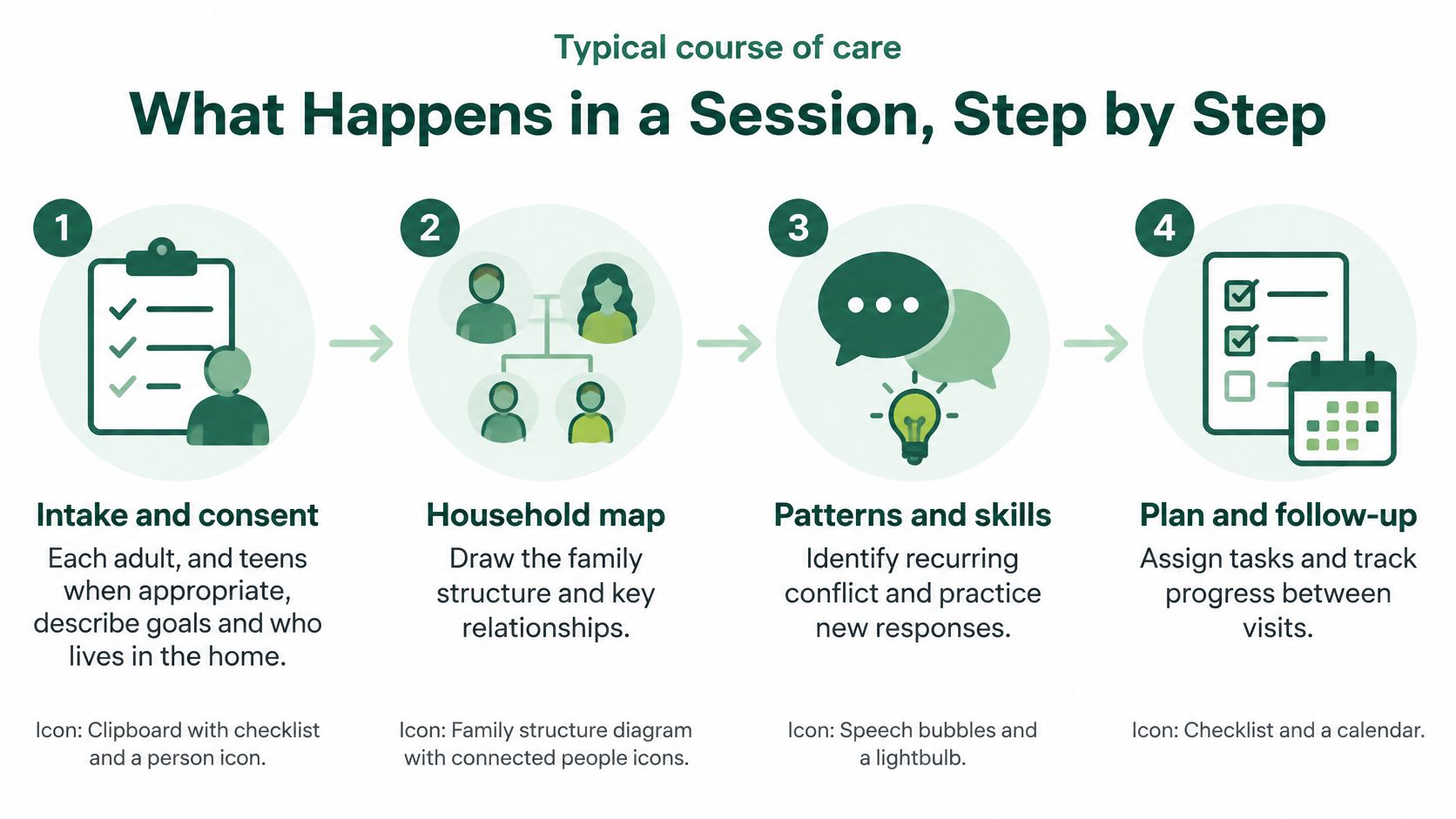
Caption: The first half of care is structured and practical; the emotional work builds on that scaffolding rather than preceding it.
Intake and consent. Each adult describes the goals in their own words, and teens get a version of the same conversation when it's appropriate. The therapist asks who lives in the home, who holds legal authority, and who is paying, because those answers shape what's possible.
Household map. You draw the households, schedules, bedrooms, handoff times and roles on one page. Seeing two homes side by side often explains a behavior that made no sense in isolation. The usual hiccup is that parents start disagreeing about the schedule while drawing it, which is useful information rather than a detour.
Safety and alliance check. Before any joint session, the therapist screens for coercive control, substance use and crisis, then checks whether each person can speak without retaliation at home. One adult sometimes reads the screening as an accusation, so a good therapist explains what the questions are for.
Goal setting. You leave with two or three measurable targets: the same consequence for the same behavior in both homes, fewer escalating exchanges at handoff, a bedtime that happens inside a fifteen-minute window. Vague goals like "get along better" survive the session and change nothing, so ask for the observable version.
Skill practice. You rehearse in the room, opening a discipline conversation, interrupting an argument before it reaches the children, slowing your own stress response. Sessions often include practices such as breathing techniques, yoga and mindfulness when a client wants them. Rehearsal feels artificial on purpose; the point is to make the words available under pressure.
Between-session practice. Each household gets one short task, not a reading list. One home tracks how often a rule was followed, another practices a two-minute handoff script. When the task doesn't happen, that's data, and it usually means the task was too big.
Progress review. Every four to six sessions you look at the targets you picked and decide whether to continue, switch entry points or step down. A teen who refuses to attend is the most common reason a review happens early, and it's a reason to change format rather than stop.
The order matters more than the speed. A family that fixes bedtime in month one and loyalty in month six is doing better than one that talks about feelings for a year and still can't agree on a curfew.
Practical Steps for Parents, Partners and Kids
The work that changes a blended household usually happens between sessions, in ordinary rooms, at ordinary hours.
For parents
Agree on two or three house rules with your co-parent before the children hear them. Announcing rules one at a time invites a negotiation in front of an audience.
Keep discipline clear at first. The biological parent leads on consequences and the stepparent backs them up, until trust makes a shared front credible rather than staged.
Count for one week. Track how often you give a positive instruction and how often you follow through. Most parents are surprised by the gap.
For partners
Hold a weekly 20-minute check-in with no screens. Agenda: one logistics item, one thing that went well, one thing to adjust.
Name the stepparent role in plain words. Who handles homework, who handles bedtime, who answers when the school calls. Ambiguity becomes resentment faster than almost anything else.
Pause conflict before it reaches the children. A disagreement you table for the check-in costs far less than one a child overhears and then carries to the other home.
For children
Give them a voice without asking them to choose sides. "You get to say what's hard" is different from "Who do you want to live with."
Protect one-on-one time with each parent. It's the cheapest loyalty relief available, and the first thing to disappear when schedules tighten.
Explain that rule changes aren't punishments. Children read new structure as a verdict on the old one unless someone tells them otherwise.
Discipline disputes between homes are the classic sticking point, and writing the agreements down helps more than remembering them; remarriage and co-parenting dos and don'ts covers which arrangements are worth putting in writing. House rules are also boundaries, and how to set healthy boundaries with family is a useful companion when you're unsure where your authority ends.
Tracking Beats Guessing
A randomized controlled evaluation of the Marriage and Parenting in Stepfamilies program, published in the Journal of Consulting and Clinical Psychology, tested a parenting-focused intervention that targeted observable behaviors such as effective discipline, monitoring, encouragement and reduced coercion rather than treating "family adjustment" as one undifferentiated problem. After controlling for months married and child age and sex, intervention-group couples showed significantly greater improvement in parenting than controls (β = .31, p < .01). Improved parenting then produced downstream effects: observed child noncompliance and parent-reported home and school problem behaviors decreased, with some benefits persisting through 24 months.
That gives you metrics worth watching instead of a feeling to argue about: frequency of positive instructions, consistency of consequences across households, how often a conflict turns coercive, how often a child complies after the first request, and what teachers report.
When to Seek Therapy and How to Choose a Therapist
Four patterns justify a call now rather than later: conflict that repeats weekly, a child whose grades or sleep have changed over several months, a parent or stepparent who feels stuck or disengaged, and discipline disputes that escalate in front of the children.
Therapy suits non-emergency concerns. If someone is in danger, contact local emergency services or a crisis line instead of booking an appointment.
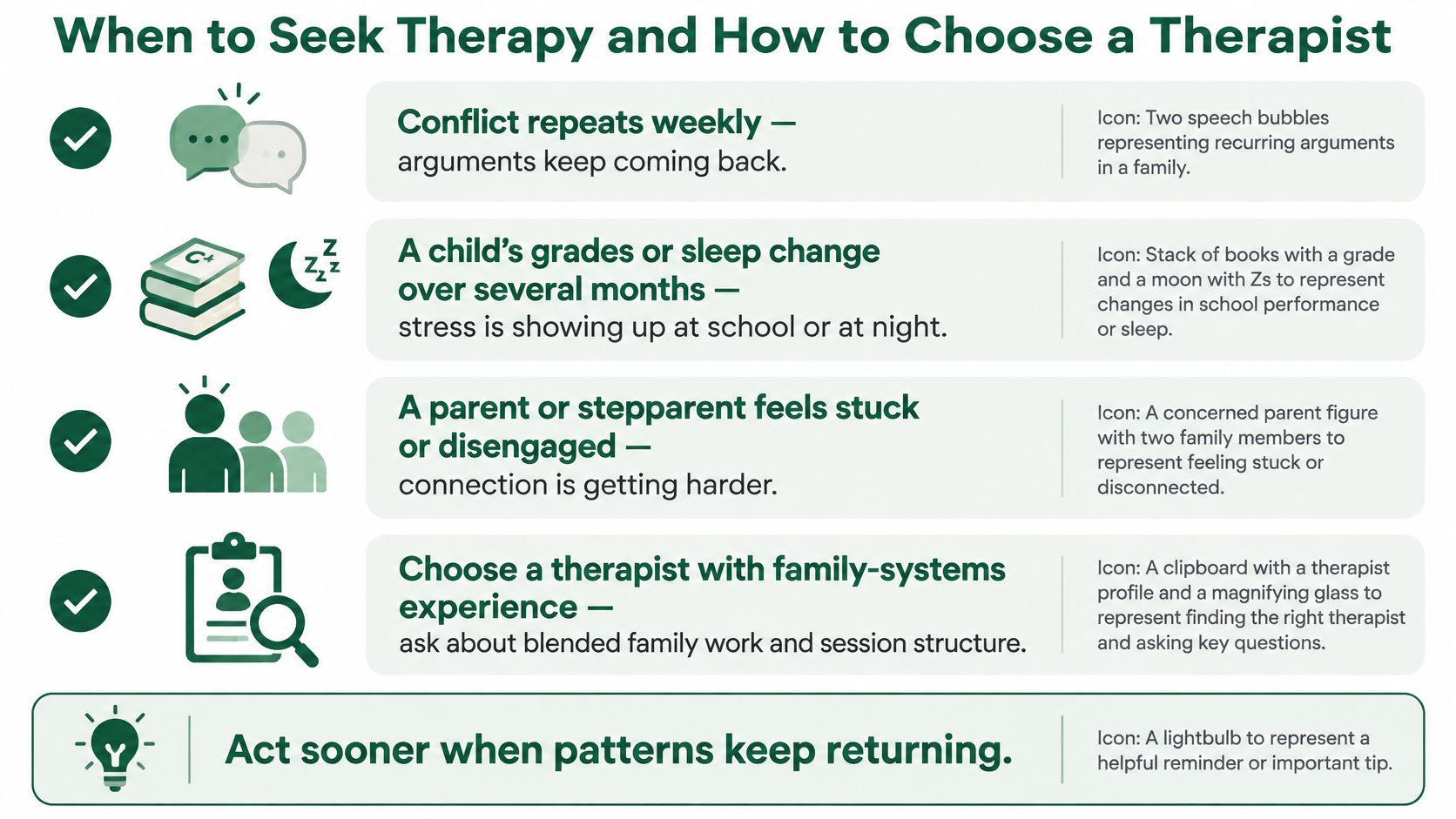
Caption: Repeating patterns are the clearest signal, and the therapist you pick should be able to explain the structure of care before the first session.
Money pressure belongs on that list too, because family structure and material conditions travel together. A clinical overview of blended family issues cites a median net worth of $86,300 for households with children in blended families versus $194,400 for households with children in other family types, which is a reason to ask about housing, transportation and child-support disputes rather than assuming every problem is a communication problem.
When you screen therapists, work through this list.
Stepfamily experience, not only general family work. Ask how the therapist typically sequences blended family care.
Training in couple work and in child work. Blended family problems rarely respect the line between the two.
A clear answer about who attends the first session. If the therapist can't say in one sentence, that's information.
Trauma-informed practice and safety screening. Joint sessions without screening can re-enact harm.
A named ethics code. We follow the American Counseling Association Code of Ethics; ask any therapist which code binds them and how they handle a conflict of interest between family members.
A written policy on between-session contact. Phone, text or portal, and what happens in a crisis.
A consultation to test fit before committing. How to judge therapy fit covers what to notice in that first conversation.
Ask three questions at the consultation: which entry point they recommend and why, what will be measured, and how progress gets reviewed. Then confirm licensure, which should be a state license in counseling, marriage and family therapy or social work, plus whatever continuing training they've completed in stepfamily work.
Motivation outperforms severity as a predictor. Our practice works with non-emergency issues and with motivated people who are ready to change but need a bit of help building the life and relationships they want, and that readiness is worth more than a long problem list.
Some readers arrive with a different question entirely: whether the marriage itself will hold. A plain-language overview from Olson & Sons on the signs it may be time for a divorce is a reasonable read if that's the main worry, because blending work assumes the couple is staying together.
Choose Your Starting Point This Week
Pick the entry point that matches the problem you'd name if someone asked you tonight. Couple conflict that saturates the house points to couple-only stabilization. Discipline and loyalty binds point to parent coaching. One distressed child points to child-focused support. A household that's basically safe but disorganized points to coordinated family sessions.
Don't choose a format because it sounds like the most committed one. Choose the one your problem fits, and let the format widen from there.
Before you call, write three things on one page: who lives in the home, who is involved but lives elsewhere, and which parts of your current routine you've already tried. Those notes shorten intake and show the therapist immediately where the household is stuck.
If you're in St. Petersburg or Sarasota, our practice provides mental health counseling in both cities, works with individuals and couples, and the best way to reach a counselor between sessions is by phone or text. Call, ask which entry point we'd recommend, and confirm the format of the first meeting.
Book one consultation this week. The first decision gets easier once the household details are already written down.
Blended families are the structure most of us grew up navigating without a map, and the adults in them often need help that starts smaller than they expect. Be Your Best Self & Thrive Counseling, PLLC works with individuals and couples in St. Petersburg and Sarasota, blending Eastern and Western practices with mind-body-spirit care to build the routines, boundaries and regulated responses that blended households run on. If you're ready to sort out who should be in the room first, visit Be Your Best Self & Thrive Counseling, PLLC and book a free initial consultation to talk through your entry point.