
7 Trauma Informed Therapy Interventions for Real Healing
You flinch when a voice rises, even though you can explain the old story in calm detail. Years of talk therapy gave you language. Your body still braces. A clinician across from you could reach for six trauma protocols before the hour ends. The problem is rarely a shortage of techniques. It is fit.
Trauma informed therapy interventions add pacing, choice, consent, and stabilization before any trauma processing. The phrase is a way of delivering care, not a single treatment. SAMHSA's Concept of Trauma and Guidance for a Trauma-Informed Approach describes care that recognizes trauma's widespread impact, understands paths toward recovery, identifies trauma-related signs, and actively resists retraumatization. That should shape the session. It should not replace a method with direct outcome evidence.
Order matters. Stabilization comes first. Processing comes later, and only when you can stay present. Below are trauma-focused CBT, EMDR, cognitive processing therapy, prolonged exposure, somatic experiencing, sensorimotor psychotherapy, and internal family systems. Each entry says who it is built for, what it asks session to session, and the caution that decides the next step. If you are the clinician, keep psychology session documentation specific enough that consent, pacing, and symptom shifts are visible next visit.
1. Trauma-Focused Cognitive Behavioral Therapy (TF-CBT)
Trauma-focused cognitive behavioral therapy (TF-CBT) is a short, structured treatment built for children, adolescents, and their caregivers, and clinicians also use it with adults. It fits families after sexual abuse, domestic violence exposure, motor vehicle accidents, or community violence, including school and agency programs. Nobody is asked to tell the hardest story on day one.
NICE recommendations for PTSD support individual trauma-focused cognitive behavioral therapy for adults with acute stress disorder or clinically important PTSD symptoms, generally across 8 to 12 sessions, with more time after multiple traumas. The work includes psychoeducation, skills for arousal and flashbacks, safety planning, and processing shame, guilt, loss, and anger.
Session to session, the PRACTICE sequence sets the pace: psychoeducation, parenting skills, relaxation, affective modulation, cognitive coping, trauma narrative, in vivo mastery, conjoint caregiver sessions, future safety, and follow-up.
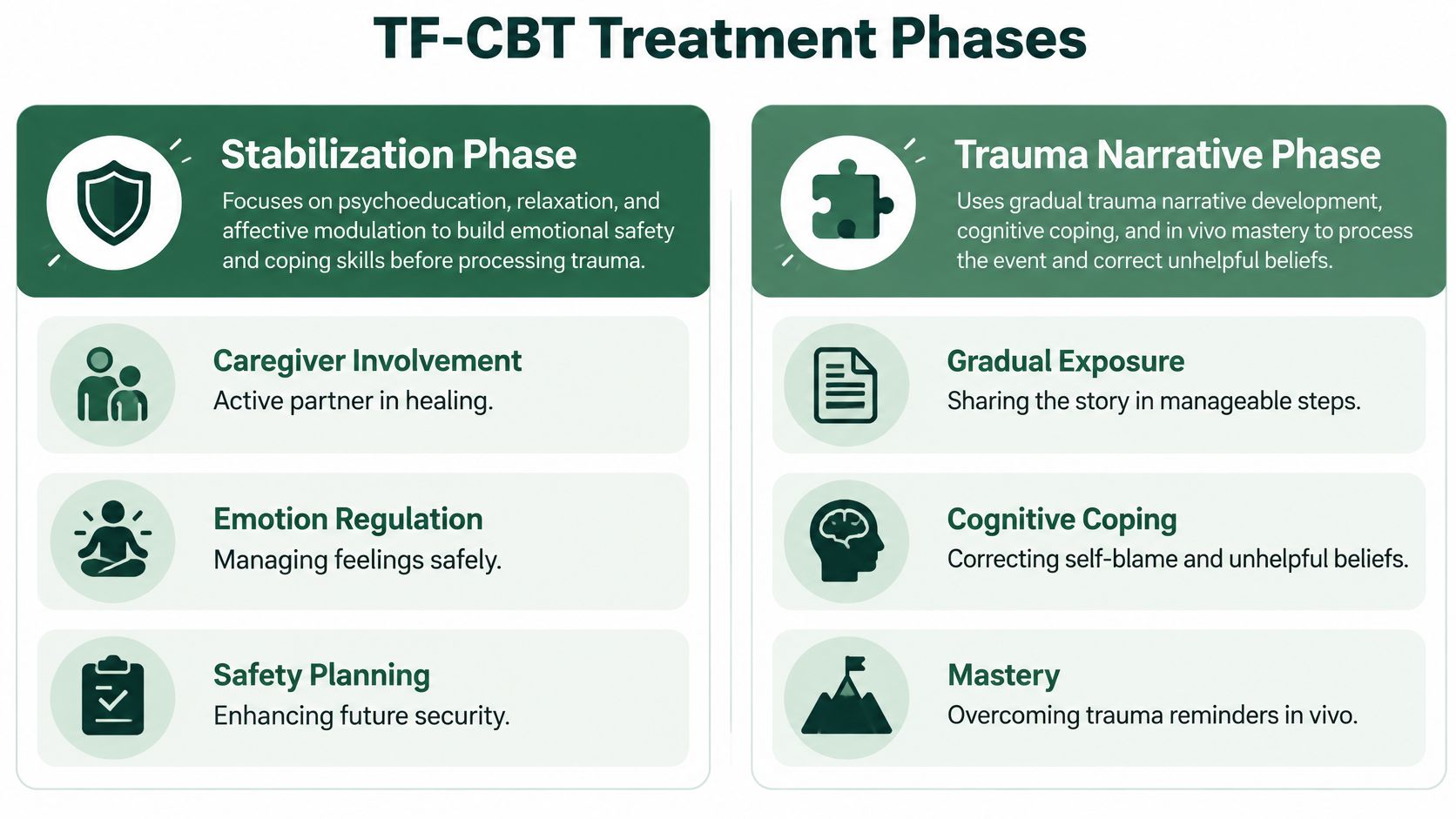
A diagram outlining the two main phases of TF-CBT treatment: Stabilization Phase and Trauma Narrative Phase.
Say a child and a parent come in after a crash. Early weeks stay on breathing, naming fear, and what the parent will do when nightmares hit. The narrative starts only after those skills hold. A 2021 systematic review found cognitive behavioral therapy improved outcomes in all five studies that tested it, across depression, anxiety, and related problems. That is a stronger bet than the label alone, and it still is not a guarantee.
Practical rule: If distress spikes, return to relaxation before you add another chapter of the story.
I would not open the narrative when the caregiver is absent or unclear about their role. Trauma-focused therapy needs that partner in the plan.
2. Eye Movement Desensitization and Reprocessing (EMDR)
Picture a veteran who can drive to the clinic but cannot watch a certain stretch of road without a surge of alarm. Eye movement desensitization and reprocessing (EMDR) is built for memories that still hit like they are happening now. It also fits single-incident trauma such as accidents, assaults, or disasters in outpatient care.
You briefly hold a distressing memory while you follow bilateral stimulation, usually guided eye movements, sometimes taps or tones. The aim is reprocessing, so the memory keeps its facts and loses some of its charge. The eight phases are history, preparation, assessment, desensitization, installation, body scan, closure, and reevaluation. Preparation is not optional padding.

A therapist guides a patient during an eye movement desensitization and reprocessing session in an office.
A 2025 descriptive study of a trauma-informed group for foster children found that 13 children, 44.8%, were later referred to evidence-based trauma treatment such as EMDR or TF-CBT. Stabilization groups often hand people toward a processing method. They do not replace one.
What a session actually asks
Recall in short doses: You touch the memory, then return to the present.
Track distress out loud: You rate how hot the memory feels so pacing stays honest.
Leave settled: Closure uses grounding so you do not walk out flooded.
Skip EMDR when sleep, substance use, or support at home is already collapsing. I recommend more resource-building first. If emotions surge, stop the set and ground. Do not push through for the sake of finishing a protocol.
3. Cognitive Processing Therapy (CPT)
Cognitive processing therapy (CPT) is for adults whose PTSD is kept alive by stuck points, beliefs such as "it was my fault" or "no one is safe." It is a common first-line option for combat trauma in VA care and for sexual assault in community clinics. You do not need to retell every sensory detail. You do need to examine meaning.
Plans often run about 12 sessions, once or twice a week. You learn how thoughts, emotions, and behavior lock together, then write about the event and the beliefs that followed. Themes usually include safety, trust, power, esteem, and intimacy.
If you want the belief to change, you have to look at the sentence that keeps it alive.
A session might start with last week's worksheet. You wrote, "If I had left earlier, it would not have happened." The therapist does not hand you a prettier thought. Socratic questions test the belief against what you know. Progress shows up when the stuck-point list gets shorter and daily choices get wider. PTSD treatment options should be compared this way, by the work they ask of you, not by reputation.
When to slow the writing
CPT goes sideways when homework becomes another way to punish yourself, or when writing pulls up memories faster than you can settle. Shrink the assignment. Stay with one belief. If you cannot read your own page without shutting down, this is not the week to add a new theme.
4. Prolonged Exposure Therapy (PE)
A driver who has not merged onto a highway since the crash is not being stubborn. Avoidance is the symptom doing its job, and prolonged exposure (PE) treats it directly by having you approach the memory and the avoided situations on purpose, in a planned way. It is used widely with veterans in VA clinics and with survivors of assault or crashes in outpatient PTSD programs.
Two pieces carry the work. Imaginal exposure asks you to recount the memory out loud, in detail, in session, more than once, until the telling loses some of its charge. In vivo exposure asks you to step toward real reminders along a hierarchy you build together. Someone avoiding highways might start with sitting in a parked car, move to a quiet side street, then take a short drive with a support person nearby.
Between sessions you repeat both. That homework is the treatment; the session is rehearsal, and the review of what happened after each attempt is what tells you whether the step was sized right.
Reviews of psychotherapy for PTSD generally find that exposure-based treatments hold their gains through follow-up, with a modest advantage over other active modalities. Modest is the honest word. Nothing about that edge makes PE the right first move for a nervous system that is still destabilized.
The caution that matters
Discomfort is expected and does not signal to stop. Overwhelm that disrupts sleep, work, or the next session indicates a pacing problem, and the solution is a smaller step rather than a new technique. I would not start PE when dissociation is frequent, when there is no safe place to practice between visits, or when the memory work is being used to prove something to a therapist.
5. Somatic Experiencing
Some people cannot stay with a story, but they can feel a tight jaw, a held breath, or a startle that arrives before any thought. Somatic experiencing is built for that pattern. It is body-oriented work used with chronic pain, accident or medical trauma, hypervigilance, and burnout, often beside talk therapy rather than instead of it.
You are not asked for a full verbal replay. You notice sensation, track how activation rises and falls, and let small movements finish responses that got stuck. Titration keeps the dose small. Resources might be feet on the floor or a slower exhale. You decide how far to go.

A woman sits in a meditative position in a cozy, modern living room practicing mindfulness and relaxation.
Say sessions already include talk about a surgery that still makes your chest clamp. A somatic pass might be thirty seconds of noticing the clamp, then a return to the chair, then a check on whether you can soften your hands. Nervous system regulation therapy lives in those small returns, not in forcing a release.
This is the wrong next step if body focus itself feels unsafe, or if you are seeking a guaranteed drop in PTSD scores from sensation tracking alone. Name what you notice. Stop when activation leaves the window you can tolerate.
6. Sensorimotor Psychotherapy
Sensorimotor psychotherapy, developed by Pat Ogden and colleagues, suits adults with complex trauma and attachment injuries, and couples whose conflict shows up as posture, shutdown, or a surge before words. It weaves psychology with attention to movement and sensation, so the body is information, not a side note.
A session might begin with how you sit. Shoulders up. Breath high. The therapist does not interpret that as a diagnosis. You try a smaller movement, unclenching a hand or letting the spine meet the chair, and you notice what memory or emotion tags along. Reflection comes after the experiment, so the insight has a body to live in.
People whose trauma intersects with culture, neurodivergence, or thin access to specialty care are often left out of generic protocols. A review of those implementation gaps points to weak, conflicting evidence for organization-wide trauma-informed care, plus trouble with training, funding, and follow-up. That is a reason to adapt pacing, sensory load, and language. It is not a reason to assume eye contact or fast verbal processing means progress.
Fit check before movement work
Curiosity over analysis: You report sensation before anyone explains it.
Small experiments: Choice matters more than a dramatic release.
Relational use: In couples work, track what your body does in conflict before you redo the argument.
I would pause this approach if movement experiments leave you more flooded than resourced. Somatic therapy versus talk therapy is a sequencing question, not a contest.
7. Internal Family Systems (IFS)
Internal family systems (IFS), developed by Richard Schwartz, fits adults who live with harsh self-criticism, and couples who meet the same fight with a protector that sounds nothing like their usual self. The model treats the mind as parts. Protectors manage pain. Exiles carry it. Self is the calmer, more curious center. Trauma is framed as parts taking extreme jobs, not as a defective personality.
SAMHSA's six guiding principles line up with how this should feel in the room: safety, trustworthiness and transparency, peer support, collaboration and mutuality, choice, and cultural, historical, and gender issues. You name parts in your own words. A protector gets appreciation before anyone asks what it guards.

A professional therapist listens attentively to a patient during a counseling session in a quiet office.
In a couples hour, one partner goes cold when voices rise. Instead of debating the topic, you get curious about the part that shuts the conversation down and what it is afraid will happen if it steps back. Exiles wait until the system feels steady. Parts work therapy turns sour when it becomes a way to avoid outside life, or when distress, avoidance, or emotional flooding climbs and nobody changes the plan.
Compassion for a part is not the same thing as proof that symptoms are dropping.
Comparing the Seven Trauma Informed Interventions at a Glance
Two clients can carry the same PTSD diagnosis and need different rooms. One has a single bad night in the past and a steady person at home; the other has spent twenty years learning to disappear in meetings. Read the length and caution columns before the name of any method, because they decide more starts than the label does.
Intervention | Best Suited For | Typical Length | Format | Main Caution |
|---|---|---|---|---|
Trauma-Focused Cognitive Behavioral Therapy (TF-CBT) | Children and adolescents with trauma symptoms, with caregiver involvement | Typically 12–16 weekly sessions | Structured, skills-based therapy leading to gradual trauma narrative work | Trauma processing can be intense; caregiver participation is often needed |
Eye Movement Desensitization and Reprocessing (EMDR) | Adults, children, and adolescents processing specific traumatic memories | Often 8–12 sessions for a single-incident memory; longer for complex trauma | Structured eight-phase individual therapy using bilateral stimulation | Requires preparation and stability; processing may bring up strong emotion |
Cognitive Processing Therapy (CPT) | Adults with PTSD and trauma-related beliefs or self-blame | Typically 12 sessions | Structured individual or group therapy with written exercises and homework | Written trauma accounts and homework may be distressing or hard to sustain |
Prolonged Exposure Therapy (PE) | People with PTSD who avoid trauma memories or reminders | Typically 8–15 weekly sessions of about 90 minutes | Structured therapy with imaginal and in vivo exposure | Emotionally demanding; severe instability needs stabilization first |
Somatic Experiencing | People with trauma-related physical symptoms or difficulty putting experience into words | Commonly 15–30 sessions; complex trauma often runs longer | Body-focused work using sensation, movement, and gradual pacing | Evidence is still developing; may not suffice alone for severe or complex PTSD |
Sensorimotor Psychotherapy | People with trauma or attachment difficulties, including complex histories | Commonly 20–30 sessions or more, worked in phases | Integrative body-centered therapy combined with emotional and cognitive work | Research is limited, and comfort with body-focused work varies widely |
Internal Family Systems (IFS) | People with trauma, self-criticism, or internal conflict | Often 20–40 sessions; longer-term for complex trauma | Parts-based psychotherapy emphasizing Self-leadership and compassion | Parts work can feel abstract or open intense material too early |
Length is the column people underestimate. A twelve-week protocol asks for steady attendance and homework in a way an open-ended course does not. Shorter does not mean gentler. It means the work is concentrated, and the drop-out risk sits in the first month.
What each method asks of you between sessions differs more than the labels suggest. TF-CBT asks a caregiver to stay in the room. CPT asks for writing. PE asks you to meet the avoided thing on purpose. Somatic Experiencing and Sensorimotor Psychotherapy ask you to notice sensation before you explain it. IFS asks you to speak for the part that objects. A course of therapy is only as good as the version of it you can finish, which is why the caution column is a better starting point than the evidence column.
Choosing Your Next Step Without Rushing the Work
Match the method to age, support at home, and whether narrative work or body-based work is tolerable right now. Children with an engaged caregiver often start better in TF-CBT. Adults with a few hot memories and enough stability may be ready for EMDR, CPT, or PE. People who flood in language, or who are autistic, ADHD, or highly sensitive, may need somatic or sensorimotor pacing before any story work. IFS helps when the main injury is an inner war, as long as exiles are not opened early.
Bring three answers to a first session. What do you avoid? What does your body do under stress? Who can sit with you after a hard hour? Those answers pick a starting point better than a brand name does.
Several of these combine well when the sequence is intentional. Skills and choice first. Processing later. A shared plan that you revisit when readiness shifts. An implementation review across SAMHSA's domains tied client involvement, flexible choice, and coordinated referrals to better engagement and satisfaction. That is operational, not magical.
Do not treat the trauma-informed label as proof of benefit. An NIH systematic review found evidence insufficient to determine effects on client outcomes, and a related editorial summary noted that studies did not adequately collect harms. Ask what should happen if distress, avoidance, or dependency rises. Adjust or stop.
A 2025 meta-analysis reported pooled effects of d = 0.72 for trauma-informed programs aimed at providers and d = 1.03 for programs aimed at recipients. Promising averages still leave your week unmeasured. Track sleep, startle, relationships, and whether you would choose this session again.
At Be Your Best Self & Thrive Counseling, PLLC in St. Petersburg, we offer trauma counseling that can include breathing, mindfulness, and mind-body-spirit work, plus a free initial consultation to test fit. The BYBS Training Institute also trains practicum students, registered interns, and licensed clinicians. If you want to see whether this pace matches you, bring those three answers and we can sort the next step without rushing the work.
Be Your Best Self & Thrive Counseling, PLLC provides counseling in St. Petersburg for trauma, anxiety, depression, couples work, and the patterns that keep you stuck, using trauma-informed pacing alongside practical mind-body tools. You can start with a free consultation to see whether the fit, the goals, and the sequence make sense before any processing begins. Visit Be Your Best Self & Thrive Counseling, PLLC when you are ready to talk it through.