
Nervous System Regulation Therapy: A Practical Guide
You finish a demanding workday feeling both wired and exhausted. Your shoulders stay lifted, your jaw is tight, and the same conversation keeps replaying in your mind. You may understand that the meeting is over, yet your body hasn't received the message.
Nervous system regulation therapy starts with that gap between what you know intellectually and what you continue to feel physically. It doesn't ask you to force calm or explain away distress. Instead, it helps you notice automatic responses, build practical ways to work with them, and develop more choice in moments when your body reacts before your thinking mind catches up.
When Your Body Stays Stuck in Overdrive
A client might describe the end of her day this way: she closes her laptop, answers one last message, and walks into the kitchen already bracing for another problem. Her heart is beating hard, her breathing feels shallow, and her thoughts jump from an unfinished task to a family concern. She's tired enough to sleep, but too activated to settle.
That “on edge” feeling can remain long after the original trigger has passed. You might startle at ordinary sounds, rush through meals, check your phone repeatedly, or feel irritated by small requests. Some people stay in a mobilized state, while others eventually go numb, distant, or unable to begin anything. These responses aren't character flaws. They're signs that the body's protective systems may be working too hard or having difficulty shifting gears.
A useful reframe: chronic dysregulation describes a learned body pattern, not a personal weakness.
Emotions don't exist only as thoughts. Fear can tighten the chest, anger can heat the face, grief can create heaviness, and shame can make a person want to disappear. Traditional talk therapy can offer insight and language, but some clients still need a way to work with the physical experience directly. That's where body awareness, movement, breathing, and carefully paced attention can add another layer.
People dealing with demanding care work may also benefit from practical resources such as clinician stress strategies that work, especially when professional responsibility makes it difficult to recognize personal strain.
A therapist may also help you understand your window of tolerance, the range in which you can think, connect, and respond without becoming overwhelmed or shutting down. The purpose isn't to remain calm every minute. It's to recognize activation sooner, return from it more effectively, and make decisions with greater flexibility.
What Nervous System Regulation Therapy Actually Means
Think of your nervous system as the thermostat in a home. It constantly responds to changes in the environment, but a faulty thermostat may keep turning the heat up after the room is already warm or switch to cooling when you need comfort. Nervous system regulation therapy helps you notice those shifts and gradually develop ways to recalibrate your responses.
The term describes a therapeutic lens, not one single treatment. A clinician might use body-based awareness within somatic therapy, EMDR, breathwork, sensorimotor psychotherapy, or another established counseling approach. The shared focus is the partnership between thoughts, emotions, sensations, behavior, and the autonomic nervous system, the part of the body that manages many automatic responses.
In plain language, people often describe three broad response patterns:
Fight or flight: You feel energized, restless, tense, vigilant, or ready to act.
Shut-down: You feel numb, disconnected, heavy, foggy, or unable to respond.
Safe and socially engaged: You can think more clearly, connect with others, and remain present with what's happening.
These descriptions are useful maps, not rigid boxes. A person can move between states during one conversation, or feel activated and disconnected at the same time. A therapist may invite you to identify a body signal, such as a clenched jaw, then explore what helps you feel a little more present without demanding an instant change.
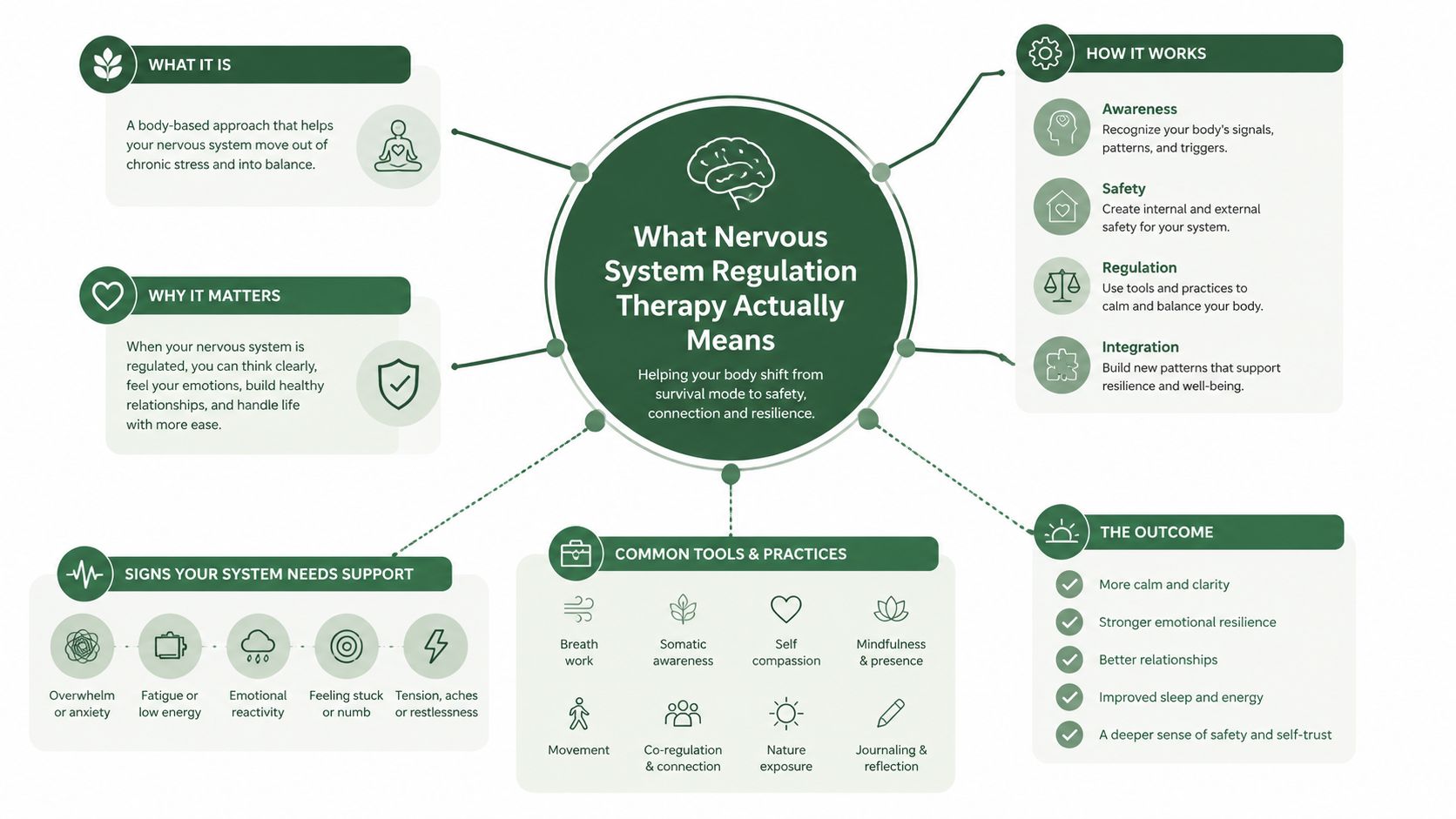
For a plain-language overview of one framework sometimes discussed in this field, see polyvagal theory explained simply. In practice, responsible therapy doesn't treat a diagram as a diagnosis. It uses your lived experience, clinical history, consent, and goals to decide which tools are appropriate.
What the Research Says About Effectiveness
The research doesn't support a single verdict that nervous system regulation therapy works equally well for everyone. Evidence varies by method, diagnosis, device, therapist training, and study design. A careful clinician should distinguish between a promising mechanism, an encouraging small trial, and a treatment with strong independent support.
Vagus nerve stimulation, or VNS, has one of the longest clinical histories in this area. A 2022 review explains that the U.S. FDA approved VNS in 1997 for medically refractory partial epilepsy and later approved it in 2005 for severe, recurrent unipolar and bipolar depression. The same review discusses heart-failure studies including ANTHEM-HF, INOVATE-HF, and NECTAR-HF, which contributed to dose-ranging hypotheses for cardiovascular outcomes. (Frontiers in Physiology)
Long-term findings are encouraging in selected clinical populations, but they shouldn't be generalized to every consumer device or therapy. In one Frontiers in Physiology study of chronic VNS, 11 of 15 patients, or 73%, showed persistent autonomic engagement after four or more years. A related review reports that the BeAT-HF trial included 140 patients and that the FDA approved baroreflex activation therapy in August 2019 for its intended-use population, while cervical VNS remained investigational for heart failure at that time. (Frontiers in Physiology)
How to interpret the evidence
Biofeedback can give you immediate information, such as changes in breathing or heart-rate patterns, while you practice responding differently. That feedback can be useful, but a favorable reading isn't proof that a person has resolved anxiety, trauma, or PTSD.
For trauma-related disorders, the evidence is more limited than online wellness language often suggests. A 2025 systematic review of randomized trials of transcutaneous vagus nerve stimulation for trauma- and stressor-related disorders found seven eligible RCTs, with six sibling publications from the same underlying data. The review judged the overall certainty of evidence very low and found possible reductions in anger and hyperarousal, but not enough evidence to support clinical use as a PTSD treatment. (Systematic review in PMC)
A separate 2026 systematic review examined 13 RCTs involving tDCS, TMS, and tVNS and found no statistically significant HRV effects for tVNS, alongside substantial protocol differences. That matters because “better HRV” is often presented as if it automatically means better mental health.
Approach | Evidence strength | Best-supported use |
|---|---|---|
Implanted VNS | Established for selected FDA-approved indications, with autonomic applications still differing by condition | Specific medical conditions under qualified care |
Baroreflex activation therapy | Regulatory acceptance exists for its intended-use population | Selected cardiovascular patients |
Biofeedback and neurofeedback | Support varies by condition, protocol, and population | Skill practice for stress-related symptoms, with individualized assessment |
Trauma-focused somatic approaches | Growing but mixed evidence | A complementary approach for body-based distress and trauma work |
taVNS for PTSD | Very low-certainty evidence in the cited review | Not established as a PTSD treatment |
For a thoughtful comparison of body-focused and verbal approaches, somatic therapy vs talk therapy can help clarify why many clients combine methods. The field is developing, but it remains younger and less standardized than established therapies such as CBT.
Core Techniques You Will Encounter
A nervous-system-focused therapist may draw from several techniques, adjusting each one to your history, preferences, and current capacity. The point isn't to perform a perfect exercise. It's to learn what your body does, what helps, and when a practice becomes too activating.
Breathwork
Breathwork uses deliberate attention to breathing. Some clients find that a gentle, longer exhale reduces urgency, while others become more anxious when they focus on the breath. A therapist won't assume one pattern fits everyone.
Try this carefully: keep your breathing comfortable, inhale without forcing, and let the exhale last slightly longer. Stop if you feel dizzy, panicky, or disconnected. The aim is not to take the deepest breath possible. It's to offer your body a manageable rhythm.
Grounding
Grounding brings attention back to the present environment. If you're dissociating or lost in a frightening memory, noticing the chair beneath you, the floor under your feet, or the colors in the room can help you orient to what is happening now.
Name a few things you can see, notice one sound, feel the texture of an object, and press your feet gently into the floor. You don't need to force yourself to feel safe. You're collecting present-time information.
Somatic tracking
Somatic tracking means observing sensations without immediately trying to eliminate them. You might notice pressure behind your eyes, warmth in your hands, tightness in your throat, or a fluttering stomach. The therapist may ask whether the sensation changes in size, temperature, movement, or intensity.
You can experiment by describing one sensation in neutral language. Say, “There's a pulsing feeling in my chest,” rather than, “Something is terribly wrong.” If attention increases distress, shift toward a neutral or comfortable sensation.
Sequencing safety before difficulty
Some clinicians use practices informed by autonomic-state frameworks to help clients establish enough steadiness before approaching painful material. That might mean looking around the room, feeling your back supported, hearing a familiar voice, or moving your arms before discussing a difficult memory.

These exercises are skills practiced collaboratively, not tests or mandatory homework. If you're curious about consumer tools connected with calming routines, achieve deep calm with Sensate offers one example to investigate, but a device shouldn't replace assessment or treatment from a qualified professional. For additional body-based ideas, see vagus nerve activation techniques, and remember that a technique's comfort and usefulness can vary widely.
What a Therapy Session Looks Like in Practice
At a first appointment, I'd expect the therapist to ask what brought you in, what symptoms concern you, and what you hope will change. They may review consent forms, medical history, medications, previous treatment, sleep, substance use, and any experiences that affect your sense of safety. This information helps determine whether body-based work is suitable immediately or whether stabilization comes first.
A session might begin with a short check-in. You could be asked, “What do you notice in your body as you sit here?” You don't need a detailed answer. “My shoulders are high,” “I feel blank,” or “I can't feel much” are all clinically useful observations.
One possible appointment includes brief psychoeducation, a guided practice, and reflection. The therapist might spend 10 minutes explaining an exercise, 20 minutes guiding breathwork or sensation tracking, and 15 minutes helping you connect the experience with your goals. Those time blocks are an example of how a session may be organized, not a universal schedule.
Responses can look very different
Some clients notice tingling, warmth, yawning, trembling, tears, or fatigue. Others feel almost nothing at first. A strong response doesn't prove that deep healing occurred, and a quiet response doesn't mean therapy failed.
Consent matters: you should be able to pause, change the exercise, open your eyes, move, talk, or stop.
A trauma-informed therapist uses titration, approaching difficult material in manageable amounts rather than flooding you with the entire story. They may move between a challenging sensation and a neutral resource, such as the support of the chair or a view through the window. If you want a practical preview of early counseling logistics, first session with a therapist can help you prepare questions.
Who This Approach Helps Most
Nervous system regulation therapy can be a good fit when distress shows up strongly in the body. That may include racing thoughts paired with muscle tension, panic symptoms, sleep disruption, emotional numbness, or a pattern of becoming overwhelmed before you can use a cognitive strategy.
People with generalized anxiety or panic may appreciate learning to recognize early physical cues and respond before activation peaks. Clients with complex trauma or PTSD may benefit from carefully paced body awareness, especially when they understand their history but still experience startle responses, shutdown, or persistent bodily alarm. Burned-out professionals may use regulation skills alongside practical changes to workload, boundaries, rest, and support.
Neurodivergent clients can also find body-based work useful, particularly when sensory input, transitions, social demands, or masking contribute to overload. The therapist should adapt the environment and language rather than treating sensory differences as pathology.
When another starting point may be safer
Active dissociation, an acute crisis, untreated substance dependence, severe instability, or urgent medical symptoms may require stabilization and coordination with other providers before intensive body-focused trauma processing. Somatic work doesn't replace emergency care, medical evaluation, medication management, or treatments designed for a specific diagnosis.
Client profile | Typical fit | Primary or complementary |
|---|---|---|
Anxiety or panic | Often useful for noticing activation and practicing response flexibility | Complementary or integrated |
Complex trauma or PTSD | May help with body-based symptoms when paced carefully | Complementary to trauma-focused treatment |
Burnout and chronic stress | Useful alongside boundaries, workload changes, and recovery support | Complementary |
Neurodivergent clients | Potentially helpful when adapted to sensory and communication needs | Complementary or integrated |
Acute crisis or severe instability | Stabilization and safety planning may come first | Not usually the primary starting point |
Strong verbal processors | Can add physical awareness to insight-oriented work | Complementary |
The evidence is not equally strong for every population or technique. Somatic therapy may sit alongside CBT or EMDR rather than replace them, and a good treatment plan should reflect your goals, risks, preferences, and access to care.
Finding the Right Trauma-Informed Therapist
Start with credentials and clarity. Verify that the clinician is licensed for the services they provide, then ask about training in somatic therapy, trauma treatment, EMDR, sensorimotor psychotherapy, or related body-based methods. If they mention a particular framework, ask what it looks like in an actual session rather than relying on a label.
Use a short consultation to assess collaboration:
Ask about pacing: How does the therapist know when to approach difficult material and when to slow down?
Ask about consent: Can you pause or change an exercise without being judged?
Ask about body awareness: Does treatment include noticing sensations, movement, breathing, or posture?
Ask about stabilization: What grounding resources can you use if you leave a session activated?
Ask about coordination: How do they work with medical or psychiatric providers when needed?
You're listening for specific answers. A thoughtful therapist should be able to explain titration in ordinary language and welcome questions about boundaries. Red flags include pressure to relive trauma quickly, dismissing physical symptoms as irrelevant, promising a total “reset,” or treating discomfort as proof that a technique is working.
You may need to speak with more than one therapist before finding a comfortable fit. That isn't a failure. In a mind-body counseling practice, intake usually includes your history, current concerns, goals, consent preferences, and any relevant medical or behavioral health coordination. Ongoing check-ins should help you decide whether a practice is supportive, too intense, or not a good match.
Regulation as a Skill You Build Over Time
Regulation is a practice, not a permanent destination. Early progress may look ordinary: falling asleep with less struggle, recovering from conflict sooner, noticing clenched muscles before anxiety escalates, or recognizing the urge to shut down while you still have choices.
A single breakthrough rarely carries the whole process. Repetition, supportive relationships, and attention to body signals help skills become more available under stress. Illness, grief, caregiving, or a heavier workload can disrupt progress, but returning to a familiar practice after disruption is itself a form of growth.
The goal isn't constant calm. It's flexible capacity, the ability to meet difficult moments with more awareness, self-trust, and choice.
Be Your Best Self & Thrive Counseling, PLLC offers individualized counseling for anxiety, trauma, stress, life transitions, couples, and neurodivergent clients, using trauma-informed and mind-body practices such as breathwork, grounding, movement, and body awareness. Visit Be Your Best Self & Thrive Counseling, PLLC to explore services and request a free initial consultation about your goals and fit.