
Is Couples Counseling Effective? Evidence and Guidance
Couples counseling often produces meaningful improvements in relationship satisfaction, with 60% to 80% of distressed couples benefiting from behavioral or emotion-focused therapy, but only about half maintaining those gains at two-year follow-up. Effectiveness varies by couple, treatment fit, therapist competence, engagement, safety, and whether new patterns get practiced after sessions end.
That gap between early improvement and lasting change is the part most couples don't hear about. A therapy can help in the room and still fade at home if the old cycle returns under stress. Judging results well means looking at three levels at once, immediate relief, durable behavior change, and whether counseling is safe and accessible for your particular relationship.
What Couples Counseling Research Actually Shows
The short answer to is couples counseling effective is a qualified yes. Counseling often improves relationship satisfaction, communication, and emotional intimacy, but researchers report group averages, not a guarantee for any one couple. Two partners can sit through the same method and leave with very different results.
The clearest comparison comes from a meta-analysis of 58 studies covering 40 unique samples and 2,092 couples, which found a large pre-to-post improvement in relationship satisfaction of Hedges' g = 1.12, while waitlist groups improved only slightly and nonsignificantly at g = 0.12. That contrast matters because waitlisted couples show what tends to happen with time alone. Treated couples, on average, changed far more, and benefits also appeared in communication, emotional intimacy, and partner behavior in that same analysis.
How to Interpret Couples Counseling Research
Finding | What It Means |
|---|---|
Large average effect | Many couples notice real change, not just a statistical blip |
Waitlist barely moves | Improvement is unlikely to be explained by time passing alone |
Behavior changes too | Counseling targets how partners act, not only how they report feeling |
Averages hide spread | Some couples recover, some improve partly, some don't change |
A large average effect still leaves room for disappointment. If one partner attends under pressure, if sessions focus on venting without new skills, or if safety problems go unaddressed, outcomes can stall. That's why careful readers separate evidence from intuition in other areas too, much like exploring the science and psychology behind tarot to distinguish a compelling experience from a tested claim.
Effective counseling should change what happens during your next disagreement, not just how hopeful you feel leaving the office.
Use concrete markers from the start. Note whether arguments escalate less quickly, whether each person can listen without immediate defense, and whether repair happens sooner after a rupture. Those observable shifts tell you more than a single good session.
Understanding What Couples Counseling Can Change
Most couples don't fight only about dishes, money, or a missed text. Underneath sits a repeated sequence. One partner presses for an answer, the other goes quiet, the pressing gets sharper, and the quiet partner leaves the room. Counseling helps you see that sequence while it's happening and practice a different move.
Caption: A young couple sitting on a couch attending a counseling session with a therapist.
What a Productive Session Targets
A therapist might slow down a live exchange, name the pursue and withdraw pattern, and coach each person to state an underlying need in plain language. Another session might build a specific repair routine, pausing before voices rise, naming what each person heard, and returning at an agreed time. The work is practical, even when emotions run high.
Targets commonly include:
Communication habits: Interrupting, criticism, dismissal, and mind reading get replaced with clearer requests
Emotional accessibility: Partners learn to signal need and respond without shutting down
Attachment wounds: Old injuries, such as feeling abandoned during a crisis, get addressed directly
Behavior change: Agreed actions at home, from check-ins to fairer task sharing, reinforce session work
Context matters too. Stress from work, anxiety, depression, trauma, chronic illness, and neurodivergent communication differences can all shape how a couple argues and reconnects. A responsible therapist asks about those pressures instead of treating every problem as a skills deficit.
Counseling isn't an automatic repair mechanism, and it isn't always joint work. Sometimes one partner needs individual support first, and sometimes the honest outcome is clarity about separating respectfully. What counseling can promise is a structured setting to interrupt a harmful cycle. It can't promise that both people will want the same future.
Comparing the Main Couples Therapy Approaches
Method names fill therapist websites, but a label tells you less than you'd expect. In a 2019 meta-analysis of 33 studies and 2,730 participants, couples receiving Behavioral Couple Therapy or Emotionally Focused Couples Therapy showed a medium-sized average improvement immediately after treatment of g = 0.60, with Emotionally Focused Couples Therapy at g = 0.73 versus g = 0.53 for Behavioral Couple Therapy, a difference that wasn't statistically significant. Neither brand won outright.
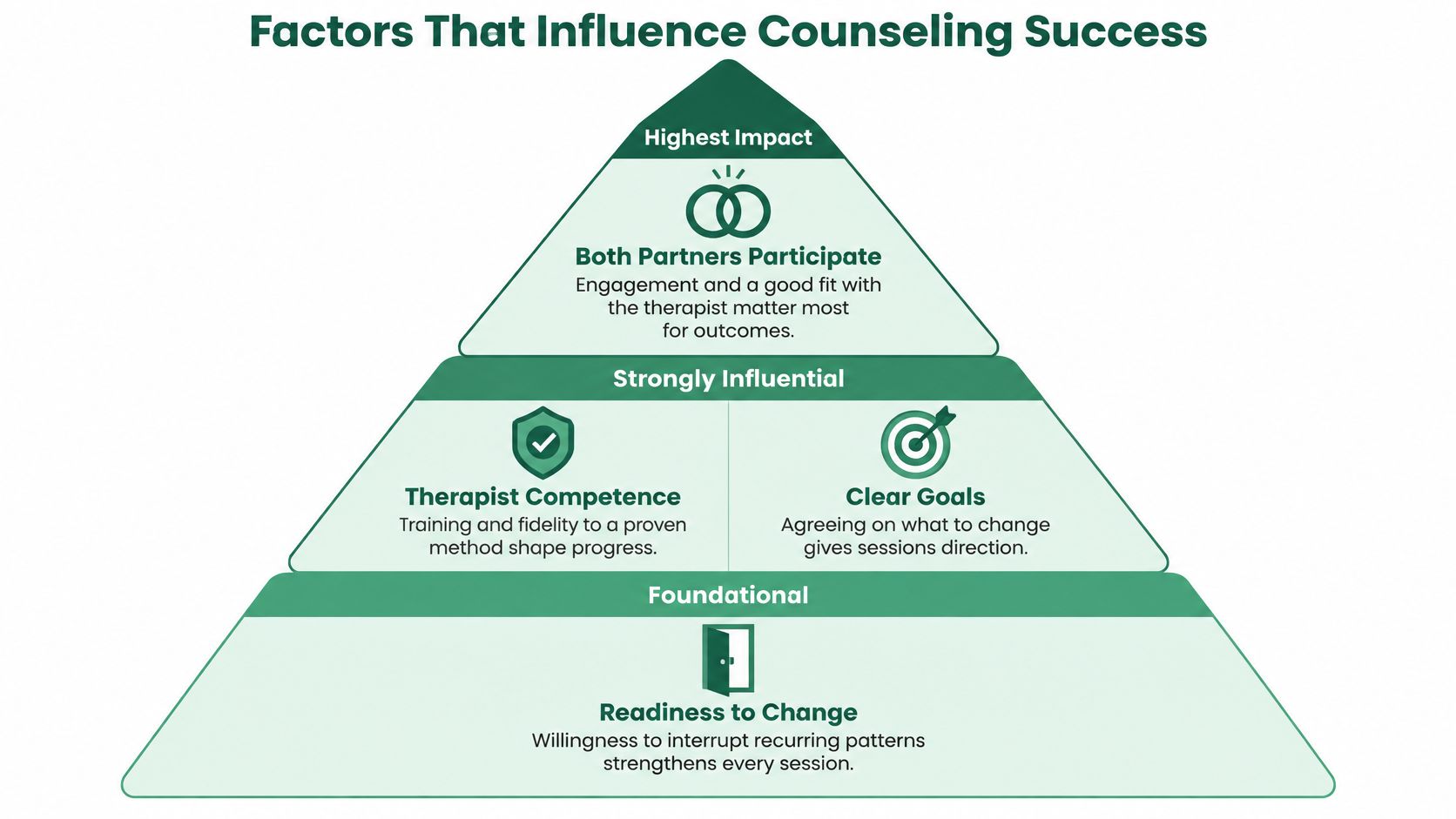
Caption: A pyramid diagram showing the key factors that influence the success of couples counseling sessions, from readiness to change at the base to both partners participating at the top.
Couples Therapy Approaches at a Glance
Approach | Primary Focus | Possible Fit | Key Caveat |
|---|---|---|---|
Behavioral Couple Therapy | Observable interactions, behavior exchange | Couples wanting concrete skills | Can feel mechanical if emotions stay unaddressed |
Emotionally Focused Therapy | Attachment, emotional accessibility | Disconnection, pursue and withdraw cycles | Requires willingness to explore vulnerable feelings |
Gottman Method | Assessment, friendship, conflict habits | Couples who like structure and exercises | A recognizable name doesn't prove superior results |
Integrative Behavioral | Acceptance plus behavior change | Stuck differences that won't fully resolve | Quality depends heavily on therapist judgment |
CBT-Informed | Beliefs, emotions, behavior links | Distorted assumptions fueling conflict | May underweight attachment needs |
Couples curious about attachment-based work can read more on attachment-based couples therapy and how it addresses bonding patterns. Some therapists also borrow brief, goal-oriented tools, so understanding how solution focused therapy works can help you ask sharper questions about session structure.
Treat the Gottman Method as one structured, research-informed option rather than proof of superiority by branding alone. Ask any therapist how their approach fits your specific problem, an affair, chronic criticism, emotional distance, and how they'll know if it's working. A clear, specific answer beats a trademark every time.
Factors That Influence Counseling Success
Two couples can hire competent therapists and still diverge. The difference usually lies in conditions around the work, not effort in some simple moral sense. A systematic evaluation of 40 studies found that several major couple-therapy models produced significantly greater reductions in relationship distress than comparison conditions after treatment, but no model met the review's strongest evidence standard because of small samples and limited independent replication. Modest evidence across models puts more weight on fit and delivery.
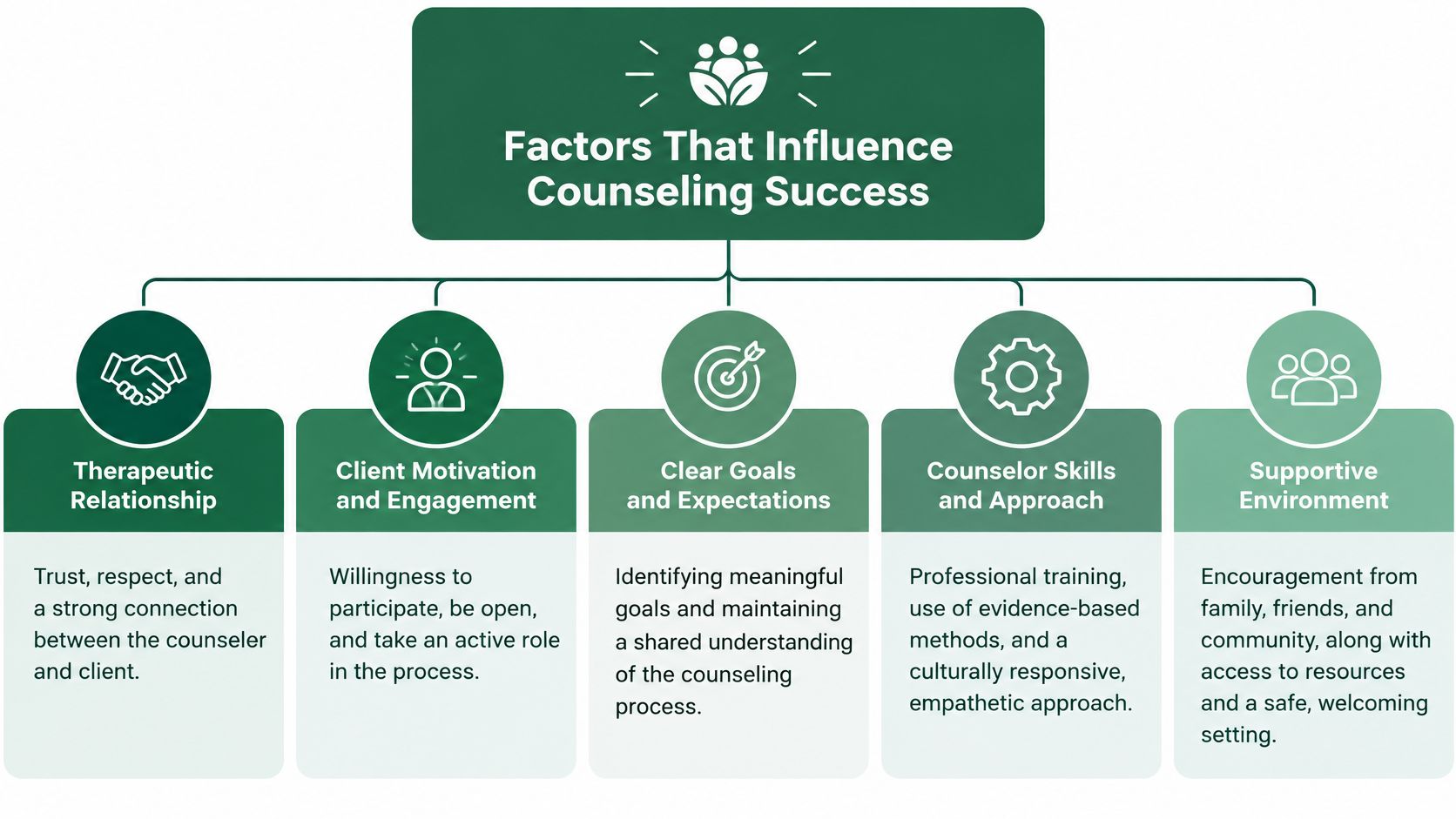
Caption: A diagram outlining five key factors that contribute to successful counseling outcomes, including relationships and environment.
Conditions That Strengthen or Limit Progress
Both partners participate: Joint work struggles when one person attends only to prove they tried
Therapist competence: Training in couples work specifically, not only individual therapy, shapes pacing and safety
Clear goals: Agreeing on targets early helps, and setting explicit couples counseling goals gives you a way to measure drift
Practice between sessions: Skills rehearsed only weekly rarely survive a stressful Tuesday night
Severity and co-occurring problems: Untreated depression, substance misuse, or serious illness can limit what joint sessions alone can do
Early discomfort doesn't automatically signal failure. Patterns often become more visible once a therapist names them, and visibility can feel worse before behavior changes. Watch instead for whether sessions stay focused, whether both voices get heard, and whether homework feels doable.
Safety boundary: Fear, coercive control, or intimate-partner violence calls for specialized assessment and safety planning, not standard communication exercises where honest disclosure could bring retaliation at home.
That distinction protects people. If one partner monitors, threatens, or frightens the other, joint counseling may be inappropriate until safety is established through individual and specialized support.
Realistic Examples of Couples Counseling Outcomes
Composite scenarios, not real clients, show why outcomes vary so much. Each couple below could receive the same general approach and still experience counseling differently.
The practicing couple. Two partners argue nightly about household labor. They attend consistently, agree on a fairer division, and rehearse a pause-and-return routine during disagreements. Progress for them doesn't mean zero conflict. It means shorter arguments, quicker repair, and requests made before resentment builds.
The constrained couple. Another pair wants help but faces rotating shifts, financial strain, and different communication needs linked to neurodivergence. Sessions get cancelled, practice slips, and written summaries or shorter check-ins would suit them better than standard verbal processing. Their slower progress reflects access and fit, not a lack of care for each other.
When the Situation Changes the Treatment
Affair recovery. One partner wants detailed answers, the other wants to move on quickly. Research summarized by the American Psychological Association indicated that approximately two-thirds of couples affected by infidelity improve during couples therapy, while at least one-third meet criteria for recovery, and in a randomized clinical trial roughly 50% were improved or recovered at five-year follow-up regardless of whether infidelity was present. Hope is reasonable here, a guaranteed rebuild isn't.
The safety scenario. A partner who feels afraid to disagree doesn't need better phrasing. That couple needs individual assessment first, and possibly a decision that joint work shouldn't proceed.
If you're unsure which pattern resembles yours, reviewing signs that therapy is working can help you separate genuine movement from temporary calm. Sometimes meaningful progress is renewed closeness. Sometimes it's a clearer, healthier decision to separate.
Setting a Realistic Couples Counseling Timeline
There's no guaranteed session count, and any therapist promising a fixed recovery date is overselling. What you can expect is a sequence of phases, each with its own job. Knowing the phase you're in prevents premature conclusions.
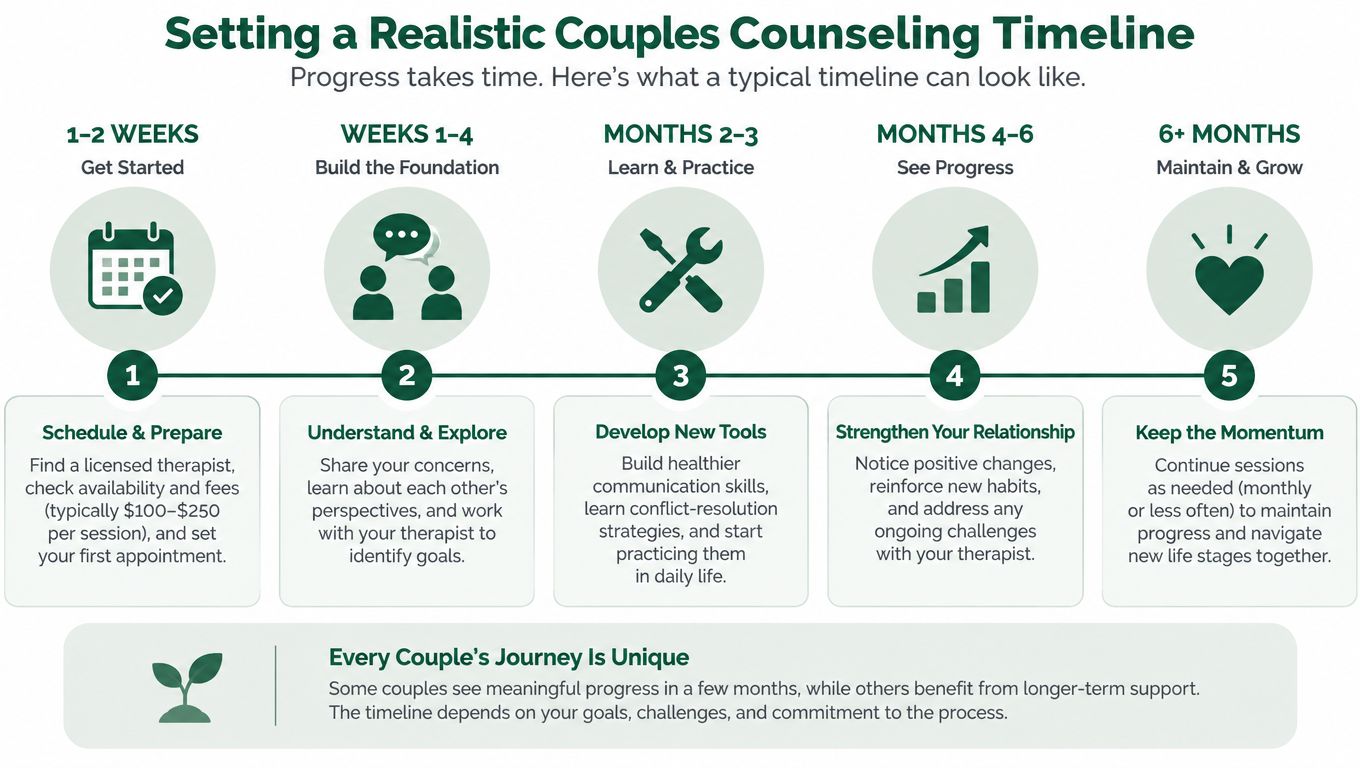
Caption: A timeline graphic illustrating the typical steps and phases involved in a successful couples counseling process.
Phases and Checkpoints
Assessment comes first: The therapist learns your history, goals, safety context, and recurring interaction patterns
Active practice follows: You test new responses in session, then repeat them at home between appointments
Maintenance closes the work: You plan for setbacks, identify early warning signs, and decide when to return
Average gains after treatment can hold for a while and then weaken, which is why maintenance isn't an afterthought. Couples who keep practicing repair skills during calm weeks handle stressful weeks better than couples who treat graduation from therapy as a finish line. If you're weighing expectations, guidance on how long therapy takes to work can help you frame patience without drifting indefinitely.
Use checkpoints you can observe at home:
Escalation: Do disagreements peak lower and end sooner than they used to
Listening: Can each partner summarize the other's view before responding
Repair: Does someone attempt reconnection, and does it land
Follow-through: Do agreed behaviors happen without the therapist present
Revisit the plan openly if several checkpoints stall or safety concerns emerge. Changing approach, adding individual support, or switching therapists is a clinical decision, not a personal failure.
How to Choose the Right Couples Therapist
Credentials on a profile page don't all mean the same thing. Licensure confirms legal qualification to practice. Couples-specific training shows preparation for two-person dynamics. Competence with your actual concern, affair recovery, trauma, neurodivergence, is a third question entirely. Ask about all three separately.
A broader evidence review estimated that 60% to 80% of distressed couples benefit from behavioral or emotion-focused therapy, while about half maintain treatment gains at two-year follow-up. With maintenance that uncertain, choose someone who talks about follow-up and measurement from the first call, and review what good therapy fit actually looks like before you commit.
Questions Worth Asking on a Consultation Call
Training and population: What couples training have you completed, and which presenting problems do you treat most
Safety screening: How do you assess for coercion, fear, or violence before starting joint work
Format and logistics: What's your cancellation policy, session length, and view on telehealth limits for couples
Accessibility: Can you offer written summaries, sensory accommodations, or scheduling flexibility
Cost options: Do you offer sliding-scale fees or lower-intensity formats when weekly sessions aren't affordable
Match questions to your situation. After an affair, ask how the therapist handles disclosure and rebuilding trust. For neurodivergent couples, ask how sessions adapt to different processing speeds and communication styles. For culturally responsive care, ask how the therapist works with values, faith, or family structures that differ from their own.
Cost and uncertainty about where to get help stop many couples who considered therapy, so practical access is part of effectiveness, not a side issue. Compare two candidates when you can. A strong therapist explains fit, goals, limits, and how progress will be tracked without leaning on a famous method name. Vague reassurance during a consultation usually predicts vague sessions later.
Making an Informed Decision About Counseling
Weigh the evidence at the three levels that opened this discussion. Immediate improvement is well supported on average. Durable change is less certain and depends on continued practice. Accessibility and safety decide whether a method that works in studies can work in your actual life.
Success also has more shapes than staying together happily. It can look like less destructive conflict, safer communication, restored trust after a betrayal, or steady co-parenting during a separation. For some couples, counseling's most honest contribution is clarity. Two people may discover, with support, that their goals no longer align, and ending the relationship carefully is healthier than repeating the same injuries.
An Honest Picture Includes Poor Outcomes
Some couples don't change, and some deteriorate. That reality shouldn't scare you away from help, but it should change how you monitor it. If sessions consistently leave one partner unheard, if homework never happens because it doesn't fit your lives, or if conflict at home grows more intense without a plan to address it, reassess fit rather than trying harder.
The right question isn't whether counseling works in general. It's whether this therapist, this approach, and this level of engagement are producing change you can observe.
Start with a consultation where you can describe your pattern, ask about safety screening and specialist experience, and hear how progress would be measured. Bring one specific recent argument as an example, since concrete detail reveals more than general labels like communication problems. Notice whether both of you feel respected and whether the therapist can explain a plausible path forward, including its limits.
Couples counseling is generally effective for many distressed couples, particularly when it's delivered competently, matched to the presenting problem, and connected to practice between sessions. It isn't universally effective, and no branded approach earns blind trust. Decide based on evidence, fit, and the changes you can track together over time.
If you're weighing whether couples work fits your relationship, Be Your Best Self & Thrive Counseling, PLLC offers couples and marriage counseling in St. Petersburg, Florida, including support for communication, conflict, trust, and affair recovery. Book a free initial consultation to discuss your goals, ask about therapist fit and safety screening, and decide together whether couples counseling is the right next step.