
8 Couples Counseling Goals for Stronger Relationships
You care about each other, but the same argument keeps returning. One partner asks for more help, reassurance, or closeness, while the other feels criticized and pulls away. A conversation about money, household tasks, sex, or parenting quickly becomes a debate about character, commitment, or whether the relationship is safe.
Couples counseling goals turn broad hopes such as “communicate better” into observable practices, shared agreements, and progress markers. The right starting point depends on the pattern causing the most distress. Some couples need communication skills first. Others need affair recovery, help with emotional distance, support through a major transition, or strategies that respect neurodivergent differences.
Couples counseling can be useful, but safety comes first. If betrayal, trauma, intimidation, or coercion is present, work with a qualified professional who can assess whether joint counseling is appropriate and adapt the process to protect both partners.
Key insight: Progress doesn't mean never struggling. It means creating safer ways to notice the pattern, respond differently, and return to each other.

Caption: A couple practices attentive listening during a calm relationship conversation.
1. Improved Communication And Active Listening
Communication improves when both partners can express an experience without turning it into an accusation, and listen without preparing a rebuttal. A therapist may help you identify habits that block understanding, such as interrupting, mind-reading, sarcasm, defensiveness, or bringing several old grievances into one conversation.
Active listening isn't passive agreement. It means trying to understand the meaning and emotion behind your partner's words before explaining your own position. A reflective response might sound like, “What I hear you saying is that you felt alone when I made that decision without asking you.” You can still disagree with the conclusion while showing that you understood the experience.
Turn vague hopes into repeatable practices
Start with low-stakes topics. Ask each other a simple question, let one person speak without interruption, and have the listener summarize before responding. A weekly check-in can give important conversations a predictable place instead of forcing them into the middle of a rushed morning or heated disagreement.
Helpful practices include:
Use experience-based language: Replace “You always ignore me” with “I feel dismissed when I'm speaking and you look at your phone.”
Set a discussion time: Choose a moment when both partners are rested enough to stay engaged.
Create a pause signal: Agree on a hand signal or phrase that means, “I'm overwhelmed, and I want to return to this safely.”
Try writing first: A brief note or letter can slow the exchange when speaking feels too intense.
Track real-life changes: Notice whether conversations outside therapy become clearer, shorter, or less defensive.
For additional structured practice, explore these couples counseling exercises, and consider resources on how to connect as a couple.
2. Rebuilding Trust After Infidelity Or Betrayal
Betrayal changes the emotional terrain of a relationship. The injured partner may feel shocked, angry, preoccupied, or unsure which memories and promises can still be trusted. The partner who broke the agreement may feel shame, fear, or urgency to move on before the injured partner feels ready.
Trust repair requires more than an apology. Couples may need to establish transparent agreements, answer difficult questions carefully, acknowledge the impact of the betrayal, and demonstrate reliable behavior over time. Counseling can also help partners determine whether both people want reconciliation, rather than assuming that staying together is automatically the right outcome.
A therapist trained in affair recovery and trauma-informed care can help pace the work. Individual counseling may also give either partner a private setting to process grief, shame, anger, or trauma responses without placing every emotional need inside the joint session.
Make safety visible
Concrete agreements often matter more than reassuring statements. Depending on the circumstances, a couple might discuss communication boundaries, financial transparency, contact with the outside person, access to relevant information, and what each partner needs when triggers arise. These agreements should be mutual, specific, and reviewed as trust changes.
The process may also include gradual intimacy rebuilding. Partners might begin with nonsexual touch, shared routines, or short check-ins before expecting emotional or sexual closeness to return. The injured partner needs room to set a pace that feels safe, while the other partner needs to show accountability without demanding quick forgiveness.
Learn more about couples counseling after infidelity when betrayal is central to the relationship's distress.
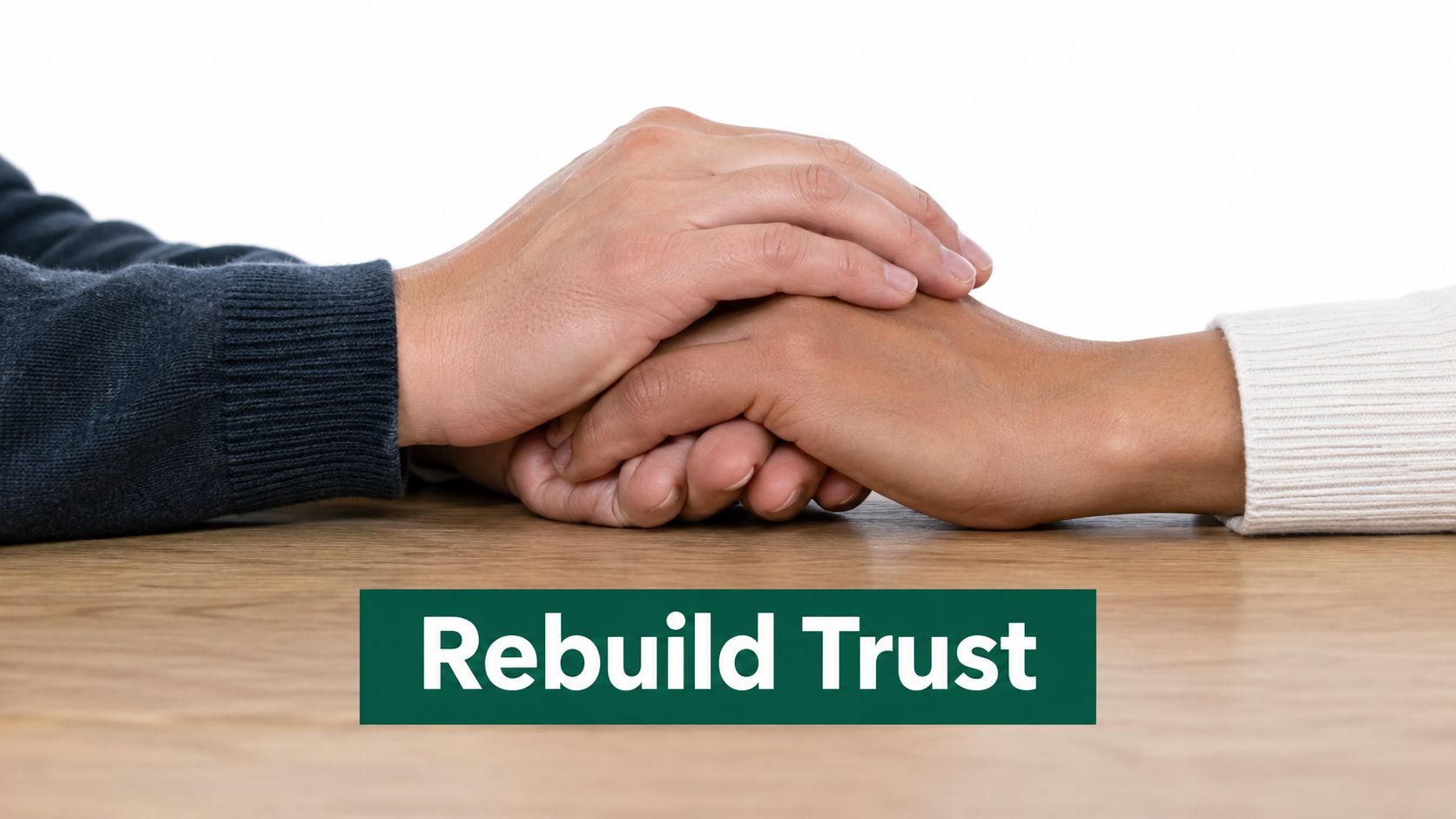
Caption: Supportive touch can represent care while partners work toward emotional safety.
3. Managing Conflict And Reducing Criticism
A request about school pickups can quickly become an argument about selfishness, reliability, or respect. Couples counseling helps partners notice that shift and interrupt the familiar cycle before harsh words make repair more difficult.
Disagreement itself is manageable. Personal attacks, threats, humiliation, and withdrawal turn a practical problem into a relationship injury. Keep the conversation focused on the shared issue: “We need a fairer plan for school pickups” creates room for cooperation, while “You're selfish” challenges character and invites defense. Ask, “What am I hoping my partner will understand?” The answer may involve consideration, consistency, respect, or reassurance.
A pause can protect the relationship when both partners know how it works. Agree on a signal, separate long enough to settle your body, and name a return time. Walking, slow breathing, or sitting can help you listen again. A pause without a return can feel like abandonment, so the follow-up matters.
Use this sequence when the discussion resumes: Name the issue, Describe the impact, Listen back, Find the underlying need, and Choose one next step. For example, one partner describes feeling overwhelmed by unequal chores, while the other summarizes the concern before suggesting a specific change for the week. A conflict resolution framework can help couples practice this process between sessions.
Keep conflict from becoming the relationship's only point of contact. Small acknowledgments, shared humor, and ordinary kindness work like regular maintenance on a bridge. They do not erase the disagreement, but they make reconnection easier. Try naming one helpful action each day, or ask, “What would help this conversation feel safer?”
Caption: Gentle closeness can communicate connection after a difficult conversation.
4. Increasing Emotional Intimacy And Connection
A couple can share a home, calendar, and responsibilities while feeling unknown to each other. Conversations may cover appointments, errands, children, work, and household logistics, leaving little room for fears, hopes, values, memories, or current needs. The relationship functions, yet partners may feel more like coworkers than companions.
Counseling helps turn emotional intimacy into a practice of noticing and responding. One partner might say, “I'm worried I'm failing at work,” instead of mentioning only a deadline. The other can first acknowledge the feeling, then ask what kind of response would help. That brief pause keeps advice from replacing empathy.
Connection also needs protected space. Choose a time when phones are away and interruptions are limited. A morning coffee, weekly date, or short evening check-in can act like a regular appointment with the relationship. Even a few undistracted minutes can make sharing feel safer and more predictable.
Use one question at a time:
Ask about the inner experience: “What has been weighing on you lately?”
Clarify the kind of support needed: “Would comfort, help thinking it through, or quiet company feel best?”
Share personal history: Discuss childhood experiences that shaped responses to conflict or closeness.
Offer specific appreciation: “I noticed you checked in before deciding. I felt included.”
Create a small ritual: Repeated moments often build more connection than occasional grand plans.
Try this exercise after a check-in: each partner names one feeling, one need, and one way the other can respond. Listen for understanding before solving. If either person becomes overwhelmed, agree on when to resume rather than letting the conversation disappear.
Physical affection can strengthen closeness when both partners feel comfortable. Eye contact, sitting near each other, holding hands, or taking a quiet walk may communicate care. Affection should not bypass unresolved hurt or pressure anyone into intimacy.
Caption: Shared planning can help partners protect time for connection and future-focused conversations.
5. Developing Secure Attachment Patterns
Partners often bring earlier relationship experiences into present-day closeness. One person may seek frequent reassurance when connection feels uncertain. Another may need distance to feel calm and become quiet during emotional conversations. Neither response automatically makes someone the problem, but the combination can create a painful pursue-and-withdraw pattern.
Counseling can help partners identify these reactions without reducing either person to a label. The anxious partner may practice self-soothing and make a clear request instead of escalating. The withdrawing partner may practice staying present, naming the need for a pause, and returning rather than disappearing. Both partners learn to treat the cycle as the problem they share.
Adapt support to the actual relationship
Attachment-focused work can be especially relevant for neurodivergent couples. ADHD, autism, and high sensitivity may affect attention, sensory comfort, emotional expression, transitions, and recovery after conflict. A couple may need concrete agreements about reminders, processing time, touch, direct language, or how to reconnect after overwhelm.
For example, an ADHD partner might use a shared calendar and verbal confirmation for commitments, while an autistic partner might request advance notice before a difficult conversation. These strategies aren't evidence of lesser care. They can translate care into forms each partner can reliably recognize.
Discussing each person's attachment history can also build compassion. Ask, “What did you learn about getting support?” and “What happens inside you when I need space?” Then practice a small alternative to the usual reaction. An anxious partner might wait briefly before sending repeated messages. An avoidant partner might send a clear reassurance and name a return time. Small, consistent changes build a more dependable bond.
Learn about attachment-based therapy when recurring closeness and distance patterns remain difficult to change.
6. Navigating Life Transitions And Shared Goals
A shared future can change shape quickly. Moving in together, marriage, parenthood, a career shift, a health crisis, or retirement may reshape time, money, identity, responsibilities, and expectations. Partners can remain committed while holding very different pictures of ordinary life.
Counseling helps couples address the practical plan and the feelings underneath it. A couple preparing for a child might examine parenting values, household labor, work, rest, family involvement, and ways to protect couple time. Someone returning to school may need to renegotiate finances and chores. A business owner may need clear limits so work stress does not fill every conversation.
Begin with a short exercise: each partner writes what the next stage should preserve. Security, independence, family connection, creativity, health, and adventure may all matter, though their order may differ. Comparing the lists reveals where the discussion begins.
Use the conversation as a roadmap:
Name one decision: Keep a major choice separate from older grievances.
Compare priorities: Include emotional needs, practical concerns, and fears.
State required conditions: Identify what cannot be casually changed.
Test an arrangement: Try a task division, budget, or schedule before treating it as permanent.
Set a review point: Revisit the plan once daily life shows what planning overlooked.
A written relationship vision can keep the conversation visible. It should work like a map, offering direction while allowing the route to change. Ask, “What would make this plan feel fair?” and “Which pressure might make us abandon it?” Shared goals then become a way to choose together, rather than letting habit, stress, or silence decide.
7. Building Healthy Sexuality And Physical Intimacy
Sexual intimacy is one part of a wider physical relationship that includes affection, comfort, desire, boundaries, and pleasure. Couples may struggle with different levels of desire, performance anxiety, past trauma, health conditions, stress, parenting demands, or emotional distance. Avoiding the subject often adds shame and misunderstanding.
A supportive therapist can help partners discuss sexuality without treating one person's desire as more valid than the other's. The conversation may include what helps each person feel safe, what creates pressure, how affection is interpreted, and which expectations need to be adjusted. Consent and comfort remain central throughout the process.
Rebuild closeness at a tolerable pace
When sexual connection has become tense, beginning with nonsexual touch may be more useful than demanding immediate sexual repair. Partners could agree to hold hands, exchange a brief hug, give a shoulder massage, or sit close without assuming that affection must lead to sex. This separates warmth from obligation.
Discuss preferences and boundaries outside the bedroom, when neither person feels exposed in the moment. A couple might talk about how stress affects desire, whether they need more emotional connection before physical intimacy, or how to create privacy. Planning intimacy isn't unromantic if it protects attention and reduces the likelihood that exhaustion will decide everything.
Trauma, depression, anxiety, medication, and medical concerns can affect sexuality. A trauma-informed or specialized clinician can help partners move carefully, particularly when touch or sexual experiences bring up fear or painful memories. The aim isn't to meet a universal standard. It's to create a physical relationship that is mutual, respectful, communicative, and comfortable for both people.
8. Cultivating Resilience And Supporting Each Other Through Stress
After a job loss, illness, parenting strain, grief, anxiety, depression, or burnout, partners may react to pressure in opposite ways. One becomes quiet and task-focused; the other seeks conversation and reassurance. Both need care, yet stress may leave neither person with much energy to offer it.
Resilience means staying connected while recognizing real limits. Start by naming the kind of help needed today: listening, practical assistance, comfort, or space. A partner might say, “I need you to listen for a few minutes,” or “Help me choose the next step.” The listener can ask, “Would comfort or problem-solving help more right now?”
A simple pressure plan can keep stress from directing the relationship. Write down urgent responsibilities, decide who will handle each one, and identify tasks that can wait. This prevents one person from becoming the household project manager. Revisit the plan as circumstances change.
Small acts also protect connection. Share a meal, take a short walk, exchange a hug, or notice a task the other person completed. These rituals work like handrails on a steep path. They do not remove the pressure, but they offer repeated points of contact.
Each partner also needs individual recovery time. Exercise, rest, time in nature, meditation, or another meaningful practice can restore capacity. Supporting someone does not mean becoming their only source of care. A therapist, doctor, financial advisor, or other qualified professional may be appropriate when stress affects health, communication, or daily functioning. Couples can also explore therapy for emotional resilience when pressure makes connection difficult.
Ask together: What signs show that either of us is overloaded? What can we pause, share, or delegate? Answering those questions before a crisis gives the relationship a usable plan rather than another problem to solve in the moment.
8-Point Comparison of Couples Counseling Goals
Goal | Implementation complexity | Resource requirements | Expected outcomes | Ideal use cases | Key advantages |
|---|---|---|---|---|---|
Improved Communication And Active Listening | Low–Medium, skill training + practice | Regular couples sessions; homework practice | Clearer dialogue, fewer misunderstandings, increased intimacy | Everyday conflicts; general relationship maintenance | Broadly applicable; quick observable improvements; transferable skills |
Rebuilding Trust After Infidelity Or Betrayal | High, trauma-informed, layered process | Specialized affair-recovery therapist; long-term work; individual support | Processed betrayal, restored transparency or informed decision to separate | Affair recovery; major breaches of trust | Structured accountability; addresses trauma; potential for deeper authenticity |
Managing Conflict And Reducing Criticism | Medium, pattern recognition and skill-building | Therapist trained in conflict frameworks (e.g., Gottman); practice of regulation skills | Fewer destructive fights, improved problem-solving, reduced criticism | Recurring arguments, criticism/defensiveness cycles | Prevents escalation; improves stability and mutual respect |
Increasing Emotional Intimacy And Connection | Medium–High, requires vulnerability and time | Consistent therapy; commitment to vulnerability and rituals | Deeper emotional connection, renewed satisfaction and attraction | Feeling like roommates; emotional distance; low closeness | Enhances long-term satisfaction; often restores physical intimacy |
Developing Secure Attachment Patterns | High, addresses deep, developmental patterns | Attachment-informed therapist; possible individual trauma work; time | Greater felt security, reduced reactive cycles, better regulation | Persistent reactivity; attachment-driven conflicts; neurodivergent couples | Targets root causes; yields lasting relational change; improves regulation |
Navigating Life Transitions And Shared Goals | Medium, planning plus emotional alignment | Sessions for values/goals work; practical planning tools; occasional external advisors | Aligned goals, smoother transitions, reduced surprises and conflict | Moving, marriage, parenting, career changes, retirement | Prevents future conflicts; builds shared vision and practical plans |
Building Healthy Sexuality And Physical Intimacy | Medium–High, sensitive, may need trauma care | Sex-positive or sex therapist; trauma-informed approach when needed; time | Improved sexual communication, increased satisfaction, less shame | Desire mismatch, sexual trauma effects, declining physical intimacy | Normalizes differences; teaches practical intimacy skills; improves connection |
Cultivating Resilience And Supporting Each Other Through Stress | Medium, skill and regulation development | Therapy for coping strategies; individual regulation practices; ongoing support | Better mutual support, improved stress management, sustained relationship under pressure | Chronic stress, health crises, caregiving, burnout | Strengthens partnership under strain; prevents stress-driven conflicts |
Turning Counseling Goals Into Daily Progress
You don't need to work on all eight goals at once. Start with the pattern creating the most distress and choose one or two goals that could make daily life safer and more workable. If arguments escalate quickly, conflict management and communication may come first. If you feel like roommates, emotional intimacy may be the better entry point. If betrayal, trauma, sexual concerns, or neurodivergent relationship dynamics shape the difficulty, seek a therapist with relevant training rather than relying on a general approach.
A useful goal describes what you will do, not only what you hope to feel. “Be closer” can become “schedule one undistracted connection period each week.” “Stop fighting” can become “use an agreed pause before yelling and return to the topic after both partners have calmed down.” “Rebuild trust” can become “follow a mutually agreed transparency plan and discuss triggers during scheduled check-ins.” These behaviors give you something to practice and something to review.
Bring your priorities to the initial consultation. Tell the therapist what happens before, during, and after the recurring pattern. Explain what you've already tried, what feels unsafe, and what each partner wants from counseling. A good fit includes clinical competence, respect for both perspectives, cultural responsiveness, and the ability to work with the specific concerns affecting your relationship.
Be Your Best Self & Thrive Counseling, PLLC offers couples and marriage counseling, including support for communication difficulties, conflict, relationship ruptures, life transitions, and neurodivergent relationship needs. Its free initial consultation can help you explore fit and clarify which goals deserve attention first. You can also ask how the therapist tracks progress, handles pauses or individual support, and adapts the work when circumstances change.
Research supports using measurable outcomes rather than vague promises. A 2022 review of couples therapy evidence reported that behavioral and emotion-focused approaches help about 60% to 80% of distressed couples, with roughly half maintaining gains at 2-year follow-up, and found large pre-post gains in relationship satisfaction, reported as Hedges g approximately 1.12. The figures don't predict what will happen in your relationship, but they illustrate why satisfaction, communication, and maintenance of gains can be useful areas to discuss with a clinician.
A broader 2022 review summarized in PMC found that, on average, a person receiving couple therapy was better off at termination than 70% to 80% of people who didn't receive treatment. The same review also noted that available controlled follow-up evidence showed roughly 35% to 50% of couples experienced deterioration or divorce within 4 to 5 years after treatment. That tension matters. Counseling can help, but durable change requires continued practice, honest reassessment, and attention to the conditions that affect safety and commitment.
Digital support can also be structured and measurable. In a randomized trial of a web-based couple intervention, satisfaction improved with a medium-to-large effect, reported as Cohen's d = 0.69. Among completers, 94% reported being mostly or very satisfied, and 97% said they would recommend the intervention, according to the published trial report. Delivery format matters less than whether the process fits your needs, protects safety, and gives both partners meaningful ways to participate.
The history of the field reflects this movement toward structured help. Marriage and couples counseling became a formal helping profession in the 1920s in Germany and expanded into the United States in the 1930s, when the first marriage-counseling institutes were established, as described in this historical overview. Today, the strongest practical goals remain familiar, improving communication, reducing destructive conflict, repairing trust, increasing intimacy, and building resilience, but effective work translates them into observable actions.
Final insight: You don't have to practice perfectly to make progress. Repeated, safe, honest attempts can gradually change the pattern you and your partner have been living inside.
If you're ready to identify your first goal, write down one recurring moment that leaves you feeling disconnected and one behavior that would make the next occurrence safer. Bring those notes to a qualified couples counselor, and treat each small repair as evidence that change can be practiced.
Be Your Best Self & Thrive Counseling, PLLC offers compassionate couples and marriage counseling for communication concerns, conflict, affair recovery, life transitions, and neurodivergent relationship dynamics. Visit Be Your Best Self & Thrive Counseling, PLLC to learn more and use the free initial consultation to explore fit and counseling goals.