
8 Couples Counseling Exercises for Deeper Connection
You care about each other, but conversations keep ending in the same place. One partner criticizes, the other withdraws. A question about chores becomes a dispute about respect. Work stress turns into anxious reassurance-seeking, while intimacy starts to feel like another obligation instead of a source of closeness.
Couples counseling exercises can create enough structure to interrupt that pattern. They help partners slow down, identify the cycle beneath the argument, express needs more clearly, and practice safer responses instead of relying on insight alone. A major 2020 meta-analysis found that couple therapy produced a large improvement in relationship satisfaction, with a pre-to-post effect size of Hedges' g = 1.12, while couples on waitlists showed no meaningful change, g = 0.12 (PubMed review of couple therapy outcomes). The same review reported gains in communication, emotional intimacy, and partner behavior.
Some practices below are appropriate for supported home use when both partners feel emotionally safe. Others, especially trauma processing, betrayal repair, severe sexual distress, or high-conflict work, are better introduced by a trained couples therapist. Active abuse, coercive control, a severe power imbalance, or overwhelming trauma responses require individualized assessment, not unsupervised joint exercises.
The article uses short subsections, practical sequences, blockquotes, and image captions. It doesn't use HTML tables, and each practice focuses on a different relational task.
1. The Gottman Method Four Horsemen Assessment and Antidotes
The Gottman Method gives couples a concrete way to recognize four destructive interaction patterns: criticism, contempt, defensiveness, and stonewalling. These patterns matter because they turn a specific complaint into an attack on character, communicate disgust, shift blame, or end contact altogether. The exercise isn't about labeling your partner as a problem. It's about identifying the move each person makes when conflict becomes threatening.
Start by reviewing a recent disagreement and writing down the first observable behavior. “You never help around here” points toward criticism. Eye-rolling or mocking suggests contempt. “I wouldn't have to do this if you communicated properly” shows defensiveness. Silence, leaving without an agreed pause, or refusing to return to the conversation may indicate stonewalling.
Replace the pattern with a specific antidote
Use one replacement at a time:
Criticism: Describe the situation and make a gentle request. “The kitchen has been difficult to manage this week. Can we decide who will handle dinner cleanup?”
Contempt: Rebuild fondness through specific appreciation. Name a behavior you value, rather than offering a vague compliment.
Defensiveness: Accept one part of your partner's concern before explaining your perspective.
Stonewalling: Use a mutually agreed pause, self-soothe, and set a clear time to resume.
Practical rule: A pause is only protective when both partners know it isn't abandonment. Name when you'll reconnect.
At home, hold a regular relationship meeting to identify the Horseman that appears most often and track moments when you use an antidote successfully. Partners dealing with recurring marriage communication problems may benefit from therapist guidance before attempting this during a heated argument. A clinician can slow the process down and distinguish ordinary conflict from intimidation or coercion.
For autistic, ADHD, or highly sensitive partners, use written examples, visual cards, or a shared note instead of requiring rapid verbal analysis. Trauma-aware work should avoid forced eye contact and should pause when either partner becomes flooded. Don't use the framework to diagnose, shame, or score points. If one person is afraid to speak openly, joint practice isn't the right starting point.
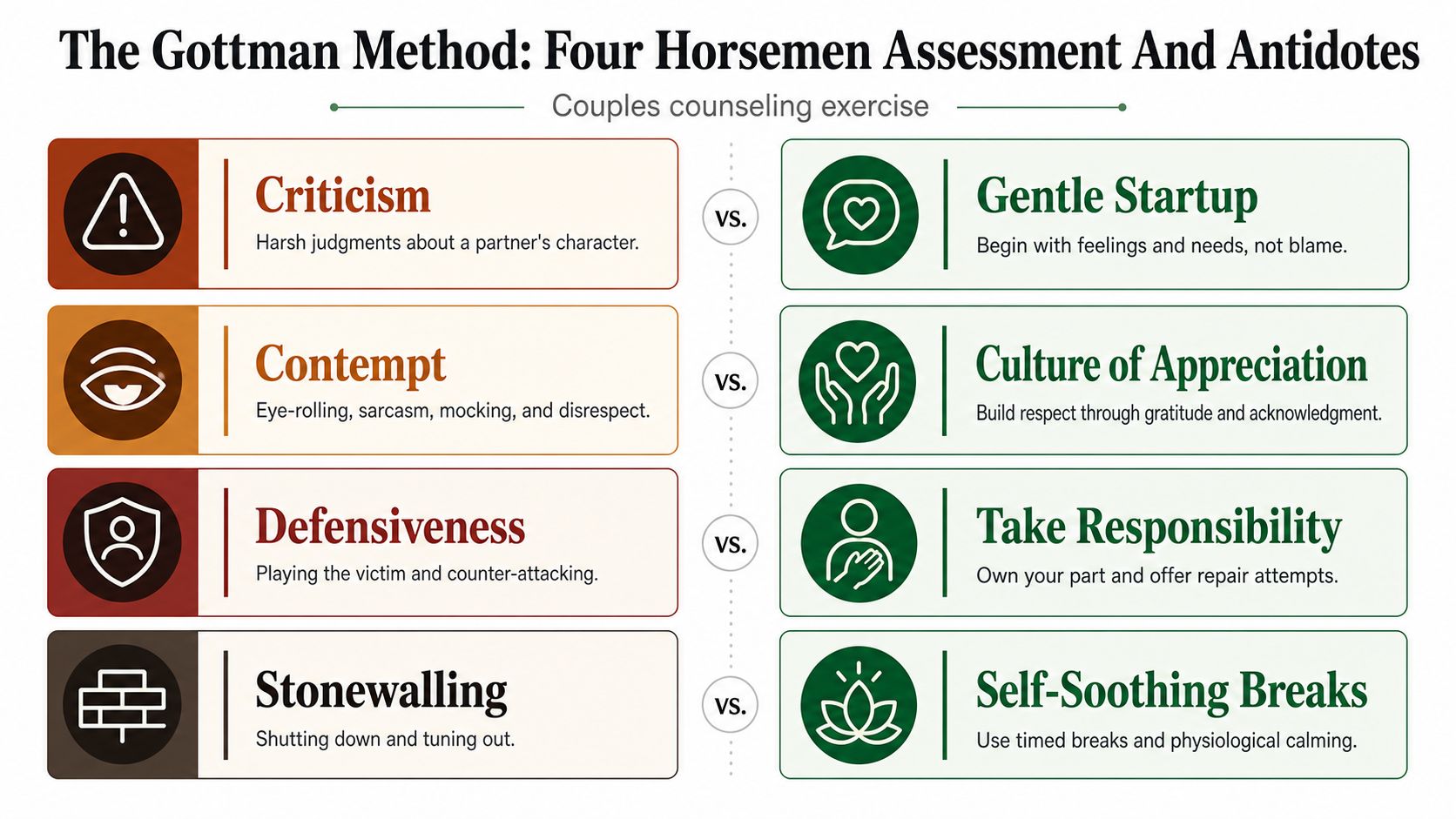
Caption: Four destructive communication patterns and their constructive antidotes.
2. Emotionally Focused Couples Therapy Pursuing and Withdrawing Cycle Intervention
A couple can argue about reassurance, texting, money, or household decisions while repeating a pursue-withdraw cycle. One partner reaches harder, asks more questions, criticizes, or demands a response. The other feels overwhelmed and pulls back, becomes quiet, delays the conversation, or physically leaves. Each reaction intensifies the other.
Emotionally Focused Couples Therapy, associated with Sue Johnson, treats both positions as protective responses rather than proof that one partner is unreasonable. Research reviews identify Emotionally Focused Couples Therapy and Behavioral Couples Therapy as central modern approaches, with a meta-analysis reporting a moderate overall post-treatment effect, g = 0.60, and positive effects for both approaches, including g = 0.73 for EFCT (Wiley review of couple therapy effectiveness). The figures support structured, repeated practice, but they don't guarantee that an exercise will be safe or effective without adaptation.
Map the cycle before discussing the issue
Choose a calm moment and complete this sequence:
Describe the trigger without assigning motive.
Name what the pursuing partner does next.
Name how the withdrawing partner responds.
Identify the softer emotion under each reaction.
State the attachment need beneath that emotion.
A partner asking repeatedly, “Do you still want this relationship?” may be protecting fear of abandonment. A partner going silent may be protecting fear of failure, shame, or emotional overload. The therapist's task is to help each person speak from that vulnerable layer without turning it into an accusation.
At home, give the pattern a neutral name such as “our loop.” Saying “we're in the loop” is more collaborative than saying “you're withdrawing again.” Partners working through trauma should move slowly, because silence, proximity, raised voices, or unanswered messages may carry meanings shaped by earlier experiences. A discussion of how trauma affects relationships can offer useful context, but individualized therapy is important when reactions feel uncontrollable or disproportionate.
For neurodivergent couples, define “pursuing” and “withdrawing” behaviorally. One partner may need processing time, reduced sensory input, or written communication, not emotional distance. Don't require immediate disclosure of vulnerable feelings, and don't use the cycle map to excuse cruelty, threats, or manipulation.

Caption: A couple practices emotional responsiveness while one partner offers comfort.
3. Imago Relationship Therapy Conscious Dialogue and Mirroring
When a partner feels unheard, adding more words can intensify defensiveness. Imago Relationship Therapy slows the exchange into three actions: mirroring, validation, and empathy. The listener does not interrupt, correct, defend, or solve. The aim is to establish accurate contact with the speaker's experience before discussing solutions.
The sender starts with one manageable statement, such as, “I feel alone when household decisions happen without me.” The listener reflects it with, “What I hear you saying is...” The sender confirms or corrects the reflection. Once the message is understood, the listener validates its internal logic, saying, “That makes sense given how you experienced the situation.” Validation acknowledges a perspective without requiring agreement with every conclusion.
Use a contained dialogue sequence
Sender: Share one feeling, event, or need.
Receiver: Mirror the words and ask whether anything was missed.
Receiver: Validate the perspective without defending or debating.
Receiver: Offer empathy by considering what the experience may feel like.
Switch: Give both partners equal time in each role.
At home, schedule the conversation when neither person is already activated. A discussion about family boundaries may show that one partner hears “obligation” because of earlier family pressure, while the other hears “rejection” because relatives represent connection. The exercise does not decide the boundary. It gives both partners clearer information for the later discussion.
Caption: Partners use a structured dialogue to exchange concerns and confirm understanding.
For partners with ADHD, autism, auditory processing differences, or language fatigue, use written prompts, turn-taking cards, captions, or speech-to-text. Allow extra processing time and shorter turns. Trauma-aware adaptations can include a planned pause, no penalty for stopping, and no pressure to disclose details before safety exists. Do not use mirroring to imitate a partner or demand validation of abusive conduct. A therapist should adapt the exercise when fear, coercion, or severe distrust affects participation.
The format may feel artificial at first. That trade-off can be useful when spontaneous conversations repeatedly become defensive. Couples seeking a gentler framework for loving communication in relationships can practice this sequence, while recognizing that therapist support may be needed when trust is badly damaged.
4. The Gottman Method Couples Meetings and State of the Union
Some couples don't need another crisis conversation. They need a dependable place to discuss the relationship before exhaustion, parenting, work, or household management consumes every opportunity for connection. A State of the Union meeting creates that place with a repeatable agenda.
Begin with appreciation. Each partner names something specific they noticed or valued. Move to stress reduction, allowing each person to discuss outside pressures without immediately turning the conversation into advice or criticism. Then review unresolved issues, practical plans, shared goals, affection, and intimacy. End by naming one action each person is willing to take.
Keep maintenance from becoming another chore
Use these boundaries:
Choose a protected time: Both partners should agree to the appointment and avoid squeezing it between competing demands.
Bring a written agenda: Note topics during the week so they don't emerge as accusations in the moment.
Separate logistics from intimacy: Household scheduling deserves attention, but it shouldn't occupy the entire meeting.
End with appreciation: Close by recognizing effort, not by pretending every concern is solved.
A couple with children might discover that the visible argument about bedtime is about depleted attention and neglected affection. Another couple may use the meeting to plan restorative time together instead of waiting until resentment makes connection feel forced.
For neurodivergent partners, a shared digital agenda, predictable duration, and advance notice can make participation more accessible. Offer asynchronous written updates when verbal processing is difficult. For trauma-impacted couples, avoid turning the meeting into an ambush. Sensitive subjects may need a therapist's containment, especially when one partner becomes fearful, dissociative, or unable to speak freely.
This exercise works best as preventive care, not as a tribunal. It won't compensate for intimidation, repeated betrayal without accountability, or untreated instability. Its strength is consistency. It gives ordinary relationship maintenance a place before drift becomes a crisis.
5. Cognitive Behavioral Couples Therapy Thought Records and Behavioral Experiments
Many conflicts escalate because partners respond to an interpretation rather than to verified information. A late arrival becomes “I don't matter.” A short text becomes “They're angry.” A forgotten task becomes “I'll always have to carry everything.” Cognitive Behavioral Couples Therapy helps partners examine the link between event, thought, emotion, and behavior.
Create a four-part record after a manageable conflict. Write what happened, the automatic thought that appeared, the emotional and physical reaction, and the behavior that followed. Then add evidence supporting the thought, evidence that complicates it, and a more balanced interpretation. The aim isn't forced positivity. It's accuracy.
Test the belief through action
Suppose one partner believes, “If my spouse loved me, they'd know what I need.” A behavioral experiment might involve making one direct request and observing the response rather than testing love through silence or resentment. If a couple believes disagreements never resolve, they can choose a low-stakes issue, define the problem together, generate options, and review whether compromise was possible.
Use the record collaboratively, not as a prosecution file. A partner who writes “you don't care” into a worksheet may need help translating that thought into a primary emotion and request. A therapist can also identify cognitive patterns that overlap with depression, anxiety, trauma, or neurodivergent communication differences. The cognitive behavioral therapy resource may help readers understand the broader model.
For ADHD, use a phone note, voice memo, or simple checkboxes instead of a detailed form. For autism, distinguish literal facts from inferred intent and allow time to process ambiguity. Trauma-aware work should never use “evidence” to argue someone out of a valid fear response. Don't conduct experiments involving money, sex, disclosure, or safety without clear consent and professional support.
The benefit is practical. Partners learn to challenge mind-reading and test assumptions. The limitation is equally important. A balanced thought can't repair an unsafe relationship, and cognitive reframing must not become a way to minimize real neglect or harm.
6. Acceptance and Commitment Therapy Values Clarification and Behavior Alignment
A relationship can become organized around avoiding conflict rather than moving toward what both partners value. Acceptance and Commitment Therapy, or ACT, offers a different question: How do we want to behave together, even when difficult feelings are present?
Each partner writes several values in personal language. “Respect,” “play,” “reliability,” “freedom,” “family connection,” or “supporting growth” may all be meaningful, but broad words need behavioral definitions. If the value is respect, the observable behavior might be pausing before insults, asking before making a decision that affects both partners, or honoring a request for space.
Turn values into committed actions
Use this sequence:
Choose two or three shared relationship values.
Describe how each value looks in ordinary behavior.
Notice which emotions pull you away from those behaviors.
Select one small action that expresses the value this week.
Review the result without demanding perfection.
A couple facing financial stress may value a safe, loving home but find themselves speaking sharply under pressure. Values work doesn't require pretending the stress isn't there. It asks whether they can choose one aligned action, such as a calm money meeting or a deliberate repair, while fear and frustration remain present.
Neurodivergent couples may need to define values in concrete, sensory-aware ways. “Quality time” could mean parallel activity in the same room, a walk without conversation, or a shared meal with reduced noise. That flexibility matters because closeness doesn't always require constant verbal exchange. Trauma-aware practice should respect protective responses and avoid treating emotional acceptance as consent to ongoing harm.
ACT's trade-off is that it doesn't promise immediate relief. It can feel less satisfying than finding the perfect argument or proving who is right. Its usefulness grows when partners repeatedly connect daily behavior to a chosen direction. Don't use values to pressure someone into sex, forgiveness, contact, or reconciliation. Values guide willing action, not compliance.
7. Sensate Focus Progressive Physical and Emotional Intimacy Exercise
Sensate Focus is designed for couples who feel pressure, anxiety, avoidance, routine, or disconnection around touch and sex. The central rule is simple but demanding: remove performance expectations before trying to increase sexual contact. Partners begin with agreed, non-sexual touch and attend to sensation, comfort, and emotional responses. Progression should happen only when both people feel ready.
Choose a private setting with enough time to stop without frustration. One partner touches while the other receives, then they switch. The receiving partner can describe pressure, temperature, pace, or areas to avoid. Neither person is responsible for creating arousal, reaching orgasm, or proving desire. The exercise is about curiosity and consent.
A randomized controlled trial of sensate-focus exercises reported improvements in sexual satisfaction and emotional intimacy, while broader evidence summarized in a clinical review describes reliable pre-to-post gains for many couples in empirically supported treatments and lower satisfaction in routine clinical settings (clinical review of sensate-focus interventions). Those findings support clinical relevance, not a guaranteed outcome. Follow-through, setting, fidelity, medical factors, and emotional safety all matter.
Consent comes before progression. A partner can pause, change the plan, or stop without owing an explanation in that moment.
At home, begin with non-sexual touch and discuss boundaries beforehand. Partners with trauma histories or medical concerns may need a sex therapist to establish pacing and prevent exposure from becoming overwhelming. Neurodivergent partners may benefit from explicit scripts, predictable sequencing, reduced sensory stimulation, or the ability to communicate through a card or text.
Don't use Sensate Focus after sexual coercion, during active violence, or when one partner fears consequences for refusing. It also isn't a substitute for medical evaluation when pain, medication effects, hormonal changes, or other health factors affect sexuality. The exercise may restore choice and playfulness, but it can't create safety where safety is absent.
Caption: Gentle, consensual touch can support comfort when partners move at a mutually agreed pace.
8. Conflict Resolution Through Interest-Based Negotiation
Partners often fight over positions. “We should save the money.” “We should spend it.” “Your family should visit.” “They shouldn't.” Positions sound incompatible until each person explains the need underneath.
Interest-based negotiation begins with a repeated, curious question: Why does this matter to me? The answer should move beyond the preferred outcome. Saving may represent security. Spending may represent joy, freedom, or a fear that life is passing by. A family visit may represent belonging for one partner and autonomy or protection from obligation for the other.
Separate discovery from solution-building
Use the following sequence:
State each position briefly.
Ask what need, fear, value, or concern makes it important.
Reflect the partner's interest before responding.
List shared or compatible interests.
Brainstorm several options without judging them.
Choose a trial plan and set a time to review it.
A household dispute may reveal that one partner wants more equal labor while the other wants recognition for contributions already made. A workable plan could address both by redistributing tasks and creating a reliable way to acknowledge effort. The solution doesn't require either person to “win.”
For ADHD or executive-function differences, make responsibilities visible through a shared app, calendar, or written list. For autistic partners, avoid vague demands and define what completion means. Trauma-aware negotiation should avoid pressing for disclosure of private histories when the relevant need can be stated without them. Don't negotiate safety, bodily autonomy, or whether someone is allowed to refuse.
This practice is useful for practical disputes because it converts accusation into joint design. It won't work well when one partner participates only to manipulate the process or when the power difference prevents genuine choice. In those situations, individual assessment and safety planning come before compromise.
Couples Counseling Exercises: 8-Point Comparison
Method / Exercise | Implementation complexity | Resource requirements | Expected outcomes | Ideal use cases | Key advantages |
|---|---|---|---|---|---|
The Gottman Method: Four Horsemen Assessment And Antidotes | Medium, structured steps and repeated practice to master antidotes | Low–Medium, therapist guidance helpful; homework and practice time | Reduced destructive communication; more positive interactions and repair | Couples with criticism, contempt, defensiveness, or stonewalling | Research-backed, concrete antidotes and measurable progress |
Emotionally Focused Therapy (EFT): Pursuing And Withdrawing Cycle Intervention | High, intensive emotional work requiring skilled facilitation | High, trained EFT therapist and multiple sessions | De-escalation of cycles, increased emotional accessibility and secure attachment | Couples stuck in pursue–withdraw patterns or recovering major ruptures | Targets underlying attachment needs for lasting change |
Imago Relationship Therapy: Conscious Dialogue And Mirroring | Medium, learning and following a strict dialogue protocol | Medium, therapist helpful; scheduled dialogue practice | Improved listening, reduced defensiveness, greater empathy and safety | Couples with repeated misunderstandings or poor communication habits | Simple, repeatable process that increases feeling heard and understood |
The Gottman Method: Couples Meetings And State Of The Union | Low–Medium, agenda-driven routine requiring discipline | Low, regular scheduled time and a written agenda | Better issue tracking, more appreciation, early problem detection | Busy couples needing structured check-ins and prevention of drift | Predictable format that fosters regular positive contact and follow-up |
Cognitive Behavioral Couples Therapy (CBCT): Thought Records And Behavioral Experiments | Medium, structured worksheets and planned experiments | Medium, therapist or workbook guidance; daily tracking time | Fewer cognitive distortions, clearer interpretations, targeted behavior change | Couples with catastrophic thinking, mind-reading, or rigid beliefs | Measurable, evidence-based tools linking thoughts to behaviors |
Acceptance And Commitment Therapy (ACT): Values Clarification And Behavior Alignment | Medium, introspective work on values and committed actions | Low–Medium, therapist helpful; reflection and homework time | Greater values-driven behavior and tolerance of difficult emotions | Couples seeking meaning, managing chronic conflict, or trauma-impacted | Builds psychological flexibility and sustained commitment to shared values |
Sensate Focus: Progressive Physical And Emotional Intimacy Exercise | Low–Medium, stepwise practice with clear stages to follow | Low, private time; sex-therapist guidance helpful for trauma or dysfunction | Rebuilt sexual intimacy, reduced performance anxiety, increased presence | Sexual dysfunction, avoidance, routine sex, or couples rebuilding intimacy | Gradual, non-pressure approach effective for reconnecting physically and emotionally |
Conflict Resolution Through Interest-Based Negotiation: Identifying Needs Beneath Positions | Medium, requires slowing down, structured inquiry, and brainstorming | Low–Medium, facilitator useful; time for joint problem-solving | Collaborative, sustainable solutions and reduced win-lose outcomes | Practical disputes (money, chores, family logistics, scheduling) | Reveals shared interests and generates mutually acceptable, durable options |
Choose the Exercise That Matches the Pattern
Don't attempt all eight practices at once. Couples usually get more from one exercise repeated with care than from a large collection of worksheets that becomes another unfinished project.
Choose the Four Horsemen assessment and antidotes when arguments repeatedly involve criticism, contempt, defensiveness, or stonewalling. Use EFT cycle work when one partner pursues and the other withdraws, especially when both people recognize that their reactions intensify the pattern. Choose Imago dialogue when the central injury is feeling misunderstood or unheard. The structure is slower than ordinary conversation, but that slowness is part of its value.
Use State of the Union meetings for preventive maintenance, relationship drift, parenting strain, and overloaded schedules. Choose CBCT thought records when interpretations, assumptions, or mind-reading drive the conflict. ACT values work fits couples who know how they want to be together but keep letting fear, resentment, or avoidance determine their behavior.
Sensate Focus belongs with intimacy pressure, sexual anxiety, avoidance, or a need to rediscover touch without performance demands. Interest-based negotiation is the practical choice for disagreements about money, chores, family boundaries, schedules, or other decisions where the surface positions conceal different needs. Couples looking for additional couples therapy activities to try at home should still adapt any practice to consent, capacity, and the seriousness of the conflict.
Start with one small action. Set a safe time, agree on a pause signal, practice briefly, and review what changed in your words, body, and behavior. Look for useful evidence such as a quicker repair, a clearer request, less escalation, or a greater ability to return after taking space. Don't measure success by never disagreeing.
The right exercise doesn't erase the pattern immediately. It helps you notice the pattern early enough to choose a different response.
Active abuse, coercive control, severe power imbalances, intense emotional activation, or trauma responses that overwhelm either partner require professional guidance. Joint exercises may be unsafe when one person cannot speak freely or when a pause is punished. Online couples therapy can be as effective as in-person care for relationship satisfaction, mental health, and therapeutic alliance, so remote work may be appropriate when the exercise is adapted to lower-arousal, asynchronous, or sensory-friendly formats (research on online versus in-person couples therapy).
Be Your Best Self & Thrive Counseling, PLLC offers individualized couples and marriage counseling, including support for communication difficulties, conflict, trauma-related patterns, intimacy concerns, and neurodivergent relationships. The practice provides a free initial consultation to explore fit and goals through its website, Be Your Best Self & Thrive Counseling, PLLC. Identify one recurring pattern, choose the least activating exercise that matches it, schedule a safe practice time, and seek qualified support when the pattern involves fear, coercion, or overwhelming distress.
Be Your Best Self & Thrive Counseling, PLLC offers compassionate couples and marriage counseling with practical, trauma-informed support for communication problems, conflict, intimacy concerns, and relationship patterns that feel stuck. Visit Be Your Best Self & Thrive Counseling, PLLC to learn about services and request a free initial consultation to discuss your goals and fit.