
Trauma Therapy Online: Modalities, Safety, and Fit
You've finished a long day, the house is finally quiet, and you're staring at a laptop, wondering whether you could talk to a trauma therapist from home. Maybe the idea feels easier than traveling to an office. Maybe it also raises questions: What happens if you get overwhelmed? Can video therapy really help? And how do you know if home is the right place to do this work?
There isn't one answer for everyone. The format is one decision among several, alongside the treatment approach, your current safety and support, and the fit with the therapist. Understanding those pieces can make your first conversation feel less uncertain.
Why Trauma Therapy Online Has Become a Practical Option
A person starting therapy from home might make tea, close the bedroom door, and join a secure video session with a therapist they haven't met in person. That's online trauma therapy: psychotherapy for trauma and PTSD delivered through live, synchronous video. It isn't just a chat window, nor is it the same thing as using a self-guided app.
The distinction matters because the relationship and structure are part of the care. A therapist and client can speak in real time, notice changes in emotion or attention, and decide together whether to continue, slow down, or take a grounding pause. The screen changes where the session happens, but it shouldn't remove the clinical plan.
Good online care aims to preserve the parts that make trauma treatment purposeful: structured assessment, psychoeducation, between-session practice, symptom monitoring, and dependable therapist contact. Think of these as the frame of a house. Video is the doorway, but a doorway alone doesn't provide the support inside.
For example, a client might meet weekly to understand symptoms, work with a validated treatment protocol, and complete a worksheet between appointments. The therapist checks how the client is doing and uses that information to adjust the pace. If the connection drops or the client becomes distressed, they should already know how to reconnect or get support.
The important question, then, isn't whether therapy can happen online. It's which kind of care fits which person, in which setting, with what safeguards. Some clients value the privacy and convenience of home. Others need an office, a hybrid arrangement, or more intensive support to feel safe enough to work.
The sections ahead look at treatment approaches adapted for video, what a session can feel like, and the safety planning that should come before trauma processing. They also offer a practical way to weigh home-based care against your circumstances and questions to ask when choosing a therapist.
Evidence-Based Trauma Modalities Adapted for Video
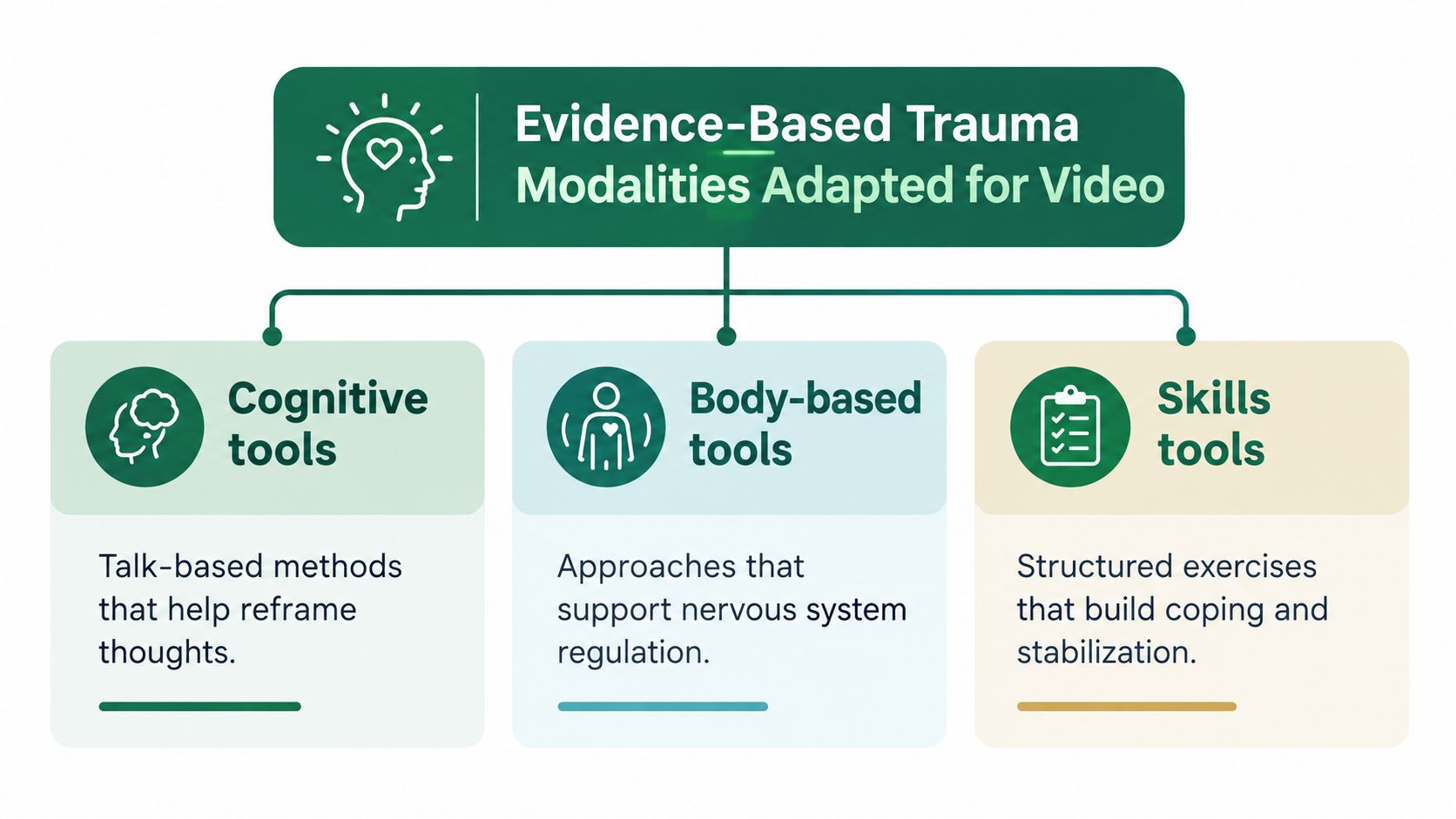
Three broad families of treatment show up often in online trauma care: cognitive methods, body-based methods, and skills practice. Each one addresses a different part of recovery, and a clinician chooses among them based on your symptoms, history, and goals. A therapy method works like a set of tools, where the right pick depends on the job in front of you.
Cognitive approaches focus on the thoughts and meanings that attach to a traumatic memory. Cognitive Processing Therapy (CPT) is one structured example. The VA/DoD PTSD guideline recommends secure video conferencing for validated treatments, including CPT and Prolonged Exposure, and randomized non-inferiority trials found video-delivered CPT clinically equivalent to in-person CPT in both individual and group formats (VA guidance on telemental health for PTSD). If you want to see how clinicians prepare to deliver this method, you can explore CPT training pathways.
Body-based approaches attend to physical signals: tension, numbness, a racing heart, a sense of being somewhere else. A therapist might help you notice where stress shows up in your body and practice orienting to the room around you.
The label matters less than the protocol behind it.
Skills-based tools cover coping and stabilization: grounding exercises, breathing practice, structured work between sessions. These often come before trauma processing or run alongside it. EMDR enters the conversation here too. If it is on your list, ask how the therapist adapts the process to video and what the setup involves, and this overview of how EMDR therapy works can help you shape those questions.
Moving a session to a screen and adapting a treatment for video are two different things. A careful clinician adjusts how the protocol runs remotely: protecting privacy, planning for a dropped call, and deciding how to respond if you become distressed at a distance. The strongest support in VA guidance applies to live video delivery of established trauma-focused protocols, while self-guided apps and text-only tools sit in a separate category with thinner evidence. Before committing, ask which specific method the therapist uses, how they deliver it online, and how the two of you will track whether it is helping.
What Happens in a Teletherapy Trauma Session
Maya joins her first appointment from her parked car because it seems quieter than home. Before asking about her trauma history, the therapist checks whether she has privacy, feels physically safe, and has a plan if someone approaches. Maya notices she would keep watching passersby, so they reschedule for a quiet room. A guide to what happens in a first session with a therapist can help you know what to expect from an initial appointment.
An initial visit often begins with questions about what brought you to therapy, what symptoms you're experiencing, what support you have, and what you hope will change. The therapist may also check your device, internet connection, and backup plan. A phone number or agreed way to reconnect can help if the video call drops. The therapist confirms your location and emergency contact so they know how to respond if an urgent concern arises.
A typical session has a rhythm: check in, work on an agreed part of treatment, then leave time to settle before signing off. The therapist might ask about sleep, mood, or recent triggers, then pause as needed. Ending after difficult material without time to reorient can feel like being left halfway through a conversation, so the closing minutes matter.
Between appointments, you might complete a worksheet, track symptoms, or practice a grounding exercise. These tasks help you notice patterns to discuss with your therapist; they are not a substitute for care during the session. If an exercise feels overwhelming or your symptoms worsen, tell the therapist so you can review the task and adjust the pace.
Building Safety and Stabilization Before Trauma Processing
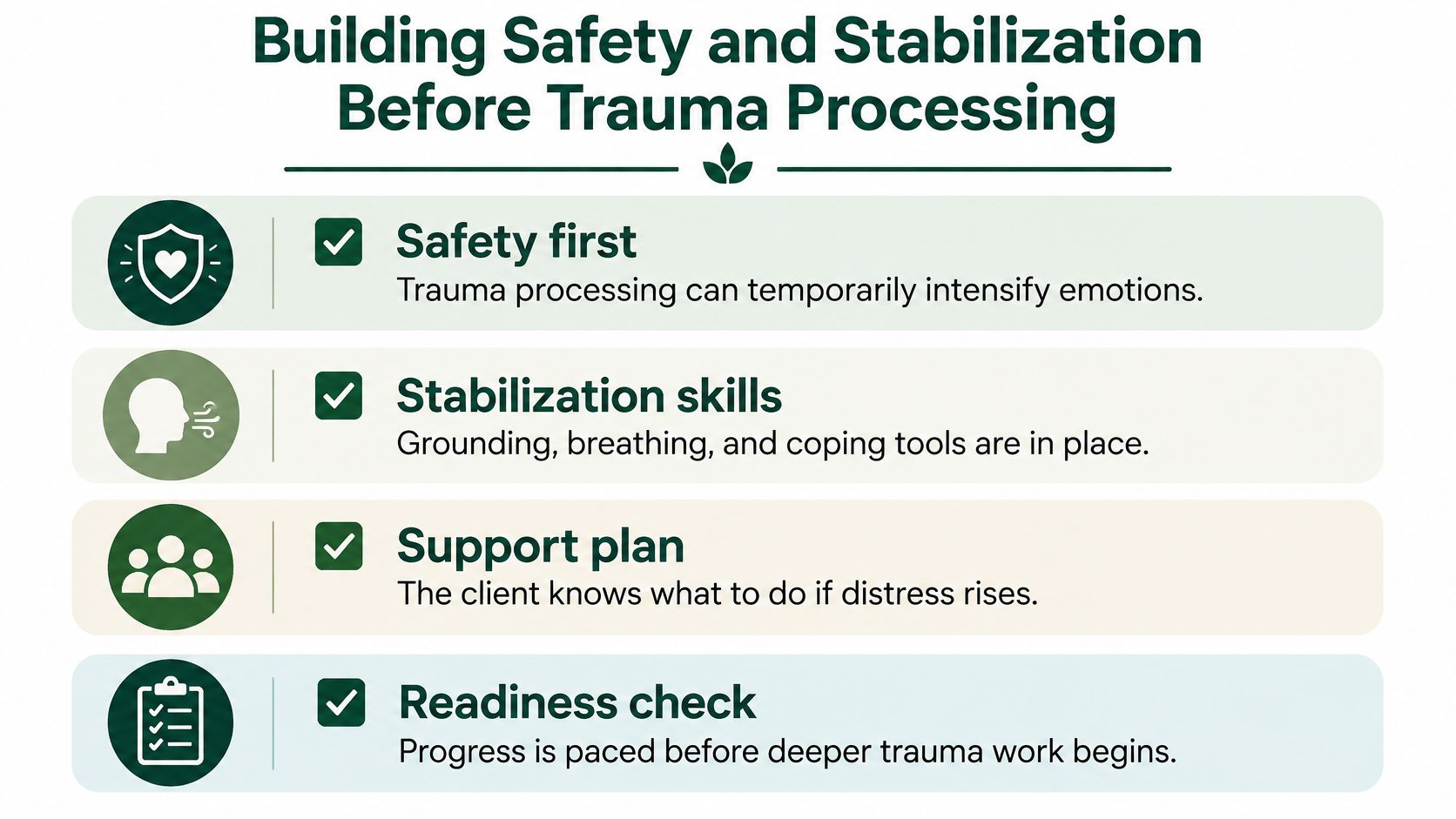
After a difficult video session, a client may feel keyed up, numb, or detached from the room. Trauma processing can temporarily intensify distress, dissociation, panic, or suicidal thoughts, so the therapist and client need a shared understanding of what helps the person stay present and safe. Preparation works like checking a climbing harness before a difficult route: it does not remove every risk, but it helps make the work more contained.
Before choosing a pace or starting trauma-focused exercises, the therapist assesses the client's current symptoms, risks, and daily circumstances, not only the events they want to address.
That assessment may include:
PTSD symptoms and daily functioning: How are sleep, concentration, relationships, and everyday tasks affected?
Suicidal thoughts and immediate safety: Direct questions help the therapist understand urgent risks and respond appropriately.
Substance use and dissociation: These can affect how manageable a session or a trauma-focused exercise may be.
Health and living circumstances: Medical concerns, privacy, physical safety, and interruptions at home can shape the treatment plan.
A crisis response plan: Agree on whom to contact and how to seek urgent help if distress becomes difficult to manage.
A therapist may delay or modify exposure work if the client's current safety or stability does not support it. That is a clinical adjustment, not a verdict on whether someone is ready for therapy. The client and therapist can practice grounding or breathing strategies, then review whether those tools help during and after sessions.
A shared understanding of the window of tolerance and how it relates to trauma responses can help clients and therapists recognize when someone feels overwhelmed or disconnected, and when the pace may need to change.
Regular symptom check-ins can show whether treatment is helping, symptoms are worsening, or attending sessions is becoming difficult. The therapist and client can use that information to adjust the approach rather than continuing by default.
VA/DoD guidance supports video delivery when a treatment has been validated through that modality or when in-person care is unavailable. This is a benefit-risk threshold, not a guarantee that every digital format works equally well. The guideline also finds insufficient evidence to recommend for or against facilitated internet-based CBT for PTSD (VA/DoD PTSD guideline quick reference). People whose trauma history includes sexual assault may also find 3rd-i sexual assault resources. The aim is a treatment plan that responds to the person's needs and risks.
Deciding Whether Online Trauma Therapy Fits Your Needs
A session can begin at home, but your surroundings affect how easy it is to speak freely and stay engaged. A private room, stable internet, and a plan for interruptions may make video workable. If those conditions are hard to arrange, an office or a mix of in-person and online appointments may suit you better. The format is one part of the decision, alongside your symptoms, daily circumstances, and access to support.
A national Veterans Health Administration study published in 2025 included 24,447 veterans receiving individual evidence-based PTSD psychotherapy. Among them, 74.4% had at least one video session, and 38.5% experienced clinically meaningful improvement (study summary from the VA Health Services Research and Development Service). The study found a small association between primarily video-delivered treatment and lower adjusted odds of meaningful improvement compared with primarily in-person care. That finding does not show that video caused poorer outcomes. Differences in health needs, treatment selection, symptom severity, or home conditions may also have played a role.
Use the questions below as a practical check, not a pass-or-fail test. Your therapist can help you weigh each factor.
Factor | Questions to consider |
|---|---|
Privacy at home | Can you speak without being overheard? If not, could you use another private location or meet in person? |
Dissociation | Do you sometimes feel detached or lose track of your surroundings? Ask how the therapist would recognize this over video and respond. |
Substance use | Could current use affect your focus or safety during a session? Share what is relevant so you can discuss the right setting. |
Suicidality | Would your current level of risk call for more support or a setting with closer supervision? |
Housing stability | Can you reliably attend from a private place, even if you move or share housing? |
Sensory needs | Do screens, sound, or face-to-face video feel uncomfortable? Consider what adjustments might help. |
Technology access | Do you have a dependable connection, a private device, and enough data to attend without interruptions? |
Caption: Personal circumstances can help you decide whether home-based video, office visits, or a hybrid approach is workable.
You do not have to settle the format before speaking with a clinician. Bring your answers to a consultation and ask how you will review whether the arrangement is working. You can also compare online and in-person therapy options and revisit your choice if your circumstances change.
How to Choose a Trauma-Informed Online Therapist
Choosing a therapist works like hiring a guide for a trail you have never walked. The map matters, meaning training in trauma-focused care, but so does the guide's habit of checking weather, pace, and whether you feel steady before the ground gets steep.
Use the consultation to look for specific behaviors behind reassuring labels.
Strong signal | A reason to ask more |
|---|---|
The therapist can explain their trauma training and how they adapt that work to video. | Their description stays broad and never names an approach or preparation process. |
They explain privacy, secure video, and what happens if a call drops. | They seem unsure about confidentiality, interruptions, or changes at home. |
They collaborate on goals and describe how progress will be reviewed. | They promise a fixed outcome or treat pacing questions as a problem. |
They discuss safety planning before any intensive processing. | They move toward trauma processing before asking about current stability and support. |
Treat these as prompts for a conversation. A trauma-informed clinician should welcome plain questions and explain why a method fits your history, symptoms, and setting. For a fuller checklist, see this guide to finding a trauma-informed therapist.
You can ask: Which trauma-focused methods do you use? How do you decide whether video is appropriate for me? How will we slow down if I feel overwhelmed? What happens if my symptoms increase, I dissociate on screen, or I lose privacy at home? A careful answer may include office care, a hybrid plan, or referral when home-based sessions are unsafe.
Be Your Best Self & Thrive Counseling, PLLC, is a counseling practice based in St. Petersburg, Florida, offering individual counseling grounded in trauma-informed principles and nervous-system work, with a free initial consultation to explore goals and fit. Wherever you inquire, ask whether video sessions are available in your state and what would lead the clinician to recommend a different format.
Taking the First Step Toward Online Trauma Care
Some people attend their first video session from a parked car, because it is the only quiet space they have. Details like that belong in your notes before you contact anyone. You do not need a finished plan, only a few honest lines: what is troubling you now, what you hope therapy might change, and anything in your home setup that could affect privacy or safety on a call.
Choosing video over an office visit is one decision among several. The therapist's training, the method they use, the pace they set, and the conditions in your home all shape whether online care will work well for you. A quick self-check helps you see where you stand:
Do you have a reasonably private space for sessions?
Is your internet connection steady enough for video?
Can you stay grounded if strong feelings surface mid-session?
Is there someone you could reach afterward if a session stirs things up?
If any answer gives you pause, say so in the first conversation. A clinician can often problem-solve around thin walls or shaky wifi, and they should tell you plainly if in-person care would suit you better.
Making an inquiry works like a test drive: you learn how the process feels before you commit to anything. Be Your Best Self & Thrive Counseling, PLLC offers a free initial consultation, so bring your notes, ask whether video sessions are available in your state, and notice how clearly your questions get answered. Choosing carefully is itself part of the care.