
How to Support Anxious Partner
Your partner is pacing before a routine phone call, stomach tight, voice rehearsing what to say. You want to help, so you offer reassurance. They ask the same question again a few minutes later. Now you're worried, they're still distressed, and neither of you knows what to do next.
Learning how to support an anxious partner means offering care without becoming responsible for eliminating every uncomfortable feeling. The balance is practical: listen, agree on support that helps your partner face what's difficult, and protect both people's needs.
What an Anxious Partner Is Actually Experiencing
At the doorway before a work meeting, your partner pauses with one hand on the handle. Their heart is pounding; their breath is shallow. They've rehearsed the first sentence repeatedly, but now they're imagining stumbling, being judged, and facing consequences that haven't happened. You say, “You'll be fine.” They nod, then ask whether you're sure.
That request may not be a bid for attention or a sign that your partner doesn't trust you. Anxiety is a health concern, not a character flaw. It can affect the body, thoughts, and behavior at once: tension and disrupted sleep, worst-case thinking, and avoidance or repeated reassurance-seeking. Someone else may go quiet or pull away, even when they want closeness.
Reassurance can feel kind, but it often doesn't settle the fear for long. The anxious person may be looking for certainty about something neither partner can guarantee. A steadier response combines emotional validation with practical support: “I can see this is hard. Do you want me to listen, help you prepare, or give you space while you get ready?”
The aim isn't to make anxiety disappear on demand. It's to help your partner feel less alone while supporting their own ability to take a next step. If attachment concerns are part of the picture, understanding anxious attachment in relationships can add context, but it doesn't replace talking about what each of you needs in the moment.
Support Versus Accommodation
Support stays alongside your partner. Accommodation takes over for anxiety. The difference isn't always obvious, because accommodating often brings immediate relief. You answer the same question again, make the call they're avoiding, or cancel a plan so they won't have to face a feared situation. The tension drops. Over time, though, your partner may get fewer chances to learn that they can cope without that rescue.
A 2025 peer-reviewed study of people with generalized anxiety disorder found that partner accommodation was common among participants. Greater accommodation was associated with more severe worry and intolerance of uncertainty, but that finding doesn't mean a caring partner should abruptly withdraw reassurance. It's a reason to make support more deliberate and collaborative. The study on partner accommodation in generalized anxiety disorder describes the pattern; a shared plan can help you respond without shaming or abandoning each other.
In the Moment | Supportive Response | Accommodation Pattern | Long-Term Effect |
|---|---|---|---|
Your partner fears making a phone call | Acknowledge the fear and ask whether they want company while they call | Make the call for them each time | Support allows practice; taking over can maintain avoidance |
They ask repeatedly whether a plan will go wrong | Give a brief, honest response, then ask what step they choose | Keep promising that nothing bad will happen | The promise may calm the moment but can invite another request for certainty |
They're distressed about an activity | Help them choose a manageable way to approach it | Cancel automatically to prevent distress | A small approach preserves choice; ongoing avoidance can narrow shared life |
Use this stepped-care protocol when you're unsure what comes next:
Validate the emotion without confirming the catastrophe. “I can hear how frightened you feel” isn't the same as agreeing that the feared outcome will happen.
Ask what kind of help they want. Listening, practical assistance, or help contacting a clinician are different offers.
Notice the impact on everyday functioning. Is anxiety interfering with work, sleep, relationships, or ordinary routines?
Encourage professional care if impairment persists. Love and patience matter, but they can't replace assessment or treatment.
Review the approach together. Talk about whether the support helped your partner move toward what matters, not only whether distress faded immediately.
This shifts the question from “How do I reassure them enough?” to “What response supports them without making me responsible for their anxiety?” The next challenge is finding words that work when everyone is already activated.
Communication Skills That Actually Land
During an anxiety spike, a rapid series of questions can feel like an interrogation, even when you're trying to understand. Slow down. One clear reflection and a choice usually land better than a speech about why there's nothing to fear.
A 2023 cross-sectional study of couples receiving infertility treatment in China found that supportive shared coping was associated with lower anxiety and depression in both partners, while criticism, withdrawal, or minimizing were associated with higher distress. The sample had a specific source of stress, so it shouldn't be treated as a prediction for every couple. Still, it illustrates why the way partners respond to each other matters. The study of dyadic coping among couples undergoing infertility treatment supports a practical principle: try to face the problem together, rather than making one partner prove that their distress is justified.
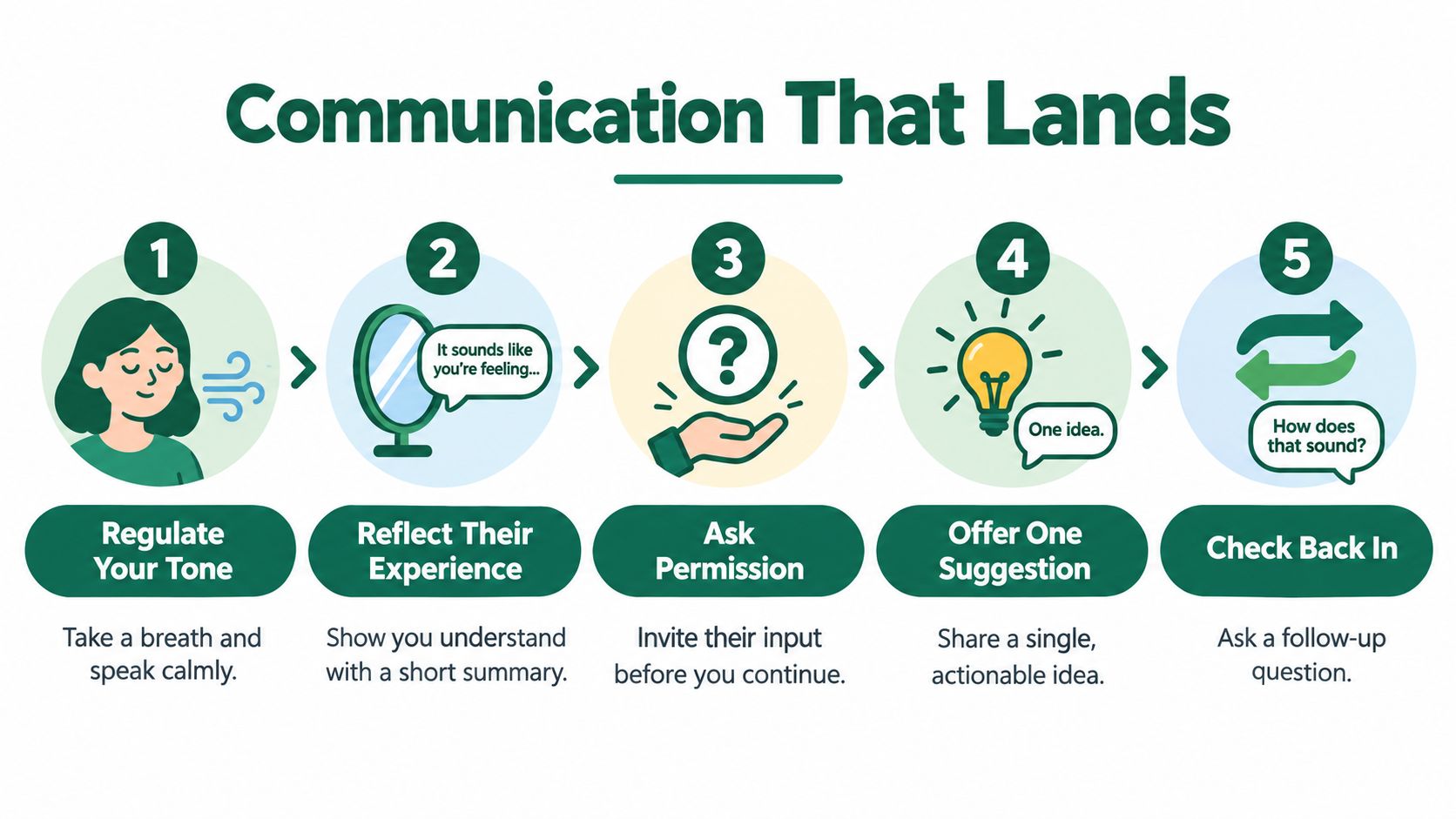
Communication That Lands infographic showing a five-step sequence for responding with calm, clear support.
Try this sequence when your partner is spiraling after a work email or panicking about a social event:
Regulate your tone and pace. Speak more slowly and keep your voice steady. Your partner doesn't need you to pretend everything is fine; they need a response that doesn't add more pressure.
Reflect their experience in one sentence. “That email has you worried about how your manager sees your work.” Name the feeling without declaring the worst case true.
Ask permission before problem-solving. “Would it help to think through a reply, or do you want me to listen first?”
Offer one concrete choice. “Would you like me to sit with you while you draft it, or take a short walk first?” A flood of questions can make it harder to choose.
Return to the shared plan once the intensity eases. Help your partner take the next action they've chosen, rather than restarting the debate about every possible outcome.
Try saying: “I can see why this feels big. Do you want listening or help choosing a next step?”
Avoid phrases that dismiss feelings or promise certainty you can't deliver:
“Just relax.”“You're overthinking it.”“I promise everything will be fine.”
Try instead: “I'm here”; “What would help right now?”; “We can take this one step at a time”; or “I can't guarantee what will happen, but I can stay with you while you decide what to do.” If conversations tend to become tense, active listening techniques can help you hear the fear without immediately arguing with it.
Watch for a demand/withdraw cycle: one partner pushes for immediate answers, the other shuts down or walks away, and both feel rejected. Keep the first check-in brief, roughly two to five minutes, then turn toward a chosen action. Words help; a written agreement makes it easier to stay consistent when the same situation returns.
Building a Joint Plan You Both Sign
A support plan should belong to both of you, not turn one partner into the supervisor and the other into a project. Write it when you're calm enough to be curious. The aim is to make each person's preferences visible, including what the supporting partner needs in return.
Start with known triggers. These might include loud conflict, money conversations, or social events. Be specific enough that you can recognize the situation without treating a trigger as a reason that the anxious partner must always avoid it.
Next, describe preferred support. Does your partner want quiet company, a distraction, practical help, or space to try a coping skill independently? Add agreed reassurance limits, too. For example, you might agree on one validating response and one factual answer, then shift to a step your partner has chosen. This isn't a punishment or a test. It's a way to make care predictable without turning an unanswerable fear into a repeated search for certainty.
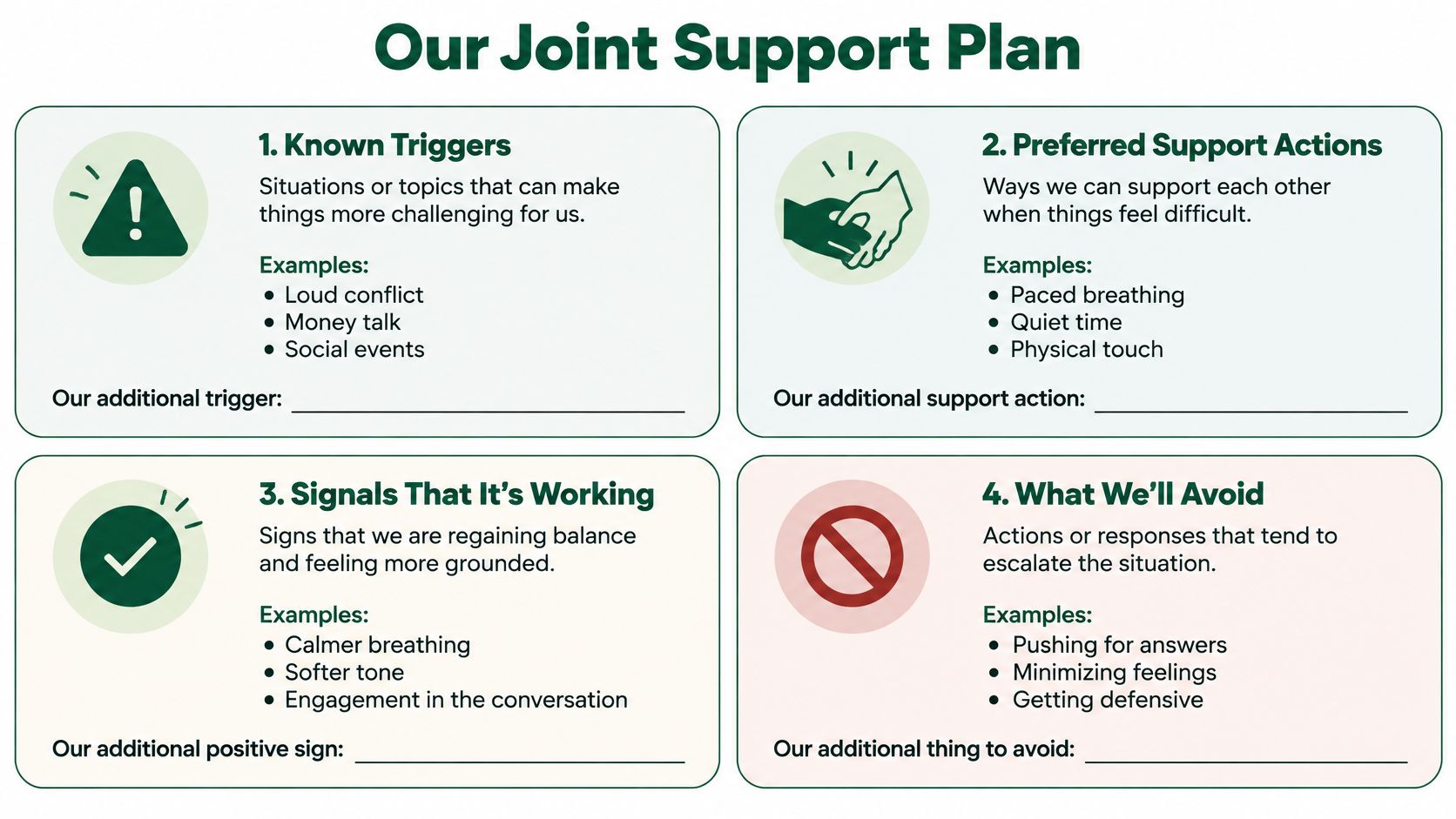
Our Joint Support Plan worksheet for recording triggers, preferred actions, signs of progress, and responses to avoid.
Choose one small approach behavior for your partner to try. That could mean sending a difficult email, attending part of a gathering, or delaying a checking habit. The point is not to make the task easy enough that there's no anxiety. It's to help your partner practice moving toward something they value while staying within a manageable plan.
A brief couple psychoeducation intervention with 21 couples reduced reassurance-seeking and accommodation, supporting the value of a shared protocol rather than improvised responses. The research on couple psychoeducation and relationship-based anxiety patterns offers a reason to make your agreement explicit. At a regular check-in, review distress on a 0–10 scale, time spent seeking reassurance or avoiding, and whether the planned approach happened. Treat these as conversation prompts, not a scorecard. Ask what helped, what felt intrusive, and whether either partner needs to adjust the plan. Even a thoughtful agreement can be difficult to remember during a spike, so it helps to decide in advance what calming options your partner can accept or decline.
Grounding Tools for the Middle of a Spike
Grounding isn't about ordering someone to calm down. It gives the anxious person something concrete to try while the intensity is high. Offer a tool and leave room for a no: “Would paced breathing help, or would you rather I just sit here?” If your partner has a preferred skill, start there.
Paced breathing may fit when your partner wants help slowing down. Invite them to breathe in for about four seconds and out for six to eight seconds, repeating for two to three minutes if it feels comfortable. Don't force a rhythm; a person who feels more distressed focusing on breath can choose another option.
For someone who feels stuck in looping thoughts, try sensory grounding: name five things in the room, hold a cool object, or run cold water over the wrists. The task is to notice immediate sensations, not to prove that the fear is irrational. If being physically still makes restlessness worse, try slow movement instead, such as walking side by side or gently shaking out the hands.

Offering calm presence while a partner tries a breathing exercise.
After the strongest wave passes, don't turn the moment into a performance review. Offer water, a gentle walk, or a low-pressure activity. Check in later: “Would you like to talk about what helped, or leave it for now?” This can help your partner return to the day without requiring a full debrief while they're still drained.
A grounding exercise can be a useful short-term tool, but it isn't a substitute for care when anxiety keeps disrupting life. Explore distress tolerance techniques together, and ask your partner which practices feel supportive. Sustainable coping also depends on the supporter remaining rested and emotionally present. That requires limits, not endless availability.
Staying a Partner and Not Becoming a Therapist
You can care and still decline to be available for repeated reassurance at any hour. When one partner becomes the other's full-time monitor, rescuer, and treatment planner, affection can give way to resentment. Your partner needs agency; you need a life that isn't organized entirely around preventing their distress.
Make limits concrete. You might agree that reassurance conversations end when you need to sleep, keep work hours protected, or handle money discussions at a planned time rather than restarting them as a crisis. Say what you can offer: “I want to be here for you, and I also need to be rested to do this well.” A boundary works best when it names your action, not a threat about what your partner must feel.
If your partner refuses professional help, you can say what you observe and offer practical support with finding a clinician or arranging an initial appointment. You can't force them to engage. If anxiety becomes tied to contempt, threats, or coercion, the issue isn't solved by providing more reassurance. It's appropriate to seek support for yourself and consider what you need to stay safe.
Don't assume every request for reassurance is irrational. Attachment anxiety can coexist with real relationship concerns, trauma, neurodivergence, or practical stress. You don't have to diagnose the cause to ask for respectful, reciprocal communication. If the same conflict keeps repeating, couples counseling can help both partners examine the pattern rather than assigning one person all the responsibility. Setting healthy boundaries can help you express limits with care, but professional support may be needed when anxiety is affecting functioning or safety.
When to Bring in Professional and Crisis Support
Anxiety deserves more than home strategies when it keeps disrupting work, sleep, relationships, or daily routines. The World Health Organization reported that approximately 470 million people worldwide experienced an anxiety disorder in 2023, an estimated 5.8% of the global population, making anxiety the most common category of mental disorder globally. The WHO overview of anxiety disorders underscores that this is a significant health concern, not a personal failing.
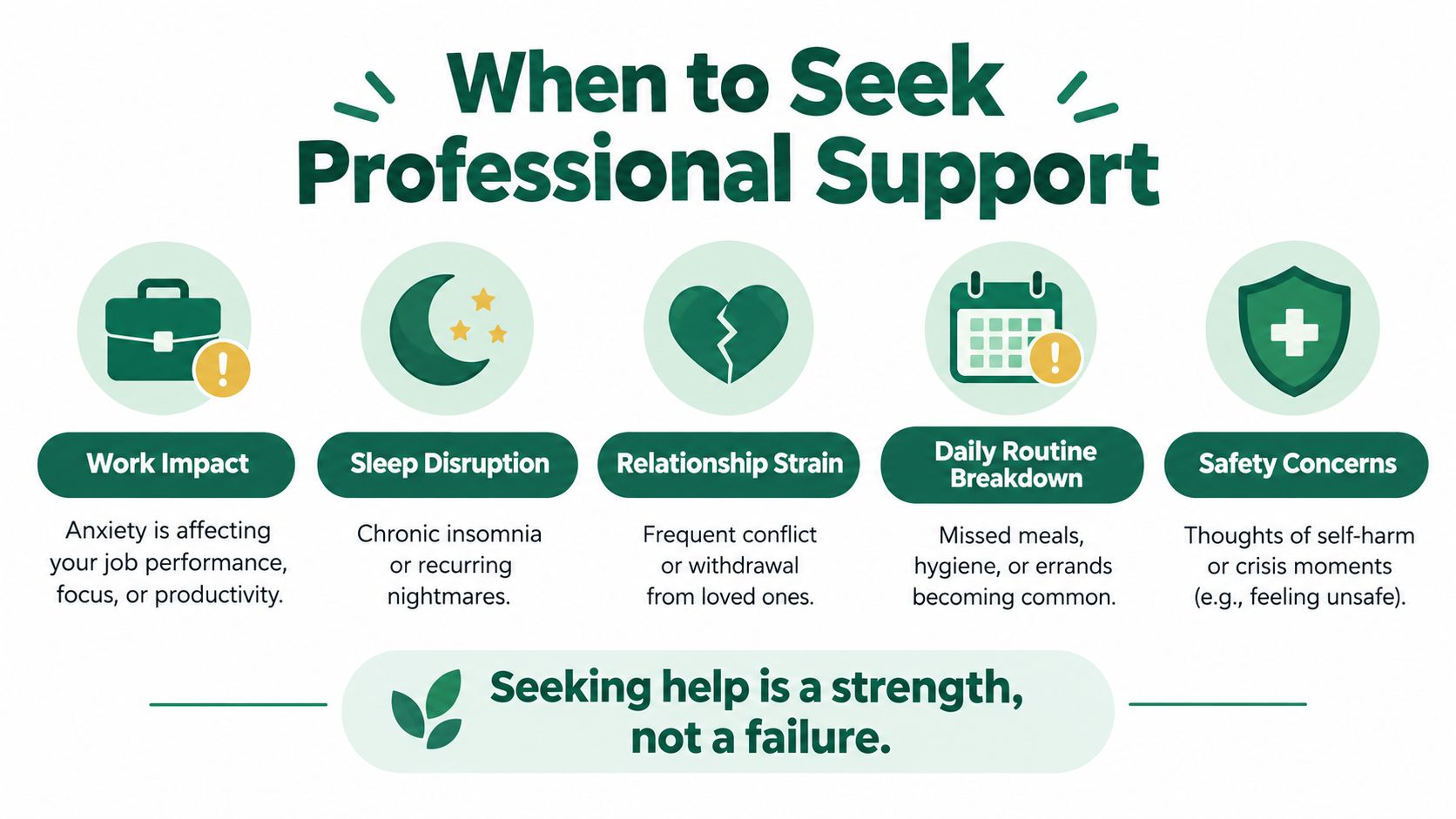
When to Seek Professional Support infographic outlining signs that anxiety may need clinical attention.
A clinician can assess what's happening and discuss appropriate care, which may include self-help resources, support groups, or structured psychological treatment. Your role is to encourage an evaluation and offer help with logistics, not decide which treatment your partner needs. Couples work may be useful when anxiety is shaping repeated conflict, withdrawal, or reassurance patterns. Anxiety treatment options can help you learn about possible forms of care. Medication isn't a cop-out; whether it's appropriate is a decision to discuss with a qualified clinician.
Suicidal communication, self-harm, dangerous substance use, or sudden severe deterioration calls for urgent professional help. If you believe someone is in immediate danger, contact local emergency services or a crisis service. A consumer resource on quality CBD for panic support may discuss products, but it isn't a substitute for clinical assessment or urgent help, and you should consult a qualified clinician before considering supplements or other products.
For the coming week, keep the plan finite: have one conversation about preferred support, agree on one small brave action, choose one self-care action for the supporter, and take one professional step if needed, such as looking up a clinician or arranging an evaluation.
Be Your Best Self & Thrive Counseling, PLLC offers individual and couples counseling for anxiety, communication difficulties, and patterns that leave partners feeling stuck. If you're looking for support in St. Petersburg or the Tampa Bay area, visit Be Your Best Self & Thrive Counseling, PLLC to explore services and request a free initial consultation.