
Understanding Anxiety Disorders: What Adults Need to Know
You're in the car outside work, heart beating hard before a meeting that's gone well many times before. Or you wake at 2 a.m. and replay a conversation, searching for the moment you might have said the wrong thing. You tell yourself to stop worrying, but your body hasn't received the message.
Many capable adults explain this away as stress, a busy season, or being someone who thinks ahead. Yet when worry starts shaping decisions, shrinking routines, or interrupting sleep, it may be more than an uncomfortable feeling. Understanding anxiety disorders begins with noticing not only what you fear, but how long the pattern has lasted and what it's keeping you from doing.
When Worry Stops Being a Normal Day
A capable person can keep meetings, care for family, and meet deadlines while spending hours anticipating what might go wrong. From the outside, life may look steady. Inside, the nervous system can remain on alert, as though a threat is still present. That mismatch can make it hard to recognize when ordinary worry has become a pattern worth discussing with a clinician.
Anxiety before a presentation may help someone prepare. Concern after an unexpected bill can prompt a practical plan. These responses often settle once the situation passes or a reasonable action has been taken. Anxiety that persists, feels hard to control, or interferes with daily life deserves closer attention. That does not mean a person is weak or that the fear is imaginary.
Consider what happens after the worry appears. Someone who feels nervous before a meeting may still attend, speak, and move on. Another person might spend days bracing for it, lose sleep, repeatedly ask for reassurance, or avoid similar responsibilities. Avoidance can bring quick relief, much like stepping away from a smoke alarm. But if avoiding situations becomes the main way to feel safe, everyday choices can gradually narrow.
The World Health Organization estimated that approximately 470 million people worldwide had an anxiety disorder in 2023, about 5.8% of the global population, making anxiety disorders the most common category of mental disorder globally (WHO overview of anxiety disorders). This global estimate does not diagnose any individual. It does underline why persistent anxiety merits a careful, individualized look rather than dismissal as a personal failing.
Look at the pattern, not one difficult moment
A clinician may ask about persistence, proportionality, and impact. How often does fear arise? Does it remain intense after an immediate threat has passed? Is it affecting work, relationships, education, sleep, or activities that matter to you? A difficult day alone cannot answer those questions.
Context matters, too. Economic insecurity, conflict, displacement, chronic illness, and relationship strain can shape how anxiety shows up and what support may fit. No single statistic or checklist can explain one person's experience.
You do not need to decide by yourself whether what you feel is “just stress.” If you are sorting out the difference, this guide to stress versus anxiety offers a place to start. You can bring a clinician a simple account of what happens, when it happens, and what it changes in your life.
What Clinicians Mean by an Anxiety Disorder
A capable person can keep meeting deadlines, caring for family, and showing up for others while privately spending hours anticipating what might go wrong. That contrast can make anxiety hard to recognize. Clinicians do not diagnose by appearance or by a single difficult moment. They look at the pattern, how long symptoms have lasted, the distress or disruption they cause, and whether another explanation fits better.
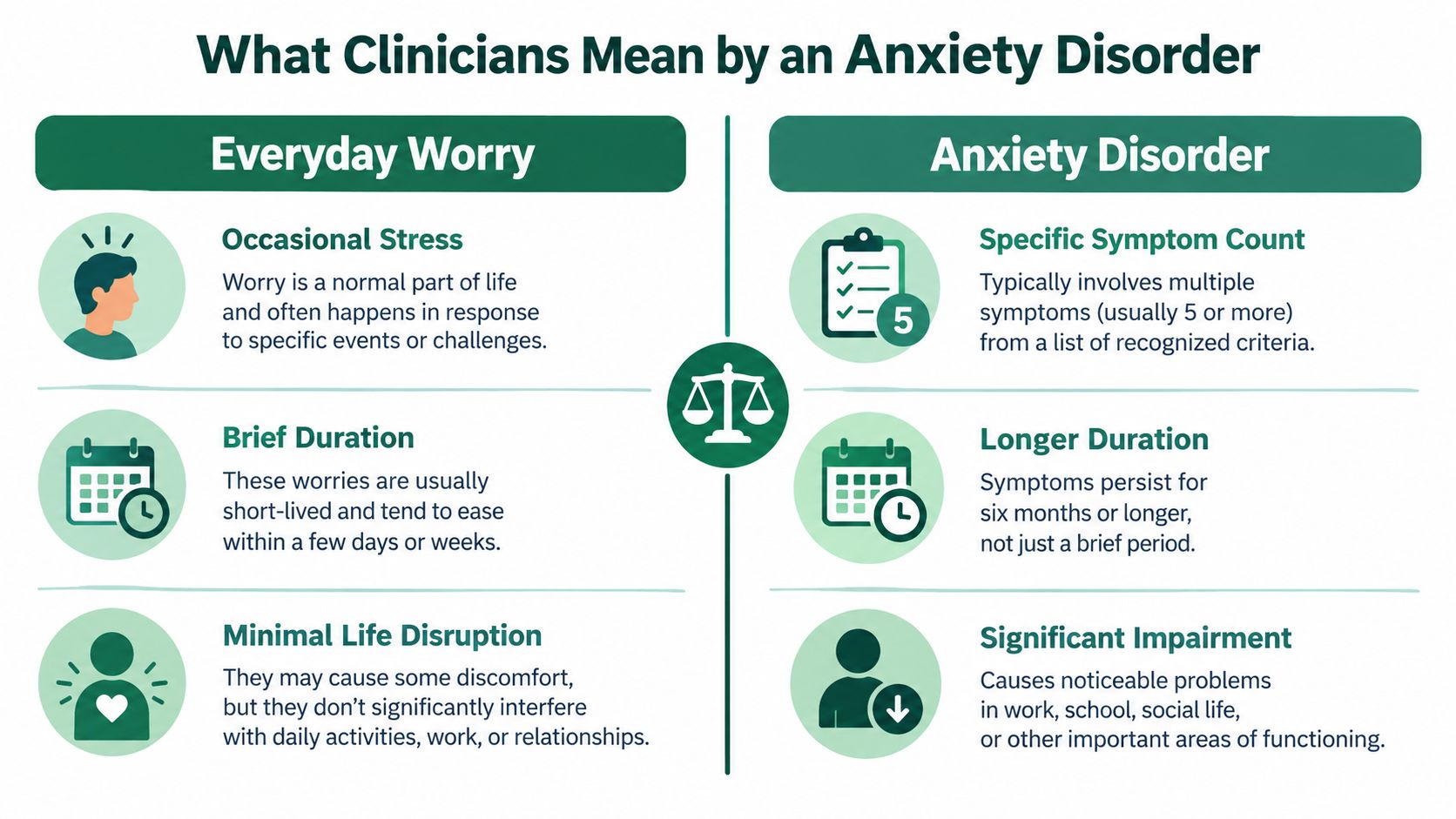
For context, the National Institute of Mental Health estimates that 19.1% of U.S. adults experienced any anxiety disorder in the previous year, and 31.1% experienced one at some point in their lives. Past-year prevalence was 23.4% among females and 14.3% among males (NIMH data on any anxiety disorder). These figures refer to disorders meeting clinical criteria, not everyday nerves or a temporary response to pressure.
Common patterns, different presentations
Anxiety disorders have distinct patterns, though people's experiences do not always fit neatly into a label:
Generalized anxiety disorder (GAD): Worry may move across work, health, finances, family, and everyday decisions. It can be hard to contain without one immediate crisis to explain it.
Panic disorder: Recurring panic attacks may be followed by ongoing concern about another attack or changes in behavior to avoid one. A single panic attack does not establish panic disorder.
Social anxiety disorder: Fear of scrutiny, embarrassment, or negative judgment can make social or performance situations difficult to face. This goes beyond occasional shyness.
Specific phobias: A marked fear focuses on an object or situation, such as flying or certain animals. Avoidance can interfere with daily life.
Agoraphobia: Fear and avoidance relate to situations where escape may feel difficult or help may seem unavailable. Clinicians assess the range of situations involved.
Separation anxiety disorder: Distress centers on separation from attachment figures. Age, duration, symptoms, and impairment help distinguish a disorder from reluctance to separate.
A label is a guide to a pattern, not a complete account of a person. OCD and PTSD are often discussed alongside anxiety, but each has distinct diagnostic features and is not another name for an anxiety disorder. The criteria can be specific: the DSM-5 comparison summarized by Psychiatry Online states that separation anxiety disorder requires at least three of eight specified symptoms, with minimum duration requirements differing for children and adults. Panic disorder and agoraphobia also have defined symptom or situation criteria (DSM-5 diagnostic comparison).
For anxiety connected to work demands, Acheloa Wellness, Inc. offers workplace anxiety causes and solutions. Such information can help describe what is happening; an individual assessment clarifies how someone's experience relates to diagnostic criteria.
How Anxiety Feels in the Body and Mind
A capable person can lead a meeting, meet deadlines, and still feel their heart pound before sending a routine message. Anxiety can arrive through several channels at once: the mind searches for what might go wrong, the stomach tightens, and the body prepares for danger. These sensations are real, even when the threat being anticipated is not immediate. Understanding them as part of the nervous system's alarm response can make them less mysterious.
That response may include a pounding heart, muscle tension, shallow breathing, restlessness, sweating, or digestive discomfort. When the body stays keyed up, sleep may become difficult. Physical symptoms can have other causes, too, so clinicians ask about health and medical factors rather than assuming anxiety explains everything.
Four overlapping channels
Thoughts may jump to the worst outcome: “If I make one mistake, I'll lose the client.” Emotions may include dread, irritability, or a sense that something bad is about to happen. Behavior can shift toward avoidance, procrastination, people-pleasing, or repeated reassurance-seeking. Each channel can feed the others: a frightening thought raises arousal, and the body's alarm can then seem like proof that the fear is true.
The pattern differs from person to person. Panic may surge as a sudden peak of intense fear or discomfort. Generalized anxiety can feel like a steady hum of worry across several parts of life. Social anxiety may start well before an event, with rehearsing what to say and anticipating others' reactions. Naming what happens for you can help you describe it to a clinician without trying to diagnose yourself.
NIMH estimates that 2.7% of U.S. adults experienced generalized anxiety disorder in the past year and 5.7% at some point in their lives; past-year prevalence was 3.4% among women and 1.9% among men. Those figures describe a specific diagnosis, not everyone who worries often.
How Common Anxiety Presentations Compare
Presentation | Past-Year U.S. Prevalence | Typical Felt Experience |
|---|---|---|
Generalized anxiety disorder | 2.7% of adults (NIMH) | Ongoing, hard-to-control worry across different areas |
Social anxiety disorder | 7.1% of adults (NIMH) | Fear of scrutiny, embarrassment, or negative judgment |
Any anxiety disorder | 19.1% of adults (NIMH) | Varies by diagnosis and individual |
If your thoughts race at night or return repeatedly to imagined outcomes, this explanation of anxiety and racing thoughts may help you find words for the experience. Notice when the alarm arises, what you feel in your body, and what you do next. Sharing those observations with a clinician can help clarify individualized next steps, especially when symptoms affect sleep, relationships, work, or daily choices.
Why Anxiety Develops and What Keeps It Going
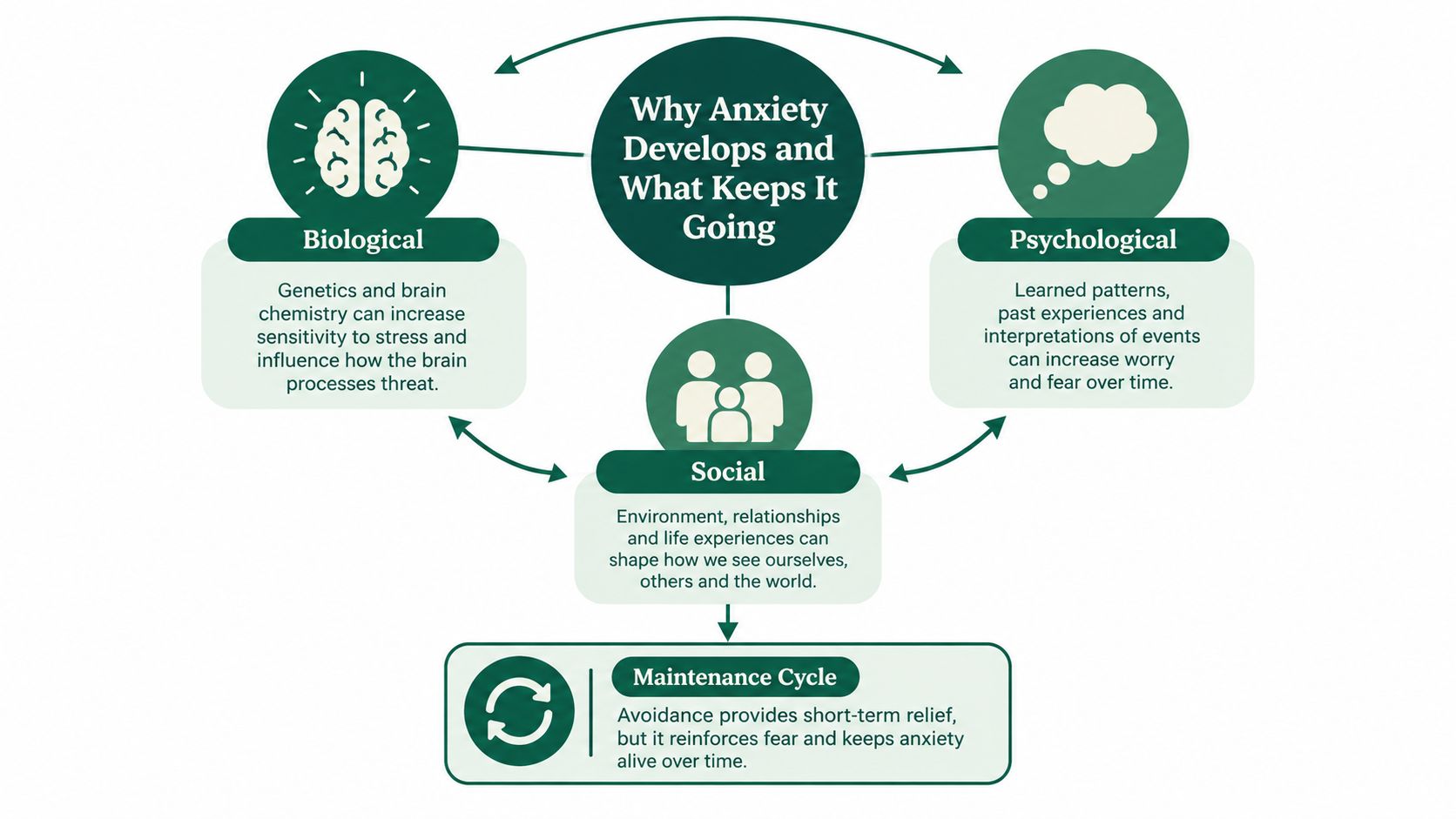
Anxiety doesn't usually have one simple cause. A person's risk can reflect interacting biological, developmental, psychological, and environmental factors, rather than a single flaw or event, as described by NIMH and in the World Health Organization's overview of anxiety disorders (WHO overview of anxiety disorders). That complexity is why two people can face similar pressures and have very different responses.
Biology and temperament may influence how readily someone responds to perceived threat. Sleep disruption, health concerns, and medical factors can also shape symptoms. Psychological influences may include learned associations, early experiences, and habitual ways of interpreting uncertainty. Social conditions matter too: discrimination, economic pressure, cultural expectations, relationship conflict, or limited support can add strain. These influences interact; they don't point to one inevitable outcome.
The loop that can keep anxiety in place
A common maintenance pattern unfolds in a sequence. First, a situation is perceived as threatening. The body becomes more aroused, and a racing heart or tight chest may be interpreted as further evidence of danger. The person avoids the situation or seeks reassurance, which often brings short-term relief.
That relief can teach the brain that avoidance was necessary, even when it prevents the person from learning what might have happened if they stayed. Over time, more situations can start to feel unsafe. A person might avoid speaking up in meetings, then worry about falling behind at work, then seek more reassurance before the next meeting. The loop isn't a choice or a character flaw. It's a learned pattern, and treatment can help change what happens within it.
Not everyone has the same triggers or safety behaviors. A clinician can help map situations, body sensations, interpretations, avoidance, and consequences so treatment targets the parts that maintain distress. Learning more about how stress responses affect daily life may also be useful through this discussion of nervous-system dysregulation.
For busy adults trying to reduce daily strain, this guide to stress relief for busy professionals can offer ideas for practical routines. Such supports may help with stress management, but persistent or impairing anxiety may call for a clinical assessment as well.
Evidence-Based Treatments That Help
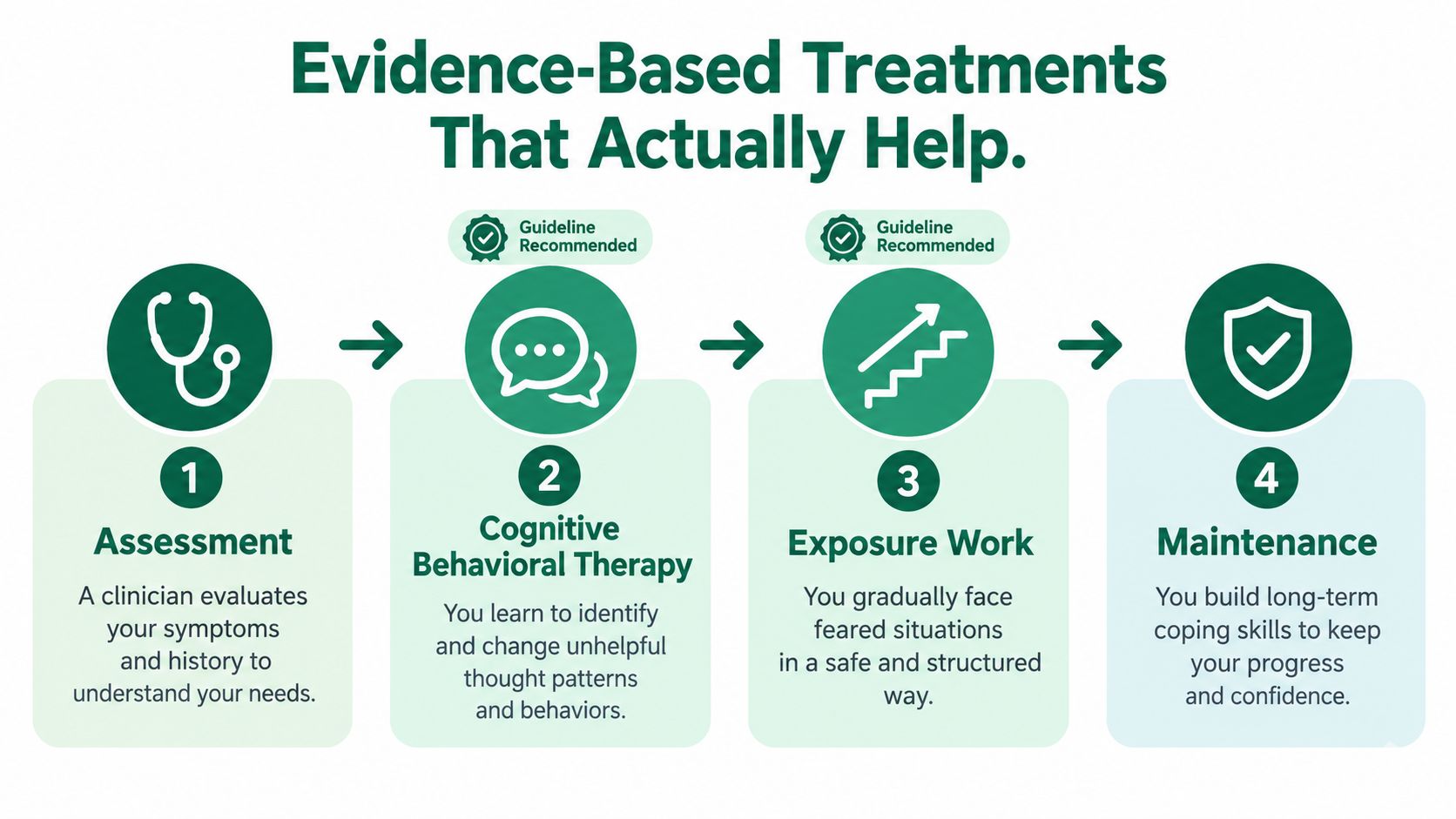
Anxiety treatment works best when it fits the person's symptoms, circumstances, and goals. Cognitive behavioral therapy (CBT) helps people notice anxious predictions, examine how well they match the facts, and change habits that keep fear in place. If avoidance is part of the pattern, therapy may include planned exposure, approaching feared situations gradually with a therapist's support.
Treatment recommendations depend on the diagnosis and the degree of impairment. NICE recommends high-intensity CBT or applied relaxation for GAD when symptoms cause marked impairment or have not improved with lower-intensity care. Its guidance describes CBT for GAD as typically 12–15 weekly, one-hour sessions. For social anxiety disorder, NICE recommends individual CBT based on the Clark and Wells model, generally up to 14 sessions of 90 minutes over roughly four months (NICE recommendations for GAD and social anxiety).
Match the tool to the problem
Exposure practice might involve contributing one comment in a meeting or entering a place someone has avoided. The goal is to test a feared prediction through planned, collaborative practice, not to push someone past what feels manageable. A therapist can adjust the pace to account for personal circumstances, including trauma history or medical concerns.
Other approaches may suit different needs. Acceptance and commitment therapy can help someone act in line with their values while making room for difficult thoughts and feelings. EMDR may be considered when trauma is relevant. A clinician can discuss which approach fits rather than assuming one method works for everyone. For questions to discuss with a prescriber, see this anxiety medication safety guide.
Medication is another option to consider with a qualified prescriber. NICE guidance includes psychological interventions and medication options for anxiety, including SSRIs for adults when appropriate. The choice depends on symptoms, health history, preferences, risks, and response. Therapists cannot prescribe unless they are appropriately qualified, so coordinating care with a prescriber may be helpful.
Breath pacing, regular sleep, gradual movement, and practicing skills between sessions can support treatment. They do not replace an assessment when anxiety is disrupting daily life. Digital resources can make it easier to begin learning, though improvement while using an app does not by itself establish lasting recovery. This CBT guide to anxiety treatment explains how structured counseling may work.
Why Smart People Wait So Long to Get Help
Being capable doesn't protect you from anxiety, and managing responsibilities doesn't prove the problem is manageable. In a representative German adult community sample, only 26% of people with an anxiety disorder had ever contacted mental-health services because of anxiety, while 40% had never considered seeking help. Reported barriers included self-reliance (18.4%), doubts treatment would help (8.7%), unavailability (8.3%), and stigma (6.7%) (community sample on barriers to anxiety care).
People often delay because they tell themselves they should handle it alone, or because the symptoms have become familiar. Others worry therapy will be pointless, can't find accessible care, or don't recognize avoidance and constant physical tension as concerns worth assessing. Those obstacles are real. They aren't evidence that a person lacks insight or isn't trying hard enough.
Choosing a reasonable next step
If anxiety is occasional, linked to a clear stressor, and not narrowing your life, self-help and practical changes may be a reasonable place to start. You might track what triggers the worry, notice whether you're avoiding a specific activity, and work on a regular sleep routine. If symptoms persist, worsen, or raise questions about physical health, a primary-care appointment can help review medical factors and discuss referrals.
A mental-health evaluation is worth considering when anxiety is disrupting work, relationships, sleep, or daily activities, or when avoidance is spreading. A consultation is a chance to ask what the clinician recommends, how they approach treatment, and whether you feel comfortable with them. It doesn't commit you to medication or a particular therapy.
Medication fears deserve a direct conversation with a prescriber rather than a rushed decision. A thoughtful therapist can help clarify symptoms and treatment goals, while a prescriber can discuss medication options and monitor them when appropriate. If access or uncertainty has been part of your delay, this overview of barriers to mental-health treatment may help you identify what would make reaching out feel more manageable.
A useful starting point: You don't need to prove that anxiety is severe enough before asking what it means. An assessment is a way to gather information and make a more informed choice.
How We Approach Anxiety at Be Your Best Self and Thrive
At Be Your Best Self & Thrive Counseling, PLLC, care in St. Petersburg draws on evidence-based practice, trauma-informed principles, and a mind-body-spirit perspective. Anxiety can be shaped by relationships, stress, health, and personal history. A capable person may keep meeting work and family demands while privately avoiding situations, losing sleep, or feeling on edge. Understanding how anxiety affects your particular life is the starting point. Individual and couples counseling can address worry, avoidance, conflict, and burnout.
A therapist can help you see how thoughts, bodily responses, and behavior reinforce one another. The nervous system's alarm can stay active even when there is no immediate danger, much like a smoke detector reacting to burnt toast. Practical strategies are chosen around your needs and may include CBT-informed tools, somatic awareness, and support for changing patterns that sustain distress. The practice also offers neurodivergent-affirming support for people with ADHD, autism, and high sensitivity, along with counseling for entrepreneurs and couples.
The free initial consultation is a low-pressure way to discuss fit and goals. Bring examples of what has been difficult, questions about the therapist's approach, or a sense that something has changed. In early sessions, you can talk about your concerns, history, priorities, and what you hope will be different. You and your therapist can then shape an individualized plan, rather than assume one protocol fits everyone.
If anxiety is taking up more of your life than you want, consider booking a free initial consultation with Be Your Best Self & Thrive Counseling, PLLC. The St. Petersburg practice offers individualized, trauma-informed counseling for anxiety, including support for adults and couples across the Tampa Bay area.