
Does Marriage Counseling Really Work? an Honest Guide
What would change if you stopped asking whether marriage counseling works in general and started asking how you'll know whether it's working for your relationship?
That distinction matters. A skeptical partner may want proof before scheduling a first appointment, while the other partner may already feel exhausted from waiting. Both reactions make sense. Counseling isn't a guaranteed rescue, a weekly venting ritual, or a verdict about whether a marriage should continue. It's a structured process designed to help partners change the patterns that keep distress going.
Why So Many Couples Ask Whether Counseling Really Works
People usually search "does marriage counseling really work" when hope and doubt are sitting in the same room. One partner may have suggested therapy after repeated arguments, emotional distance, an affair, or years of feeling unheard. The other may wonder whether counseling will turn private conflict into an expensive conversation with a stranger.
That skepticism can be useful. Couples deserve to know what therapy is intended to change, how progress is measured, and what happens when the first approach doesn't help. Barriers such as cost, stigma, scheduling, fear of judgment, and uncertainty about finding the right clinician can also delay care, as discussed in this overview of barriers to mental health treatment.
The research supports a hopeful but qualified answer. Structured couples therapy can improve relationship satisfaction, communication, emotional intimacy, and partner behavior. The strongest evidence doesn't support a universal success promise, though. Outcomes vary with the therapy model, the therapist's skill, each partner's participation, the couple's safety, and whether new behaviors continue outside sessions.
A better question than yes or no
Instead of asking only whether counseling works, ask:
What is our repeating cycle? Are you caught in criticism and defensiveness, pursuit and withdrawal, secrecy, shutdown, or unresolved injury?
What would improvement look like? You might choose shorter escalations, more successful repairs, greater emotional responsiveness, or a clearer decision about the relationship.
How will we measure movement? A calmer week can feel encouraging, but specific observations are more reliable than hope or panic.
What happens if we plateau? A skilled therapist should be willing to reassess the formulation, change methods, add individual support, or discuss whether joint therapy remains appropriate.
Counseling can help couples reconnect. It can also help partners understand that reconciliation isn't possible or advisable. Either outcome can involve meaningful clarity when the process is honest, collaborative, and safe.
What the Research Actually Shows About Effectiveness
The evidence doesn't reduce neatly to a percentage of marriages “saved.” Researchers usually measure changes in relationship satisfaction, communication, emotional intimacy, conflict behavior, and responsiveness. Those outcomes are more useful because a couple can make important progress even when the final decision is not to remain together.
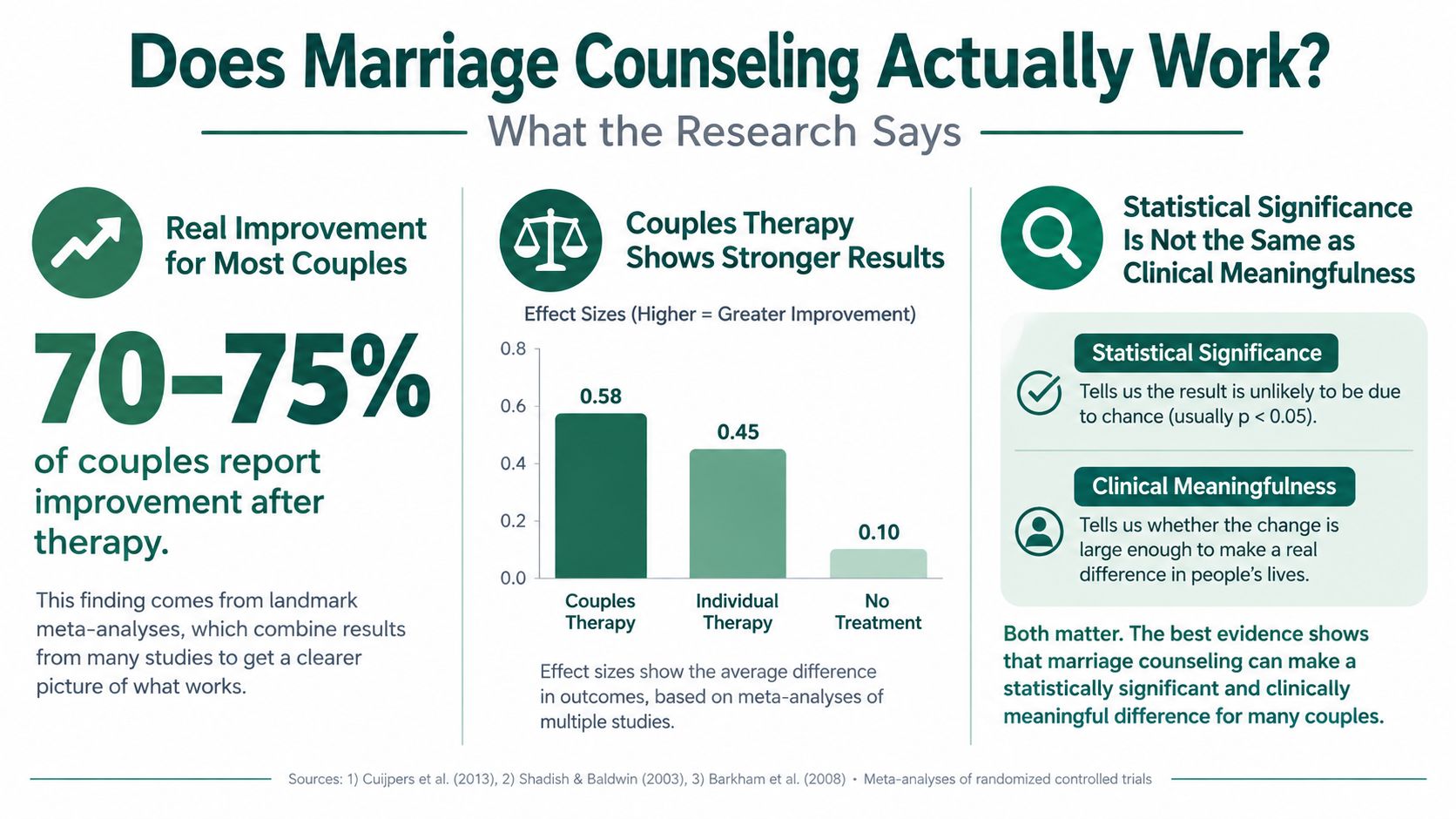
A meta-analysis of 30 randomized controlled trials of behavioral marital therapy found a standardized between-group effect size of d = 0.585 compared with no-treatment controls. That represents a moderate effect, meaning treated couples improved substantially more than distressed couples who didn't receive treatment. The findings are reported in the PubMed review of behavioral marital therapy.
A broader meta-analysis covering 58 studies, 40 unique samples, and 2,092 couples found a pre-to-post improvement in relationship satisfaction of Hedges' g = 1.12, with a 95% confidence interval of 0.92 to 1.31. Couples on waitlists showed a nonsignificant change of g = 0.12, with a 95% confidence interval from −0.04 to 0.29. The review also found improvements in self-reported and observed communication, emotional intimacy, and partner behavior, as summarized in this meta-analysis of couple therapy outcomes.
Improvement after therapy is not the same as permanent change
A separate meta-analysis of behavioral couple therapy and emotionally focused couples therapy, covering 33 studies and 2,730 participants, found medium post-treatment effects overall, with Hedges' g = 0.60. The estimate was g = 0.53 for behavioral therapy and g = 0.73 for emotionally focused therapy. At six months, the overall effect remained small to moderate at g = 0.44, including g = 0.35 for behavioral therapy and g = 0.66 for emotionally focused therapy. The available behavioral-therapy estimate at twelve months was near zero at g = 0.06, and the authors cautioned about possible publication bias. These findings come from the Journal of Marital and Family Therapy meta-analysis.
Counseling reliably improves relationship functioning in the short term. Long-term results depend heavily on what couples practice between sessions and whether ongoing stressors reactivate the old cycle.
That distinction explains why an early breakthrough isn't proof that the work is finished. A couple may communicate better in the protected setting of therapy, then return to sleep deprivation, financial strain, trauma triggers, parenting pressure, or unresolved betrayal. Without repetition, repair planning, and follow-up, old reactions can regain strength.
A separate review of marital-distress interventions found an overall effect of Cohen's d = 0.85, with a 95% confidence interval from 0.56 to 1.14, a result significantly different from zero at Z = 5.79 and P < 0.001. The authors combined different intervention models and study designs, so the figure isn't a guaranteed outcome for every couple. It does provide further evidence that structured interventions can reduce marital distress compared with no intervention, as described in this review of interventions for marital distress.
For a plain-language discussion of why broad success claims can mislead, compare the research with this guide to marriage counseling success rates. The practical conclusion is neither blind optimism nor dismissal. Counseling can produce meaningful change, but couples need a plan for keeping that change alive.
Matching the Therapy Model to Your Couple
Not every therapist means the same thing by “couples counseling.” One clinician may focus on observable interaction habits, another on attachment injuries, and another on a structured blend of assessment, communication training, and relationship exercises. The right model depends on the mechanism maintaining your distress.
Three common approaches
Behavioral couple therapy targets what happens during interactions. The therapist may help you identify criticism, defensiveness, withdrawal, escalation, ineffective repair attempts, and patterns in which one partner pursues while the other retreats. Sessions often include concrete practice, such as making a specific request, reflecting what was heard, pausing before escalation, or replacing a global accusation with a description of one behavior.
Emotionally focused couples therapy, often called EFT, looks beneath the argument. A fight about household responsibilities may include a deeper fear of being unimportant, abandoned, controlled, or alone. EFT helps partners recognize the attachment cycle and express vulnerable needs in ways that invite responsiveness rather than triggering protection.
Integrative and Gottman-influenced methods combine assessment with practical skills. A therapist may examine friendship, conflict management, repair, trust, emotional connection, and shared meaning while also teaching structured conversations. The method matters, but so do the clinician's training, ability to track the cycle, and willingness to adapt when a technique isn't landing.
Model | Core Focus | Best Fit For | Typical Arc |
|---|---|---|---|
Behavioral couple therapy | Interaction patterns and behavior change | Couples stuck in criticism, defensiveness, withdrawal, or recurring practical conflict | Identify the cycle, learn skills, practice repairs, review progress |
Emotionally focused couples therapy | Attachment needs and emotional responsiveness | Partners who feel alone, rejected, disconnected, or caught in pursuit and withdrawal | De-escalate the cycle, access underlying emotions, build new responses |
Integrative or Gottman-influenced work | Assessment, communication, repair, friendship, and shared meaning | Couples seeking a structured blend of insight and practical tools | Assess strengths and risks, target conflict and connection, consolidate gains |
A couple dealing with an affair may need trust and accountability work before ordinary communication exercises can help. A neurodiverse couple may need adaptations for sensory load, processing speed, attention, or memory rather than being told to communicate harder. A pair facing possible separation may need discernment-focused work before committing to relationship repair.
Ask prospective therapists direct questions: Which model do you use? What pattern do you think it fits? How do you measure progress? What do you do when partners improve unevenly? You can also ask about training in approaches such as attachment-based couples therapy. A convenient location matters, but it shouldn't be the only selection criterion.
The Four Factors That Decide Whether Counseling Helps You
Couples often blame the severity of their problems when therapy stalls. Severity matters, but it isn't the whole story. A severely distressed couple can improve when the treatment fits the problem and both partners participate. A less distressed couple can plateau when sessions remain vague, the therapist misses the cycle, or neither partner practices outside the office.
Motivation has to be active
Both partners don't need equal enthusiasm on the first day. They do need enough willingness to examine their own contribution, try unfamiliar behaviors, and tolerate discomfort without using therapy as a courtroom.
One partner can begin cautiously. That partner should still be able to answer, “What are you willing to try?” If the answer is only “I want my spouse to change,” the therapist has limited room to work.
Timing can support or undermine the work
Therapy started during a crisis may first need stabilization. A couple affected by an affair, active substance misuse, severe depression, or relentless sleep deprivation may need immediate safety and individual care alongside joint sessions. Therapy started after years of untreated injury can still help, but partners may require patience because trust and emotional flexibility have eroded.
Therapist fit deserves a deliberate test
A therapist should be able to interrupt escalation without humiliating either partner, hold both perspectives without creating false equivalence, and explain why a particular exercise fits the couple's pattern. If you leave every appointment feeling exposed but not oriented, or if one partner consistently feels blamed, raise the concern early.
Practice turns insight into a relationship
Insight can be valuable, but relationships change through repeated behavior. Partners might rehearse a ten-minute check-in, use an agreed pause procedure, write down one specific appreciation, or return to a difficult conversation using a repair script. The task should be realistic enough to complete and concrete enough to review.
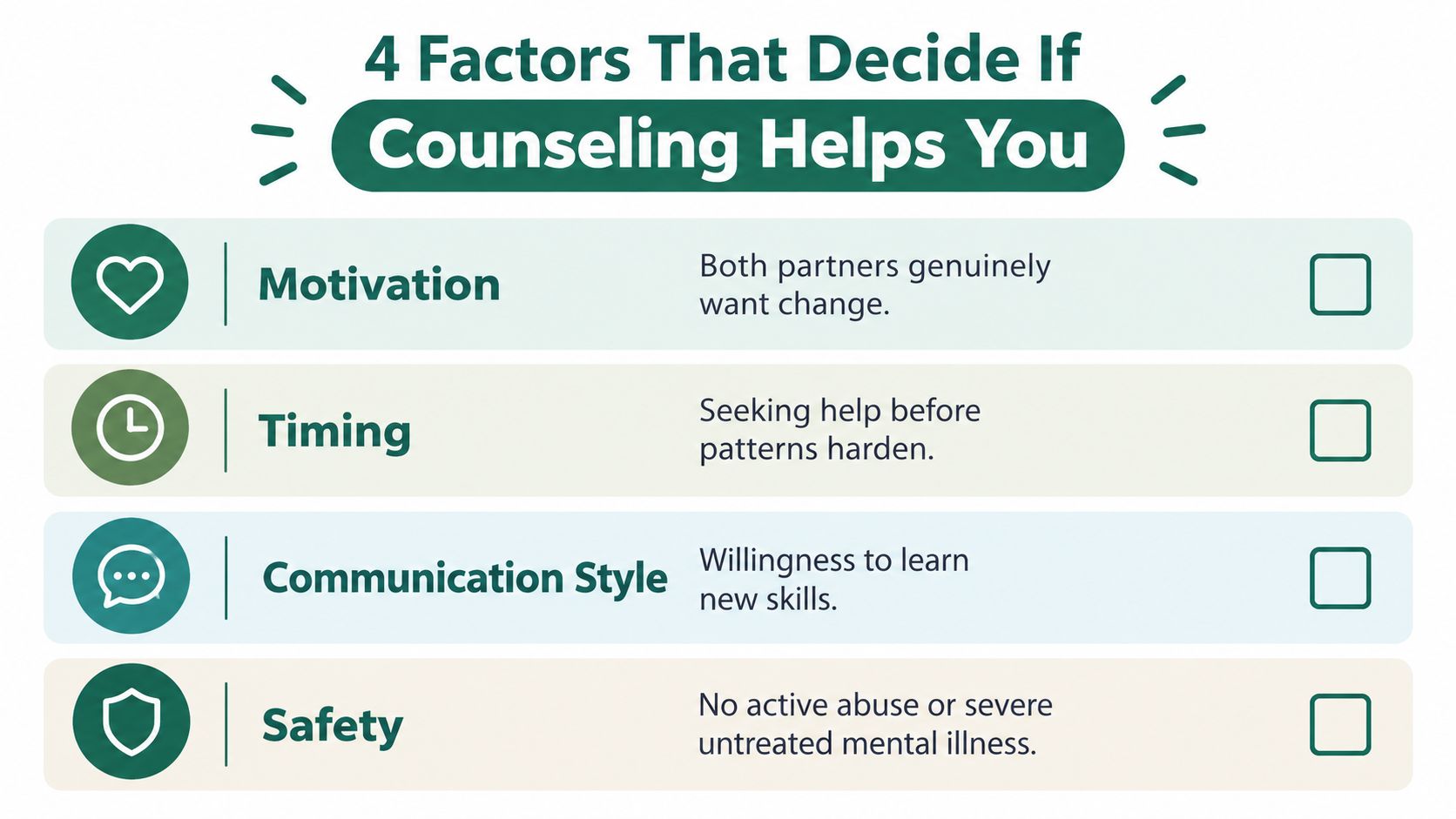
Before booking, ask yourselves:
Can each of us name one pattern we want to change?
Can we practice a new response even when it feels unnatural?
Can we speak truthfully without fear of retaliation?
Will we tell the therapist when an exercise or interpretation doesn't fit?
Can we define progress in observable terms?
If the answer to safety is no, joint counseling should not be treated as the automatic next step. Safety changes the clinical question entirely.
What Actually Happens Inside the Therapy Room
The first appointment may feel awkward because the therapist is gathering information while both partners are trying to decide whether the room is safe. A careful intake usually includes the presenting concerns, each person's relationship history, relevant family and trauma experiences, current stressors, mental-health concerns, and what each partner wants from treatment.
A clinician may meet privately with each partner when appropriate. That private time can help identify safety concerns, coercion, undisclosed risks, or experiences that someone cannot describe freely in front of the other person. The therapist should explain confidentiality boundaries and how private information will be handled before those conversations begin.
From the cycle to a shared target
After assessment, the therapist usually offers a working explanation of the couple's pattern. You might hear that one partner protests disconnection through repeated questions while the other protects against criticism by going silent. Or you might identify a cycle in which practical stress becomes a personal accusation, followed by defensiveness and a failed attempt to reconnect.
The therapist may then use structured conflict conversations, reflective listening, repair-attempt rehearsals, emotion-focused dialogues, or behavioral agreements. The purpose isn't to produce a perfect session. It's to help partners notice the cycle sooner and choose a response that interrupts it.
Progress often feels uneven
A couple can have a productive session and still argue that evening. The middle phase may feel worse before it feels better because partners are noticing patterns they previously acted out automatically. That discomfort isn't proof of failure, but repeated escalation without learning, safety, or a change in direction deserves attention.
A good therapist periodically asks what is changing outside the room. Are conflicts shorter? Does one partner return after taking a pause? Do apologies lead to changed behavior? Can each person describe the other's experience with less distortion? These questions are more informative than whether the session felt emotionally intense.
Treatment should also include an ending plan. Partners may need relapse-prevention steps, a method for revisiting unresolved topics, and booster sessions during major transitions. This practical guide to the first session with a therapist can help you arrive with realistic expectations and useful questions.
When the Picture Is More Complicated Than Average
Real couples rarely arrive with one clean problem. An affair may sit alongside attachment injury, depression, parenting exhaustion, or years of avoidance. Neurodivergence may affect timing, sensory tolerance, executive functioning, and how each partner shows care. Coercion can make ordinary communication advice unsafe.
Infidelity changes the treatment task
Affair recovery usually requires more than learning to argue fairly. The injured partner may need answers, emotional acknowledgment, consistent transparency, and evidence that the outside relationship has ended. The partner who had the affair must take responsibility without demanding quick forgiveness or using the injured partner's reactions as proof that repair is impossible.
Counseling may support reconciliation, but it shouldn't presume that reconciliation is the goal. Some couples use therapy to reach clarity, establish respectful separation, or decide whether rebuilding trust is realistic. The therapist should assess accountability, honesty, ongoing contact with the affair partner, and each person's capacity to tolerate a long repair process.
Neurodiverse couples need accurate interpretation
A partner with ADHD may struggle with follow-through, time awareness, working memory, or task initiation. An autistic partner may process language at face value, need more time to shift topics, experience sensory overload, or communicate care in ways the other partner doesn't immediately recognize. These differences don't excuse cruelty or neglect, but they can make a simple "communication problem" diagnosis incomplete.
A neurodiversity-affirming therapist adapts the process. That might mean written agreements, explicit requests, extra processing time, reduced sensory stimulation, reminders, predictable agendas, or separating intention from impact. The aim is not to make one partner perform a more socially familiar style. It's to build reliable ways for both partners to understand and respond to one another.
Safety comes before relationship technique
Joint therapy requires enough safety for each person to disagree, disclose, pause, and leave the session without retaliation. Ask privately:
Can both partners speak with the therapist alone?
Does either person fear consequences after sessions?
Does one partner control phones, money, movement, work, friendships, or access to care?
Can either person say no without intimidation?
Has severe physical aggression, coercive control, psychosis, or untreated substance use affected the relationship?
A 2025 clinical review states that evidence-based couple therapy may be appropriate for selected couples with mild-to-moderate situational intimate-partner violence when both partners want to remain together, the abusive partner accepts a no-harm commitment, and clinicians complete careful suitability and safety assessment. The same guidance identifies severe physical aggression, coercive control, court-ordered no-contact situations, major cognitive impairment or psychosis, and some untreated substance-use circumstances as contraindications, as described in this review of couple therapy and intimate-partner violence.
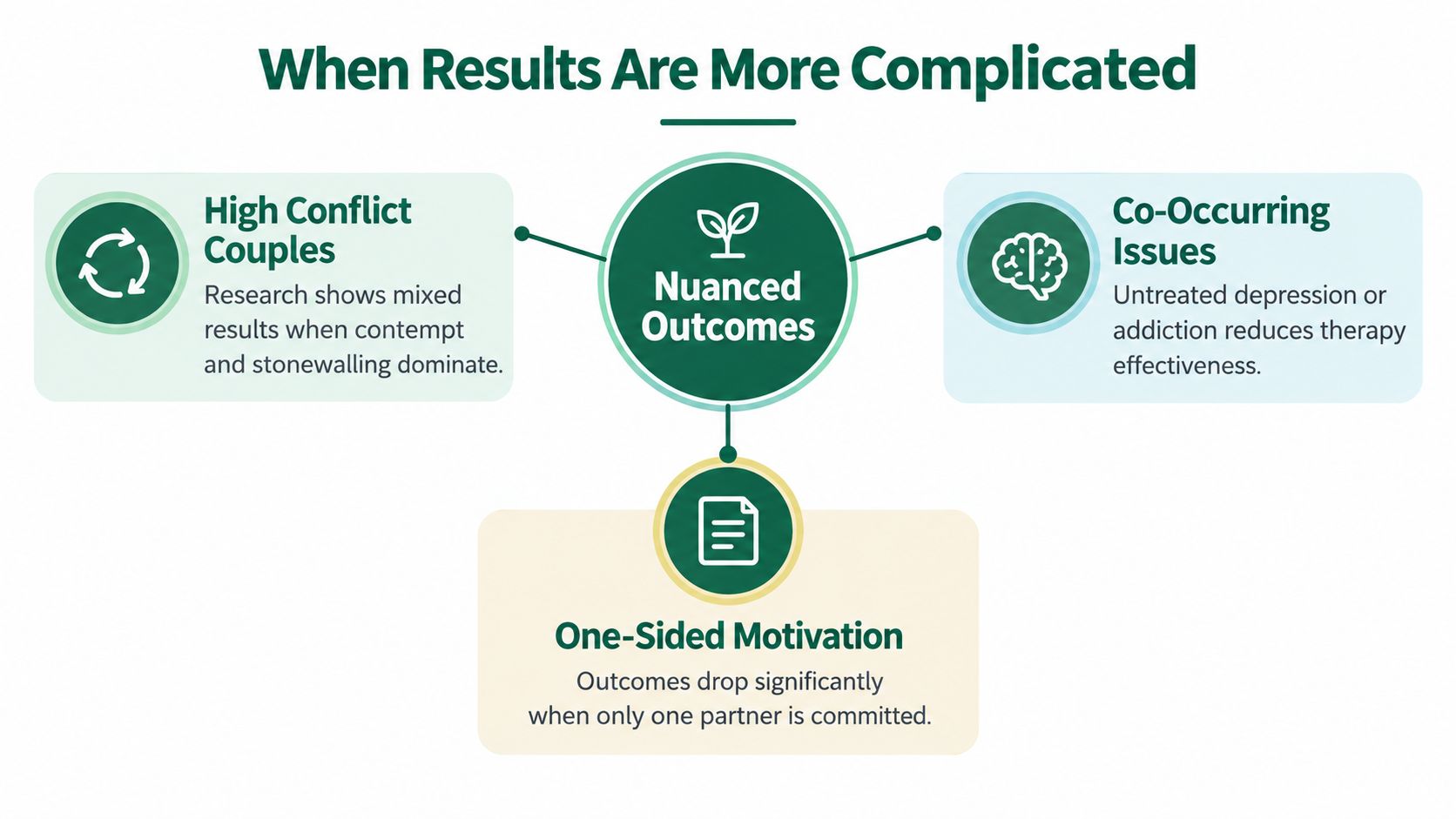
When intimidation or severe violence is present, individual support, safety planning, specialized domestic-violence services, or separation-focused care may be more appropriate than ordinary joint counseling. Articles discussing couples counseling with a narcissist should also be read carefully, because labels matter less than observable behavior, accountability, coercion, and the safety of the person seeking help.
A Practical Toolkit for Choosing Well and Staying With It
Start by identifying two or three therapists whose training matches your needs. Ask about their primary model, experience with affairs or neurodiverse couples when relevant, safety screening, how they handle uneven motivation, and how they review progress. A free initial consultation can help you determine whether both partners feel respected and whether the therapist explains the work clearly.
Set goals you can observe. Track conflict frequency, escalation length, repair success, emotional connection, and satisfaction ratings. Review those targets periodically instead of deciding that therapy works only because one appointment felt hopeful or fails because one week went badly.
During treatment, protect the gains:
Create a pause plan: Agree on how to stop escalation, when to return, and what each person may do during the break.
Rehearse repair: Practice the conversation before the next crisis, not only after someone has said something damaging.
Plan for relapse: Identify stressors that reactivate the old cycle and decide what action comes first.
Use follow-up care: Consider booster sessions when major life transitions or recurring patterns threaten progress.
For couples in St. Petersburg and the Tampa Bay area, local in-person continuity may complement telehealth, especially when a consistent therapeutic relationship helps both partners stay engaged. Counseling is one tool inside a long relationship. It can support reconnection, safer communication, and informed decisions, but it can't replace accountability, practice, or honest attention to safety.
Be Your Best Self & Thrive Counseling, PLLC offers individual and couples or marriage counseling in the St. Petersburg area, including support for communication difficulties, relationship disconnection, affair recovery, and neurodivergent couples. Visit Be Your Best Self & Thrive Counseling, PLLC to request a free initial consultation and discuss whether the therapist, approach, and goals fit your relationship.