
Depression Treatment for Women: Care That Works
You're in St. Petersburg, standing in the kitchen after everyone else has gone to bed, trying to decide whether your low mood has lasted long enough to justify calling a therapist. Sleep has become unreliable, work feels strangely distant, and you're avoiding people you used to enjoy. You may also be managing a new baby, menstrual-cycle changes, perimenopausal night waking, conflict at home, care for an aging parent, or a career that no longer fits.
That context isn't a distraction from depression treatment for women. It's part of the clinical picture. Effective care has to account for biology, life stage, relationships, responsibilities, trauma, and access, not only a diagnostic label. The map below is evidence-informed and practical, but it can't replace an individual assessment, especially when safety concerns, pregnancy, severe symptoms, or medication decisions are involved.
Why Depression in Women Deserves Its Own Map
A woman may describe herself as “just overwhelmed” because her depression arrived gradually. She's still answering emails, packing lunches, and showing up for other people. Yet she wakes exhausted, feels detached from conversations, and can't remember the last time pleasure came easily. Her first question often isn't “Which treatment category should I choose?” It's “Why does everything feel harder when I'm still functioning?”
Generic depression advice misses the conditions surrounding that question. A postpartum woman may be sleeping in fragments and carrying fear about harming her bond with her baby. Someone in perimenopause may be experiencing persistent insomnia, irritability, and mood changes that follow a pattern she hasn't previously recognized. Another woman may be grieving a relationship, caring for a parent, or living with a workplace that steadily erodes her sense of competence.
A useful care plan starts by asking what changed, what repeats, and what keeps the symptoms going. That may include cycle timing, reproductive events, medical conditions, trauma exposure, social isolation, financial pressure, and the practical availability of childcare or transportation. Women seeking a personalized starting point can also review women's mental health counseling resources while considering what kind of support fits their situation.
A practical rule: The complication is often the treatment clue.
This is the biopsychosocial frame in action. Biological factors may shape energy, sleep, hormonal sensitivity, or medication response. Psychological patterns may include rumination, perfectionism, grief, trauma responses, or hopeless predictions. Social conditions may determine whether a woman can attend weekly sessions, rest after childbirth, leave an unsafe relationship, or afford a prescription.
The right plan is therefore individualized. Mild depression may respond well to structured psychological treatment, while moderate or severe depression may require medication, therapy, or coordinated medical care. The goal isn't to label a woman by her life stage. It's to understand the full system in which her symptoms are occurring.
The Biopsychosocial Frame for Women's Depression
A woman may be exhausted because she is caring for a parent, sleeping poorly after childbirth, or managing symptoms that change with her menstrual cycle. Another may feel stuck in rumination after trauma or a relationship loss. The biopsychosocial model brings these possibilities into one clinical assessment by examining the body, psychological patterns, and social conditions together.
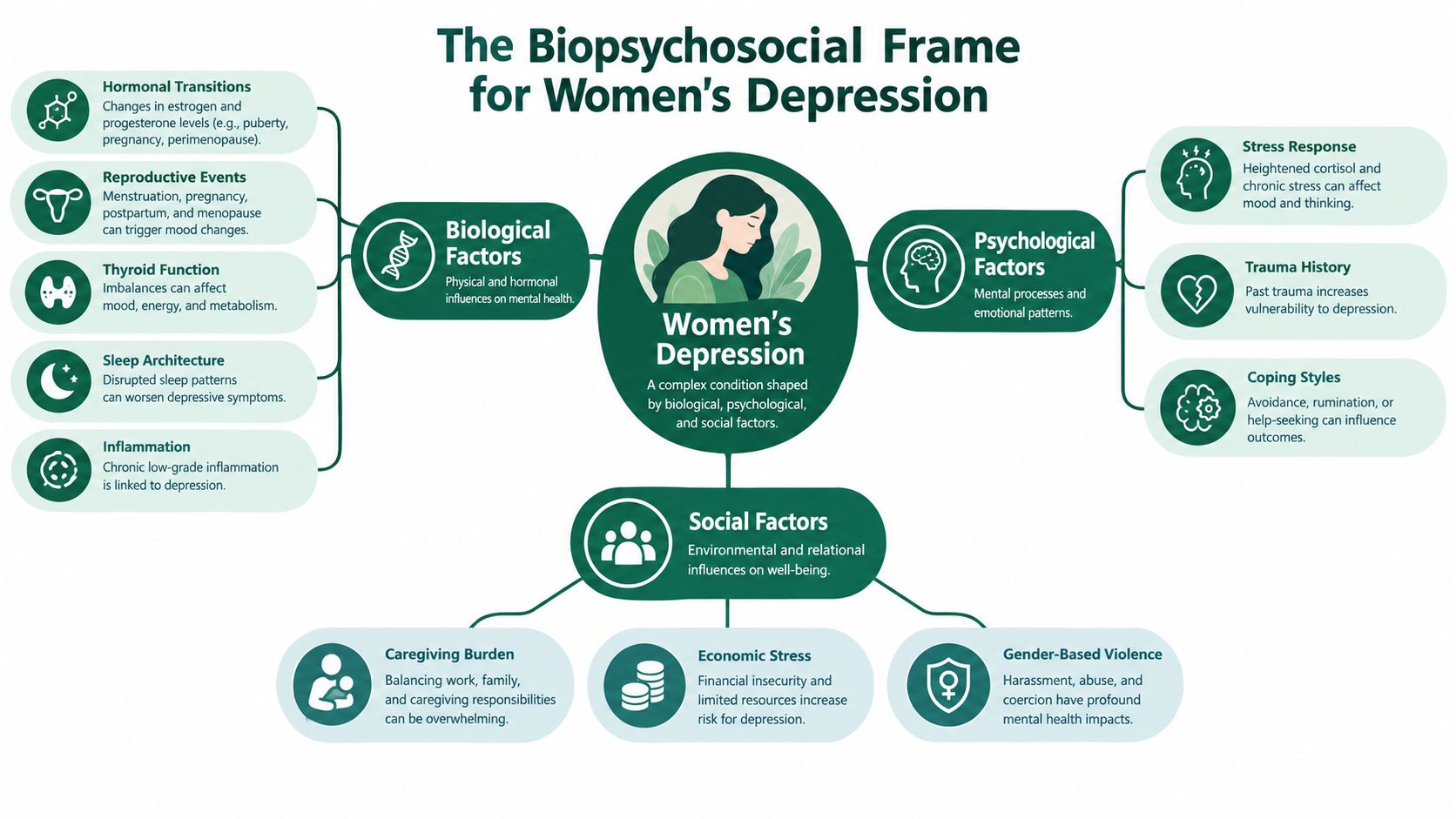
The World Health Organization estimated that in 2023, depression affected 6.2% of adult women globally compared with 4.1% of adult men, and that depression was approximately 1.5 times more common among women overall (World Health Organization depression fact sheet). More than 10% of pregnant women and women who have recently given birth experience depression worldwide, according to the same source. These figures do not prescribe one treatment. They show why reproductive transitions, pregnancy, postpartum changes, caregiving, trauma exposure, and social stress need a place in assessment.
Three lenses for describing what's happening
Biology includes menstrual and reproductive transitions, thyroid function, sleep architecture, inflammation, medication metabolism, and other medical contributors. Persistent fatigue, sleep disruption, or mood changes may call for coordination with primary care, obstetrics, or a menopause specialist rather than a purely psychological response.
Psychology includes the patterns that maintain distress or support recovery. Rumination can keep a painful event active long after it ends. Perfectionism can turn ordinary limits into proof of personal failure. Trauma history may affect trust, emotional regulation, body awareness, and how quickly therapy feels safe.
Social context includes caregiving demands, relationship conflict, economic strain, isolation, discrimination, and gender-based violence. A woman who cannot sleep because she is caring for a parent needs a different practical response from someone whose fatigue follows panic and nighttime fear.
Assessment should connect these lenses to treatment choices. Mild depression may be addressed with structured psychological care, while moderate or severe symptoms may call for medication, therapy, or coordinated medical support. Preferences, reproductive stage, prior treatment experiences, safety, and access all matter. A plan that requires weekly appointments may fail if childcare or transportation is unreliable.
A related explanation of how the nervous system works can make body-based symptoms easier to understand. Nervous-system education can support treatment, but it does not replace depression assessment or evidence-based care.
Therapy Modalities That Have the Strongest Evidence
Therapy is most useful when its method matches what keeps depression going. A woman who has withdrawn from nearly every enjoyable activity needs a different starting point from someone whose mood fell after divorce, a caregiving change, or another major role transition. Treatment should also account for time, childcare, prior disappointing therapy, and whether weekly attendance is realistic.
CBT and behavioral activation
Cognitive behavioral therapy examines how thoughts, emotions, and actions reinforce one another. A therapist might help a client test the belief, “I'm failing at everything,” against specific evidence, then develop a more accurate interpretation and choose one small behavior that supports recovery. The work is structured, practical, and collaborative, although it requires enough concentration to practice between sessions.
Behavioral activation puts less emphasis on debating thoughts and more on restoring contact with meaningful activity. A client who spends weekends in bed might schedule a brief walk, one phone call, and one manageable household task, then track what changes after acting instead of waiting for motivation. This approach can be especially useful when depression has narrowed daily life. A practical guide to behavioral activation for depression explains why planned, modest actions can matter.
Clinical guidance identifies CBT and behavioral activation as effective psychological treatments (APA clinical practice guideline). For mild depression, psychotherapy is often a reasonable initial choice, particularly when a person wants skills-based care and can participate consistently. If symptoms are more severe, therapy may need to be combined with medication or medical support.
IPT and problem-solving therapy
Interpersonal psychotherapy, or IPT, suits depression linked with grief, relationship conflict, isolation, or a major change in role. A new mother who feels unsupported, or a woman adjusting to divorce, retirement, or intensive caregiving, may use sessions to clarify needs, communicate more directly, and rebuild practical support.
Problem-solving therapy is concrete. The therapist and client define one problem, list possible responses, select a workable action, and review the result. That structure can fit childcare gaps, workplace strain, medical appointments, or financial pressure, especially when open-ended discussion feels difficult.
Dialectical behavior therapy skills may help when intense emotions, impulsive reactions, or low distress tolerance obstruct recovery. Practice can include noticing emotion before reacting, grounding during escalation, and communicating needs more effectively.
A plan may start with weekly sessions and an activation focus, then shift toward maintenance as symptoms improve. Comfort alone does not determine fit. By the second or third meeting, you should usually know the treatment target, understand what you are practicing between sessions, and have a clear way to discuss changes if progress stalls.
Medication Decisions That Respect Female Physiology
Medication decisions should start with the person's symptoms, treatment history, reproductive plans, and tolerance for specific risks. Ask what needs to improve, what has caused problems before, and how untreated depression is affecting work, relationships, caregiving, sleep, and safety. Pregnancy and lactation also change the benefit-risk discussion, but they do not make treatment decisions automatic.
Selective serotonin reuptake inhibitors, or SSRIs, are commonly used first-line medications when medication is indicated. Sertraline and escitalopram are practical options in relevant peripartum situations, with prescribing shaped by medical history and previous response. Sertraline is also often considered during breastfeeding because evidence indicates relatively low transfer into breast milk (NCBI perinatal depression review). The choice still depends on prior benefit, side effects, other medicines, and the person's current circumstances.

A 2018 systematic review in Biological Research for Nursing found evidence of biological differences involving hormonal, neuroendocrine, inflammatory, and pharmacokinetic factors (systematic review of sex differences in depression treatment). These findings may help explain differences in response or adverse effects, but they do not support gender-only prescribing. Research has suggested that SSRIs may work better for some women, and that some women may respond to lower doses of fast-acting ketamine than men. Broader evidence has not consistently shown a sex difference in remission outcomes, so the individual response remains more useful than a category label.
What to track with a prescriber
Mood and functioning: Record changes in pleasure, concentration, energy, work, parenting, and relationships.
Sleep and anxiety: Improvement in depression can occur alongside worsening agitation, anxiety, or insomnia.
Activation symptoms: Report unusually increased energy, reduced need for sleep, impulsivity, or racing thoughts before increasing a dose.
Cycle and reproductive timing: Note changes across the menstrual cycle, pregnancy, postpartum period, or perimenopause.
Sexual side effects and withdrawal: Discuss reduced libido, delayed orgasm, emotional blunting, dizziness, or discontinuation symptoms. Do not stop abruptly without medical guidance.
Pregnancy or breastfeeding alone should not automatically end an effective medication. The American College of Obstetricians and Gynecologists recommends discussing benefits and risks, using validated screening tools, and avoiding discontinuation solely because someone is pregnant or breastfeeding (ACOG perinatal mental-health assessment and treatment). Adjustments should follow shared, measured benefit-risk reasoning rather than a fixed dose rule.
Perinatal, Postpartum, and Perimenopausal Considerations
A new mother may be sleeping in fragments, caring for an infant, and still telling everyone she is fine. Routine screening matters because shame, exhaustion, and the belief that suffering is just part of motherhood can keep symptoms hidden. Approximately 1 in 8 postpartum women reported depressive symptoms in 2018, while depressive-disorder diagnoses during U.S. delivery hospitalizations rose from 4.1 per 1,000 hospitalizations in 2000 to 28.7 per 1,000 in 2015, according to NIMH's summary of postpartum depression research.
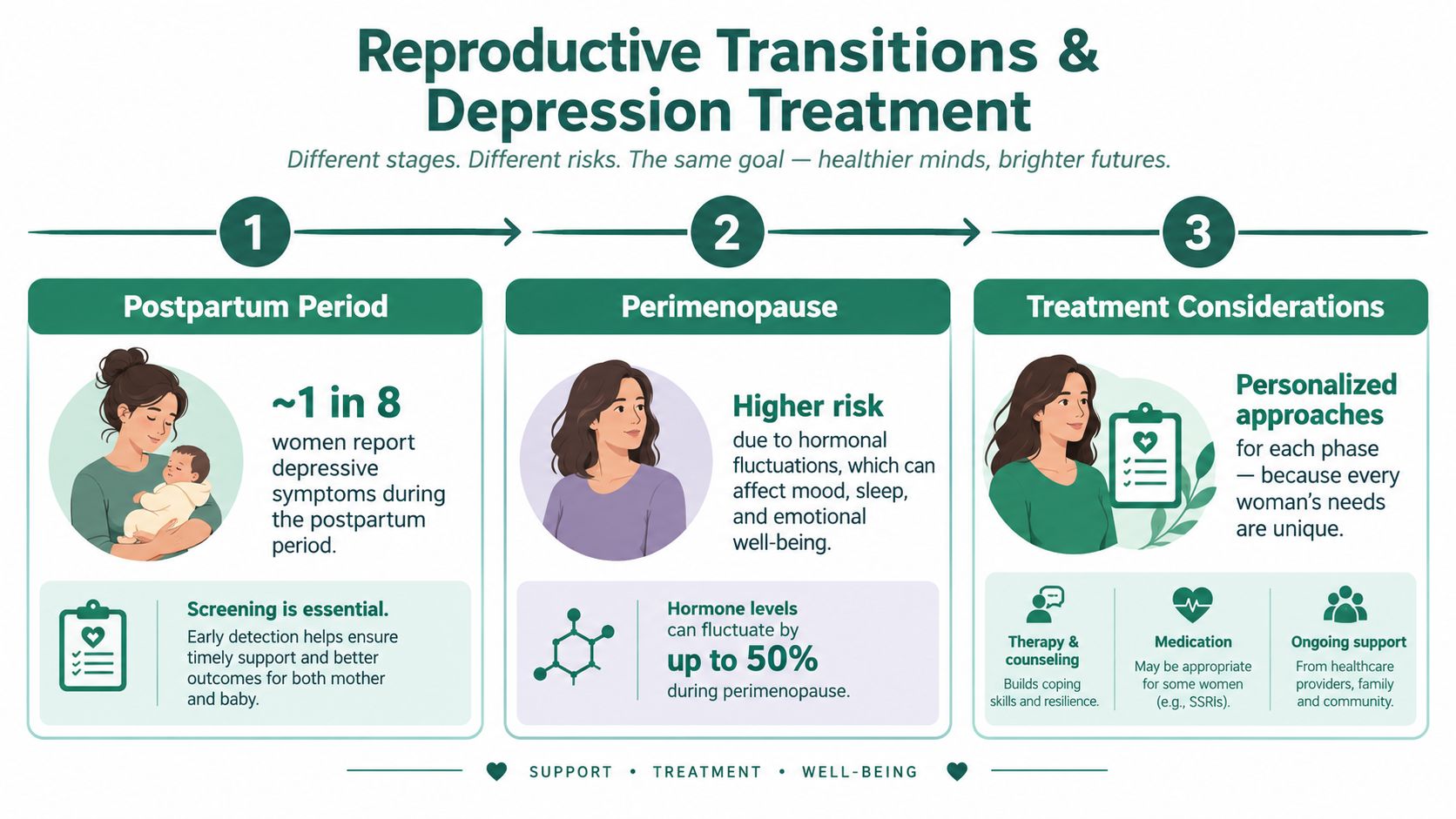
For mild-to-moderate peripartum depression, CBT and IPT have strong support. Moderate-to-severe symptoms may call for psychotherapy, an antidepressant, or both. Combined care is often considered when therapy alone does not provide enough relief. SSRIs are commonly used first, and sertraline may be considered when there is no prior medication history. Treatment choice still depends on symptom severity, previous response, pregnancy or lactation, and the patient's preferences.
A practical assessment includes the PHQ-9 or Edinburgh Postnatal Depression Scale, suicide-risk questions, and screening for bipolar-spectrum symptoms before prescribing. Agree on a meaningful target, such as improved sleep, functioning, bonding, or pleasure, rather than tracking a score alone. Needs can shift during pregnancy and after delivery, so follow-up should continue beyond birth, as shown in the NIMH population study of depression before, during, and after pregnancy. For immediate coping ideas, see our guide to mental health tools for new moms.
Perimenopause requires a separate review of timing and symptoms. One review reports an estimated 40% higher depression risk during perimenopause than premenopause (Frontiers review of depression across reproductive transitions). Sleep disruption, hot flashes, cycle changes, grief, caregiving, and earlier depression can overlap. Options such as transdermal estradiol or neuroactive steroids including brexanolone require individualized assessment, not casual self-treatment.
Women seeking another perspective on coordinated access can review online psychiatry for depression. Involve primary care, obstetric, or menopause specialists when symptoms track reproductive changes, medical symptoms appear, medication safety is uncertain, or depression is severe.
Lifestyle, Mind-Body, and Nervous-System Supports
Lifestyle measures should form the floor under treatment, not serve as a moral test or a substitute for care. Exercise, sleep repair, behavioral activation, regular nourishment, and social connection can make therapy more usable and medication effects easier to evaluate.
A workable starting sequence looks like this:
Move modestly and consistently. A short walk, gentle strength session, or other tolerated activity is more useful than an ambitious routine that collapses after a difficult week. Exercise has stronger support for mild-to-moderate depression than many fashionable wellness protocols.
Protect sleep as treatment. Set a consistent wake time, reduce late-night problem-solving, and ask for practical help when caregiving makes uninterrupted rest impossible. Persistent insomnia deserves clinical attention rather than being treated as a character flaw.
Eat patterns, not promises. Regular meals, stable blood-sugar patterns, adequate protein, and attention to omega-3 intake are more sensible than restrictive detoxes or complex supplement stacks. Discuss supplements with a medical professional, especially during pregnancy or lactation.
Schedule human contact. Depression narrows the world. One honest text, a walk with a friend, or a support group can interrupt isolation even when socializing feels effortful.
Two-minute regulation practices
Try a gentle paced exhalation for two minutes, allowing the out-breath to last slightly longer than the in-breath without forcing it. You can also use coherent breathing at a comfortable rhythm, or orient to the room by naming five neutral details you see and feel.
These practices may reduce immediate arousal and improve the transition into therapy, sleep, or a difficult conversation. Evidence is stronger for exercise, sleep support, and behavioral activation than for specific breathwork protocols, cold exposure, or elaborate supplement combinations. The point isn't to regulate perfectly. It's to create a small amount of steadiness that makes the next helpful action possible.
When Care Is Hard to Access and What to Do Anyway
More treatment availability won't solve every access problem. Global World Mental Health data from community surveys in 22 surveys across 19 countries found that among people who perceived a need for treatment, common barriers included low perceived severity at 52.9%, doubts about treatment effectiveness at 44.8%, nonfinancial barriers at 40.2%, financial barriers at 32.9%, and stigma at 20.6%. Many respondents reported multiple barriers (Global World Mental Health findings on treatment barriers).
That pattern matters in the United States, too. CDC data show that in 2023, 15.3% of women took medication for depression compared with 7.4% of men, a difference that indicates greater exposure to medication, not necessarily better recovery (CDC medication use among adults). A woman may recognize that she needs help and still lack childcare, insurance coverage, privacy, transportation, trust, or confidence that treatment will be worth the effort.
Build a plan around the actual constraint
Use phased care: Begin with brief, skills-focused therapy while waiting for a longer-term opening.
Consider telehealth: Remote sessions or asynchronous messaging may remove travel and childcare barriers where clinically appropriate.
Ask about cost pathways: Sliding-scale clinicians, community mental-health centers, and group therapy can create parallel options.
Coordinate medication care: A primary-care clinician may help with an initial medication conversation while a psychiatric referral is pending.
Include support selectively: A partner or family member may help with logistics or relationship repair when the client wants that involvement.
Escalate early: Worsening suicidal thoughts, inability to care for yourself or dependents, new psychotic symptoms, or severe depression during pregnancy require urgent professional assessment.
A practical guide to barriers to mental-health treatment can help turn “I can't do the textbook plan” into a smaller plan that can actually happen. Treatment constrained by money, time, or caregiving is still treatment when it has clear goals, follow-up, and a route to greater support.
Your First 90 Days and How We Can Help in St. Petersburg
A useful first three months should create information, momentum, and options without demanding that you solve your entire life immediately.
Weeks one and two
Start with an assessment of symptoms, safety, sleep, medical history, reproductive context, medications, substance use, and current responsibilities. Complete a PHQ-9 or, when relevant, the Edinburgh Postnatal Depression Scale. Gather prior treatment records, note what helped or failed, and choose one or two functional goals, such as returning to regular meals or reconnecting with a trusted person.
Weeks three through eight
Use active therapy with a defined method, whether that means CBT, behavioral activation, IPT, problem-solving therapy, or selected DBT skills. Add a realistic foundation of movement, sleep support, regular nourishment, and brief grounding practices. Review progress through functioning, not only mood. If symptoms aren't improving, tell the therapist directly rather than continuing an approach that doesn't fit.
Weeks nine through twelve
If depression remains persistent, arrange a medication consultation or medical review and repeat symptom measures such as the PHQ-9. Coordinate with obstetric, primary-care, or menopause providers when reproductive timing, pregnancy, breastfeeding, or hormonal symptoms affect the risk-benefit discussion.
In St. Petersburg, Be Your Best Self & Thrive Counseling, PLLC offers a free initial consultation to discuss fit and goals, individual and couples counseling, trauma-informed work, and nervous-system-informed practical tools. The practice can also support collaborative referrals for medication management and obstetric or perimenopause coordination, with Tampa Bay telehealth options across Florida and accessibility considerations such as evening sessions.
The aim isn't to promise instant relief. It's to build sustainable skills, clarify the next medical or therapeutic step, and create whole-person support that reflects the life you're living.
Be Your Best Self & Thrive Counseling, PLLC offers individual and couples counseling for women navigating depression, trauma, caregiving strain, reproductive transitions, and relationship stress, with practical, trauma-informed and mind-body support. Visit Be Your Best Self & Thrive Counseling, PLLC to request a free initial consultation and discuss whether the practice fits your needs.