
Anxiety Intrusive Thoughts: How to Cope and Find Calm
93.6% of people experience unwanted intrusive thoughts with obsessional content, and having one isn't, by itself, evidence of a mental disorder. These thoughts can feel frightening, especially when anxiety convinces you that a mental image or impulse must reveal something important about who you are.
You might be washing dishes when a sudden image of harming someone flashes through your mind. You might be standing near a balcony and think, “What if I jumped?” Or you might question whether you locked the door, sent the wrong message, or secretly want something that goes against your values. The thought arrives without permission, your body reacts with alarm, and then your mind starts investigating.
The distress often comes less from the thought's content than from the meaning you assign to it. Understanding that difference can help you respond with more steadiness, while recognizing when anxiety intrusive thoughts are persistent enough to deserve professional support.
When Unwanted Thoughts Invade Your Mind
A person stands on a balcony, looks down, and suddenly experiences a vivid image of jumping. Their heart pounds, their stomach tightens, and they step away while asking, “Why did I think that? Does this mean I might do it?”
An intrusive thought is a mental event, not automatically a plan, wish, intention, or statement about character. A disturbing image may conflict with a person's values, which can explain the alarm it creates. The image itself does not prove what that person wants or will do.

Anxiety also affects the body. Muscles tense, breathing may become shallow, attention narrows, and the brain starts scanning for danger. In that alarm state, a passing thought can feel like urgent evidence. The nervous system's reaction then makes the thought seem even more convincing.
Why the mind locks onto the thought
Intrusive thoughts often attach themselves to what matters most. A caring parent may fear harming a child. A religious person may experience a blasphemous image. Someone who values safety may repeatedly picture an accident. The more unacceptable the thought feels, the more attention it can receive.
A multinational study surveyed 777 people across 13 countries and found that 93.6% reported at least one unwanted intrusive thought with obsessional content during the previous three months. The finding indicates that these experiences occur across cultures and are not limited to people with a clinical diagnosis. (The multinational intrusive-thought study)
The clinically useful question is what follows the thought. You may notice it, allow discomfort to rise and fall, and return to your activity. Or you may check, analyze, avoid, mentally review, or repeatedly ask someone for certainty. Each reassurance-seeking episode can bring brief relief while teaching the brain that the thought required an answer, strengthening the cycle.
Support through anxiety-focused resources can help you identify this pattern and practice a different response.
Remember: A thought can be vivid without being meaningful, and frightening without being dangerous.
Understanding What Makes Thoughts Distressing
A sudden image appears while you are making dinner. You notice it, feel briefly unsettled, and return to cooking. Someone else may treat the same image as evidence of hidden danger, examine what it says about their character, and ask a partner for reassurance. The difference often lies in the meaning assigned to the thought and the response that follows, rather than in the thought itself.
Unwanted fears, doubts, images, and impulses can occur without a mental health diagnosis, as noted in the multinational study cited earlier. Distress becomes more significant when thoughts feel persistent, difficult to disengage from, or linked to compulsions, avoidance, and disruption in daily life. Occurrence is common; suffering is often driven by appraisal, especially interpreting a thought as dangerous, morally revealing, or requiring certainty.
The meaning-making loop
Anxiety can turn a passing mental event into a question that seems urgent:
A thought, image, or urge appears.
You interpret it as dangerous, revealing, or needing an answer.
Anxiety, guilt, disgust, or fear rises.
You check, suppress, review, avoid, pray, replace the thought, or seek reassurance.
Relief arrives briefly.
The brain learns that the ritual seemed necessary, so the next thought feels urgent again.
Reassurance-seeking can sound reasonable. You might ask, “You know I would never do that, right?” You might search online, replay a memory, examine your feelings, or ask someone to confirm that the thought has no meaning. These responses can reduce anxiety for a moment, but they also keep the question active. Each attempt to obtain certainty teaches the mind that safety depends on solving the thought.
Content isn't the same as intention
Intrusive thoughts may involve harm, sex, religion, contamination, mistakes, or relationships. Their alarming content can make them feel like confessions or predictions. Assessment looks more closely at distress, avoidance, neutralizing behaviors, time consumed, functioning, intent, planning, behavior, psychosis, and immediate safety than at the topic alone.
A frightening thought does not automatically indicate a wish or plan. At the same time, professionals assess safety carefully rather than dismissing every concern. Support that considers emotional history alongside present-day patterns, such as trauma-informed counseling, may help clarify what is happening and identify an appropriate response.
Practical Strategies For Managing Intrusive Thoughts
The aim isn't to create a perfectly quiet mind. Trying to guarantee that no unwanted thought will ever return can become another form of monitoring. A more workable aim is to notice the thought, allow uncertainty, and choose your next action without performing a ritual.
Research hosted by Harvard indicates that deliberately suppressing unwanted thoughts can increase distress. Acceptance and focused distraction performed better, while suppression required monitoring whether the thought had disappeared, keeping it cognitively active and increasing its salience. (Harvard-hosted research on thought suppression)
Label the event without debating it
When a thought appears, use a brief, neutral label such as, “This is an intrusive thought,” or, “My mind is producing a frightening image.” Don't add a second question such as, “But what does it mean?” The label creates distance without demanding that you prove the thought false.
If you're worried that you might harm someone, you don't need to argue with the thought or list evidence about your character. Notice the discomfort, name the experience, and return to the task in front of you.
Let discomfort remain
Acceptance doesn't mean liking the thought or agreeing with it. It means allowing the thought and the accompanying anxiety to exist without trying to force certainty. You might say, “I'm willing to feel unsettled while I continue making this meal.”
Try these steps:
Notice: Identify the thought, image, or urge.
Name: Call it an intrusive thought rather than a warning.
Allow: Let anxiety rise and fall without checking or seeking reassurance.
Redirect: Place attention on a chosen activity, sound, sensation, or conversation.
Repeat: Practice the same response when the thought returns.
Ground your body and attention
Regulation can make it easier to resist automatic reactions, but it shouldn't become a ritual used to guarantee that the thought will disappear. Feel your feet on the floor, describe objects in the room, relax your shoulders, and breathe at a comfortable pace. You can also focus on the temperature of a cup, the texture of clothing, or sounds around you.
For additional guidance on settling mental overactivity without feeding the demand for certainty, explore this resource on how to calm racing thoughts. Gentle movement, grounding, and yoga therapy may complement psychological strategies, particularly when anxiety shows up strongly in the body.
CBT ERP And Nervous System Regulation Approaches
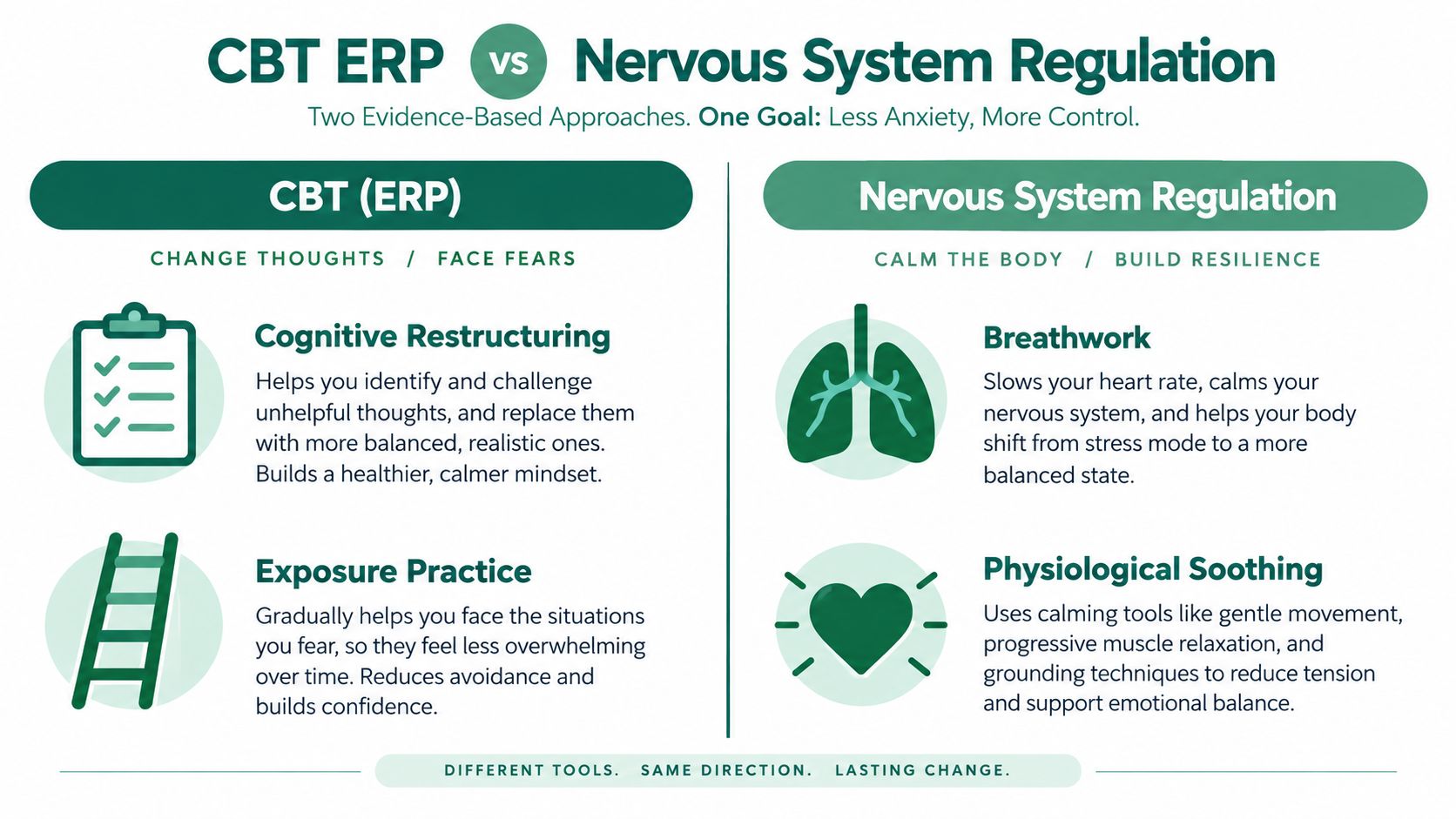
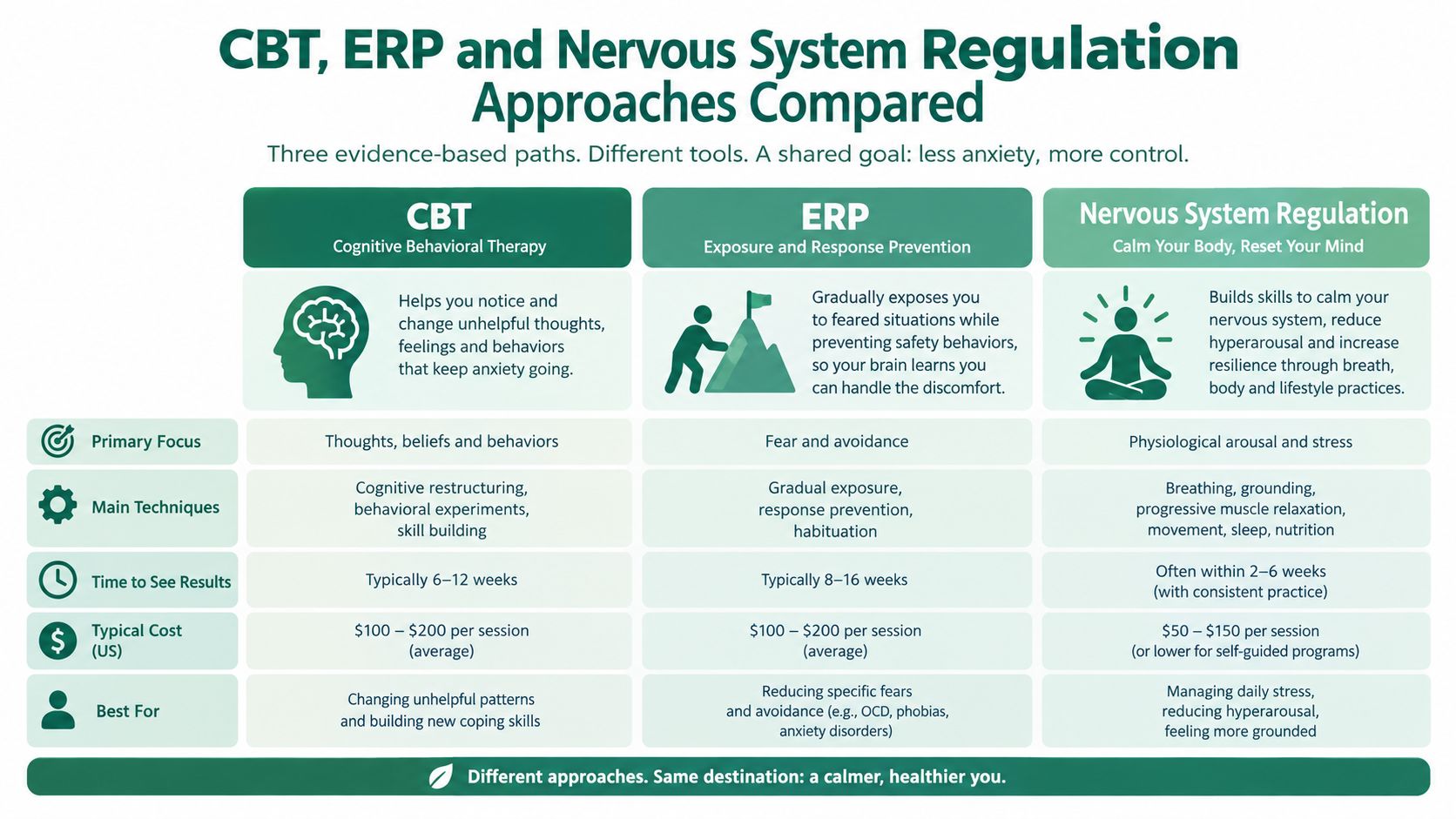
Self-help can support mild, occasional intrusions, but persistent cycles often need a structured treatment plan. Cognitive Behavioral Therapy, or CBT, helps identify interpretations that intensify anxiety, including thought-action fusion and inflated responsibility. Thought-action fusion treats thinking about an event as morally similar to causing it, while inflated responsibility creates a demand to prevent every possible negative outcome.
Exposure and Response Prevention, or ERP, takes a different route. With a qualified therapist, you gradually approach feared thoughts, images, situations, or sensations while refraining from the usual neutralizing behavior. You don't use exposure to prove that a feared event is impossible. You practice allowing uncertainty without checking, avoiding, reviewing, or asking for reassurance.
Matching the approach to the pattern
CBT may be useful when you need to understand thinking traps and the beliefs attached to them. ERP is especially relevant when avoidance and rituals maintain OCD-related distress. Mindfulness and nervous-system regulation can help you notice sensations, reduce automatic escalation, and stay engaged while discomfort passes.
These approaches work together, but they aren't interchangeable. Breathing exercises may settle arousal, yet they shouldn't become a requirement before you can face a feared situation. Likewise, cognitive reframing can clarify that a thought isn't an intention, but repeatedly analyzing the thought can become another compulsion.
ERP is regarded as a first-line intervention for OCD. Expert estimates suggest that approximately 65% to 80% of patients respond well, although outcomes vary and treatment should be individualized. Research also suggests that approximately half of patients respond to SSRIs, with symptom severity reductions of about 40% to 50% among responders. (NIMH information on OCD treatment)
Supporting the body without chasing certainty
Sleep routines, movement, paced breathing, and muscle relaxation can create more capacity for therapeutic work. If you're considering everyday options such as tea, learn about ingredients and personal considerations through educational information such as Pep Tea's discussion of L-theanine, rather than treating any product as a replacement for assessment or treatment.
A clinician can help distinguish general anxiety management from OCD-specific response prevention. Anxiety treatment may include integrated support for worry, stuck thought patterns, avoidance, and body-based anxiety responses.
Recognizing When Professional Help Is Needed
Occasional intrusive thoughts don't automatically indicate OCD or another disorder. Clinical concern grows when unwanted thoughts remain persistent, consume significant time, create marked distress, trigger compulsions, or interfere with work, relationships, sleep, concentration, or ordinary activities. Diagnostic descriptions of OCD also consider whether obsessions or compulsions take more than one hour per day or cause clinically significant distress or impairment. (Clinical classification of OCD)
Look for the response pattern rather than judging yourself for the thought's subject. Repeated checking, reviewing memories, researching symptoms, confessing, asking for reassurance, avoiding people or places, and mentally replacing images can all become attempts to neutralize uncertainty. These behaviors may feel protective, but they can teach your brain that the thought is too dangerous to experience without a ritual.
Why waiting can feel easier than seeking care
Stigma and embarrassment can make taboo thoughts difficult to disclose. People may fear that a therapist will misunderstand them, or they may assume their symptoms aren't serious enough for treatment. Poor insight, limited knowledge, and uncertainty about where to begin can add further delays.
A recent mixed-methods study reports that only about 30% to 40% of people with OCD seek professional help, with average delays of approximately seven years. The study identifies barriers including stigma, embarrassment, limited knowledge, poor insight, and uncertainty about whether symptoms are severe enough for treatment. (Research on help-seeking and delays in OCD)
A practical threshold: Seek an assessment when your response to the thought is shrinking your life, even if the thought itself feels occasional.
You can start by describing what happens after the thought appears. Mention the time spent, rituals, avoidance, reassurance-seeking, sleep disruption, and impact on relationships. If you have genuine intent, a plan, inability to control your behavior, psychosis, or immediate danger, seek urgent local help rather than relying on online information. A confidential first step toward counseling can help clarify what kind of support fits.
Building Lasting Resilience And Finding Support
Progress doesn't require permanent silence in your mind. It means an intrusive thought can appear without automatically controlling your attention, behavior, or sense of identity. You may still feel a jolt of anxiety, but you become more able to label the event, allow uncertainty, regulate your body, and continue with your values.
A sustainable approach combines several layers:
Daily awareness: Notice thought patterns without turning observation into constant symptom checking.
Flexible regulation: Use grounding, breathing, movement, and rest to support your body, not to guarantee that anxiety will vanish.
Behavioral courage: Reduce avoidance and reassurance-seeking gradually, with therapist guidance when the pattern is strong.
Compassionate support: Share openly with a qualified professional or trusted person who understands intrusive thoughts.
Values-based action: Choose what matters to you even when your mind produces doubt or discomfort.
Measuring progress differently
A difficult thought returning doesn't mean you've failed. Progress may look like asking for reassurance less often, returning to work sooner, staying in a situation you previously avoided, or allowing an unanswered question to remain unanswered. These changes weaken the cycle because your actions stop treating every thought as an emergency.
Digital tools, mindfulness apps, and chatbots may offer psychoeducation, tracking, breathing exercises, or structured CBT activities. Evidence for digital mental-health tools is more conditional for anxiety and remains preliminary for obsessive-compulsive symptoms, so they shouldn't replace assessment when thoughts are disabling or linked to compulsions. Repeated chatbot questioning or symptom searching can also become reassurance-seeking for some people.
Therapy is especially important when self-guided strategies become another system for checking whether you feel calm enough. A qualified clinician can tailor CBT, ERP, trauma-informed work, and nervous-system practices to your symptoms, history, safety needs, and goals. Seeking help isn't an admission that your thoughts are dangerous. It's a practical decision to stop letting fear dictate your life.
Be Your Best Self & Thrive Counseling, PLLC offers individual and couples counseling for anxiety, trauma, stress, and stuck thought patterns through an integrated, trauma-informed approach that includes practical and mind-body support. Visit Be Your Best Self & Thrive Counseling, PLLC to explore services and begin with a free initial consultation about your needs.