
Couples Counseling with a Narcissist Guide
The most popular advice about couples counseling with a narcissist is also the most dangerous when applied without careful assessment: communicate better, use “I” statements, and let the therapist help both partners meet in the middle. Those tools can help couples who have conflict but retain mutual safety, honesty, and freedom to disagree. They can fail, or even increase risk, when one partner controls the narrative, punishes vulnerability, or performs accountability in the therapy room and retaliates at home.
A diagnostic label isn't the starting point. Safety, power, and observable behavior are. Before joint sessions, a therapist needs to determine whether both partners can speak freely, whether each person can accept responsibility, and whether honest disclosure creates danger. You also need permission to decide that individual therapy, specialized domestic-violence support, or separation-focused planning is more appropriate than relationship repair.
Understanding Narcissistic Traits Versus Clinical Diagnoses
Many people search for a definitive answer because a label seems to organize years of confusion. A partner may be defensive, entitled, self-focused, dismissive, or highly reactive, and those behaviors can cause real harm. They still don't establish narcissistic personality disorder, or NPD, by themselves.
A formal diagnosis requires clinical assessment of enduring patterns, functioning, empathy, relationships, and behavior across settings. A disagreement, a difficult season, or a partner's poor conflict skills can't be converted responsibly into a diagnosis based on a few arguments. The signs of a narcissistic relationship may help you name patterns worth discussing with a qualified professional, but online descriptions aren't substitutes for assessment.
The distinction matters because formal NPD is uncommon compared with everyday narcissistic characteristics. One review of epidemiological studies reported a median population prevalence of 1.6%, while another review of structured-interview studies found a mean prevalence of 1.2%, with estimates ranging from 0% to 6.2%, according to the Merck Manual's clinical overview of NPD. Differences reflect variations in sampling, diagnostic tools, and definitions, not a settled global rate.
Replace the label with a behavioral formulation
In practice, the more useful questions are concrete:
Accountability: Can your partner acknowledge a specific action without immediately blaming you?
Emotional regulation: Can they tolerate frustration or shame without insults, threats, withdrawal, or retaliation?
Empathy in action: Do they respond to your distress with curiosity and care, or only with statements about their own pain?
Boundary respect: Do they honor a clear limit when they dislike it?
Functional impact: Do these patterns damage work, friendships, parenting, finances, or daily stability?
A diagnosis doesn't predict one counseling outcome. Motivation, reflection, trauma history, coercion, and each partner's ability to participate voluntarily all influence treatment planning. Joint therapy should therefore target behaviors such as turn-taking, repair, responsibility, and boundary respect rather than becoming a courtroom where one person tries to prove the other has a disorder.
If your partner insists on a label while refusing to discuss what they did, the label may be distracting from the central issue. You don't need diagnostic certainty to recognize intimidation, deception, chronic blame, or fear.
Evaluating Relationship Safety Before Joint Sessions
Couples counseling is often treated as the mature next step. In relationships shaped by coercion, it can become another place where one partner performs reasonableness and the other pays for honesty later. Before any joint session, the core question is whether speaking openly is safe.
That question needs a private answer.
A careful therapist will meet with each partner separately and ask about intimidation, coercive control, surveillance, financial restriction, sexual pressure, threats, and fear. The screen should include what happens after conflict, after limit-setting, and after therapy itself. Some partners stay calm in the office, then retaliate in the car, at home, or through money, sex, parenting, or silence once no one else is watching.
Research supports that caution. A published meta-analysis found a weak positive association between narcissistic traits and intimate-partner-violence perpetration, with stronger links for psychological and cyber violence than physical violence. That does not prove causation, and it does not mean every person with narcissistic traits is abusive. It does mean safety screening should happen before conjoint work is considered, not after harm has already been disclosed in a risky setting.
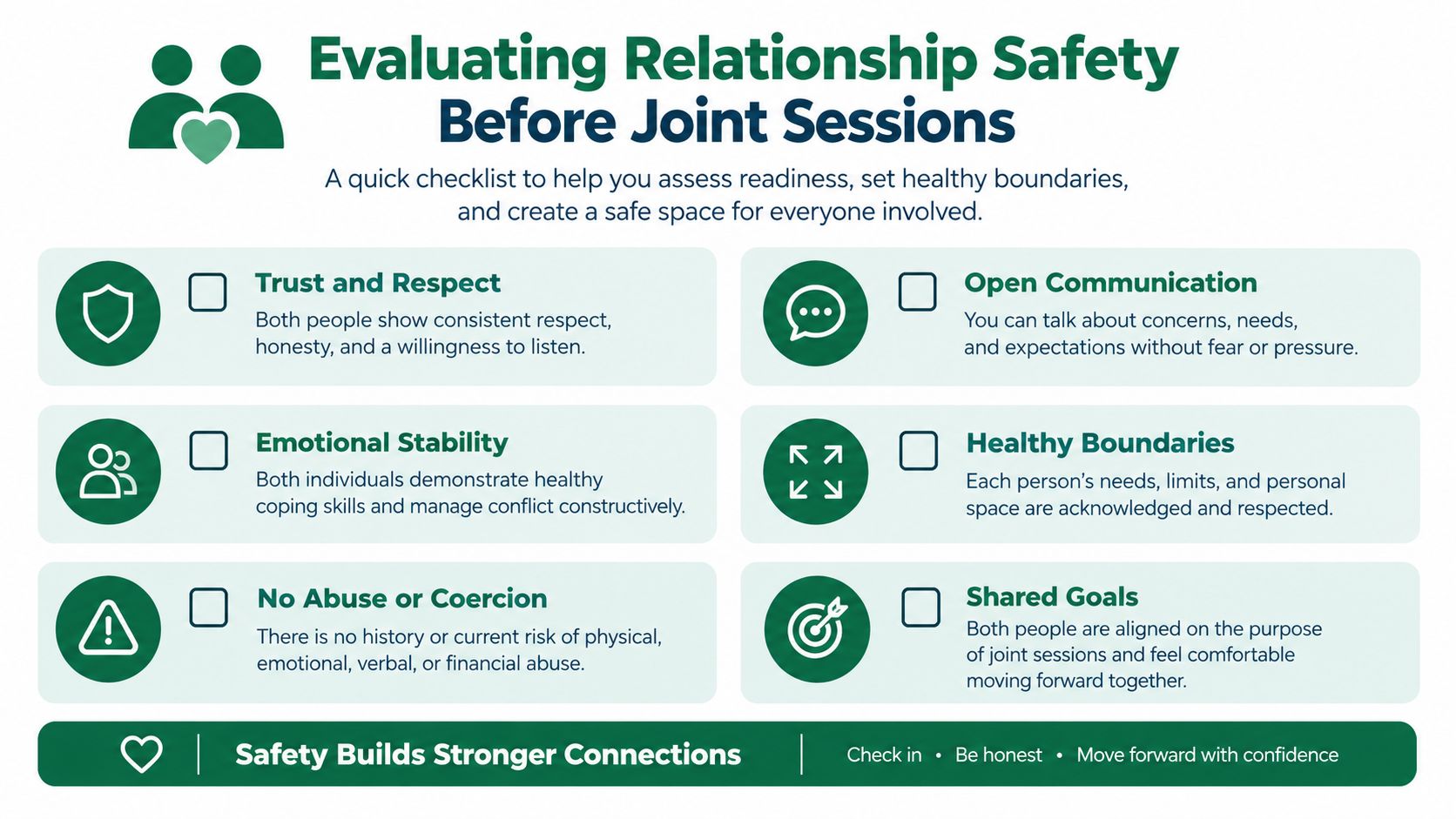
Caption: A relationship-safety checklist can help identify fear, coercion, retaliation, and other concerns before joint counseling begins.
Here is the standard I use. You should be able to disagree without bracing for punishment. You should be able to keep some information private without being monitored, interrogated, or forced to surrender access. You should be able to leave a hard conversation, or a therapy session, without worrying about what will happen on the way home. And when you set a limit, the limit should still exist after the appointment ends.
Notice what happens when truth enters the room. Does honesty trigger threats, humiliation, property damage, financial restriction, sexual pressure, or the use of children or pets as tools of control? Does your partner accept a pause, or do they press harder the moment you try to slow things down? Those details matter more than how insightful they sound in session.
Joint therapy also fails when impression management takes over. A persuasive partner may speak first, frame the story, drip out selective facts, and present your distress as the main issue. Then your visible anxiety gets treated as the problem, while the pattern producing it stays hidden. If that sounds familiar, the confusion often resembles these examples of gaslighting.
If you cannot speak freely without consequences, standard conjoint therapy is the wrong format. The safer path may be individual therapy, separate sessions, safety planning, or services focused on intimate-partner violence. A label does not decide that. Control and fear do.
Measuring Genuine Progress Through Observable Behaviors
Progress is easy to fake in a therapy office. Real change shows up later, in the car ride home, during a disagreement about money, when plans change, or when you say no and mean it.
That is why I tell partners to stop grading insight and start tracking conduct. A moving apology, a polished explanation, or fluent therapy language does not reduce harm by itself. What matters is whether daily life becomes more predictable, more respectful, and less costly to your body and mind.
A private baseline helps. Write down the behaviors that concern you, the situations that tend to set them off, and what follows afterward. Keep it brief and concrete. Note whether conflict stays verbal or turns into intimidation, surveillance, financial pressure, sexual coercion, silent treatment, blame shifting, or punishment after the fact. If keeping notes could put you at risk, do not do it at home or on a shared device. Your goal is not to win an argument. Your goal is to protect your reality.
Then watch for a different pattern over time.
Responsibility looks plain. Your partner names what they did, names its effect on you, and stops there. No counterattack. No edited version that turns your reaction into the main offense.
Respect for boundaries is visible. They stop pushing for your phone, your passwords, your location, your money, or immediate emotional access after you have said no.
Repair has patience in it. They make amends without demanding quick reassurance, sex, affection, or a statement that the relationship is fine now.
Tolerance for frustration matters more than charm. Can they hear disagreement without contempt, threats, intimidation, or pulling other people in to pressure you?
Non-retaliation is one of the clearest markers. After a hard session, do they leave you alone to think, or do they punish your honesty later?
Watch what happens under stress, not only during calm weeks. A short stretch of cooperation can be sincere, or it can be an attempt to regain control. Lasting change holds when your partner feels criticized, disappointed, embarrassed, or thwarted.
This focus on observable behavior also protects you from getting pulled into diagnosis debates. People living with chronic relational harm often develop anxiety, depression, confusion, and self-doubt. That pattern appears in the study record. You do not need a definitive label to take your own deterioration seriously.
A useful question for any therapist is simple: what specific behavior would count as progress, and how will we know it continues between sessions? If you want a clearer framework, signs therapy is actually working can help you judge whether treatment is producing change you can see, not just language that sounds promising.
Prioritizing Individual Therapy And Nervous System Care
Many partners enter couples therapy hoping the joint room will finally make the truth visible. In higher-control relationships, private therapy is often the place where things start to make sense. If you leave joint sessions more activated, more doubtful, or more afraid of what happens at home afterward, individual treatment gives you space to think without managing another person's mood in real time.
That privacy matters.
A trauma-informed therapist pays attention to your body as much as your words. Chronic relational stress often shows up in sleep disruption, scanning for danger, brain fog, muscle tension, digestive changes, and a shrinking sense of self. The point is not to prove who is right. The point is to restore agency, rebuild trust in your own perception, and help you make choices based on what is happening, not on what you keep being told happened.

Caption: Individual therapy offers a private setting to process relationship stress, clarify choices, and develop safety-centered coping strategies.
Individual work is often practical before it is profound. Early sessions may focus on what helps you stay oriented during conflict, what makes things worse, which conversations predict retaliation, and where you still have room to choose. That can include steadying routines, rehearsing short boundary statements, documenting incidents and agreements in a secure place, reconnecting with people who do not pressure you, and sorting through options without assuming the relationship must be preserved at any cost.
I also want clients to hear this clearly. Regulation skills are for you, not for making harmful dynamics more tolerable. Breathing, movement, hydration, sleep support, and sensory grounding can help you respond with more clarity. They do not replace safety planning, and they do not obligate you to stay present for intimidation, contempt, or manipulation. If you need concrete practices, this guide on how to regulate your nervous system offers a useful starting point.
If your partner seeks treatment, that work is theirs to do. Mayo Clinic's treatment guidance notes that psychotherapy is the main treatment for NPD, with goals such as improving relationships and building more realistic self-understanding. Your healing does not need to wait for their insight, their apology, or their participation. Individual therapy can help you recover stability now.
How Our St Petersburg Practice Supports Complex Dynamics
A client may arrive asking for couples counseling because they want the relationship to feel normal again. During an initial conversation, the more important discovery may be that they haven't been able to describe the relationship accurately for a long time. They may worry that their partner will be offended by the therapist, that a private disclosure will become an argument, or that setting a limit will create consequences at home.
A careful practice doesn't rush to communication exercises. It first clarifies the client's goals, consent, support system, conflict patterns, and sense of safety. If joint work is appropriate, therapy can address interaction cycles, emotional connection, and repair. If it isn't, the clinician can help the client build a private plan for individual treatment and additional support.
A whole-person, individualized approach
Be Your Best Self & Thrive Counseling, PLLC works with individuals and couples in St. Petersburg, Florida, using a trauma-informed approach that considers mind, body, and spirit. Care may address anxiety, depression, trauma, stress, relationship patterns, burnout, and the practical skills needed to reclaim stability. The practice also supports neurodivergent individuals and couples, where communication differences, sensory needs, attention patterns, or high sensitivity may require a more specific formulation.
The method matters less than the discipline behind it. A therapist should explain confidentiality, identify the limits of joint treatment, and invite both partners into goals without assuming equal power. Sessions should track concrete changes such as reduced verbal aggression, reliable boundary respect, accountability, and non-retaliation.
Practices also need systems that protect clinical quality and continuity. Therapists developing ethical educational material or maintaining client communication may explore blogging and newsletter tools for therapists, while keeping client privacy and professional obligations central.
A free initial consultation can help determine whether the practice's style and services fit your situation. You don't have to commit to couples counseling just because you contacted a couples therapist. The first useful outcome may be clarity about what kind of support is safe.
Taking The Next Step Toward Clarity And Healing
You don't need to settle the diagnosis before taking your experience seriously. You need to ask whether you can speak freely, whether your partner accepts responsibility, whether boundaries hold outside the office, and whether therapy leaves you safer or more exposed.
If you're considering joint counseling, request private screening before agreeing to shared sessions. Ask how the therapist handles intimidation, surveillance, threats, financial control, retaliation, and disclosures that one partner disputes. You can also learn how to prepare for couples counseling, but preparation should never mean coaching yourself to tolerate danger more effectively.
A grounded decision process
Use these questions as a reality check:
What happens after honesty? If disclosure produces punishment, plan for safety before increasing disclosure.
What has changed outside therapy? Look for sustained actions, not therapeutic vocabulary.
What support belongs only to you? Individual therapy, trusted relationships, secure records, and practical resources can strengthen decision-making.
What would make treatment inappropriate? Fear, coercive control, threats, and inability to participate voluntarily require a different level of care.
What outcome do you want? Reconciliation isn't the only valid goal. Safety, independence, emotional recovery, and clear decision-making matter too.
A partner with narcissistic traits may change some behaviors, but you can't manufacture accountability for another adult. You can choose what you participate in, what boundaries you enforce, what support you seek, and what conditions must exist before shared therapy continues.
Pay attention to your own observations. Repeated confusion, fear, exhaustion, and shrinking freedom are meaningful information, even when your partner appears charming or cooperative to others. A trauma-informed therapist can help you examine that information without forcing you toward either staying or leaving.
Be Your Best Self & Thrive Counseling, PLLC offers individual and couples counseling for complex relationship patterns, with trauma-informed support for safety, emotional regulation, and personal agency. Visit Be Your Best Self & Thrive Counseling, PLLC to explore a confidential initial consultation and discuss which form of care fits your situation.