
Therapy Fit: How to Find a Therapist Who Truly Fits
You leave therapy feeling heavier than when you arrived. You replay the conversation on the drive home, wondering whether you were finally honest or just misunderstood. The therapist may be kind, qualified, and available, yet something still feels wrong. You're left deciding whether to quit, push through, or blame yourself for not connecting.
That uncertainty is common, but it shouldn't be dismissed. Therapy fit isn't merely a matter of liking your therapist. It's the practical alignment between how a therapist works, what you need, and whether the relationship gives you enough safety and direction to do meaningful work.
Recognizing When Therapy Does Not Feel Right
A client once described leaving sessions with the same thought each week: “I talked a lot, but nothing moved.” The therapist listened attentively, but rarely summarized patterns, clarified goals, or explained why a particular intervention mattered. Another client felt the opposite. Sessions were highly directive, yet the pace left her shutting down before she could explain what was happening.
Neither experience automatically proves that therapy is ineffective. It does suggest that the relationship deserves closer attention.
A poor therapy fit isn't always obvious hostility. Sometimes it's a repeated sense that the work isn't reaching the person you actually are.
People often reduce fit to chemistry. Warmth matters, but warmth alone doesn't tell you whether the therapist understands your concerns, can adapt the treatment, or will respond constructively when you disagree. A therapist can be pleasant and still use a style that doesn't suit your processing speed, cultural context, relationship circumstances, or capacity at that point in your life.
Access creates another layer of difficulty. U.S. data for 2023 found that 48.6% of adults didn't know how or where to get treatment, while 40.7% couldn't find a program or professional they wanted (National Library of Medicine). When finding any appointment is difficult, clients may tolerate a mismatch longer than they otherwise would.
Pay attention to what happens inside the room. Do you censor yourself because you expect judgment? Do you leave confused about the purpose of treatment? Are you uncomfortable because difficult material surfaced, or because the therapist repeatedly assigns motives you've said don't fit? If you become detached or lose contact with yourself during sessions, learning about dissociating in therapy may help you describe the experience more precisely.

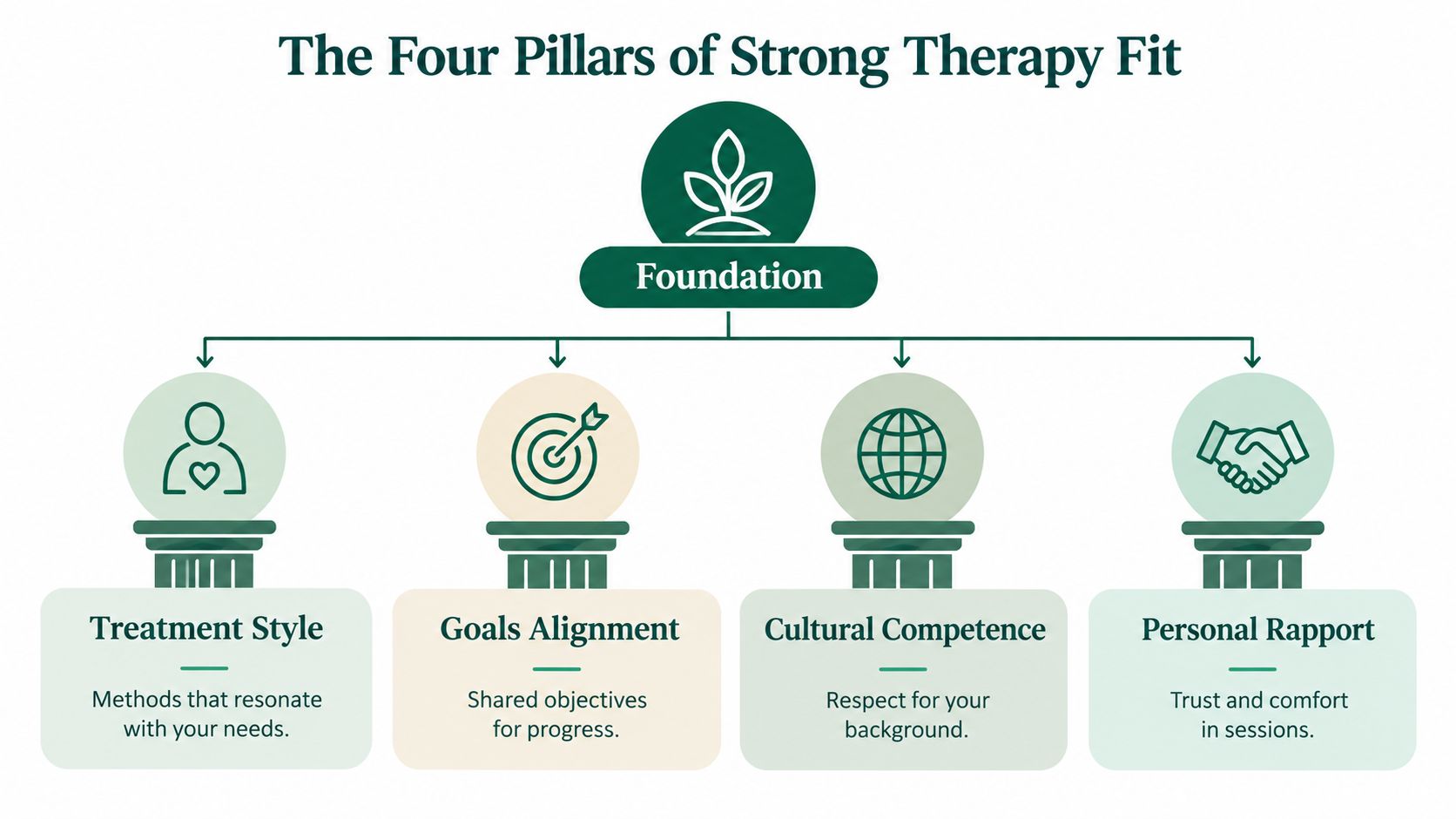
The Four Pillars of Strong Therapy Fit
A useful assessment starts with structure rather than instinct. Strong therapy fit has several dimensions, and a weakness in one can affect the entire treatment relationship.
Treatment style
Some clients want clear agendas, skills practice, and help identifying patterns. Others need room to think aloud before they can decide what they feel or want. Neither preference is inherently superior. The problem arises when a therapist's default method leaves you either unsupported or pressured.
Ask how the therapist typically conducts sessions, what happens between appointments, and how they decide whether an intervention is helping. A named modality can describe training, but it doesn't fully describe the experience of working with that clinician.
Goals alignment
You and your therapist need a shared understanding of what progress means. Your goal might be reducing panic, improving communication with a partner, grieving a loss, changing a persistent pattern, or becoming more functional during a demanding transition. The therapist may bring clinical priorities, but those priorities should connect to the concerns that brought you to care.
A working formulation should be understandable. You should be able to ask, “What do you think is maintaining this problem?” and receive an answer you can discuss rather than a label you're expected to accept.
Cultural competence
Cultural identity is not a background detail that can be added after treatment begins. Family roles, faith, race, gender, sexuality, disability, immigration history, finances, and community expectations can all shape what feels possible. You shouldn't have to spend every session teaching your therapist why a recommendation won't work in your life.
Cultural competence also includes curiosity and humility. Demographic similarity may help, but it doesn't guarantee understanding. The more important question is whether the therapist can listen without forcing your experience into a familiar category.
Personal rapport and logistics
Trust, emotional safety, scheduling, privacy, cost, location, and communication practices form the practical foundation. A therapist may be clinically impressive, but inconsistent appointments or an inaccessible format can make participation unsustainable.
For practices that provide both counseling and professional education, clear role boundaries matter too. This resource on separating therapy from coaching operations offers useful context for understanding why distinct services should have distinct expectations.
Clear Signs You Have Found the Right Therapist
Good therapy doesn't mean every session feels comfortable. It means the discomfort has a place in the work, and you can talk about what's happening without fearing punishment, dismissal, or withdrawal.
You're likely moving toward a workable fit when the therapist listens for meaning rather than waiting for a keyword. They remember relevant context, check assumptions, and can summarize your concerns in a way that feels recognizably yours. You don't need perfect agreement, but you should feel that your perspective is treated as important information.
A strong match also makes the treatment understandable. You know what you're working on, why a particular exercise or conversation matters, and how you'll recognize movement. The therapist welcomes questions about their reasoning and can revise the plan when your circumstances change.
What progress may look like
Progress isn't always immediate relief. It may look like noticing a pattern sooner, recovering more quickly after conflict, naming a need before resentment builds, or staying present during a difficult conversation. Sometimes the first sign is that you're less focused on managing the therapist's reaction and more able to discuss what matters.
Look for these practical indicators:
You can be specific: You're able to describe what feels wrong, confusing, or helpful.
The therapist repairs misunderstandings: They listen when you correct them and work with you to clarify the issue.
The plan evolves: Interventions change when they aren't helping rather than being repeated automatically.
Your goals remain visible: Sessions don't drift indefinitely away from the concerns you brought in.
You feel more capable outside sessions: Therapy gives you insight, language, or skills that connect with daily life.
This doesn't mean your therapist will always get it right. A good relationship can include mistakes. The meaningful distinction is whether both of you can recognize and repair them. For a more detailed way to evaluate change, review how to know if therapy is working.
Essential Questions For Your First Consultation
A consultation shouldn't be a performance where you try to appear easy to treat. It's a short opportunity to learn how the therapist thinks, communicates, and responds to your needs.
Start with the clinical questions that matter most to your situation:
“What experience do you have with my main concerns?” Listen for relevant, specific experience rather than a broad list of conditions.
“How do you usually structure sessions?” This reveals whether you'll receive a clear framework, open exploration, or a combination.
“How do you decide what treatment approach to use?” The answer should connect methods to your goals and individual formulation.
“How do you respond when a client disagrees with your interpretation?” You're assessing openness to correction, not searching for a flawless therapist.
“How do you adapt therapy for ADHD, autism, sensory needs, trauma history, or communication differences?” A practical answer should include adjustments, not just affirming language.
“How will we review progress?” You should hear how goals, feedback, and treatment decisions will remain visible.
Ask about accessibility in concrete terms
Neurodivergent clients may find standard therapy settings difficult because of sensory distractions, sustained attention demands, or challenges with virtual rapport. A 2025 review notes that hybrid care may help some clients, while evidence comparing virtual and in-person care for underserved populations remains limited (Frontiers in Public Health).
Ask whether sessions can include a written agenda, predictable structure, reduced eye contact, visual or chat-based communication, pacing changes, or explicit emotional language. Telehealth isn't automatically more accessible. Home distractions, privacy limitations, executive-function demands, and sensory load can make remote sessions harder.
The same principle applies when evaluating other helping professionals. A practical checklist such as questions to ask a midwife demonstrates the value of turning a first conversation into an active assessment rather than accepting a provider passively.
Before booking, clarify scheduling, cancellations, fees, location, technology, and between-session contact. You can also read about what a free consultation typically involves so you know what information to bring and what you're entitled to ask.
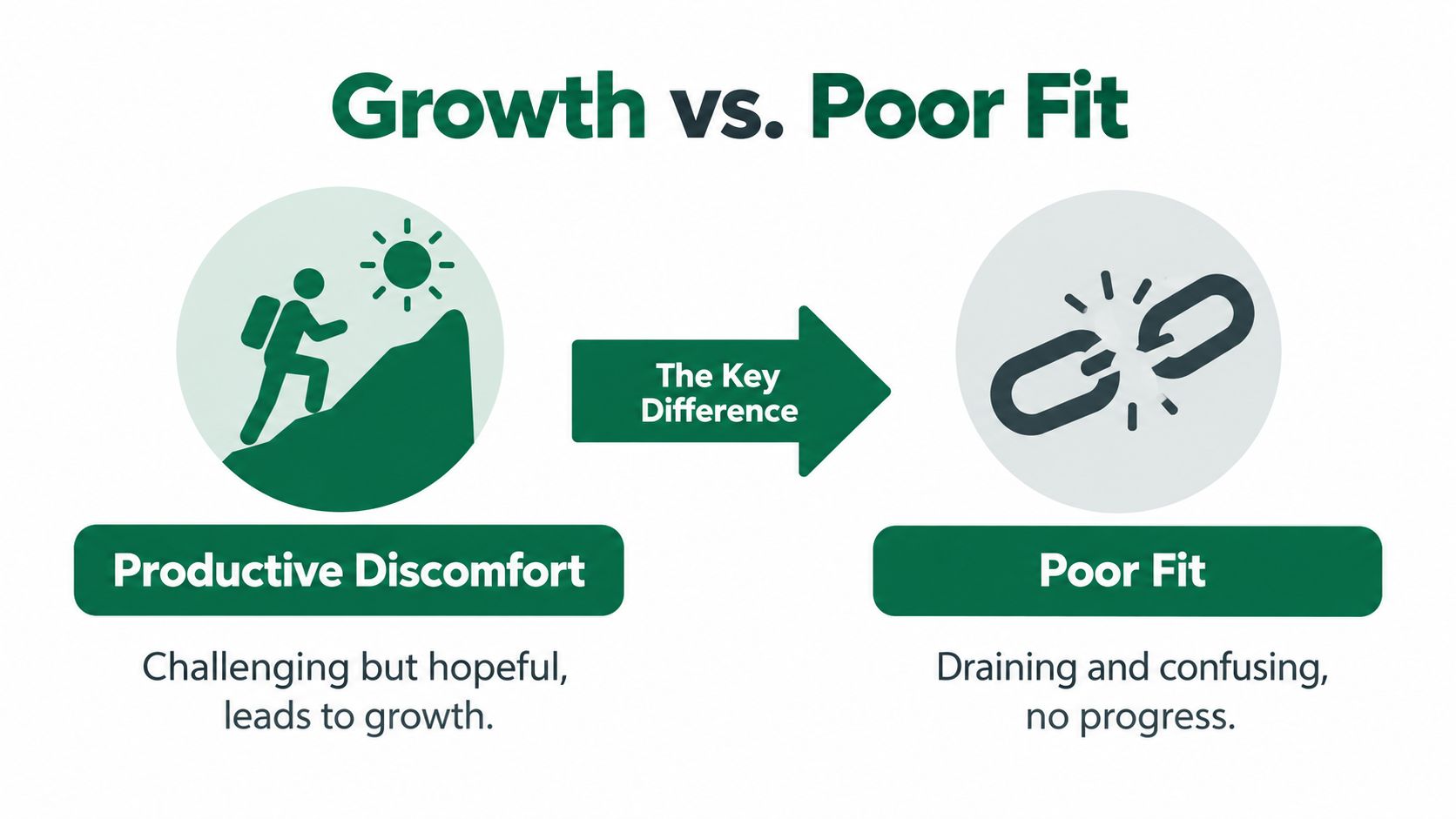
Distinguishing Productive Discomfort From Poor Fit
Therapy can feel difficult for good reasons. You may discuss grief, shame, anger, trauma, or a relationship pattern you've worked hard to avoid. Feeling exposed doesn't automatically mean the therapist is wrong for you.
The more useful question is what the discomfort produces. Productive discomfort usually comes with curiosity, context, and a sense that the challenge serves your goals. Poor-fit discomfort tends to leave you confused, diminished, or increasingly unable to speak with clarity.
Productive discomfort | Poor-fit discomfort |
|---|---|
You feel challenged, but the therapist explains the purpose. | You feel pressured without a clear clinical reason. |
You can say, “That doesn't feel accurate,” and continue the conversation. | The therapist argues, dismisses, or repeatedly overrides your account. |
Difficult sessions lead to reflection or useful next steps. | Sessions leave you drained and confused without a workable direction. |
The pace can be adjusted when you become overwhelmed. | Your limits are treated as resistance or lack of motivation. |
Early discomfort may reflect the normal strain of learning new skills or approaching avoided material. It may also signal that the pacing needs adjustment. A therapist who fits well won't require you to choose between total comfort and total exposure. They'll help you find a level of challenge that keeps you engaged.
The test isn't whether therapy feels hard. The test is whether you can understand the hardship, influence the pace, and remain respected while doing the work.
Raise the concern directly when you can. Try, “I felt pushed past what I could process,” or “I'm not understanding how this connects to my goal.” The therapist's response provides important information. If you're unsure whether the difficulty relates to trauma work, why trauma therapy is so hard can offer helpful context, but it shouldn't be used to excuse persistent invalidation.
Next Steps If Therapy Fit Is Poor
You're allowed to leave a therapy relationship that repeatedly feels unsafe, inaccessible, or misaligned. Switching providers isn't proof that you failed at therapy. It's a form of self-advocacy, especially when you've made a reasonable effort to communicate your concerns and the treatment still doesn't adapt.
Begin by identifying the mismatch in plain language. Is the issue the therapist's style, the goals, cultural understanding, accessibility, scheduling, or response to feedback? A precise explanation helps you choose differently next time instead of searching for another version of the same arrangement.
A practical transition plan
Review the pattern. Write down what happens before, during, and after sessions. Look for repetition rather than judging one difficult appointment.
Name the concern. If it feels safe, tell the therapist what isn't working and what adjustment you need.
Evaluate the response. Notice whether they become curious, defensive, dismissive, or willing to revise the plan.
Plan continuity. Ask about referrals, records, medication coordination, crisis support, or other care needs before ending.
Interview the next therapist differently. Use the questions above and describe the specific conditions that help you participate.
Give yourself permission to pause. If you're not in immediate danger and need time to search, a short pause can be different from abandoning care altogether.
You don't owe a long justification for ending treatment. A brief message stating that you're choosing another provider is enough, although your therapist may need to discuss clinical continuity and referrals. If therapy is addressing significant risk, ask about a transition plan rather than stopping abruptly.
When you search again, look beyond labels. A therapist who describes themselves as trauma-informed may still differ greatly in pacing, communication, structure, and willingness to make adjustments. Resources on finding a trauma-informed therapist can help you develop more focused questions, but your lived experience remains central to the decision.
Be Your Best Self & Thrive Counseling, PLLC offers individual and couples counseling for concerns including anxiety, depression, trauma, stress, life transitions, and neurodivergent needs, with a free initial consultation to discuss goals and fit. Visit Be Your Best Self & Thrive Counseling, PLLC to ask questions and explore whether its approach and services match what you need.