
Control Issues Anxiety: Signs and How to Loosen Control
You've rewritten Tuesday three times. The stove got a second look before you left the house. When a friend's text lands two hours late, your stomach drops before you've read a word.
None of that is dramatic. On paper you're the organized one, the person who remembers the details and catches problems before anyone else sees them. Underneath runs a quieter sentence: if I stop managing the moving parts, something will break, and it will be my fault.
That sentence captures what many people mean when they search for control issues anxiety. It isn't a diagnosis and it isn't a character flaw. It's a pattern in which fear of an uncertain outcome pushes someone to manage people, plans, and routines more tightly than the situation calls for. The aim here isn't to talk you out of liking order. It's to help you tell the difference between structure that serves you and structure that has become a way of managing fear, and to practice the second one differently.
What Control Issues Anxiety Means in Everyday Life
Sunday night is where the pattern usually shows itself. The notebook comes out, the week gets mapped, then crossed out and rewritten with the gym sessions moved to different days. The stove gets checked twice on the way out. A friend's unread message sits in a pocket like a small emergency.
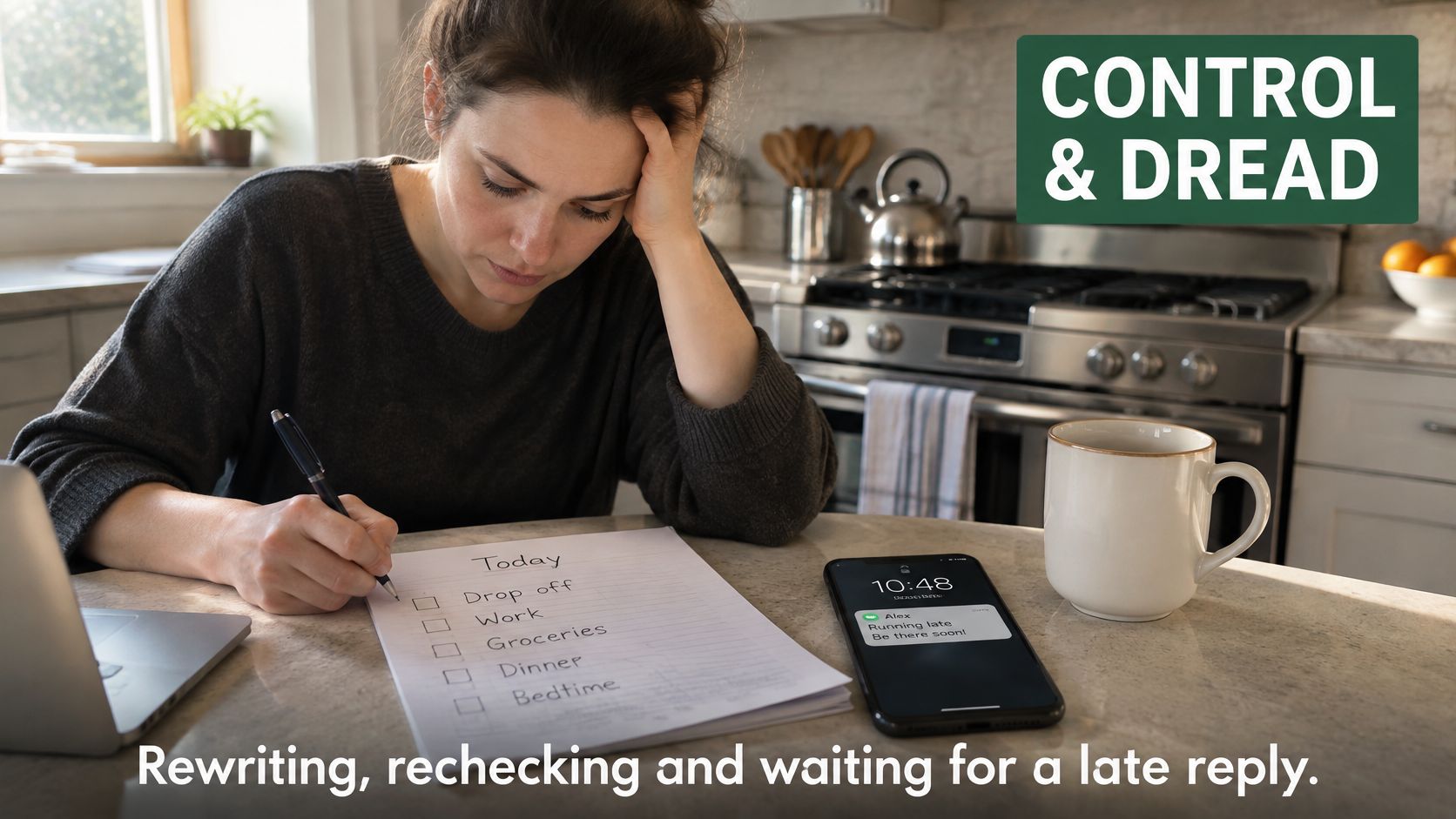
Rewriting the list isn't the problem by itself. The question is what happens inside when the list changes without permission.
Control issues anxiety is the informal label for that loop: fear of an uncertain outcome driving a person to manage people, plans, and routines tightly. A smoke alarm makes a decent analogy. The alarm earns its place when there's real smoke. Calibrate it so finely that it screams every time someone makes toast, and you're still technically safe, but you spend your mornings waving a towel at the ceiling. The system built to protect you becomes the thing exhausting you.
Liking order is not the problem. Plenty of people keep careful calendars, arrive early, and color-code their files while staying loose when a plan shifts. The distinguishing feature isn't how much structure someone uses. It's what happens in the body when the structure breaks.
Context helps, because this isn't a private quirk. In the American Psychological Association's 2026 Stress in America report, 28% of U.S. adults said they had little or no control over their future, up from 23% in 2025, as CNBC's coverage of the Stress in America findings reports. That's a great many people bracing.
There's no formal diagnosis called control issues anxiety, which is why it helps to read about how anxiety disorders are actually classified before labeling yourself. The clinical question isn't whether you like a plan. It's whether the need for control is persistent, hard to switch off, and expensive in time, sleep, or relationships.
The first thing to notice: does the control give you lasting calm, or a few minutes of relief before the next worry takes its place?
Spotting the Pattern in Daily Behavior
A plan, a checklist, a quick question to a partner. Any of these can be an ordinary habit or a quiet purchase of certainty, and the difference rarely shows in the behavior itself. It shows in what the behavior is for. Reading across the rows below is usually enough to tell which version is running.
Behavior | Healthy form | Anxiety-driven form | Quick check |
|---|---|---|---|
Planning ahead | Sets a plan and adjusts when it changes | Needs every contingency mapped before acting | Can you start when one detail is unknown? |
Checking | Checks once at a natural point | Repeats checks until a feeling of certainty appears | Does the check end the worry for more than a few minutes? |
Seeking reassurance | Asks one clarifying question | Asks for the same reassurance several times a day | Does the answer still matter an hour later? |
Routines | Keeps routines that support sleep and work | Becomes distressed when any routine breaks | Can you skip it once without a spike of dread? |
Communicating with others | Shares expectations clearly | Scripts or monitors other people's reactions | Are you trying to control how someone else responds? |
Read the two middle columns together. They hold roughly the same amount of structure; the anxiety-driven column has no give in it. Someone can check a lock three times and sleep fine, while someone else checks once and replays it until midnight. What separates them is whether the checking settled the question or only muted it for a while. Frequency is the wrong ruler. Flexibility is the right one.
Three Questions for the End of the Week
Did the relief last? If a behavior buys you five minutes of calm and the worry returns at full volume, the behavior is feeding the loop rather than closing it.
Is it taking more than it used to? Compare this month with last year. Growth in time spent checking, researching, or rehearsing is a signal worth respecting.
What is it costing? Sleep, focus at work, patience with your partner, the energy you'd otherwise spend on something you care about.
A few yes answers don't diagnose anything, and one bad week proves very little. Anxiety symptoms are common enough that any single snapshot is noisy: in a 2026 study of university students, 11.5% scored in the severe range on the GAD-7 and 22.1% in the moderate range, with higher uncertainty tracking higher anxiety scores, according to the published student anxiety study. What deserves attention is a cluster: several rows in the table and several questions here pointing the same direction over several weeks.
Sensitivity to uncertainty also varies between people, and some of that variation is physical. In an imaging study of 61 healthy participants, higher intolerance of uncertainty was associated with greater striatal volume, particularly in the putamen, and the association appeared in people with no diagnosed anxiety disorder, as the American Psychological Association's summary of the study describes. Association is not proof that brain structure creates the pattern. It does mean this tendency runs on temperament and wiring, not on some failure of character.
Which is why willpower is a poor tool for changing it. Skills for tolerating uncertainty grow through repeated practice with steady guidance, the way a nervous new driver learns traffic through calm tuition for anxious beginners rather than by being told to relax. For now, circle the row that happens most often for you and note where it shows up first: at work, in a relationship, or in the quiet hour before bed.
How the Control Loop Keeps Anxiety Going
A single check is harmless. What turns it into a pattern is the payoff, and the payoff is the problem.
Trigger. An unanswered email, a delayed flight, a message left on read.
Threat appraisal. The gap between what you know and what you need to know gets marked as dangerous.
Control attempt. You check, plan, correct, or ask someone to reassure you.
Brief relief. The urge quiets for minutes or hours. It doesn't resolve.
Learning. Your brain records the sequence: uncertainty became tolerable only after I stepped in.
A louder alarm. The next uncertain moment arrives with more weight than the last.
Think of a fire drill that never ends. The siren sounds, everyone files out, nothing burns, everyone returns. The drill felt responsible and it delivered relief. Run it every morning and the people in the building stop trusting quiet. Safety stops being the normal condition of the place and becomes something only the drill can produce.
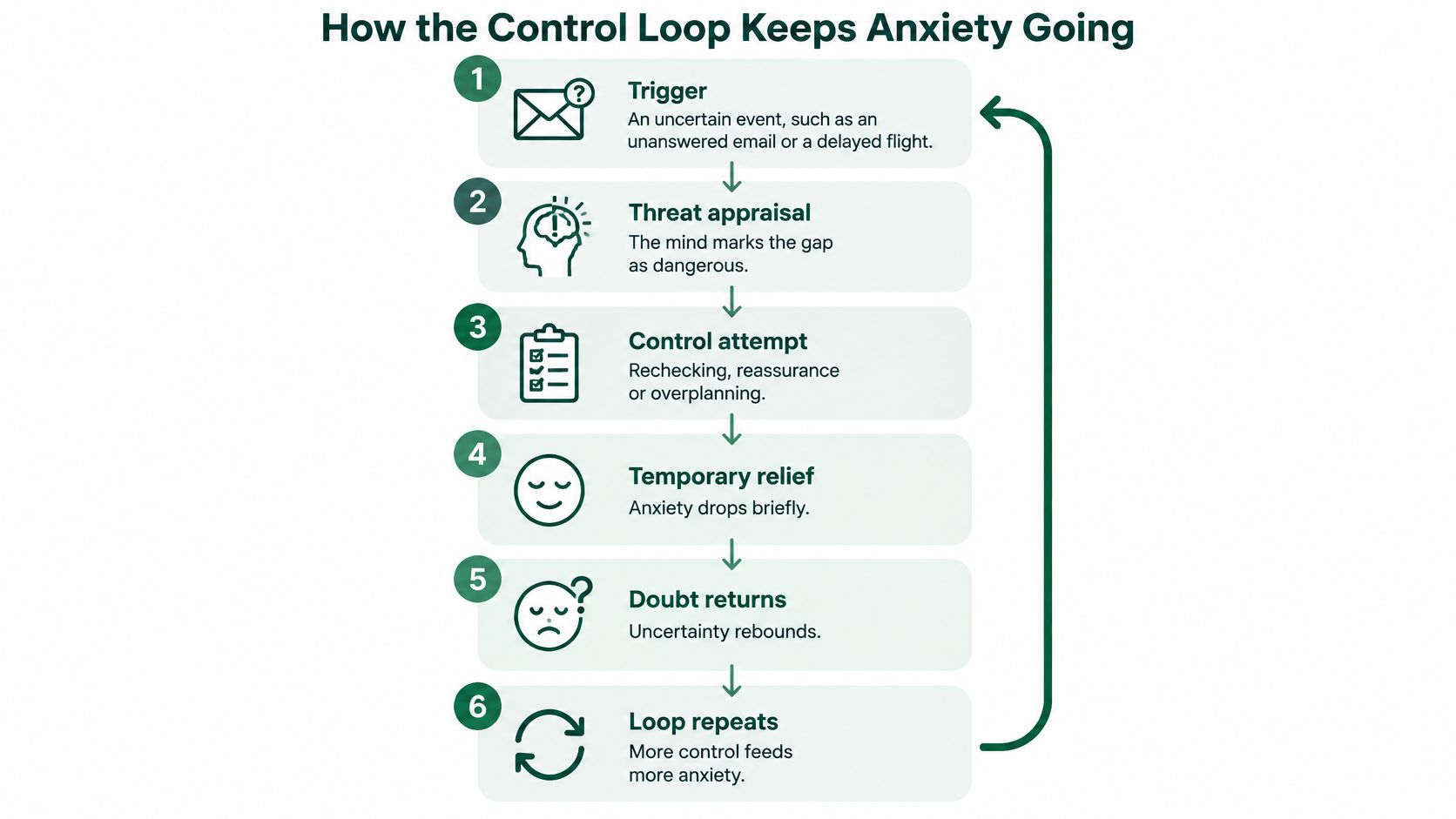
Relief at step four is real, and that's exactly why the loop survives.
The evidence on the control piece is solid enough to take seriously. A meta-analysis of 51 studies involving 11,218 participants found a large negative association between perceived control and both trait anxiety and disorder-specific anxiety, with the strongest relationship in generalized anxiety disorder. In practical terms, persistent attempts to control uncontrollable events can amplify threat monitoring and worry, while a low sense of agency raises anticipatory anxiety.
The authors are careful about direction, and so should you be. This is an association, not proof that low perceived control causes anxiety in every case. The relationship was also stronger in adults than in children and shifted depending on how control was measured.
The same thread shows up early in life. In a meta-analysis of 31 studies of children and adolescents, intolerance of uncertainty accounted for 36.00% of the variance in anxiety and 39.69% of the variance in worry (the review of uncertainty research in young people). Variance figures describe shared statistical ground, not a verdict on cause, which is why the review frames uncertainty as a promising treatment target rather than the whole story.
This is one reason nervous system regulation therapy works on the body as well as the thought record. A loop that runs on arousal is hard to interrupt with logic alone.
The exercise that teaches the most is the least impressive one. For seven days, keep a single page with four columns: trigger, what I did, how long the relief lasted, and what set me off next. If the relief column keeps reading five minutes, you've found the loop.
What to Control, What to Influence, What to Tolerate
Most advice on this collapses into "let it go," which is useless because it skips the sorting. The practical question has three parts, and each one earns a different response:
What should I control?
What can I only influence?
What do I need to tolerate?
Target | Controllable? | Useful action | Anxiety trap |
|---|---|---|---|
Your own preparation | Yes | Set a plan with one review point | Rewriting the plan endlessly |
Your reply and boundaries | Yes | Send a clear message, then stop editing | Checking for replies every few minutes |
Your coping response | Yes | Choose a breath or a walk, then act | Ruminating to solve the feeling |
Routines at home | Partly | Keep core routines and allow variation | Treating every change as a threat |
Another person's reaction | Influence only | State the need and accept the response | Rehearsing scripts to prevent their anger |
Future certainty | No | Practice tolerating an open answer | Seeking guarantees from others |
Outcome of a decision | Partly | Decide on the information available | Waiting for a risk-free choice |
A controllable target invites action. An influence-only target invites a clear request and acceptance of whatever comes back. An uncontrollable target invites practice in tolerating an open answer, which is a skill rather than a decision. Confusing the three is where the strain comes from: demanding certainty from the future, or trying to control how a colleague feels about your email.
Say a business owner is launching a new product line. Preparation sits squarely in the control column, so the work there is a plan with one review point. Launch messaging is influence, so the move is to say it clearly once and stop refreshing the analytics. The market's response goes in the tolerate column, which means deciding in advance how much data would justify a change. Three columns, one worry, three different behaviors.
Partly controllable items need a practical test: can I act on this today without constant checking? Household routines are the classic case. Whether you keep a Sunday reset is up to you. Whether your partner sticks to it isn't.
"Let go" is also the wrong instruction, and the trend data suggests it's getting harder to follow. A meta-analysis of 137 studies covering 37,298 U.S. and Canadian college students found intolerance of uncertainty rose between 1992 and 2023, with the annual rate of increase three times higher from 2012 to 2023 than in the two decades before (the summary of that trend analysis). The researchers list phones, social media, financial stress, loneliness, and pandemic effects as possible contributors rather than confirmed causes.
Flexible control, not surrender, is the target. Influence is also where most relationship friction lives, which is why healthy boundaries tend to work better than persuasion. Before moving on, take one worry you're carrying today and fill in a three-column sort: control, influence, tolerate. Write the action next to each.
A Four-Step Method to Loosen Control Safely
Loosening control works better as a set of small experiments than as a decision to be less anxious. Each test answers a practical question: what happens when the usual check, reassurance, or second-guessing is reduced?
Name the prediction. Write the exact fear in one sentence: "If I don't recheck the order, it will be wrong and I'll be blamed." Vague worry can't be tested. A specific prediction can.
Limit the check or the reassurance. Keep one planned check at 3 p.m. instead of a scan every twenty minutes. The limit is the experiment, and it needs a defined edge so you know whether you held it.
Tolerate the arousal. Stay with the discomfort for a set period, using slow breathing or a body scan, and rate the distress from 0 to 10 every ten minutes. Arousal usually crests and falls if you don't feed it, which is information you only get by staying.
Evaluate against the prediction. Note what happened and how you coped. Did the feared result occur? If something went imperfectly, did you handle it? Skipping this step turns the exercise into another ritual with extra paperwork.
Start with moderate situations and build a ladder. A low rung might be sending an email without a second read. A higher rung might be handing a task to a colleague and not checking the result until Friday. The ladder works like strength training: enough challenge to create learning, without so much pressure that the old habit takes over.
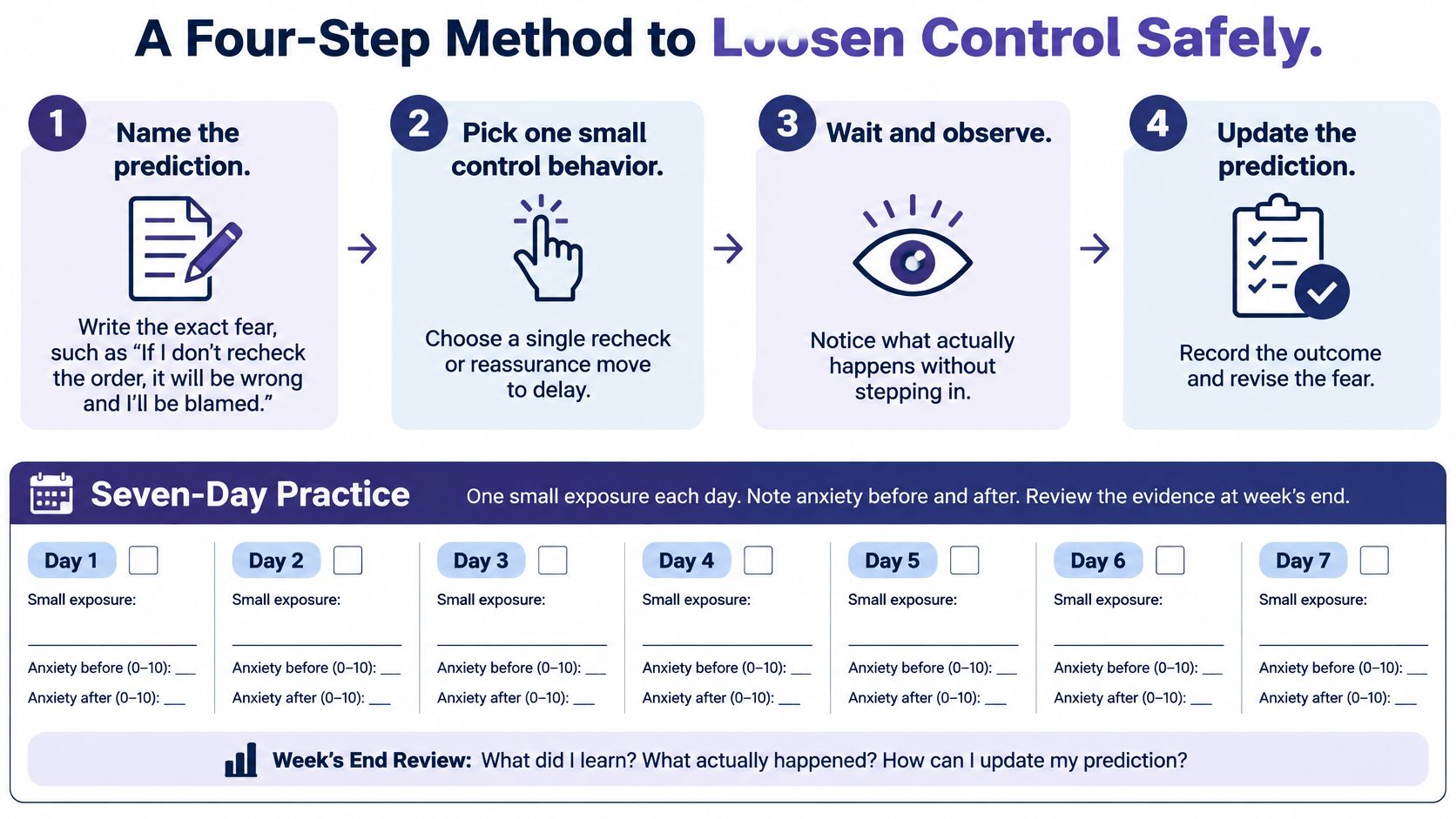
The evaluation step is the one people skip, and the one that teaches the brain anything new.
The research behind this sequence is specific. The meta-analysis of treatments targeting intolerance of uncertainty reviewed 26 studies involving 1,199 adults with generalized anxiety disorder and found large reductions in intolerance of uncertainty after psychological treatment (Hedges' g = 0.88), maintained at follow-up (g = 1.05), alongside large improvements in worry and anxiety. Treatments that targeted uncertainty directly outperformed general cognitive behavioral therapy right after treatment, and more treatment time on that target produced larger effects.
The reductions held at follow-up, which suggests the gains can last, though continued practice is what keeps new habits in place over time. A protocol completed last spring still needs use during a hard December.
The same pattern shows up in management. If you lead a team, Fluidwave's guide for hands-on managers covers the delegation side of the identical problem: the check that feels responsible can keep other people from learning. Acceptance and commitment therapy also describes the posture needed in step three: make room for discomfort while acting on your values.
A rule that prevents most failures: if a step needs more courage than you have on a Tuesday, the step is too big. Shrink it.
For one week, choose one moderate situation each day. Write the prediction, set the checking limit, stay with the arousal, and record the outcome at night. Pick situations you'd rate a 4 or 5 out of 10 rather than a 9, and repeat the same rung until the distress rating drops by roughly half before climbing.
Supportive Habits That Make Flexibility Easier
None of these replace the experiments. They lower the background arousal that makes the control urge feel urgent, which makes each experiment easier to run.
Anchor your wake time. Disturbed sleep and irritability feed worry and push people back toward checking. A consistent wake time plus a real wind-down window does more than chasing an extra hour of ragged sleep.
Move once a day. A walk gives the body somewhere to put arousal that would otherwise arrive as an urge to check something.
Name the urge kindly. When it shows up, say it in one sentence and answer the way you would a friend: that's the part of me that doesn't want to be blamed. Scolding yourself adds a second stressor on top of the first.
Tell one person. Ask them to back the plan rather than supply reassurance on demand, and be specific about what support looks like.
Watch caffeine and alcohol. Notice whether jitteriness spikes on the days the urge to control spikes, then shift the timing instead of swearing off forever.
Stress tightens the whole system. A 2023 study of children and adolescents found that participants who reported more stress also reported greater intolerance of uncertainty, more maladaptive emotion-regulation strategies, and more anxiety symptoms (the study of uncertainty and emotion regulation in young people). Adults run the same machinery, which is why a hard quarter at work tends to tighten the grip.
Pick one habit to strengthen this week and leave the other four alone. Five simultaneous changes is just another plan to manage.
Neurodivergent Needs, Trauma and Couples Dynamics
The most useful question about a control behavior is rarely "how do I stop?" It's "what is this doing for me?"
For an autistic adult, a fixed routine may be regulating sensory overload. For someone with ADHD, written lists may be carrying executive function that working memory can't hold. After trauma, scanning a room may be hypervigilance doing its old job. Generic anxiety advice tends to file all three under rigidity or perfectionism, which shames people who are managing real demands with the tools they have.
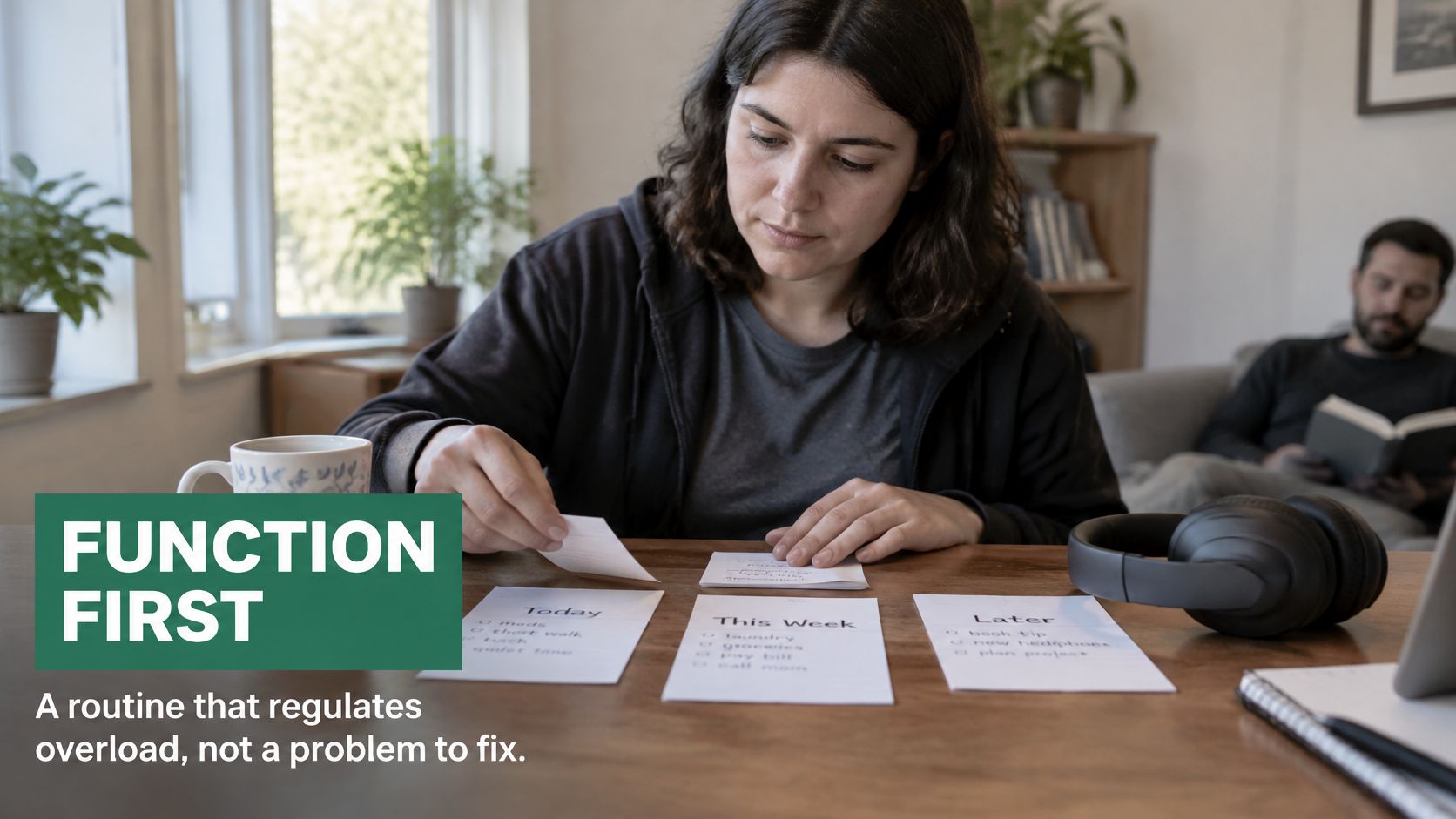
Sorting tasks into today, this week, and later can be accommodation rather than avoidance. What it's holding at bay decides which.
A recent synthesis describes heightened needs for psychological safety in anxiety and PTSD, and notes that OCD commonly involves pronounced needs for control and certainty because compulsions temporarily reduce distress from uncertainty. The same review identifies intolerance of uncertainty as a transdiagnostic process across generalized anxiety, social anxiety, panic disorder, and OCD, shaped by emotion regulation and cognitive flexibility (the Frontiers in Psychology review of uncertainty across conditions).
That gives a workable dividing line. Clear expectations, sensory supports, written plans, and communication agreements are accommodations: they lower the demand and free the person up. Avoidance and compulsive rituals that consume hours are maintenance: they lower distress now and raise the cost later. The honest test is direction over months, not intensity on any given day.
"I need the plan by Thursday so I can rest on Friday" asks for something specific. "You always have to be in charge" asks the other person to change who they are.
Couples get stuck precisely here. One partner's need for predictability lands as criticism or domination, while the other's spontaneity feels less like freedom and more like standing on a ledge. Both reactions are understandable, and neither partner is the villain.
Name the function. Ask what the behavior protects against before debating whether it should stop.
Agree on one accommodation. A shared calendar, a heads-up before guests arrive, a quiet hour after work.
Set a review date. Two weeks, then check whether it helped or became a new rule.
Check the direction. Is the behavior shrinking as safety grows, or expanding into more of the week?
Counseling for neurodivergent couples usually begins with exactly this negotiation, because the goal isn't to make either partner less themselves.
When Control Issues Anxiety Needs Professional Support
Some of this is a normal response to an unstable stretch. A job loss, a sick parent, a move across the country: control behaviors spike and then settle as life steadies. Clinical attention becomes relevant when the worry is persistent, hard to control, and impairing.
The Markers Clinicians Look For
Diagnostic criteria for generalized anxiety disorder require excessive worry about several areas of life, such as work or school performance, present more days than not for at least six months. Adults also need at least three of six associated symptoms: restlessness or feeling on edge, fatigue, difficulty concentrating, irritability, muscle tension, or disturbed sleep. The criteria specifically include difficulty controlling the worry, and they require clinically significant distress or impairment in social, occupational, or other important areas (BMJ Best Practice's clinical summary of generalized anxiety disorder). A clinician also rules out substances, medications, medical conditions, and other mental disorders before any diagnosis, which is part of why self-diagnosis from a checklist goes wrong.
Scale puts the pattern in context. The World Health Organization estimated that about 470 million people worldwide were living with an anxiety disorder in 2023, equal to 5.8% of the global population, making anxiety disorders the most common category of mental disorder (the WHO anxiety disorders fact sheet).
Red Flags That Justify an Assessment
Compulsive checking that eats more than an hour a day, especially when it's crowding out work or sleep.
Avoidance that shrinks your world, such as declining projects, trips, or social plans to prevent uncertainty.
Panic episodes, particularly if you start avoiding places where one happened.
Repeating conflict with a partner, family member, or colleague that follows the same script no matter how many times you discuss it.
A licensed counselor or physician can sort out what's anxiety, what's habit, and what's something else wearing an anxiety costume. If you or someone near you is in crisis or feels unsafe, contact local emergency services or a crisis line right away rather than waiting for an appointment.
Your Next Step Toward Flexible Control
Choose the least threatening item in your sorting table and practise with it for a week. Small, repeated tests give you a chance to notice what happens, rather than relying on anxious predictions or willpower alone.
At week's end, review your log. Which feared outcomes came true? Which did you handle without extra checking? The result may be mixed: uncertainty remained, and you coped.
If the pattern still feels stuck after several weeks of practice, or a red flag from the previous section applies, consider speaking with a licensed counselor. Be Your Best Self & Thrive Counseling, PLLC offers support for non-emergency concerns and works with people who are ready to make changes but want help building the life and relationships they want. Its counseling services include online and in-person sessions, workshops, group therapy, and workbooks. Rochelle Young's focus areas include anxiety and panic, people-pleasing, and boundaries.
Bring your sorting table and first-week log to a first conversation. The goal is to care about outcomes while making room to act without a guarantee.
Be Your Best Self & Thrive Counseling, PLLC is based in St. Petersburg, Florida, and offers online counseling. Its approach draws on evidence-informed, mind-body-spirit care, nervous-system work, trauma-informed principles, and mindfulness. Visit Be Your Best Self & Thrive Counseling, PLLC to schedule a free initial consultation and discuss your goals.