
EFT Couples Therapy Explained for Partners
EFT couples therapy is attachment-based work that changes the bonding cycle between partners. The goal is helping each person reach the other in a new way, instead of finding more polite words for the same argument.
Maybe you're reading this after another tense evening. You asked for help, your partner heard criticism, and somehow a conversation about dishes became a conversation about whether you matter.
That gap between what you meant and what your partner felt is the territory EFT works in.
You don't need a perfect explanation of your feelings to begin. You need an approach that makes room for both people, including differences in processing speed, sensory needs, culture, and the ways each person expresses care. A method that expects every couple to move at the same emotional pace can leave some partners behind, so fit matters from the first session.
What EFT Couples Therapy Changes
You might argue about spending on Monday and bedtime on Thursday, yet end both conversations in the same place. One person feels abandoned; the other feels impossible to please. The subject changes, but the emotional ending doesn't.
Emotionally Focused Couples Therapy, also called EFCT or EFT couples therapy, treats that recurring distress as a problem in the bond. The therapist works with how partners experience and respond to each other, not only with the words they use.
What the satisfaction findings mean
A 2019 meta-analysis in the Journal of Marital & Family Therapy, covering 33 studies and 2,730 participants, all measuring relationship satisfaction, reported end-of-treatment effects of Hedges' g = 0.73 for EFCT and 0.53 for Behavioral Couples Therapy, with EFCT at 0.66 at six-month follow-up and the overall effect across both approaches at 0.44.
For orientation, about 0.50 represents a medium average change, while about 0.80 represents a large one. The EFT result therefore describes a meaningful average improvement, not a tiny statistical difference that partners would necessarily struggle to notice.
It doesn't mean a particular percentage of couples recovered. An effect size describes the magnitude of measured change, not the odds that your relationship will improve.
These are also averages across studies, not a promise for your relationship. Study populations and follow-up periods vary, and your circumstances still matter.
Beyond better phrasing
Consider a partner who learns to ask calmly for more time together. The sentence may sound respectful, but if the response is distracted or dismissive, that partner can still feel painfully alone.
EFT asks what happens at that moment of reaching. Can the other person recognize the need, stay engaged, and respond in a way that feels believable?
Communication skills help partners express a request clearly.
Emotional responsiveness helps the person making the request feel received.
Felt security means partners increasingly trust that reaching won't lead to humiliation, dismissal, or disappearance.
Practical agreements still belong in the work. Someone still needs to handle dinner, discuss money, and make the school pickup plan. Emotional connection doesn't replace shared responsibility.
The target is a relationship in which those conversations happen with more confidence that you're on the same side. That requires understanding the loop beneath the disagreement, not just improving the wording at its surface.
The Cycle Under the Argument
An attachment question can sound surprisingly ordinary: Are you there for me when I need you? Partners don't usually ask it that plainly during an argument. They ask why someone hasn't answered a message or why they're looking at their phone.
Think of the argument as a dance. One partner steps forward with questions, criticism, or repeated attempts to get a response. The other steps backward with silence, explanations, or a turned shoulder.
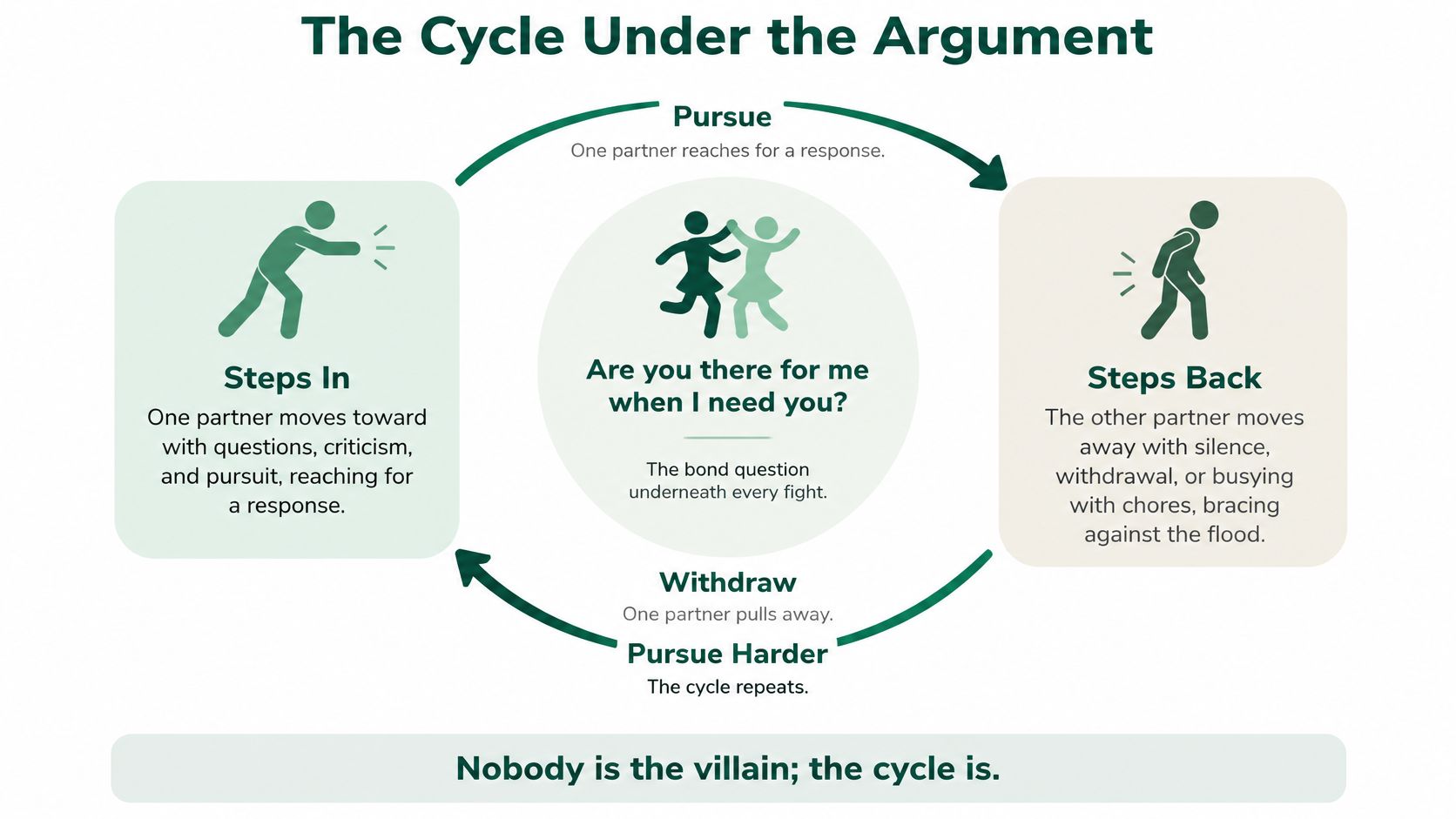
The forward step seeks a response; the backward step seeks relief from overwhelm.
What each step protects
Say a partner becomes sharp when an evening passes without conversation. Under that sharpness may be fear of being unimportant: If I don't push, will you notice me at all?
The partner who retreats may be thinking something very different: I'm already getting this wrong. If I keep talking, I'll make it worse. Washing a pan or explaining the schedule can become a way to escape that sense of failure.
Neither interpretation should be assumed. The therapist helps each person discover what fits, rather than assigning a hidden feeling from the outside.
The enemy is the cycle, not the partner. Each person is still responsible for how they treat the other.
That distinction matters. Understanding why someone lashes out doesn't excuse insults, and understanding withdrawal doesn't erase its impact.
From protest to a reachable message
The protest might be: You never listen.
A more reachable message might be: I miss you, and I'm scared we're drifting.
The second message doesn't guarantee a warm response. It does make the need easier to recognize because the listener isn't first being asked to defend their character.
Anger, sarcasm, and shutdown can be protective layers. Loneliness, shame, fear, and longing may sit closer to what someone needs their partner to understand. A therapist helps partners notice the loop while it's happening, slow down, and make room for those less defended messages.
Withdrawal also isn't a diagnosis or proof that someone doesn't care. Learning about avoidant attachment in relationships can offer useful language, but a label shouldn't replace curiosity about this person in this moment.
For a home listening task, notice who moves closer, who moves away, and what fear might sit beneath each move. Observe without announcing your analysis during a fight. The useful discovery is your own protective step, not a new argument about your partner's attachment style.
How the Five Session Moves Work
An EFT session is guided and slower than a kitchen argument. The therapist may spend much of a meeting helping a partner understand a feeling that ordinarily gets covered by a quick accusation or a shrug.
The EFT Tango names a sequence of therapeutic moves, described in Sentio's guide to EFT stages and steps. A session may complete only part of that sequence; emotional access isn't something to rush through to finish a checklist.
The guided sequence
Mirror the present process. The therapist describes what's happening without making either partner the villain. A sharp question is followed by a turned shoulder, then another question. Naming the exchange gives both people something observable to work with.
Assemble and deepen emotion. The therapist helps a partner gather the feeling beneath their reaction. That might involve noticing a tight chest, recalling the meaning of the moment, or choosing between concrete emotion words. Body awareness can help, but it shouldn't become another test someone must pass.
Choreograph an engaged encounter. The partner is invited to share the deeper experience directly with the other person. Instead of only telling the therapist about loneliness, they might turn toward their partner and say that loneliness in language they can manage. This is an invitation, not a demand for intense eye contact.
Process the encounter. Both partners explore what the exchange felt like. Was the message believable? Did hearing it bring relief, doubt, tenderness, or fear? A hesitant response matters too, because receiving vulnerability can feel unfamiliar.
Integrate and validate the change. The therapist helps name what shifted. Perhaps someone stayed present rather than defending, or asked for reassurance without attacking. Naming the difference makes the new response easier to recognize and attempt again.
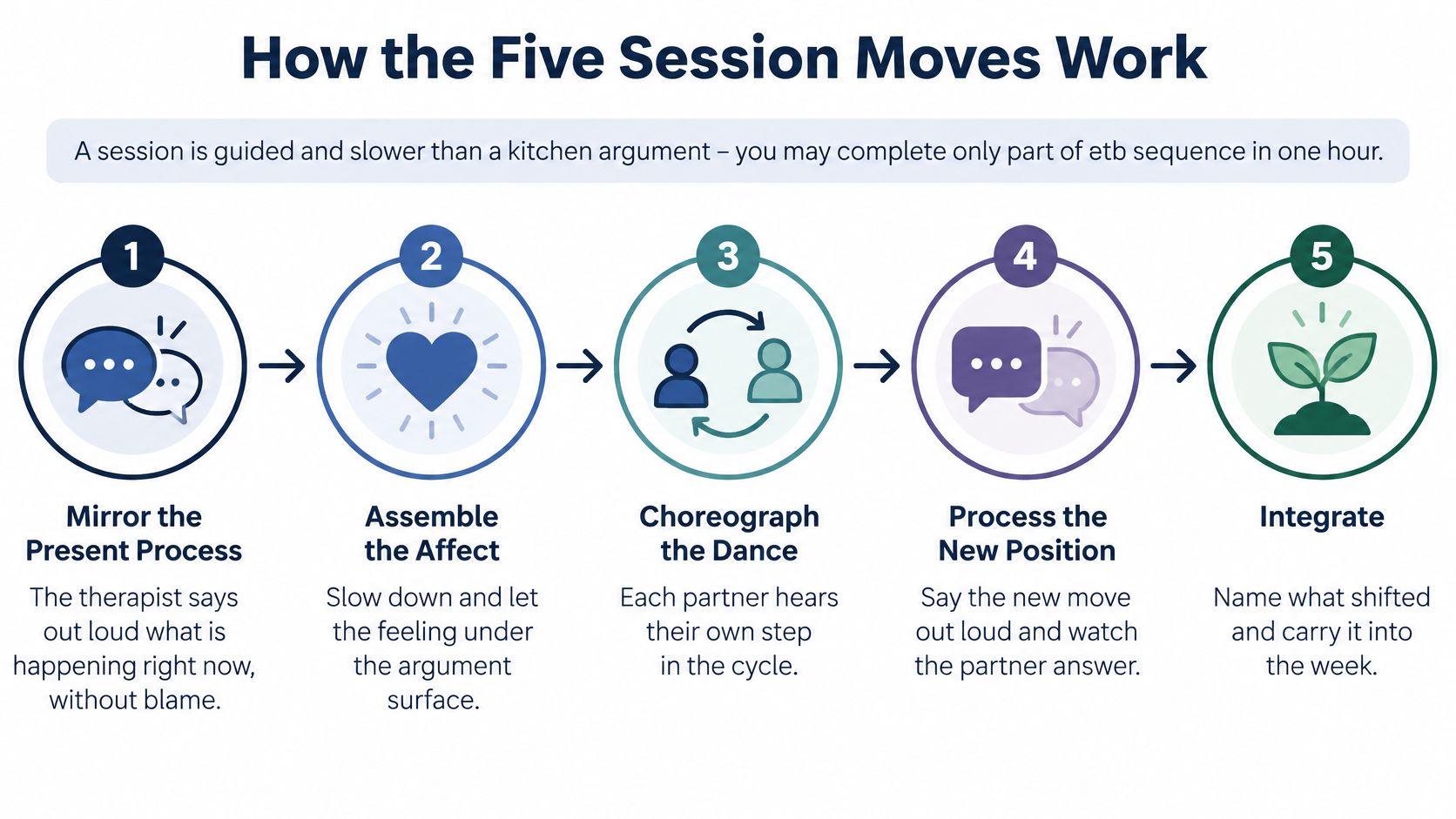
The sequence is mirror the present process, assemble emotion, choreograph an engaged encounter, process the encounter, and integrate and validate.
Why this isn't simply opening up
Generic advice to communicate openly leaves difficult questions unanswered. What should you share when you only know you're upset? What happens when your partner hears vulnerability as blame?
These moves have different jobs: observing the interaction, understanding emotion, creating contact, exploring the response, and consolidating meaning. The therapist helps with the transitions instead of leaving you to improvise through the hardest part.
Care often unfolds through meetings over months, rather than a single revealing conversation. Don't confuse the Tango's session moves with a fixed treatment length.
Between sessions, keep the practice modest: catch the cycle and attempt a softer reach. That could mean naming that you're getting defensive and asking to restart, rather than expecting yourselves to reproduce an entire therapy session at home.
Who Benefits and Who Should Wait
When EFT Couples Therapy Fits
Situation | Often a fit when | Pause or adapt when |
|---|---|---|
Repeating pursue and withdraw | Both partners want the bond and can look at fear under anger | One partner is coerced, unsafe, or unwilling to stop the attack |
Polite but distant | Skills talks stay calm while the bond still feels cold | The only goal is a script with no emotional contact |
Affair recovery | Both will name what happened and rebuild responsiveness | Deception is ongoing and will not be acknowledged |
Life stress or transition | The conflict is about feeling alone inside the stress | One person is in an acute personal crisis |
Neurodivergent or highly sensitive partners | Attachment work includes pacing, sensory needs, and clear language | Fast emotion talk is treated as the only correct style |
The shared requirement isn't that you arrive calm or already know how to be vulnerable. It's that you can participate voluntarily and take responsibility for your behavior.
A high-conflict couple may have a workable starting point when both people want repair and can become curious about what happens beneath anger. A quiet couple may need just as much help if politeness has become a way to avoid contact.
When safety comes first
Violence and coercive control aren't a difficult dance between equals. If someone fears punishment for telling the truth, asking them to become more emotionally exposed in a joint session can create further risk.
A therapist should assess whether either person is being threatened, monitored, isolated, or controlled. Safety planning and individual support may need to come before relationship-focused work.
Coming to therapy to monitor a partner, gather ammunition, or make them comply isn't the same as coming to repair. The distinction concerns behavior and safety, not whether a partner fits a label; questions about couples counseling with a narcissist are best approached with that distinction in mind.
An acute personal crisis can also make intensive relationship work the wrong immediate priority. Stabilizing the person and arranging appropriate support may be more useful than asking the couple to process vulnerable material together.
Safety first: Being able to speak honestly without retaliation matters more than being able to finish a joint conversation.
At our practice, we work specifically with non-emergency issues and motivated people who are ready to change but need help building the life and relationships they want. That scope matters when deciding where to begin.
A readiness check
Both want repair. Neither person is being forced to attend or expected to persuade the other to stay.
Both can be honest about safety. Concerns can be raised privately with the therapist, not negotiated under pressure.
Both will consider feelings and logistics. The work can include hurt and longing alongside concrete changes in behavior.
You don't need equal confidence about therapy. You do need enough freedom and willingness for the process to be shared.
One Evening From Fight to Reach
The following scene is a composite illustration, not a client story.
After dinner, Jordan asks: Are you even in this marriage? Alex goes quiet, turns toward the sink, and starts washing dishes. Jordan hears the running water as another refusal to answer.
Alex scrubs harder while Jordan repeats the question. Neither person experiences their own behavior as starting the problem. Both feel they are responding to something painful.

A composite couple moment showing distance during an ordinary kitchen disagreement.
Slowing the kitchen moment
In a session, the therapist brings attention to that exact minute, rather than reviewing every disagreement from the week. What happened inside Jordan just before the question? What happened inside Alex just before turning away?
Jordan eventually reaches a less defended explanation: I get sharp because I'm scared you've already left.
Alex doesn't immediately offer reassurance. First comes a description Jordan hasn't heard clearly before: I freeze because I think I'll say the wrong thing and make it worse.
Neither statement settles the underlying disagreement. But each person has offered information the other couldn't easily see from the outside.
They try a 30-second redo within this hypothetical scene. Jordan names the fear without the accusation, and Alex turns from the sink to stay for another sentence instead of disappearing into the task.
What carries into the week
The next week isn't suddenly peaceful. Jordan still becomes impatient, and Alex still feels the urge to shut down. This time, though, they interrupt the exchange sooner.
Later, Alex sends a text: I got quiet, and I'm still here.
Progress can look like a message that makes reconnection possible, not a dramatic conversation that resolves everything.
Jordan doesn't have to pretend the silence didn't hurt. Alex doesn't have to produce a perfect explanation immediately. They have a small opening in which acknowledgment and follow-through can happen.
That opening needs repetition. A redo doesn't finish therapy, and a reassuring text doesn't replace an overdue conversation about responsibilities, trust, or time together.
For partners who want a manageable way to practice, couples counseling exercises can support an agreed pause, a check-in, or a clearer request. Choose something both people consent to, rather than turning practice into a test of commitment.
The useful measure isn't a conflict-free week. It's a smaller loop and a clearer reach: less time lost to the familiar argument, and a more recognizable attempt to return.
Adapting EFT Without Forcing One Style
There isn't a single correct way to show emotional engagement. Naming feelings quickly, speaking face to face, and tolerating intense emotional conversation aren't equally accessible to every partner.
For autistic, ADHD, highly sensitive, and otherwise neurodivergent partners, access needs can include differences in processing speed, sensory load, emotional vocabulary, and expression. Those differences aren't evidence of less love or commitment.
What the limited evidence supports
A scoping review published in Psychotherapy and Counselling Journal of Australia identified nine relevant studies, only two examining relationship-therapy models and one trialling a therapeutic model; that trial's 12 sessions improved communication discomfort and emotional-awareness discomfort, but didn't improve relationship-satisfaction measures.
Those findings don't establish a ready-made EFT protocol for neurodivergent couples. They support being careful about promises and testing whether an adaptation helps the people using it.
Attachment work may remain valuable while its delivery changes. Access is part of treatment fit, not an optional courtesy after the work begins.
Make emotional work accessible
Useful options to discuss include:
An emotion map. Start with concrete choices such as disappointed, worried, overloaded, or uncertain, rather than a broad demand to identify a feeling.
Written check-ins. Let someone compose a message before discussing it, with an agreement about when their partner will respond.
Processing pauses. Allow time to understand a question without treating silence as rejection.
Structured turns. Make clear who is speaking, what the listener is being asked to do, and when roles change.
Sensory accommodations. Adjust lighting, seating, background noise, and movement where possible.
Consent-based contact. Ask before eye contact, physical closeness, or rapid emotional exercises.
A partner might communicate care more clearly through direct language than through a softer tone. Another might need a concrete example before an emotional question makes sense. A neurodivergent couples therapy conversation should make room for these differences without treating either person as defective.
Don't turn context into attachment alone
A retreat from conversation may also reflect racism, immigration stress, poverty, gendered labor, religious expectations, or fear about safety. A partner carrying most of the household work needs a fairer arrangement, not merely help expressing loneliness more gently.
A paper on cultural adaptation of EFCT emphasizes alignment with local values, communication styles, relationship dynamics, and lived experience. Emotional meaning needs to be understood within that context rather than assigned from a standard script.
For LGBTQ+ couples, that includes naming minority stress and avoiding heterosexual or monogamous assumptions. Therapists should ask about relationship agreements, identity safety, and external pressures instead of presuming what commitment looks like.
A useful fit question is: Will you change the delivery, or only translate us into one emotional style?
Choose a Couples Therapist and Start
Bring these questions to a first meeting:
How do you work with our negative cycle? Ask how the therapist helps both partners understand their part without flattening differences in responsibility.
How do you pace emotion for our communication and sensory needs? Listen for concrete adaptations, not just a promise to be flexible.
How many sessions do you expect, and how long is each couples session? Ask how the initial plan will be reassessed rather than treating an estimate as a guarantee.
What will progress look like? Discuss fewer and shorter repeats of the cycle, and greater ability to name a primary feeling without attacking.
You can also ask how the therapist checks safety and handles a moment when someone becomes overwhelmed. A thoughtful answer should leave room to slow down without abandoning the difficult topic.
Make the practical fit clear
Choose a setting suited to motivated partners working on non-emergency conflict, distance, and repair, with safety checked first. You don't have to agree about every problem before attending, but each person should be able to explain what they hope will change.
At Be Your Best Self & Thrive Counseling, PLLC, we see individuals and couples. Jamie Molnar's couples sessions cost $155 for 50 minutes or $225 for 90 minutes; confirm the appointment format and current arrangements before booking.
For other providers, confirm fees and session length directly. Budget, scheduling, and the ability to attend consistently are practical parts of choosing care, not distractions from the emotional work.
Prepare without rehearsing a case
Use this guide to preparing for couples counseling to organize your concerns without compiling evidence against each other. Bring a recent example, what you each felt, and what you wish had happened instead.
Book a consultation together if it's safe to do so. Name the cycle you want to change, then decide after that meeting whether the therapist's approach and pace feel workable for both of you.
We offer individual and couples counseling for people ready to work on non-emergency concerns, including relationship conflict, distance, and repair. Visit Be Your Best Self & Thrive Counseling, PLLC to arrange a free initial consultation and discuss your goals, communication needs, and whether our approach feels like a fit for both partners.