
Fight Flight Freeze Fawn: What Each Stress Response Means
Your manager's voice sharpens across the meeting table and your body answers before you've formed a thought. Your jaw sets and your hands tighten, or your shoulders drop and you hear yourself agreeing quickly with a plan you don't support. Twenty minutes later you're still shaky, and you can't quite explain why.
That gap between what you wanted to do and what your body did is the whole subject of fight flight freeze fawn. These are protective states your nervous system shifts into when it registers threat, and they run on a timeline faster than conscious choice. Learning to read them is less about finding your type and more about noticing what a situation asked of you, and whether the answer it produced is still serving you.
What Fight, Flight, Freeze and Fawn Actually Mean
Say you're three minutes into a team meeting and a manager's tone turns sharp. Your body reacts before you've picked a strategy. Your jaw sets, your hands tighten, or your shoulders drop and you start agreeing with everything in the room. Neither response is a character flaw. Each is your nervous system answering a question it asks constantly, which is how close the danger is and what gives you the best chance right now.
Fight, flight, freeze and fawn are the four names we give to those answers. A peer-reviewed review of acute stress describes the response as far more than a simple fight-or-flight choice, with the sympathetic–adrenomedullary axis setting fight-or-flight behavior in motion while also coordinating metabolic and immune changes (this review of acute stress physiology). The same review notes that freezing can immobilize an animal, which means reduced movement can be an active defensive response rather than passivity or refusal.
Fight pushes back. It's the surge that makes you argue your case, confront the person, or defend a boundary, sometimes with more force than the moment deserved.
What sits underneath: Anger is the visible layer of the fight response. Beneath it you'll usually find a flash of being dismissed, trapped or exposed.
Flight creates distance. You leave the room, cancel the call, avoid the conversation, or stay so busy that you're never quite where the discomfort is.
Freeze holds still. Attention climbs, movement drops, and words can disappear entirely, which is why people go blank when put on the spot and then blame themselves for it.
Fawn appeases. You agree fast, apologize for things that aren't your fault, minimize your own needs, and work to keep the more powerful person calm.
The table below puts the body signs and the protective goal side by side, so you can start recognizing your own pattern in real situations rather than in the abstract.
Response | Common signs in body and behavior | Protective goal |
|---|---|---|
Fight | Raised heart rate, muscle tension, firm voice, pushing back or confronting | Control over the threat and the situation |
Flight | Restlessness, urge to leave, racing thoughts, planning an exit | Distance from the danger |
Freeze | Stillness, numbness, difficulty speaking or moving, heightened alertness | Holding still while the brain assesses danger |
Fawn | Quick agreement, over-apologizing, minimizing needs, placating | Safety, belonging or approval in a threatening relationship |
Notice what the four share. Each is a defensive state shaped by perceived threat, available escape routes and who holds power in the room, not a fixed personality. Individuals often move between several of them in a single day, and the same person can fight with a sibling and fawn with a supervisor. Fawn is the least established of the four in the research, and that gap is worth understanding before you apply the term to yourself. For a clinical view of how these protective patterns play out in relationships, counselling support for trauma reactions sets it out in plain language.
How Your Body Drives Each Stress Response
Your body's alarm system works like a building fire alarm with two stages. One is the siren, loud and instant and impossible to ignore. The other is the control panel, which keeps coordinating sprinklers, lifts and ventilation long after the noise starts.
Fast Chemistry and Slow Hormones
The siren stage runs on catecholamines released through the autonomic nervous system within seconds. Heart rate climbs, blood flow shifts toward large muscles, attention narrows, and you're physically ready to move. This stage powers fight and flight most directly.
The control-panel stage is slower. The hypothalamic–pituitary–adrenal pathway releases corticosteroids that help regulate longer-lasting responses, so the effects outlast the moment (a comparative review of stress physiology). Acute activation therefore involves both fast bodily changes and slower hormonal ones, rather than a single switch you flip on and off.
The trigger doesn't have to be physical. In laboratory experiments, people who went through a validated stress-induction protocol were more willing to exert physical effort, measured through grip force, to avoid a possible electric shock, while effort aimed at earning money showed no comparable increase. A critical email or a raised voice can run the same two stages, because the body reads social threat cues through the same alarm system.
The diagram below lays out both stages and shows where each response sits on them.
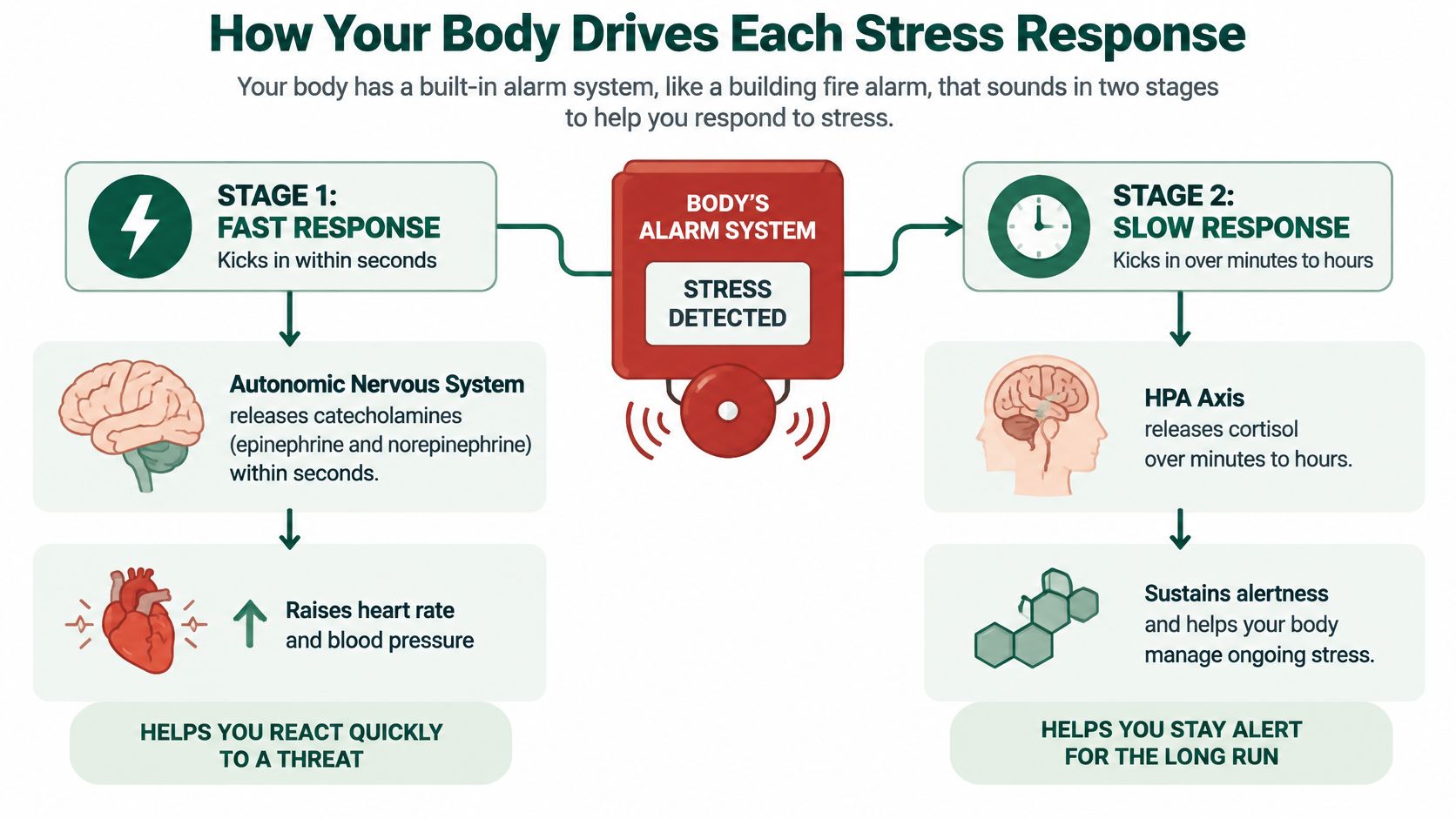
Seconds versus hours. The fast stage gets you moving and the slow stage keeps the system on alert well after the moment passes.
This timing explains a lot of ordinary confusion. An argument ends, the other person has moved on, and you're still shaky an hour later because the hormonal tail is doing its work. Nothing is wrong with you in that state. Your body is finishing a job it started.
It also explains why regulation work targets the body and not only the thoughts. Reasoning with yourself helps once arousal has come down a little. Before that, slower breathing, cooler air, a walk and a glass of water do more than a good argument. If you want the wider map of how the nervous system organizes these shifts between states, this plain-language explanation of nervous system states is a useful companion, and a general guide to fight, flight, freeze and fawn sets out the four patterns side by side.
Why Fawn Has a Thinner Evidence Base
Search the phrase and you'll find plenty of graphics showing four animals side by side, presented as four equally proven biological settings. They aren't equally proven. A map works as a comparison here: fight, flight and freeze are highways with decades of neurobiological and behavioral research underneath them, while fawn is closer to a footpath that clinicians walk often but researchers have barely surveyed. That difference matters when you're trying to understand your own reactions.
What the Fourth F Actually Rests On
The 2025 review of fawning reports that the idea of fawning as an autonomic response tied to childhood trauma has grown in popularity over the previous decade, without establishing a universally accepted diagnostic category or a precise prevalence rate. In plain terms, fawn describes a pattern well. It isn't a diagnosis, and no study can yet tell you what share of adults do it.
The terminology has a short academic history. The modern use of fawn as a fourth F is associated with trauma writer Pete Walker's 2013 work, while academic writing has more often used terms such as appeasement or submissive defense. Direct research is thin: one grounded-theory study interviewed a small group of experienced Australian mental-health practitioners, who tended to read fawning as a contextual adaptation rather than individual pathology, especially where a person faces entrapment, power imbalance or repeated interpersonal threat. The same paper shows how uneven the measurement is: a clinical study cited in that 2025 grounded-theory paper in the Australian Counselling Research Journal reported significant tonic immobility in approximately 70% of sexual-assault survivors in that sample.
A working rule: Treat fawn as a description of a pattern you fall into under pressure, not a trait you either have or don't.
That figure describes one sample and can't be generalized to all trauma survivors. What it shows is that freeze and related immobility can be counted in a population, which is precisely what fawn lacks. A small set of interviews is a thin base for population claims, and grounded theory is designed to generate hypotheses rather than prevalence figures. The 2025 review also notes that many clinicians have had little formal training on the construct, which helps explain why descriptions of fawning vary so widely between sources.
The childhood link is the part most repeated online and least tested. Repeated threat in childhood, a caregiver whose moods shifted without warning, criticism that arrived whatever you did: any of these may teach a person to reach for appeasement early and automatically. Clinicians describe that pathway often, and controlled research hasn't confirmed it. Plenty of people with difficult childhoods never default to fawning.
So use the term as a question rather than a verdict. If you notice yourself agreeing to avoid conflict, the useful next step is exploring context, safety and cost: who you fawn with, what you fear would happen if you didn't, and what it takes from you over a month.
Everyday Situations Where Each Response Appears
Take one ordinary Tuesday. On the drive in, a car cuts across two lanes without signalling and your hand is on the horn before you've checked your mirrors. At ten, a manager criticizes your project in front of the team and you go quiet, then hear yourself offering to redo the whole thing over the weekend. At six, a parent comments on your weight, and you laugh, pass the bread and change the subject.
Three settings, three different responses, one nervous system. You don't have a single response style. You have a repertoire, and the situation picks which one shows up.
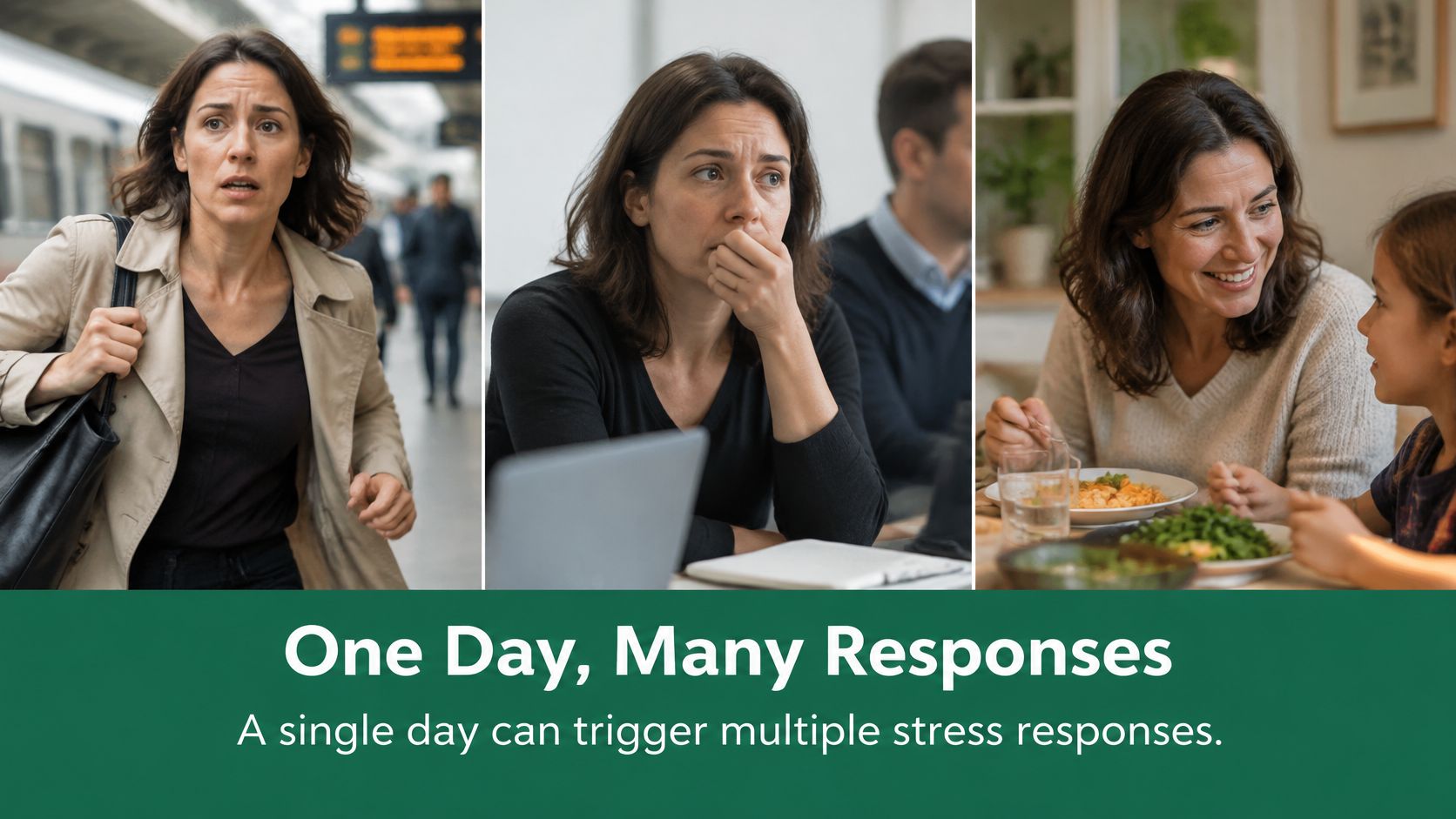
The same person, hours apart, in three different protective states.
Six Everyday Settings and What They Tend to Trigger
Setting | Trigger | Likely response | Why it makes sense |
|---|---|---|---|
Team meeting with a raised voice | Sudden criticism from a manager | Fawn or freeze | Agreeing or going still reduces conflict while the person assesses the risk |
Car cutting in without warning | Sudden close threat on the road | Flight | Moving away from danger is the fastest protection |
Escalating argument with a partner | Feeling cornered or blamed | Fight or freeze | Pushing back defends a boundary, while going still can stop escalation |
Medical procedure involving needles | Pain or a loss of control | Freeze | Stillness is a common protective state when escape is not possible |
Critical parent at a family gathering | Repeated criticism from a person with power | Fawn | Placating may protect belonging and reduce further criticism |
Stressful call followed by a noisy hallway | Overwhelm and sensory overload | Flight | Leaving the overload lowers arousal quickly |
Read the table as a set of hypotheses rather than rules. Power, past experience and whether an exit is available shift the answer, which is why two people can sit through the same meeting and leave with completely different reactions.
The family-dinner row is the one people most often misread as kindness. If you recognize yourself in it, therapy for people-pleasing walks through how the pattern forms and what changing it involves, including why the first attempts usually feel dangerous.
None of these reactions is a failure. Each is a signal about what the moment required: distance, control, information, or a relationship kept intact. Reading the signal accurately is more useful than judging it.
When Protective Responses Become Automatic
A terse email from a manager can raise your shoulders before the message is even open. Nothing in the email can hurt you directly, yet the body may already be leaving the room, arguing back, going blank or smoothing things over. That speed is the point. A response that reduces danger once gets rehearsed, and rehearsal makes it easier to trigger next time, including when the threat is only a tone of voice, a delayed reply or a look that seems colder than usual.
Where the Four-Response Model Runs Out
Fawning blurs your own preferences. You can get so practiced at reading the room that you lose track of what you wanted before you walked in, and resentment builds.
Freeze outlasts the threat. People describe going blank in meetings, staring at tasks they cannot start, or feeling far away during conversations that matter.
Flight becomes avoidance. Work, medical appointments, difficult conversations and closeness itself can all get postponed.
Fight becomes a reputation. The person who reacts fast gets described as difficult, which makes the underlying alarm harder to talk about.
The evidence is uneven here. Fight, flight and freeze draw on a longer physiological record, while fawn is still being defined and compared across studies. Clinicians often describe fawning as strategic appeasement that preserves safety, belonging or approval inside unfair or coercive settings. That makes it a survival move in context, even when it becomes costly outside that context.
The better question is which response preserves safety and agency in this specific situation.
That reframing matters for anyone whose circumstances include real risk. Discrimination, economic dependence, an abusive partner, immigration worries or a retaliatory workplace can make appeasement the safest available move, and pushing someone toward confrontation in those conditions is careless. Safety planning comes before pattern change.
It also means treating quick fixes with suspicion. Recent literature acknowledges inconsistent definitions and limited comparability between studies, so claims that one breathing exercise reliably shifts someone from fawn to fight deserve caution. Immediate stabilization and deeper pattern change are different projects, and stabilization usually comes first. If you want language for the range where thinking and feeling can stay online together, what the window of tolerance means is a useful next read.
How Therapy Supports Nervous System Regulation
Regulation doesn't mean forcing calm. It means building the ability to move between states, so you can mobilize when something needs doing and settle once it's over. A nervous system that never activates isn't regulated. It's under-responsive.
For a freeze pattern, the work starts with orientation. A therapist guides you to name what's in the room, the door, the window, the colour of a chair, and to add small voluntary movements such as pressing your feet into the floor or turning your head slowly. The point is to give the body new information that action is possible, which is what freeze temporarily suspended.
For the high arousal that comes with fight and flight, paced breathing and a slower speaking pace come before problem-solving. Trying to reason through a conflict while your heart is going hard rarely produces anything you'd stand behind an hour later. Bring the activation down first, then think.
Regulation isn't the absence of a stress response. It's the ability to move between states without getting stuck in one.
For fawn, therapy starts with validation and then moves slowly. Situational safety planning comes first, then boundary experiments small enough to survive, then gradual increases in authentic choice. Nobody sensible asks someone to confront a volatile boss in week two, because abrupt confrontation isn't the goal. Choice is.
The checklist below shows what each pattern needs and where the therapeutic work goes.
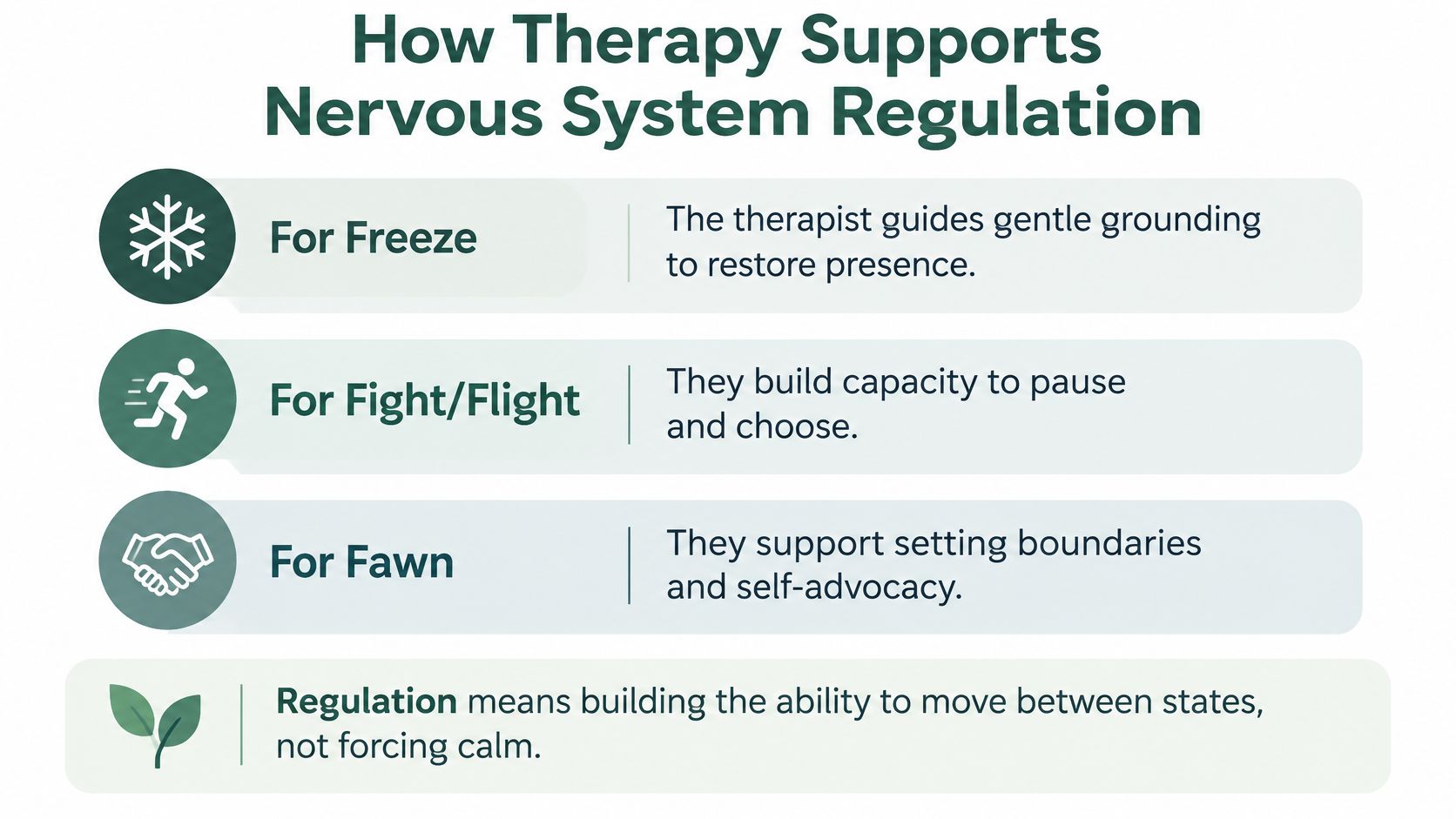
Three patterns, three different entry points, one shared aim of flexibility.
Response pattern | Helpful in the moment | Work done in therapy |
|---|---|---|
Freeze | Orienting to sensory cues in the room and small voluntary movements | Grounding practice and gradual re-engagement with activity |
Fight or flight with high arousal | Paced breathing and slowing the pace of speech | Learning to recognize early arousal and pause before responding |
Fawn | Pausing before agreeing and checking your own preference | Validation, safety planning and boundary experiments |
Pattern across relationships | Noticing repetition and what followed the episode | Assessing context, safety and values to choose the right response |
Assessment looks at specifics rather than labels. A clinician asks how close the trigger felt, whether escape seemed possible, what happened in the body, whether attention narrowed or went blank, and what you did next (a review of threat imminence and defensive behavior). Calling someone avoidant or compliant tells you far less than knowing what followed the episode.
Some people add hands-on bodywork alongside talking therapy, and cranial osteopathy for nervous system tension is one complementary option that some find calming between sessions. It doesn't replace trauma-informed therapy and isn't a treatment for trauma responses on its own. If you want to see how a therapist sequences the clinical side, trauma-informed therapy interventions outlines the main approaches. Be Your Best Self & Thrive Counseling in St. Petersburg, Florida, provides trauma-informed, nervous-system-focused counseling for anxiety, trauma and stuck patterns, and offers a free initial consultation to explore fit.
Choose Your Next Step Toward Regulation
You don't need to diagnose yourself to make use of any of this. Work through five steps, in order, and give each one a week before judging whether it helped.
Notice the pattern and the setting. Use the everyday situations table and mark which response shows up most often, and where.
Check safety before anything else. If a relationship, workplace or home environment involves threat, violence or coercion, safety planning comes before any experiment with a new response.
Track what it protected and what it cost. Over the past month, what did the pattern save you from, and what did it take?
Practice one small skill. Pausing for three slow breaths before agreeing to a request teaches your body that a pause is survivable.
Get help if the pattern repeats. If the same response keeps showing up across relationships, or it's costing you work, sleep or closeness, a trauma-informed counselor can help you map the context and build flexibility.
If you want a starting point for the body side of this, how to regulate your nervous system covers grounding, breath and orienting in plain language. The aim throughout is choice, not a fixed label or a personality you're stuck with.
Be Your Best Self & Thrive Counseling, PLLC works with adults and couples in St. Petersburg and across the Tampa Bay area who want to understand why their body reacts the way it does and then practice something different. Sessions combine trauma-informed, nervous-system-focused counseling with practical tools you can use the same day, whether the pattern is fawning in a meeting, freezing during conflict, or a fight response that fires before you've chosen it. Visit Be Your Best Self & Thrive Counseling, PLLC to request a free initial consultation and talk through what you've been noticing.