
Therapy for People Pleasing: What Actually Works
You're probably here because the pattern is costing you something now.
Maybe you keep saying yes at work and then lie awake replaying your resentment. Maybe you can feel a no in your body, but what comes out of your mouth is, “Sure, no problem.” Maybe people describe you as supportive, flexible, and easy to be around, while inside you feel stretched thin, invisible, or oddly guilty for even wanting rest.
That's where therapy for people pleasing can be helpful. Not because a therapist gives you a magic boundary script, and not because “people pleasing” is a formal diagnosis. It isn't. Recent work suggests it's better understood as a cluster of overlapping processes rather than one single disorder, including neglecting your own needs, feeling responsible for others' wellbeing, and tying self-worth to others' expectations, as described in a 2026 scale validation paper.
That distinction matters. If your pattern is mainly anxiety-driven, therapy looks different than if it's rooted in attachment fears, self-silencing, or perfectionism. Good therapy starts there. It asks what function the behavior is serving, then chooses an intervention that fits.
What People Pleasing Really Looks Like
Maya's manager asks if she can lead one more project. She already has too much on her plate. She feels the answer instantly. It's no. Then another thought arrives just as quickly: If I say no, I'll look difficult. She smiles, agrees, and spends the night working until 2 a.m., alternating between panic and resentment.
That's a familiar version of people pleasing. It isn't kindness gone wrong. It's a chronic pattern of suppressing your own preferences, needs, or limits in order to secure approval or avoid conflict.
A lot of readers think people pleasing only means “I have trouble saying no.” That's part of it, but the fuller picture usually includes three layers.
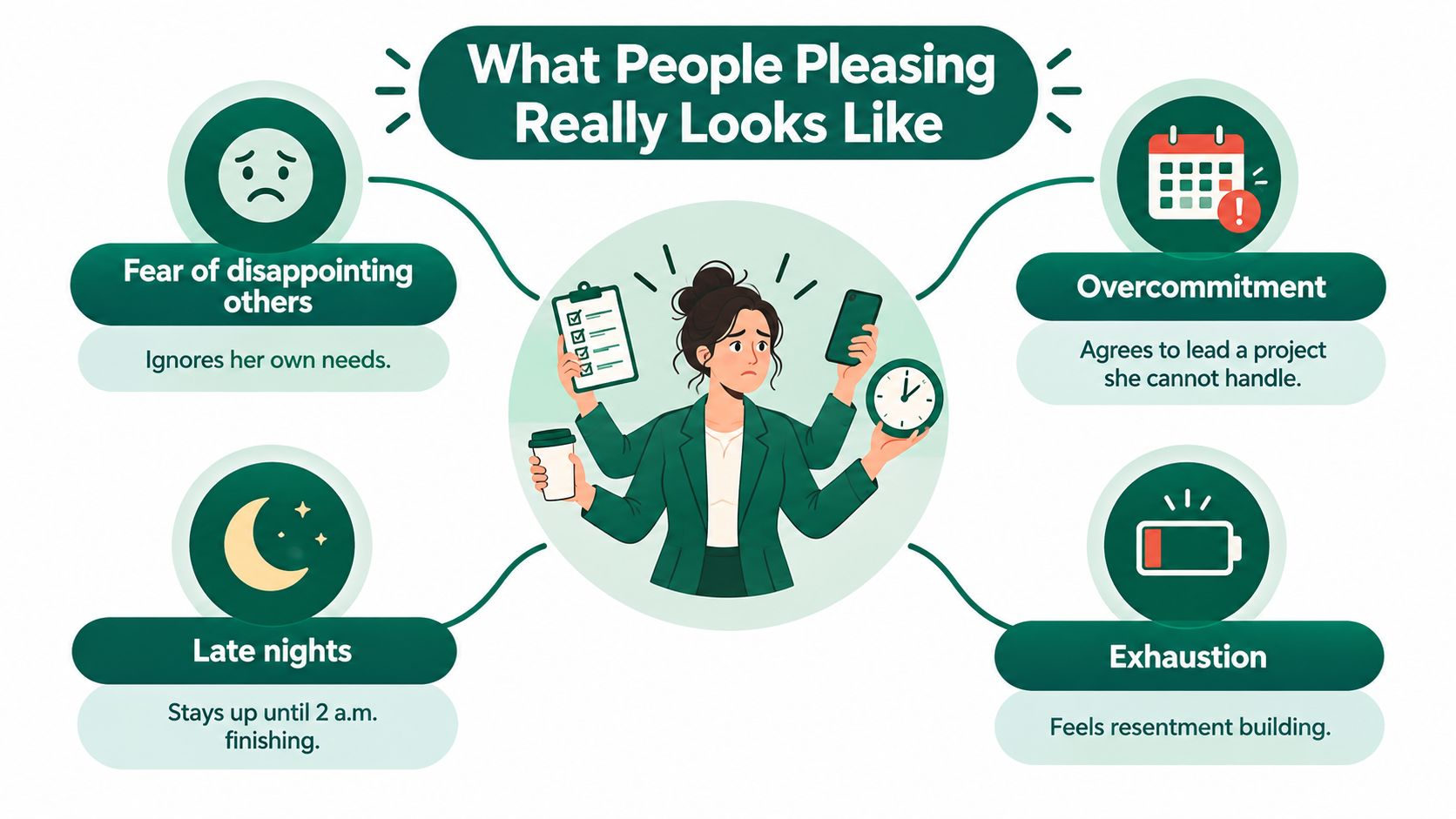
Caption: What people pleasing can look like in daily life, from overcommitment to exhaustion.
The emotional layer
This is the part many recognize after the fact. You worry someone will be disappointed, hurt, annoyed, or distant if you show a limit. Their discomfort starts to feel unbearable, even when they haven't reacted badly.
The behavioral layer
This is what other people see. You over-agree. You volunteer too quickly. You apologize reflexively. You soften every preference. You say “whatever works for you” when you do, in fact, have an opinion.
Sometimes you'll also notice a fawning style of coping, where keeping the peace becomes automatic. If that sounds familiar, this article on always saying yes may put language to what you've been experiencing.
The somatic layer
This part confuses people because it can make a simple boundary feel oddly intense. Your chest tightens. You hold your breath. Your stomach clenches before you answer a text. Your body reacts as if disagreement is dangerous, even when your rational mind knows the stakes are low.
Practical rule: If saying no feels small in logic but huge in your body, the pattern usually runs deeper than communication skills alone.
Two people can behave the same way on the outside and have very different inner drivers. One says yes because she fears criticism. Another says yes because closeness once depended on being easy. Another says yes because she no longer notices her own needs in real time.
That's why one-size-fits-all advice often falls flat.
The Patterns That Drive the Behavior
Treating people pleasing as one problem creates a lot of frustration. The same behavior can come from different internal systems, and each one needs a different point of entry.
Some patterns overlap heavily. Still, it helps to ask one simple question: What feels most threatening if I don't accommodate?
Four drivers of people-pleasing at a glance
Driver | Core Fear | Telltale Sign | What Maintains It |
|---|---|---|---|
Anxiety-driven pleasing | Disapproval will lead to danger, rejection, or conflict | Fast yes, overthinking afterward | Short-term relief after accommodating |
Attachment-driven pleasing | Love or closeness will be lost if you have needs | You become “easy” in relationships | Conditional beliefs about belonging |
Self-silencing | Speaking up will disrupt harmony or make you too much | You can't locate your preference quickly | Habitual override of inner signals |
Perfectionism-driven pleasing | Saying no will expose you as selfish, flawed, or disappointing | High standards for being endlessly capable | Rigid rules about worth and performance |
Anxiety in the driver's seat
When the pattern is anxiety-driven, the mind treats another person's possible disappointment like a threat. You might rehearse conversations, scan tone changes, or feel a spike of guilt before anyone has even responded. Pleasing reduces that anxiety briefly, which is exactly why it keeps repeating.
Attachment underneath the accommodation
Some people don't primarily fear criticism. They fear distance. If love once felt conditional on being undemanding, helpful, or emotionally low-maintenance, pleasing becomes a strategy for preserving connection. The behavior says, “I won't need much, so please stay.”
If you're trying to sort out whether this pattern comes from old relational learning, reading about attachment trauma can help you notice what belongs to the present and what may be getting carried forward from earlier experiences.
Self-silencing as a learned habit
This pattern often gets missed. You may not feel dramatic fear at all. You may be practiced at leaving yourself out. Over time, your preferences get quieter because your attention stays trained on what others want, what the room needs, or what will keep things smooth.
Research and commentary on people pleasing increasingly point out that self-silencing deserves its own attention rather than being collapsed into a generic “boundary problem.”
Many people don't need a stronger script first. They need help hearing themselves clearly enough to know what the script should protect.
Perfectionism behind the niceness
Here the rule is often moralized. I should be endlessly accommodating. I should never disappoint anyone. I should handle everything well and gracefully. A review of CBT for perfectionism found that maladaptive perfectionism is strongly linked to anxiety, depression, and eating-disorder symptoms, and that CBT for perfectionism is efficacious in reducing both perfectionism and associated symptoms. When people pleasing runs on perfectionistic rules, therapy works better when it targets those rigid standards directly.
How CBT Targets the Approval-Seeking Loop
Cognitive behavioral therapy is one of the clearest, most practical approaches for people whose pleasing is maintained by fear, prediction, and avoidance. The target isn't “being nicer to yourself” in the abstract. The target is the approval-seeking loop.
A focused CBT approach identifies the learned prediction that saying no or setting a limit will trigger rejection, conflict, or abandonment. Then it tests that prediction against evidence and uses graded behavioral experiments so the brain can receive corrective feedback that the feared outcome does not reliably occur, as outlined in this overview of CBT for people-pleasing.
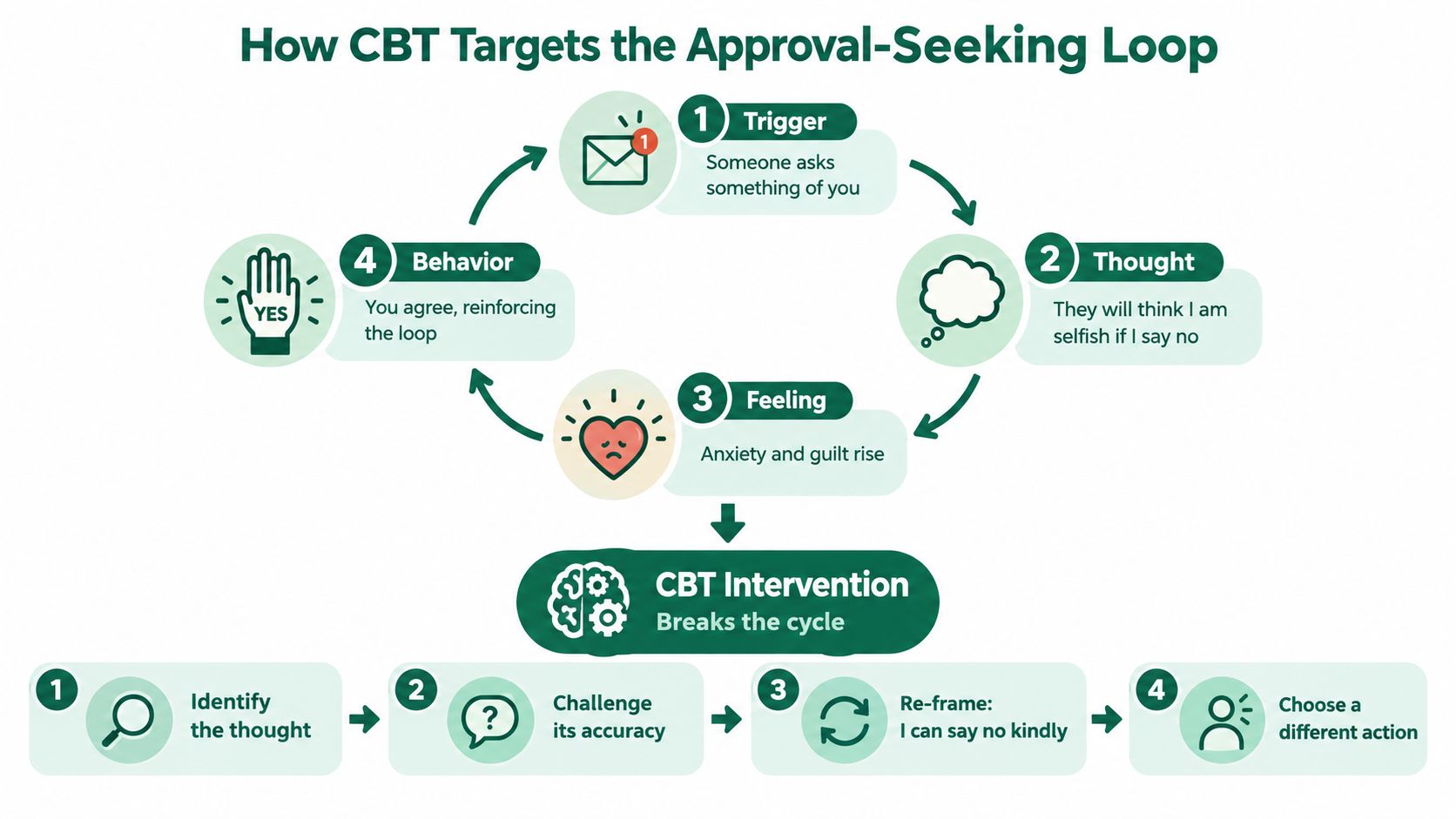
Caption: A simple view of how CBT interrupts the approval-seeking cycle.
What the loop looks like
A request comes in. Then comes the thought: They'll think I'm selfish. Anxiety and guilt rise. You say yes. Relief shows up immediately.
That relief is the trap. It teaches your brain that accommodating prevented danger, even when no real test ever happened.
What therapy actually does
High-yield CBT work for people pleasing often includes:
Trigger analysis: You write down specific situations that pull the pattern online.
A prediction-versus-outcome log: Before setting a boundary, you record what you think will happen. Afterward, you write what happened.
One boundary exposure per week: You practice one concrete act of tolerating discomfort rather than avoiding it.
The important shift is this: therapy interrupts the reinforcement cycle. Approval-seeking reduces anxiety for a moment, which strengthens future avoidance. CBT loosens that cycle by combining cognitive restructuring, in-session rehearsal, and between-session practice.
A belief that often needs direct work
Many people with chronic pleasing don't just think, They might be upset. They also carry a deeper rule like, My value depends on keeping other people comfortable.
That belief won't usually dissolve because you read a good Instagram post. It changes when you challenge it, test it, and survive the discomfort of acting differently.
Discomfort during boundary practice usually means learning is happening. It does not mean you chose the wrong boundary.
If you're looking for a practical way to compare providers, this therapist selection guide for Vancouver is useful for the kinds of questions it suggests around CBT fit, treatment style, and therapist approach. You can also read more about understanding therapist cognitive behavioral therapy if you want a clearer sense of what the work looks like in session.
Modalities That Reach Different Root Causes
CBT is often a strong fit, but it isn't the only helpful model. Once you know what's driving the pattern, other approaches may reach parts of the problem CBT doesn't fully address on its own.
The key is simple. Modality choice should follow assessment, not the reverse.
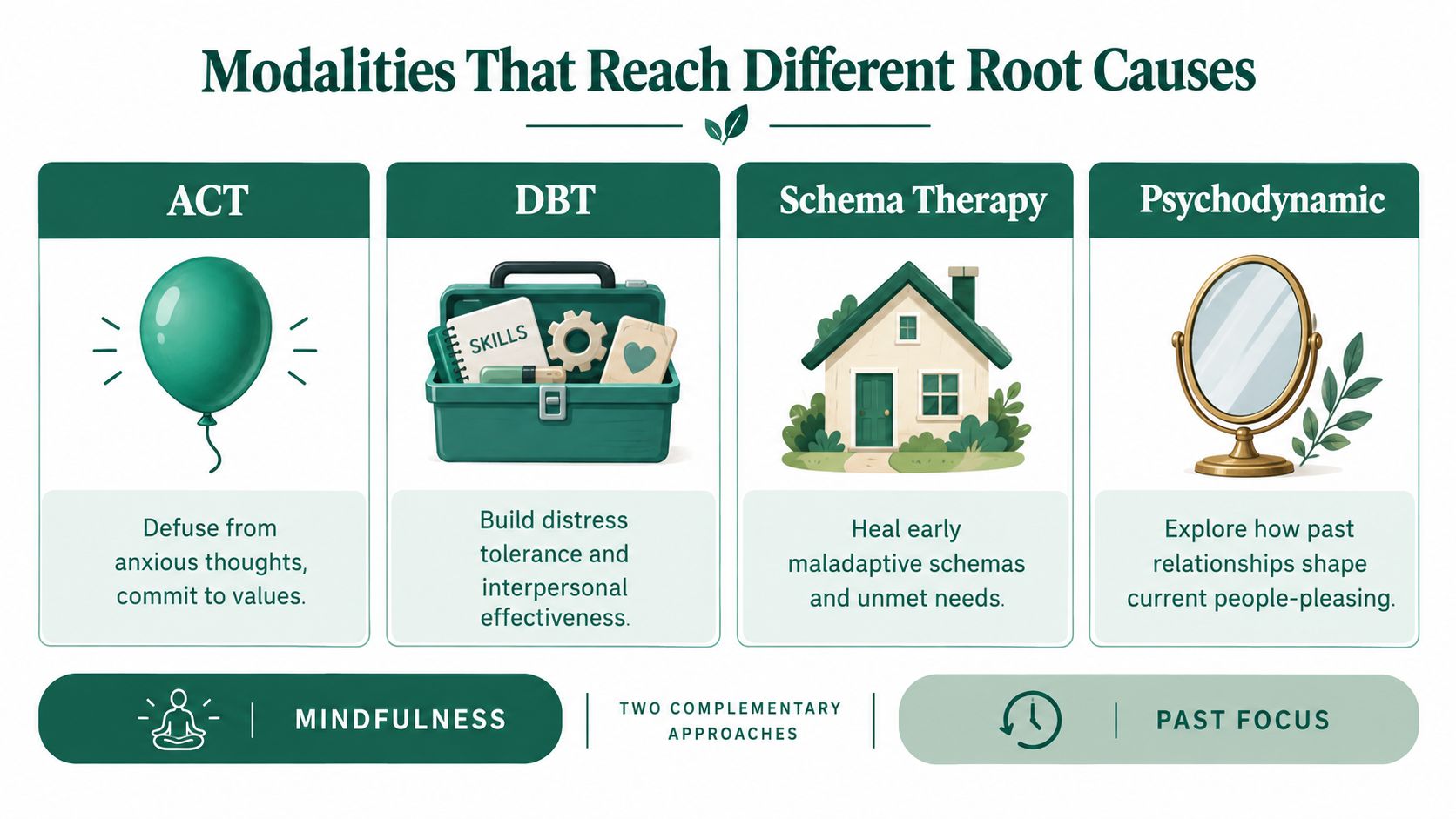
Caption: Different therapy approaches tend to help with different roots of people-pleasing.
ACT for thought fusion and values drift
Acceptance and Commitment Therapy helps when you get hooked by thoughts like, I can't handle them being upset with me. Instead of arguing with every thought, ACT teaches defusion. You notice the thought, name it, and choose action based on values rather than fear.
This can be especially useful when you know your pattern is there, but you still get pulled off course in the moment.
Schema therapy for old relational rules
Schema therapy is often helpful when the pattern feels old, painful, and tied to identity. It targets maladaptive schemas such as subjugation or enmeshment, often through imagery rescripting, mode work, and a corrective therapeutic relationship.
For someone who learned, I stay connected by complying, this approach can reach the emotional roots beneath current behavior.
EFT for couples dynamics
Emotionally Focused Therapy is often relevant when people pleasing shows up inside a partnership. One person accommodates, swallows resentment, and avoids direct need expression. The other partner may unknowingly rely on that pattern, or may misread silence as agreement.
EFT helps bring the attachment fear into the open so the couple can organize around honesty rather than appeasement.
EMDR for stored relational pain
Some people know exactly where their pattern came from. Others don't. But when earlier experiences taught your system that saying no led to rejection, anger, or rupture, EMDR can help process the emotional imprint those memories still carry.
If you're curious about that method, this guide on how EMDR therapy works gives a straightforward explanation.
A therapist may also blend approaches. For example, someone might use CBT for current triggers, ACT for values-based action, and EMDR for unresolved memories that keep the whole system reactive. In St. Petersburg, practices such as Be Your Best Self & Thrive Counseling, PLLC offer individual and couples counseling using evidence-informed, integrative approaches that can be adapted this way.
What Progress Looks Like Over Time
People often expect therapy to make boundary-setting feel natural right away. Usually it doesn't. At first, it often feels awkward, guilty, and unfamiliar. That doesn't mean therapy isn't working. It often means the old pattern is finally being interrupted.
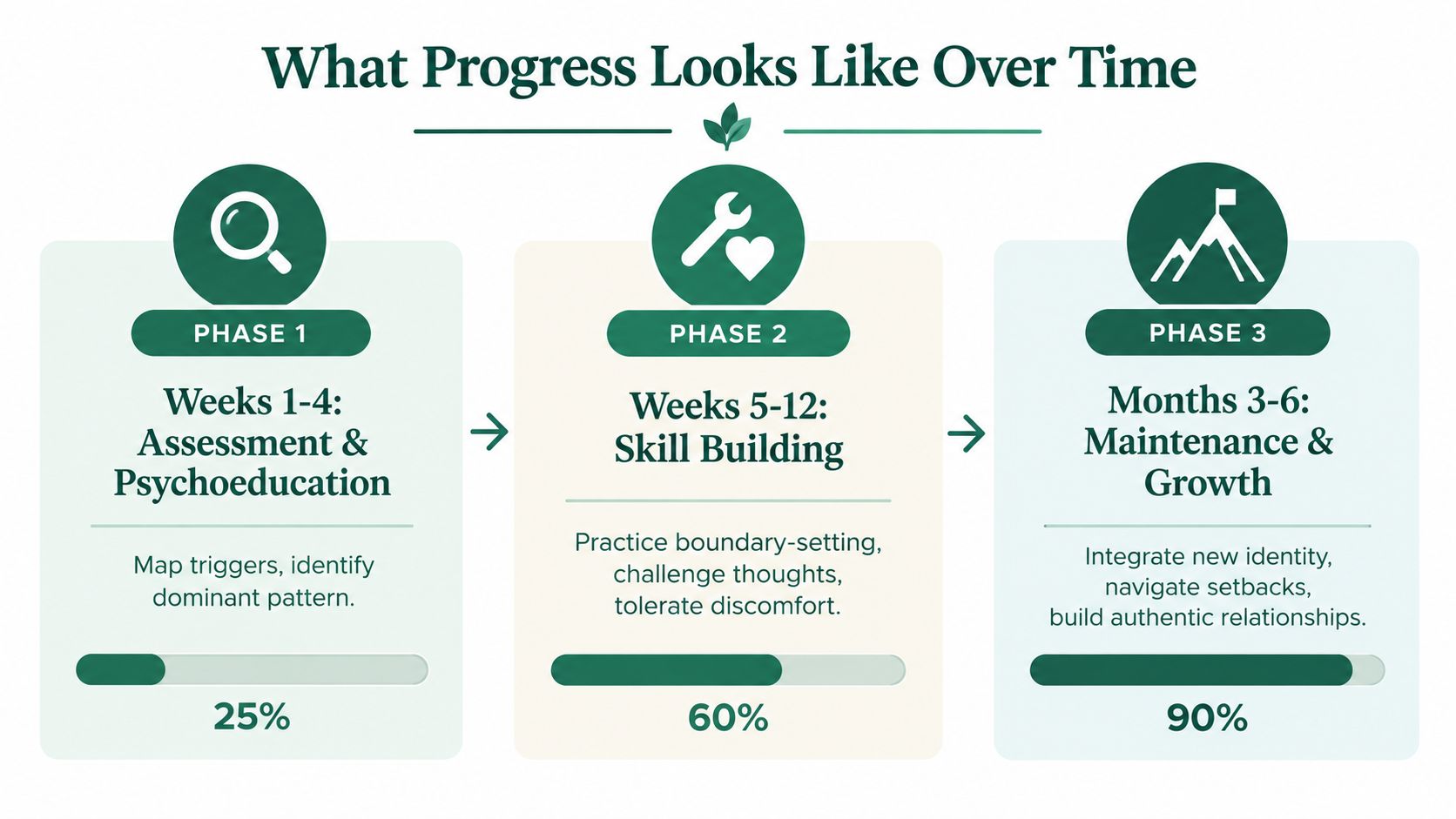
Caption: Progress in therapy usually unfolds in phases rather than one dramatic breakthrough.
Early work
In the beginning, therapy usually focuses on assessment and pattern-mapping. You notice when the pull to accommodate happens, what thoughts arrive, what your body does, and which driver seems strongest.
That stage can feel surprisingly emotional. Many people realize they've been overriding themselves for so long that even identifying a preference takes practice.
Active change
Then comes the harder middle. You start trying new responses. You pause before answering. You tolerate guilt without fixing it immediately. You experiment with clearer language.
Small backslides are normal here. Insight tends to arrive before behavior catches up.
Progress often looks less like “I never people-please now” and more like “I notice it sooner, recover faster, and choose differently more often.”
Consolidation
Later, the newer responses become less effortful. The automatic yes doesn't fire as quickly. You spend less time spiraling after disappointing someone. You trust your own internal signals more.
Relationships can shift during this phase. Some people adjust well to the new you. Others may resist it because the old pattern benefited them. That tension is often part of the work, not a sign you've done something wrong.
Self-Help Tools Between Sessions
Therapy works better when sessions connect to real life. Between appointments, you need simple tools that help you catch the pattern early enough to choose something different.
These tools won't replace therapy when the pattern is rooted, but they can strengthen it.
Boundary scripts you can actually use
Try these in increasing order of difficulty:
Low-stakes script: “I'm going to pass on that.” No long explanation. Let the sentence stand.
Moderate script: “I can't do that, but I can offer this instead.” This helps if your reflex is to overfunction.
Higher-stakes script: “I know this may be disappointing, and my answer is still no.” This is useful when someone pushes after you've already been clear.
If the person presses you, keep the follow-up short.
When they argue: “I understand you want a different answer.”
When they guilt you: “I hear that this is frustrating.”
When you want to over-explain: “I'm not available.”
For more language you can adapt to everyday life, this article on setting boundaries in relationships is a practical companion.
Body-based check-ins
People pleasing often happens fast, so cognitive insight alone may arrive too late. Brief body awareness can buy you time.
Window-of-tolerance check: Pause and ask, “Am I grounded, activated, or shut down?” If you're highly activated, don't force an immediate answer unless you must.
Somatic resourcing: Place a hand on your chest or both feet firmly on the floor. Look around the room. Name a few neutral things you see. This can help interrupt automatic compliance long enough to choose deliberately.
Journaling prompts that sharpen insight
Use a notebook or notes app and keep entries short.
Prediction versus outcome: What did I fear would happen if I said no? What happened?
Inner critic tracking: What rule showed up? Was it about being good, easy, helpful, or flawless?
Values clarification: If fear weren't running this interaction, what would a self-respecting response look like?
If reflective writing helps you organize your thoughts, this post on journaling for mental health offers useful structure.
A weekly reset
Once a week, ask yourself:
Where did I override myself?
Where did I tell the truth, even imperfectly?
Which relationship feels more reciprocal, and which one feels more draining?
What's one boundary I can practice next week?
Self-help is strongest when the pattern is mild or newly recognized. If your pleasing is tied to entrenched attachment wounds, chronic guilt, or a felt responsibility for other people's emotions, support usually helps you go farther and with less self-blame.
Finding the Right Therapist In Tampa Bay
Finding a therapist for this issue can feel oddly similar to people pleasing itself. You may minimize your needs, settle too quickly, or choose someone because their profile sounds generally nice rather than because their approach fits your pattern.
A better approach is to get specific.
Start with the kind of clinician and the kind of problem
In St. Petersburg, Tampa, Clearwater, and nearby areas, look for licensed clinicians such as LMHCs, LCSWs, and LMFTs who explicitly mention concerns like anxiety, perfectionism, boundaries, assertiveness, codependency, or relationship patterns. People pleasing often shows up under those labels even when the phrase itself isn't front and center.
It's also worth verifying Florida licensure through the state portal before you schedule. That step is simple, and it keeps the process grounded in facts rather than marketing language.
Match the therapist to the driver
If your pattern feels very fear-based and repetitive, a CBT-oriented therapist may be a strong starting point. If your pattern is tied to old relational wounds, schema therapy or EMDR may matter more. If the issue shows up most intensely in romantic conflict, an EFT-informed couples therapist may be relevant, but not always first.
Most of the time, individual therapy is the best place to begin. That gives you space to identify your own signals before adding the complexity of a partner dynamic.
Couples work becomes more important when the relationship itself is now maintaining the pattern. That can happen when one partner has gotten used to the accommodation, when conflict escalates quickly, or when your attempts to change the pattern keep getting pulled back into the same cycle.
Use consultation calls well
Directories such as Psychology Today, TherapyDen, and local Tampa Bay listings can help you narrow by zip code, specialty, and format. Once you have a few names, the consultation call matters more than people think.
Ask direct questions like:
How do you assess people-pleasing patterns?
How do you tell whether this is driven more by anxiety, attachment, self-silencing, or perfectionism?
What does a typical treatment plan look like?
How do you track progress besides asking whether I feel better?
If boundaries get harder before they get easier, how do you support clients through that phase?
The answers should sound concrete. You're listening for a therapist who can describe process, not just offer encouragement.
Don't ignore logistics
A good fit on paper can fall apart if the practical side doesn't work. Ask about insurance, out-of-network reimbursement, telehealth availability across Florida, scheduling consistency, and whether they give between-session practices or worksheets if that matters to you.
Also pay attention to how you feel in the first conversation. Not whether you felt instantly comfortable, because this topic often brings discomfort. Ask whether you felt understood, whether the therapist seemed able to organize your concerns clearly, and whether you sensed enough steadiness to do real work together.
The right therapist won't treat you like a generic boundary problem. They'll help you identify what your people pleasing is protecting, what it costs you, and how to change it without shaming the part of you that learned it for a reason.
Be Your Best Self & Thrive Counseling, PLLC offers individual and couples counseling for adults in St. Petersburg and the Tampa Bay area who feel stuck in patterns like overgiving, anxiety, burnout, self-silencing, and relationship strain. If this article sounded uncomfortably familiar, you can visit Be Your Best Self & Thrive Counseling, PLLC to learn more about their approach and explore whether support feels like the right next step.