
Why Do I Feel Stuck in Life? Causes and Next Steps
You may be keeping up with work, answering messages, and handling everyday responsibilities, yet still feel as if your life isn't moving. You might know you want something to change but feel too tired, uncertain, or overwhelmed to choose a next step. Asking “Why do I feel stuck in life?” doesn't mean you're lazy or failing. It can mean that something important is getting in the way of action.
Feeling stuck is often a bottleneck problem. The missing ingredient may be energy, safety, clarity, support, or meaningful choice. Identifying what's missing helps you choose a first step that fits, instead of demanding more motivation from yourself.
The Most Common Reasons You Feel Stuck
Feeling stuck usually points to one of several identifiable patterns, not a lack of willpower. Use this table as a sorting tool: find the signs that feel most familiar, then try the first step. It's a starting point for reflection, not a diagnosis.
Pattern | Usual Cause | Typical Signs | First Step |
|---|---|---|---|
Chronic stress | Sustained stress narrows attention and energy | Hard to plan ahead, constant overwhelm | Cut non-essential demands for two weeks |
Burnout | Long overwork without recovery | Exhaustion, cynicism, numbness about work | Drop one non-essential commitment |
Avoidance | Postponing tasks or hard conversations | Busy but no progress, growing dread | Schedule one 20-minute action each day |
Perfectionism | Waiting for the perfect plan or moment | Starting and abandoning projects, all-or-nothing thinking | Set a good-enough version with a deadline |
Trauma-related threat response | Past experiences keep the body on alert | Hypervigilance, shutting down, difficulty trusting | Seek a trauma-informed assessment |
Loneliness or disconnection | Little belonging, support or shared activity | Withdrawal, few people to talk to | Arrange one check-in with a known person each week |
Values conflict or life transition | Current path no longer matches goals | Restlessness, unsure what you want next | Write what you want to keep and what to change |
Depression or anxiety | A clinical condition can look like stagnation | Low mood, hopelessness, sleep or appetite changes | Book a professional assessment |
More than one row can fit. Someone might be burned out at work and lonely after moving, or feel anxious while also questioning whether their current path still suits them. You don't need to settle on a single explanation before trying a useful next step.
Notice which signs affect your life most, and ask what might be missing: energy, a sense of safety, clarity about what matters, supportive people, or the ability to make a meaningful choice. The pattern that matches most closely is a sensible place to begin.
Why Stress and Burnout Drain Your Ability to Move
Your attention works like a phone battery. When the charge runs low, the phone shuts down background apps to keep calls and texts working. A stressed mind responds in a similar way. It keeps urgent tasks running and closes down reflection, creativity, and long term planning.

Caption: A tired person rests beside a laptop and a low-battery phone, illustrating how stress can leave little energy for planning.
Sustained stress narrows attention to what needs handling right now. Energy goes toward deadlines, bills, caregiving, or putting out small fires. Less remains for weighing options, comparing tradeoffs, or picturing a different future. Planning can feel impossible even when you want change very much.
That missing ingredient is often energy, not motivation. In the American Psychological Association's 2023 Stress in America survey of more than 3,000 U.S. adults, 28% said stress had made it difficult to plan for the future during the previous month. When the battery is drained, the first move is recharging, not pushing harder.
Think of a teacher who spends all day managing a classroom, then stares at a blank job application at night. Or a parent who handles work plus nighttime wakeups, then cannot decide about a training course on the weekend. Both care about change. Both lack the mental room to think it through.
When immediate demands dominate, survival tasks crowd out reflection. You may stay in an unsatisfying routine because finding another route takes capacity you do not have right now. If planning feels impossible, start by reducing the load. Sleep, rest breaks, lighter expectations for a week, and asking for help can return some charge. Revisit direction once you have more room to think. If overwork and lack of recovery are central, this guide to healing from burnout offers ideas for what to adjust first.
How Avoidance and Perfectionism Keep You in Place
A task feels heavy, so you postpone it. Postponing brings brief relief, but the task remains and may feel even more daunting next time. That growing pressure can make avoidance more appealing, deepening the sense that you're not moving.
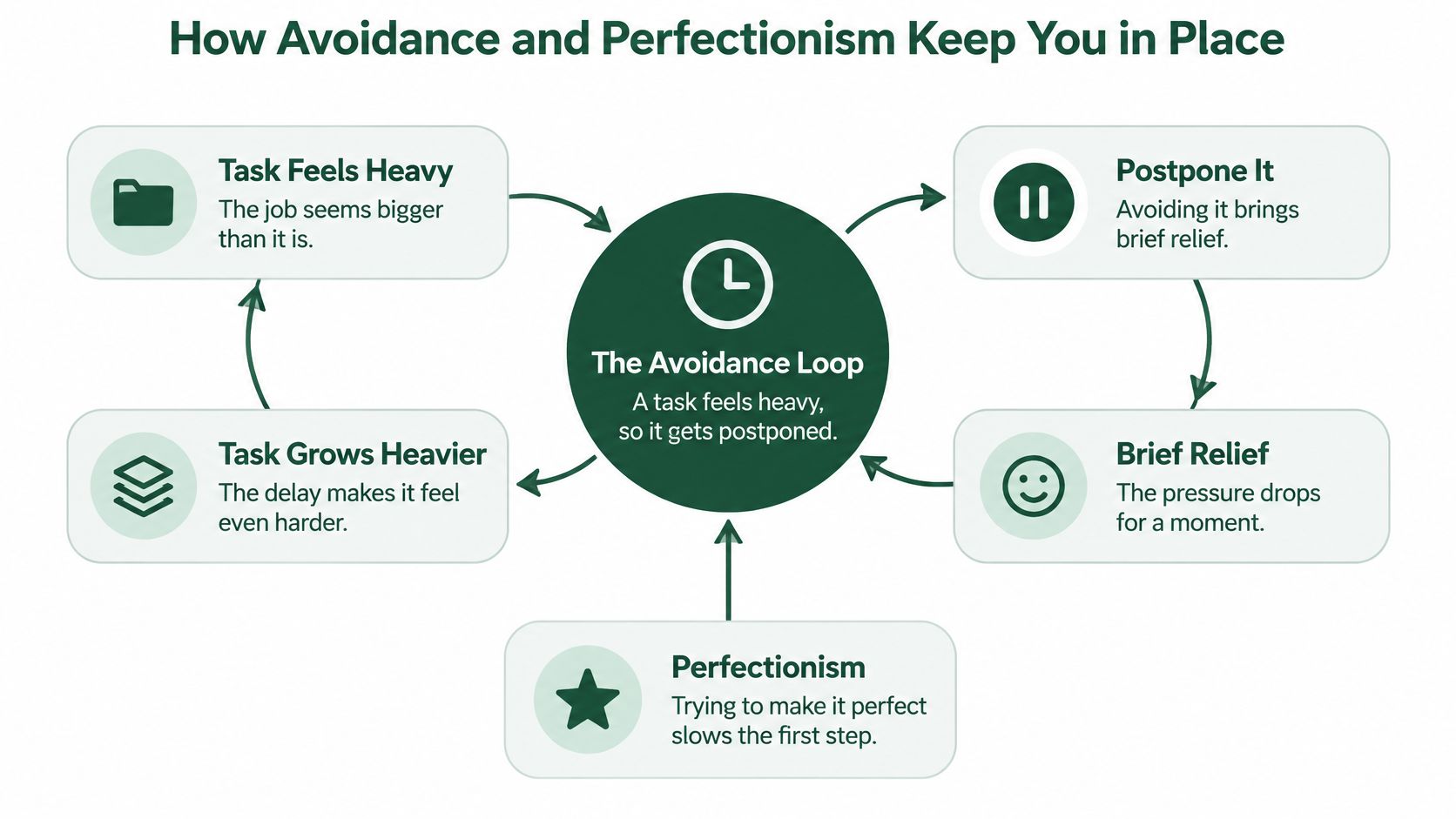
Caption: The diagram traces how a heavy-feeling task leads to postponement and brief relief, then grows more difficult, while perfectionism slows the first step.
Perfectionism can add another obstacle. If you're waiting for the perfect plan, job, or moment, there may always be a reason not to begin. All-or-nothing thinking can extend the delay: you miss one planned day and decide the whole effort has failed.
Consider someone who has rewritten a résumé for two years without applying. The revision might seem productive, but if it prevents them from sending an application, it's also part of the stuck pattern. Someone considering a career change might research endlessly yet never speak to a person who does that work. The research can help, but it can also become a way to avoid the uncertainty of a real conversation.
A counter-move is behavioral activation: scheduling small actions that connect with something you value, rather than waiting to feel motivated first. The aim isn't to force a major decision. It's to make an achievable move and learn from what happens. For practical ideas on making a smaller, realistic start, read about overcoming perfectionism.
Try this: Choose one action that takes under 20 minutes, put it on your calendar, and notice your mood and energy afterward. You might send one application, draft three questions for someone in a field you're curious about, or open a document and write a rough outline.
That check-in gives you information, not a grade. If a small action feels manageable, repeat it. If it feels impossible, make it smaller or look for what's getting in the way.
How Past Wounds and Isolation Hold You Back
Say someone leaves a controlling relationship and later freezes whenever they have to make a decision. Each choice can feel like a test of whether they'll be safe, even when the options are ordinary. Or someone who grew up with constant criticism may treat every new start like a chance to fail. In both situations, moving forward can feel threatening, not because the person lacks ambition, but because past experiences may have taught them to expect harm or rejection.
Patterns can include hypervigilance, shutting down, difficulty trusting, or avoiding situations that feel exposing. When these reactions persist, support from a professional with a trauma-informed approach can help someone explore them at a pace that feels manageable. This overview of signs of unresolved childhood trauma offers more context.
Isolation can be another bottleneck, even when someone has clear goals. Being physically alone isn't the same as feeling disconnected. A person can spend time with others yet lack relationships where they feel understood, safe, or able to ask for practical help. Without that sense of belonging, everyday decisions can feel harder and fewer options may seem reachable.
The World Health Organization's 2025 Commission on Social Connection found that approximately 1 in 6 people worldwide experience loneliness, and that lonely people are twice as likely to develop depression, according to the WHO Commission on Social Connection. Loneliness is not a personal failing, and “put yourself out there” can overlook the significant barriers people face.
Remote work, relocation, caregiving, disability, and neurodivergence can all make connection more difficult or require different ways of building it. Start with low-pressure contact: arrange a regular check-in with someone you know, join a shared activity that meets repeatedly, or look for a community or support group that fits your circumstances. The goal isn't to become instantly outgoing. It's to create steadier opportunities for mutual support.
Life Transitions and Values Conflicts That Stall You
A graduate starts a job that fits an old plan, then realizes the work no longer matches the interests they have now. A parent returns to career planning after a pause and feels trapped because a professional identity that once fit now feels too tight. Stuckness here works like a bottleneck in a hallway. The issue is not effort. The hallway is blocked by missing clarity about what this next chapter should look like.
A values conflict often sounds like, “I know what I don't want, but I can't name what I do want.” That uncertainty feels like low motivation when it is really a direction problem. Young adulthood can bring many of these pressure points at once, from finishing school to starting work to redefining relationships, which helps explain why transitions feel heavy even when nothing is clearly wrong.
Instead of demanding an immediate answer, try three smaller questions:
What drained your energy this month?
What would you keep if you could change one thing?
What would you do if the outcome didn't matter?
These questions often reveal a small preference or boundary first. A complete life plan comes later.

Caption: A recent graduate stands in an empty apartment, representing the uncertainty that can accompany a transition.
If you're navigating a change, you may find this guide to counseling for life transitions useful. You do not have to make a dramatic leap to test a new direction. Have one conversation with someone in a field you feel curious about. Or adjust a single boundary that is taking more time than you want to give. Small experiments give clearer feedback than one large, irreversible decision, and each result points to the next choice worth trying.
How to Move Forward One Step at a Time
A workable plan starts by matching the next move to the bottleneck. Pushing a major decision on someone who's depleted can add pressure without restoring capacity. Use these steps to learn what helps and adapt the plan as you go.
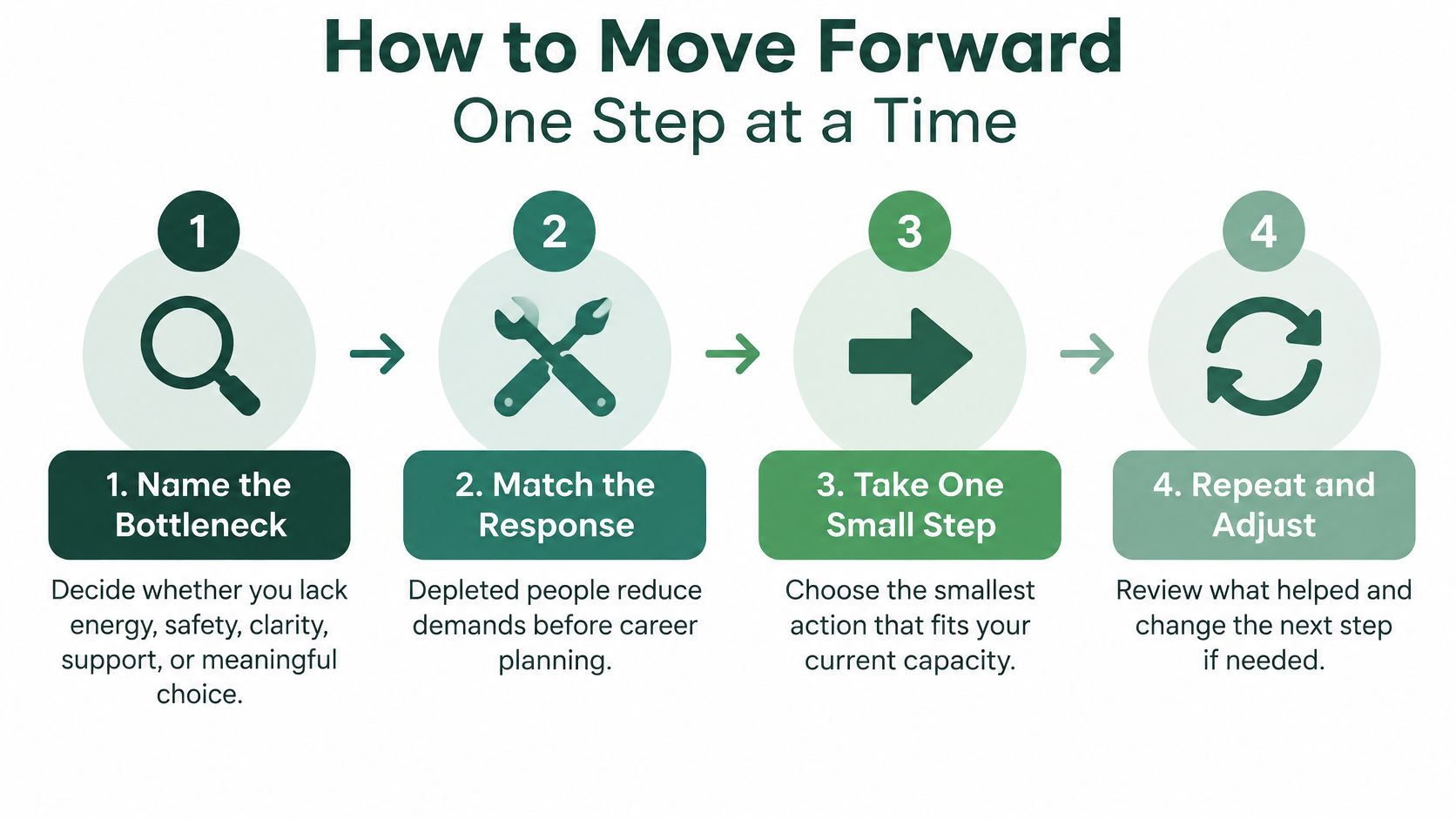
Caption: The process diagram moves from identifying the missing ingredient to matching a response, taking a small action, and reviewing what to adjust.
Name the bottleneck. Ask whether you're short on energy, safety, clarity, support, or meaningful choice. Naming the missing ingredient helps you avoid treating every kind of stuckness as a motivation problem.
Match the response. If you're depleted, reduce demands before taking on career planning. If your path conflicts with your values, test a small change. If you feel unsafe or isolated, seek support before asking yourself to make a high-stakes decision.
Choose one scheduled action. Pick a small step that fits your current capacity and connects to something you care about. It could be a 20-minute walk with a friend or a one-page outline. Learn more about behavioral activation for depression, which uses meaningful activity to address avoidance and inactivity.
Repeat and review. Try the action regularly for two weeks, noting your mood, energy, and how much effort it took. If it starts to feel easier, add one small step; if it doesn't, shrink the action or bring in support.
A 2023 systematic review and meta-analysis examined 12 randomized controlled trials involving 3,274 participants. It found that internet-based behavioral activation reduced depressive symptoms compared with inactive control groups, but the review found no significant depression benefit at the six-month follow-up, as reported in the 2023 meta-analysis of behavioral activation. In other words, short-term improvement isn't the same as permanent recovery; keeping up helpful practice or adding support may matter.
Progress doesn't have to mean having your whole future figured out. It might look like less avoidance, more clarity about what you need, and a short list of next actions. If you want another practical perspective on breaking free from feeling stuck, look for ideas you can adapt to your actual capacity rather than treating any plan as a test of willpower.
Deciding When to Get Holistic Support
Seek a professional assessment if feeling stuck lasts several weeks and affects work, relationships, or sleep, if hopelessness appears, or if isolation becomes severe. The shape of the problem can help you decide what to discuss. Burnout tends to show up as exhaustion and cynicism tied mainly to work; depression can involve low mood or loss of interest across much of life, often alongside changes in sleep or appetite and a sense that nothing will improve. Anxiety can involve persistent worry and physical tension that make action harder.
These patterns can overlap, so they're not a substitute for an assessment. In U.S. Centers for Disease Control and Prevention data for 2024, 19% of adults had ever been told by a health professional that they had a depression disorder, and 19% had ever been told they had an anxiety disorder. The CDC also reported that 14% of adults received counseling or therapy from a mental-health professional during the previous 12 months, in its 2024 mental-health conditions and care data.
If you have thoughts of self-harm, contact emergency services or a crisis line immediately. You don't need to wait for symptoms to become unbearable before asking for help.
Counseling may combine talk therapy with mindfulness, practical coping skills, lifestyle changes, and work on purpose and direction. Be Your Best Self & Thrive Counseling, PLLC works with non-emergency concerns and people who are ready to change but would benefit from help building the life and relationships they want. Through integrated guidance, clients can work on regulating their nervous system, understanding their needs and goals, and building healthier relationships.
To take a next step, visit Be Your Best Self & Thrive Counseling, PLLC, bring the signs that matched you in the table and one goal for the next month, and ask how the team would tailor a plan.
Be Your Best Self & Thrive Counseling, PLLC offers counseling to help people work through stress, anxiety, depression, trauma, and life transitions with practical support for building healthier patterns. If you're ready to explore what's keeping you stuck and find a next step that fits, visit Be Your Best Self & Thrive Counseling, PLLC.