
Mental Health Triggers Explained: Types, Signs and Coping
You're reading this with your shoulders still up. A short text landed wrong an hour ago, or a tone at dinner is still sitting in your chest. The room is quiet. Your body hasn't caught up.
Plenty of adults hit that gap on an ordinary week and then wonder if they're overreacting or missing a real problem. Both mistakes are easy. One leaves you avoiding harmless cues. The other leaves you explaining away something that isn't safe.
You don't have to call yourself dramatic to take the jolt seriously. You also don't have to treat every strong feeling as unfinished trauma.
What a Mental Health Trigger Really Is
Say you're getting into your car after work and a door slams two rows over. Your shoulders lock. Your heart races. For a breath the lot isn't this lot. It's an old accident, even though the other driver is only leaving the grocery store.
A mental health trigger is a cue, inside or outside the body, that pulls a past experience or a stressful pattern into the present and produces an intense emotional or physical reaction.
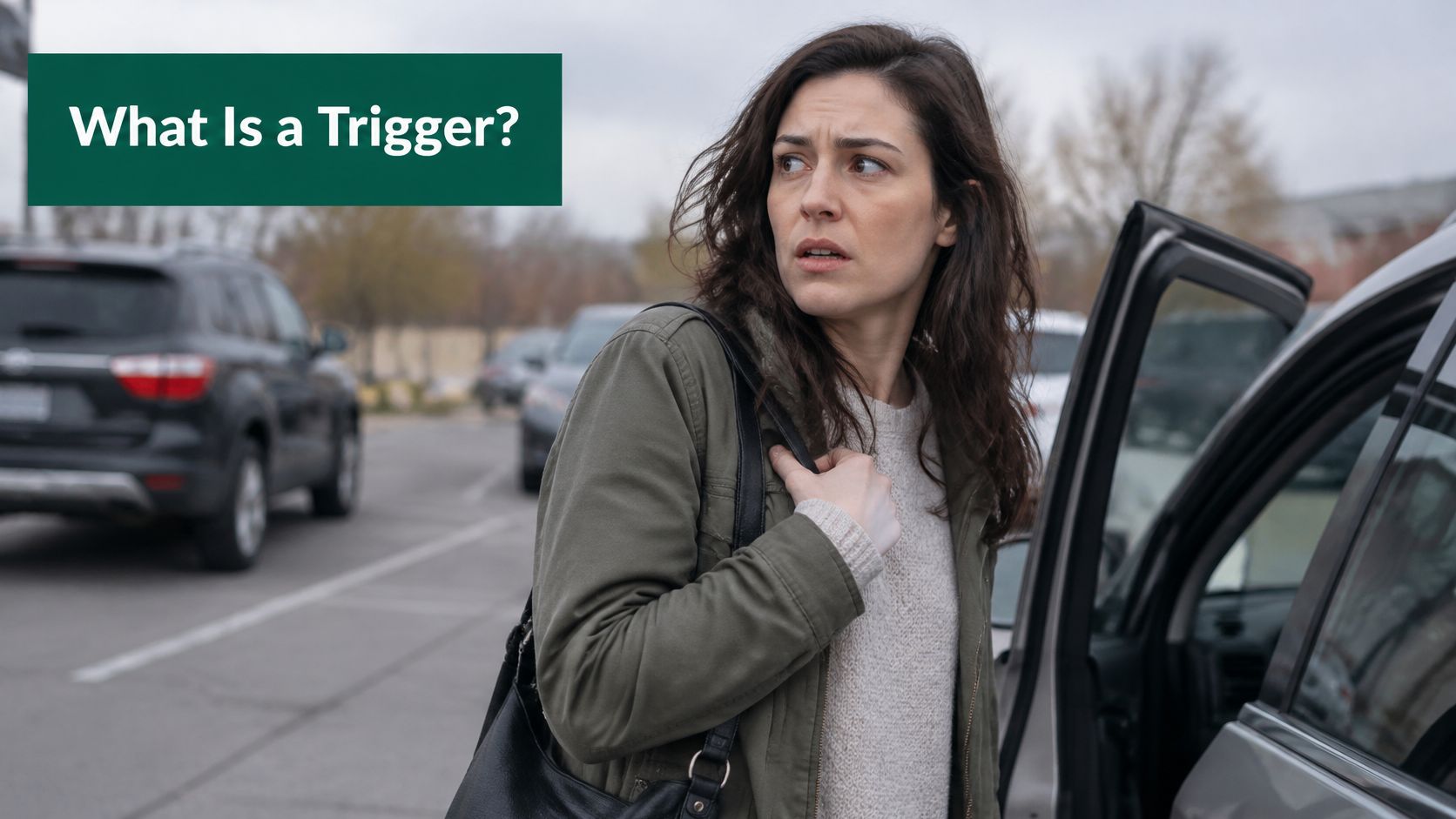
A slam in a quiet lot can send the body back to an old accident before any story forms.
A smoke alarm is a fair comparison. It protects you, and it also sounds for burnt toast. The sensor isn't inventing heat. It's answering a cue that once meant fire, or answering a week already loaded with stress. Triggers aren't limited to trauma. Ordinary pressure and stacked demands, a sick child plus a late shift plus a short night, can trip the same system.
How common the original events are
Trauma exposure is widespread, and it still doesn't write the ending. The World Mental Health Survey Consortium found that 70.4% of respondents across multiple countries had at least one traumatic event in their lifetime. Among people exposed to trauma, lifetime PTSD prevalence was 5.6%. Many people who live through trauma don't develop post-traumatic stress disorder (PTSD), the condition of reliving, avoidance, and ongoing alarm after trauma. Outcome turns on the type, severity, repetition, timing, and personal meaning of the event, and on the support around you. Violence, sexual assault, accidents, combat, disasters, and the unexpected death of someone close can all act as pathways.
Signs worth checking tonight
Sensory, relational, and situational cues are the three types worth sorting. Three signs help you check your own reaction before you name the type.
Out of proportion: the feeling is far larger than the cue in front of you.
Reliving: part of you is in an older scene, not only in this room.
Body first: pounding, tightness, or nausea arrives before a clear thought.
If the body answers before you can explain the moment, map the cue. You're not required to call it trauma on the spot.
Sensory, Relational and Situational Triggers Compared
Trigger type | Common examples | What it often feels like | First question to ask |
|---|---|---|---|
Sensory | Smoke smell, sirens, a specific song, crowded noise, touch on a sore spot | A jolt in the body before any thought | Which sense was hit first? |
Relational | A raised voice, a partner going quiet, criticism, being ignored in a group | Feeling judged, rejected, or unsafe | Who or what does this moment remind me of? |
Situational | Anniversaries, medical visits, deadlines, job insecurity, a move | Dread tied to a date or place | What is happening here and now? |
Sensory triggers arrive through the body. Perfume in an elevator, a siren on your street, the first notes of a song from a hard year, bright clinic lighting, or pressure on an old injury. The jolt lands before a sentence forms. Say you smell smoke at a backyard grill and your hands go cold, even though the food is fine and nobody is hurt. Name the sense first, then decide whether anything in the room needs action.
Relational triggers come from people. A sharp email from a boss, a partner who goes quiet at dinner, being talked over in a group, or a fight that copies an old family script. The feeling is judgment, rejection, or unsafety, sometimes before anyone has named the actual issue. A raised voice at a family table can be relational and sensory at once, sound plus history. How those patterns show up between partners is laid out in how trauma affects relationships. The first question is who or what the moment resembles, not whether you're too sensitive.
Situational triggers attach to time and place. An anniversary, a medical waiting room, a move, a new role, or the week a review lands. Dread shows up because of the date or the setting. Work belongs in this row. In the American Psychological Association's 2025 Work in America survey, 54% of U.S. workers said job insecurity had a significant impact on their stress levels. The same cue can be charged for you and neutral for a coworker who doesn't carry that history.
A quick way to spot your pattern
Notice three things while the moment is still fresh.
Sense first: which sense got hit before the story started.
Person or echo: who the moment reminds you of.
Date or place: whether the setting itself is doing the work.
The same slammed door can be nothing to one person and a full alarm to another. That difference is history and load, not a character flaw.
How Triggers Set Off the Body's Alarm
An ambiguous text shows the chain cleanly. Your partner replies "fine" after a long pause. Nothing in the word says you're in trouble. Your body may disagree anyway.
Cue. The cue is a short word, not a speech. A sound, a place, or a look can play the same role.
Interpretation. Your mind reads rejection. The prediction does that work. The text doesn't.
Body response. Your chest tightens, breathing speeds up, and heat rises in your face.
Behavior. You send several follow-ups, or you go silent and put the phone in a drawer.
Consequence. Later you argue about the pile of messages, and the fight feels much bigger than one word.
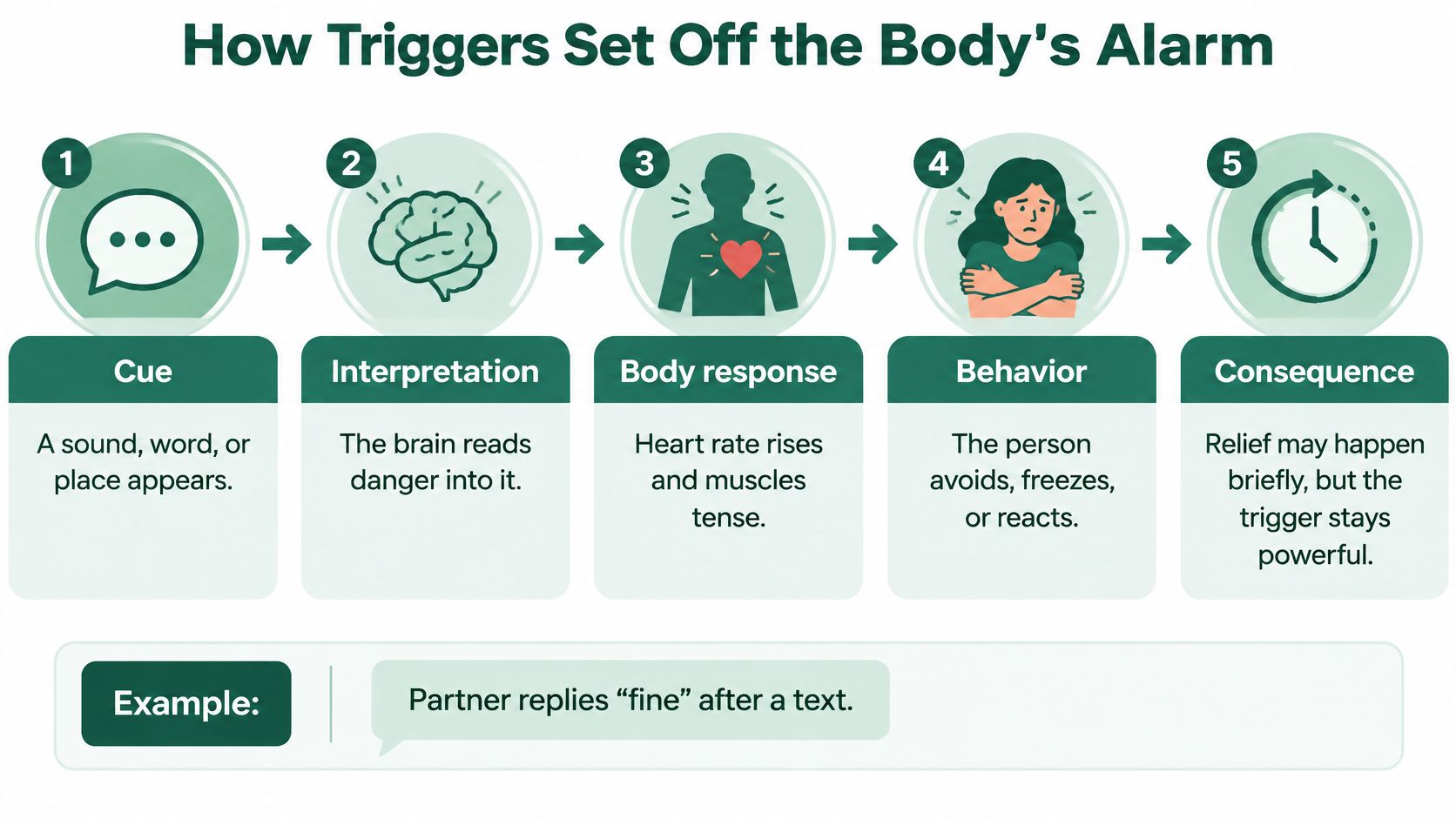
Cue, interpretation, body, behavior, and consequence, using a short text as the example.
That's threat generalization. The nervous system learns to link neutral cues, a tone of voice, conflict, a location, social judgment, with danger, so it fires even when the present moment is safe. Being sized up by another person is especially sticky, because evaluation already feels like risk.
When the alarm is slow to shut off
Repeated stress can dysregulate the hypothalamic-pituitary-adrenal (HPA) axis, the stress circuit that releases cortisol, a hormone that helps the body mobilize. A review of HPA-axis changes under chronic stress describes the sequence. Stress turns on corticotropin-releasing hormone, then pituitary adrenocorticotropic hormone, then cortisol. When the strain lasts, the shutoff signal can weaken. Cortisol may stay high, or the response may go oddly flat. Either pattern makes it harder to return to baseline, which raises vulnerability to anxiety, depression, and post-traumatic stress symptoms. Prolonged strain is also tied to inflammatory signaling and to changes in the hippocampus, a brain region involved in memory and stress regulation.
Watch the recovery, not only the spike.
Sleep: you wake wired, or you can't fall back asleep.
Irritability: small friction still feels large an hour later.
Focus: you reread the same line and lose it.
Downshift: you can't settle after the threat is gone.
These changes reflect risk, not destiny. They can ease when symptoms remit and treatment works. Consistent sleep and wake times, movement, fewer stacked demands, paced breathing, and trauma-informed therapy aim at the recovery system. How trauma affects the body goes further into that physical side.
Relief after you avoid the cue can be brief. The prediction often stays just as loud the next time.
Why Past Experiences Make Some Triggers Stronger
Adverse childhood experiences (ACEs) are early hardships that can shape how strong a later cue feels. They include abuse, neglect, living with household mental illness or substance use, and family instability. One hard season is different from a household where danger was the background noise. Exposure adds up.
These experiences are common. The CDC's overview of ACEs describes them as widespread and preventable, and links greater exposure to higher risk for depression, substance misuse, suicidality, and other health problems. Common is not the same as universal, and higher risk is not a diagnosis. Plenty of people with difficult childhoods build steady lives, and plenty of strong reactions have nothing to do with childhood at all.
What the old household teaches the body
A smoke detector that shrieks at burnt toast isn't broken. It was installed in a kitchen where smoke was routine, so it learned to fire early. Early environments can teach the body something similar about closeness, conflict, or silence: which tones count as warning, how fast to brace, whether a raised voice means harm is coming.
Later relationships then set off reactions larger than today's event explains. Say someone grew up with anger that arrived without warning. At a calm dinner, a partner raises their voice about a bill. The adult freezes. Fork down, words gone, eyes on the table. The partner is frustrated, not dangerous, and the freeze still makes sense once the old household is in view. Volume used to come before harm.
ACE history gives context for anxiety, depression, trauma responses, relationship trouble, and stress sensitivity. It isn't a diagnosis, and it doesn't mean every strong reaction is trauma. Disappointment, grief, and ordinary anger often belong to today.
A history of adversity can explain the size of a reaction. It doesn't require you to treat every feeling as a wound.
When the freeze, the snap, or the urge to leave shows up, ask one question. Which earlier relationship does this moment resemble?
Telling a Past Trigger From a Present Threat
A popular belief says every trigger should be found and removed. That belief feels protective. It can also train fear. A trigger isn't always a reliable predictor of distress, and avoiding triggers may sometimes reinforce fear.
Response type | Key signal | Typical example | Best first response |
|---|---|---|---|
Trauma trigger | Intensity far beyond the present event | A raised voice echoes an abusive childhood home | Ground first, then identify the memory |
Ordinary emotional cue | Feeling fits the situation and eases with time | Disappointment after a missed call | Acknowledge the feeling and check the facts |
Present-day threat | Danger is real and ongoing | A partner threatens harm during an argument | Act on safety, set a boundary, leave, or get help |
Why blanket avoidance backfires
Your response depends on context, personal history, how safe you feel, who is with you, and how loaded the week already is. A meta-analysis of trigger and content warnings found that warnings didn't improve emotional responses or educational outcomes overall. They reliably increased anticipatory affect, the dread that shows up before anything happens, while effects on avoidance were mixed. PTSD treatment also includes carefully supported exposure to real or imagined triggers. The aim is often more tolerance, meaning, and flexibility, not a life organized around permanent avoidance.
Social-media lists make this muddy. Not every strong emotion proves unresolved trauma. Managing a trigger isn't suppressing feeling, and it isn't tolerating unsafe behavior. You can be answering the past and the present at once. That overlap isn't a personal failure.
A pause you can use
Try a short test before you decide what the moment is.
Pause and name what is happening now, in this room.
Notice what the body seems to remember.
Check whether the danger is still here.
If you want a record that isn't a trending checklist, choose a consistent mood scale and mark intensity beside the cue for a week. Pair that with your window of tolerance, the range where you can feel something and still think. Ground when you're outside that range. Set a boundary or leave when the threat is real. Consider gradual, supported contact with a cue only when the present is safe.
Coping Steps for a Trigger in the Moment
When the alarm is already on, you need a short routine, not a life overhaul. Six moves cover the minute. Each one has a job.
Name the cue. Say what you notice, a raised voice, a closed door, a song. Naming separates the signal from the story your mind is about to write. You're labeling input, not judging yourself.
Slow the exhale. Breathe in for four counts and out for six, for about a minute. A longer exhale gives the body a physical reason to leave high alert. If those counts feel like too much, shorten both and keep the out-breath longer.
Ground the senses. Name five things you see, four you can touch, and three you can hear. That count pulls attention into the room you're in. A fuller walk-through sits in what grounding techniques are.

A quiet bench can be where you finish the longer exhale and let your shoulders drop.
Orient to the present. Tell yourself where you are, what day it is, and that this room isn't the old one. Orientation is a fact check, not a pep talk. Say the facts out loud if your thoughts are racing.
Decide the next action. If the present is safe, step away briefly or ask for a pause. If it isn't safe, leave or contact someone you trust. Choosing the right branch matters more than looking calm.
Set a boundary once you're steadier. Try a concrete line such as, "I need ten minutes, then I want to finish this." A boundary made in panic often sounds like an exit. A boundary made after the exhale can be specific and kind.
Slips that make the minute harder
Forcing breath: pushing huge inhales until you feel dizzy. Keep the breath small and the exhale longer.
Judging the reaction: calling it weakness while your heart is still up. Judgment adds a second alarm.
Skipping the repair: calming down and never coming back to the conversation. The cue stays loaded if the relationship never gets a clean ending.
A calmer state is specific. Your heart rate eases. Your shoulders drop. Thoughts come back as words you can choose, not only as pictures.
Deciding When to Get Trauma-Informed Support
Seek support when triggers keep disrupting work, sleep, relationships, or safety. One rough afternoon isn't the line. A month that won't settle is. The CDC's definition of frequent mental distress is 14 or more mentally unhealthy days in the previous 30, tied to stress, depression, or emotional problems. In 2021, 14.7% of U.S. adults met that threshold, and adults reported an average of 4.7 recent mentally unhealthy days.
We provide mental health counseling in St. Petersburg and Sarasota, Florida, for non-emergency concerns and for motivated people who are ready to change but need help building the life and relationships they want. Through integrative guidance, you learn to regulate your nervous system, get clearer on your needs, wants, and goals, and build healthier relationships. Seeing what a trauma-informed therapist focuses on can help you judge fit.
If there is an emergency or a threat to safety, contact local emergency services or a crisis line first.
Track three triggers this week with the cue-to-consequence sequence, and label each one sensory, relational, or situational. Book a consultation if the pattern keeps breaking your days.
Be Your Best Self & Thrive Counseling, PLLC offers trauma-informed counseling for adults and couples who want practical tools when mental health triggers disrupt daily life, sleep, or relationships. Therapists help you tell a past alarm from a present threat and practice regulation skills you can use between sessions. Visit Be Your Best Self & Thrive Counseling, PLLC to explore a free initial consultation and see whether the fit is right.