
How Trauma Affects the Body: The Hidden Physical Signs
Trauma can rewire the body's alarm system, causing physical symptoms long after danger passes, but this wiring can be safely retrained through nervous-system support. PTSD affects an estimated 6.1%–8.3% of people in the United States across their lifetime, compared with an estimated 3.9% global prevalence, and its effects can reach far beyond emotional distress.
You may notice your heart pounding while sitting still, your shoulders tightening before a difficult conversation, or your stomach reacting to an ordinary appointment. Perhaps you've finished a stressful period, yet sleep, digestion, energy, and pain still haven't returned to normal. These sensations can feel mysterious and frightening, especially when medical tests don't provide one clear explanation.
Trauma doesn't mean your body is broken. It means your protective systems learned to anticipate danger, sometimes long after the original threat ended. Understanding how trauma affects the body can replace self-blame with curiosity and help you choose support that addresses both physical sensations and emotional wounds.
When Your Body Still Fights The Battle
Maya noticed the changes after leaving a chaotic relationship. During the relationship, she had learned to stay alert to footsteps, changes in tone, and sudden silence. Once she moved into a peaceful apartment, she expected relief. Instead, she felt exhausted in the morning, clenched her jaw during the day, and developed stomach discomfort before routine conversations.
Her mind knew she was safer. Her body hadn't updated the message.
That mismatch is common after overwhelming experiences. A loud sound may make your heart race. A crowded room may tighten your back. A difficult email may bring nausea before you consciously identify what feels threatening. These reactions aren't deliberate choices. They're automatic protective responses that once helped you prepare, escape, endure, or disconnect.

Caption: A body can remain watchful even when a person's surroundings have become safer.
Physical symptoms can carry a protective purpose
Muscle tension may be the body's attempt to brace. Fatigue may follow long periods of internal vigilance. Digestive changes can appear when the body repeatedly prioritizes readiness over ordinary maintenance. Sleep disruption, headaches, sweating, chest discomfort, and chronic pain can also accompany trauma-related stress responses, as described in clinical information from the National Center for Biotechnology Information.
These symptoms deserve medical attention rather than dismissal. Trauma can be part of the picture, but it shouldn't automatically explain every new symptom. A clinician can evaluate urgent or unrelated causes while a trauma-informed therapist helps you understand patterns that may involve the nervous system.
The health implications are serious without being a prediction of your future. PTSD is associated with cardiovascular disease, type 2 diabetes, dementia, and other chronic conditions, and a meta-analysis of 24 studies found that PTSD increased mortality risk by at least 30% (Journal of Traumatic Stress). This evidence supports whole-body care, not fear. Your symptoms are signals from a system trying to protect you, and signals can become more accurate with safety, treatment, and repeated experiences of regulation.
The Alarm System That Won't Turn Off
The body's rapid threat response involves two connected systems. The hypothalamic-pituitary-adrenal axis, usually called the HPA axis, coordinates hormonal stress signaling. The autonomic nervous system adjusts functions such as heart rate, breathing, digestion, and blood pressure without requiring conscious control.
A threat can prompt the hypothalamus to communicate with the pituitary gland, which then signals the adrenal glands. The adrenal glands release stress hormones, including cortisol, that help mobilize energy. The sympathetic branch of the autonomic nervous system increases arousal, while parasympathetic activity supports recovery and settling.
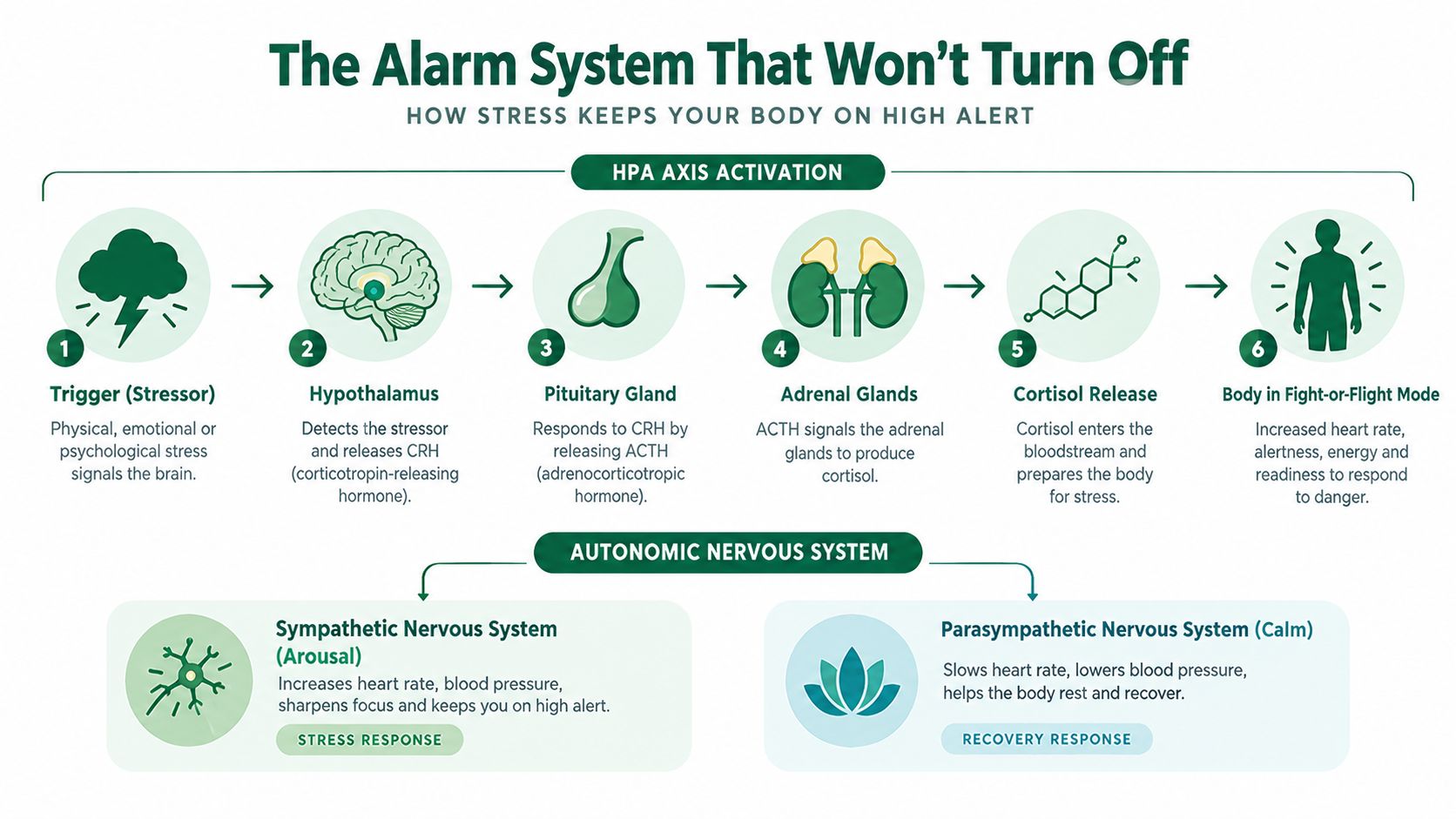
Caption: The HPA axis and autonomic nervous system coordinate the body's response to perceived danger and recovery.
Why the same system can speed up or slow down
After trauma, the alarm may remain highly sensitive. You might experience racing heartbeats, muscle tension, sweating, raised blood pressure, poor sleep, and a strong startle response. Other times, the nervous system may reduce outward activity. You may feel numb, detached, slowed, or unable to respond when pressure rises. These states can look opposite, but both can reflect an overwhelmed protective system.
Research identifies HPA-axis dysregulation as a cardinal feature of PTSD, alongside changes in cortisol signaling and reduced hippocampal volume, which can affect how the body manages stress (review in PMC). Cortisol normally helps bring a stress response toward completion and helps regulate immune activity. Trauma-related changes can therefore influence several systems at once.
Not every person has the same biological pattern. The HPA axis may show either hyperactivation or a blunted response depending on the timing, type, and chronicity of stress (review of HPA-axis function). That's why one person may feel constantly keyed up while another feels flattened and depleted.
A useful question: “Is my body responding to what's happening now, or to what it learned might happen next?”
People with fainting, rapid heart rate, dizziness, or other autonomic symptoms may need specialized medical evaluation. Information about POTS and dysautonomia care can help clarify why nervous-system symptoms sometimes require coordinated medical support. For anxiety symptoms that keep the alarm active, anxiety treatment can provide a structured way to build safety without forcing yourself to ignore real sensations.
Inflammation And The Long-Term Wear And Tear
A short-lived stress response can help you act quickly. Repeated activation is different. When the body repeatedly prepares for danger, hormonal and immune regulation may become less coordinated, creating a background of physiological strain rather than one isolated burst of stress.
Trauma is associated with a pro-inflammatory phenotype. Reviews describe heightened C-reactive protein, or CRP, IL-6, and TNF-α, along with reduced anti-inflammatory signaling, including IL-10 (review in Molecular Psychiatry). These markers aren't feelings, and they don't provide a standalone diagnosis. They're biological clues researchers use to study how persistent stress can interact with immune regulation.
From emergency response to chronic load
Inflammation is part of the body's defense system. It helps respond to injury and infection, then should settle when the immediate problem has passed. Trauma-related stress can interfere with that rhythm. Repeated stress signaling may weaken the body's ability to restrain inflammatory activity, allowing low-grade activation to continue.
That pattern helps explain why some survivors describe fatigue, cognitive fog, mood changes, diffuse discomfort, or increased sensitivity. It doesn't mean inflammation causes every symptom, nor does it mean trauma is the only possible cause. Sleep problems, infection, medication effects, autoimmune conditions, nutrition, and many other health factors can also matter.
Childhood adversity may shape immune regulation during a period when the body is still developing. A child who must repeatedly scan for danger may devote energy to immediate survival rather than restoration. Later, the adult body may respond to stress with a different baseline of reactivity. This is an adaptation, not a character defect.
The compassionate interpretation is not “my body is attacking itself.” It's “my body learned to protect me under conditions that required too much protection for too long.”
Whole-person care can address this burden from several directions. Medical evaluation can investigate inflammation and related symptoms, while trauma-informed counseling can work with the stress patterns that keep reactivating the alarm. Support through chronic illness therapy in Sarasota may be relevant for people managing persistent symptoms alongside trauma, particularly when physical and emotional care have been treated as separate problems.
Different Types Of Trauma Leave Different Marks
Trauma isn't one uniform biological event. A single frightening incident, repeated interpersonal harm, emotional neglect, and prolonged instability can all affect the body, but the timing and demands of each experience differ.
A single-event trauma may produce a sharp shift in threat detection. A sound, place, or body sensation can become associated with danger, even when the present situation is safe. Chronic adversity may create a broader pattern of bracing, exhaustion, disrupted sleep, or difficulty recognizing calm because the body had little opportunity to return fully to baseline.
Threat and deprivation are not identical
Researchers have begun separating childhood adversity into different dimensions. Threat involves experiences such as exposure to harm or danger. Deprivation involves an absence of expected resources, care, stimulation, or stable support. These categories can overlap, but they don't place identical demands on a developing nervous system.
Recent research found that childhood adversity categorized as “threat” versus “deprivation” was linked to different mitochondrial patterns and cellular effects (research on adversity and mitochondrial biology). Mitochondria help cells manage energy, so findings in this area invite a more precise view of trauma's physical impact. They don't mean clinicians can identify a person's history from a single biological test.
Duration also matters. Repeated unpredictability may train the body to monitor small changes in other people. Neglect may leave someone less practiced at noticing and trusting internal needs. A single accident may make driving or sudden movement feel dangerous. None of these responses proves weakness, and none determines a fixed outcome.
Your physical pattern may therefore be personal and layered. One person may have tension and insomnia. Another may have digestive symptoms and shutdown. A third may alternate between frantic activity and profound fatigue. Care becomes more effective when it respects the actual history instead of applying one generic trauma script.
Reframing How Trauma Is Stored In The Body
People often say that “the body keeps the score.” The phrase can validate the reality of physical symptoms, but it can also create confusion if it suggests that trauma sits permanently inside muscles, organs, or tissues like a physical substance.
A more useful question is how the brain and nervous system interpret body signals. After trauma, a racing heart, tight chest, or sudden dizziness may be read as evidence that danger is returning. That interpretation increases alarm, which intensifies the sensation, which then seems to confirm the original prediction. The loop can feel physical because it is physical, but it isn't the same as a literal traumatic memory stored inside a muscle.
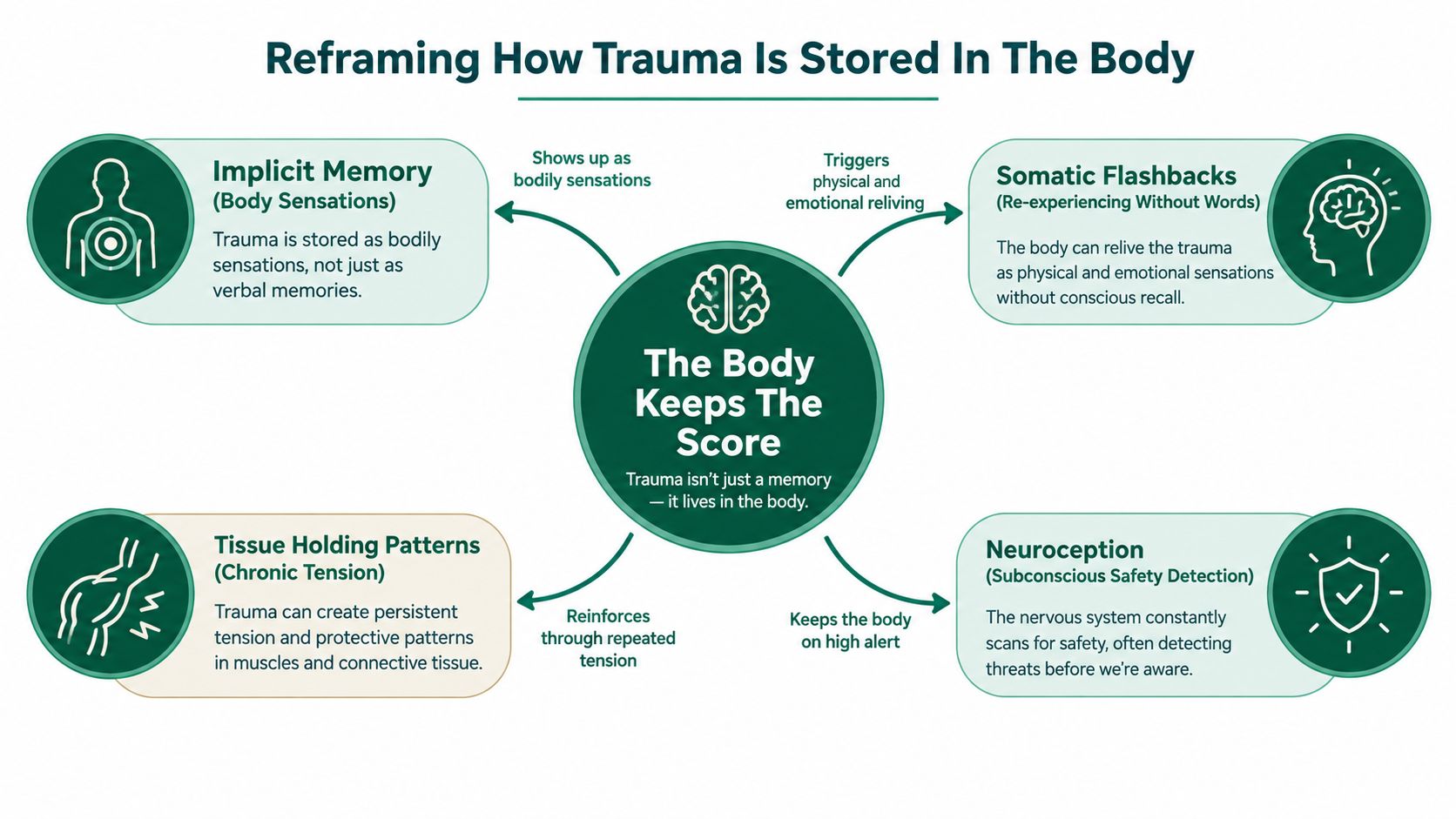
Caption: Body sensations, implicit memory, tension, and safety detection can interact in a reinforcing prediction loop.
Prediction is not permanent damage
A 2026 review argues that the body itself does not store trauma. Instead, the brain may reenact trauma through maladaptive inference and reduced flexibility in network states (review in Frontiers in Systems Neuroscience). In plain language, the brain makes ongoing predictions about what sensations mean and what might happen next. Trauma can make those predictions overly focused on danger.
This doesn't make symptoms imaginary. A predicted threat can produce real muscle contraction, changes in heart rate, altered breathing, nausea, and exhaustion. The body is responding to the brain's interpretation, even when the interpretation no longer fits the present.
Somatic therapy works with this body-brain relationship by helping a person notice sensations gradually, identify signs of activation, and practice responding without overwhelming the system. The work may include orienting to the room, feeling the support of a chair, tracking a small change in tension, or pausing before a familiar reaction. These practices don't erase history. They create new evidence of safety.
For some readers, spiritual and values-based support can make that process more meaningful. Spiritual wellness therapy can be one option when healing includes questions about identity, purpose, connection, or the kind of life you want to build beyond survival.
The hopeful shift: A learned prediction can become more flexible. You don't have to prove that your symptoms are “only trauma” to begin teaching your nervous system that the present is different.
Practical Steps To Regulate Your Nervous System
Regulation isn't about forcing yourself to feel calm. Start with small signals of safety and stop or modify an exercise if it increases panic, dizziness, dissociation, or pain. New or severe physical symptoms still deserve appropriate medical care.
Lengthen the exhale. Breathe gently into the lower ribs, then let the exhale last a little longer than the inhale. If comfortable, you can explore a 4-7-8 breathing pattern, but don't force breath holds or deep breaths. The aim is a steady message of control, not perfect technique.
Orient to the present. Name what you can see, hear, feel, smell, and taste. The 5-4-3-2-1 grounding method gives attention a concrete task and can help distinguish current surroundings from remembered danger.
Use gentle movement. Walk slowly, stretch your neck and shoulders, or try accessible yoga. Movement can help you notice whether your body is bracing, but it shouldn't become punishment or performance.
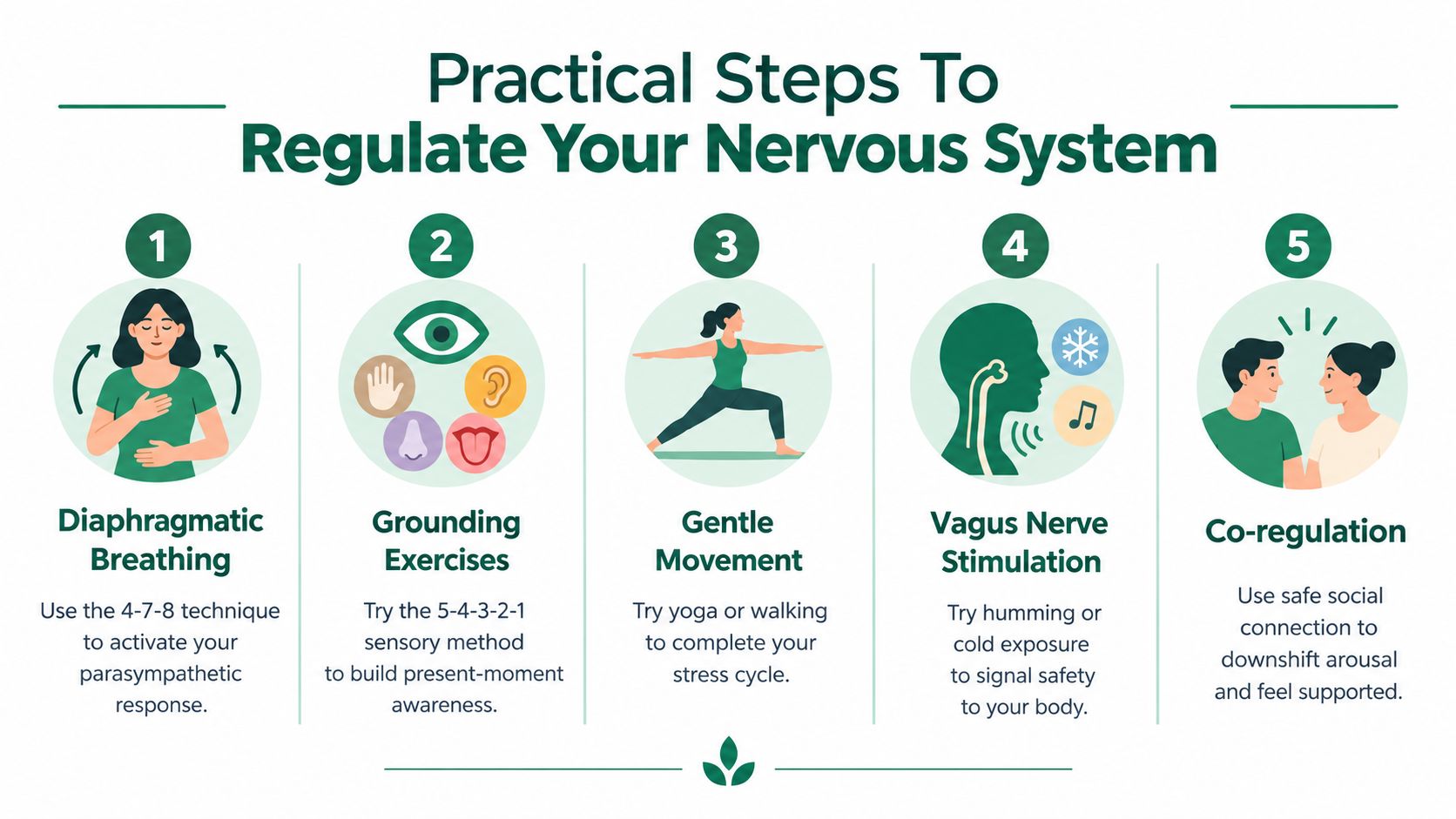
Caption: Small, repeatable practices can help the nervous system recognize present-moment safety.
Add a safe sensory cue. Humming, a comforting texture, warm tea, or a familiar scent may help you stay connected to the present. Cold exposure isn't appropriate for everyone, so approach it cautiously and avoid it if it worsens symptoms.
Borrow calm through connection. Sit with someone trustworthy, speak at an unhurried pace, or ask for practical companionship. A safe relationship can make regulation easier than trying to manage every sensation alone.
For additional guidance, evidence-based regulation techniques can help you choose practices that fit your health and trauma history. A trauma-informed yoga therapy approach may also adapt movement and breathwork to your capacity rather than asking your body to push through.
Finding Support For Whole-Body Healing
The body remembers patterns through repeated predictions, habits, and protective responses. It also learns through repetition in the other direction. Consistent safety, respectful relationships, appropriate medical care, and trauma-informed therapy can give the nervous system new information to work with.
Early adversity has long-term health relevance. The CDC's ACE study linked childhood abuse and household dysfunction with a higher risk of major adult diseases decades later, including heart disease and cancer (CDC ACE study information). This doesn't mean childhood trauma guarantees illness. It means prevention and support should include physical health rather than treating emotional distress as separate from the body.
What whole-body care can include
A supportive plan may combine medical evaluation, sleep and pain care, trauma-focused psychotherapy, body awareness, movement, and practical changes to daily stress. A therapist can help you approach memories at a tolerable pace, while a physician can assess symptoms that require medical attention. Neither role replaces the other.
You might seek help when symptoms interfere with work, relationships, sleep, eating, movement, or your ability to feel present. You don't need to wait until you have a perfect explanation. Describing what happens in your body, what triggers it, and what helps can give a provider useful starting information.
Be Your Best Self & Thrive Counseling, PLLC offers individual and couples counseling for concerns including trauma, anxiety, depression, stress, and difficult life transitions. Its mind-body-spirit approach may include nervous-system awareness, practical self-care, and trauma-informed support for people who want to understand physical reactions without shame. Learn more about trauma therapy in Sarasota if you're looking for professional guidance in connecting past experiences with present-day symptoms.
Healing doesn't require you to deny what happened or force your body to relax on command. It involves building enough safety to notice what your system is doing, understanding why it learned that response, and practicing alternatives with support. The alarm may have been necessary once. It can become quieter, more accurate, and more responsive to the life you're living now.
Be Your Best Self & Thrive Counseling, PLLC offers compassionate individual and couples counseling grounded in mind-body-spirit care, with support for trauma, anxiety, depression, stress, and unhealthy patterns. Visit Be Your Best Self & Thrive Counseling, PLLC to explore counseling options and arrange a free initial consultation about your goals.