
Couples Therapy Not Working: How to Diagnose and Fix It
You are sitting in the car after another session, engine still running, and neither of you wants to open a door. You did the "I feel" statements. You paid for the hour. The same fight showed up again, only louder. Couples therapy not working is a pattern you can diagnose, not a verdict on the relationship, and the worst move is to stop and never say why.
A stall usually looks like several sessions in a row with no new skill, not one hard night. Most couples feel worse for a few weeks while hard topics start. That soreness is not the same thing as treatment that has stopped moving.
Signs Your Couples Therapy Has Stalled
Therapy that has stalled shows up as a repeatable pattern, not a single bad evening. Match what you see at home or in the room to a likely cause, then take one first move before you decide the work is finished.
Sign | Likely cause | First move |
|---|---|---|
Same argument repeats after eight or more sessions | Goals are vague or never measured | Rewrite two goals as observable behaviors |
One partner often late or cancelling | Unequal motivation or unclear attendance expectations | Raise attendance openly in the next session |
Both feel more tense for two or more weeks after sessions | Pacing too fast or hard topics raised without support | Ask the therapist to slow the pace and plan the next session |
One partner dreads sessions, the other does not | Alliance or therapist fit gap | Ask each partner privately how sessions feel, then discuss it with the therapist |
Gains fade within a few months | No between-session practice | Set one small practice task each week |
Intimidation, threats, control or unsafe conflict | Factors couples therapy alone cannot address | Pause joint sessions and request an individual safety assessment |
Repeated content after eight or more sessions usually means the goal was never turned into a behavior anyone could watch. "Communicate better" cannot be scored. "We finish one planning talk without interrupting" can.
Attendance drift is data. If one partner is regularly late or cancels, motivation is uneven or nobody named what showing up requires. Say it in the next session, not in the parking lot.
A two-week tension hangover for both of you points to pace. Hard material got opened without enough support to close the hour. Ask the therapist to slow down and to plan the next session before you leave.
Split dread, where one person hates the appointment and the other feels fine, is an alliance or fit gap. Each partner should say, privately first, how the room feels, then bring that into a joint conversation with the therapist.
Gains that fade within a few months almost always mean nothing was practiced between meetings. One small weekly task beats a stack of worksheets nobody opens.
Safety is not a style preference. Intimidation, threats, control, or conflict you cannot de-escalate means joint sessions should pause until each person has an individual safety assessment.
A Simple Test for Productive Discomfort
Practical rule: Productive discomfort means a named goal is being approached even though it hurts. A stall means the same complaint keeps returning in new words.
If you can point to the goal and see one step toward it, stay with the discomfort and name it. If the complaint only changes costumes, treat that as a stall and use the first move in the row that matches, on a date you both can see.
How to Track Whether Therapy Is Working
Most couples never measure anything, so a bad month and a useful month feel identical. I would start with a five-step routine you can run without special software.
Before the first session, each partner rates overall relationship satisfaction and their own distress on a simple 0 to 10 scale. A baseline stops you from arguing later about whether anything moved.
After each session, collect a brief outcome rating and an alliance rating, including whether each partner feels heard and on track. A one-line note beats a vague memory by Thursday.
Flag early when scores slip or stay flat across several sessions. Flat is a signal, not a personality flaw.
Review the numbers together with both partners, never with one partner in private. Private reviews breed a prosecution.
Change the goals, pacing, approach, or therapist fit based on what the review shows. A number that never changes the plan is decoration.
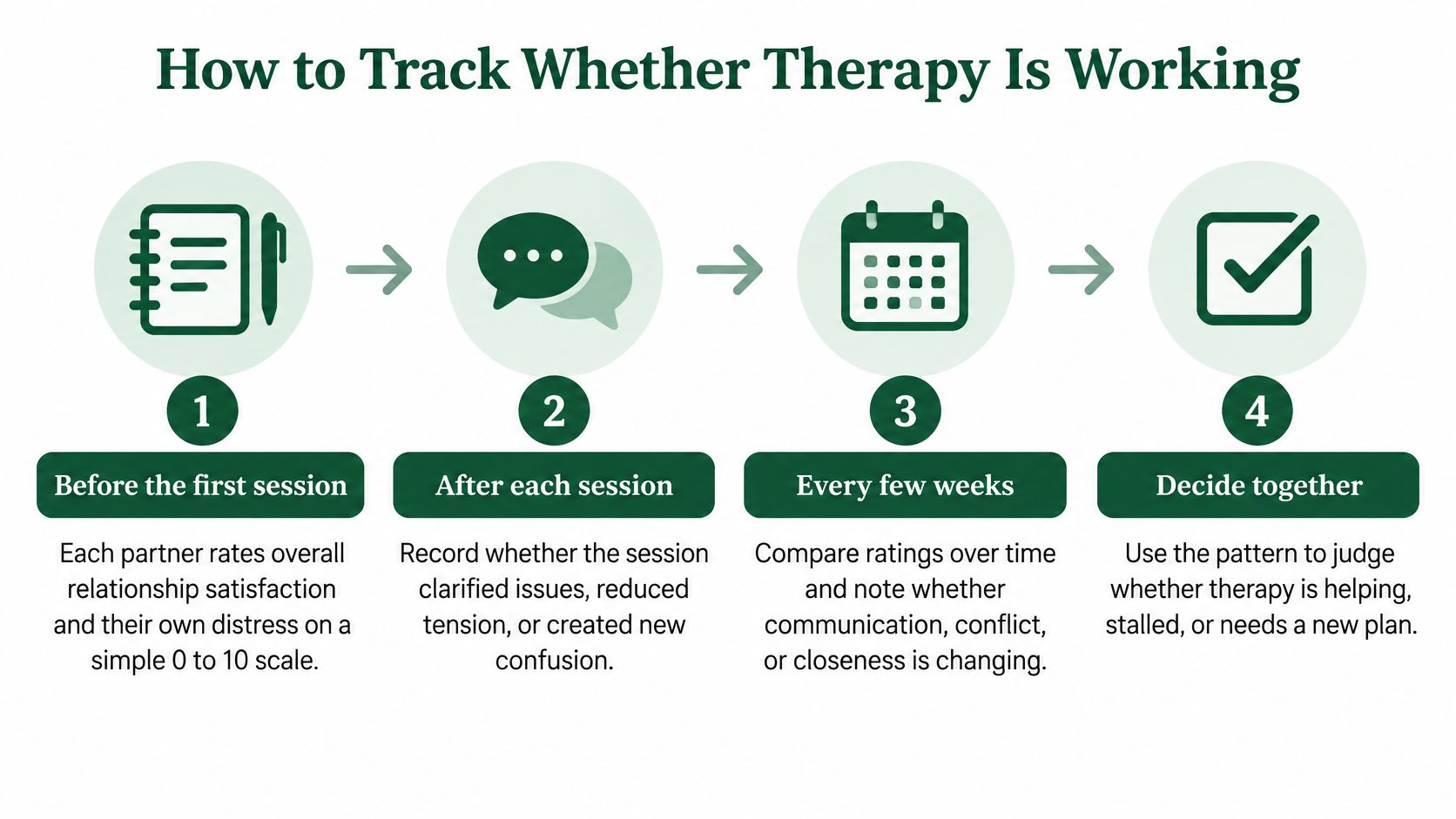
Four checkpoints for tracking satisfaction, session outcome, change over weeks, and a joint decision.
Why the Alliance Rating Matters
The bond with the therapist predicts outcomes. A Cambridge University Press chapter on psychotherapy relationships reports a meta-analytic alliance effect of about 0.30–0.62, depending on the analysis. Alliance often improves early, then dips in the middle phase when the work turns confrontational. That dip is a repair signal, not proof the couple is resistant. Feedback-informed checks can reverse relationship deterioration. They do not reliably fix no-shows, so attendance still has to be named out loud.
Models with a research record, including the evidence behind EFT and CBT for couples summarized by Vancouver Counselling Clinic, still need this kind of tracking. A strong method does not tell you whether this couple is on track this month. If you want a fuller checklist of session-by-session signals, our guide on how to know if therapy is working sits next to this routine.
What the Measure Changes
The scale you pick changes the answer. In a 1987 marital therapy study in Family Process, three measures told three stories, and only about 60% of the original sample completed the six-month follow-up.
Outcome measure | Improved | Deteriorated |
|---|---|---|
Marital Conflict Inventory | 54% | 19.5% |
Marital Communication Satisfaction Scale | 33.7% | 19.3% |
Locke–Wallace Marital Adjustment | 36% | 15.1% |
Among people who did return at six months, improvement ranged from 44.4% to 54.5%, depending on the measure. Pick the measure that matches the actual goal, whether that is conflict, communication satisfaction, or overall adjustment. Average success hides couples who got worse, stayed the same, or never came back.
Why Couples Therapy Does Not Work for Everyone
Therapy does not work for every couple, and pretending otherwise makes a stall feel like a personal failure. A 2020 Annual Review of Clinical Psychology reported that about 60–80% of distressed couples benefit from behavioral or emotion-focused approaches, so roughly 20–40% may not reach substantial benefit during treatment. Effects are weaker in routine practice than in controlled trials, and benefits dissipate after treatment for about half of couples.
That base rate is the honest starting point. A method can be sound in a lab and still miss the couple in the room.
Barriers That Sit Behind a Stall
The usual blockers are concrete.
Unequal motivation: one partner is building a case, the other is enduring the hour.
Inconsistent attendance: the dose never accumulates.
Untreated depression or anxiety: one person's symptoms swallow the joint work.
Substance use: the session cannot compete with what happens the other six days.
An affair that keeps reopening trust: agreements collapse because the third fact is still live.
Trauma, coercion, or violence: joint talk can raise risk instead of lowering it.
Communication differences linked to ADHD, autism, or high sensitivity that the protocol never adjusted for.
The miss is often in the design, not in the couple's character. Goals never became behaviors. Practice between sessions was optional. The protocol never changed when the scores stayed flat. Screen for these barriers before you decide therapy itself has failed. When one partner's pattern looks controlling rather than merely withdrawn, individual work has to come before more joint hours, which is the point of our note on couples counseling when narcissistic traits are in the mix.
A stall is information about the plan. It is not a character reference for either partner.
Read the base rate that way. Nonresponse is a clinical outcome you can investigate, not a surprise you should hide from the therapist.
Telling Fit, Method and Limits Apart
You cannot look up a universal recipe for which process helps which couple. A 2025 Journal of Marital and Family Therapy review of 48 quantitative process studies found a fragmented base. No study examined the full change process, and current process research cannot yet tell a clinician exactly how to run effective therapy. The decision is local. In one integrative behavioral couple therapy study cited in that same review, 46.7% were treated or recovered, 16.7% improved, 33.3% were unchanged, and 3.3% deteriorated. Reassessment beats a single verdict.

A joint session is the place to test goals, safety, and whether both partners can speak freely.
A UCLA review of couple interventions makes the same design point from outcome trials. Many participants in efficacy and effectiveness studies respond poorly, and gains from leading treatments can weaken over time. Check early alliance and safety, mid-treatment behavior, end-of-treatment satisfaction, and follow-up. In a randomized online program with 740 lower-income U.S. couples, completion ran 54% to 65% by coaching intensity, treatment groups showed pre–post effect sizes around 0.40–0.46 versus waitlist, and some gains held at four months. Completion and effect size are different questions. Ask both.
Seven Questions Before You Change Anything
Are the goals written down and observable?
Do both partners agree on the goals and attend?
Does the therapist adjust pace and approach to what the couple reports?
Have trauma, coercive control, and safety been screened?
Have neurodivergent communication differences been accommodated?
Does each partner feel free to speak in the room?
Has the couple had a direct conversation about fit with the therapist?
A no on questions 1 or 2 is a goals problem. A no on question 3 is the method. A no on question 7 is poor fit. A no on question 4 or 6 means conjoint therapy alone cannot resolve the issue, so individual attention comes first. Our page on therapy fit walks through how to have that conversation without turning it into a blame session.
Fit also includes whether the clinician can hold ambition, schedules, and high standards without pathologizing them. Choosing a therapist who respects ambition, as Nick Donahue, LICSW, frames it, is part of that match, not a luxury add-on. At our practice we prefer therapists trained in, or studying, couple counseling, and who are training in an integrative modality such as yoga, meditation, sound healing, energy work, nutrition, or art therapy. That preference does not replace a safety screen or a written goal. It does change whether the room can work with body, meaning, and the relationship in the same hour.
If progress is absent after those checks, revise the formulation and the dose, add targeted individual work, or plan a respectful transition. Do not keep an unchanged protocol because cancelling feels rude.
Fixes to Try Before Changing Therapists
Changing therapists is a real option. It is a poor first reaction to one hard session. Pull a smaller lever, set a reassessment date, and judge the lever by behavior, not by how hopeful you felt in the parking lot.
Change to try | Fits when | Reassess after |
|---|---|---|
Add a communication structure, such as one speaker at a time | Arguments escalate inside sessions | Three to four sessions |
Rewrite goals as observable behaviors | Goals stay vague, such as "communicate better" | Two to three sessions |
Increase between-session practice | Gains fade within a week or two | Four weeks |
Add individual therapy for one partner | Depression, anxiety, trauma, or burnout blocks engagement | Six to eight weeks |
Change the therapeutic approach | No measurable change after the reassessment window | At the next formal review |
Switch therapist | Alliance or fit stays poor after a direct conversation | After two sessions with the new therapist |
Use one row at a time. Stacking a new method, a new therapist, and a pile of homework in the same week makes it impossible to know what helped.
A Sunday Planning Conversation
Say a couple spent every session on chores. The complaint never changed shape. They rewrote the goal as one planning conversation each Sunday, twenty minutes, one speaker at a time, phones in another room. The argument stopped escalating in the room once the goal was something they could do or fail to do. The dishes did not become a spiritual event. The session finally had a target.
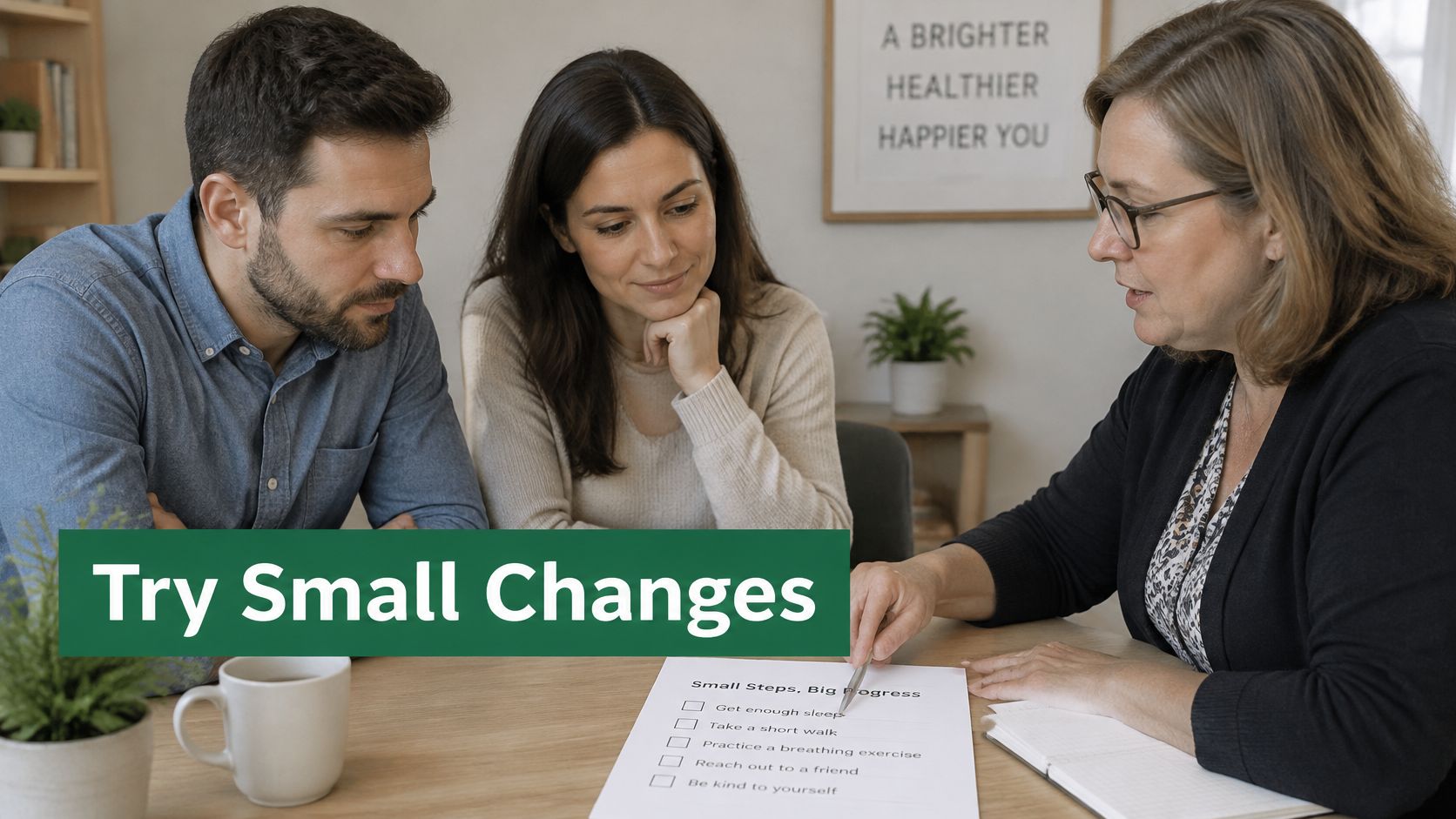
A short checklist keeps the next change specific instead of swapping therapists after one rough hour.
Three habits make those levers stick.
Bring one concrete request to each session, not a highlight reel of the week.
Ask which measures the therapist is tracking, and look at them together.
Keep old fights out of the hour unless they are the agenda. Re-trying last March eats the dose.
Structured listening is one of the cheaper levers. If interruptions are the escalation, practice a timed turn before you shop for a new clinician. The steps in active listening techniques are small enough to test in a single week. Switch therapists only after a direct fit conversation, then reassess after two sessions with the new person, not after the intake smile.
Decide Whether to Continue, Pause or End Therapy
Make this call in a scheduled, time-limited review session. The mood in the driveway after a hard hour is a bad instrument for the decision. Ending early is its own clinical problem. A 2025 study in PubMed of 160 people who discontinued couples therapy without discussing it with their therapist found that 69% reported discomfort such as home life getting more stressful, 67% cited cost or scheduling, 59% were dissatisfied with the partner, therapist, or treatment, and 51% believed they had improved enough to stop. Nearly half avoided telling the therapist they were leaving, and 85% attended fewer than 10 sessions.
Discomfort can be the hard middle of useful work. Discomfort nobody names is how people vanish. Withdrawing without mention carries its own risk: it removes the one conversation that could correct course, and the pattern that stalled therapy tends to follow the couple home.
Run the Review in One Session
Name the original goals in the words you used at the start.
List two observable changes since then, including "none."
Raise pacing and fit with the therapist while both of you are in the room.
Treat cost and scheduling as logistics. A couples 50-minute session with Jamie Molnar is $155, which is one concrete number to set beside drive time and missed work.
Choose one of four outcomes: continue, adjust, pause, or end, and put the next check on the calendar.
If you disagree about stopping, each partner writes a short case. The decision waits for a joint session, because one person's exit email is not a treatment plan. The practice sees individuals and couples and follows the American Counseling Association Code of Ethics, which includes telling you when conjoint work should pause for safety or when individual care is the cleaner next step.
Open that review with a plain sentence: "We are not sure this is working, and we want to review the goals with you before deciding." A steady therapist will welcome the question. A defensive one gives you information too.
Questions worth asking before you book the next block are listed in couples counseling questions to ask. Bring them into the review itself rather than saving them for after you have already left.
Silent quitting removes the one person who can correct course.
Treat the stall like a diagnosis with a review date. Book a review session with your current therapist, or ask a counselor for a consultation that is only about fit and goals. Leave with one of the four outcomes written down, and a date to look again.
Be Your Best Self & Thrive Counseling, PLLC offers couples and marriage counseling in St. Petersburg, including Gottman Therapy, for recurring fights, repair, and the question of whether joint work should continue, change, or pause. We also see individuals when safety, trauma, or one partner's symptoms need attention before more sessions together, and a free initial consultation is there to test fit and goals. Visit Be Your Best Self & Thrive Counseling, PLLC to set up that conversation.