
How to Stop Self Sabotaging Behavior: A Practical Guide
You've opened the report, read the same sentence again, and somehow ended up checking email. Or you've finally met someone you like, but now you're pulling away and searching for reasons it won't work. You care about the outcome, which makes your own behavior feel especially frustrating.
Learning how to stop self sabotaging behavior starts with a different question: What feeling does this behavior help me avoid? Trying harder won't tell you whether you're protecting yourself from shame, uncertainty, rejection, or overload. Recognizing that feeling gives you something specific to work with, without turning another difficult moment into a verdict about your character.
Name the Sabotage Patterns and the Relief They Buy
You receive a request for revisions, feel your stomach tighten, and open your inbox instead of the document. For a moment, you're busy rather than exposed. Later, you still have the revisions to do, plus less time and more dread.
Common self-sabotage patterns, their payoff and their cost
Pattern | Short-Term Relief | Long-Term Cost | Early Warning Sign |
|---|---|---|---|
Procrastination | Avoids a hard task and the discomfort it brings | Unfinished work piles up and stress grows | Checking email or tabs instead of starting |
Perfectionism | Avoids the risk of a visibly flawed result | Work never ships and deadlines slip | Rewriting the same paragraph for an hour |
Self-handicapping | Protects self-image if performance falls short | Failure gets blamed on the setup, not on skill | Late-night cramming before an exam or presentation |
Withdrawal | Avoids conflict, judgment or rejection | Isolation and unresolved problems build up | Declining invitations without a clear reason |
Choosing unavailable partners | Avoids the vulnerability of real closeness | Repeated heartbreak with the same pattern | Feeling a rush when someone is distant |
These are possible functions, not automatic explanations. Declining an invitation may be a healthy boundary, and someone else's emotional unavailability isn't your fault. Look for a repeated mismatch between what you want and what you do, rather than labeling every uncomfortable choice sabotage.
Notice what happens immediately afterward
Self-handicapping adds an obstacle that can explain a disappointing result. Staying up late before an exam, for example, leaves sleep deprivation available as an explanation; a review of procrastination mechanisms reports a correlation of r = 0.48 between self-handicapping and procrastination across studies.
This isn't a rare struggle: a review of procrastination evidence estimates that 20%–30% of adults procrastinate chronically and describes a U.S. survey of 65,950 students across 97 colleges and universities in which 72.3% reported procrastination as a problem during the previous 12 months, while 45.4% said it harmed academic performance.
The useful pattern is trigger, discomfort, avoidance, relief, later cost. If your explanation immediately becomes an attack on yourself, these examples of negative self-talk can help you recognize the difference between describing behavior and condemning yourself.
Pick the row that repeats most. Write down the feeling it helps you escape: fear, shame, overwhelm, or threat. Treat the table as a working map, not a clinical diagnosis or a verdict.
How to Log the Trigger, Prediction and Cost
Say a freelance designer receives a sharp client email about a revision. They predict that opening the file will confirm they're incompetent, so they reorganize their desktop instead. They feel briefly relieved, then spend an extra day dreading the project and miss the revision window.
A useful log captures that sequence without becoming another project to perfect. Use a phone note, a notebook, or a simple document you can reach when the episode happens.
Record the episode without prosecuting yourself
Note the trigger. Describe the specific event, such as receiving critical feedback or noticing an unanswered message. Write what happened, not your conclusion about what it means.
Write the prediction. Put the feared outcome into ordinary language, such as “If I start, I will fail.” A prediction is something you can examine; a vague description like feeling bad gives you less to test.
Record the immediate payoff. Name what avoidance provided: relief, distraction, escape, or temporary protection from embarrassment. Also note what you did, so you can recognize the behavior next time.
Record the later cost. Include deadline pressure, shame, lost sleep, or a conversation becoming harder. Keep consequences separate from insults about your worth.
Rate the urge before and afterward. For example, use a personal scale from zero to ten to compare the urge before avoidance with the urge after it. Add the emotion and body sensation, such as shame with a tight chest, rather than treating the rating as a diagnostic score.
Choose a testable experiment. Try working for ten minutes, asking a clarifying question, or sharing an imperfect draft when that's appropriate. Decide what you'll observe, such as whether starting produces the failure you predicted.
Review on Sunday. Mark the trigger that repeats most and the experiment you attempted. Don't grade your personality or demand an explanation for every difficult day.
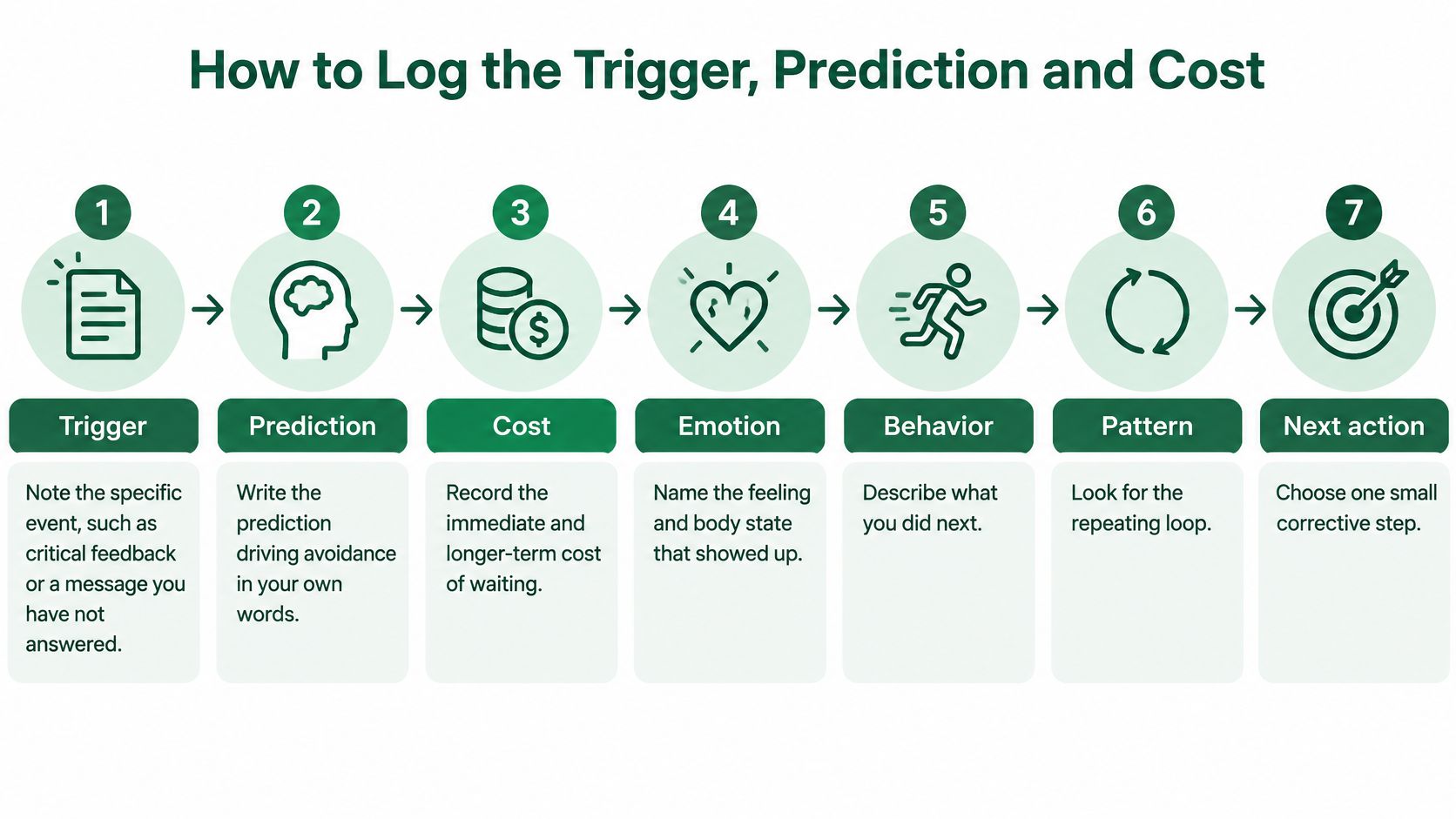
Use this flowchart to capture the event, emotional response, behavior, and a small corrective action.
Start before the consequences become severe
In a 2022 university-student study, 96%–97% of participants in a severe-procrastination group considered procrastination a problem, compared with 42%–48% in a less-severe group; 35%–38% of the severe group had considered seeking help, compared with 5%–7% of the less-severe group.
Those differences don't prove that logging prevents severe procrastination. They do support taking your concern seriously before the consequences feel intolerable.
For a manageable writing format, use these ideas for journaling for mental health. If you're helping a teenager identify the event behind a reaction, Katy Teen & Family Counseling's resource on recognizing triggers in teens offers a relevant starting point.
Which prediction have I never tested?
Calm Your Nervous System Before You Act
Sometimes you notice a tight jaw, restless hands, or an urgent desire to leave before you can identify a thought. Treat those sensations as information, not proof that you're in danger or evidence that you should push harder.
The aim isn't to become completely calm. It's to make enough room for a deliberate choice.
Use a pause-and-name script
Pause and breathe gently. Try three slow breaths, letting the exhale lengthen comfortably rather than forcing it. If focusing on breathing makes you more uncomfortable, keep your eyes open and notice your feet against the floor.
Name the anticipated emotion. Choose a word such as fear, shame, overwhelm, or threat. You don't need the perfect label to acknowledge that something feels difficult.
Reduce the demand. Choose a next action that could fit into roughly five to fifteen minutes, such as opening the file and marking the requested changes. Treat that as a starting experiment, not a requirement to keep going through overload.
Use a replacement response. Ask a colleague to clarify the priority, request support, or decline an extra assignment. Sometimes the appropriate action is a boundary, not greater productivity.

A pause-and-name moment creates space to notice discomfort before choosing what to do.
Match the response to the difficulty
These clues can guide reflection, but they aren't diagnostic tests:
Fear of failure: You anticipate a bad outcome.
Shame: You turn that outcome into a story about your worth.
Overwhelm: You can't find a starting point among competing demands.
Threat sensitivity: You feel urgency even without an immediate deadline.
Executive-function difficulty: You lose the sequence, forget the next step, or struggle to organize.
Trauma-linked avoidance: You experience flashbacks or strong body reactions connected with reminders.
A study involving 1,224 Peruvian students found that self-efficacy predicted self-regulation and that difficulty managing emotions was associated with greater procrastination. That association doesn't establish cause, but it challenges a willpower-only explanation.
Self-compassion isn't permission to abandon responsibility: a meta-analysis of 19 trials involving 1,350 participants found a medium reduction in self-criticism, g = 0.51, following self-compassion interventions.
For practical grounding, explore how to regulate your nervous system. Embodied Living Counseling's guidance can also help you listen to what your body communicates, without assuming every sensation has a single explanation.
If avoidance includes flashbacks or strong physical reactions, stop self-directed work on those reactions and seek a trauma-informed clinician. Don't turn tolerating discomfort into forcing yourself through distress.
How to Write If-Then Rules That Survive Real Triggers
Use this template: If a recognizable cue occurs, then I will perform a specific, manageable response. Unlike a promise to be more disciplined, the rule tells you what to do at the moment you usually get stuck.
A useful plan should be clear enough that you could tell whether you followed it without debating your intentions.
Build the rule around an actual cue
Start with a recurring event from your log, such as postponing important work after critical feedback. Define the replacement in observable terms: opening the document and working briefly, not becoming confident or having a better attitude.
For example:
If I notice the urge to avoid after criticism, then I will take three slow breaths, label the thought as an avoidance signal, and complete five minutes of the task before deciding whether to stop.
Rehearse the sequence while you're relatively settled. Put a brief prompt where you make the decision, such as beside your laptop, rather than storing the plan in a journal you rarely open.
The stopping permission matters. You're practicing a workable start, not disguising a demand to finish everything. Choose a task where a rough start is appropriate, and retain necessary quality checks for safety-sensitive work.
Plan for the obstacle you bring with you
Mental contrasting adds a useful question: What internal obstacle could prevent the outcome I want? Start with a concrete outcome, imagine its benefit, then identify your likely contribution to getting off track.
Suppose you want to respond calmly during conflict because you value trust. Your obstacle might be interpreting delayed replies as rejection and sending accusatory messages.
A coping plan could be:
Cue: You notice yourself interpreting silence as rejection.
Response: Wait twenty minutes, consider alternative explanations, and send a neutral clarification.
Observation: Record whether you used the plan and what happened next.
This is an illustrative plan, not a prescribed waiting period. Don't use it to dismiss genuine mistreatment or delay responding to an urgent safety concern.
A meta-analysis of 94 independent studies found that implementation intentions improved goal achievement with a medium-to-large effect, d = 0.65; a larger review described effects across 642 tests ranging from d = 0.27 to 0.66, with stronger outcomes when contingent plans were rehearsed and motivation was present.
The evidence for combining mental contrasting with implementation intentions is more modest: a meta-analysis covering 21 studies and 15,907 participants found g = 0.336, and the authors noted possible publication bias. Neither finding guarantees that a particular rule will work for you.
Keep the plan usable
Avoid ambiguous cues, oversized responses, and several competing rules. A lapse means you need to examine the cue, task, or support, not conclude that you're incapable of change.
If you need a written format, Lila's guide to a daily symptom action plan can help organize cues and responses. A values-based approach, such as acceptance and commitment therapy, also offers a way to connect action with what matters rather than waiting for uncomfortable thoughts to disappear.
Review your results weekly. Keep a frequent trigger and a small replacement behavior until you have enough experience to judge whether the plan fits.
When to Get Help and Which Support Option Fits
You may believe you should be able to fix this alone. But needing support isn't the same as refusing responsibility, and not recognizing a need for care isn't the same as consciously rejecting it.
A review of help-seeking barriers describes WHO World Mental Health surveys across 24 countries, where only 38% of people with a 12-month mental-disorder diagnosis perceived a need for treatment, and a 2025 Ipsos survey of 23,274 adults across 34 countries, where 36% viewed mental-health support as too expensive or too limited. These findings describe different populations, but both make a practical point: recognizing a problem and accessing support are separate challenges.
Stigma, confidentiality concerns, cost, and limited availability deserve a concrete response, not another instruction to try harder.
Choose the lowest-pressure useful option
Support options by situation and access
Option | Best Fit | Access Note |
|---|---|---|
Trusted conversation | Early check-in before the pattern hardens | Free and immediate when a trusted person is available |
Primary-care screening | Physical or mood symptoms that may feed avoidance | Check appointment access, coverage, and screening fees |
One-time consultation | Testing whether a counselor fits your goals | Ask about fees before booking |
Peer or support group | Feeling isolated inside the loop | Check facilitator qualifications, privacy rules, and cost |
Individual therapy | Patterns linked to anxiety, trauma, or perfectionism | Confirm regional licensure, fees, and relevant training |
Couples counseling | Avoidance that plays out inside a relationship | Check relationship-focused training and suitability for your situation |
Crisis line | Immediate safety concern | Available at no cost in many areas |
You don't have to tell your whole history during an initial conversation. You can explain the behavior, its consequences, and what you've already tried, then ask what an assessment or treatment plan would involve.
If you distrust therapy, make that part of the conversation. A useful discussion about therapy fit includes your goals, concerns, preferred pace, and whether you feel able to disagree with the counselor.
Know when self-help is no longer enough
Seek professional assessment when avoidance persists despite a realistic plan, disrupts work or relationships, or comes with anxiety, depression, trauma symptoms, or substance-related concerns. You don't need to establish the underlying diagnosis yourself before asking for help.
A partner can offer encouragement without becoming your monitor. Agree on a specific request, such as sitting nearby while you begin a difficult task, rather than making them responsible for checking your compliance.
Support boundary: Ask someone to help you carry out your plan, not to become responsible for your choices.
At our practice, we work specifically with non-emergency issues and motivated people who are ready to change but need help building the life and relationships they want. We follow the American Counseling Association Code of Ethics.
If you're in immediate danger, contact local emergency services or a crisis line now rather than waiting for a routine appointment. Before choosing ongoing support, ask yourself: is this a habit I can address independently, or a pattern that has outlasted my own plans?
Start Your Relapse-Prevention Plan This Week
Don't turn habit formation into another deadline you can fail. A British Psychological Society summary of a habit study describes 96 undergraduates practicing a new health behavior daily for 84 days; among the 82 who completed the study, average time to maximum automaticity was 66 days, individual estimates ranged from 18 to 254 days, and about half hadn't reached the habit threshold after 84 days.
Those findings concern health behaviors, not a treatment timeline for self-sabotage. The same study found that a missed day had little effect on later automaticity, while repeated missed opportunities could reduce eventual habit strength.
Your plan should make returning easier, not establish a streak you're afraid to break.
Write a plan for the difficult day
List your early warning signs. Choose three you can actually notice, such as opening unrelated tabs, repeatedly editing a finished message, or avoiding a familiar person. Use descriptions, not labels like lazy or hopeless.
Name the main trigger and attach its rule. Put the cue and response together in the same note. Keep the wording short enough to find and use when you're distracted.
Choose a support contact and a request. Write down who you'll contact if you get stuck and what you'll ask for. A specific request for help choosing a starting point is more actionable than asking someone to keep you accountable indefinitely.
Write a lapse response. For example, after a missed opportunity, return to the smallest version of the task the next day. Address any practical consequence, such as notifying a colleague about a delay, without adding a trial about your willpower.
Schedule a review and choose a measure. You might set a review four weeks out and count tasks started within ten minutes of the planned time. That's an example tracking arrangement, not a validated cutoff or a measure of your worth.
Decide when to add professional support. Write down the consequences that would prompt a consultation, such as continued missed commitments, worsening distress, or withdrawal from important relationships. Don't require yourself to exhaust every self-help option first.
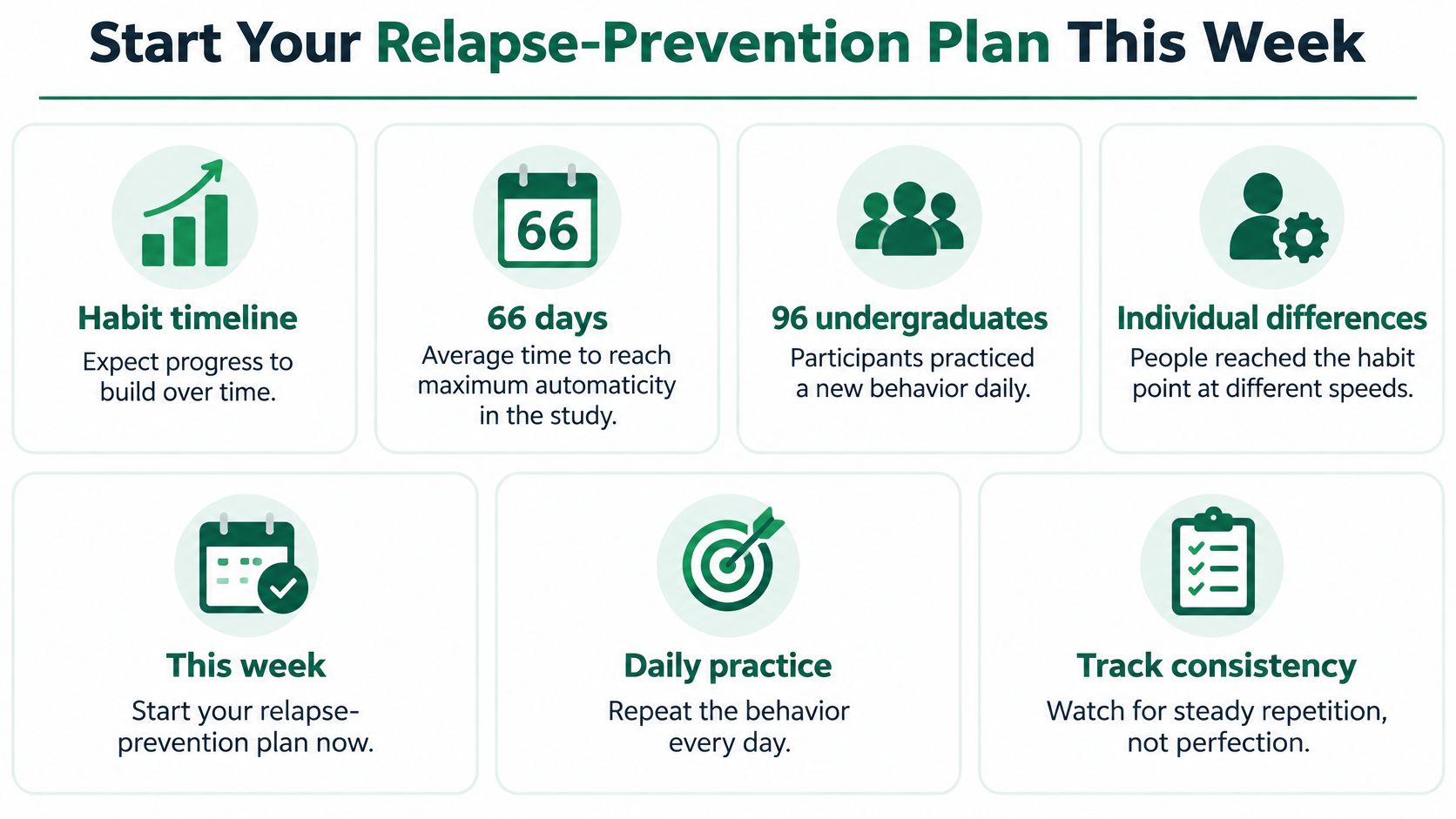
Use the checklist as a reminder to practice consistently and allow for individual differences, not as a deadline for recovery.
Make your review practical
At the review, ask whether you noticed the cue, whether the replacement was possible, and whether your circumstances require a different response. A plan designed for a quiet morning may not fit a caregiver's interrupted evening or an entrepreneur's unpredictable workload.
Through our supportive guidance, clients learn to regulate their nervous system, understand their own needs, wants, desires, and goals, and build healthy relationships with other people and the world around them. That process leaves room for practical adjustments rather than treating productivity as the only sign of progress.
Complete the warning signs, trigger rule, and support request today. You don't need a polished plan; you need something accessible before the next difficult moment.
Be Your Best Self & Thrive Counseling, PLLC offers online and in-person counseling, workshops, group therapy, and workbooks to support healthier patterns and relationships. If you're ready to understand what your avoidance protects you from and practice a different response, visit Be Your Best Self & Thrive Counseling, PLLC to explore a free initial consultation and discuss your goals.