
Why Marriage Counseling Works: Benefits and When to Start
Why wait until a marriage feels close to ending before getting help with the conversations that keep going wrong? Couples can care about each other and still get caught in a familiar sequence: one pushes for an answer, the other withdraws, and both feel misunderstood.
That's a useful starting point for understanding why marriage counseling can help. The work isn't about settling disagreements alone. It's about noticing what happens between partners, practising a different response, and deciding what kind of relationship they can realistically build.
Reasons Couples Seek Marriage Counseling
Couples usually seek counseling because one pattern keeps repeating and they can't break it alone, not only because their marriage is near collapse. The topic might change from chores to spending to family obligations, while the sequence stays remarkably familiar.
A therapist helps separate the practical problem from the way partners handle it. Both deserve attention, but resolving who washes the dishes won't help much if every disagreement ends in sarcasm or silence.
Common reasons couples seek counseling
Reason | What Counseling Targets | Early Warning Sign |
|---|---|---|
Communication breakdown | Listening, tone, and how talks end | Conversations stall, turn sarcastic, or go silent |
Recurring conflict | Escalation cycles and unresolved arguments | The same fight returns with no resolution |
Emotional disconnection | Closeness, acceptance, and shared time | Partners feel like roommates |
Affair or betrayal | Disclosure, accountability, and trust | Secrecy, broken promises, or constant checking |
Life transitions | Stress management and shared decisions | Strain after a move, job loss, new baby, or illness |
Premarital preparation | Expectations, money, and conflict style | Engaged couples want a head start on tough topics |
Say a couple argues about chores every Sunday. One partner lists everything left undone; the other hears criticism and starts defending themselves. Counseling can help them make a workable division of labor while also changing how they raise concerns.
Another couple barely argues, but one partner withdraws every evening and stops sharing feelings. Their problem isn't loud conflict. It's that neither knows how to approach the distance without inviting rejection. Recognizing these marriage communication problems can make the first conversation about help more specific.
Notice the pattern before choosing the solution
A spouse replaying the discovery of an affair needs something different from newlyweds who want money rules agreed before tension builds. Counseling should fit the issue rather than treating every difficulty as a listening exercise.
Practical rule: Count the early signs that repeatedly describe your relationship, not the isolated bad days.
Two or more repeated patterns are a practical reason to book a consultation, not a diagnostic cutoff. You don't need to prove that your marriage is struggling enough to deserve attention.
Who Benefits From Marriage Counseling
Marriage counseling can help couples at many stages, including those who aren't considering separation. Engaged partners may want to discuss expectations, newlyweds may need help combining routines, and established couples may want a structured place to address growing distance.
Preparation isn't unusual: 30% of nearly 17,000 engaged or recently married couples surveyed had attended premarital counseling or couples therapy in The Knot's 2025 Real Weddings Study, as reported by Axios. Seeking support before a major disagreement doesn't mean partners expect failure. It can mean they want to make difficult decisions more deliberately.
Support during ordinary strain
A new baby, a career change, or caregiving responsibilities can leave partners coordinating constantly without feeling connected. A 2014 randomized Marriage Checkup trial involving 215 cohabiting married couples found improvements in intimacy, acceptance, and relationship satisfaction compared with a wait-list group, with benefits evident for as long as two years when a booster session occurred at the one-year point, as summarized in the Administration for Children and Families review. Dropout at follow-up limits how confidently those results apply to everyone who begins.
Other useful starting points include:
Feeling stuck: Partners want help discussing a subject they keep abandoning.
Different processing needs: Couples need room for sensory, attention, or communication differences. Neurodivergent couples therapy offers a useful framework for thinking about accommodations without assigning blame.
Personal work alongside relationship work: Individual sessions can provide space to clarify boundaries or address personal distress, with confidentiality arrangements agreed in advance.
Communication is a common entry point: 48% of therapists surveyed in the British Association for Counselling and Psychotherapy's 2025 survey named communication problems as the most common issue behind relationship breakdowns, according to BACP's Mindometer. That's a report of therapists' views, not proof that communication causes every breakup.
Couples facing abuse, fear, or coercive control shouldn't begin with joint sessions. Private assessment and appropriate support come first.
What Research Shows Counseling Improves
A 2021 meta-analysis of 58 studies, representing 40 unique samples and 2,092 couples, found a large pre- to post-treatment improvement in relationship satisfaction, with Hedges' g of 1.12 and a 95% confidence interval of 0.92 to 1.31. Couples on a wait list showed a small, statistically nonsignificant change of 0.12, according to the meta-analysis published in the Journal of Consulting and Clinical Psychology.
Hedges' g describes the size of a change in standardized units. It is not a percentage of marriages saved. These figures describe change within each group, so they do not directly compare every couple receiving therapy with every couple who did not.
Meta-analysis effect sizes for relationship satisfaction
Group | Hedges' g | 95% confidence interval |
|---|---|---|
Couples receiving therapy | 1.12 | 0.92 to 1.31 |
Wait-list control | 0.12 | −0.04 to 0.29 (not statistically significant) |
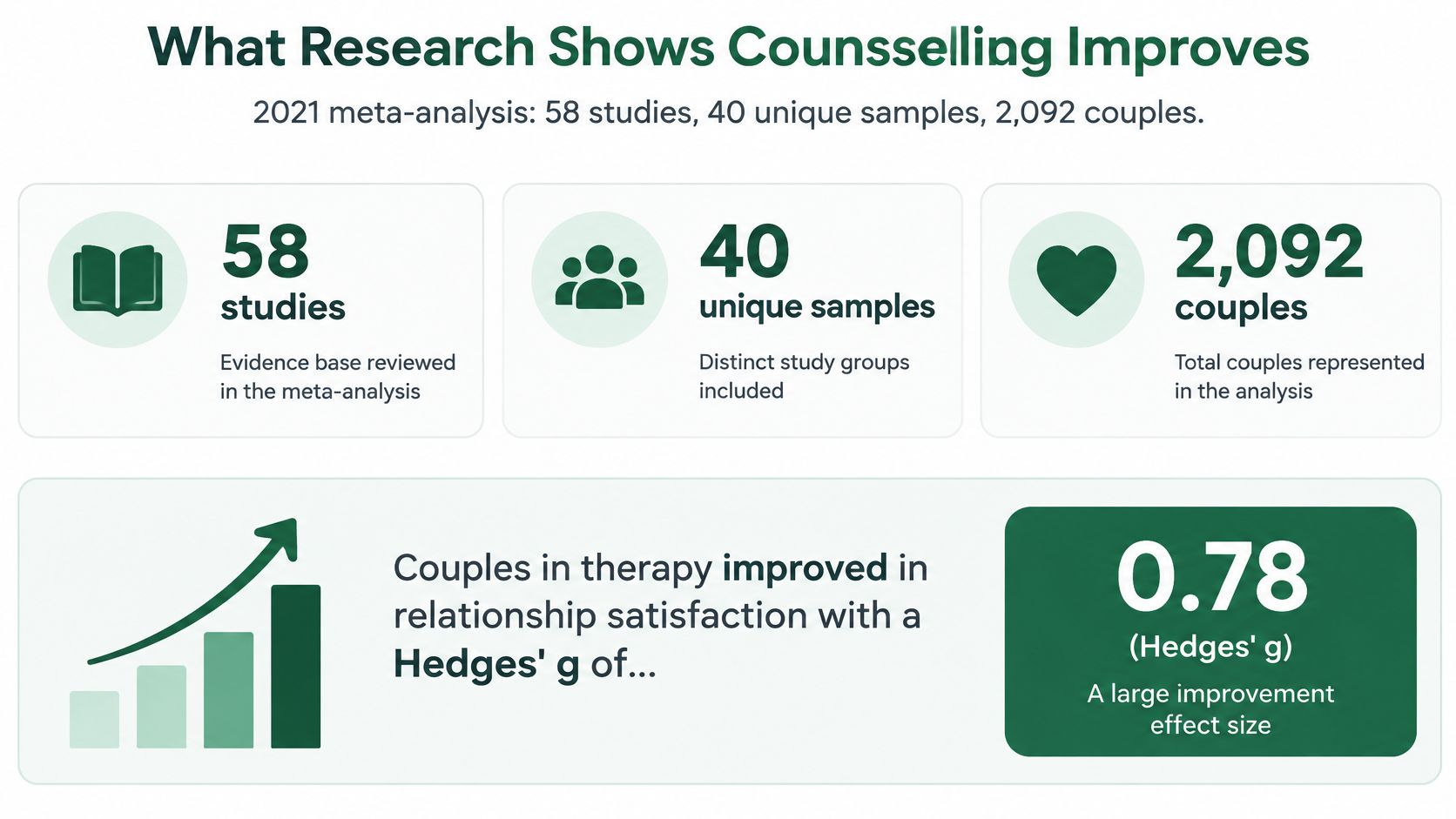
The meta-analysis found substantially greater improvement during therapy than during waiting-list periods.
What improvement looks like at home
The analysis found benefits in self-reported and observed communication, emotional intimacy, and partner behavior. In other words, improvement appeared both in how partners described their relationship and in how observers assessed their interactions.
At home, a change might start with listening differently. One partner finishes explaining a concern before the other responds. The listener summarizes what they heard, then answers, rather than building a defense while the other person is still speaking.
Over time, clearer conversations can support shared problem-solving. Partners might name household responsibilities, discuss obstacles, and revise an arrangement that is not working. Emotional closeness can also mean expressing disappointment without assuming that the relationship is at risk.
Counseling can address repeating criticism, avoidance, or emotional distance before those patterns feel fixed. The research on marriage counseling success rates also calls for clarity about what “success” means: greater satisfaction, less distress, changed behavior, or a clearer understanding of the relationship.
Readers considering separation may find broader context in divorce statistics for Florida families. Population figures cannot predict whether therapy will help a particular couple.
These findings describe averages, not guarantees. Results vary by therapy model, a couple's circumstances, and the clinical setting.
How Counseling Teaches Repair During Conflict
A couple argues about a forgotten pickup. One partner's voice rises; the other notices they can no longer follow the conversation and asks for a pause, with an agreed time to return. The pickup still needs discussing, but they've interrupted the escalation.
That interruption is a repair attempt. It might involve acknowledging harm, softening a statement, apologizing, requesting a break, or explaining a need without attacking the other person.
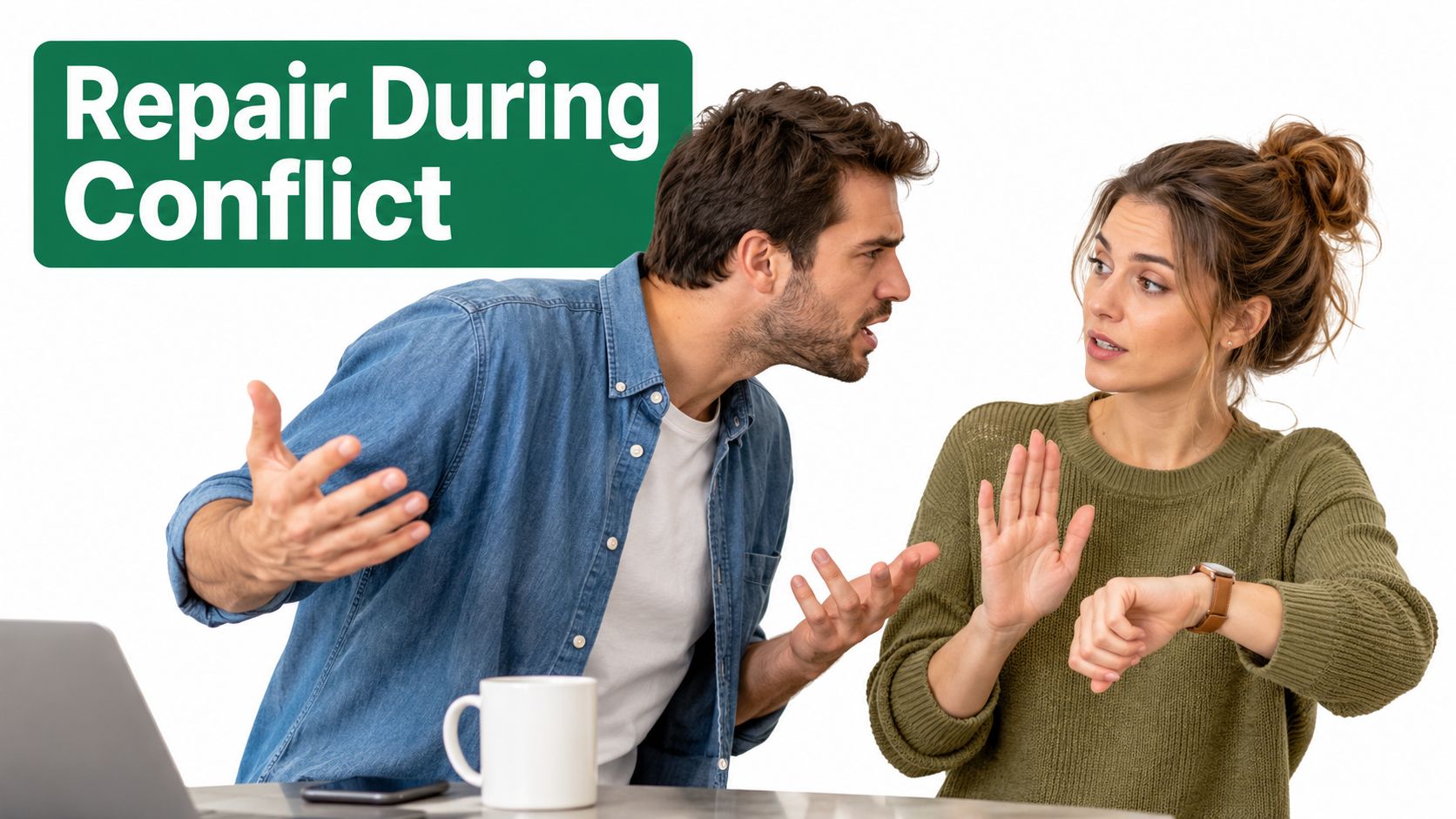
Repair means interrupting escalation without abandoning the issue that needs attention.
The Gottman Institute's discussion of conflict repair reports that repair attempts in happy relationships succeeded about 80% of the time, with success connected to an underlying foundation of friendship and care. The finding doesn't mean a particular phrase works reliably in every marriage.
A therapist can help partners identify what makes a repair feel sincere. Humor might soften tension for one person but feel dismissive to another. A request for space might sound reasonable to one partner and like abandonment to the other; Uptown Psychology on anxious-avoidant dynamics offers context for understanding that pursuit-and-withdrawal pattern without turning it into a fixed identity.
Practise a repair that fits both partners
Name the tipping point. Notice when interruptions begin, voices sharpen, or someone stops taking in information. Naming observable behavior is more useful than diagnosing your partner's motives.
Pause with a return time. Agree when you'll resume and honor that agreement. A break should reduce escalation, not become a way to avoid accountability.
Reconnect before restarting. Offer a warm acknowledgment or a gesture both welcome. Then return to the actual concern rather than pretending it disappeared.
In counseling, partners can rehearse this exchange slowly enough to notice what goes wrong. The therapist might stop a conversation when an apology becomes a justification, or help someone replace a broad accusation with a specific request.
Repair isn't surrender, and accepting an apology doesn't require immediate forgiveness. It means making enough room to continue.
A repair attempt needs to feel safe to receive. When contempt dominates, seek help sooner; when fear or coercion is present, prioritize private support rather than joint practice.
Rebuilding Trust After an Affair
After discovering an affair, a partner may keep returning to the same question because the answer still feels incomplete. The partner who had the affair may want to stop discussing it because they feel ashamed. Those needs collide, but they aren't equivalent: accountability requires making room for the harm without asking the betrayed partner to manage the other person's guilt.
Infidelity therefore needs more than an ordinary communication exercise. The betrayed partner may need honest disclosure, meaningful answers, and a reliable understanding of what happened before deciding whether rebuilding is possible.
What the pilot trial can tell us
A randomized controlled pilot trial of Gottman Method Couples Therapy after infidelity enrolled 49 couples, but only 19 completed every pre- and post-treatment assessment; the Gottman group showed stronger overall improvement in trust, conflict management, relationship satisfaction, and sexual quality than treatment as usual. Partners who had the affair improved significantly in relationship satisfaction, while partners who hadn't showed reduced separation-proneness.
The small completion sample is a substantial limitation. These findings support offering structured help, not promising reconciliation or assuming that a named approach will fit every couple.
Moving from crisis toward informed choices
Consider a couple who wants to explore staying together but can't discuss the affair without becoming overwhelmed. A careful process might include:
Stabilizing the immediate situation: Establish boundaries around ongoing contact, daily functioning, and conversations that become unmanageable.
Structuring disclosure and questions: Agree on how to discuss what happened without uncontrolled interrogation or avoidant half-answers.
Understanding contributing circumstances: Examine choices and relationship context without treating dissatisfaction as an excuse for betrayal.
Building daily reliability: Make concrete agreements about transparency and follow through consistently. Transparency should be mutually understood, not become indefinite surveillance.
Individual sessions may sit alongside couples work when personal distress, trauma symptoms, or safety concerns require separate attention. The therapist should explain how information shared privately will be handled before those conversations occur.
A guide to couples counseling after infidelity can help partners prepare for that distinction between understanding the affair and excusing it. Neither partner should be pressured to forgive or decide the future immediately.
Some couples choose separation. A responsible process supports informed decisions and appropriate boundaries, not staying together at any cost.
How Long Counseling Gains Last
Counseling can help, but lasting improvement isn't automatic. The Catholic University of Applied Sciences Freiburg's summary of controlled research reports significant improvement for approximately 70% of couples after therapy, declining to about 40% five years later, and notes that roughly 40% improved enough to no longer meet the threshold for clinically significant relationship distress.
How long couples therapy gains last
Time point | Share of couples |
|---|---|
Right after couples therapy | About 70% show significant improvement |
Five years after treatment | About 40% still show improvement |
After treatment | About 40% no longer meet the threshold for clinically significant relationship distress |
These findings came from randomized trials conducted under highly controlled conditions. Results in ordinary community practice may differ, and the decline doesn't establish a single reason why particular couples lost ground.
It does make a practical point: finishing therapy isn't the same as finishing the work of relating to each other. Skills need a place in ordinary routines, especially when partners become tired or stressed.

Maintenance means making deliberate time to notice how the relationship is functioning.
Make maintenance observable
A useful maintenance plan includes specific actions rather than a general promise to communicate better:
Hold a weekly check-in: Cover appreciation, practical demands, and an unresolved concern using a set agenda.
Review what's working monthly: Name a helpful behavior you want to keep, not only problems you want removed.
Write a repair plan during calm periods: Record how either partner can request a pause and how you'll reconnect.
Return when old habits reappear: Seek support before avoiding each other becomes the default again.
For example, a couple might stop honoring their pause agreement during a stressful year. When familiar arguments return, they could book a short return to therapy to examine what changed and rehearse the agreement again. That's maintenance, not evidence that every earlier improvement was false.
Choose two skills to practise over the next six months as a personal maintenance exercise. Agree who will raise the concern when either slips, and choose language that sounds like an invitation to reset rather than a performance review.
Deciding Whether and How to Book Joint Counseling
What changes when the same disagreement keeps returning, even after you both promise to handle it differently? That repeating pattern can be a reason to seek counseling before the relationship reaches a crisis.
Joint sessions are not the right first step for every couple. Ongoing abuse, fear, coercive control, or an active crisis calls for individual support, safety planning, and appropriate crisis services before relationship exercises.
A 2025 study on barriers to couple therapy identified privacy concerns, stigma, traditional coping strategies, financial difficulties, lack of information, and misconceptions as obstacles to seeking help. Discuss practical questions such as confidentiality, fees, and what an initial assessment involves. A therapy model's name alone cannot tell you whether it fits your needs.
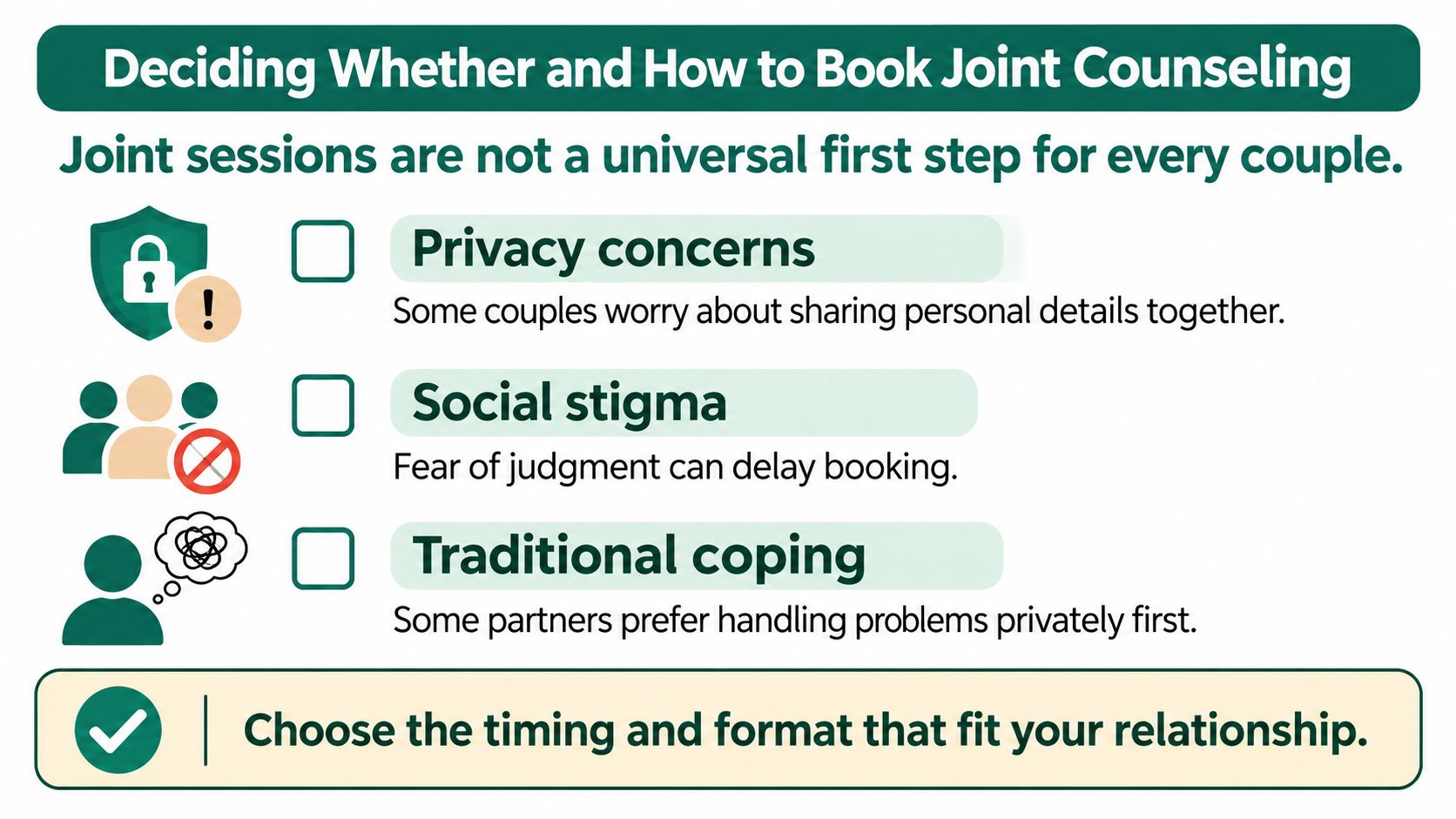
Choose the timing and format that fit your relationship, with safety assessed before joint work.
Clarify fit, safeguards, and progress
Ask a prospective counselor how they would approach your specific concerns. These questions can help you decide whether the process feels appropriate:
Training: What preparation do you have for our concerns?
Progress: How will we notice whether sessions are helping?
Privacy: What are the limits of confidentiality, including during individual check-ins?
Accessibility: How will cultural context and neurodivergent needs shape the work?
Safety: What happens if joint sessions are not appropriate?
Be Your Best Self & Thrive Counseling follows the American Counseling Association Code of Ethics and works with non-emergency concerns and motivated people ready for change. The practice prefers therapists with couples-counseling training, or an interest in pursuing it, who are also studying or have specialized training in a modality such as yoga, meditation, sound healing, energy work, nutrition, or art therapy.
Make a practical booking plan
Be Your Best Self & Thrive Counseling offers a free initial consultation to explore fit and goals. Jamie Molnar's couples sessions cost $155 for 50 minutes or $225 for 90 minutes. Holly Case offers in-person counseling in Sarasota and online counseling throughout Florida. Between-session contact should be by phone or text, not social media.
Before booking, jot down the recurring interaction pattern you want help changing, any safety concerns you want to raise privately, and who will make contact. The guide to preparing for couples counseling can help you organize questions.
An early goal might be to understand the pattern, practise a repair skill, and agree on a change you can observe. These are topics to discuss with a counselor, not promises about what a set number of appointments will achieve.
Be Your Best Self & Thrive Counseling, PLLC offers individual and couples counseling with evidence-informed, whole-person care for non-emergency concerns. A free initial consultation can help you discuss whether support for recurring conflict, disconnection, or trust concerns fits your next step.