
How to Help Anxiety with a Practical Plan
It's Tuesday afternoon. You open your inbox, your chest tightens, and suddenly every task looks like a test you could fail. You want relief, but another list of wellness tips feels like more work.
Learning how to help anxiety starts with a smaller question: What's happening right now, and what action fits it? A body alarm, a looping prediction, and weeks of dread don't all need the same first move.
Match Your First Move to the Moment
Before trying a technique, find the closest match below. These patterns aren't diagnoses, and you may recognize more than one. Choose the one that's interfering most right now, unless a safety concern needs attention first.
First move by anxiety pattern
Pattern | First move | Get more help if |
|---|---|---|
Panic spike | Name five things you see, then slow the exhale for about two minutes | Chest pain, fainting, or breathing trouble could be medical |
What-if spiral | Rate it 0 to 10 and write the feared outcome in one sentence | Worry happens most days for weeks, with sleep, work, or relationships slipping |
Avoidance | Stay with a smaller version of the task or place for about 10 minutes | Avoidance is shrinking driving, work, errands, or relationships |
Sleepless worry | Leave bed, use dim light, and sort one solvable problem from a hypothetical | Sleep loss lasts beyond about two weeks |
Caffeine, alcohol, cannabis, or a short night | Note the amplifier and delay the next big decision | Substances are the main way anxiety gets shut off |
Conflict or people-pleasing | Write one boundary sentence you could say today | Fear for safety is part of the conflict |
Weeks of dread with low mood | Book a professional assessment and keep a simple log | You have thoughts of suicide or of harming someone |
The time suggestions are practice starting points, not diagnostic cutoffs or reasons to postpone help. New, severe, or unexplained chest pain, fainting, or trouble breathing needs urgent medical assessment, not an assumption that it's anxiety.
If you have thoughts of suicide or harming someone, seek urgent professional help. If you might act on those thoughts, can't stay safe, or someone is in immediate danger, contact emergency services or go to an emergency department.
Make two notes before doing more
Rate your anxiety from 0 to 10, where zero means no anxiety and ten means the strongest anxiety you can imagine. Then write a single sentence naming the feared outcome: for example, If I answer this email imperfectly, my manager will think I'm incompetent.
The rating records intensity. The sentence identifies what you may need to problem-solve or test, rather than leaving you fighting a vague sense of danger.
Needing help beyond a coping tip is ordinary. The World Health Organization reports that approximately 470 million people worldwide experienced an anxiety disorder in 2023, while only 27.6% of people who need care receive any treatment.
That gap isn't evidence that people should try harder on their own. Persistent symptoms deserve accessible, individualized care that considers health, history, culture, and preferences.
Start small: Do only the first move in your matching row. You don't need to complete an entire anxiety plan this afternoon.
Settle Your Body in Five Minutes
You're waiting in the school pickup line when a stressful text arrives. Your shoulders lift, your breathing changes, and you start composing a defensive reply before you've finished reading. While safely parked, give yourself a brief pause before answering.
This routine is for a familiar anxiety spike that's already underway, not unexplained symptoms that may need medical care. Treat the timing as flexible. You're practicing a return to the situation, not racing a stopwatch.
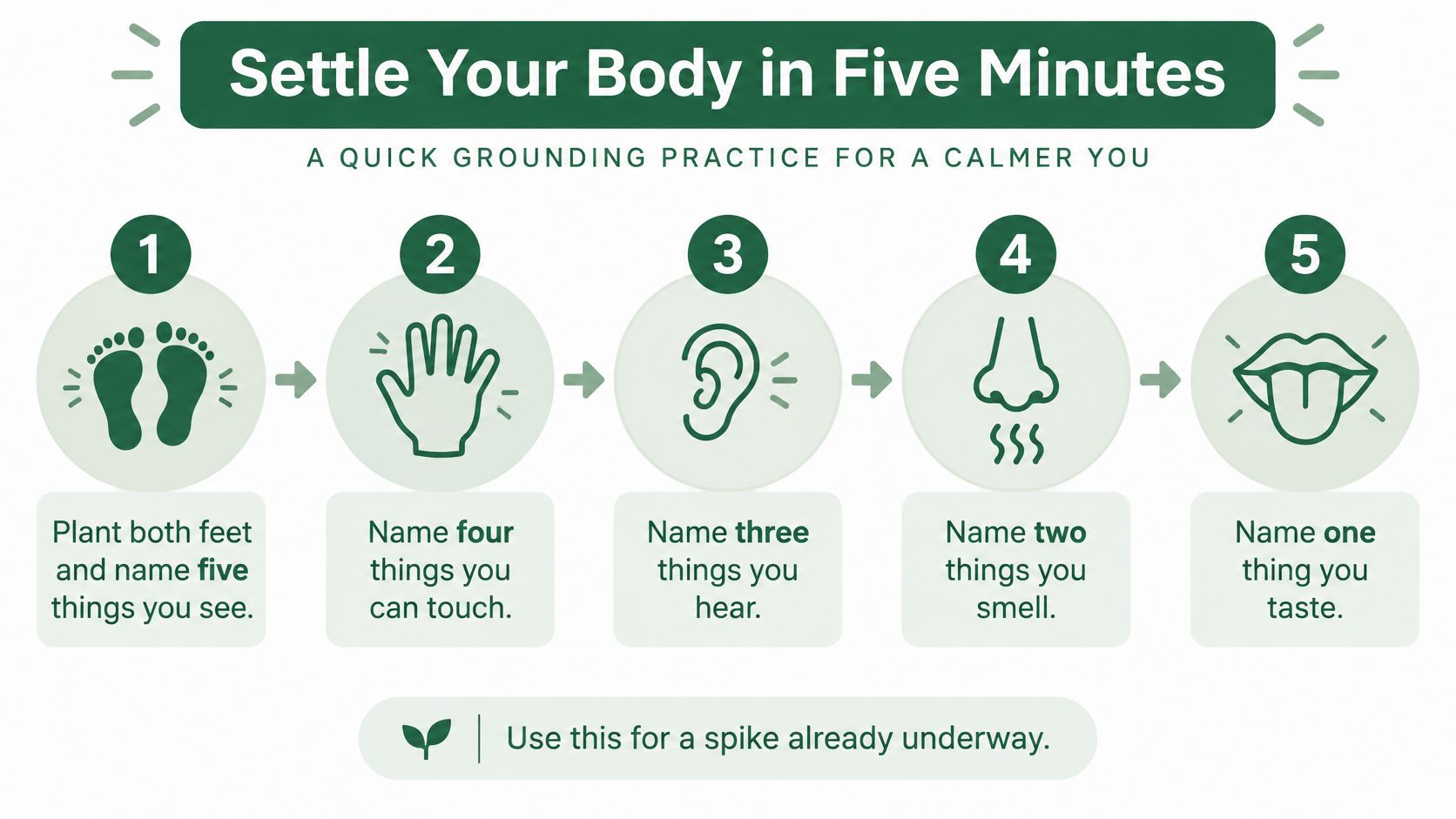
Five-minute sequence back into the moment, beginning with the senses rather than the stressful message.
A routine for the spike
Plant both feet and orient to your surroundings. Name five things you see, four things you can touch, three you hear, two you smell, and one you taste. Notice what's available, such as the seat fabric or a lingering toothpaste taste. Don't strain to find a sensation that isn't there.
Let the exhale become a little longer. Try breathing in for about four counts and out for about six, for roughly two minutes. Keep the breaths comfortable rather than unusually deep. Alternatively, try two short inhales followed by one long exhale, repeated three to five times, if that feels easier.
Describe the body cue without adding a prediction. Use plain words such as tight chest, warm face, or buzzing hands. There's a difference between noticing a sensation and concluding that it means something terrible is about to happen.
Record your intensity. Use your rating without debating whether it should be lower. The number is an observation, not a grade.
Remain with the safe situation for another minute. In the pickup line, that might mean leaving the text unanswered while you look ahead, rather than scrolling or asking someone to promise everything is fine. Don't practice this while driving or in an unsafe setting.
Notice what helped. If the number drops even one point, jot down what you did. If it doesn't drop, notice whether you still gained enough space to choose your response instead of reacting automatically.
Adjust instead of forcing it
If longer breaths make you dizzy, shorten the counts and return to gentle, ordinary breathing. Look at one still object and describe its shape or color. Stop the breathing exercise if it makes you feel worse.
For muscle tension, progressive muscle relaxation offers a different practice to explore. Choose a skill you can use comfortably, rather than collecting techniques you feel obliged to perform perfectly.
If you're exploring supplements, Wallaby Wellness's discussion of how hemp may support relaxation is a resource to review critically with a clinician or pharmacist, not evidence that a hemp product will treat your anxiety. Check ingredients, interactions, and suitability before using a product.
The routine is a bridge, not the whole plan. You don't have to erase every sensation before answering the text, entering the meeting, or making a reasonable decision.
Calm is useful when it helps you stay present. It doesn't have to become a condition you must achieve before living your life.
Test the Worry Instead of Feeding It
An email from your manager asks for an update. You predict that an imperfect answer will expose you as incapable. Your stomach tightens, so you reread your draft, ask a colleague whether it sounds acceptable, and postpone sending it.
That's a complete anxiety loop: trigger, threat prediction, body alarm, avoidance, and reassurance. The useful intervention isn't another promise that your manager likes you. It's a small, safe opportunity to discover what happens when you respond without the usual protective ritual.
Write the prediction before a small test, so you can compare what you feared with what happened.
Turn the email into a useful experiment
Record the whole cycle. Write the trigger, prediction, body cue, and safety behavior. Be specific about the behavior, such as repeatedly rereading the draft or asking someone else to decide whether it's ready.
Sort the problem. Is there something solvable today, such as a missing project detail? Or are you trying to settle a hypothetical question, such as whether your manager might secretly disapprove of you?
Act on the solvable part. Define the problem, list three options, choose one, set a deadline, and review what happened. For a missing detail, the options might be checking the project notes, asking the person responsible, or stating clearly that confirmation is pending.
Test the hypothetical prediction. For example, send a routine, appropriately checked email and wait 20 minutes without checking for a reply. Record the feared result beforehand, then compare it with what you observe. A delayed reply doesn't prove disapproval.
Create a manageable ladder. Arrange avoided situations from easier to harder. You might begin with a routine update, then ask a clarifying question, then contribute an idea in a meeting. Repeat a tolerable rung until avoidance decreases rather than jumping straight to the hardest situation.
A simple record needs four fields: prediction, action, observed outcome, and what I learned. The lesson may be that an awkward moment was manageable, not that nothing uncomfortable ever happens. Anxiety therapy worksheets can help keep those observations organized.
Know what structured care adds
For generalized anxiety disorder, NICE guidance describes clinician-led CBT as approximately 12–15 weekly, one-hour sessions, shortened when recovery comes sooner or extended when clinically indicated; its evidence review also reports one intervention's 6.09-point reduction on a GAD severity scale at 18 months, versus 4.08 points with usual care.
Those findings don't predict your personal result. They illustrate why treatment involves a structured formulation, practice, and review, rather than relaxation alone.
For work-related context, Peak Performance's mental wellness insights for busy professionals can complement reflection on how anxiety affects your working day. Listening is preparation, though, not the behavioral test itself.
Schedule one manageable ladder rung this week. Put the action in your calendar and write the prediction before you begin.
Steady the Week With Daily Supports
By late afternoon, you're tired and behind, so you pour another coffee. That evening you scroll until 1 a.m., then wake feeling shaky and interpret the shakiness as evidence that you can't handle the day.
Rather than judging the whole week, look for a practical adjustment. The question isn't whether you can build a flawless routine. It's whether you can reduce an amplifier that makes ordinary demands harder to meet.
Daily supports and common slips
Support | Useful target | Common slip |
|---|---|---|
Sleep | Make room for about 7 to 9 hours and keep a steady wake time | Late scrolling and weekend catch-up |
Movement | Most days, even a 20-minute walk | All-or-nothing workouts after a bad week |
Caffeine | Earlier in the day and a smaller dose if jittery | Extra cups during a worry spike |
Alcohol and cannabis | Not used as the calm-down tool | Next-day rebound anxiety |
Connection | One real check-in rather than only scrolling | Isolating until you feel better |
Recovery | A pause planned before you're depleted | Rest treated as a reward you never earn |
Use these as practical starting targets, not prescriptions that fit every body, health condition, or work schedule. If you depend on alcohol or another substance, get medical guidance about changing your use rather than abruptly stopping on your own.
Choose the easiest useful adjustment
For the afternoon-coffee pattern, the first change might be a smaller, earlier serving and a phone-charging spot away from bed. Don't simultaneously demand a new exercise program, perfect meals, and a complete social calendar.
Movement can be a walk rather than a test of fitness. Connection can be a conversation in which you say how you're doing, rather than watching other people's updates while feeling increasingly alone.
Planned recovery should have a place in the day before you're exhausted. If structured attention practice appeals to you, explore mindfulness-based stress reduction without turning mindfulness into another task you can fail.
For an optional sensory ritual, Aroma Warehouse's ways to use oils for calm offers ideas to consider cautiously. Fragrance isn't an anxiety treatment, and you can skip it entirely if scents irritate you or make you feel unwell.
Run a modest weekly trial
Pick one row for seven days. Track your anxiety rating alongside one functioning marker, such as meetings attended, errands finished, or evenings when you began winding down as intended.
At the end of the week, ask whether the change made daily life more workable and whether it was sustainable. Sleep, activity, connection, and relaxation can support recovery, but severe or persistent anxiety needs more than lifestyle adjustments.
Repair the Plan When Progress Stalls
A week of honest practice can still feel disappointing. You've made time, tried the skills, and remained anxious. That's information to examine, not evidence that you lack discipline.
Look closely at how you're practicing before adding more techniques. Sometimes the repair is smaller and more personal than the original plan.
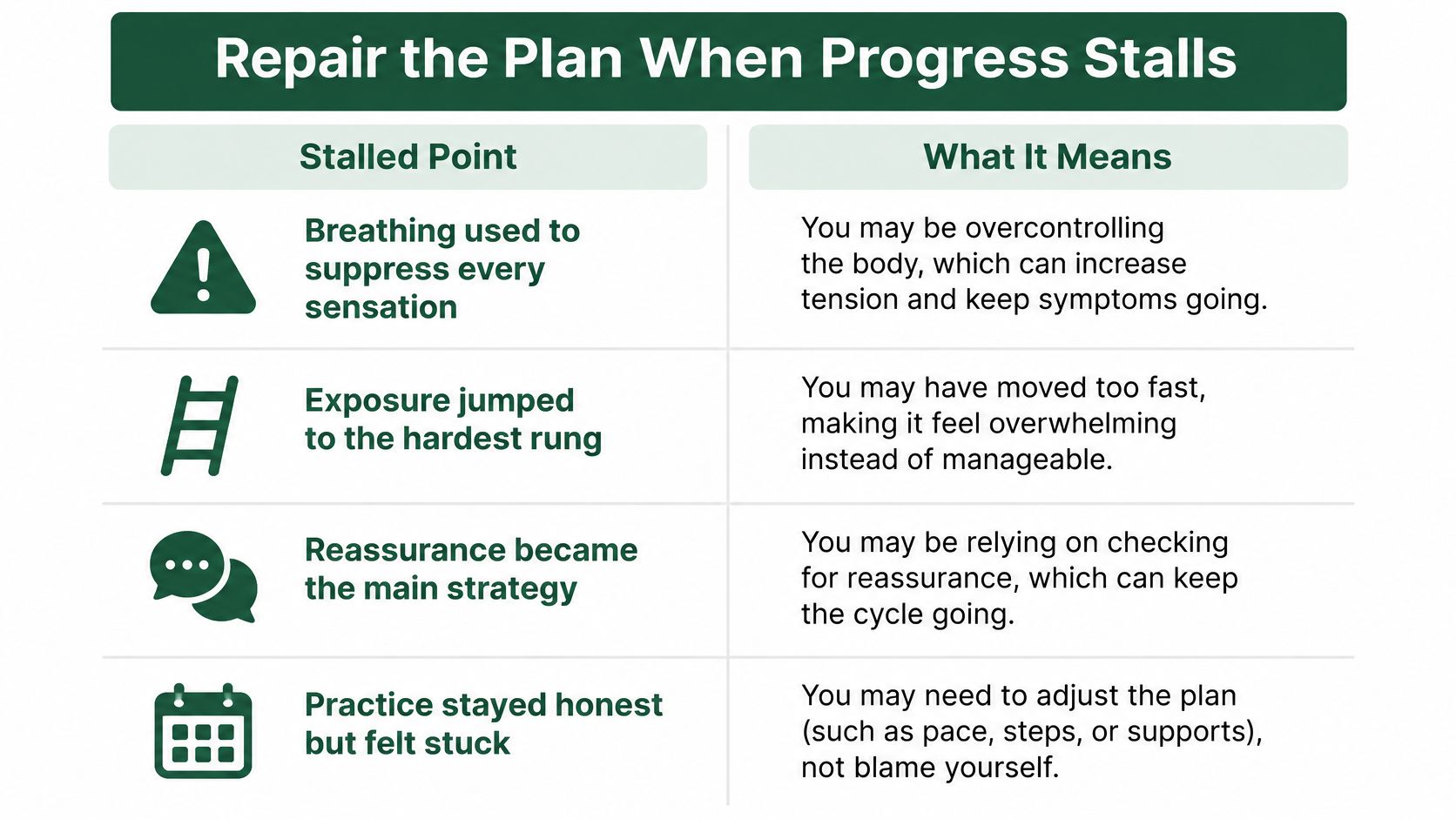
Common practice obstacles call for adjustments, not self-blame.
Match the stall to the repair
Breathing became a way to suppress every sensation. Stop measuring success by whether your body feels completely quiet. Use the skill briefly, then return attention to the activity you chose.
Exposure jumped to the hardest rung. Step back to something uncomfortable but doable and repeat it. You're building the ability to engage, not proving how much distress you can endure.
You judged success only by the anxious hour. Use your weekly functioning marker. Replying to a message or completing an errand while anxious may represent meaningful progress even when the intensity rating stays high.
A symptom spike became proof of failure. Allow for temporary increases during practice. Consider what you did and learned, while taking sustained deterioration seriously.
The advice never matched your particular loop. Replace broad instructions to relax or think positively with a personal formulation. Identify what triggers you, what you predict, and what you do to prevent that prediction.
Reassurance remained the main strategy. Agree on a manageable limit to repeated checking. Ask a supportive person to help you follow your chosen action rather than repeatedly certify that nothing bad can happen.
Decide when the plan needs a fuller check
If a couple of weeks of genuine practice brings no meaningful change in symptoms or functioning, revise the plan with a qualified professional. Don't keep increasing the effort without reconsidering the approach.
The WHO recommendation on brief structured psychological interventions strongly supports care based on cognitive behavioral principles for adults with generalized anxiety disorder or panic disorder. That supports structured help, not the assumption that one protocol fits everyone or that long-term outcomes need no review.
A fuller assessment can screen for panic, low mood, trauma-related symptoms, substance use, possible medical contributors, and suicide risk. You don't need to diagnose these yourself. Bring observations about changes in your body, behavior, sleep, and daily responsibilities.
The questions in how to know if therapy is working can help you discuss progress directly rather than wondering whether you're doing treatment wrong.
A useful review asks: Is this plan helping me participate in my life, and what needs to change if it isn't?
If panic, avoidance, sleep, work, or relationships keep worsening, arrange a consult rather than extending the same self-help experiment indefinitely.
Use a First Consult to Find the Right Fit
Book an assessment when worry, panic, avoidance, or sleep difficulties persist for weeks, when work or relationships are impaired, or when genuine skills practice hasn't improved functioning after a couple of weeks. You don't have to reach a crisis to justify care.
If there's immediate danger, use emergency services rather than a counseling inbox. A routine consultation is a place to assess fit and next steps, not an emergency response service.
Bring a useful snapshot
You don't need a polished explanation. Bring your intensity log, the situations you avoid, what you've already tried, and one or two goals that describe a life you want to participate in.
A goal might be attending meetings without repeatedly seeking approval, sleeping without prolonged worry, or discussing a disagreement without automatically agreeing. Concrete goals help distinguish useful treatment from a pleasant conversation that never changes the pattern.
A first consult is an opportunity to discuss goals, treatment approach, and whether the working relationship feels suitable.
Use the conversation to ask:
How will practice and personal history fit together? You shouldn't have to choose between practical skills and understanding the experiences that shape your reactions.
How will we review progress? Ask how symptoms and functioning will be checked at regular intervals and what happens if the plan isn't helping.
What will shape the approach? Discuss trauma, neurodivergence, relationships, and health issues that may affect pacing or accessibility.
Does the clinician's focus match the problem? Anxiety, panic, burnout, trauma, and couples work are examples of fit questions, not interchangeable treatment labels.
Look for a reasoned plan, not a guarantee
A Cochrane systematic review of psychological therapies for generalized anxiety disorder, including 25 studies involving 1,305 participants, found short-term benefits for CBT-based treatment over usual care or waiting-list conditions, while comparisons with other therapies and long-term effectiveness remained insufficiently established.
That's a reason to value evidence alongside individual fit. A clinician should be able to explain the proposed approach, its limits, and how you'll decide together whether it's useful.
At Be Your Best Self & Thrive Counseling, PLLC, we're a boutique, self-pay practice providing mental health counseling in St. Petersburg and Sarasota, Florida. We work with non-emergency concerns and motivated adults who are ready for change, offering online counseling, in-person counseling, workshops, group therapy, and workbooks.
Our free initial consultation provides space to explore fit and goals. Reviewing what a free consultation involves can help you prepare to make a decision, rather than leave with another collection of tips.
Be Your Best Self & Thrive Counseling, PLLC offers individualized counseling to help you turn anxiety-management skills into a workable plan for daily life. Visit Be Your Best Self & Thrive Counseling, PLLC to request a free initial consultation, bring your notes and goals, and decide whether our approach is the right fit for your next step.