
Therapist Burnout Prevention for a Lasting Practice
It's Thursday. Say you've finished six heavy sessions, your notes are still open at 9 p.m., and you're already calculating what can wait until tomorrow. You still feel competent with clients. That's partly why it's hard to admit the week isn't sustainable.
Therapist burnout prevention starts before you lose confidence or stop caring. It means measuring what's changing, adjusting the work that's draining you, and treating recovery as part of practice operations, not another assignment for your evening.
Early Warning Signs Clinicians Should Track
Check Separate Dimensions, Not One Label
Start with emotional exhaustion, depersonalization, and professional accomplishment as separate scores. A clinician can feel effective while becoming depleted or emotionally distant. Don't let a strong sense of purpose cancel out a worsening exhaustion score.
Use this week's check to choose an action within the next 48 hours. That's a practical response window, not a validated clinical cutoff.
Burnout signs and the first move
Signal | What it looks like | Benchmark | First move |
|---|---|---|---|
Emotional exhaustion | Dread, irritability, empty empathy after sessions | A review of burnout among mental health workers reported high emotional exhaustion in 54% and high depersonalization in 38% of a Northern California sample of 151 community mental health workers; most still reported strong accomplishment | Move one cluster of demanding sessions and protect a recovery block |
Depersonalization | Cynicism, detachment, or going through the motions with clients | Emotional distance can coexist with continued commitment to clients | Book supervision before the next high-risk case |
Reduced accomplishment | Feeling ineffective even when clients are progressing | Many exhausted clinicians still report strong accomplishment | Review outcomes with a colleague instead of adding night study |
Early-career overload | Burnout during training or the first practice years | The APA's 2025 Practitioner Pulse Survey reported burnout among 51% of early-career psychologists versus 16% at the most advanced career stage; overall, 34% felt burned out and 19% couldn't maintain a positive work-life balance | Negotiate a developmentally appropriate caseload, not a senior clinician's full schedule |
Overall burnout | Persistent depletion rather than a hard week | Look for a sustained change in functioning and recovery, not an isolated difficult day | Rescreen quarterly and change workload if a dimension worsens |
These benchmarks aren't diagnostic thresholds or targets to compare yourself against. Your own pattern over time is more useful for deciding whether your current working conditions are tolerable.
The distinction between stress and burnout matters here. A difficult week may resolve with rest and a lighter stretch. Persistent depletion, distancing, and reduced efficacy call for a closer look at the job itself.
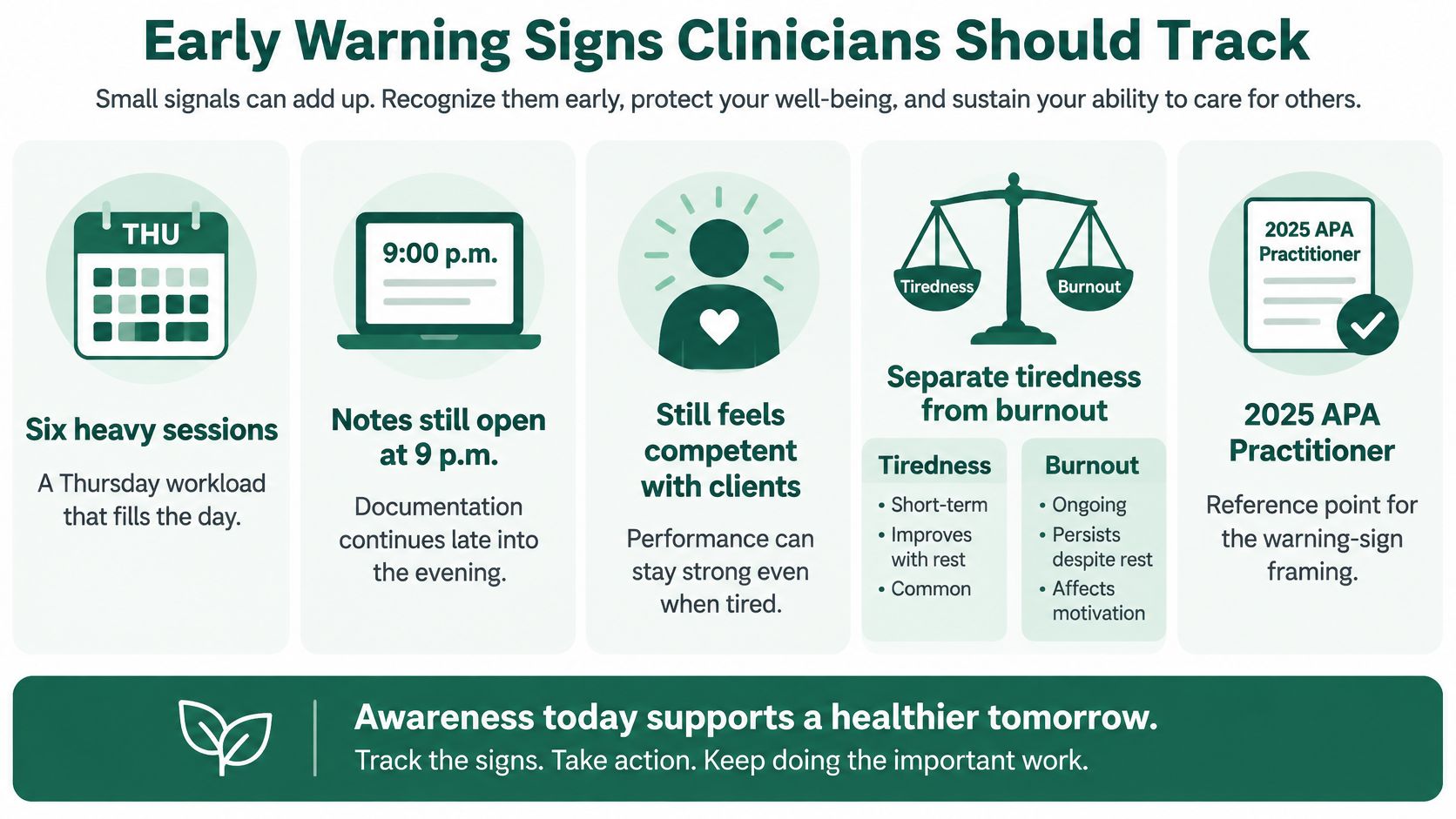
Caption: Warning signs can emerge during a full clinical day even when a therapist still feels competent.
Notice What You're Compensating For
Pay attention to the extra effort required to maintain your usual standard. Are you rehearsing routine conversations because you feel inadequate? Are you becoming impatient with clients whose progress is slow? Are you spending your personal time recovering just enough to return to work?
For early-career therapists, unpaid preparation can hide the true workload. Track preparation, consultation, and emotional processing alongside sessions. A calendar that shows available appointments may conceal a clinician who has no usable capacity left.
Practical rule: A worsening score starts a conversation about working conditions. It doesn't automatically create a new self-care assignment.
How to Run a Prevention Protocol
A solo clinician can start with a private worksheet. A group practice needs an agreed process, a person responsible for implementing changes, and clarity about who can see individual results. Screening shouldn't become a performance-management shortcut that discourages honest answers.
Build the Sequence Before Buying a Program
Set a baseline. Use a validated tool such as the Maslach Burnout Inventory, following its administration and scoring requirements. Record the dimensions separately and check score direction carefully: higher accomplishment isn't the same as higher reduced accomplishment. Keep personal screening results separate from client records.
Map the demands you can change. Record session volume, trauma intensity, crisis work, preparation, documentation, administrative tasks, and schedule control. Mark work completed outside planned hours. The useful question isn't how busy you are, but which demands repeatedly exceed the time and support available.
Redesign a workflow with the people doing it. Choose a specific bottleneck, such as intake paperwork landing during lunch or crisis calls interrupting documentation. Ask clinicians what would remove the problem rather than asking them to accommodate another scheduling template. Give the change an owner and protect the resources needed to implement it.
Add support inside working time. Reserve consultation, recovery, and relevant skills training after addressing the workload problem. Choose training that matches the clinical need, with opportunities to practice and review application. Don't turn professional development into another unpaid evening obligation.
Set reassessment and escalation dates. The meta-analysis of organizational interventions supports reassessment at approximately 3, 6, and 12 months and reported exhaustion effect sizes of −0.30 for organizational interventions and −0.54 for combined individual-plus-organizational interventions, with workload interventions ranking strongest. These are effect sizes, not percentage reductions or promises of individual improvement.
A practical overview can help keep the process manageable.
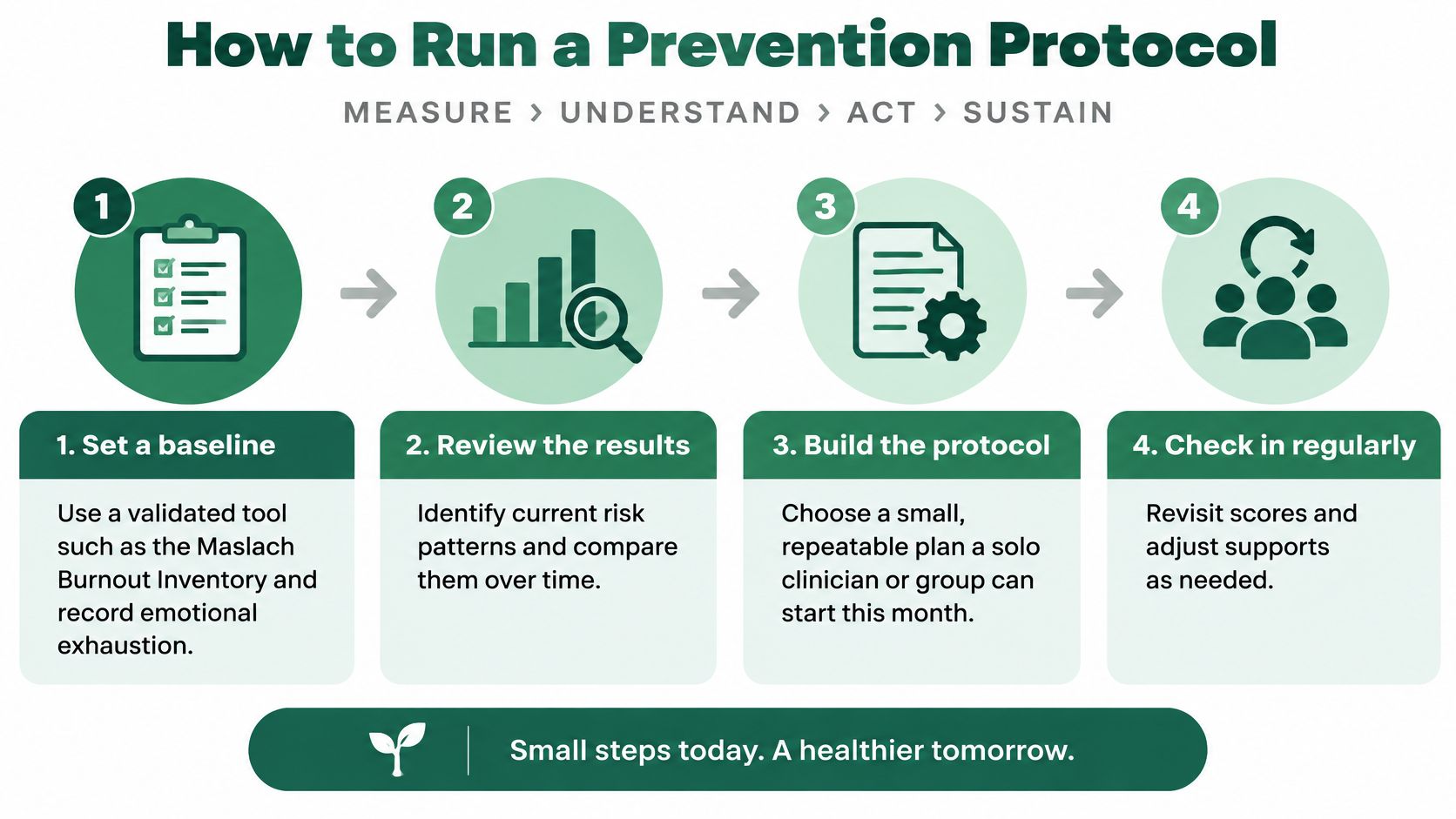
Caption: Establish a baseline, review patterns, build a repeatable plan, and revisit the results.
Test Changes Against Actual Working Conditions
Say a group practice stops clustering trauma-processing appointments, protects a weekly consultation meeting, and schedules a review of clinician scores and after-hours charting. The owner also stops counting consultation as an empty appointment slot that clinicians must make up elsewhere.
That last decision matters. Without it, the practice has added support while preserving the same production pressure.
Brief education can help, but duration and follow-through matter: a systematic review of interventions for mental health professionals found more enduring benefits from 8- and 12-week programs than from brief interventions, including a two-day workshop. A useful workshop can introduce skills; it can't remove an overloaded caseload.
Use this blank protocol for the coming quarter:
Work exposure to change: ______
Person authorized to change it: ______
Time or funding protected: ______
Support to add: ______
Outcome to monitor: ______
Review date and escalation decision: ______
Caseload Limits and Practice Changes
Say a private-practice week looks healthy on paper: appointments filled, revenue predictable, clients attending. Underneath that calendar are four trauma intakes, unpaid preparation, and notes completed after dinner. Headcount alone won't tell you whether the work is sustainable.
A systematic review and meta-analysis in European Psychiatry found emotional exhaustion in about 40% of mental health professionals and identified workload and workplace relationships as major determinants. Autonomy, fair treatment, role clarity, and clinical supervision belong in prevention conversations alongside personal habits.
Set Limits Around Intensity
There isn't a universal safe caseload number that accounts for acuity, experience, administrative support, and crisis responsibility. Use explicit working limits and revise them when functioning deteriorates. These red flags are operational prompts, not validated safety thresholds.
Caseload red flags and the schedule change
Signal | Unsafe when | Change to make |
|---|---|---|
Clinical hours | Sessions run back-to-back with no transition | Trial a protected 10-minute gap and an in-day documentation block |
Trauma density | Several high-intensity cases land on one day | Cap intensity and alternate with lower-demand work |
Documentation | Notes regularly happen after hours | Treat charting as scheduled work, not leftover time |
Crisis coverage | The clinician is always on | Share on-call duties or write a clear response limit |
Cancellations | Every opening is filled to protect income | Keep buffer slots instead of packing the day |
Unpaid labor | Preparation and emotional work stay invisible | Name them in supervision, fees, or the job plan |
Leave | Time off is interrupted by client contact | Arrange coverage that protects genuinely uninterrupted leave |
For example, trial the transition gap rather than presenting it as a proven minimum. Check whether it allows you to reset and document, or whether administrative work consumes it immediately.
Intensity limits also need flexibility. A long-term client's acute deterioration may change the week unexpectedly. Preserve room to respond without making every clinician's normal schedule an emergency schedule.
Make the Policy Fit Your Role
For an intern or early-career clinician, bring a concrete request rather than a general statement that you're overwhelmed. Try this wording without including identifying client details:
I need us to review the concentration of trauma work and the preparation it requires. Can we pace new high-intensity assignments and identify where documentation fits within my scheduled work?
For a solo clinician, calculate what your practice needs to cover consultation, leave, administration, and unfilled recovery time before deciding how many sessions you must offer. A workable fee and therapy cancellation policy should make expectations clear, including notice, exceptions, and how hardship is handled. Don't fund sustainability through surprise charges or abrupt changes for existing clients.
Protect access deliberately. A planned reduced-fee allocation is more sustainable than making every exception informally while relying on a completely full calendar. Changes to scheduling or fees need clear communication and attention to continuity of care.
For a group owner, write a caseload range that accounts for intensity and career stage, provide paid documentation time, and hold consultation on the clock. Assign crisis coverage explicitly. Cancellation policies shouldn't transfer every revenue gap or administrative task to the clinician with the least bargaining power.
Pay belongs in this discussion. A clinician who must add sessions to afford supervision hasn't received a workable prevention plan.
As a local management rule, if multiple red flags persist through a month, change the schedule before prescribing another wellness habit. Don't wait for that review if care is already becoming unsafe.
Supervision and Consultation That Protect Care
In an exploratory study indexed by the American Psychological Association, all nine novice psychotherapists interviewed described supervision as helpful for ethical practice, managing burnout, reducing anxiety, and maintaining a growth mindset. High caseloads, personal challenges, and inadequacy were common triggers. These interviews describe experiences, not prevalence or proof of a universal causal effect.
Supervision should make room for the clinician's functioning, not only the next intervention. A technically sound treatment plan can still be carried by someone who is struggling to stay present.
Bring a Standing Agenda
Use recurring prompts rather than waiting until you have a crisis to disclose:
Emotional processing: What material is staying with you after work?
Boundary review: Where are availability, responsibility, or unpaid work expanding?
Countertransference: What reactions are affecting pacing, avoidance, or overinvolvement?
High-risk planning: What consultation and coverage does this case require?
Fitness to practice: Is this week affecting attention, judgment, or reliable follow-through?
A consultation that asks only which intervention to use may miss overload. Add the question of what the clinician is carrying and what support the treatment plan requires.
The image below represents the care that good consultation is intended to protect.

Caption: Sustainable clinical support helps therapists remain attentive during demanding client work.
Raise Overload Without Unnecessary Disclosure
Describe themes, workload hours, and risk level before introducing case details. Use approved consultation channels and avoid identifiable information in informal peer messages. An overload discussion usually doesn't require a client's name.
At our practice, consultation with clinical supervisors or other treatment team members is part of how client health information is used for treatment. We follow the American Counseling Association Code of Ethics. That isn't blanket permission to share identifying information with any peer group.
For interns and registered clinicians, the safer time to raise strain is before exhaustion affects care. Licensed therapists whose formal supervision has ended can establish a standing peer group with clear confidentiality agreements and appropriate case-discussion practices. Trauma-informed supervision should make honest disclosure possible without abandoning accountability.
You can send these sentences this week:
I'm noticing that my current workload is affecting my recovery and concentration. I'd like our next meeting to address case intensity, boundaries, and coverage alongside treatment planning. Can we agree on a specific adjustment and a time to review whether it helped?
Recovery Habits Between Sessions
Recovery habits work best when they fit into time you have. They become counterproductive when you're asked to perform them perfectly while the workday keeps expanding.
A review covering nine studies and 542 therapists reported that 92% named self-care as a burnout-avoidance strategy, while supervision helped minimize burnout for about one-third of participants in one included study. The evidence was heterogeneous and doesn't establish self-care alone as the best response once burnout is present.
Choose Familiar Practices You'll Use
Movement: After the heaviest clinical block, take a short walk or use another accessible form of exercise. Don't turn it into a fitness target.
Leisure: Plan something unrelated to competence. Read fiction, garden, cook, or make art without converting it into professional development.
A brief reset: Stand, drink water, and orient to the room. Finish a brief clinical note before welcoming the next person, rather than mentally carrying unfinished work into the session.
Social connection: Arrange regular contact where you aren't the helper. Keep client material out of it.
Our clinicians engage in varied regular healing practices, and we don't teach clients anything we haven't tried or experienced ourselves. Apply that same discernment personally: choose familiar, helpful practices rather than collecting techniques. These clinician self-care rituals offer starting points, not another standard to meet.
Recovery needs time on the calendar, not just permission in principle.
Judge Habits by What Changes
If scheduling is the obstacle, the time-blocking guide from SyncThemCalendars can help you build a sustainable schedule with SyncThemCalendars. Use calendar blocks to reserve transitions and personal time without entering confidential client information.
For a trial month, monitor work hours, cancellations, after-hours documentation, and whether leave stayed uninterrupted. Liking a workshop or attending every session isn't an outcome.
If those markers worsen, don't stack on more routines. Revisit working conditions or seek additional clinical support.
When Burnout Becomes Impairment
Burnout and impairment aren't interchangeable. Impairment means your functioning is interfering with your ability to provide safe, competent care. You don't need to wait for a formal label before acting on a concern.
Unexplained errors, repeated failures to follow through on safety planning, or a growing belief that clients would be better off without you warrant urgent supervisory review. Evaluate the actual care problem rather than dismissing it as ordinary fatigue.
Escalate According to Functioning
Act on deterioration. If a quarterly rescreen shows worsening functioning, make a same-week plan to reduce caseload intensity. Treat this as a practical escalation rule, not a diagnostic threshold.
Consult before further high-risk work. Contact your supervisor or appropriate consultant before the next high-risk case. Begin with themes, hours, and risk level, then share necessary treatment information through approved channels. If safety is already compromised, arrange qualified coverage rather than working through the appointment.
Seek personal treatment when strain persists. If exhaustion continues despite a meaningful schedule change, pursue therapy for therapists. Personal therapy offers a different space from supervision, particularly when work activates your own history or symptoms extend beyond the workday.
Stop unsupported crisis coverage. Arrange a shared rota or written coverage limit before resuming that responsibility. Don't abruptly leave clients without an appropriate response pathway.
Plan leave and return together. Coordinate uninterrupted leave, continuity arrangements, and a reduced-load return with a supervisory check-in. Returning to the identical conditions without review isn't a recovery plan.
Treat Immediate Danger Differently
Any thought of harming yourself or a client requires immediate contact with crisis or emergency support for assessment. If there is intent, a plan, access to means, or uncertainty about staying safe, use emergency services and stop providing care while qualified support arranges safe coverage. Don't wait for the next consultation meeting.
Write your trigger: Name the observable change that would make you seek help.
Name your contact: Identify the supervisor, consultant, treating clinician, or emergency resource you'll use.
Document the care plan: Record appropriate coverage and clinical decisions without turning client records into your personal therapy notes.
Start a One-Month Sustainable Practice Plan
Leave with a change you can implement, not a longer reading list. Choose something that reduces exposure to excessive demands rather than something that only helps you tolerate them.
Put the Decisions in Writing
Pick the workload change this month. Remove a recurring pressure point, such as intake clustering or charting that routinely spills into home life.
Book the standing consultation. Give it a protected place in the workweek and an explicit purpose.
Reserve a recovery block. Choose an activity you already find restorative.
Set the review and escalation marker. Schedule an initial review for the coming quarter, with an earlier response if functioning deteriorates. Write down what would require a bigger change, such as increasing after-hours notes or declining concentration.
Keep the plan visible, but keep confidential clinical information elsewhere. The useful outcome is a changed workday, not a beautifully maintained worksheet.
Choose Support That Matches the Need
For clinicians seeking personal support, Be Your Best Self & Thrive Counseling offers therapy for therapists and health professionals. Jamie Molnar's focus areas include stress and burnout, empaths and HSPs, couples and marriage counseling, and high-conflict couples.
For practicum and internship students, registered interns, and fully licensed clinicians, the BYBS Training Institute offers mind-body-spirit education, online courses, and group consultation. Our owner and founder has extensive therapy training and individually trains and supervises all clinical team members.
You don't have to redesign your entire career this month. Decide which work exposure you'll change, who needs to help, and what you'll stop treating as inevitable.
Be Your Best Self & Thrive Counseling, PLLC offers therapy for therapists and health professionals who need space to address stress, boundaries, and burnout. Visit Be Your Best Self & Thrive Counseling, PLLC to explore support for a more sustainable clinical life and discuss fit through a free initial consultation.