
ADHD and Emotional Regulation: A Clear Guide
It's Tuesday evening. You're making tea when a clipped comment lands: you forgot something again. Your chest heats up, you send a sharp text, and before the kettle boils, you're already ashamed of what you wrote.
You might understand the situation perfectly afterward. The hard part is getting access to that understanding while the feeling is happening.
What ADHD Does to Emotional Regulation
ADHD and emotional regulation can be a difficult combination because knowing what you want to do isn't always enough to help you do it under stress. You might intend to ask a question, then hear yourself making an accusation instead.
Emotional regulation means noticing a feeling, keeping its size roughly matched to the moment, and returning to baseline without hurting yourself or someone else.
Baseline doesn't mean cheerful or completely relaxed. It means settled enough to think flexibly, hear another person, and choose your next action.
The ADHD-linked pattern can include rapid mood shifts, low frustration tolerance, irritability, anger, emotional impulsivity, and a slow climb down. Think of a stereo whose tuner jumps stations while the volume knob shoots upward and turns down reluctantly. This pattern is common but not universal, and it isn't a character flaw or automatic proof of another diagnosis.
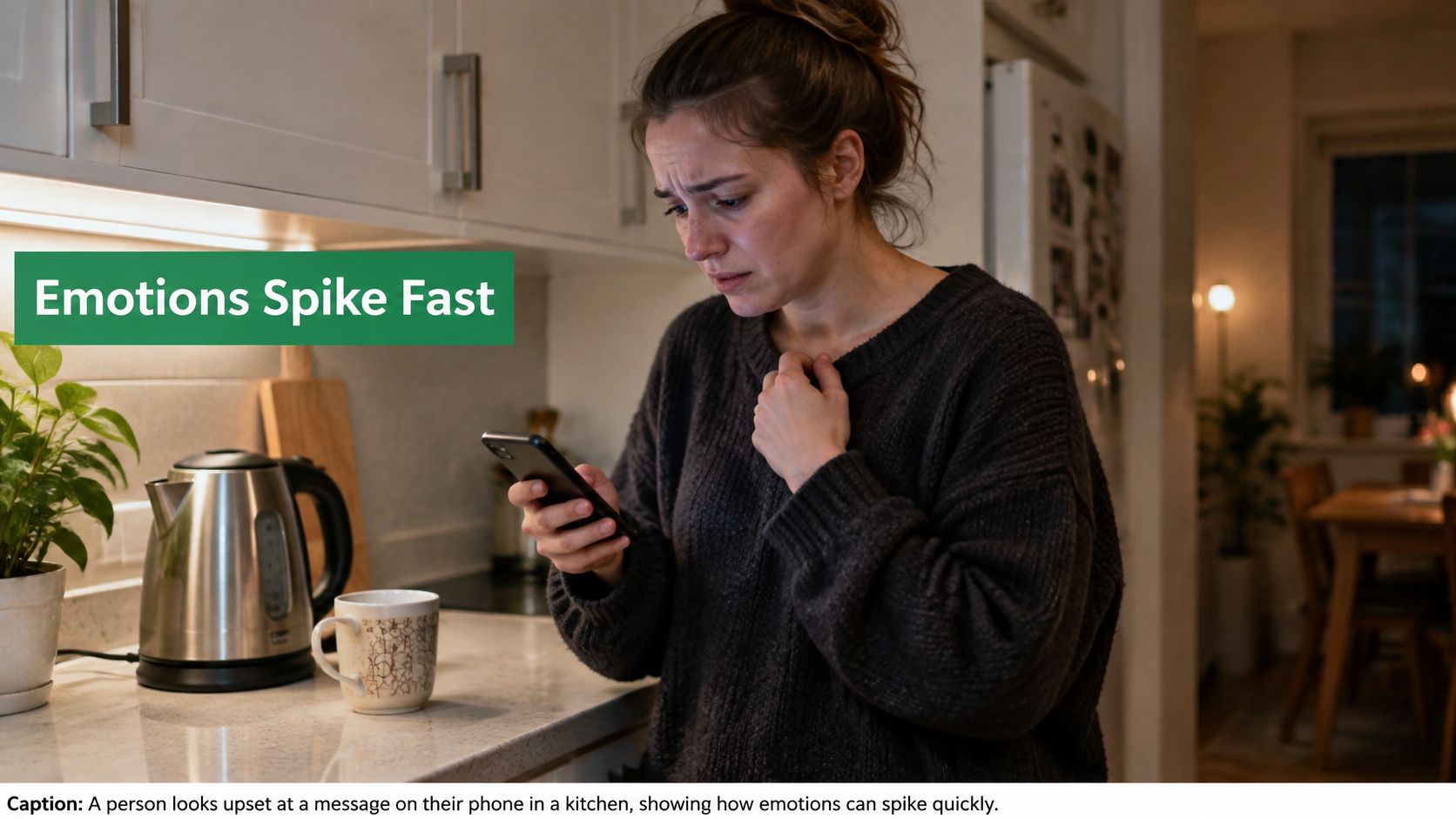
Caption: A person pauses with a phone in hand, alongside the metaphor of a volume knob turned all the way up.
At work, feedback can become a defensive exchange. In parenting or couples conflict, overload can become a raised voice, followed by exhausting self-criticism. Parents navigating their own reactions while helping a child may find Children Psych's guidance to support children's emotional regulation at home useful for building shared language.
Understanding the pattern involves more than naming anger. Its frequency, the processes behind the surge, possible trauma or mood symptoms, and what helps recovery all deserve attention.
How Often This Pattern Shows Up
How often emotional dysregulation appears in ADHD research
Group | Estimate | What was measured | Sample or review |
|---|---|---|---|
Children | 25–45% | Clinically significant emotional dysregulation | A 2014 review summarized by the American Psychological Association |
Adults | 30–70%; a later review reports 34–70% | Significant emotional dysregulation | The earlier review and a later PLOS ONE systematic review |
Young people, parent report | 38%, approximately 10 times the general-population rate | Mood lability among children with ADHD | Population study of 5,326 young people summarized by the American Psychological Association |
Young people, self-report | 27% | Emotional lability among young people with ADHD | Same evidence base, with lower rates among unaffected peers |
Boys in clinic sample | 40% | Abnormally elevated emotional problems | Sample of 1,450 children summarized by the American Psychological Association |
Girls in clinic sample | 49% | Abnormally elevated emotional problems | Same sample of 1,450 children |
Adults versus controls, clinic cutoff | 55% versus 3% | Scores above the 95th percentile on population norms for emotional dysregulation | Surman and colleagues' 2013 study, with 206 adults with ADHD and 123 controls |
Adults versus healthy controls | Hedges' g = 1.17 | General emotional dysregulation | A 2020 BMC Psychiatry meta-analysis of 13 studies involving 2,535 participants; it also describes a treatment-trial sample of 47 adults in which 78% met emotion-dysregulation criteria |
Why the estimates spread so widely
These rows don't all measure the same thing. A parent noticing mood swings, an adult completing a questionnaire, and a clinic applying a strict cutoff are answering different questions. Age, setting, and the definition of dysregulation change who gets counted.
Clinic and treatment samples can produce higher estimates because people seeking help may have greater impairment. That doesn't make those findings useless, but it does mean they shouldn't become a universal percentage for everyone with ADHD.
Hedges' g is different from a prevalence percentage: the value in the meta-analysis means the average adult with ADHD scored more than a standard deviation higher than the average control participant. It describes a difference between groups, not the chance that a particular reader has ADHD.
What the numbers can tell you
The everyday difficulties include quick anger, losing your temper, argumentativeness, easy frustration, touchiness, and emotional over-reactivity. These are descriptions to discuss, not a checklist to use for self-diagnosis.
For practical ideas to bring into that discussion, reVIBE Mental Health's strategies for ADHD emotional regulation offers an additional resource. Choose tools based on the difficulty you experience, rather than on the highest estimate you encounter.
Treat the table as a reason to ask about regulation directly, not as a score that proves ADHD.
Why Feelings Spike and Settle Slowly
Say you're cooking dinner while a timer sounds, someone asks about an overdue bill, and your phone lights up. You'd planned to step away if you became frustrated. Instead, the words come out before you remember the plan.
A useful teaching model involves cooperating systems, not a good brain fighting a bad brain. Bottom-up reactivity is the smoke alarm: noise, frustration, perceived rejection, or a missed deadline can register quickly and intensely. Top-down control is the firefighter, helping you decide what to do with that alarm.
The alarm and the firefighter
The firefighter needs working memory to hold the plan to pause, inhibition to delay the reply, and attention to shift away from the spark. During an emotional surge, those tasks can become harder to coordinate. The kitchen plan hasn't disappeared because you stopped caring; you may not be able to retrieve and use it quickly enough.
This is also how the stereo analogy fits. The alarm influences how loud the moment feels, while executive control helps you change the station, lower the volume, or stop listening long enough to reconsider.
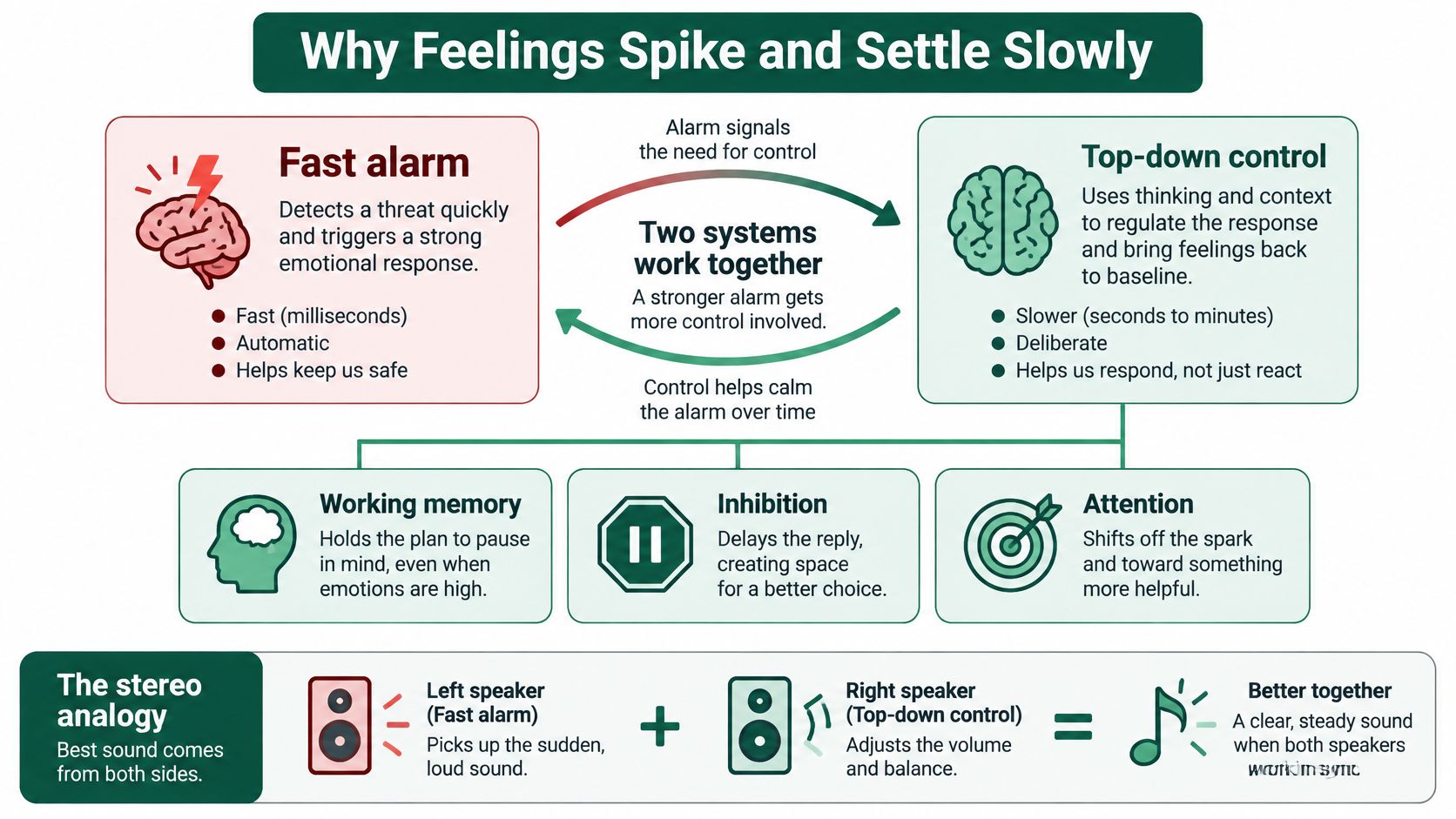
Caption: A concept map connects emotional regulation with a fast alarm, the pause, working memory, and recovery time.
These are analogies, not a brain scan or an explanation of every person's experience. Our guide to nervous-system dysregulation provides broader language for understanding bodily activation without treating it as a diagnosis.
What the findings actually support
In the adult ADHD meta-analysis available through PubMed Central, emotional lability showed the strongest domain-level difference (Hedges' g = 1.20; 95% confidence interval, 0.57–1.83), while ADHD severity correlated with general emotional dysregulation at r = 0.54 and negative emotional responses at r = 0.63.
Emotional lability means rapid, intense shifts in feeling that are difficult to stabilize. Emotion recognition is another piece: noticing whether you're angry, embarrassed, frightened, or overloaded can affect which response you choose.
Those findings are correlational. They don't establish a single cause, and they don't mean everyone with ADHD experiences severe dysregulation.
Instead of judging your character, observe the sequence:
Trigger: What happened immediately before the feeling changed?
Escalation: How quickly did you notice heat, tension, tears, or urgency?
Recovery: When could you consider another explanation or listen again?
Behavior: Did you send a text, shut down, slam a door, or ask for space?
That sequence gives you something specific to change. A character verdict doesn't.
When the Pattern Points Beyond ADHD
Is this part of ADHD, or is it anxiety, depression, trauma, bipolar disorder, exhaustion, or the relationship? The useful answer isn't necessarily either-or. Emotional dysregulation can be central to someone's ADHD-related impairment without being a standalone diagnostic marker.
A systematic review indexed in PubMed included only 22 adult studies meeting its criteria, highlighting a limited and heterogeneous literature. That calls for careful assessment, not dismissal of the feelings or certainty based on a social-media description.
Clues that separate ADHD-linked lability from other conditions
Pattern | Fits ADHD-linked lability when | Look harder at another condition when | Ask next |
|---|---|---|---|
Fast irritation after overload | The spike tracks noise, deadlines, or interruption and eases as demand drops | Irritability persists regardless of demand | What was the demand, and when did baseline return? |
Anger or a sharp text | Words come before a pause, followed by regret | Aggression is planned or used to control a partner | What happened immediately before and after the reaction? |
Low mood | Frustration is reactive and lifts with the situation | Hopelessness, loss of interest, or guilt persists | How sustained is the change, and what happened to sleep? |
High energy | Restlessness resembles the person's usual pattern | Reduced need for sleep accompanies a distinct change in mood or energy | Is this energy new, and is sleep genuinely less necessary? |
Threat and worry | The feeling follows a present frustration | Dread and scanning begin before anything happens | Is this anticipation or in-the-moment overload? |
Shutdown or flashback | Sensory or task demands overwhelm coping | Reminders of past harm bring numbness, panic, or reliving | Was the trigger a memory or a current demand? |
Hurt after criticism | The pain is intense, but isn't treated as diagnostic proof | Trauma, depression, or relationship patterns may explain the hurt | Does the pattern occur across settings and relationships? |
Poor sleep | Irritability follows insufficient rest | Insomnia or nightmares repeatedly shape daytime functioning | What are the sleep schedule, caffeine pattern, and nighttime symptoms? |
This table helps organize a conversation. It doesn't establish diagnoses, and no single row rules ADHD in or out.
When both explanations matter
Say someone's anger flares in traffic and during interrupted tasks, but their nights also include trauma nightmares. They need attention to both patterns, not ADHD education alone. Similarly, sleep deprivation can make anyone irritable, even when ADHD is also present.
Relationship context matters too. Feeling hurt during repeated belittling isn't automatically an internal regulation problem, and ADHD doesn't excuse intimidation or coercion. Safety and accountability remain necessary.
Rejection sensitivity isn't a settled, universal ADHD symptom. Intense pain after criticism can occur in several conditions and in difficult relationships; the feeling deserves care without becoming proof of a label.
Overlapping neurodevelopmental traits may also warrant discussion. Our explanation of the difference between ADHD and autism in adults can help you prepare questions about lifelong patterns.
Bring a clinician the episode's duration, whether the trigger involved past harm or a current demand, and whether attention treatment improved focus while leaving emotional distress unchanged. Those details help distinguish what needs targeted assessment.
Skills and Therapies Matched to the Surge
Treatment often needs more than a single tool: a systematic medication review covering 21 adult randomized, double-blind trials found ADHD medication better than placebo for emotional dysregulation overall, while cautioning that bottom-up processes may change less; accompanying review evidence reports Wender–Reimherr Adult ADHD–Emotion Dysregulation Scale improvements with atomoxetine and extended-release methylphenidate, with effect sizes around d = 0.66 and d = 0.70, respectively. Medication may strengthen executive control without fully settling fast reactivity, so decisions belong with a qualified prescriber.
Match the response to the sticking point
Which support fits which part of the emotional surge
Mechanism | Response to practice | What it changes | Evidence note |
|---|---|---|---|
Thin executive pause | Name the feeling aloud, use a visible reminder, and try a ninety-second delay before sending | Creates space before an impulsive reply | A practice interval, not a biological reset deadline |
Fast body alarm | Try a longer exhale, brief movement, cool water on wrists, yoga, or mindfulness | Offers a way to downshift bodily activation | Options to test, not guaranteed treatments |
Sensory or task overload | Reduce inputs, use headphones where safe, choose a smaller task, or plan a break | Reduces immediate trigger load | Environmental support, not a diagnostic test |
After conflict | Name what happened, its impact, and the next action | Addresses relationship fallout | A clinical target alongside symptoms |
Trauma alongside ADHD | Use choice, pacing, and no forced retelling | Supports safety during learning | May require trauma-informed treatment |
Focus improves but feelings remain | Track intensity, recovery, conflicts, and consequences | Identifies remaining treatment needs | Attention scores alone don't capture these outcomes |
A visible reminder can be very ordinary: put a sticky note beside your keyboard with the words name it, save draft, step away. Practice when mildly irritated rather than expecting a brand-new skill to appear during your hardest argument.
The sending delay is an experiment. If you still feel driven to punish, prove, or win when it ends, keep the message unsent.
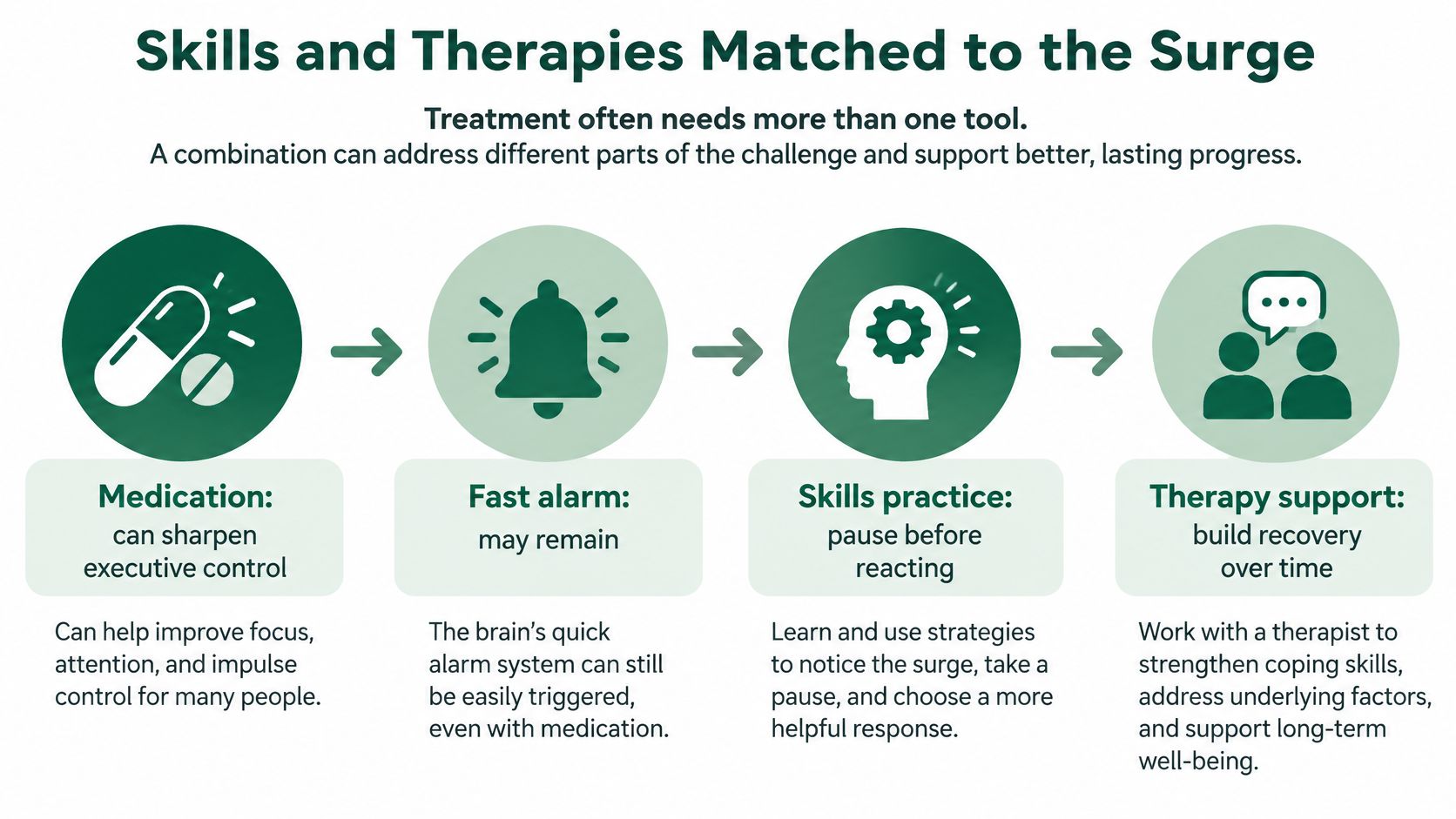
Caption: Medication, awareness, skills practice, and therapy can support the path from body cues to a pause, a downshift, and repair.
Make the skill usable, not impressive
Body-based options should feel like choices, not another person ordering you to calm down. If focusing on breathing makes you uncomfortable, try walking or reducing noise instead. Stop any exercise that increases distress or causes dizziness.
Once you can think more flexibly, reconsider the interpretation. A colleague's short reply might mean annoyance, distraction, or a crowded schedule; you don't have to decide which explanation is true while activated.
For repair, describe the behavior without turning the conversation into a trial of your worth. A useful script would name the raised voice, acknowledge its effect, and explain how you'll signal a break next time.
Practical rule: Choose a response you can remember while upset, then make it easier to reach.
Mindfulness has promising findings, including improvement in dysregulation alongside executive functioning and impairment, but its evidence base is smaller than that for core ADHD symptom treatment. It's an option to evaluate, not a reason to blame yourself if sitting still doesn't solve the problem.
How to Measure a Shorter Recovery
Never getting upset is a poor treatment goal. It can encourage suppression, or make you miss meaningful changes because the original feeling still arrives.
Consider a hypothetical example: Maya rates criticism-related distress at 8 out of 10 and needs 40 minutes to settle during her first week of tracking. By her fourth week, the peak is still 8, but she returns to baseline in 12 minutes and leaves the sharp email unsent.
Her feeling hasn't vanished. Her recovery and choices have changed.
Track the moment rather than the whole week
Ecological momentary assessment, or repeated real-time check-ins, can capture emotional variability that retrospective questionnaires miss: a 2025 JMIR review describes 33 EMA studies involving approximately 2,678 participants, links momentary frustration and irritability with ADHD severity and impairment, and notes a mindfulness study in which these check-ins detected improvement that standard self-report missed.
A simple daily log can use these fields:
Sleep hours | Medication timing if prescribed | Sensory overload | Menstrual or hormonal shift | Conflict cue | Intensity from 0 to 10 | Minutes to baseline | Coping response used |
|---|---|---|---|---|---|---|---|
Note rest | Record timing only | Name the input | Note if relevant | Describe the event | Give a personal rating | Estimate recovery | Record what actually happened |
Don't turn tracking into another perfection test. A brief note after a difficult event is more useful than an elaborate template you avoid.
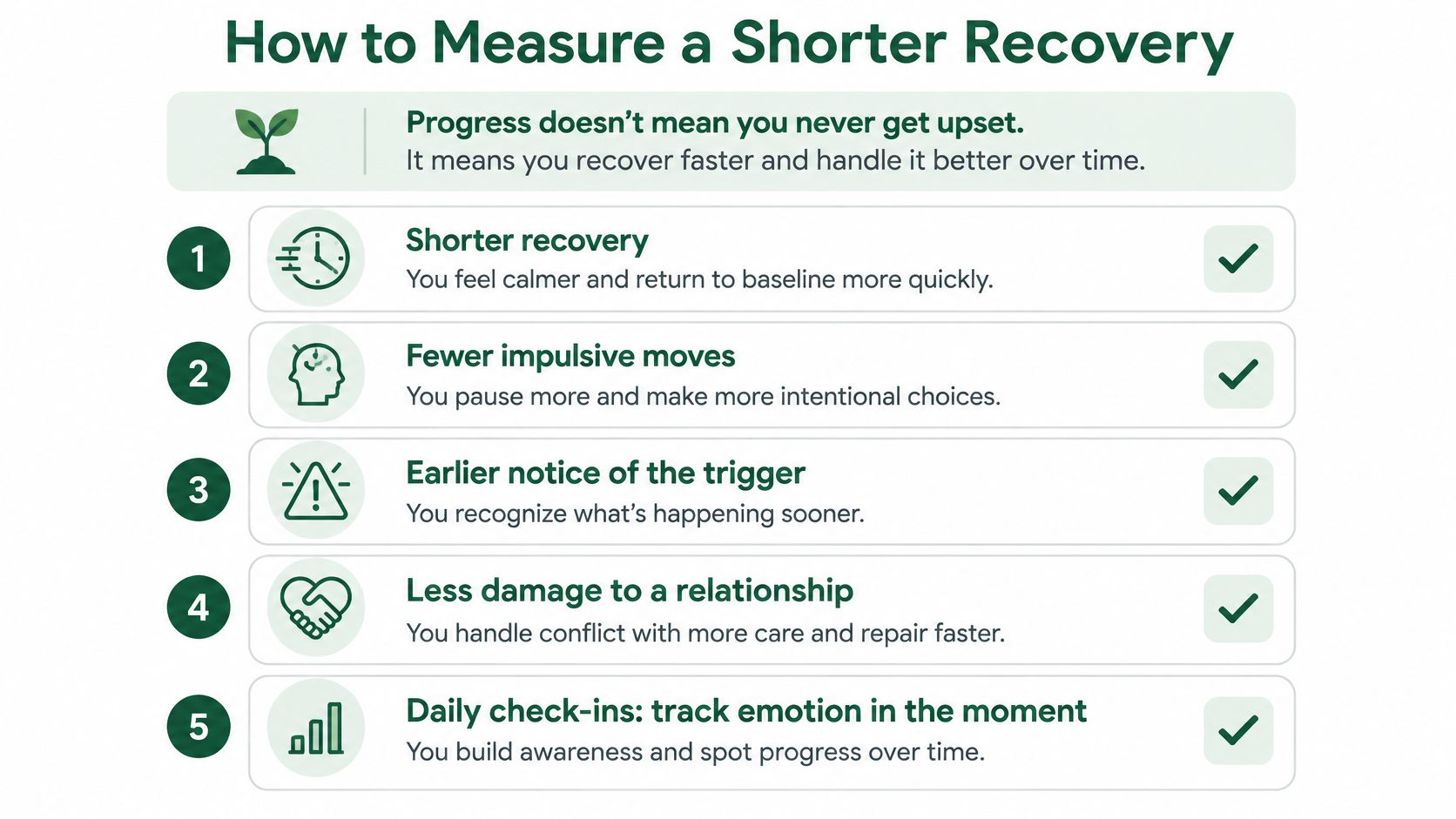
Caption: Daily check-ins highlight shorter recovery, fewer impulsive actions, earlier trigger awareness, and less relationship fallout.
Keep expectations evidence-informed
The same JMIR review describes DBT as promising but reports inconsistent emotion-regulation findings, including a randomized trial without clear benefit on that outcome despite gains elsewhere.
A separate DBT-based group trial involving 121 adults, with a mean age of 37, found greater improvement in executive dysfunction after 14 weeks than usual care (mean changes −12.8 versus −0.37, effect size 0.64), with executive-function, ADHD-symptom, and quality-of-life gains remaining significant at six months, but no significant immediate between-group difference on the emotion-regulation measure.
The log supports treatment conversations. It doesn't diagnose ADHD, demonstrate that a therapy works for everyone, or authorize medication changes.
What Partners and Clinicians Can Change
For partners
Replace sweeping accusations with a time-limited observation. A partner might say:
I can see this got big fast. I'm here, and I'll come back to talk after a short break.
Agree beforehand on a pause word, who will step away, and a specific return time. An announced break with follow-through is different from disappearing or using silence as punishment.
Don't debate the validity of the feeling at its peak, diagnose across the table, or gather evidence of every previous blowup. Once both people are settled, organize repair around what happened, how it landed, and what to try differently.
Our ADHD strategies for partners offers additional ways to support communication without making a partner responsible for managing someone else's emotions. Boundaries still apply, and no pause agreement requires tolerating threats or violence.
For clinicians
Keep emotional regulation as an assessment target beside attention, sleep, and executive functioning. Useful questions include:
Sequence: What triggers the surge, how quickly does it build, and what behavior follows?
Recovery: When can you listen, reconsider, and resume ordinary activity?
Context: Are mood episodes, trauma reminders, anxiety, or sleep problems involved?
Criticism: What does perceived rejection feel like, without assuming it's a formal ADHD symptom?
Prefer repeated observations to a single intake account. Explore avoidance, rumination, and other unhelpful coping strategies rather than stopping at psychoeducation, and coordinate medication questions with the prescriber.
The shared measure is recovery and repair, not who felt the feeling first.
Start With a Focused Conversation About Help
Professional assessment makes sense when emotional spikes damage work, parenting, or relationships, when recovery remains difficult, or when trauma, mood changes, or hopelessness may be involved. This is a path for non-emergency, motivated change; if anyone is in immediate danger, contact local emergency services right away.
Prepare for a useful first visit
Bring a manageable record. Aim for several weeks of notes about sleep, intensity, recovery, and an example of repair or fallout. Don't delay seeking help because the log isn't complete.
Ask for a combined assessment. Discuss ADHD and emotional regulation together, including episode length and triggers.
Expect a broader conversation. Trauma, depression, anxiety, and sleep deserve attention, not only organization tips.
Separate treatment roles. Send medication questions to a qualified prescriber while therapy addresses reactions and relationships.
Our guide to therapy for adults with ADHD can help you prepare. Ask how regulation will be measured, how progress will be tracked, whether individual or couples work fits, and how nervous-system skills will complement a prescriber's plan.
You don't need to arrive without strong feelings. You need a workable way to understand them and reduce their consequences.
We offer ADHD Therapy alongside anxiety, trauma, depression, and couples counseling, with online and in-person counseling, workshops, group therapy, and workbooks. Visit Be Your Best Self & Thrive Counseling, PLLC to explore support for emotional recovery, practical coping skills, and healthier communication.