
How to Help Depression and Anxiety: A Step-by-Step Guide
Your friend cancels plans again, then says they're just tired. You want to help, but you don't want to overreact or make them feel judged. Start by looking for a pattern, check whether they're safe, and offer practical support without assuming that a good routine can replace professional care.
Telling a Rough Patch From Depression or Anxiety
A few difficult days can follow a loss, conflict, illness, or demanding stretch at work. A pattern is more concerning when low mood or loss of interest happens most days for at least two weeks, or worry becomes hard to control and persists for months, especially when sleep, appetite, energy, concentration, or daily activities also change. These signs don't establish a diagnosis. They're a reason to ask what's happening and consider an assessment.
Depression and anxiety are common and treatable. The World Health Organization's mental-disorders fact sheet estimated that 322 million people worldwide were living with depression in 2023, including 43 million children and adolescents; approximately 470 million people had an anxiety disorder. The same source reports that only about one-third of people with depression receive formal mental-health care, and 27.6% of people with anxiety disorders receive any treatment. Getting support isn't a last resort, and self-care alone isn't enough for everyone.
Sign | What It May Look Like | How to Respond |
|---|---|---|
Low mood or lost interest | Skips favorite activities, stays in bed most of the day | Ask directly and suggest one small activity together |
Sleep or appetite change | Sleeps ten or more hours or wakes at 4 a.m., eats much more or much less | Track the pattern for two weeks and mention it to a doctor |
Constant worry | Worry takes over most of the day for months and feels hard to switch off | Ask what the feared outcome is and encourage an evaluation |
Avoidance | Cancels plans, stops driving, or stops leaving the house | Support small steps outside the comfort zone without forcing them |
Panic episodes | Sudden racing heart, shortness of breath, fear of dying | Stay calm, guide slow breathing, and arrange a medical check to rule out cardiac causes |
Talk of death or self-harm | Says others would be better off, gives belongings away | Ask directly about suicide and start the safety steps in the next section today |
Sleep changes can affect mood, focus, and everyday choices. For a practical look at how sleep shapes decision quality, consider what has changed in the person's sleep routine before concluding that a mood disorder explains everything. A doctor can also check for possible contributors such as thyroid problems, anemia, medication side effects, and substance use.
Keep the first conversation concrete. Say, “You've cancelled three plans in a row,” ask an open question such as “How have you been feeling lately?”, and listen before offering advice. For a clearer picture of persistent worry and other patterns, this guide to understanding anxiety disorders can help frame what to discuss. Write down symptoms, how long they've lasted, and how often they happen over two weeks, so a clinician can start with observations rather than guesswork.
Safety Planning and Emergency Steps
A sister sees her brother's pill bottles on the kitchen counter and pauses, unsure whether to ask. Ask now if there are emergency warning signs: a specific plan to hurt himself, a method in hand, self-harm he can't stop, inability to stay safe, or confusion and hearing things that aren't there. If danger seems immediate, don't wait for a scheduled appointment.
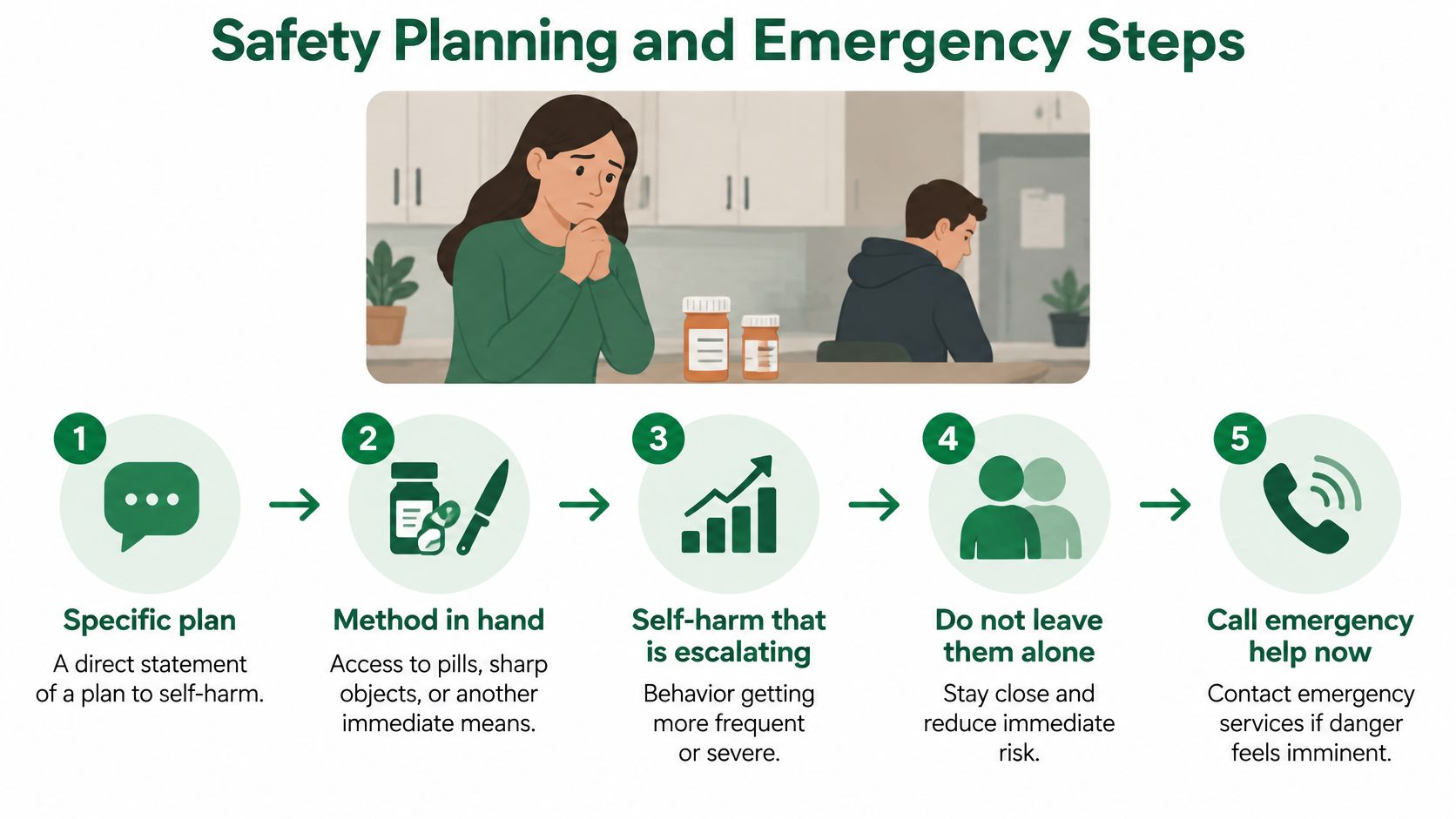
Ask plainly. Say, “Are you thinking about killing yourself?” Direct language makes the concern clear and gives the person a chance to answer. Asking about suicide doesn't plant the idea.
Reduce access to immediate means. If there's a plan or access to means, lock up medications, remove stockpiles, and arrange for firearms to be moved out of the home by a trusted person where that can be done safely. Don't leave potentially dangerous items within easy reach while you work out the next step.
Write a one-page safety plan. List warning signs, activities that can help in the moment (such as a walk, shower, or specific playlist), people to contact, professional contacts, and crisis lines. A written plan is easier to follow when distress makes it hard to think.
Agree on check-ins. Decide who will call, how often, and what changes mean someone must call for immediate help. Clear responsibilities are more useful than a vague promise to “keep an eye on things.”
Get emergency help if risk is imminent. Stay with the person or arrange for someone to stay, then call or text 988 in the United States, call 911 or the local emergency number, or go to the nearest emergency department. Outside the United States, use the local emergency number. A private counseling practice can't provide emergency response, so crisis services come first. If you're looking for language that can make a supportive conversation easier, verbal support for someone at risk offers another way to think about how to respond.
Review and update the plan. Revisit it weekly and after any crisis, so contacts and steps still fit the person's circumstances.
A common mistake is waiting for the perfect moment, or taking away the person's phone. Confiscating a phone can cut off access to supportive people and crisis services. Be Your Best Self & Thrive Counseling, PLLC works with non-emergency concerns and with motivated people who want help building the life and relationships they want. Between sessions, the best way to contact a counselor is by phone or text; those messages aren't a substitute for emergency services.
Evidence-Based Skills and How to Start Them
Choose a skill based on the problem. Withdrawal and low motivation call for scheduled activity; racing thoughts call for structured worry work; physical tension calls for paced breathing. Keep the first practice small enough to repeat.
Technique | Best For | How to Start | Daily Time |
|---|---|---|---|
Behavioral activation | Withdrawal and low motivation | List ten activities, schedule two small ones, rate mood before and after | 15–30 minutes |
Graded task assignment | Feeling overwhelmed by large tasks | Split one task into five steps and do only step one | 10–20 minutes |
Paced breathing | Physical anxiety and rising panic | Inhale for four seconds, exhale for six, for five minutes | 5 minutes, two or three times |
Worry postponement | Constant rumination | Set a twenty-minute worry window, write worries down, and set them aside outside it | 20 minutes |
Behavioral experiments | Feared outcomes that never happen | State the prediction, test it, and record what actually happened | 10 minutes per test |
Problem-solving | Feeling stuck on a specific life problem | Define the problem, list three options, choose one, review in a week | 20–30 minutes |
Behavioral activation is about rebuilding contact with activities that provide a sense of pleasure or accomplishment, not waiting until motivation appears. If choosing a first activity feels difficult, this practical guide to behavioral activation for depression can help you turn a vague intention into a scheduled action.
Treat the routine as something to test, not a measure of willpower. Use a brief log to record the skill, whether you tried it, and what happened to your mood or anxiety afterward. A clinician can help choose a suitable approach, including behavioral activation, CBT, interpersonal therapy, mindfulness-based cognitive therapy, problem-solving therapy, ACT, or short-term psychodynamic therapy.
The VA/DoD depression guideline describes a measurement-based approach that can combine psychotherapy, medication, or both according to clinical presentation and patient preference. It recommends tracking symptoms with a validated measure such as the PHQ-9, then reviewing response, adherence, adverse effects, and suicidal ideation 2–4 weeks after treatment begins. If improvement is inadequate, the treatment plan may need a different modality or greater intensity.
Two pitfalls undermine otherwise sensible plans: choosing activities that exceed the person's current energy, and treating avoidance as refusal rather than as a symptom to address. Scale the task down, record what gets in the way, and raise concerns about safety or stalled progress with a qualified professional.
Daily Habits That Make Progress Stick
Routines are scaffolding for skills, not a replacement for treatment. They reduce the number of daily decisions someone has to make, while leaving room for a low-energy day. Choose a manageable baseline first, then build only when it feels sustainable.
Keep a consistent wake time: Aim to get up within an hour of the usual time each day.
Get morning daylight: Spend fifteen minutes outside in the morning, walking or sitting somewhere comfortable.
Add movement: Plan movement three times a week; a brisk walk of twenty to thirty minutes counts.
Eat regular meals: Keep meal times steady, even when appetite is low, and make the first step as easy as possible.
Limit alcohol: Cut back if it worsens sleep or mood, and notice whether symptoms change.
Create an evening wind-down: Set aside a short period without screens before bed.
Try a mind-body practice: Start with ten minutes of gentle yoga or stretching, or take a nature walk without a phone.
Use a values journal: Once a week, write one thing that matters and one small action you can take toward it.
On a difficult day, the minimum might be one meal, one shower, and one short walk. That's a foothold, not a verdict on whether the person is trying hard enough. Return to the activation or breathing practice that fits the problem rather than adding more techniques at once.
If tracking helps keep plans manageable, a simple record of activities and mood can show what's realistic; tools for monitoring progress across training plans offer one example of how a routine can be logged over time. Keep the record focused on the person's wellbeing, not on achieving a perfect streak. For more routine ideas that connect coping habits with confidence, see daily habits that quiet anxiety and build self-belief.
On Sunday, ask: What helped me feel a little steadier this week, and what's one small adjustment I'll make next week?
Getting Professional Care and Choosing the Right Path
When depression or anxiety persists or disrupts daily life, more than self-care is often needed. Therapy is an active treatment, and some people may also benefit from medication or coordinated medical support. The right starting point depends on the symptoms, medical history, personal preferences, and safety needs.
Situation | Usual First Step | Next Step If Progress Is Limited |
|---|---|---|
Mild, persistent symptoms | Psychotherapy such as CBT or behavioral activation | Review at two to four weeks and consider a medication consultation or a different therapy |
Moderate to severe depression | Clinical evaluation with therapy and a medication discussion | Consider combined treatment, which may work better than either approach alone |
Anxiety that limits daily life | CBT-based psychotherapy | Discuss medication and consider a change in approach |
Symptoms alongside ADHD, trauma, sleep disorder, or chronic illness | Medical review and full assessment first | Coordinate care across providers |
Symptoms with psychosis, substance use, or suicidal thoughts | Urgent medical or crisis evaluation | Arrange ongoing specialist care after stabilization |
For depression, treatment may involve psychotherapy, medication, or both. The U.S. National Institute of Mental Health's depression guidance notes that psychotherapy can be in person or virtual and that clinicians often try psychotherapy first for milder depression, adding medication if the response isn't sufficient. That's a common sequence, not a universal rule.
Ask a prospective therapist direct questions:
Relevant training: What training do you have in treating this problem?
Progress checks: How will we measure whether treatment is helping?
Coordination: Can you coordinate with my primary-care doctor if needed?
Plan B: What would you change if this approach hasn't helped after four to six weeks?
If the plan stalls, consider a different therapist, a different therapy approach, or a medication consultation with a physician. Fit matters: feeling understood and knowing what the work is aiming to change can make it easier to stay engaged. This guide to therapy fit can help you think through what you want from a working relationship.

Choose one step to take this week: book a primary-care visit to check for medical contributors, request a therapy consultation using two or three questions above, or schedule the first safety-plan check-in. Be Your Best Self & Thrive Counseling, PLLC is a boutique, self-pay counseling practice specializing in mind-body-spirit approaches to mental health. For non-urgent questions between sessions, phone or text is the best way to reach a counselor; social media messaging isn't secure and may not be read promptly. Put your next check-in in the calendar before you close this page.
If anxiety or depression is keeping you stuck, Be Your Best Self & Thrive Counseling, PLLC offers individualized counseling that pairs evidence-informed care with practical mind-body-spirit approaches. Reach out to explore whether working together fits your needs and goals.