
Is Online Therapy as Effective as in Person? a Guide
Online therapy can match in-person care for some conditions and formats, but convenience alone does not establish equivalence. Reviews of anxiety treatment have found broadly comparable outcomes, with small differences favoring in-person care for generalized anxiety disorder.
A private video appointment for structured anxiety treatment differs from an app exercise, a text exchange, or a family session held within earshot of others. These formats do not offer the same level of therapist contact or privacy, so evidence for one cannot automatically support the others.
The key distinction is between whether a treatment can work and whether it can be used safely and consistently in a particular situation. Clinical outcomes address the first question; privacy, risk, and the ability to participate shape the second, whether you live in St. Petersburg, elsewhere in Tampa Bay, or beyond.
Verdict by Condition and Format
For common conditions, live therapist-guided online treatment is a reasonable option when the clinician considers it appropriate. The answer becomes less certain when therapist contact decreases, observation becomes more important, or the home environment interferes with participation.
Verdict by condition and format
Condition or Context | Online Evidence | In-Person Comparison | Verdict |
|---|---|---|---|
Generalized anxiety, individual therapy | Broadly non-inferior in an anxiety review | Small differences favoring in-person | Online is viable; in-person has a slight edge |
Child and adolescent anxiety, therapist-guided video | Meaningful benefits from both videoconference formats studied | Intensive therapist-delivered care gave significantly greater benefit than stepped care, not an office-based comparator | Online works when therapist contact stays high |
Child anxiety, stepped or lighter digital care | Noninferiority not established | The comparison doesn't establish equivalence to office treatment | Do not assume equivalence |
Couples and family therapy | Few and limited trials | No firm conclusion that either delivery method is interchangeable | Decide case by case |
Trauma and dissociation | Thin controlled evidence for real-world detection through screens | Reliable screen-based detection of dissociation isn't established | Favor in-person or hybrid while dissociation or instability is active |
Suicidal risk or intoxication | Comparable screen-based detection isn't established | In-room assessment provides direct observation, but doesn't guarantee detection | In-person assessment or hybrid as the default, with urgent care when needed |
These are decision guides, not a ranking of treatments. In particular, the child-anxiety comparison concerns different levels of care delivered through videoconferencing. It doesn't demonstrate that office sessions outperform video sessions.
Read the Verdict at the Right Level
For adults considering anxiety treatment options, the useful distinction is between a treatment approach and its delivery method. Ask what you'll do together in practice: discuss avoidance, practice coping skills, review between-session exercises, or work through relationship conflict.
A clinician might deliver structured conversation through video without substantially changing the work. A session requiring close observation of a distressed child or rapidly escalating interaction creates a different assessment problem.
Decision rule: Choose a format for the clinical task, not for the label “online therapy.”
The cautious recommendations for dissociation, intoxication, and suicidal risk aren't proof that remote treatment fails. They reflect uncertainty about assessment and response when the clinician isn't physically present. Active danger may require emergency assessment rather than either a routine office appointment or a video session.
Each verdict applies to the format and context named. None establishes that all online care, or all in-person care, performs alike.
What the Research Shows and What It Cannot Prove
Superiority means one treatment produced better outcomes than its comparator. Equivalence means the difference fell within a prespecified range considered small enough to treat the approaches as clinically comparable. Non-inferiority means a treatment wasn't worse than its comparator by more than a prespecified acceptable margin.
Finding no statistically significant difference isn't the same as establishing equivalence. A small or imprecise study can fail to distinguish treatments without showing that they're close enough to substitute confidently.
Why the Distinction Matters
A 2025 systematic review of digital versus face-to-face systemic psychotherapy found digital delivery superior for 18% of measured outcomes, face-to-face superior for 5%, and neither superiority nor equivalence for 75%.
Those percentages describe measured outcomes, not percentages of clients who improved. They also shouldn't be read as a complete partition beyond what the review reported or converted into a probability that online therapy will work for you.
The authors said the limited number and diversity of trials prevented firm conclusions about equivalence, adherence, attrition, and family functioning. The appropriate conclusion is uncertainty about interchangeability, not a victory for either setting.
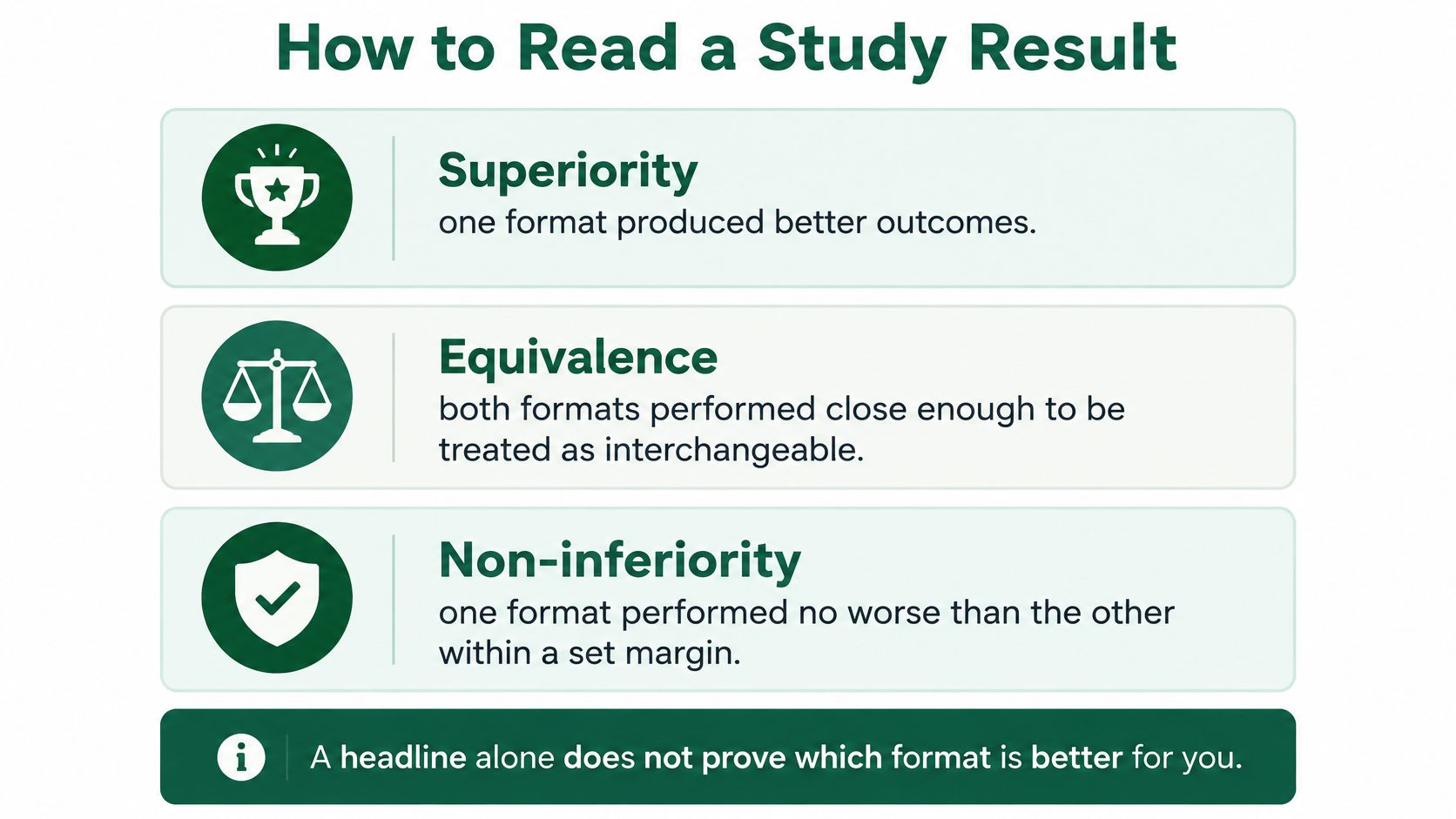
How to read a study result: superiority, equivalence, and non-inferiority answer different questions.
Separate Treatment Intensity From Delivery
The child-anxiety finding also needs careful interpretation: both videoconference-guided approaches offered meaningful benefits, but the more intensive therapist-delivered approach produced greater benefits. Researchers couldn't establish noninferiority of stepped care.
That comparison changes how a consumer should read the word “digital.” Removing travel and reducing clinician involvement are different changes. Evidence supporting the former doesn't automatically justify the latter.
When comparing resources across countries, DeTalks' guide to online therapy options in India offers another starting point for exploring available services. A service guide can help generate questions, but it isn't evidence that every format it discusses has equivalent clinical outcomes.
Symptom scores can capture improvement during treatment without answering whether someone could speak freely at home or attend reliably. Before accepting a headline, ask:
Which condition? Evidence about individual anxiety doesn't automatically answer questions about family conflict.
Which format and contact level? Live treatment, guided exercises, and self-directed programs aren't interchangeable.
Which outcome? Symptom improvement doesn't establish safety, relationship functioning, or sustained engagement.
Format-by-Format Strengths and Limits
Start with what a session requires the therapist and client to exchange. Facial expression, spoken conversation, written reflection, and independent practice provide different kinds of information.
Format comparison at a glance
Format | Therapist Contact | Best Fit | Main Limitation |
|---|---|---|---|
Live video with a therapist | Real-time, with visible expression | Adults seeking talk-based work for anxiety, depression, or life transitions, following assessment | Requires a private room and stable connection |
Audio-only phone | Real-time, without visual cues | Clients who avoid screens or need an agreed check-in | Loses facial and body cues |
Text or chat-based therapy | Often delayed or asynchronous; some services offer live chat | Clients who express themselves more comfortably in writing | Slower exchanges; harder to gauge urgency |
Self-guided digital program | Little or none | Skill practice or mild symptoms when clinically appropriate | Not automatically equivalent to therapist-guided care |
In-person office session | Direct, in-room interaction | Risk assessment, couples observation, and complex trauma assessment | Travel, scheduling, and associated costs |
Hybrid plan | Scheduled combination of office and video sessions | Clients needing flexibility alongside periodic in-room assessment | Different setups and availability to coordinate |
Real-Time Conversation
Live video preserves immediate dialogue and visible facial expression. A therapist can ask a follow-up question as distress appears, although the camera still limits what they can observe outside its frame.
Audio-only sessions retain tone, pauses, and conversational timing. They remove visual information, so a clinician who needs to observe changes in affect or alertness must decide whether spoken description is sufficient.
Neither format should be chosen just because it's available on a particular device. Ask what the clinician would lose by switching channels and whether that information matters for your treatment.
Writing and Independent Practice
Text-based work can give someone room to formulate a difficult thought without speaking immediately. Its limitation is interpretive: a short message might reflect distress, distraction, hesitation, or just someone's writing style.
Self-guided programs can organize exercises, reminders, and skills practice. Treat them as a defined intervention or an adjunct, not as an assumed replacement for the assessment and feedback a therapist provides.
A digital tool can deliver an exercise. That doesn't mean it supplies the judgment needed to decide when the exercise is appropriate.
Office Sessions and Hybrid Plans
In-person appointments allow the clinician to observe posture, movement, and interaction without relying on camera placement. That advantage must be weighed against whether travel or scheduling makes regular attendance impractical.
Hybrid plans can reserve office visits for assessment or difficult clinical decisions while using video for routine follow-through. Confirm that the same clinician can provide both, rather than assuming the practice offers that arrangement.
For readers comparing family services outside Florida, Providers for Healthy Living's information on online support for Ohio families is a location-specific resource to explore. Confirm eligibility, available formats, and the proposed level of therapist involvement directly with any provider.
Match the format to the work the session has to do, not to convenience alone.
Situations That Change the Answer
Online therapy can be a reasonable fit for one person and a poor fit for another. A 2025 review of anxiety interventions published in Cureus found telemedicine broadly non-inferior to in-person therapy, while noting variation across studies and small differences favoring in-person care for generalized anxiety disorder. These findings do not establish that the two formats work identically for every client or situation.
Your privacy, sensory needs, and current symptoms also shape whether remote participation is workable. The question is not only whether therapy can happen by video, but whether the format allows you to speak freely and the clinician to assess what is happening.
Shared Homes and Sensory Needs
A closed laptop does not guarantee confidentiality. If a partner, child, roommate, or controlling family member can overhear, you may hold back information your therapist needs.
Headphones keep the therapist's voice private, but they do not conceal yours. Arrange a room where you can speak without being overheard. If you cannot, an office appointment may be a better setting for sensitive conversations.
For neurodivergent clients, discuss camera expectations, captions, lighting, movement breaks, and session length. Shorter appointments or a writing option may help, provided the format still allows the assessment and therapeutic contact the work requires.
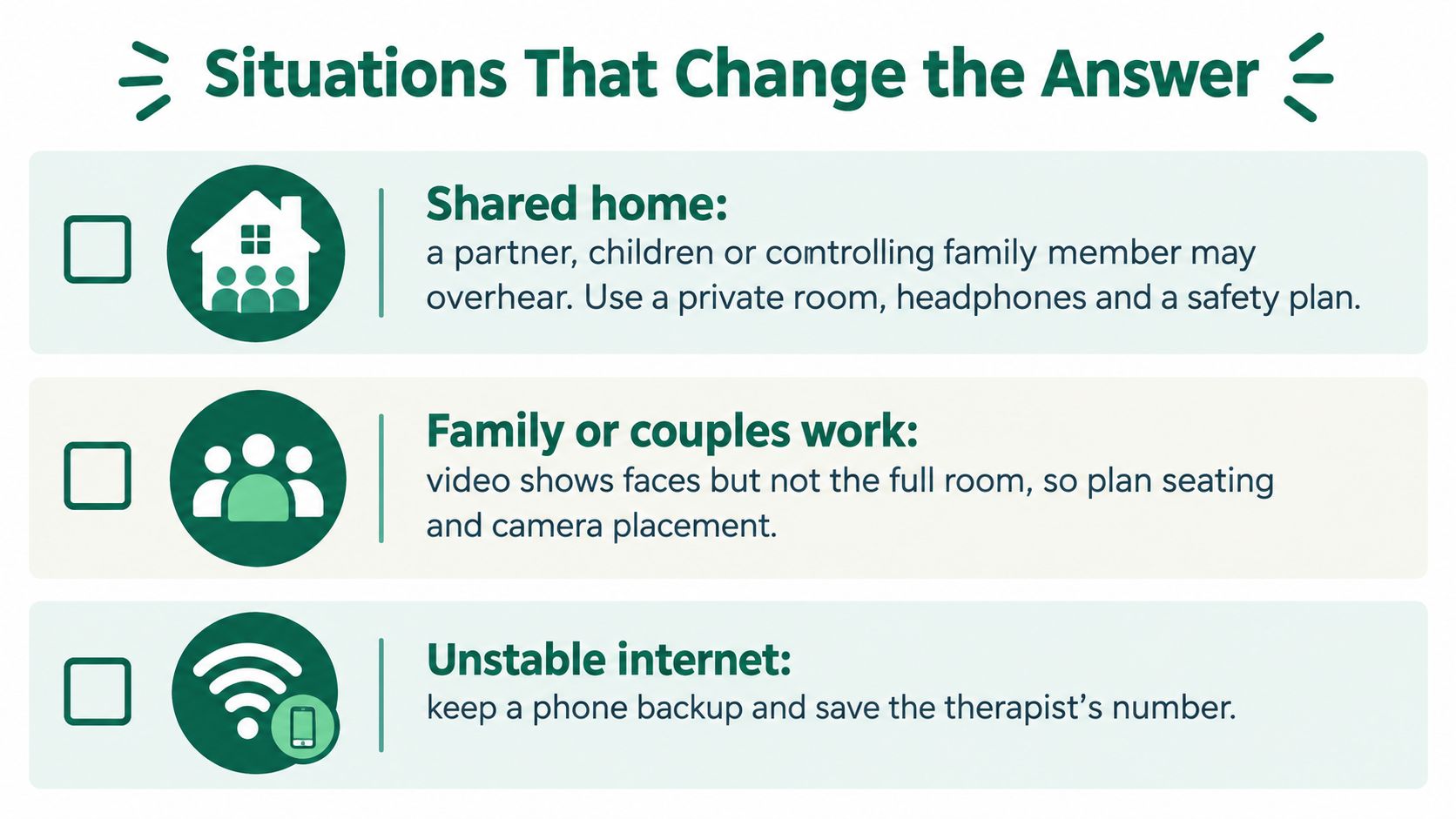
Check the room, participation arrangements, and connection before relying on video care.
Clinical Complexity Changes the Calculation
Dissociation, escalating domestic conflict, intoxication, or suicidal risk can make it harder to assess what is happening and respond promptly. When these concerns are active, discuss direct assessment and how help would be reached. A hybrid schedule alone does not resolve an urgent safety problem.
For trauma-related concerns, information about trauma therapy online can help you prepare questions about stabilization, connection interruptions, and escalation procedures. A trauma history by itself does not make video unsuitable. Current symptoms and the clinician's ability to respond matter.
The review's small average advantage for in-person care in generalized anxiety does not identify which individuals would benefit from changing settings. If symptoms are severe or progress stalls, discuss an in-room review. Those concerns support reconsidering the format, not assuming that one setting is superior for everyone.
Before choosing video, check:
Privacy: You can speak without being overheard or monitored.
Connection: Your device and internet support an uninterrupted conversation.
Sensory access: The setup accommodates your communication and attention needs.
Safety: Current risk concerns have been assessed and an appropriate response arranged.
Consistency: You can attend without repeatedly multitasking or relocating.
If any condition is unmet, consider hybrid or in-person care. An immediate safety concern calls for prompt clinical or emergency help, not merely a different appointment format.
Couples and Family Sessions Online
Say a couple begins a video session after an argument. One partner sits close to the laptop and answers most questions; the other sits beyond the camera's edge and becomes increasingly quiet.
The therapist can hear both voices but can't confidently distinguish withdrawal, distraction, or pressure from the partner nearby. The practical problem isn't whether video can transmit a conversation. It's whether each person can participate freely and whether the therapist can evaluate the interaction.
Arrange Participation Before Difficult Work
A hybrid plan could begin with an office assessment, where the therapist can observe both partners and clarify whether joint work is appropriate. Video check-ins could follow once participation rules and safety expectations are established.
For affair recovery or high conflict, discuss starting in person rather than making remote sessions the automatic default. If coercion or abuse is present, the clinician should assess safety privately before deciding whether conjoint therapy is appropriate at all.

Shared-screen sessions need deliberate seating, balanced participation, and a way to pause safely.
Make the Rules Observable
Agree on practical arrangements rather than relying on good intentions:
Camera placement: Keep both partners visible without requiring either person to hold the device.
Speaking order: Decide who begins and how the therapist will invite the other person in.
Pause protocol: Let the therapist set a timed pause and define how the conversation resumes.
Unequal participation: Raise interruptions, silence, or off-camera exchanges during the session.
Private disclosure: Arrange a safe way to tell the clinician something that can't be discussed jointly.
Each participant needs privacy from uninvolved household members. Separate rooms may sometimes help, but they don't automatically solve monitoring or coercion within the home.
Because evidence for systemic and family work remains limited, the case for video should rest on the particular couple's assessment, not a blanket promise of equivalence. Readers considering whether couples counseling is effective should ask both whether the treatment fits their relationship and whether its setting supports honest participation.
How to Get Better Results From Teletherapy
Preparation can't make an unsuitable treatment appropriate. It can prevent avoidable technical and environmental problems from consuming the appointment.
Prepare the Space and the Backup
Test the equipment beforehand. As a practical preparation target, check the device, camera, microphone, and connection 24 hours before your first session, then save the therapist's backup phone number. A common slip is discovering that the browser can't access the microphone after the appointment starts; open the actual appointment link in advance when possible.
Choose a private room with a closed door. Tell household members when you'll be unavailable, provided doing so is safe. Joining from a busy kitchen or a car with passengers makes distraction and overhearing predictable; arrange a stationary, private alternative instead, and never attend while driving.
Place the camera at eye level. Keep your face and upper body visible, with light coming from in front of you. A phone resting in your lap or a bright window behind you can make expression difficult to read; use a stable stand or stack of books.
Use headphones and check sound leakage. They can reduce echo and keep the clinician's voice private, but they won't stop others hearing your responses. Don't mistake wearing earbuds for having a confidential space; check what can be heard outside the room.
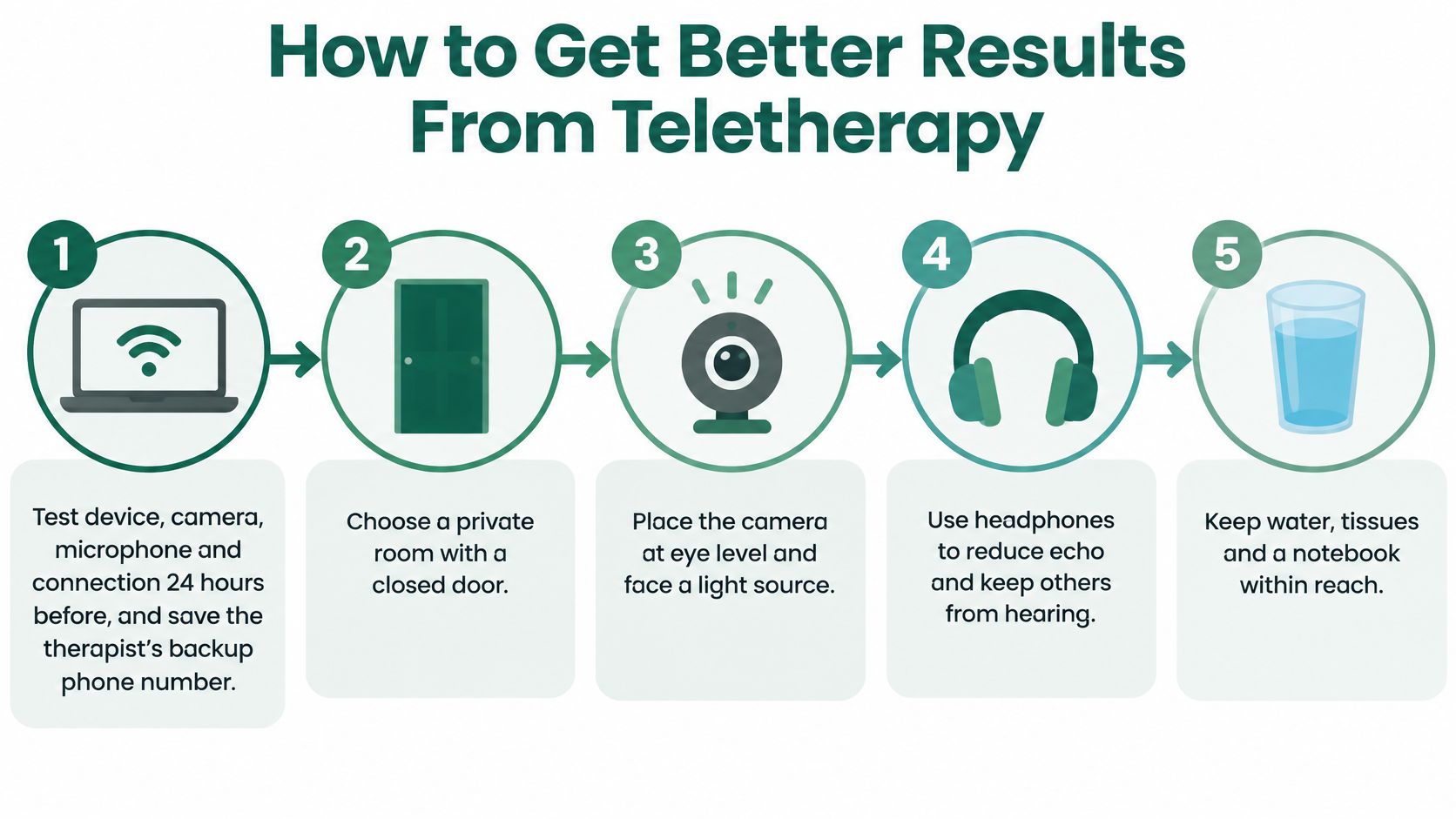
Prepare your equipment and surroundings, and keep water, tissues, and a notebook within reach.
Protect the Clinical Work
Reserve transition time. Try a five-minute buffer before and after the appointment as a scheduling aid, not a treatment requirement. Moving directly from a work call into therapy can leave you mentally elsewhere; close other applications and silence notifications before joining.
Agree on a crisis and disconnection plan. Confirm your current address, a local emergency contact where appropriate, and what the therapist will do if contact drops during distress. Don't assume the clinician knows where you are, especially if you've changed locations.
Bring a brief progress record. Note symptoms, functioning, and the situations in which difficulties occurred, using the same clinician-agreed rating method between sessions. Relying only on how you feel that afternoon can miss the broader pattern; bring concrete examples of sleep, avoidance, conflict, or follow-through.
Raise format problems early. Tell the clinician about dropped calls, distraction, difficulty connecting emotionally, or feeling watched at home. Don't silently tolerate repeated disruption; ask whether phone, office appointments, or a revised treatment plan would help.
Discuss how long therapy takes to work alongside how you'll recognize progress. Prioritize consistent attendance and usable clinical contact over finding a platform that looks impressive.
Confirm the Right Format Before Your First Session
Write down your main concern, household setup, and current safety concerns. Use those details to identify a preferred format and a fallback, then bring both to the provider rather than committing to a package first.
For example, an adult with anxiety, a private room, and reliable internet might propose live video with office review if engagement becomes difficult. Someone who can't speak freely at home might start with office sessions and reconsider video only after privacy is resolved.
Confirm Fit and Authority to Practice
Ask whether the clinician's assessment supports your proposed format and whether hybrid appointments are available. Confirm that the clinician is licensed or otherwise authorized to treat you in the state where you'll physically be during sessions, including when you travel.
For Tampa Bay readers, Be Your Best Self & Thrive Counseling, a St. Petersburg practice, offers an initial consultation to discuss fit and goals. Readers comparing providers elsewhere can also explore Vernon therapy options through Interactive Counselling, while checking local eligibility and arrangements directly.
Agree on When to Reassess
As a practical example, you might agree to review fit after four to six sessions, sooner if safety or participation changes. Use that conversation to assess symptoms, functioning, engagement, and whether another format would help.
Bring these questions to your first session with a therapist: Which online format is appropriate, how much therapist contact does it need, and what would make us change it?
Be Your Best Self & Thrive Counseling, PLLC offers individual and couples counseling with evidence-informed, whole-person care. To discuss whether online or in-person treatment fits your concerns, privacy, and goals, visit Be Your Best Self & Thrive Counseling, PLLC and arrange a free initial consultation.