
How Long Does Therapy Take to Work
You pull out of the parking lot, place both hands on the steering wheel, and replay the session. Maybe it was your first appointment. Maybe it was your fifth. You said too much, or not enough. You felt lighter for an hour, then anxious again by Tuesday. A question keeps circling: How long does therapy take to work, and how will I know whether this therapist is helping?
Therapy rarely follows the dramatic breakthrough story people expect. Change usually builds through repeated conversations, new skills, honest feedback, and small experiments between sessions. The useful question isn't only how long treatment lasts. It's whether your response is changing, whether daily life is becoming more workable, and whether your current approach still fits your goals.
The Question Almost Everyone Asks in the Car After Session One
After a first session, many people look for an immediate verdict. Did I connect with the therapist? Did I explain the problem correctly? Should I feel different already? If the appointment involved tears, you may wonder whether it helped. If it felt ordinary, you may worry that nothing happened.
Those reactions are common because therapy begins with uncertainty. You're meeting a professional while deciding how much to reveal, learning the therapist's style, and trying to describe experiences that may not have a neat beginning or end. The therapist is also gathering context, identifying patterns, and considering what kind of support could fit. That early work can feel less satisfying than a promised breakthrough, but it creates the map for later treatment.
A first appointment may include goals, history, current symptoms, relationships, sleep, stress, safety, and what you hope will change. You don't have to tell the complete story perfectly. You do need enough room to correct the therapist when something feels inaccurate or overly simplified. A practical overview of what to expect from a first therapy session can help you arrive with realistic expectations.
A useful starting point: Don't judge therapy only by how calm you feel when you leave. Judge it by what becomes possible between appointments.
The gap between therapy's popular image and its real process creates unnecessary discouragement. People often imagine insight arriving first and behavior changing immediately afterward. In practice, you may understand a pattern long before you can interrupt it under pressure. You may also behave differently before you fully understand why the old reaction had such power.
What to ask yourself after an appointment
Use three questions rather than one emotional temperature check:
Did I feel safe enough to be honest?
Did we work on something connected to my goals?
Did I leave with an idea, question, or observation to carry into the week?
You don't need a perfect score. You're looking for enough safety and direction to continue evaluating the work. The rest of this guide focuses on that evaluation, including what meaningful progress looks like, how session counts translate into calendar time, and when slow progress calls for a conversation rather than an immediate decision to quit.
What Working Actually Means Beyond Feeling Better for an Hour
Feeling better after therapy can matter, but it isn't the only measure of change. A good session may bring relief because someone finally listened, a confusing experience gained language, or an emotion had space to move. That relief can fade without meaning the appointment failed.
It helps to separate three layers of improvement. Acute relief is the lighter feeling that follows a productive conversation. Functional change appears in your behavior and daily routines. Durable change means a new response becomes more available, including when stress returns.
Think about a cut on your skin. The bandage moment resembles acute relief. It protects the wound and reduces immediate discomfort. The scab resembles functional change. The area is still tender, but healing is underway and you're less likely to reopen it. A scar resembles durable change. The tissue has changed enough that ordinary movement no longer returns you to the original injury.
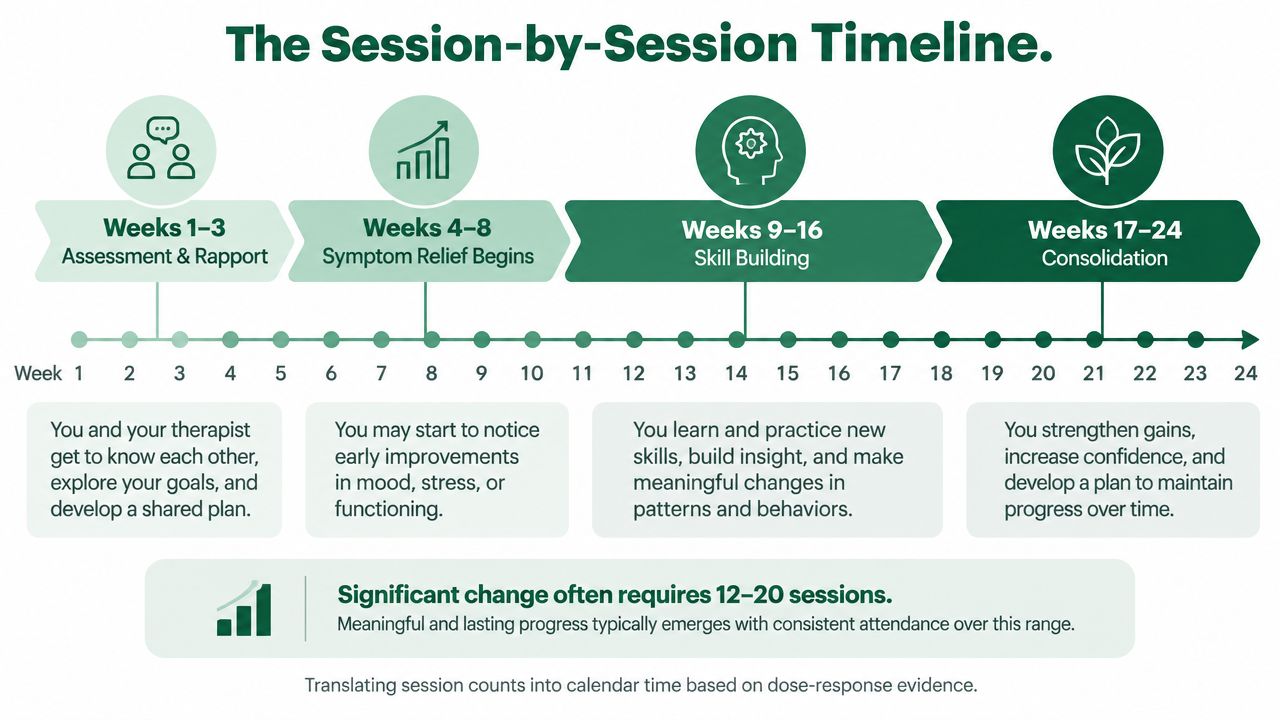
Translating session counts into calendar time based on dose-response evidence.
How to read the layers
Early relief may show up quickly, especially after you name something you've kept private. Functional change often takes observation and practice. You might pause before sending an angry message, return to sleep after waking worried, or tell a partner what you need instead of withdrawing.
Durable change is harder to recognize while it's developing. It often becomes visible when an old trigger appears and your response no longer follows the entire familiar sequence. You still feel hurt or afraid, but you recover sooner, choose a different action, or ask for support without abandoning yourself.
A large UK routine-practice study of 26,430 psychotherapy patients found an average course of 8.3 sessions, with a median and mode of 6 sessions. By the end of treatment, 60.0% achieved reliable and clinically significant improvement, and the study reported a CORE-OM pre-to-post effect size of 1.89. These findings, detailed in the British Journal of Psychiatry study on therapy duration and recovery, support a balanced expectation. Many people can see measurable benefit during a relatively short course, but improvement is not identical to feeling permanently well after one memorable conversation.
For a practical way to distinguish a good session from broader change, use this guide to knowing whether therapy is working alongside your own observations.
The Session-by-Session Timeline Most People Actually Experience
Therapy doesn't operate on a stopwatch, but research does show a cumulative pattern. A widely cited session-by-session analysis, summarized in later reviews, found that about 50% of clients were measurably improved by session 8, roughly 50% showed clinically significant change by session 21, and about 75% reached clinically significant change after more than 40 sessions. The summary is discussed in Psychotherapy Networker's review of the tyranny of time.
Those figures aren't promises for an individual client. They describe a broad pattern in which some people respond early, while others need sustained work for complex or chronic concerns. Weekly attendance turns sessions into calendar time, but missed appointments, pauses, and changing frequency alter the pace.
A working calendar
Weeks one through three often focus on assessment, rapport, safety, and selecting a direction. You may gain language for the problem or notice brief relief, but the main task is understanding what keeps the difficulty going.
Sessions four through eight commonly bring more active practice. Depending on the treatment, you might learn to challenge an anxious prediction, regulate an escalating conversation, approach an avoided situation, or notice a trauma response without being completely governed by it. This is often when small weekly wins become easier to identify.
Sessions eight through sixteen, approximately three to four months of consistent weekly work, are a common window for meaningful movement on standardized measures. Evidence syntheses cited by the American Psychological Association indicate that 15 to 20 sessions are needed for 50% of patients to recover on self-reported symptom measures, while many structured therapies show clinically significant change in 12 to 16 weekly sessions. The available summary of that evidence appears in this overview of how long therapy takes.
After session 20, treatment may shift from immediate symptom reduction toward maintaining gains, repairing relationships, processing deeper experiences, or changing the identity and expectations built around the problem. That doesn't mean every client needs a long course. It means the goal often changes once the crisis is less dominant.
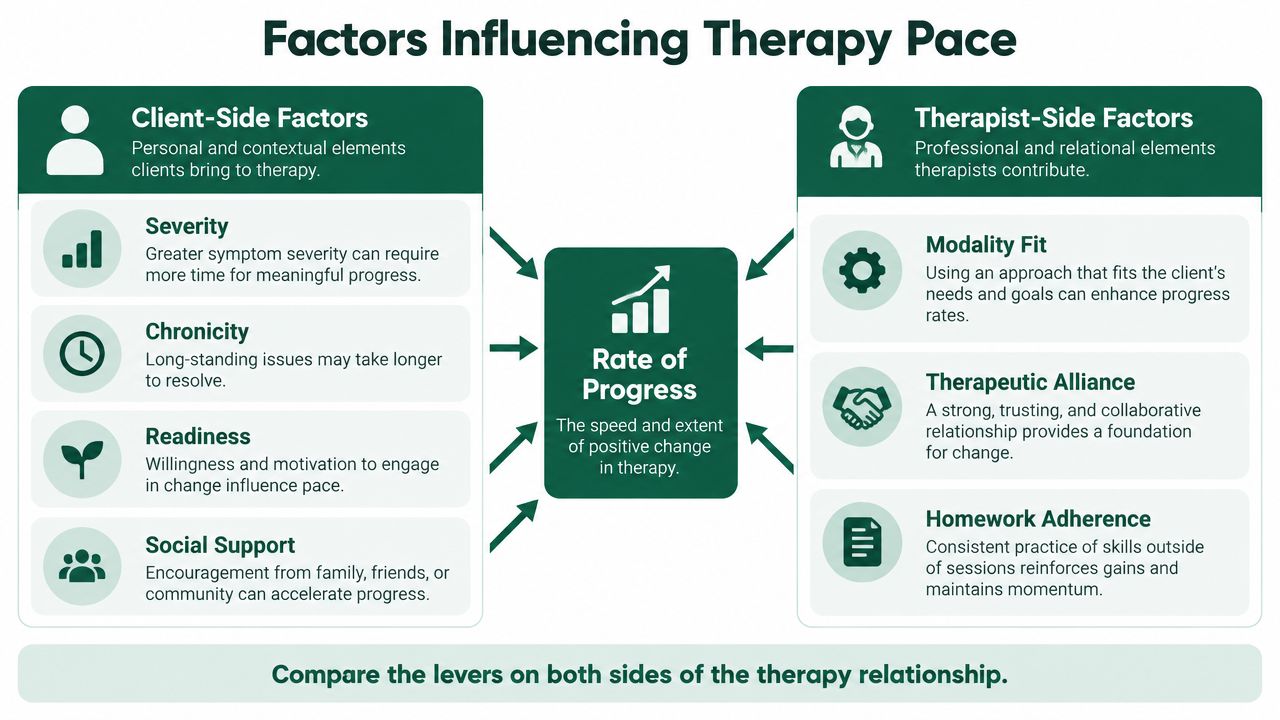
Compare the levers on both sides of the therapy relationship.
A large 2026 psychotherapy outcomes analysis found that first response occurred at a median of 6 sessions, and first remission at 8 sessions. It reported that 81.9% of responses occurred by session 12, with most symptom change concentrated in the first 8 to 16 sessions. After about 24 to 26 sessions, incremental gains were minimal, which supports monitoring progress and adjusting treatment when improvement remains limited. The findings are summarized in this discussion of the science behind therapy timelines.
For trauma-focused care, pacing deserves particular care. A resource on how long trauma therapy can take can help explain why symptom relief and deeper processing may unfold on different schedules.
What Makes Therapy Move Faster or Slower for You
Two clients can attend the same type of therapy and move at different speeds. The difference isn't a matter of motivation alone. Symptoms, history, support, treatment design, therapist experience, and the quality of the working relationship all influence what becomes possible.
Client-side dials
Severity matters. Someone dealing with a recent, focused anxiety problem may have a different starting point from someone managing depression, trauma, substance use, chronic pain, or several concerns at once.
Duration matters too. A pattern practiced for years can feel automatic even after you understand it. Replacing it requires repeated experiences that contradict the old expectation.
Engagement between sessions can help treatment become real-world practice. That might mean tracking panic cues, trying a boundary, completing exposure work, writing down a conflict sequence, or noticing when self-criticism begins. The assignment should fit your capacity. More homework isn't automatically better.
Support and health affect the runway. Isolation, unstable housing, ongoing conflict, substance use, sleep disruption, and untreated medical conditions can make psychological change harder to sustain. A therapist may need to coordinate care or adjust the immediate goal rather than interpret every difficulty as resistance.
Therapy-side dials
The modality shapes the first kind of change you may notice. CBT and DBT often target observable behavior and coping skills early, while depth-oriented work may spend more time examining attachment, defenses, and long-standing emotional patterns before behavior shifts become clear. EMDR and intensive formats may organize the work differently from weekly outpatient therapy, so their timelines shouldn't be compared casually.
Frequency also changes momentum. Weekly sessions give you a regular place to review what happened and practice the next step. Biweekly care can work for some goals, but more time between sessions may make it harder to remember the sequence of a difficult event or maintain an experiment.
Fit includes the therapist's experience with your concern, the clarity of the treatment plan, and whether you can disagree without fear. If you're exploring an approach outside conventional talk therapy, review a careful guide to ketamine therapy for healing and discuss safety, appropriateness, and coordination with qualified healthcare professionals.
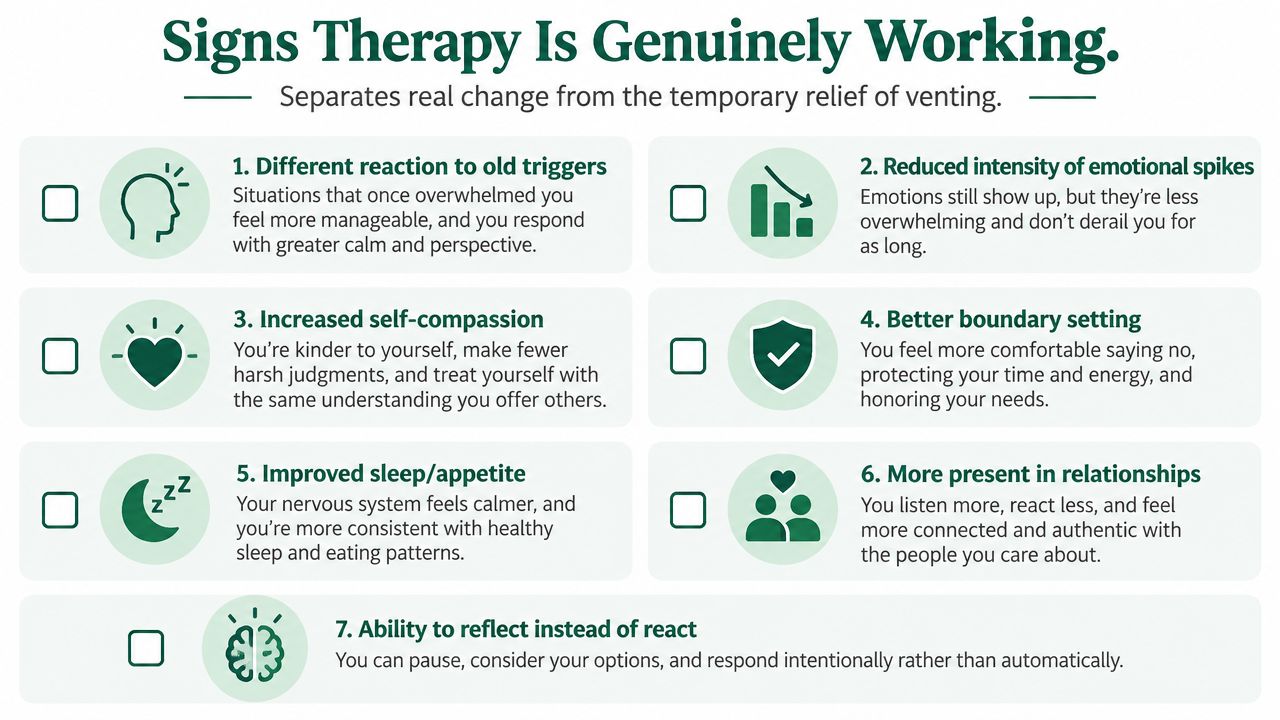
Separates real change from the temporary relief of venting.
Deep attachment injuries, trauma complexity, and co-occurring conditions may require a longer runway. Evidence syntheses cited by the American Psychological Association note that co-occurring conditions or personality-related difficulties can extend effective treatment to roughly 12 to 18 months. That isn't a sentence. It's a reason to build a plan that includes review points instead of demanding a quick fix.
How Progress Really Looks Week to Week
Progress is rarely a clean line. It can move quickly in one area, stall in another, and become visible only after you compare today's response with an older pattern.
Consider a person with mild work anxiety. During the first two weeks, rumination drops because they learn to separate a task from the catastrophic story attached to it. Then a demanding project arrives, and by week six they spend an evening checking messages repeatedly. That setback doesn't erase the earlier change. It shows that the new response hasn't generalized to high-pressure conditions yet.
A grief client may have the opposite experience. Early sessions feel raw and repetitive. Talking about the loss seems to increase pain rather than reduce it, and the client leaves unsure whether anything is moving. Several months into treatment, a previously avoided memory becomes accessible, and the client can mourn a specific part of the relationship instead of feeling only a blurred, overwhelming sadness.
Couples can also change at different speeds. In an EFT process, one partner may stop pursuing during conflict and begin naming fear more directly. The other partner may remain guarded for months, then respond differently after enough experiences of safety accumulate. A later session can become a turning point, not because one conversation performed magic, but because earlier work made a new response tolerable.
Look for patterns, not perfect weeks
A setback during a hard project, family visit, anniversary, or health scare can provide useful information. Ask what happened before the reaction, which part of the old sequence returned, and whether any part of your response was different.
Progress can mean the trigger still hurts, but it no longer controls the entire day.
That distinction protects you from two errors. You won't dismiss genuine growth because you still have symptoms, and you won't label temporary relief as durable change just because one week felt easy.
Signs Therapy Is Genuinely Working That You Can Track
A productive conversation can feel meaningful without changing your habits. To evaluate therapy, track what happens outside the office. Choose observations you could describe to another person without using broad words such as “better” or “healed.”
A practical audit
Notice a different reaction to an old trigger. You receive a critical email and wait before replying instead of immediately defending yourself.
Track emotional intensity. The same conflict produces distress, but the spike peaks lower or settles sooner.
Check your tolerance for difficult feelings. You stay with sadness, anger, shame, or uncertainty without rushing into avoidance, reassurance-seeking, or numbing.
Watch your boundaries. You decline an unreasonable request, state a limit, or stop explaining after you've already answered.
Observe sleep and bodily baseline. You return to sleep more easily, eat more consistently, or carry less physical tension through an ordinary day.
Look for presence in relationships. During a conversation, you notice your urge to withdraw and remain engaged long enough to hear and respond.
Recall insights between sessions. A therapeutic idea comes to mind while you're in the situation, not only when the therapist reminds you.
You can make the review concrete with a brief weekly note. Rate your coping from 1 to 10, then record one specific win and one moment that remained difficult. Don't treat the rating as a diagnosis. Use it as a prompt to identify conditions, patterns, and questions for treatment.
For example: “Coping was 5. I paused before calling my sister back and used a direct sentence. I still avoided opening the bill because I expected bad news.” That entry gives your therapist something actionable to explore.
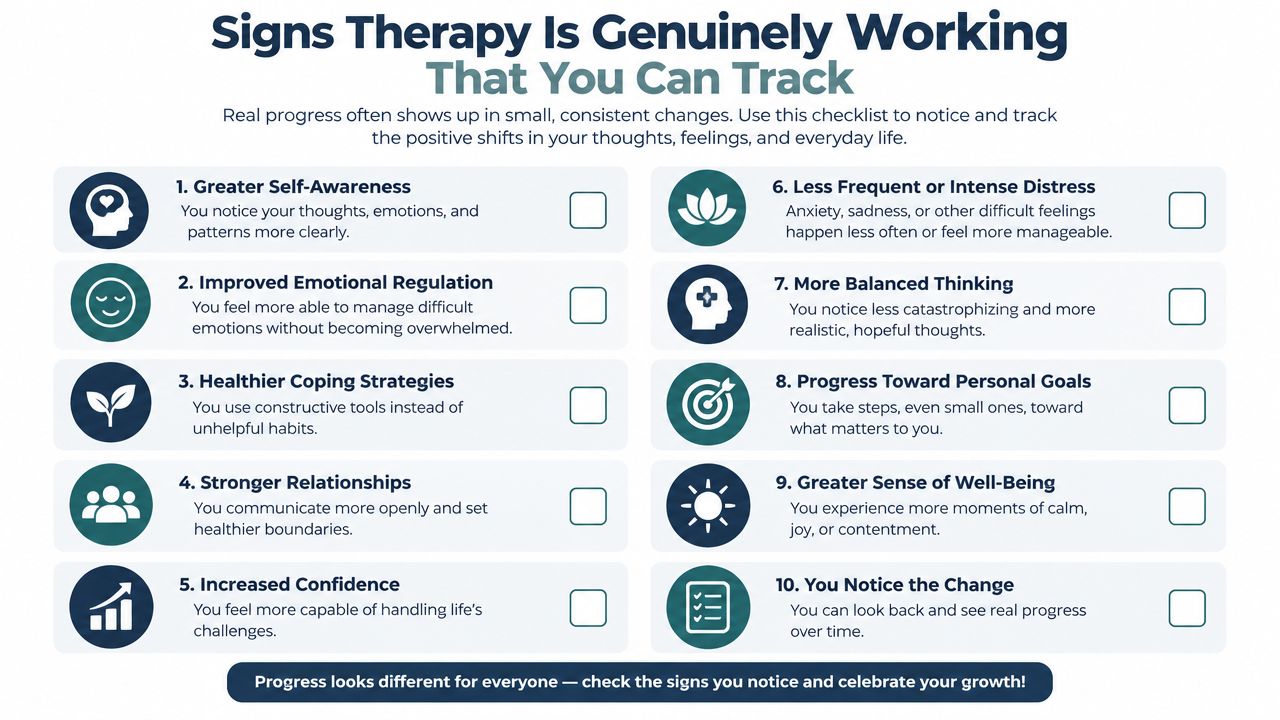
Writing down these observations can also support therapy progress notes that help you notice change. Bring the notes into session, especially when memory becomes selective after a difficult week.
When Slow Progress Is a Signal to Talk Not Quit
Slow progress is information. It may mean the treatment needs more consistent practice, the goal is too broad, the therapist's formulation doesn't fit, or the current method isn't addressing the main problem.
Separate three possibilities before making a decision:
A plateau may call for consistency and adjustment. You've improved in some situations but not others. Ask what new condition is exposing the remaining difficulty.
A fit problem may call for a different therapist or modality. You don't feel understood, sessions stay vague, or the therapist avoids explaining the plan.
A goal mismatch may call for renegotiation. You wanted help with panic, but every session centers on family history without connecting it to current functioning.
Try direct language in your next appointment:
“Can we review what progress you expected by this point?”
“What do you notice about my engagement between sessions?”
“Which part of the plan should we change if this symptom isn't shifting?”
“I'm not sure our focus matches the reason I started. Can we reset the goals?”
A fit conversation doesn't require blame. You might say, “I value the work we've done, but I don't think this approach is matching what I need right now. Could you help me think through another modality or referral?” A responsible therapist can discuss options, provide referrals when appropriate, and help you leave with continuity rather than confusion.
The session-by-session evidence described earlier supports progress monitoring, not rigid deadlines. Many people adjust their therapist, treatment focus, frequency, or modality during meaningful care. Changing course can be part of effective treatment, not proof that therapy failed.
Setting Realistic Expectations and Your First Move This Week
The clearest answer to how long does therapy take to work has layers. Early sessions often stabilize and orient. Meaningful shifts commonly develop over roughly two to three months of consistent attendance, while larger goals may unfold across six to twelve months, depending on the concern, treatment, frequency, and response. These are practical planning ranges, not guarantees, and the research shows that clients vary widely.
Your first move this week can be simple:
Choose one symptom or behavior to track. Record avoidance, sleep, panic intensity, conflict recovery, or the number of times you pause before reacting.
Protect the treatment rhythm. Schedule the next appointment before leaving the office when possible, then discuss frequency if attendance keeps breaking apart.
Define your eight-week signal. Write one observable change that would tell you therapy is moving in the right direction, such as returning a difficult call, sleeping more steadily, or recovering from a trigger without losing the entire day.
If you're preparing to begin, use this guide to preparing for your first therapy session to identify goals and questions. You don't need a polished life story. You need enough honesty to describe what hurts, what you want to change, and what would count as evidence that treatment is helping.
Therapy is a layered investment, not a single transaction. Relief may come first, behavior may shift next, and durable change may become visible only after your new responses have been tested by ordinary stress. Your role isn't to force a perfect timeline. It's to participate, observe, speak up when the plan misses the mark, and keep choosing treatment based on real evidence from your life.
Be Your Best Self & Thrive Counseling, PLLC offers individual and couples counseling for anxiety, depression, trauma, stress, life transitions, and persistent relational patterns, with care designed around your goals and a free initial consultation to explore fit. Visit Be Your Best Self & Thrive Counseling, PLLC to learn about available support in St. Petersburg and the Tampa Bay area and take the next step with a clear progress question in mind.