
Therapy Progress Notes: A Complete Clinical Guide
You finish a difficult session, walk the client to the door, and immediately face the familiar administrative question: what belongs in the chart, and what should remain in your private clinical reflections? The pressure gets sharper when the session involved conflict between partners, sensory overload, trauma processing, or body-based regulation that doesn't fit neatly into a generic template.
Therapy progress notes aren't reminders of what happened. They document clinical reasoning, support continuity of care, help justify services, and may be reviewed by payers, supervisors, other providers, or legal authorities. The strongest notes stay concise while showing a clear connection between the client's needs, your intervention, the client's response, and the next treatment step.
Defining Therapy Progress Notes and Legal Boundaries
In U.S. mental health practice, progress notes are part of the official medical record. They communicate treatment information to authorized readers, while private process notes serve a separate clinical purpose. HIPAA established this distinction through its definition of psychotherapy notes, which receive separate treatment under the Privacy Rule implemented in 2003 (Mentalyc's explanation of process notes and progress notes).
A progress note should let another authorized professional understand the service, clinical decision-making, client response, and plan. A process note can hold private hypotheses, personal reflections, reminders for future questions, or detailed impressions of the therapeutic relationship. Store the two categories separately in your record system. Avoid placing private formulation material into the official chart because it feels clinically interesting.
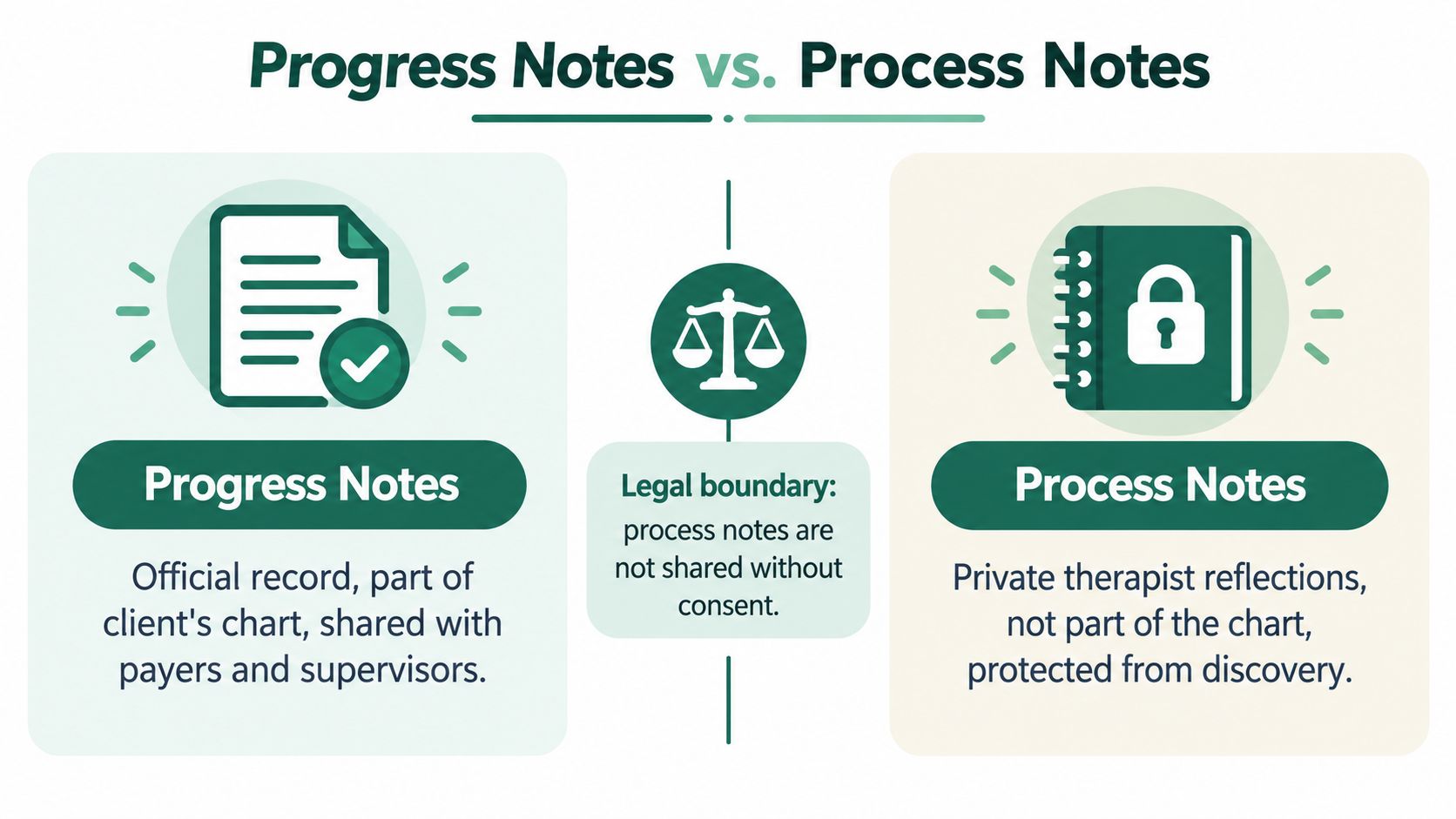
Practical boundary: Information that explains the service, treatment decision, client response, risk assessment, or plan generally belongs in the progress note. Private analysis of the conversation belongs in a properly separated process-note location.
What belongs in the official record
Progress notes typically include the session date, duration, presenting concerns, interventions used, client response, progress toward goals, and next-step planning (therapy progress note guidance). Include client identifiers, service format, relevant diagnoses or codes, risk information, and your signature with credentials when your setting or payer requires them.
Write for continuity rather than transcription. Describe observable behavior and client reports, then connect them to the intervention and treatment goal. “Client participated in communication rehearsal and identified a specific boundary” supports clinical reasoning better than “good session.” In couples work, identify the participants and distinguish each person's response. For neurodivergent clients or trauma work, document the functional concern, intervention, observed response, and clinical rationale without turning a formulation into unsupported fact.
Retention is a clinical and legal issue
Progress notes may be requested for insurance review, legal proceedings, supervision, or continuity of care. The AMA recommends retaining adult records for 10 years from the last date of service, while many state laws set a seven-year minimum, so confirm the longest applicable requirement for your jurisdiction (therapy note retention guidance).
Requirements can vary by jurisdiction, client age, payer, profession, and practice setting. Create a written retention policy and verify it with your licensing board, insurer, attorney, or compliance professional. Your HIPAA privacy policies should explain access controls, storage, releases, and secure disposal. Audit readiness depends on more than having a template. The chart should show a defensible link between the client's needs, the service delivered, the response, and the next clinical step.
Choosing the Right Documentation Framework
Choose the format that records the session accurately and supports a defensible clinical story. SOAP, DAP, BIRP, and custom progress-note formats can all work when they capture the required elements. Consistency across the chart matters more than the acronym, provided the note connects the service, clinical need, intervention, response, and plan.
A usable template should prompt date, time, duration, client presentation, interventions, response, and clinician signature. These fields create a reliable baseline for review, while your narrative supplies the clinical reasoning. If a template omits one of them, add it or choose a tool that supports secure drafting, review, and signing. Comparing options that help clinicians find clinical note software can clarify which workflow fits your practice.
Framework | Core Structure | Best Clinical Use Case |
|---|---|---|
SOAP | Subjective, Objective, Assessment, Plan | Medical-model settings, interdisciplinary care, and notes requiring a clear distinction between client report and clinician observation |
DAP | Data, Assessment, Plan | Efficient outpatient documentation when observed and reported material can be summarized together |
BIRP | Behavior, Intervention, Response, Plan | Community behavioral health and settings that emphasize the relationship between the intervention and the client's response |
Standard Progress Note | Flexible clinical narrative with required data fields | Couples, family, holistic, or specialized work that needs structure without rigid acronym-driven sections |
SOAP works when clinical separation matters
Use SOAP when the distinction between report and observation affects clinical reasoning. Subjective records reported symptoms, concerns, and relevant client statements. Objective captures behavior and assessment findings you observed. Assessment explains your interpretation, while Plan identifies the next treatment steps.
The audit risk appears when Subjective is detailed but Assessment says only “client is improving.” State what changed, how it relates to the treatment goal, and why the next intervention follows from that evidence.
DAP is efficient, but don't make Data a transcript
DAP suits outpatient work that requires concise documentation. Data can combine the client's report, your observations, and the interventions delivered. Assessment should explain the current clinical picture and progress. Plan should specify the next clinical action.
Avoid copying the session into Data. If avoidance continues, describe its relationship to the active goal and explain why the selected intervention remains appropriate. The note should show judgment, not just chronology.
BIRP highlights the intervention and response
A supervisor skimming forty notes needs to locate the intervention in seconds. BIRP supports that review by placing Behavior, Intervention, Response, and Plan in a direct sequence. It works well in high-volume agency settings, particularly when the response to treatment must be easy to identify.
The format also supports specialized work without forcing every session into an individual medical narrative. A standard progress note may better fit couples, family, or nervous-system-focused care when the clinical story requires more room. For trauma-focused documentation, use language consistent with what trauma-informed care means. Record the intervention and observed response without presenting a formulation as established fact. Then state the clinical rationale and next step clearly.
Technology should reduce drafting friction without replacing review or judgment. Whichever framework you choose, configure required fields, preserve a consistent sequence, and check that each completed note can stand on its own during supervision, payer review, or an audit.
Specialized Templates for Complex Client Populations
A couples session can contain meaningful clinical work and still fail review if the note reads like two disconnected individual summaries. Neurodivergent care and trauma treatment create similar documentation risks. The record must show who received the service, what changed, which intervention produced that change, and how the next step relates to the treatment plan. The APA Division 31 progress-record guidance offers a useful baseline, but audit readiness requires more specific documentation of relational change, shared goals, boundaries, and nontraditional outcomes.
Couples counseling requires more than two individual summaries
A couples note should identify the unit of treatment, each participant's involvement, the relational pattern addressed, the intervention used, and the shared or individual response. Do not write as though one partner is the sole client unless that matches the service and consent structure. Document observable interaction rather than assigning blame or recording only each person's private report.
A concise example might read:
Service: Couples therapy, telehealth. Both partners attended. The couple reported recurring escalation when discussing household responsibilities. Therapist used structured turn-taking, reflective listening, and a repair sequence to slow interruption and clarify each partner's underlying request. Partner A restated Partner B's concern with one prompt. Partner B identified a specific boundary around late-night conflict. Both partners agreed that the active goal is to improve conflict repair and will practice the agreed discussion structure before the next session. No safety concerns reported. Next session will review use of the repair sequence and assess barriers.
This entry records the treatment unit, clinical action, response, shared goal, and follow-up. “The couple communicated better” is too vague unless the note explains what they did differently.
Neurodivergent clients need functional, respectful detail
For neurodivergent clients, document relevant sensory, communication, attention, executive-functioning, and environmental factors without treating difference as pathology. Explain how a factor affected participation and which accommodation or intervention supported access to treatment.
For example:
Presentation: Client requested reduced visual stimulation and used written prompts to organize priorities.
Intervention: Therapist broke the problem-solving task into sequenced steps, offered processing time, and used a visual agenda.
Response: Client selected a first action, identified one barrier to initiation, and rehearsed a transition strategy.
Progress: Client connected the strategy to the treatment-plan goal involving task initiation and daily functioning.
Plan: Continue using written structure and review whether the strategy transfers to the client's identified setting.
The record should establish clinical relevance, not catalogue traits. State why the accommodation mattered to participation and treatment. Do not imply that the client's communication style requires correction.
Trauma-focused notes should show pacing and choice
Trauma-focused documentation benefits from precise language about stabilization, consent, pacing, grounding, and client choice. Include only the trauma material needed to explain the service, intervention, and response. For clinicians treating complex trauma, therapy for complex trauma offers additional clinical context, while the progress note must remain individualized and observable.
A defensible entry might state that the client became visibly activated while discussing a treatment target, requested a pause, and selected a grounding exercise. The therapist supported the pause, returned attention to present-moment orientation, and collaboratively revised the session goal. The client reported feeling more settled and identified a preferred pace for future work. The note then links that decision to the treatment plan and records the next clinical action.
Use a template as a prompt, not as a substitute for judgment. A reviewer should be able to identify the service, response, rationale, and next step without reconstructing the session from vague narrative.
Establishing Medical Necessity and Billing Justification
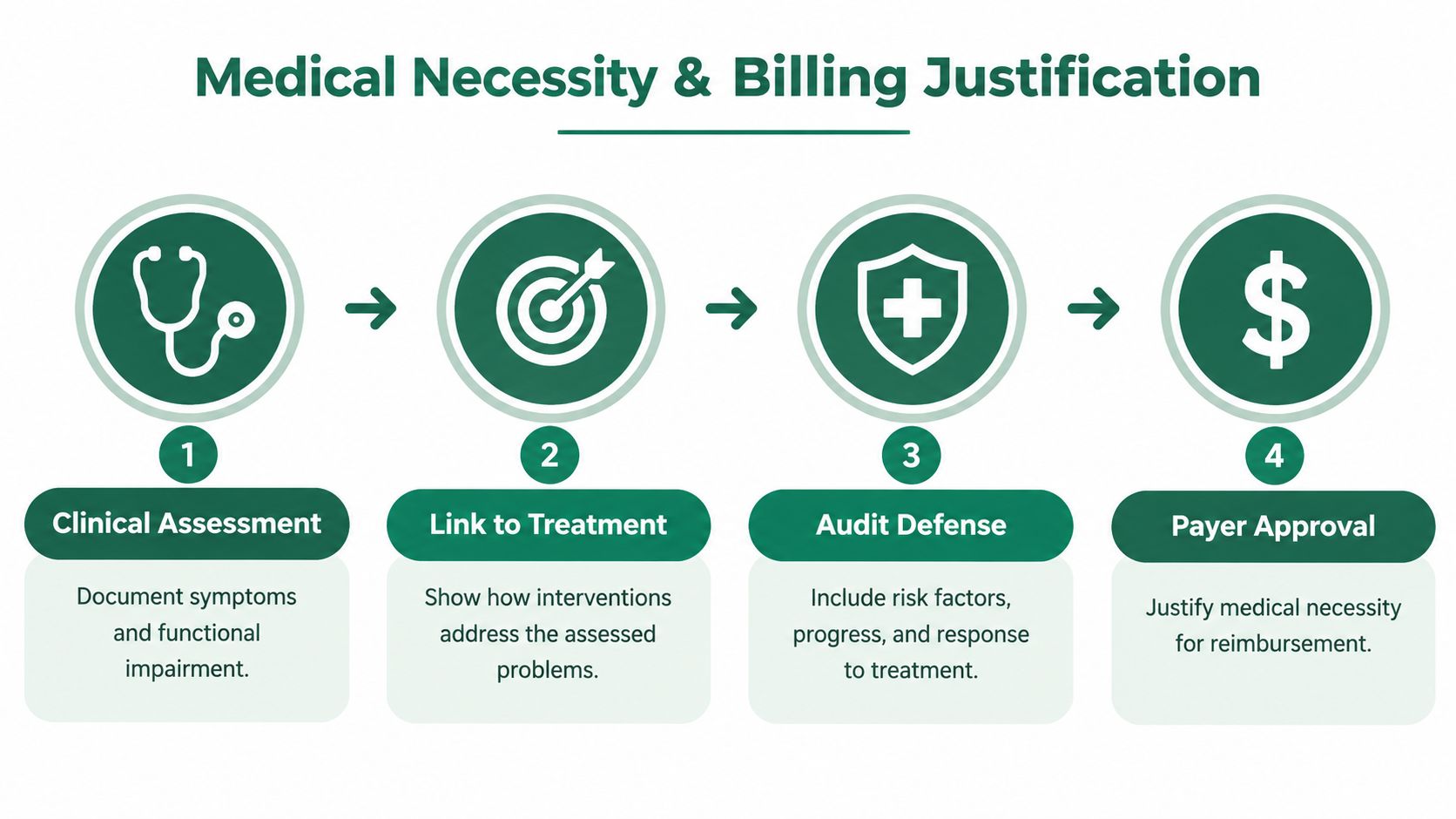
A polished summary can still fail an audit if it doesn't explain why the service was needed and how the intervention addressed the treatment-plan goal. Medical necessity becomes defensible when the note forms a continuous thread from presenting behavioral-health need, to intervention, to client response, to ongoing plan.
County training materials and behavioral-health documentation guidance emphasize the need to identify the service type, explain how the service addressed the behavioral-health need, and include date, duration, location, diagnoses or codes, and next steps (behavioral-health documentation best practices).
Build the golden thread
Start with the presenting status. What symptom, functional impairment, risk factor, or behavioral-health need required treatment today? Then name the intervention specifically. “Provided support” doesn't explain the clinical service. “Used cognitive restructuring to examine the client's catastrophic interpretation and generate an alternative response” gives the reviewer something to evaluate.
Next, document the response. Did the client identify a pattern, practice a skill, tolerate an avoided topic, engage in repair, or make a safety decision? Finally, connect the work to an active treatment-plan goal. The connection can be brief, but it must be visible.
Audit question: Could another clinician read the note and understand why this intervention was appropriate for this client on this date?
Use a fixed sequence
An audit-ready workflow follows a practical order: confirm client identifiers, record exact session start and stop times, document presenting status, name the specific intervention, capture the client's response, tie the intervention to at least one active treatment-plan goal, add a next-step plan, and sign with credentials (audit-ready progress note workflow).
Before signing, check for common failure points:
Vague interventions: Replace “processed feelings” with the technique or clinical action used.
Missing risk screening: State the relevant risk finding and document follow-up when risk is present.
Untimely signing: Complete and sign the note according to your practice and payer requirements.
Service mismatch: Make sure the service described matches the service billed.
Disconnected goals: Identify the active goal addressed during the session.
A superbill can summarize services for reimbursement, but it doesn't substitute for a progress note. Understanding what a superbill is for therapy helps clarify the difference between a billing document and the clinical record that supports the claim.
Documenting Mind-Body and Nervous System Interventions
A client may describe “blocked energy” or say their nervous system feels “healed.” Record the clinical meaning rather than repeating those phrases without context. Connect the intervention to observable symptoms, functional effects, clinical techniques, and client response.
For example, document the presenting change, your action, and the result: the client reported physical tension and difficulty staying engaged during a conflict discussion. You guided paced breathing, sensory orientation, grounding through contact with the chair, and a choice about continuing the topic. The client reported lower activation, resumed the discussion, and selected a coping practice for use between sessions.
Translate meaning into defensible clinical language
Whole-person work can retain the client's meaning when the note links that meaning to treatment.
Before: “Client released blocked energy and experienced spiritual healing.”
After: “Client identified chest tightness and shallow breathing while recalling the conflict. Therapist guided orientation to the room and attention to current sensory information. Client reported reduced activation, resumed the planned discussion, and connected the coping practice to sleep preparation.”
This translation identifies symptoms, technique, response, and function without requiring a reviewer to share the clinician's theoretical model. If you use movement, breathing, mindfulness, imagery, or sensory grounding, state how the method addressed the presenting need and an active treatment goal.
Document couples work with the interactional target, not only each partner's internal experience. For example, identify the escalation pattern, the communication intervention, each partner's response, and the agreed practice between sessions. For neurodivergent clients, distinguish regulation support from compliance. Record sensory conditions, communication preferences, pacing, or concrete choice-making when they affected participation or access to treatment.
Trauma-focused and nervous-system approaches also require scope and restraint. Describe what you observed and what the client reported. Avoid treating a metaphor, body sensation, or spiritual interpretation as an established physiological fact. A brief, concrete entry is more defensible than an elaborate account with no treatment connection.
Record time, modality, and service context
HIPAA guidance recognizes that mental-health documentation can include counseling session start and stop times, treatment modalities and frequencies, and related service information, making time and service specifics a normal part of the record (HHS guidance on mental-health information and HIPAA).
Include the modality used, the approximate focus, the client's response, and the service's relationship to the treatment plan. Clinicians developing this vocabulary may consult nervous system regulation therapy, while the progress note should remain specific to the session.
Streamlining Your Workflow for Supervision and Compliance
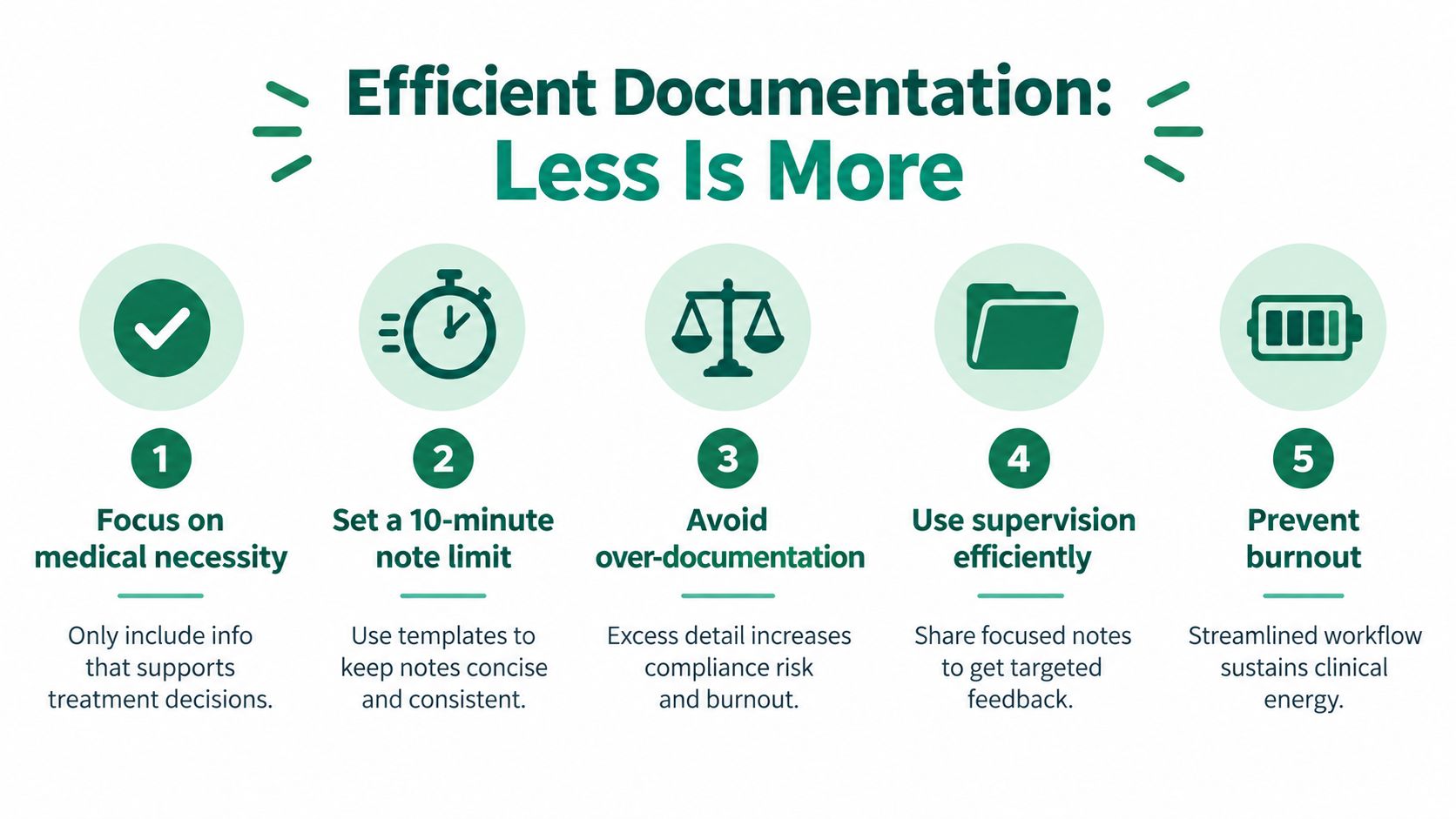
Long notes are not automatically stronger records. Documentation should remain clear, precise, and timely, because extra detail can increase review burden without improving clinical communication. The audit-ready note is concise, but it still shows why the service occurred and what followed.
Start before the session ends. Capture brief keywords during the encounter, then complete the structured note while the sequence is fresh. A consistent template should prompt the modality, clinical focus, client response, connection to the treatment goal, risk information, next step, credentials, and signature. This structure supports supervision without turning the record into a transcript.
Review the chart like a supervisor
Before supervision or consultation, read for a coherent clinical story. The record should make the presenting problem, selected intervention, client response, treatment goal, and unresolved clinical question easy to identify. Review whether the entry distinguishes relational work, neurodivergent access needs, or trauma pacing when those factors shaped the service.
A brief supervision exchange can expose an audit gap:
Intern: “I documented the grounding intervention and linked it to the trauma goal, but I did not record how the client responded.”Supervisor: “Add the client's reported or observed response, and state whether the plan continues, changes, or requires further assessment.”
That correction is more useful than checking whether a template was completed. It tests the link between clinical judgment and the record.
Bring one focused question to supervision, such as whether the treatment goal accurately reflects couples work or whether the pacing of trauma processing is appropriate. Do not use consultation time to read every line aloud.
Administrative support can protect clinical attention when duties are separated. A qualified patient intake coordinator may organize nonclinical intake logistics, while the treating clinician remains responsible for assessment, documentation, privacy, and final sign-off.
The efficient note is not the shortest note. It gives the next authorized reader enough information to understand the service without searching through a transcript.
Real-time completion, consistent templates, and timely signatures reduce reconstruction from memory. A workflow that routinely runs past session end is a workflow problem. Adjust the template, task division, or documentation timing before changing expectations.
Be Your Best Self & Thrive Counseling, PLLC provides individual and couples counseling for anxiety, depression, trauma, stress, and life transitions, along with clinician training, online education, and group consultation grounded in ethical, integrative practice. Visit Be Your Best Self & Thrive Counseling, PLLC to explore client services or professional resources that support thoughtful, defensible care.