
Therapy for Complex Trauma Healing Beyond Survival
You're safe at home, yet a delayed text, a tense conversation, or an ordinary mistake suddenly sends your body into panic, numbness, anger, or the urge to disappear. You may understand that the present moment isn't the past, but your reactions can feel faster and stronger than your reasoning. After repeated or prolonged trauma, that conflict can become an everyday experience.
Therapy for complex trauma offers more than a list of techniques. It creates a paced pathway from survival toward mind-body-spirit reintegration, helping you build safety, process what happened without being overwhelmed, and reconnect with identity, relationships, meaning, and choice. The approach can be evidence-informed while still honoring practical, relational, and whole-person healing.
When Past Wounds Keep Showing Up in Present Life
Consider someone who grew up needing to monitor a caregiver's mood. As an adult, they may reread a partner's short message, apologize before anyone has accused them of wrongdoing, or work relentlessly to prevent conflict. Another person may feel detached during joyful moments, struggle to name what they want, or become intensely alert whenever someone sounds disappointed.
These responses can look confusing from the outside. Inside, they often make sense as survival patterns that once served a purpose. A child who learned to stay quiet, please others, scan for danger, or disconnect from feelings wasn't failing at healthy coping. They were adapting to conditions they couldn't control.
Complex trauma can continue to shape present life even after the danger has ended. The body may react to reminders, relationships may feel unsafe, and self-criticism may sound like an internal fact rather than an old message. You might recognize yourself in this guide to signs of unresolved childhood trauma in adults, but recognition alone doesn't require you to diagnose yourself.

Image caption: A quiet moment of reflection can be part of noticing how past experiences still affect present-day safety and connection.
Healing needs more than insight
Talking about the past may help, but complex trauma often involves emotional regulation, bodily responses, self-concept, and relationships. A person may know intellectually that they deserve respect and still feel compelled to earn love. They may understand a boundary in theory yet freeze when trying to express it.
That's why a trauma-informed therapist often combines conversation with grounding, pacing, body awareness, relational work, and carefully chosen trauma-processing methods. The work isn't about forcing a memory open. It's about helping you develop enough internal and external support to approach difficult material with choice.
This guide is for adults seeking holistic care and for clinicians wanting a clearer view of phased treatment. It will explain what complex trauma is, how the three healing phases work, how evidence-based and mind-body approaches differ, what safety tools may look like in practice, and how to choose a therapist who respects your pace.
Understanding Complex Trauma and How It Differs
A single assault, serious accident, or disaster can leave a person feeling unsafe long after the event ends. Complex trauma usually refers to repeated or prolonged traumatic experiences, often within relationships or circumstances where escape, protection, or dependable support were unavailable. This distinction does not rank one person's pain against another's. It helps clinicians see why healing may involve more than reducing distressing memories.
The nervous system works like an alarm system. After one threat, it may stay sensitive for a time and gradually reset. When danger continues, the alarm can learn that constant readiness is necessary. Later, a neutral expression, raised voice, or uncertainty in a relationship may trigger the same protective response, even when the current setting is safer. A simple explanation of this mind-body process appears in this guide to polyvagal theory.
Complex trauma can influence several connected areas:
Emotional regulation: Feelings may become overwhelming, hard to identify, or strangely absent.
Self-perception: Shame, guilt, worthlessness, or a lasting sense of being defective may feel familiar.
Relationships: Trust, boundaries, conflict, closeness, and fear of abandonment can become difficult to manage.
Threat responses: A person may fight, flee, freeze, comply, overfunction, withdraw, or move quickly between these states.
Body experience: Tension, numbness, agitation, fatigue, and disconnection can make the body feel unfamiliar or unsafe.
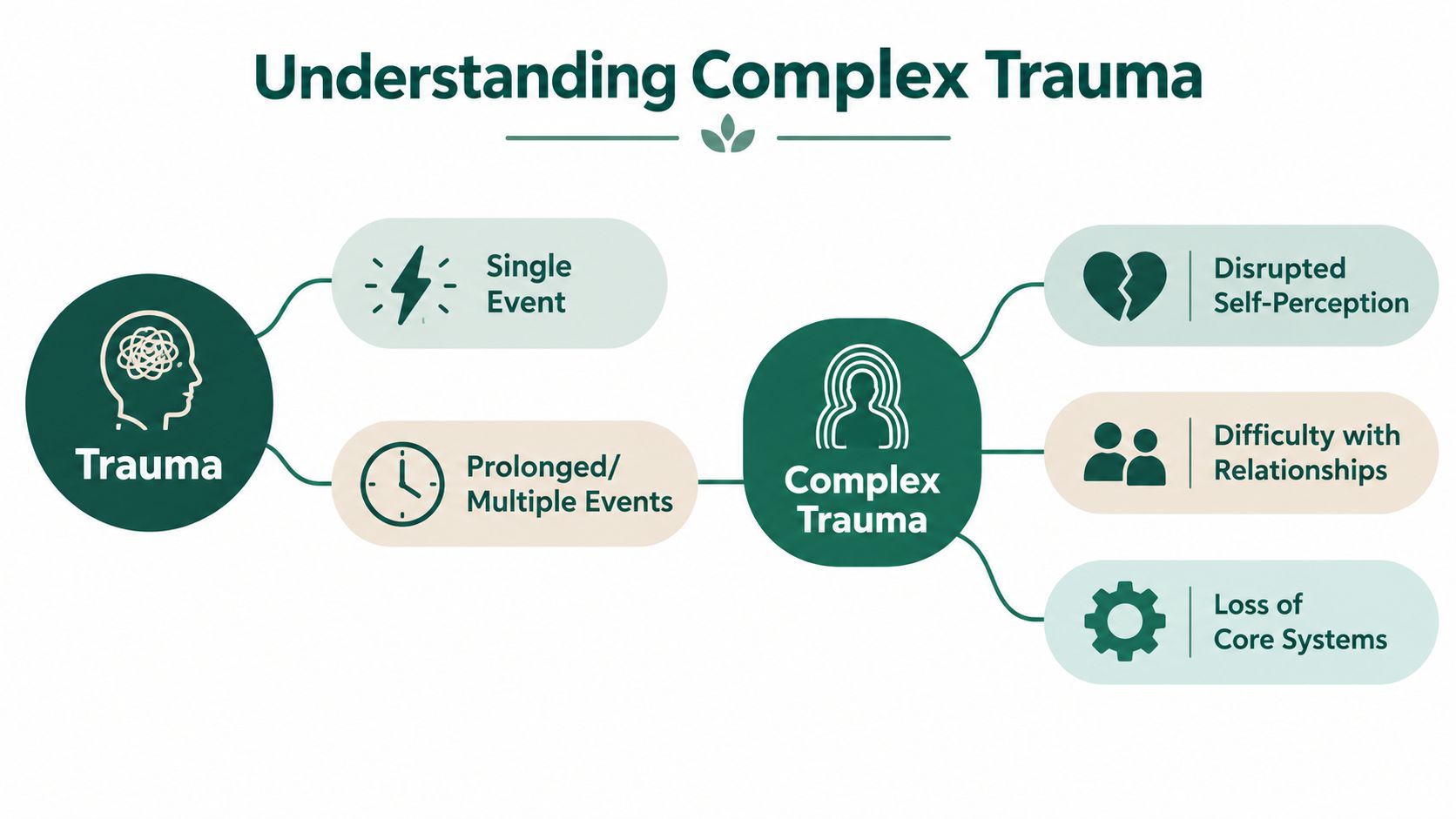
Infographic caption: A concept map shows how trauma can develop from a single event or prolonged, multiple events, with complex trauma affecting self-perception, relationships, and core systems.
Why exposure alone doesn't explain the whole picture
Research indicates that 70.4% of people worldwide experience at least one traumatic event during their lifetime, while many do not develop PTSD according to the cited review. Exposure alone does not determine the outcome. Timing, repetition, interpersonal power, available protection, and individual vulnerability all shape how someone adapts.
Complex trauma is not a checklist. Similar experiences can lead to different patterns, and similar symptoms can have different causes. A qualified clinician considers a person's history, present safety, functioning, relationships, body experience, and goals before suggesting treatment.
A whole-person formulation asks: What helps this person stay present? Which protective response appears most often? What beliefs about self and others keep the pattern going? Which values, spiritual resources, relationships, and strengths can support recovery? These questions connect practical safety work with mind-body-spirit reintegration.
The Three Phases of Healing in Complex Trauma Therapy
Modern complex trauma care commonly uses a three-phase sequence:
Phase 1, safety and stabilization
Phase 2, trauma processing
Phase 3, reintegration and reconnection
This framework became more visible through professional guidance in the 2010s and continues to shape practice. A foundational practice guideline for complex trauma describes phased care because many clients need regulation skills and reliable safety before direct trauma work can be helpful.
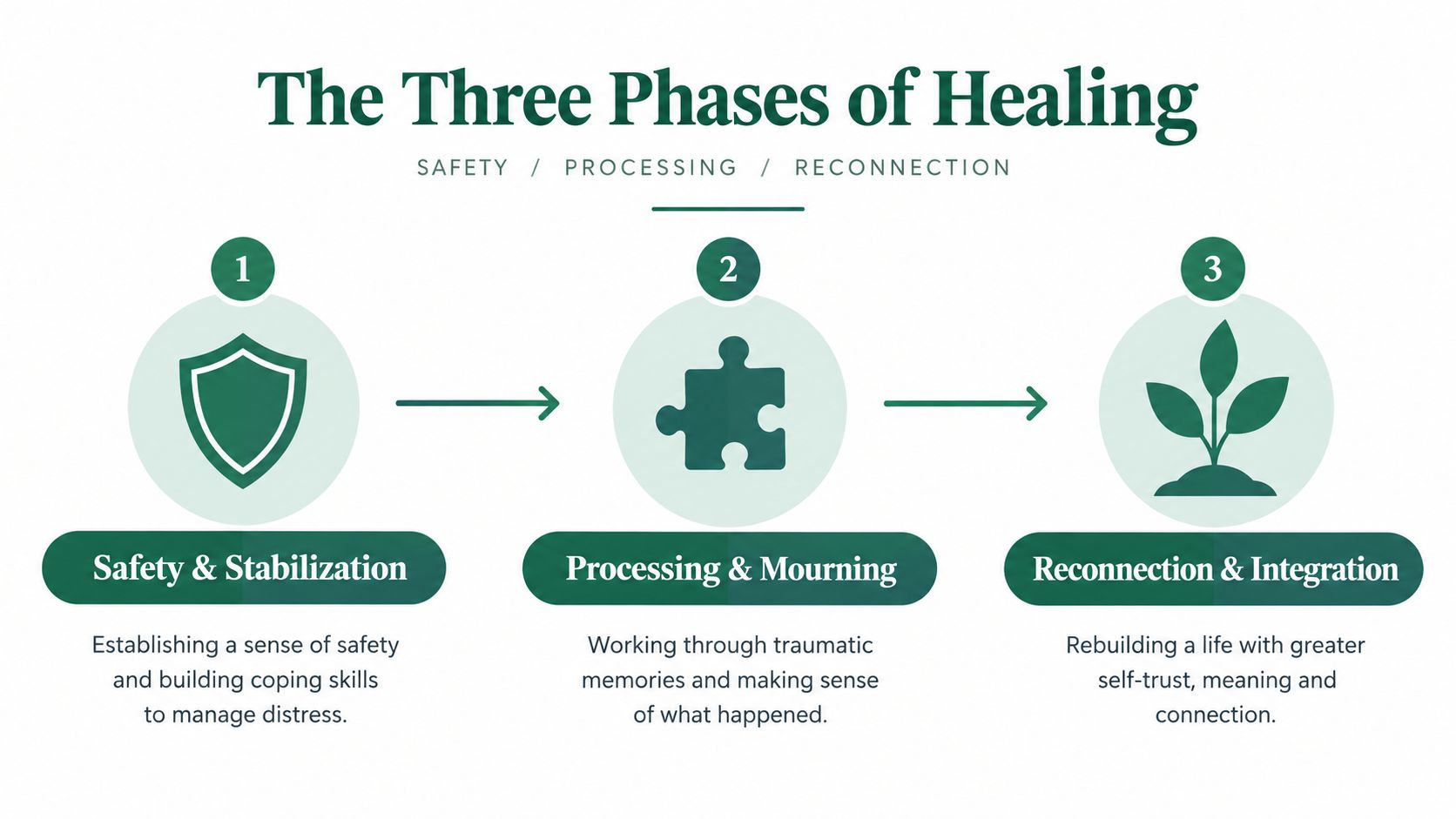
Infographic caption: The three-phase pathway moves from safety and coping skills, through supported processing, toward reconnection and an integrated life.
Phase 1 builds a platform for choice
Safety doesn't mean you'll never feel activated. It means you're developing ways to notice activation, reduce escalation, and return to the present. Therapy may focus on grounding, emotional regulation, sleep routines, boundary awareness, crisis planning, supportive relationships, and identifying situations that increase risk.
A therapist might help you recognize early signs such as clenched muscles, racing thoughts, people-pleasing, or mental blankness. You'll practice responding before the reaction reaches its most intense point. Readiness for deeper processing isn't measured by perfection. It's reflected in growing capacity to pause, communicate needs, recover after activation, and remain connected to the present.
Phase 2 approaches memories with care
Trauma processing can involve EMDR, cognitive methods, exposure-based work, narrative approaches, or other structured interventions. The therapist helps you approach memories, meanings, body sensations, and emotions in manageable portions rather than flooding you with the entire history at once.
Pacing matters: The aim isn't to relive everything as intensely as possible. It's to process enough that the memory becomes part of your history rather than an ongoing emergency.
Phase 3 supports a fuller life
Reintegration involves relationships, identity, purpose, creativity, sexuality, work, community, and spiritual or existential meaning. You may practice receiving care, making decisions from present values, grieving what was lost, or building routines that reflect who you are now.
The phases can overlap and repeat. A difficult life event may call for renewed stabilization after meaningful processing. Good therapy remains collaborative, flexible, and responsive instead of treating the framework like a rigid staircase.
Evidence Based Therapy Options and How They Help
No single approach fits every complex trauma presentation. The most useful question is often, Which difficulty is most disruptive right now, and what method can address it without exceeding the person's capacity?
Evidence remains strongest for established trauma-focused approaches, including cognitive processing therapy, prolonged exposure, and trauma-focused CBT, as summarized in APA guidance on PTSD treatment. A systematic review of ICD-11 complex PTSD treatments reported superior PTSD outcomes compared with usual care for CBT, exposure alone, and EMDR, with effects reported as g = -0.90 for CBT, g = -1.06 for exposure alone, and g = -1.26 for EMDR in the published review. These results don't mean one therapy is universally superior. They support thoughtful matching and competent delivery.
Therapy Approach | Primary Focus | Best When This Is Prominent |
|---|---|---|
EMDR | Reprocessing distressing memories with structured bilateral stimulation and preparation | Intrusive memories, triggers, vivid body responses, and distress linked to specific experiences |
Cognitive Processing Therapy | Examining trauma-related beliefs and meanings | Shame, guilt, self-blame, mistrust, and rigid conclusions about safety or responsibility |
Trauma-focused CBT and exposure approaches | Learning new responses while approaching avoided memories, situations, or meanings | Avoidance, persistent threat, fear conditioning, and difficulty returning to valued activities |
DBT skills | Emotion regulation, distress tolerance, mindfulness, and interpersonal effectiveness | Rapid emotional shifts, impulsive coping, self-harm risk, or relationship conflict |
Somatic, sensorimotor, and mindfulness-based approaches | Increasing awareness of bodily cues and expanding regulation choices | Numbness, tension, dissociation, difficulty identifying feelings, or body-based distress |
Relational and integrative therapy | Exploring attachment patterns, boundaries, identity, and connection | Negative self-concept, relational disturbance, chronic people-pleasing, or isolation |
For readers who want a plain-language explanation of one structured method, this resource on how EMDR therapy works can make the process less mysterious. Trauma-informed care also includes the way therapy is offered, not only the named modality. A practical trauma-informed care guide by Zoe Behavioral Health can help you think about choice, collaboration, trust, and power in treatment.
Where holistic approaches fit
Mind-body and integrative methods may support regulation, self-compassion, self-concept, and interpersonal functioning. They can be valuable additions, particularly when a person feels disconnected from bodily signals or finds purely verbal work limiting.
The evidence for newer options remains early. APA coverage states that MDMA-assisted therapy and ketamine don't yet have enough evidence for recommendation, while a later review describes promising findings for MDMA-assisted psychotherapy, ketamine, virtual reality, and digital delivery alongside small samples, methodological limitations, and limited direct comparison with established treatments. “Holistic” shouldn't be used as a substitute for careful assessment, informed consent, or evidence-aware planning.
What to Expect in Therapy and Safety Tools You Will Learn
A first appointment may begin with why you are seeking help, current symptoms, relevant history, relationships, safety concerns, strengths, and hopes. You do not need to tell your entire story in vivid detail before trust has formed. A trauma-specialized therapist should explain the purpose of questions, invite you to pause, and work with you to decide what information is useful now.
Infographic caption: Therapy may include assessment, collaborative goals, trauma education, gradual processing, grounding, regulation, visualization, and distress-tolerance practice.
The early work is practical
Phase 1 can seem quieter than trauma processing, yet it may change how you move through ordinary days. You might learn to:
Orient to the present: Name the date, location, and visible objects when an old memory feels immediate.
Use sensory grounding: Notice your feet against the floor, the temperature of a cup, or several sounds nearby.
Practice paced breathing: Let the exhale lengthen gently, without forcing deep breaths or ignoring discomfort.
Build a safe-place image: Create a detailed mental or sensory representation of a place, person, animal, or activity connected with steadiness.
Track your window of tolerance: Notice rising activation or shutdown, then adjust the pace before overwhelm.
Strengthen relational skills: Practice saying “I need a pause,” asking for clarification, setting a limit, or receiving support without apologizing immediately.
You can explore more examples in this resource on distress tolerance techniques. These practices are not meant to erase difficult emotions. They help you remain connected to yourself while feelings pass through your body and mind.
Titration and resourcing protect the process
Titration means approaching painful material in small, manageable amounts. You might briefly touch a memory, notice a body sensation, return to a present-moment anchor, and then decide whether to continue. Resourcing strengthens access to internal, relational, sensory, or spiritual experiences that support steadiness, helping mind, body, and meaning reconnect at a tolerable pace.
A useful question: “Can I stay connected to the present while noticing this?”
Your therapist should monitor your responses and welcome feedback. Feeling pressured to disclose, repeatedly leaving sessions destabilized without a plan, or being told that distress proves therapy is working are reasons to slow down and reassess.
Sustained participation can affect how trauma treatment unfolds. Research reviews have found that some participants leave treatment before completion, which is one reason alliance, pacing, practical support, and shared decision-making deserve attention from the beginning. These findings do not predict your outcome. They point instead to the value of a therapy relationship where safety, consent, and the whole person remain part of the plan.
How to Choose a Trauma Specialized Therapist
A therapist's modality matters, but clinical fit and trauma-specific judgment matter just as much. Look for a licensed professional who has training in trauma treatment and experience with prolonged, interpersonal, developmental, or complex presentations. Ask whether they understand stabilization, dissociation, attachment injuries, emotional regulation, and the effects of trauma on self-concept and relationships.
A consultation should feel like a two-way conversation. You're evaluating the therapist, not auditioning for care.
Questions worth asking
Treatment planning: “How would you decide whether to begin with stabilization or trauma processing?”
Pacing: “What do you do if I become overwhelmed, numb, or disconnected during a session?”
Experience: “Have you worked with complex trauma, childhood trauma, relationship trauma, or medical trauma?”
Integration: “How do you include body awareness, values, spirituality, or meaning if those are important to me?”
Collaboration: “How will I know what we're working on, and how can I ask to slow down?”
Access: “Do you offer in-person sessions in St. Petersburg or the Tampa Bay area, virtual support, or intensives?”
Green flags include transparency, respect for consent, clear explanations, cultural humility, attention to current safety, and willingness to adapt. Red flags include promises of guaranteed rapid healing, pressure to describe traumatic events before you're ready, dismissing your concerns, or presenting one method as the answer for everyone.
You can use this trauma-informed therapist guide to refine your questions before a consultation. For local adults, Be Your Best Self & Thrive Counseling, PLLC offers individualized counseling with evidence-informed, mind-body-spirit care, including support for trauma-related patterns and practical regulation skills. Clinicians may also look for training and consultation that deepen ethical, integrative practice.
Your Path Forward With Sustainable Healing and Support
Healing from complex trauma rarely follows a perfectly straight line. You may feel more grounded in one area while another relationship, anniversary, transition, or loss brings old patterns close again. That doesn't erase progress. It gives you information about where support and practice are still needed.
Sustainable progress may look quieter than a dramatic transformation. You might recover sooner after conflict, recognize a trigger before reacting, set a boundary without lengthy justification, choose a supportive relationship, or experience pleasure without immediately bracing for something to go wrong. Over time, therapy can help you develop self-compassion, resilience, emotional flexibility, healthier relationships, and a more coherent sense of identity.
The timeline depends on your history, current circumstances, goals, support, safety, and treatment fit. A careful therapist won't promise a fixed schedule. They'll help you define meaningful markers, review what's helping, and adjust when the work becomes too intense or too disconnected from daily life.
Support outside sessions can include trusted relationships, community, creative expression, restorative routines, spiritual practice, movement that feels safe, and continued use of grounding skills. If you're in immediate danger or considering harming yourself, contact local emergency services or a crisis resource in your area rather than waiting for a therapy appointment.
Healing isn't about pretending the past didn't happen. It's about allowing the past to become one part of your story while your present choices, relationships, body, values, and hopes become available again.
Be Your Best Self & Thrive Counseling, PLLC offers compassionate individual and couples counseling for trauma, anxiety, depression, stress, and life transitions, with personalized mind-body-spirit support and practical stabilization tools. Visit Be Your Best Self & Thrive Counseling, PLLC to explore a free initial consultation and discuss whether phased therapy for complex trauma fits your needs.