
Counseling Supervision Models: Five Options Compared
You've brought a difficult case to supervision, along with a progress note and the uneasy feeling that you missed something. Your supervisor asks how the session went. You can describe it, but you're less sure what should happen next: instruction, reflection, a recording review, or help deciding whether your treatment plan makes sense.
Counseling supervision models give that meeting a clearer purpose. The useful question isn't which model sounds most advanced. It's which approach fits this clinician, this client situation, and the change you need to see in practice.
Five Counseling Supervision Models Side by Side
A first-semester practicum student sits down and asks what the supervisor is supposed to do. The practical answer is to choose a way of working that makes the student's next clinical decision safer, clearer, and more independent.
That might mean demonstrating a skill, examining an emotional reaction, or watching the student work. Although developmental, integrated, competency-based, reflective, and live supervision offer useful starting points, Bernard's Discrimination Model deserves its own row because it helps supervisors choose their response in the moment.
Counseling supervision models compared
Model | Core focus | Supervisor role | Main limitation |
|---|---|---|---|
Developmental | Growth through stages from dependence to independence | Shifts from instructor to consultant as trainee advances | Stage labels can hide differences in learning style |
Integrated | Combines theory, process, culture, ethics, and the person | Blends instruction, reflection, and consultation | Requires supervisors trained in several orientations |
Discrimination (Bernard) | Intervention, conceptualization, and personalization | Teacher, counselor, or consultant, chosen by the session's need | Roles must be diagnosed each time rather than followed in sequence |
Competency-based | Observable skills measured against written standards | Evaluator who sets measurable goals | Can miss relational process if used alone |
Reflective practice | Self-awareness, countertransference, and reasoning | Facilitator who prompts reflection | Gives less direct correction of technique |
Live supervision | Real-time observation and coaching during sessions | Observer or coach in the room or on a feed | Requires client consent and can interrupt the session |
Most programs blend several approaches rather than use one exclusively. Use the comparison to decide which approach should anchor the supervision plan, with others supporting a specific learning need.
Separate the Model From the Meeting Format
A group meeting isn't automatically reflective supervision, and a video call isn't automatically live supervision. Group and individual describe who attends; live supervision means the supervisor observes or coaches while clinical work happens.
Likewise, a competency checklist can support a developmental plan without replacing it. When comparing mental health training programs, look for an explanation of what supervisors observe, teach, and evaluate, not just a list of model names.
Find the row that most closely matches your trainee's current level of independence before choosing the approach you'll use.
Developmental and Integrated Models Explained
A first-semester student may need direct instruction and sample language for opening a session. A second-year intern may benefit more from consultation questions that require them to explain their choices. Training year is a starting clue, not a substitute for examining the clinician's work.
Developmental supervision adjusts structure, challenge, autonomy, and reflection as the supervisee develops. The structure works like scaffolding around a building: you remove pieces as the clinician's own judgment starts bearing weight, not according to a fixed schedule. You don't remove support just because someone has accumulated experience; you change support when their clinical judgment warrants it.
Match the Supervisor's Move to Development
Developmental frameworks share one core idea: supervisees move from dependence on the supervisor toward self-directed, self-aware practice. Use these working distinctions to plan your response:
Early in training: Provide structure, demonstrate skills, and make expectations concrete. Ask the trainee to rehearse an opening rather than merely promise to feel more confident.
Gaining independence: Ask for the trainee's proposed plan before offering yours. Help them explain uncertainty without treating every question as evidence of incompetence.
Mostly independent practice: Challenge the reasoning behind complex decisions. Invite alternative explanations and ask what evidence would change the treatment plan.
Advanced practice: Emphasize consultation, reflection, and refinement of professional judgment rather than routine instruction.
Don't confuse a developmental label with a learning preference. Trainees at a similar stage may need different teaching methods, such as a visual case map, spoken rehearsal, or written feedback.
Treat the label as a hypothesis, too. Research has not shown that one supervision model produces better client outcomes than another, so the only way to know whether your scaffolding adjustments work is to track change yourself: fewer missed risk questions, clearer case conceptualizations, less prompting needed week over week.
Practical rule: Adjust the amount of direction to the clinical task, not just the trainee's overall confidence.
Add an Integrated Lens
Integrated supervision brings theoretical orientation, client complexity, ethics, culture, and the clinician's personal style into the discussion. It can also examine parallel process, when a relational pattern in therapy appears again between trainee and supervisor.
Say a trainee working with a couple asks why you keep returning to cultural background. Explain the clinical reason: before labeling one partner's silence as avoidance, explore what silence means to that person, how power operates in the relationship, and whether your preferred intervention fits their values.
You might also notice the trainee agreeing with you as quickly as one partner agrees with the other. Explore that possibility without declaring the situations identical. A trauma-informed supervision approach can help you keep challenge collaborative rather than coercive.
For the next meeting, assign each trainee a provisional developmental stage based on observed work. Then select integrative questions about culture, ethics, or relational patterns that could deepen the case discussion.
Bernard's Discrimination Model and Its Three Roles
After a session, ask yourself: What did the trainee do, how did they understand the client, and what did they bring of themselves? Those questions help distinguish a technique problem from a reasoning problem or a personal reaction.
The counselor supervision text hosted by Liberty University explains Bernard's Discrimination Model through three supervisor roles, teacher, counselor, and consultant, and three skill areas, intervention, conceptualization, and personalization.

Caption: A supervisor and trainee examine clinical work and choose the role that fits the learning need.
Choose a Role, Then a Focus
As teacher, you supply instruction, modeling, structure, and direct feedback. As counselor, you help the supervisee examine emotional experiences and internal reactions that affect clinical work. As consultant, you support independent judgment and problem-solving.
The counselor role doesn't turn supervision into personal therapy. Keep exploration connected to the trainee's clinical responsibilities, and maintain a clear boundary around personal treatment needs.
The focus tells you what you're working on:
Intervention: Observable counseling behavior and delivery of techniques.
Conceptualization: How the trainee understands client material and selects an intervention.
Personalization: How the trainee uses themselves while managing bias, personal concerns, and countertransference. Countertransference means the clinician's emotional responses to the client, including responses shaped by their own history.
Recognize the Need in a Clinical Moment
A trainee freezes during a risk conversation. Start with an intervention focus and a teacher role. Model clear assessment language, have the trainee rehearse it, and correct omissions rather than offering reassurance alone.
A trainee misreads a family's dynamics. The focus is conceptualization. You might consult by asking them to compare competing explanations, or teach if they lack a framework for understanding family interactions.
A trainee feels compelled to rescue a client. Use a personalization focus and the counselor role to explore how that urge affects boundaries and treatment choices. Then help the trainee plan a response that supports the client's agency.
Roles and foci combine; they aren't a sequence to complete. Before the next supervision session, identify the most likely focus and choose your opening role, while remaining ready to change it when the trainee presents new information.
Competency-Based, Reflective and Live Supervision in Practice
Verbal case reports mostly sample what the trainee thinks happened. Recordings, live observation, and standardized-patient exercises, where someone portrays a client for training, make counseling behavior available for review.
Competency-based supervision compares that behavior with written standards for alliance building, empathy, risk assessment, cultural responsiveness, and intervention fidelity. Fidelity means delivering an intervention consistently with its intended method, not naming the approach in a note.
Make Learning Observable
A randomized trial comparing video-based and verbal-report supervision found that both approaches improved therapist competence, therapeutic alliance, and empathy, with no significant between-group difference. Observation is useful, but a recording alone doesn't guarantee better supervision.
The review of evidence-based-practice supervision describes gains in knowledge, attitudes, and treatment fidelity after training across participants, with subsequent improvement occurring specifically in the group receiving supervision; it also summarizes a 21-study motivational interviewing meta-analysis in which therapists without post-training feedback or coaching lost skill over six months, while those receiving ongoing support gained slightly. The same review describes incremental improvement across three supervision meetings using session review, modeling, role-play, and corrective feedback, and a distance-supervision meta-analysis covering 2000 through 2018 that found no statistically significant format differences in satisfaction, supervisory alliance, or competency.
The practical implication is to build active learning into the meeting, whether you're together in person or online. For help translating broad learning aims into observable performance expectations, LearnStream's guide to competency-based training offers a useful framework to adapt, while retaining clinical and ethical standards.
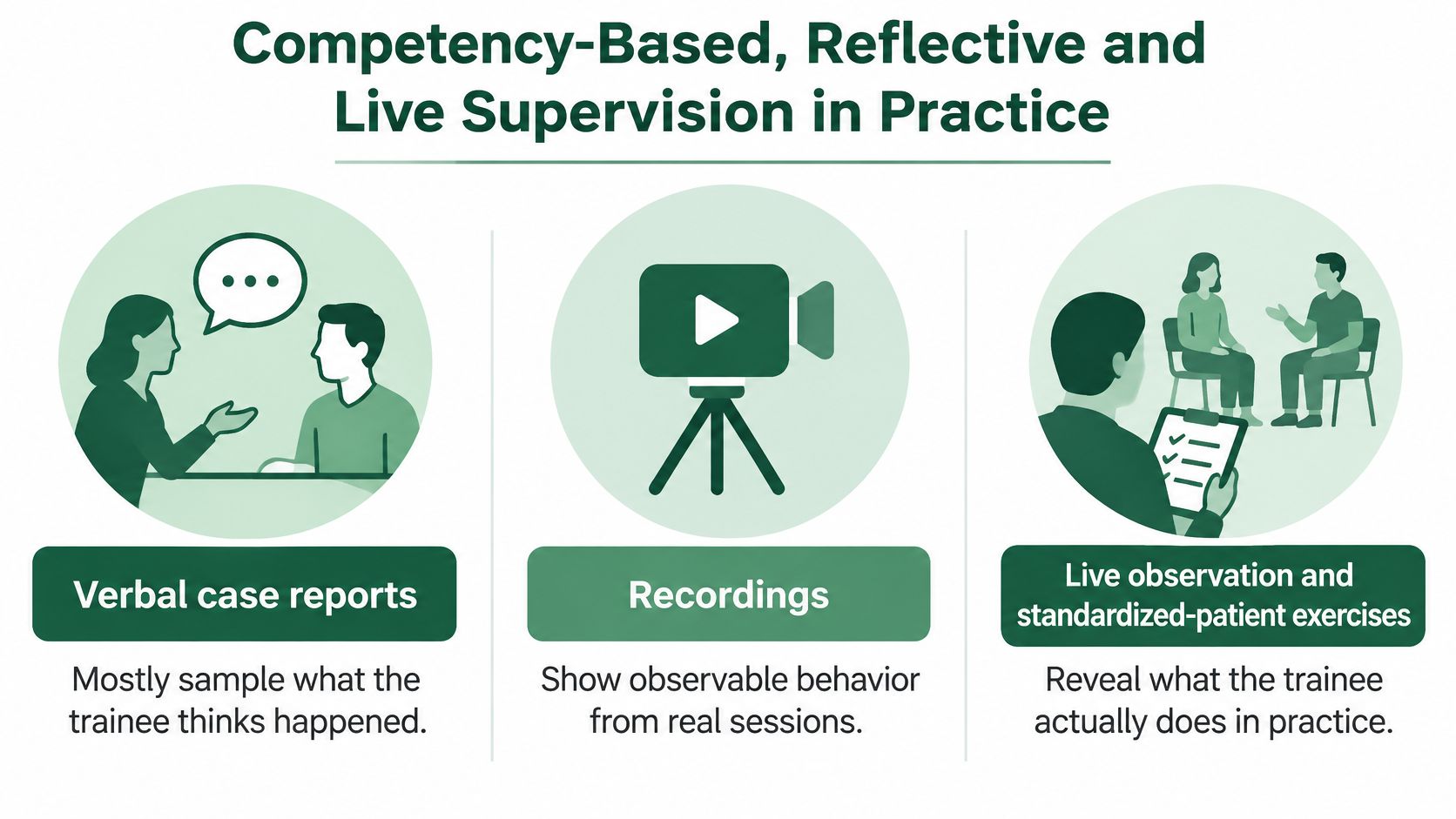
Caption: Case reports describe the trainee's understanding; recordings and observation make clinical behavior available for closer examination.
Pair Reflection With Correction
Reflective practice uses journaling and case discussion to examine reasoning and emotional reactions. Ask the trainee to distinguish what they observed, what they inferred, and what they felt compelled to do.
Live supervision places an observer or coach alongside the clinical encounter, physically or through an agreed feed. Establish client consent, privacy protections, and how coaching will occur before the session begins.
Use this practice cycle:
Select the targets. Choose two or three observable competencies for the review cycle.
Collect direct evidence. Review a consented recording, observe practice, or use a simulated encounter.
Specify the next action. Turn feedback into one measurable next-session goal, such as summarizing the client's concern and checking whether the summary fits.
Use therapy progress notes to examine documentation and clinical reasoning, but don't treat a polished note as proof that the counseling skill occurred.
Matching a Model to Trainee Level and Setting
Research hasn't established that one named counseling supervision model produces better client outcomes. A model label is therefore a planning tool, not a guarantee of clinical results.
A systematic review and meta-analysis indexed by OUCI identified 32 psychotherapy-supervision studies, with 13 suitable for quantitative analysis, and found a small, non-significant effect on client symptom reduction. Effects on therapist competence and therapeutic alliance were stronger against passive controls, while adherence findings were heterogeneous.
Start With a Provisional Match
Use the following as a decision aid, not a placement rule. A licensed clinician learning an unfamiliar intervention may need direct skills coaching, while an intern may already show sound judgment in a familiar area.
Supervision model by trainee level and setting
Trainee level | Model emphasis | Typical setting | Evaluation focus |
|---|---|---|---|
First-term practicum | Live or recorded observation with competency checklist | University or training clinic | Alliance, empathy, and risk screening |
Mid-program intern | Developmental supervision with discrimination-model roles | Agency or group practice | Intervention and conceptualization accuracy |
Licensed clinician | Reflective and integrated supervision | Private practice or group consultation | Case conceptualization, countertransference, and cultural accountability |
Setting changes what you can arrange. In an agency, plan around access to private meeting space and approved recording systems; in consultation, clarify whether you're offering developmental guidance or conducting a formal performance evaluation.
Our owner and founder has extensive experience and training in therapy and individually trains and supervises all clinical team members. That individualized attention matters because a clinician's needs can't be inferred from professional title alone. Keep licensed therapist requirements separate from your judgment about the learning task.
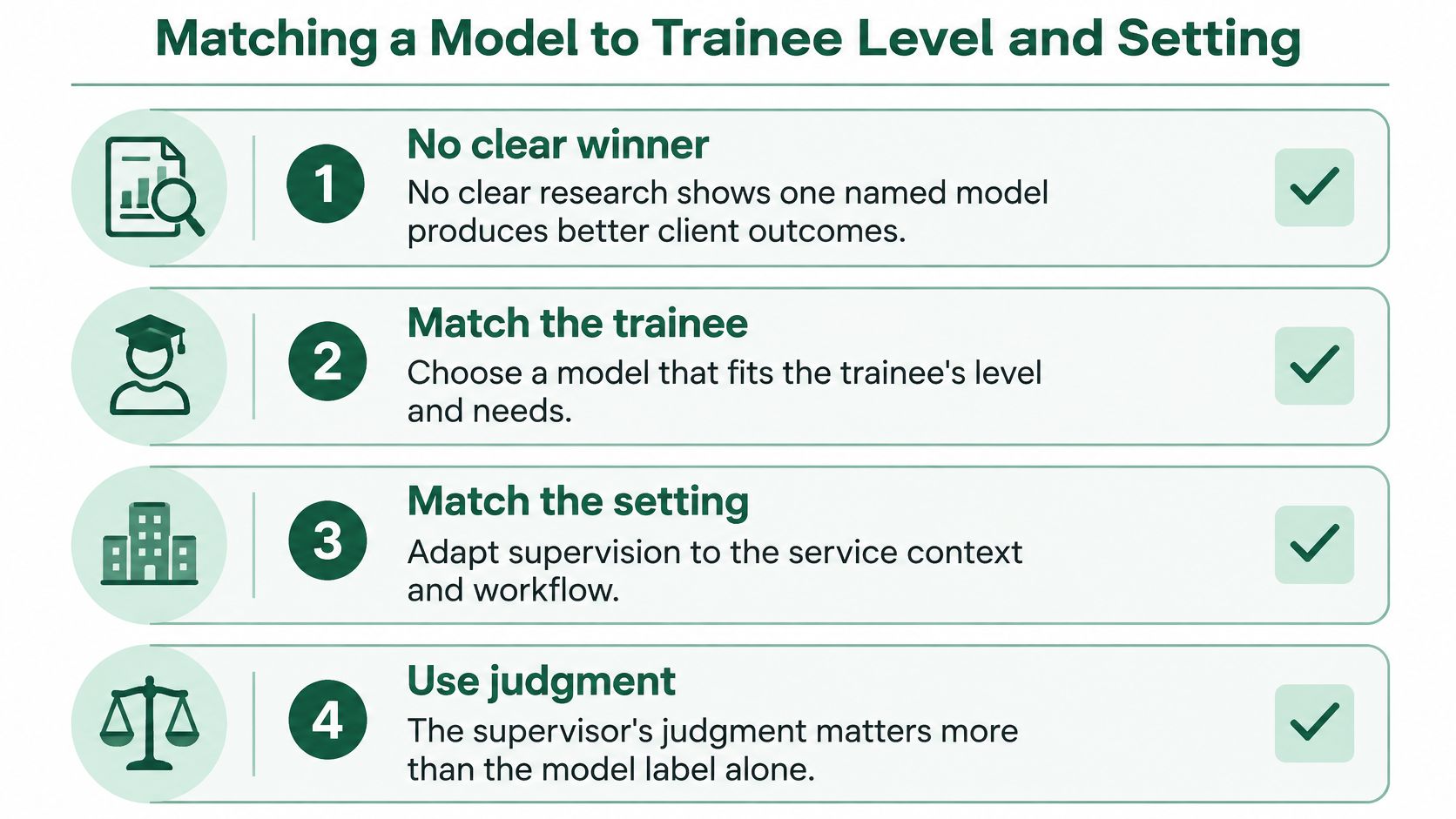
Caption: Select a supervision approach by considering the trainee, service setting, and evidence of progress rather than the model label alone.
Complete a Trainee-Specific Decision Checklist
For each supervisee, write down:
Supervisee level: What can this clinician currently do independently, and where do they need direction?
Client population: Which cultural, relational, accessibility, or developmental considerations affect the work?
Presenting problem: What clinical difficulty needs attention now?
Supervision goal: Choose skills coaching, case conceptualization, relational processing, cultural accountability, or therapist wellness as the immediate priority.
Measured outcome: What evidence would show that your chosen emphasis helped?
Collect multisource feedback, meaning perspectives from the supervisee, supervisor, and other appropriate contributors. Combine it with client measures, consented recorded-session review, and supervisee self-assessment.
Don't count agreement with the supervisor as evidence of growth. Look for a defensible change in clinical reasoning or behavior.
If the trainee rates their empathy highly but the client reports feeling misunderstood, examine that discrepancy together. Use it to select the next learning task rather than deciding that either person must be wrong.
Using Generative AI Without Losing Clinical Judgment
Generative AI creates a supervisory question that model names alone can't resolve: is the trainee using a tool to examine their thinking, or to avoid doing the thinking?
Recent scholarship on AI in clinical supervision recommends human supervisory authority, informed consent, privacy protection, and attention to equity, while noting that empirical comparisons of AI-augmented and traditional supervision remain absent. Treat AI output as material for discussion, not clinical authority.
Preserve an Independent Clinical View
Use a documented sequence:
Write independently. The supervisee prepares a case conceptualization before opening an AI tool.
Check permission and privacy. Use a de-identified prompt only when organizational policy, consent, and privacy safeguards permit it. Removing a name alone may not prevent identification.
Preserve the output. Save the response without editing away mistakes or uncomfortable assumptions.
Compare in supervision. Examine both versions for reasoning gaps, unsupported recommendations, bias, and cultural responsiveness.
Say an output interprets a neurodivergent client's communication difference as resistance. Ask what evidence supports that interpretation, what alternatives were omitted, and how the recommendation might affect the client.
For nonclinical orientation materials, AI strategies for developing onboarding content from VideoLearningAI offers a separate administrative use case to consider. Keep drafting generic training content distinct from processing confidential clinical material.
Boundary check: If the trainee can repeat a recommendation but can't explain or challenge it, pause before applying it.
Don't enter identifiable client material or use AI as the decision-maker for urgent risk management. Record which version the trainee's final decision followed, what they rejected, and why their clinical reasoning supports that choice.
Set Your Supervision Plan for the Next Cycle
A useful supervision agreement should let the trainee predict how learning, accountability, and evaluation will work. It should also let you explain a performance judgment without relying on a general impression.
The ethical foundations of clinical supervision chapter explains that the American Counseling Association's framework calls for regular, constructive, and fair evaluations using clear criteria connected to professional development. Build those expectations into the written plan before a concern becomes a dispute.
Put the Agreement Into Writing
Include these elements:
Model or combination: Name the primary approach and when you'll use another.
Explicit competencies: Define the behavior or reasoning you expect to see.
Ethical structure and role clarity: Explain confidentiality limits, responsibilities, consultation procedures, and how concerns will be addressed.
Evidence sources: Identify consented recordings, live observation, practice exercises, or other appropriate material.
Meeting schedule: Specify when supervision occurs and how urgent concerns are raised.
Review date: Set a review point appropriate to the trainee's developmental needs.
Keep formative feedback, which supports learning, separate from summative evaluation, which informs readiness or remediation. Label each clearly so the trainee knows whether you're coaching a developing skill or making a formal performance judgment.
Respond to Difficulty With Specificity
When a trainee struggles, identify the performance standard, describe the observed gap, provide developmental practice, and set a reassessment date. Document feedback and performance judgments in behavioral terms, including the evidence and expected next step.
Use therapist continuing education to address a defined knowledge or skill gap, not as a substitute for reviewing clinical performance. Check whether your current agreement makes these distinctions clear.
For prospective trainees, our practice accepts applications for Masters Level Counseling Practicum and Internship positions for the upcoming Fall 2027 and Spring 2028 terms. Regardless of placement, begin the next cycle with a concrete commitment: pick one model, one competency, and one measure, and schedule the review meeting before the next clinical session.
Be Your Best Self & Thrive Counseling, PLLC's BYBS Training Institute provides education and training for practicum and internship students, registered interns, and fully licensed clinicians, focusing on integrated mind-body-spirit approaches to therapy. Visit Be Your Best Self & Thrive Counseling, PLLC to explore clinician training and supervision opportunities that fit your developmental level and the clinical skills you want to strengthen.