
Difference Between ADHD and Autism in Adults: A Clear Guide
You're rereading a work email, trying to remember whether you paid a bill, and wondering why a small change of plans left you so overwhelmed. Then you see descriptions of ADHD and autism that both sound familiar. You don't need to choose a label from a list of relatable traits. Understanding the difference between ADHD and autism in adults starts with asking what happens before a difficulty, how you respond, and whether that pattern has followed you through life.
Why ADHD and Autism Are Easy to Confuse in Adults
Consider two hypothetical adults describing their evenings. Both missed something important during a meeting, came home exhausted, and argued with a partner about unfinished chores. From the outside, their difficulties look similar.
For one, attention drifted during a lengthy discussion, and the chore disappeared from awareness without a reminder. For the other, the meeting's indirect instructions were confusing, and an unexpected change at home made it difficult to switch tasks. The outward result doesn't tell us what caused it.
Similar Experiences Don't Necessarily Mean the Same Condition
ADHD and autism are lifelong neurodevelopmental conditions, not labels for a difficult week. Clinicians look for patterns extending through development, including how someone functioned before adult responsibilities became demanding. They also consider whether both conditions could be present, rather than assuming one excludes the other.
NICE's adult autism guidance emphasizes considering other neurodevelopmental conditions and the broader pattern of a person's needs during assessment, not interpreting isolated behaviors in a vacuum (NICE adult autism guideline).
A useful question isn't simply whether you miss deadlines or struggle socially. It's what makes those situations difficult for you.
Keep several distinctions in mind when comparing your experiences:
Behavior versus cause. Interrupting, withdrawing, or forgetting can happen for different reasons.
A moment versus a pattern. An exhausting day provides less diagnostic information than a developmental history.
Recognition versus diagnosis. Feeling understood by a description can guide your questions without settling the answer.
The practical value of this comparison is finding language for your needs. Understanding why a conversation, workday, or household routine becomes difficult can help you seek support without reducing yourself to a checklist.
What ADHD Looks Like in Adult Life
ADHD primarily involves persistent inattention and/or hyperactivity-impulsivity that interferes with daily functioning. In adulthood, that can affect organization, time management, finishing tasks, and pausing before acting. U.S. diagnostic guidance requires symptoms to have begun before age 12, even when someone receives a diagnosis much later (CDC adult ADHD report).
Think of a mental dashboard with too many open tabs and unreliable notifications. You know the appointment matters, but its reminder doesn't appear at the right moment. Meanwhile, a less important task keeps grabbing your attention.
Knowing What to Do Isn't the Same as Doing It Consistently
Executive functions are the skills involved in organizing actions toward a goal. An adult with ADHD may understand an assignment perfectly yet struggle to begin, keep the steps in mind, estimate the time needed, or return after an interruption.
Everyday examples might include:
Starting a household task. You intend to sort the mail, notice an unpaid bill, open your laptop, and lose track of the original job.
Managing work. You contribute useful ideas but struggle with the administrative follow-through.
Pausing in conversation. You speak before another person finishes because the thought feels urgent.
Settling down. Restlessness makes it hard to stay with a quiet or repetitive activity.
These examples illustrate possible patterns, not a diagnostic checklist. Occasional distraction or procrastination doesn't establish ADHD, and a clinician needs to understand the extent of impairment.
Why Recognition Can Come Later
A hypothetical adult might manage school with substantial help from family, then struggle when employment, parenting, and household administration require more independent coordination. Looking back can reveal difficulties that were present but partly supported or overlooked.
The CDC report cited above found that 55.9% of adults reporting current ADHD received their diagnosis at age 18 or older. A late diagnosis therefore doesn't mean the condition began in adulthood.
If these experiences feel familiar, understanding ADHD in adults can help you put words to your questions. Bring specific examples to an appointment rather than trying to prove you match every description. The important issue is how the pattern affects your life, not whether you resemble someone else with ADHD.
What Autism Looks Like in Adult Life
Autism involves a different developmental profile: persistent differences in social communication and interaction, together with restricted or repetitive patterns of behavior, interests, or sensory responsiveness. Predictability, intense interests, and sensory needs can be important parts of everyday life (CDC overview of adults living with autism).
One useful analogy is a finely tuned instrument that registers details others may barely notice. That sensitivity can support close engagement with an interest, but a loud, ambiguous, constantly changing environment may become overwhelming. It's an analogy, not a description of every autistic person.
Social Understanding May Require Deliberate Work
Consider a hypothetical manager who asks an employee to finish something “when there's a chance.” The employee may need an explicit deadline rather than an implied expectation. The difficulty isn't necessarily unwillingness or lack of concern. The communication may leave too much unstated.
An autistic adult might consciously rehearse a conversation, interpret language word for word, or rely on learned scripts in familiar interactions. Those strategies can make social situations more manageable while leaving the underlying effort invisible.
Practical examples include:
Unclear expectations. A direct request may be easier to act on than a hint.
Unexpected transitions. A changed plan may require time to process and reorganize.
Sensory demands. Noise, lighting, touch, or crowded surroundings may affect participation.
Intense interests. Sustained engagement may be enjoyable, while shifting away can be difficult.
Predictability Can Serve a Purpose
A familiar routine may reduce uncertainty. For example, knowing the meeting agenda, where you'll sit, and when you can leave removes decisions that would otherwise need attention. That's different from assuming someone dislikes all change.
Understanding a preference means asking what it makes possible, not just whether it looks unusual.
Autism-related patterns tend to remain recognizable across settings, although their visibility and impact can change with the environment. Someone may communicate comfortably during a structured discussion about a familiar interest and find an informal gathering much harder. Ease in one setting doesn't erase difficulty elsewhere.
For practical ways to make interactions clearer, explore autism communication strategies. The aim isn't to make everyone communicate identically. It's to reduce unnecessary ambiguity and understand what helps each person participate.
Where ADHD and Autism Overlap and Differ
The clearest comparison separates shared experiences from the patterns that may help explain them. Neither condition can be identified from attention, social discomfort, or sensory overload alone.
Shared Traits and Different Mechanisms
Adults with ADHD, autism, or both may experience executive-function strain, emotional regulation difficulties, sensory overload, and social challenges. Those shared experiences deserve attention, but they don't tell the whole diagnostic story.
The following distinctions are useful starting points, not rules that divide everyone neatly:
ADHD-leaning attention patterns. Performance often varies with novelty, urgency, reward, or external structure. Repetitive work with a distant payoff may be harder to sustain.
Autism-leaning attention patterns. A person may sustain intense focus on an interest but struggle to disengage, shift direction, or tolerate an unexpected interruption.
Different routes to conversational difficulty. Someone might miss information because attention wandered, or because the speaker's implied meaning wasn't clear.
Different relationships with routine. Planning and maintaining a routine can be difficult, while predictability itself may be strongly needed. Both experiences can occur in the same person.
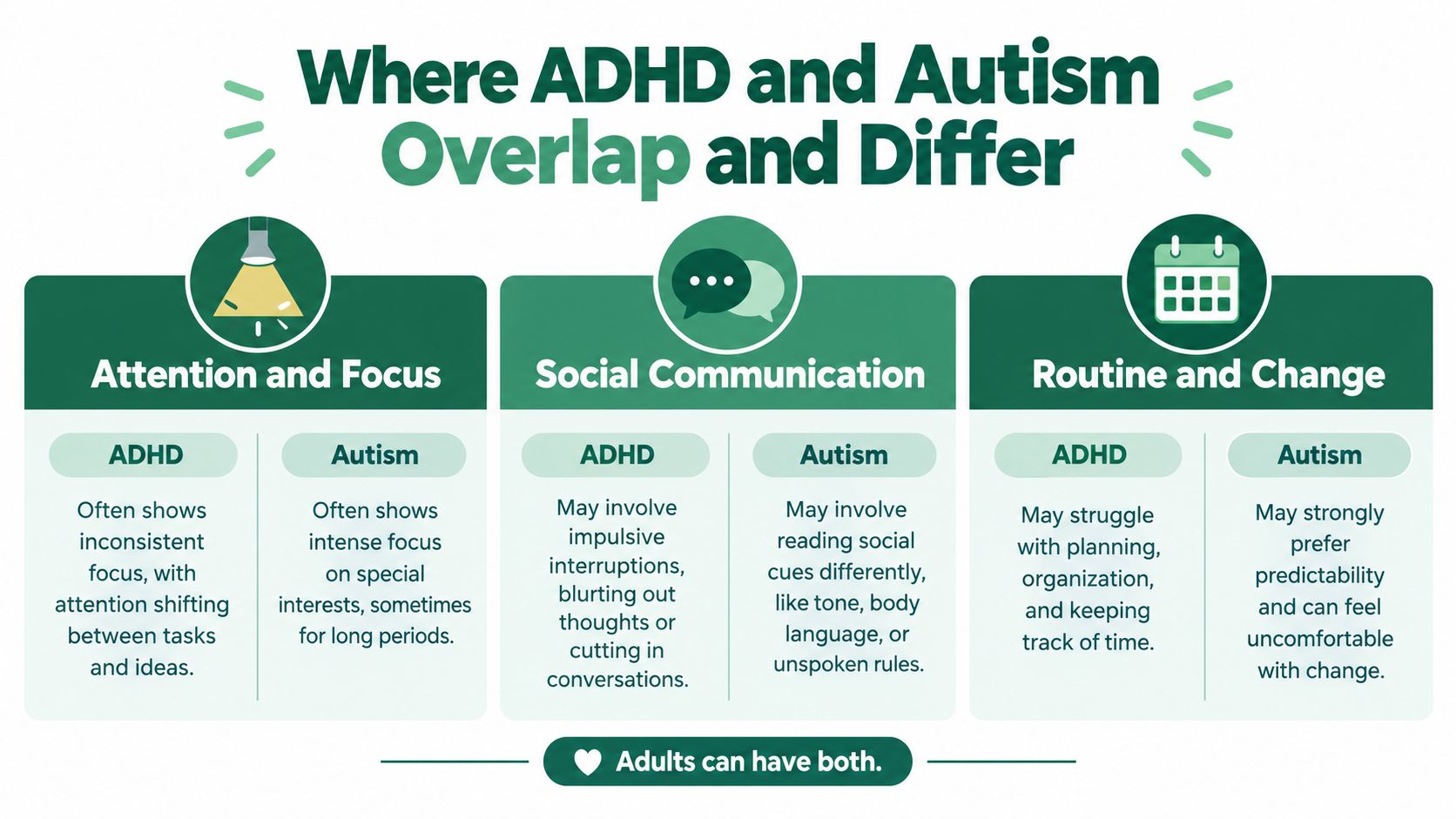
Attention, communication, and routines offer useful comparison points, but adults can have both ADHD and autism.
Co-Occurrence Isn't a Contradiction
A 2024 systematic review reported clinically significant autistic traits in ADHD samples ranging from 15% to 64.3%; an adult outpatient study discussed in that review found that 16.1% of adults diagnosed with ADHD also met autism criteria (systematic review of autistic traits and autism in ADHD).
These figures aren't interchangeable prevalence estimates. Traits identified on a screening measure are different from meeting diagnostic criteria, and results from particular research or outpatient samples don't describe every adult with ADHD.
The practical conclusion is narrower and more useful: one diagnosis shouldn't automatically end consideration of the other.
Co-occurring traits can also pull in different directions. A hypothetical adult might want a reliable daily plan but struggle to follow it, or seek an exciting outing and then find the environment overwhelming. That apparent inconsistency is something to explore, not evidence that the person's needs aren't real.
Rather than counting which description sounds most familiar, bring the contradictions to an evaluator. They may provide more useful information than the traits that seem straightforward.
Why Adults Get Missed and What Often Co-Occurs
Looking capable isn't the same as functioning comfortably. A hypothetical employee may prepare extensively for every meeting, copy conversational phrases that seem to work, and rely on elaborate reminder systems. Colleagues see the finished work, not the preparation or exhaustion afterward.
Masking and compensation can make support needs less visible. Research involving late-diagnosed women with co-occurring ADHD and autism describes how traits can conceal or counteract one another, complicating recognition (research on late-diagnosed co-occurring ADHD and autism).
The Effort Behind the Appearance
Adult assessment can become harder when childhood records are unavailable or learned strategies obscure earlier difficulties. Anxiety and depression may also overlap with the experiences someone is trying to explain. A careful conversation needs room for both outward functioning and its personal cost.
Useful questions to bring to counseling include:
Preparation. What do you have to do before a situation to get through it?
Recovery. How do you feel after work, social events, or household demands?
Support. Which responsibilities become difficult when your usual systems aren't available?
History. Were there similar struggles earlier, even if other people described you as doing well?

Balancing work, study, and home responsibilities can leave little room for recovery, even when someone appears to be managing.
Other Difficulties Need Their Own Attention
Anxiety and depression don't identify which neurodevelopmental condition is present. A large adult case-control study found greater odds of diagnosed anxiety, depression, and combined internalizing difficulties in both autistic adults and adults with ADHD compared with neurotypical adults (study of internalizing difficulties in adults).
Sleep problems, trauma, substance use, and learning differences can also mimic or intensify attention-related difficulties. Burnout may be part of the picture someone brings to counseling, but it doesn't establish a developmental diagnosis.
If exhaustion is your most pressing concern, ADHD and burnout recovery offers a starting point for discussing daily demands and recovery needs.
A diagnosis can provide an explanation without becoming a verdict about your abilities or future. It also doesn't automatically determine treatment. Current distress, relationships, sleep, and practical needs still deserve individual consideration.
How the Difference Shows Up in Relationships and Work
A useful daily-life lens is trigger, response, support. Identify what happened just before the difficulty, describe the response without blame, and consider what adjustment addresses that particular obstacle.
The examples below are hypothetical. They're ways to organize observations, not shortcuts to diagnosis.
A Missed Deadline at Work
An employee leaves a meeting believing they understand the assignment but doesn't submit it. Before calling the problem procrastination, ask what broke down.
If the deadline never reached a usable reminder system, a calendar alert and smaller task steps may be worth trying. If the instruction was vague, agreeing on the exact deliverable and due date addresses a different problem. Someone facing both barriers may need both supports.
Make the task visible. Write the next action somewhere it will be noticed.
Make the expectation explicit. Confirm what finished work should contain.
Check the fit. Ask whether the adjustment changed functioning rather than assuming it should have worked.
A Partner Feels Unheard
Suppose a partner changes dinner plans during a busy moment. Later, one person feels ignored while the other feels blindsided.
Instead of debating who should have understood, clarify what happened: Was the message missed, misunderstood, or difficult to adjust to? A shared calendar, a direct check that the message landed, or more notice before a transition may address different parts of that interaction.
Relationship practice: Describe the obstacle before interpreting it as a statement about love, effort, or respect.
Neurodivergent couples therapy can provide space to examine these recurring misunderstandings and develop agreements that both partners can use.
An Office Becomes Hard to Tolerate
In an open-plan office, someone may lose track of work after repeated interruptions, struggle with the sensory environment, or experience both. Ask which elements are hardest: conversations nearby, lighting, unexpected questions, or returning to the original task.

Clear expectations and direct discussion can help colleagues identify what makes collaboration more manageable.
Possible adjustments to discuss include written requests, protected work periods, a quieter location, or advance notice of changes. Treat these as individualized experiments, not prescriptions attached to a label. Notice what improves, what remains difficult, and what deserves further assessment.
Choosing Evaluation and Support Next Steps
Choose a starting point based on your question. Wanting diagnostic clarity, wondering whether further assessment is warranted, and needing help with distress are related needs, but they aren't identical.
Understand What Each Route Can Offer
A thorough developmental assessment examines your history and functioning across settings. For adult ADHD, NICE recommends specialist assessment that includes developmental and psychiatric history, observer information where available, and consideration of other explanations and coexisting conditions. A rating scale alone isn't enough (NICE ADHD assessment recommendations).
For autism, the assessment question centers on lifelong social-communication patterns alongside behavioral, interest, routine, and sensory patterns. When contacting a provider, ask whether they evaluate adults and can consider both conditions if your history raises questions about overlap.
A screening questionnaire has a narrower role. NICE's adult autism guidance covers people aged 18 and over and identifies the AQ-10 as an initial screening tool; a positive result should lead to a full assessment, not be treated as a diagnosis (adult autism screening guidance summarized by the Royal College of General Practitioners).
Individualized counseling focuses on distress and daily functioning. You can discuss communication, overwhelm, routines, emotional regulation, or relationship conflict while diagnostic questions remain open. Therapy for neurodivergent adults can help you consider what you want from that support.
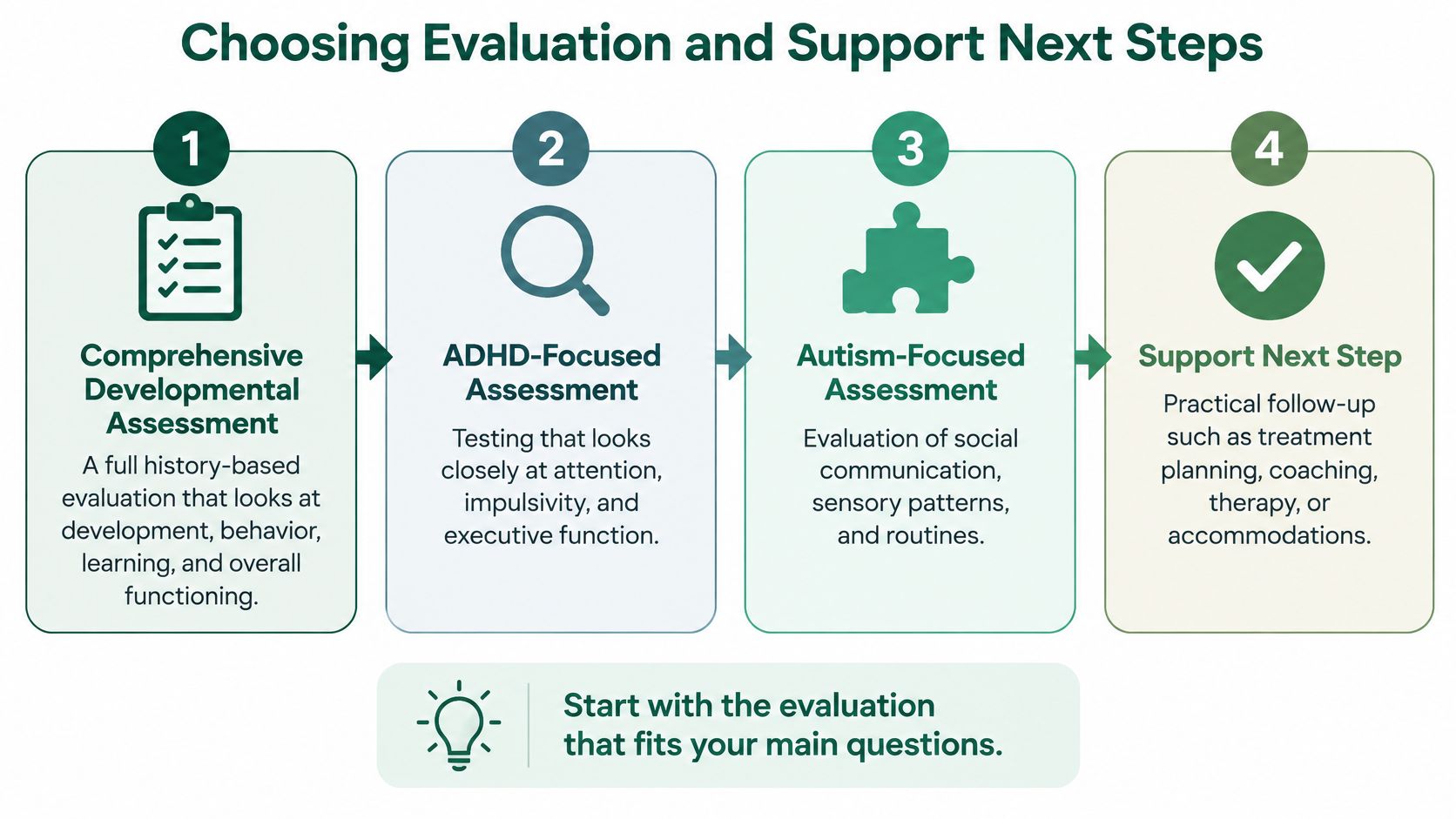
Assessment should connect developmental questions with an individualized support plan, rather than stop at a questionnaire result.
Prepare Questions Before You Book
If you're exploring remote options, Total Mental Wellness provides information about online psychiatric assessments for Florida adults. Ask whether the available evaluation addresses your particular questions, especially if you're seeking adult autism assessment or consideration of co-occurring ADHD and autism.
Before an appointment, prepare:
Your timeline. Write down when you first remember the difficulties and what you recall about childhood.
Your settings. Note examples from work, home, relationships, education, and unstructured time.
Your existing supports. Record what helps, including reminders, clearer instructions, or environmental changes.
Your priorities. Identify what you most want to understand or change.
You don't need a polished explanation. A few concrete observations give a clinician something useful to explore, including what information is missing and which assessment or support route fits your needs.
Be Your Best Self & Thrive Counseling, PLLC offers individual and couples counseling in St. Petersburg, Florida, for anxiety, depression, trauma, stress, and patterns that keep you feeling stuck, including difficulties you're exploring alongside ADHD or autism questions. Write down when your difficulties began and where they show up, then visit Be Your Best Self & Thrive Counseling, PLLC to book a free initial consultation to discuss your goals, fit, and support options.