
10 Stress Management Worksheets: Who Each One Helps
It's Tuesday night in St. Petersburg. Your inbox won't clear, sleep was shallow last night, and a printed page with blank boxes feels like one more task you didn't ask for. Stress management tends to falter not because of a lack of information. The harder part is turning insight into a routine you'll keep repeating when work, caregiving, or a relationship gets tense.
Stress management worksheets help when they do a narrow job well. That principle shapes solid public resources, too. The World Health Organization's illustrated guide Doing What Matters in Times of Stress from April 2020 was built around practical exercises rather than abstract psychoeducation, including grounding, making space for difficult thoughts, acting on personal values, and practicing kindness. It's a useful standard for everything below.
Below are ten free resources matched to specific situations, not ranked by popularity. Some fit a single stressful week, others fit a student workload, movement-based coping, or a first therapy session. Each entry names who it helps, where it falls short, and when to pair it with a clinician. Pick one that matches your current stressor, personalize the language, and run it long enough to see a pattern. A single page won't do all the work, but the right page at the right moment can make the next step clear.
1. Therapist Aid - Stress Management Worksheet
For a client who says “I'm stressed” but can't yet name how it's showing up, this is a clean starting point. The Therapist Aid Stress Management Worksheet is brief, three pages, and asks how stress affects daily life before moving toward one practical change. I reach for it in early sessions because it opens a conversation without requiring a long homework assignment.
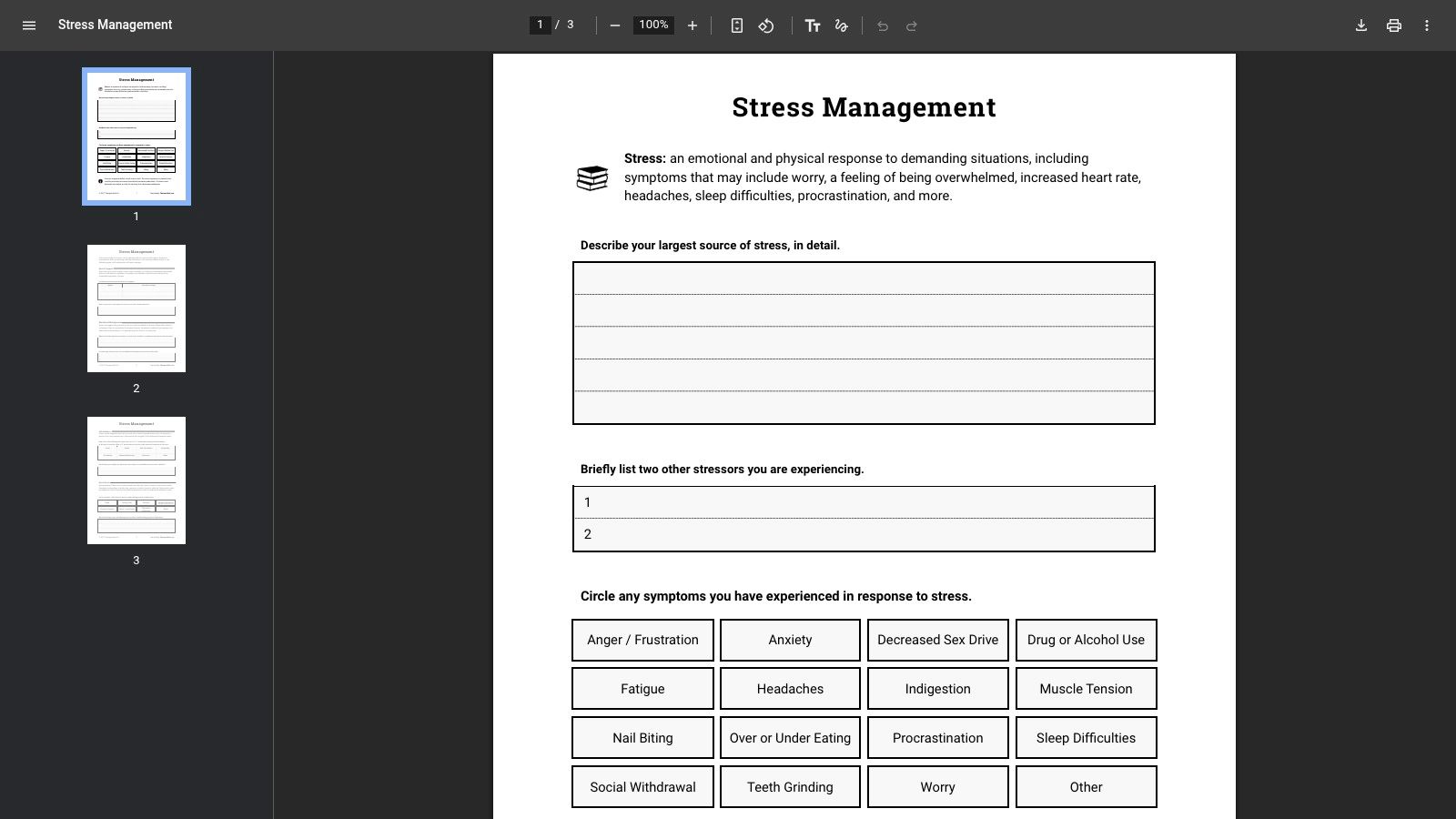
Caption: The Therapist Aid worksheet page, showing prompts for reflecting on stress, coping habits, and life balance.
What It Does Well
Coping habits prompts: Asks what you're already doing, helpful or not
Life balance ratings: Rates satisfaction across life areas so imbalances are visible
Basic needs check-in: Connects stress to sleep, food, and other foundations
Planning space: Leaves room to name a specific change, not just an intention
That structure makes it easy to connect with therapy for stress management when reflection alone isn't enough. Honest limitation: it's a reflection exercise, not a step-by-step treatment plan. If you have one acute stressor, such as a deadline or conflict, it may feel too general. Personalize it by circling one life area and writing the change in plain, everyday language.
2. VA - Manage Stress Workbook
Someone who wants more than a single handout, but doesn't want to pay for a program, will get more mileage here. The U.S. Department of Veterans Affairs Manage Stress Workbook is a free downloadable workbook that moves from identifying stressors to tracking stress, setting a goal, and trying coping approaches. It was created by the VA, but the skills aren't Veteran-specific.
How to Use It Without Getting Buried
Start with the stress tracker for a few days before you read everything else. Then use the stressor prompts to separate what's frequent from what's intense, and set one SMART goal tied to the pattern you see. Mindfulness and other coping exercises work best when they're attached to that goal, not practiced at random.
Practical rule: Don't assign the whole workbook at once. One section per week, reviewed briefly, beats a thick packet that sits unopened.
Pros: it offers more depth than a single handout and combines tracking, goal setting, and skills practice in one place. Cons: the VA context will feel most relevant to Veterans, and the number of activities can overwhelm someone looking for one quick exercise tonight. Clinicians can help by pre-selecting pages and renaming examples to fit civilian work or family life.
3. VA South Central MIRECC - MyBriefCBT Patient Workbook
This one belongs in treatment, not on a refrigerator. The MyBriefCBT Patient Workbook comes from a brief CBT program and divides skills into sections. One section focuses on relaxation skills for managing stress and tension, while others address activity, unhelpful thoughts, and wellness.
Caption: The MyBriefCBT logo, identifying the VA South Central MIRECC brief CBT workbook program.
The workbook includes worksheets and monitoring forms and offers Spanish-language sections, which matters for access. Because sections can be downloaded separately, you don't have to hand a client material that doesn't fit their goals. That modular design matches how brief therapy works in practice. You pick the skill, practice it, monitor it, and adjust.
Honest limitation: it's more treatment-oriented than a casual printable, and many people will find it easier with a clinician than entirely on their own. That's not a flaw. It's a signal about fit. If stress is tangled up with persistent low mood, avoidance, or unhelpful thought loops in Tampa Bay or anywhere else, use this inside a broader plan and review the monitoring forms together. Personalize by keeping the CBT sequence intact while changing the examples to your client's real situations.
4. Cal Poly Counseling Services - Stress Survival Kit Workbook
A student facing exams, poor sleep, and a racing mind needs practice, not just prompts. The Cal Poly Stress Survival Kit Workbook is a free 26-page workbook built for a one-session stress and anxiety workshop. It mixes written worksheets with experiential work, which is exactly why I keep it in the student folder.
Caption: The Cal Poly Stress Survival Kit student workbook cover, created for a campus stress and anxiety workshop.
Inside you'll find:
Stress curve and breathing exercises: Links body arousal to performance
Guided imagery and relaxation: Practice you do, not just read about
Thought reframing worksheet: Challenges the story stress is telling
Sleep and mindfulness materials: Targets two drivers students often ignore
Space to reflect on how each exercise affects stress is a genuine strength. You're asked to notice, not assume. Cons: it's designed for students and workshop use, it's longer than a quick worksheet, and it spreads across topics rather than focusing only on stress tracking. For non-students, swap campus examples for work or caregiving ones and pull out two or three sections instead of assigning all 26 pages.
5. Mental Health America - Self-Help Tools and Worksheets
Not everyone wants a workbook. Some people want a menu. Mental Health America's Self-Help Tools offers free online access and downloads for noticing stress patterns and considering realistic changes, with worksheets and interactive tools on the same page. It suits the client who wants to browse privately before committing to anything structured.
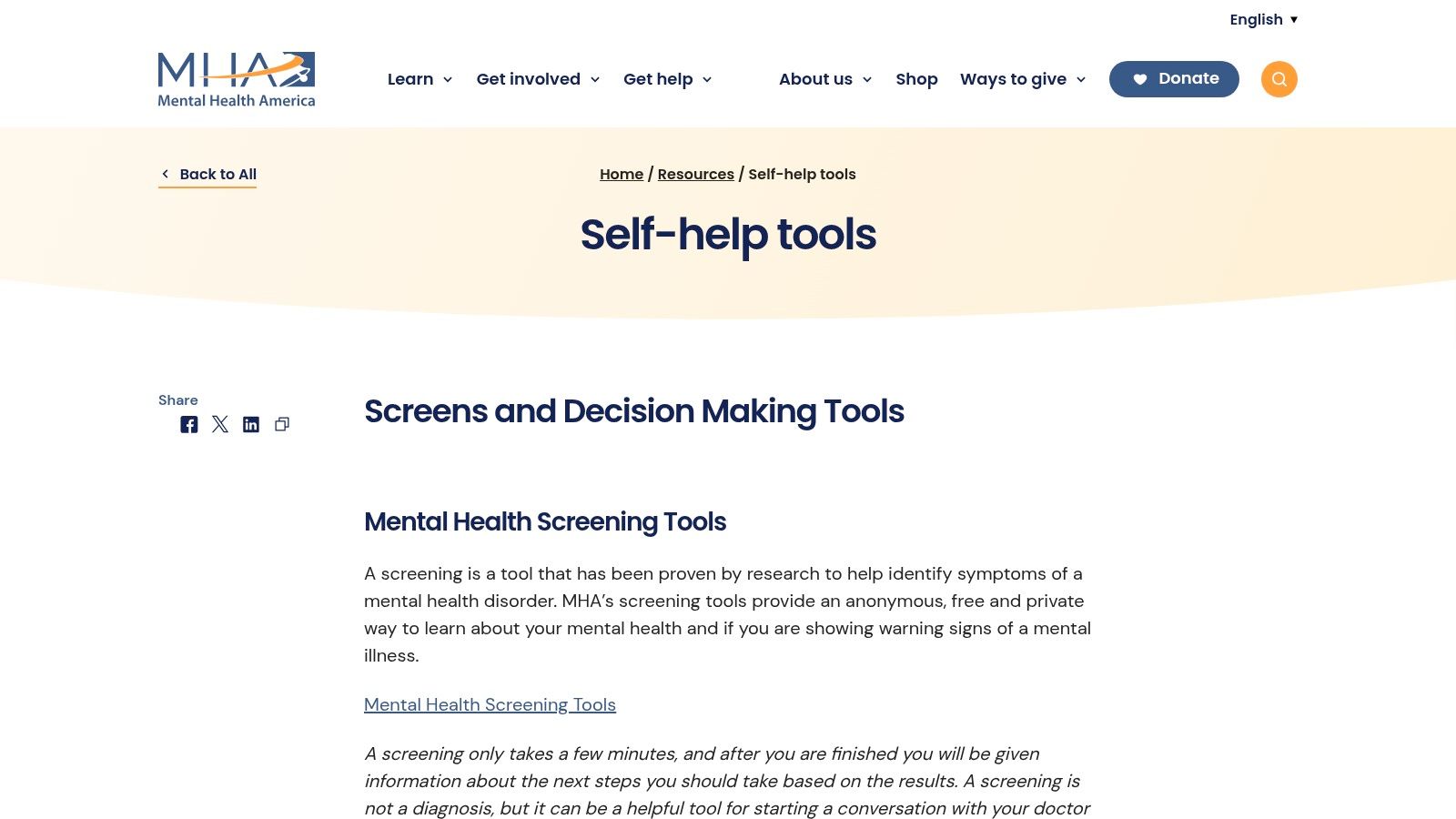
Caption: Mental Health America's self-help tools page, listing worksheets and interactive resources for stress and general wellness.
The stress questionnaire gives a quick snapshot. The physical symptoms and feelings tracker helps people who notice stress in their body before they can name an emotion. The "When Managing Stress is Hard" worksheet is the sleeper pick here, because it addresses barriers directly instead of pretending motivation is the only issue. Grounding and planning tools round out the set.
Self-guided pages like these have some evidence behind them. In a 2013 randomized controlled trial, 66 healthy but stressed participants were assigned to a self-guided stress intervention or a control condition, and the intervention group reported significantly lower perceived stress among the 59 who completed. One small trial doesn't certify every handout on the page, and a questionnaire result is a snapshot, not an assessment. If a client's answers concern you, bring the printout into session and work through it together.
Cons: this is a collection, not one complete stress-management workbook, and some materials cover general mental wellness rather than stress alone. Pick one tool and use it consistently before sampling another.
6. Centre for Clinical Interventions - Stress and Anxiety Resources
Clinicians who want structured, skills-based pages often end up here. The Government of Western Australia's Centre for Clinical Interventions anxiety resources provides free downloads that anyone can access online, with no U.S. residency requirement. The tone is clinical, and that's the point.
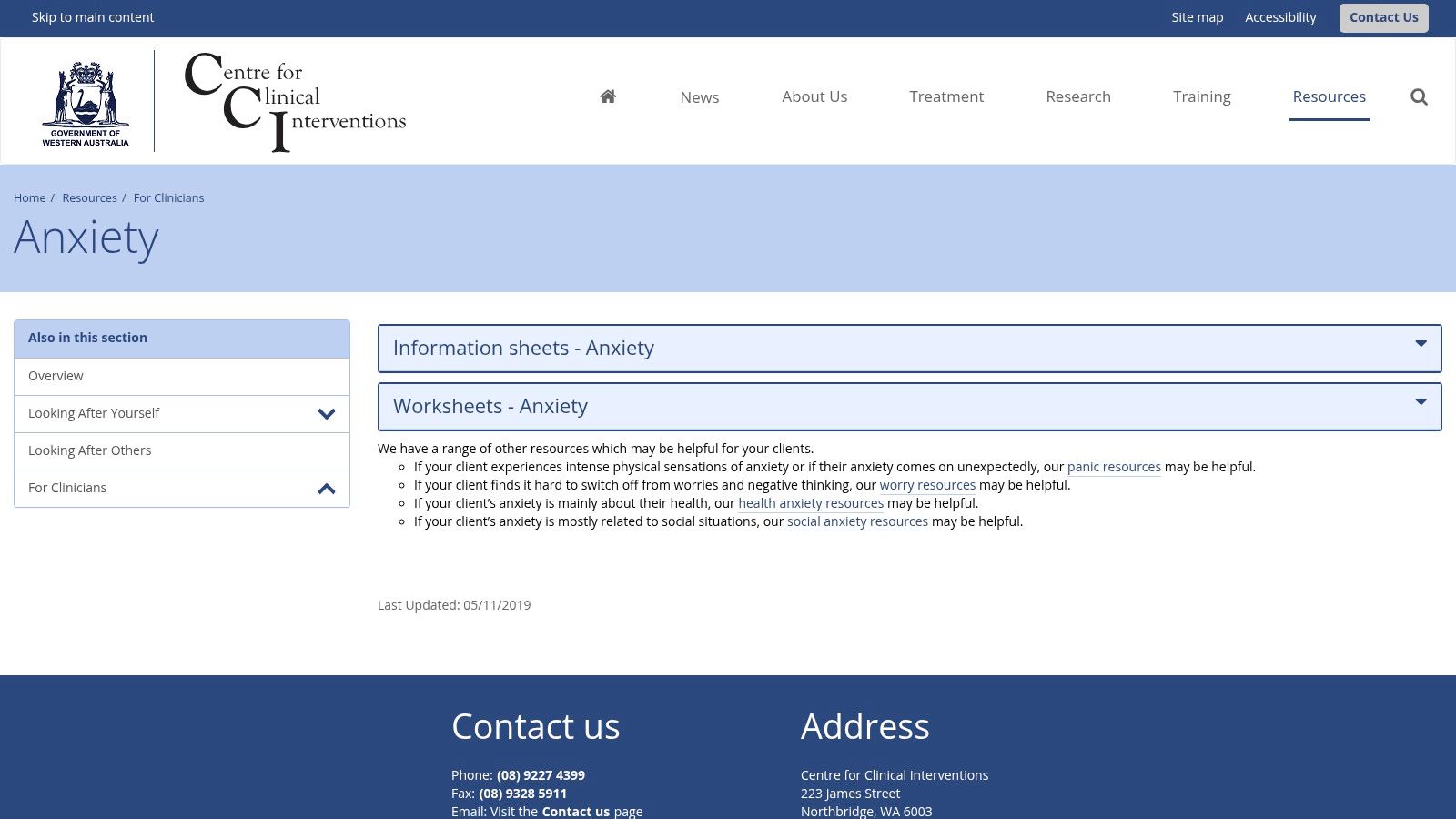
Caption: The Centre for Clinical Interventions anxiety resources page, listing information sheets and CBT worksheets for clinicians.
You'll find information sheets about coping with stress and stress and anxiety, plus CBT-informed tools such as thought diaries, breathing-rate records, and relaxation monitoring. These work well when a client needs to see the link between a thought, a body response, and a behavior across several days. If you're sorting out whether stress is the same as anxiety, that tracking can clarify what you're treating.
A thought diary only helps if the client writes the real thought, not the polite version. Spend two minutes in session completing the first row together.
Cons: the library covers broader topics than stress alone, so you'll need to curate, and clinical language and sequential exercises may feel less approachable to some readers. Personalize by defining terms in plain words and assigning one record at a time.
7. VA South Central MIRECC - Walking to Wellness Workbook
Some clients won't sit with a worksheet, but they'll walk. The Walking to Wellness Workbook connects emotional well-being with physical activity and is described by the VA as a self-help guide for Veterans experiencing mild to moderate stress, anxiety, or depression symptoms. It's a fillable PDF, so it works digitally or printed.
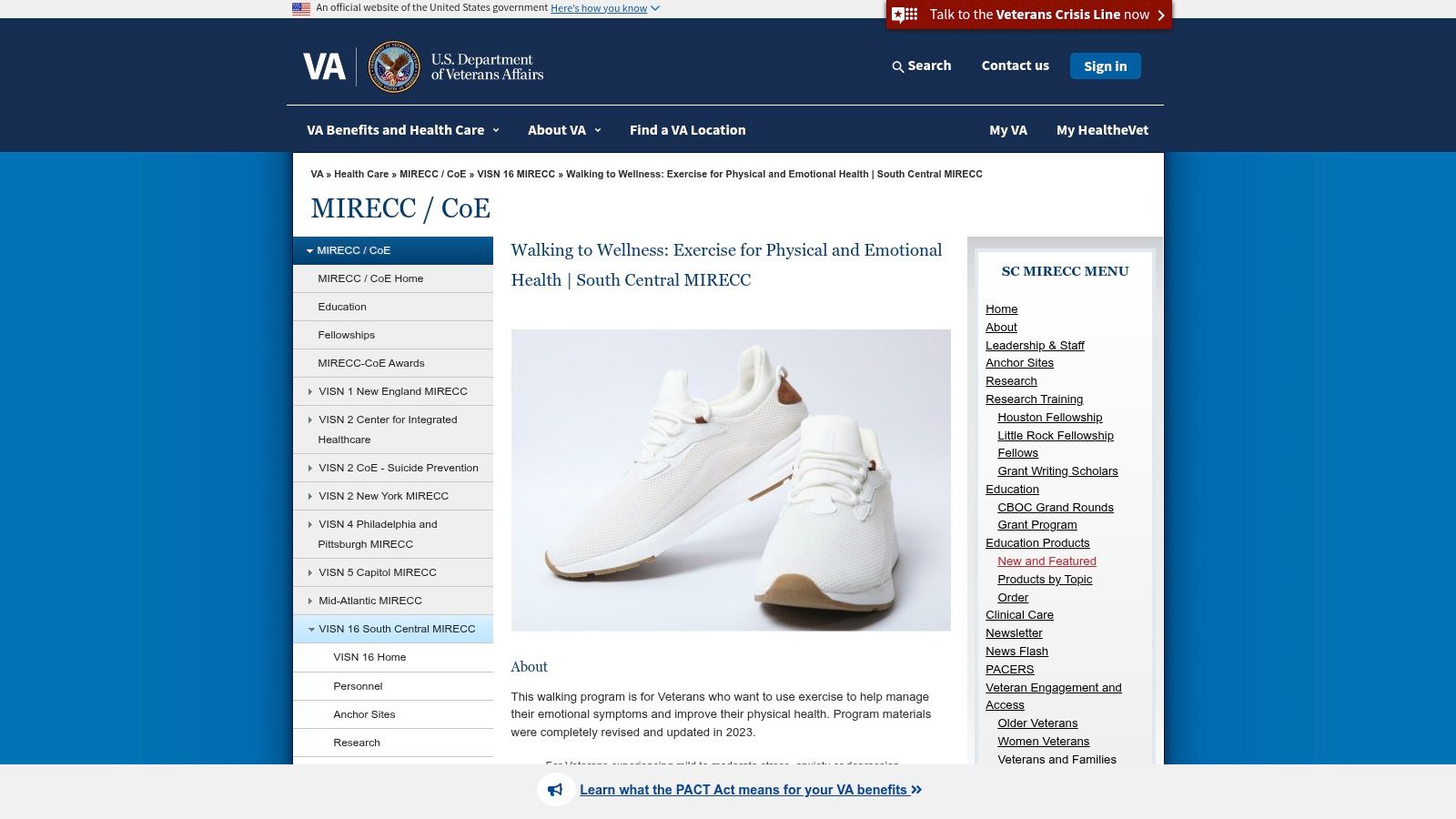
Caption: Running shoes pictured with the Walking to Wellness workbook, a movement-based guide for activity planning and mindful walking.
The tools are simple on purpose:
Activity-planning worksheets: Decide when and where you'll walk
Personal logs: Record what you did and how it landed
Mindful-walking guide: Adds attention to a routine walk
For someone curious about walk and talk therapy, this is a low-pressure way to test whether movement helps before committing to a different session format. St. Petersburg's waterfront paths make adherence easier than a treadmill for many people.
Cons: it focuses on walking and physical activity rather than a full range of stress approaches, and the intended audience is Veterans. Screen for mobility, health, and neighborhood safety first. Personalize the route, distance, and log prompts, but keep the log. Without it, you can't tell if walking changed anything.
8. ACEs Aware - Stress Busters Handouts
This set reframes stress as a whole-life issue, which some clients find relieving. ACEs Aware Stress Busters organizes free handouts around seven themes, supportive relationships, sleep, nutrition, physical activity, mindfulness, time in nature, and mental healthcare. Materials come in English and Spanish, with an overview handout plus clinician and community resources.
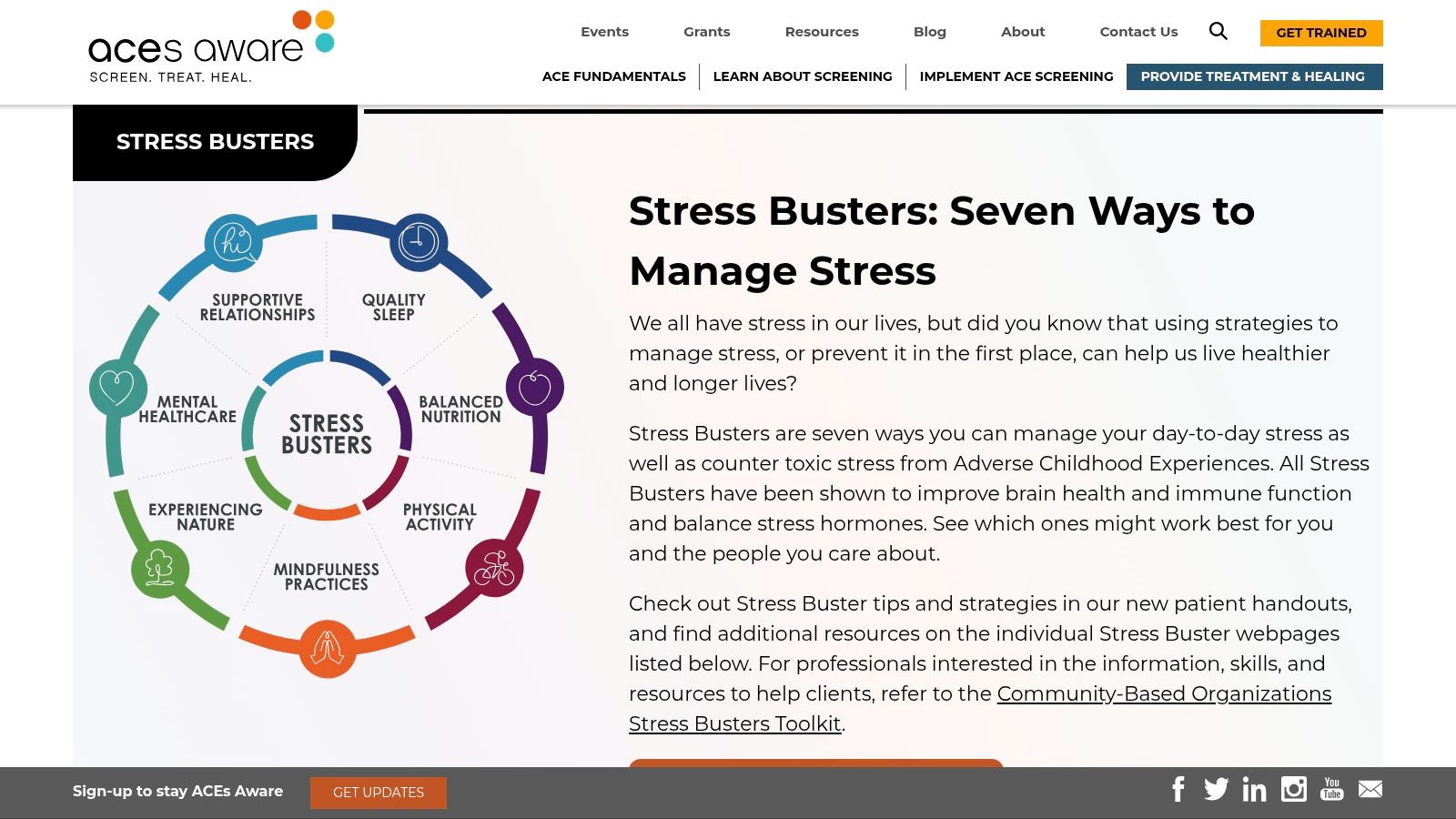
Caption: The ACEs Aware Stress Busters materials, organized around seven whole-person stress-management themes.
Who This Fits Best
It fits clients who feel blamed by “just relax” advice. Instead of starting with thoughts, you start with conditions. Is sleep broken? Is there one supportive person? Is nature accessible this week in Tampa Bay? You choose one manageable area and work there. For caregivers and couples, the relationships handout can open a conversation about shared load that a breathing exercise never will.
Honest limitation: these are primarily educational handouts rather than detailed journaling worksheets. You'll get guidance, not many boxes to fill in. The ACEs and toxic-stress context also may not be central to everyone's needs. Pair a handout with a simple tracker from another resource if you want written follow-through, and let a clinician help if the material brings up difficult history.
9. University of Denver Health & Counseling Center - Stress-Management Materials
Everyday overload often isn't a clinical crisis. It's a calendar problem. The University of Denver Health & Counseling Center stress-management page offers free materials for exactly that layer of stress, including a gratitude exercise worksheet, a time-management worksheet, and relaxation tips. The center also offers stress-management presentations for groups.
The time-management worksheet is the most distinctive piece here. Many stress management worksheets skip workload entirely and jump to calming down. This one asks you to look at how time is truly allocated, which is where entrepreneurs and students often find the core friction. The gratitude exercise works better as a brief perspective shift than as a cure, and I'd frame it that way. Relaxation tips are general, but general is fine for maintenance.
Pros: materials are free, practical for everyday stress and workload pressures, and address topics beyond relaxation. Cons: this is not a thorough clinical workbook, and some content is oriented toward student life. If sleep, mood, or functioning are slipping, this level of material is probably too light on its own. Personalize by rewriting student examples around your job, business, or household, and review the time worksheet with real calendar data, not guesses.
10. Therapist Aid - Stress Exploration Worksheet
The client who says "I just need to cope better" is the person I hand this to first. The Therapist Aid Stress Exploration Worksheet asks the user to fill in two sides of a single page: the stressors weighing on them, and the resources already working in their favor, including daily uplifts, healthy coping strategies, and protective factors such as supportive relationships or steady routines. It fits anyone who wants to see stressors alongside supports before choosing a coping skill.
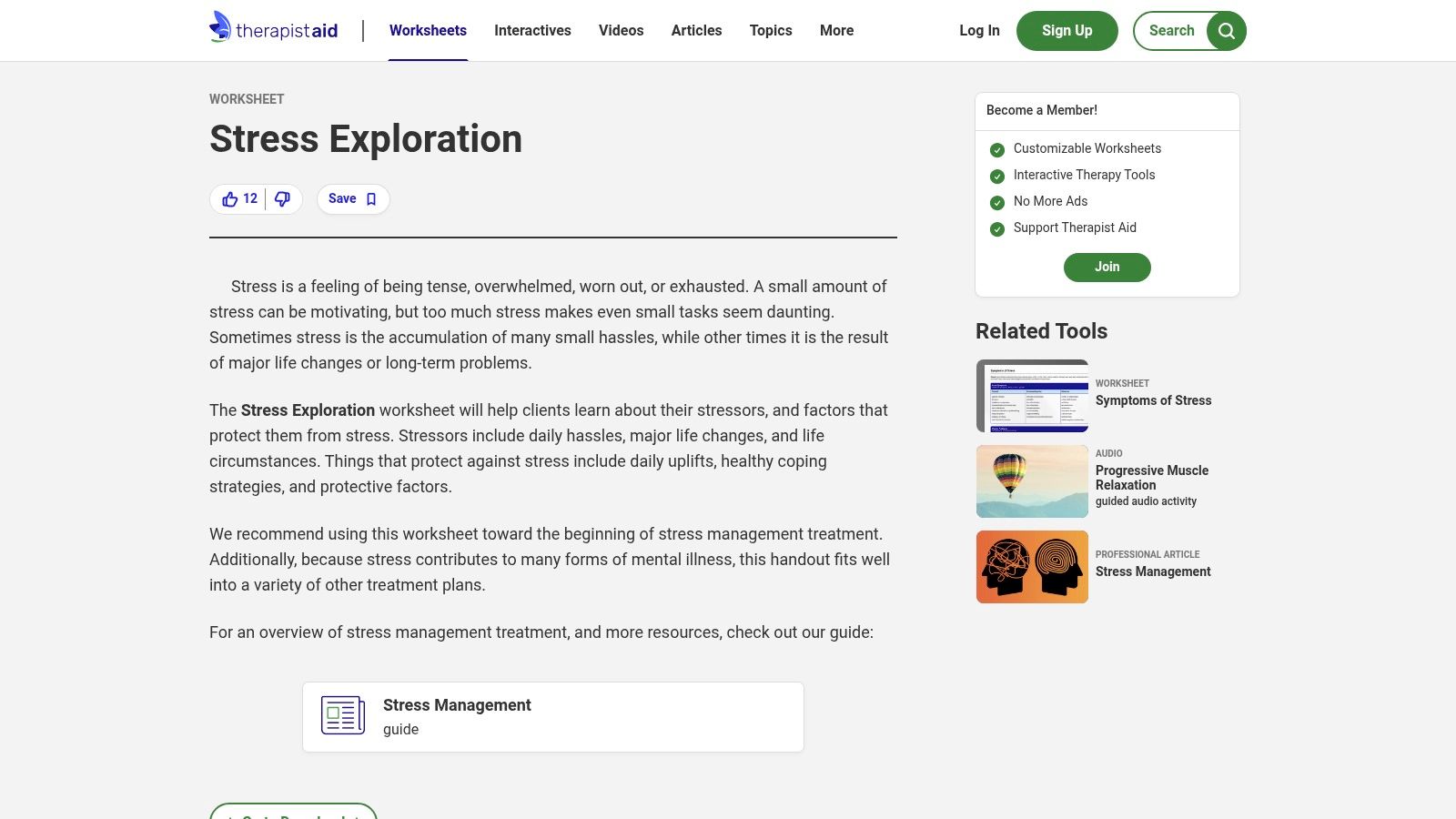
Caption: The Stress Exploration worksheet, with stressors on one side and uplifts, coping strategies, and protective factors on the other.
That two-sided layout is the reason to use it. Gallup's global employee wellbeing indicator reports 40% of employees experienced substantial stress during much of the previous day in 2025. When stress runs that widely, a page listing only problems makes the load look like a personal failure. Writing a flexible supervisor or a reliable friend next to the stressor turns the task into using resources rather than enduring pressure.
Pros: free worksheet, quick to finish in session or as homework, and produces an inventory you can use to pick the next tool. Cons: it stops at mapping, so you still need a separate skills worksheet afterward, and protective factors like housing or an unsupportive workplace change slowly. Involve a clinician when the stressor column surfaces trauma, safety concerns, or functioning that keeps declining despite existing supports. Pair it with anxiety therapy worksheets when worry is the dominant pattern.
How the Stress Management Worksheets Compare by Format, Audience, and Limitations
Item | Format | Best For | Main Limitation |
|---|---|---|---|
Therapist Aid, Stress Management Worksheet | Three-page reflection worksheet | Self-reflection on stress, coping habits, and life balance | Not a step-by-step treatment plan |
VA, Manage Stress Workbook | Downloadable workbook | Tracking stress, setting goals, and practicing coping skills | Multiple activities may feel overwhelming |
VA South Central MIRECC, MyBriefCBT Patient Workbook | CBT-based workbook with downloadable sections | Structured skills practice, especially alongside a clinician | May be harder to use independently |
Cal Poly Counseling Services, Stress Survival Kit Workbook | 26-page workshop workbook | Practicing breathing, relaxation, reframing, sleep, and mindfulness | Longer and designed for student workshop use |
Mental Health America, Self-Help Tools and Worksheets | Collection of worksheets and interactive tools | Exploring stress patterns and finding related support | Not one complete stress-management workbook |
Centre for Clinical Interventions, Stress and Anxiety Resources | Structured self-help materials and CBT worksheets | Practicing thought, breathing, and relaxation skills | Clinical language and sequential exercises may feel less approachable |
VA South Central MIRECC, Walking to Wellness Workbook | Fillable activity-planning workbook | Movement-based stress support and mindful walking | Focuses mainly on walking and physical activity |
ACEs Aware, Stress Busters Handouts | Themed educational handouts | Choosing a manageable whole-person wellness focus | Not detailed journaling worksheets |
University of Denver Health & Counseling Center, Stress-Management Materials | Worksheets, relaxation tips, and group presentations | Everyday stress and workload management | Not a comprehensive clinical workbook |
Therapist Aid, Stress Exploration Worksheet | Stressor and coping reflection worksheet | Identifying stressors, supports, and protective factors | Exploration exercise rather than a complete skills program |
Turning a Printed Page Into a Habit
Start smaller than you think you should. Pick one worksheet that matches your current stressor. If the problem is a single brutal week, reach for a short reflection or exploration page. If it's workload, start with time management. If your body won't settle, start with breathing, relaxation, or walking. If you can't name the pattern yet, track it for a few days first. Downloading ten resources feels productive, and it usually produces ten unfinished pages.
Then run that one tool for two weeks. Short and repeatable beats ambitious and abandoned. The format matters far less than whether you keep using it, and in my experience worksheets hold up when they're small enough to finish in one sitting, focused on a single skill, and attached to some form of accountability. That accountability can be a calendar reminder, a weekly check-in with a friend, or a review in session. What it cannot be is willpower alone.
A longer, supported routine can also produce real movement on stress and resilience, though results vary from person to person. What you can borrow from structured programs is the scaffolding. Pair a little psychoeducation with self-monitoring and concrete practice, and set a baseline and a follow-up check so progress is observable instead of vague.
After two weeks, review what changed and what didn't. Ask three questions. Did stress intensity or recovery time shift? Did sleep, focus, or irritability move at all? Did the worksheet expose a structural stressor, such as workload, caregiving load, conflict, or lack of control, that needs a boundary or a conversation rather than another relaxation exercise? Separate stressors into controllable, influenceable, and non-controllable. Build two plans from there: one for settling your body in the moment, and one for changing conditions, asking for support, or renegotiating responsibilities.
Personalize without gutting the tool. Rename headings, swap the examples for your real life, and write prompts in your own words. Keep the tracking, rating, and review steps, because those are what turn a nice handout into usable data. A worksheet helps you notice patterns. It cannot replace care when stress is affecting work, sleep, health, or relationships, so if functioning keeps slipping after you've really tried a matched tool, treat that as a signal to bring in support.
If you'd like a clinician to help you select, adapt, and track these materials, you can book the free initial consultation offered by Be Your Best Self & Thrive Counseling in St. Petersburg, Florida, to explore whether counseling is a good fit. Bring the worksheet you tried, even if it's half finished. A half-finished page tells a good therapist exactly where to start, and that's a better outcome than a perfect page that taught you nothing.
If stress is starting to shape your work, sleep, or relationships, Be Your Best Self & Thrive Counseling, PLLC offers whole-person, evidence-informed counseling for individuals and couples in St. Petersburg and the Tampa Bay area, with a free initial consultation to explore fit and goals. Our therapists can help you choose the right worksheet, adapt it to your life, and build the follow-through that turns a printed page into lasting change. Visit Be Your Best Self & Thrive Counseling, PLLC to book your consultation and take the next step.