
Anxiety Before Therapy: What to Expect and How to Prepare
You've opened the appointment page, typed a message, and stopped before pressing send. Or you've already booked, and now you're rehearsing what to say, wondering whether you'll cry, go blank, or discover that your problems aren't serious enough.
Anxiety before therapy doesn't mean you're doing something wrong. Understanding what makes the appointment feel threatening can help you take the next step without forcing yourself to feel ready first.
Why Anxiety Before Therapy Is So Common
Starting therapy means approaching something unfamiliar while you may already feel overwhelmed. You're considering talking with a stranger about experiences you might struggle to explain even to yourself. Nervousness in that situation isn't a character flaw.
The treatment gap also puts hesitation in context: the World Health Organization's anxiety-disorders fact sheet estimates that approximately 5.8% of the global population currently experiences an anxiety disorder, while only 27.6% of people who need treatment receive any care. U.S. estimates attributed to the National Institute of Mental Health put anxiety disorders at 18.1% of adults within a 12-month period, with only 12.7% of affected adults receiving treatment considered minimally adequate.
These figures describe anxiety disorders and treatment access, not how many people feel nervous before an appointment. They do show why hesitation deserves attention rather than criticism.
Reluctance Has Recognizable Causes
A German study of help-seeking among people with anxiety disorders included 650 respondents with a diagnosed anxiety disorder; nearly 40% had never considered seeking help, and respondents reported the following barriers.
Barriers to seeking help among people with a diagnosed anxiety disorder
Barrier | Share Reporting It |
|---|---|
Wanted to handle it alone | 18.4% |
Doubted treatment would work | 8.7% |
Limited availability | 8.3% |
Fear of stigma or judgment | 6.7% |
Financial or insurance barriers | 1.1% |
Any treatment barrier | 31.3% |
Much of this reluctance concerns independence, expectations, or anticipated judgment. Those concerns can be discussed before treatment begins. The low financial-barrier figure belongs to this German sample, however; it doesn't mean cost is unimportant in other settings.
Learning about how anxiety disorders affect everyday life can help you describe what's happening without diagnosing yourself. If faith is part of your support system, Ayah's English Quran reflections for anxious readers may offer a personally meaningful companion to professional care, not a replacement for it.
How the Avoidance Loop Keeps You Stuck
A smoke alarm sounds whenever you make toast, so you remove its battery. The silence brings relief, but it hasn't made the kitchen safer, and a real fire could now go unnoticed. This is an analogy for avoidance, not advice about handling a smoke detector.

Caption: Removing the alarm creates silence, just as postponing an appointment can create relief without resolving the underlying concern.
With therapy, you may anticipate judgment, emotional exposure, or losing control. Your heart speeds up, your stomach tightens, and canceling suddenly seems sensible. When cancellation brings relief, you learn that postponement helps you escape discomfort, making another postponement more likely.
Nervousness Isn't Always the Main Obstacle
Sometimes the harder question is whether you believe you need help at all. In a 2025 study published in JMIR Mental Health involving 640 participants, 32.2% didn't believe they might benefit from psychotherapy; among those who perceived a need, obstacles included money or insurance (74.4%), not knowing where to go (53.0%), and lack of time (43.8%).
Try separating emotional discomfort from the practical decision:
Look at impact: Is anxiety disrupting sleep, work, relationships, or concentration?
Review your coping: Are your usual self-help strategies helping you function, or mainly helping you endure?
Name the obstacle: Would you feel more willing if you understood the cost, schedule, or therapist's approach?
You don't need to reach a crisis or arrive with a diagnosis before asking for an assessment. For example, repeatedly avoiding work presentations may justify support even if you're still meeting deadlines.
Practical rule: Choose a smaller approach step, such as asking about availability, rather than waiting for all your hesitation to disappear.
Learning how to break a pattern starts with noticing what you do immediately after discomfort rises. Gathering information is a step toward clarity, not an agreement to long-term treatment.
What Happens in Your First Therapy Session
You're sitting outside the clinic with the engine off, rehearsing an opening sentence. You've considered explaining everything, then worried you'll say nothing. A first therapy session is mainly orientation and assessment, not a requirement to disclose your entire history.
The NCBI Bookshelf guide to cognitive behavioral therapy describes an initial meeting in which you briefly explain current problems and expectations, then collaborate on goals and a treatment plan that can be revised. Other approaches may organize the meeting differently, but you can still ask the clinician to explain the structure.
A Typical Appointment From Arrival to Closing
Typical stages of a first therapy session
Stage | What Happens | What You Can Do |
|---|---|---|
Arrival and intake | Paperwork, consent, and an explanation of confidentiality and its limits | Ask what is recorded and who can see it |
Opening conversation | Brief account of current problems and what prompted the call | Share only what feels manageable today |
Expectations | How sessions run, including length, fees, cancellation rules and format | Ask what the first three sessions will cover |
Goal setting | One or two concrete goals and a starting plan | Name one goal you want to see change |
Pacing check | Agreement on what to cover next and what can wait | Say if you want to slow down or skip an exercise |
Closing summary | Recap and booking of the next appointment | Note one question for next time |
At intake, read the consent information rather than treating it as paperwork to finish quickly. Ask the therapist to explain unfamiliar terms, how records are handled, and the circumstances in which information might be shared.
During the opening conversation, start with what brought you there now. For example, you might describe lying awake rehearsing conversations or feeling tense before ordinary errands. That gives the therapist a useful starting point without requiring a detailed account of painful experiences.
You Don't Have to Perform Therapy Correctly
When you discuss expectations, check whether the proposed format works for your life. Clarify scheduling, payment, and cancellation policies before assuming you understand them.
For goal setting, everyday language is enough: wanting to stop avoiding messages is more useful than finding the perfect clinical term. At the pacing check, explain whether you need more structure, more time to answer, or a pause before changing topics.
You can arrive uncertain and still have a useful appointment.
The closing summary should leave you with a basic understanding of the proposed next step. Before you leave, write down a goal and prepare questions about the process and pace. You're helping shape a working plan, not signing off on a permanent account of who you are.
Questions to Bring and Pacing You Can Ask For
Questions help you assess how a therapist works, not just demonstrate that you've prepared. You're allowed to ask about the relationship and process before discussing sensitive material.
A qualitative study in Frontiers in Psychology describes barriers involving personal, cultural, logistical, and professional-ethics concerns. That broader picture matters: difficulty opening up isn't always something you should solve by trying harder.
Early direction: What will we focus on in the first three sessions? This helps you understand the proposed starting point.
Confidentiality: How do you protect my information, and when might you need to share it? Ask for a plain-language explanation.
Choice and pacing: Can I pause, decline an exercise, or slow down? Clarify how you'll communicate a limit.
Emotional responses: How do you work with someone who cries, freezes, or feels judged? Notice whether the answer sounds respectful and specific.
Telehealth privacy: Who else might hear, and what happens if the connection drops? Discuss privacy at both ends.
Treatment length: How will we decide how long to continue? Ask how progress and changing needs affect the plan.
Make Communication Work for You
You can request written questions, extra processing time, or permission to read from notes. If hearing access is a concern, iScribe Live Transcribe's guide to appointment captioning for people with hearing loss offers a starting point; discuss consent, recording, storage, and privacy before using any transcription tool.
An NIH-supported clinical reference on anxiety treatment describes psychotherapy as commonly lasting about 6 to 12 weeks, with continuation when helpful, and notes that exposure-based work for panic disorder can temporarily cause a mild increase in anxiety. Your own treatment may follow a different timeline.
Temporary discomfort isn't automatically a sign that something has gone wrong. Still, exercises should have a clear rationale, agreed pacing, and room for your questions.
If the relationship doesn't feel workable, explain what isn't helping or seek another clinician. This guide to evaluating therapy fit can help you identify what you need.
Finish your notes with a practical question: what would make the next appointment manageable?
Breathing and Journaling Before Your Session
Preparation should reduce the pressure to perform, not become another assignment you can fail. Try this routine for about ten minutes the night before, then use a shorter, five-minute version in the morning.
Keep a notebook or notes app nearby. If concentrating on your breathing feels uncomfortable, keep your eyes open and notice the contact between your feet and the floor instead.
A Routine You Can Adapt
Sit comfortably and set a timer for five minutes.
Follow a gentle breathing rhythm, in through your nose for a count of four and out through your mouth for a count of six.
Relax your shoulders while noticing whether your breath moves mainly in your chest or belly.
Write your main fear in a sentence, such as worrying that the therapist will judge you.
Record a piece of evidence supporting that fear and a piece that challenges it.
Describe a change you hope to notice within a month.
Mark two questions from your preparation notes to bring with you.
The visual below condenses the routine into breathing, writing, and reviewing your notes.
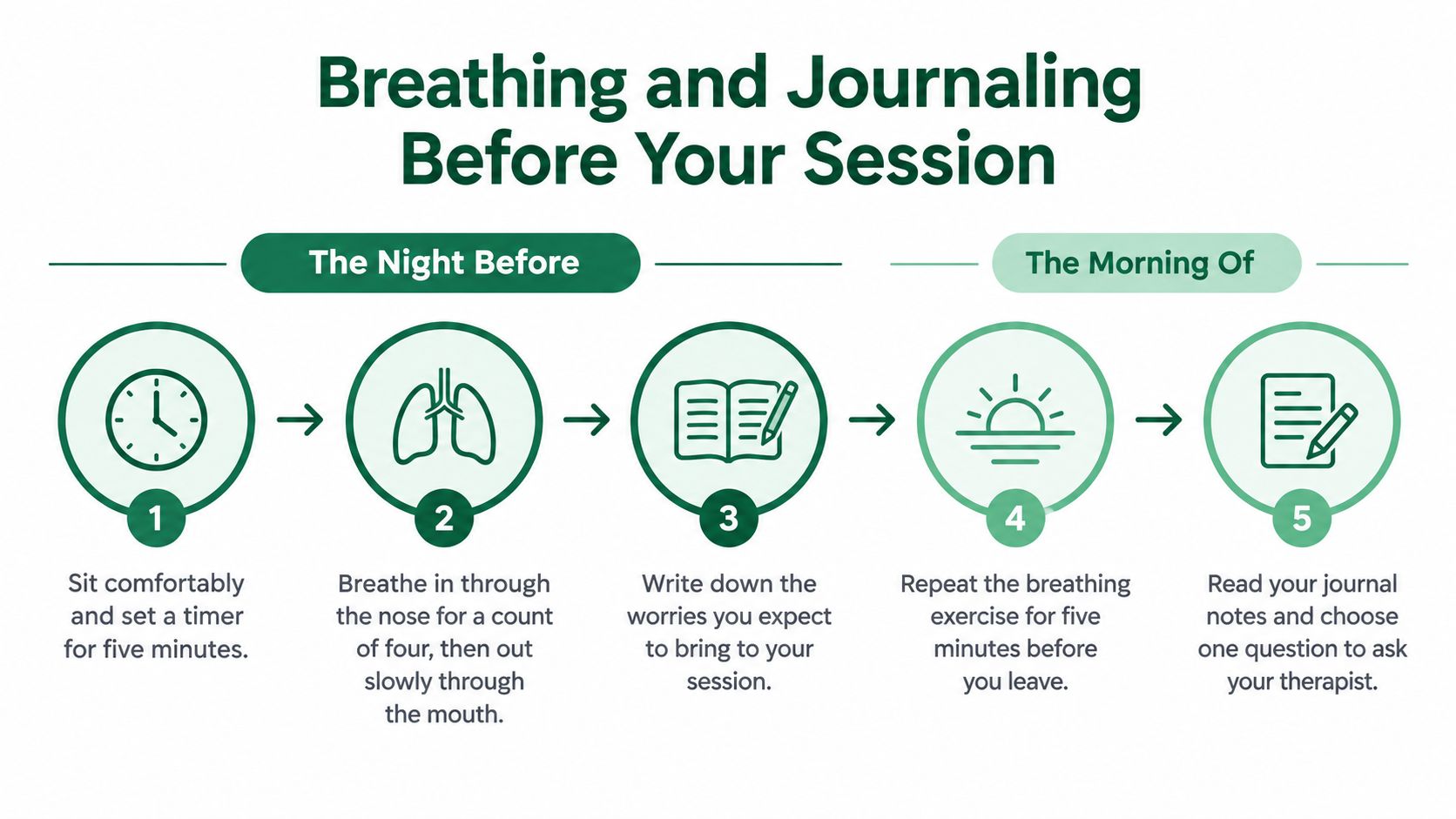
Caption: Use the night-before routine to put worries on paper, then briefly revisit your breathing and notes before the appointment.
Write to Clarify, Not to Convince Yourself
Say your fear is that crying will make you look incapable. Evidence supporting it might be that someone previously dismissed your emotions; evidence against it might be that this clinician hasn't responded that way and is trained to discuss distress. You're distinguishing a prediction from an established fact, not demanding optimism.
For more prompts, explore journaling for mental health. If handwriting or typing is difficult, Voice Control Pro's guide to hands-free journaling for daily reflection describes another approach; choose a private setting and check where dictated material is stored.
Keep the aim small: Prepare enough to begin, not enough to eliminate every possible uncomfortable moment.
A comfortable, slightly longer exhale can help many people settle physical arousal, while writing lets you examine a worry instead of repeatedly rehearsing it. Don't force deep breaths or hold your breath to meet the count. If you feel dizzy, stop and breathe normally; these tools don't replace care, and escalating symptoms may require immediate support.
When to Get Immediate Support Instead of Waiting
Most pre-session anxiety can be addressed at the scheduled appointment. Some symptoms, however, need action now rather than waiting for therapy to begin.
Warning signs and the right immediate response
Warning Sign | What to Do Now |
|---|---|
Thoughts of suicide, self-harm or not wanting to live | Call or text 988, the U.S. Suicide and Crisis Lifeline, now; call 911 if in immediate danger |
Chest pain, trouble breathing or fainting during an episode | Call 911 or go to the nearest emergency department |
Unable to eat, sleep or leave home for several days | Contact your primary care clinician or a crisis line the same day |
Anxiety stopping work, school or childcare | Ask the practice for the earliest available appointment or urgent care |
Feeling unsafe with a provider or during an intake | End the session, leave, and contact the practice or emergency services if needed |
Prioritize Safety Over Preparation
Don't assume chest pain, trouble breathing, or fainting is just anxiety, even if you've experienced panic before. Medical assessment comes before deciding how to prepare for therapy. If you're faint or otherwise medically unstable, don't drive yourself.
If you're struggling to stay safe, tell someone you trust and ask them to stay with you while you contact support. Outside the United States, use your local emergency number or crisis service.
When an intake is already booked but symptoms have become severe, contact the practice directly. Describe what you can no longer manage and ask whether they can offer an earlier assessment or direct you to urgent care; don't rely on a routine voicemail for an emergency.
You also don't have to remain in an appointment that feels threatening or unsafe. Stop the interaction and seek appropriate help.
Asking for urgent support early is part of caring for yourself. It isn't a failure to prepare, and you don't need to wait until the situation becomes worse.
Book a Free Consultation Before Your First Session
Start with access, not a promise to attend ongoing therapy. Ask about insurance coverage, sliding-scale options, scheduling, and waitlists, and confirm whether the consultation itself is free before booking.
Be Your Best Self & Thrive Counseling offers a free initial consultation to explore fit and goals, alongside options you may find through insurer directories or community providers. Learning what a free consultation involves can help you distinguish a fit conversation from a full clinical assessment.
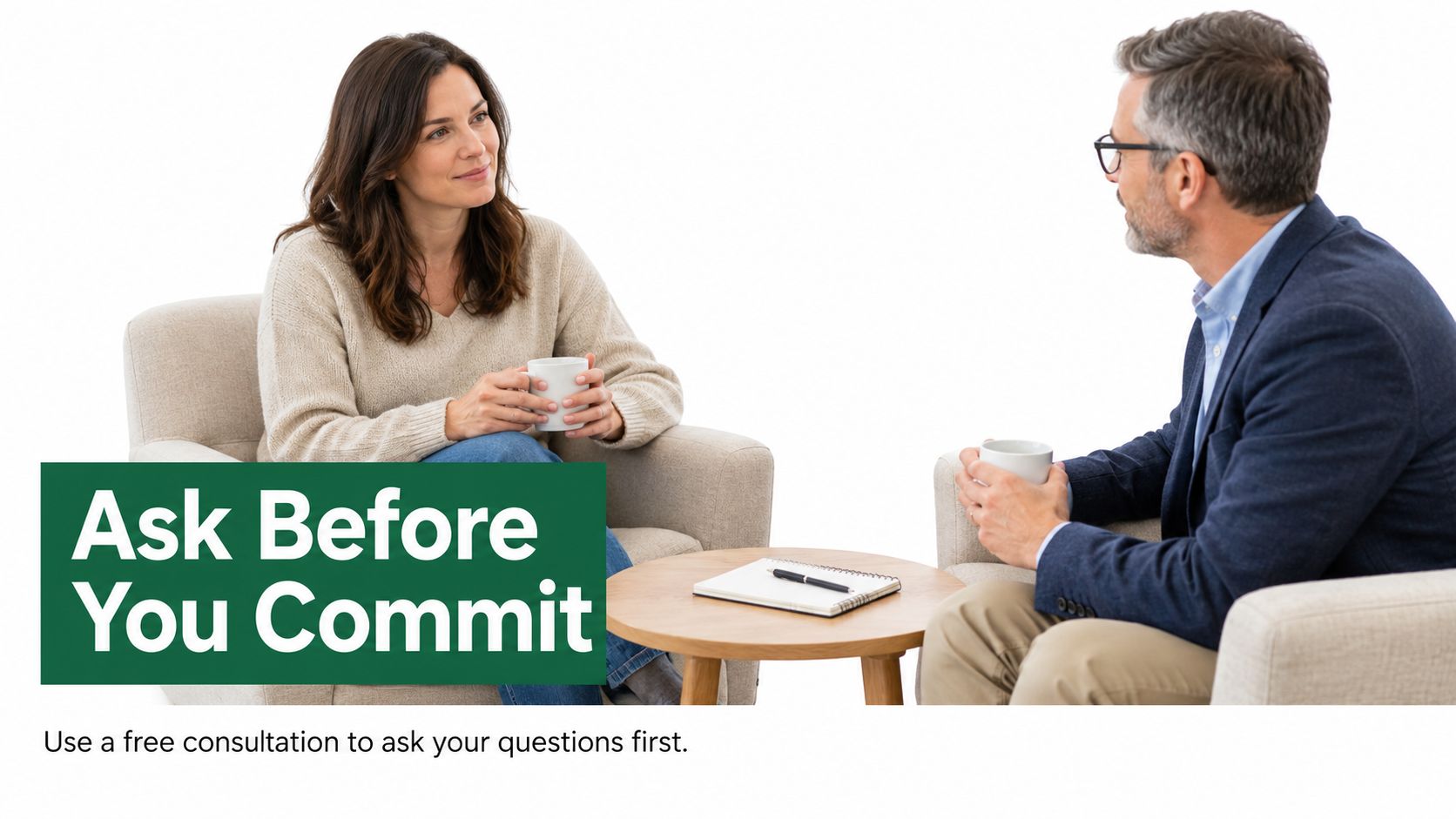
Caption: A consultation gives you space to ask practical questions and assess whether the proposed approach feels workable.
Choose a Manageable Next Step
The WHO treatment recommendations support CBT-based interventions for adults with generalized anxiety disorder or panic disorder through online, in-person, group, or self-guided formats. Ask which clinically appropriate options suit your privacy, comfort, and access needs.
Choose a target date within the next seven days to request a consultation.
Bring your goal and your two questions.
After the call, rate how safe and understood you felt on a scale from one to five.
If your score is below three, keep looking for another clinician.
That rating is a personal reflection tool, not a validated assessment. Notice the reasons behind your answer, including whether the clinician explained things clearly and respected your concerns. The consultation is for information; you can decide afterward whether to continue.
Be Your Best Self & Thrive Counseling, PLLC offers individual and couples counseling, with a free initial consultation to discuss concerns, goals, and fit. If anxiety before therapy is making it difficult to begin, visit Be Your Best Self & Thrive Counseling, PLLC to ask questions and explore a manageable starting point.