
How to Break a Pattern That Keeps You Stuck
You notice it before you can explain it. Sunday evening arrives, your partner asks a simple question, and your jaw tightens before the conversation has even started. Or a vulnerable text sits unanswered, your chest pulls inward, and your fingers reach for the phone, a streaming app, or an argument you know won't help. The moment feels new, but your body recognizes it.
That recognition matters. A recurring reaction has a structure, and a structure can be observed, named, and changed. You don't need to shame yourself into a new life, and you can't reliably outmuscle a cue-driven response with willpower alone. You need to understand what happens before the reaction, what you do next, and what short-term relief keeps the cycle alive.
The practical question isn't “Why do I keep doing this?” It's how to break a pattern when the old response arrives faster than conscious choice. The answer involves awareness, a specific replacement plan, enough regulation to use that plan, and attention to the relationship or environment where the loop happens.
When the Same Moment Keeps Finding You
Maybe the scene is familiar. You and your partner are cleaning up after dinner when a small disagreement about plans turns sharp. One of you asks for reassurance, the other hears criticism, and within minutes one person is pursuing while the other is pulling away. You later promise to handle it differently, but the next Sunday evening brings nearly the same exchange.
Other loops look quieter. You send a message that reveals something tender, then check your phone repeatedly. When no reply comes, you tell yourself the other person is losing interest, send a second message, and eventually retreat into silence. Or loneliness lands at night, and you scroll until your eyes hurt, even though the scrolling leaves you more disconnected.
Your body often signals the pattern before your mind names it:
Activation: Your jaw tightens, shoulders rise, or breathing becomes shallow.
Contraction: Your chest pulls inward, and your attention narrows around the threat.
Preparation: Your hand reaches for the phone, your voice sharpens, or you begin composing an exit.
Familiar relief: You withdraw, argue, numb out, apologize, or seek reassurance.
Then comes the quiet recognition: “This is the same moment again.”
That moment isn't proof that you're broken. Human beings repeat familiar responses because repetition connects situations with actions, making the response easier to start without deliberate decision-making. Research summarized by the University of South Carolina reports that about 65% of everyday behaviors are initiated habitually, while earlier work estimated that around 40% of daily activities occur in the same situations each day. Those findings help explain why a particular time, tone, room, or relational cue can pull you into a response before you feel fully involved in choosing it. University of South Carolina's summary of habit research
Stop calling the loop a character flaw
People often respond to repetition by blaming themselves. They call it a bad mood, a lack of discipline, a personality problem, or evidence that the relationship is doomed. Sometimes they numb the discomfort long enough to avoid seeing the pattern clearly.
A steadier interpretation is more useful. You are not the pattern. You are the person who learned a response in a particular context. That doesn't excuse harmful behavior, especially when someone is being intimidated, controlled, or harmed. It does mean you can investigate the sequence without turning the investigation into self-punishment.
Start here: Notice the moment you usually lose choice. Don't demand that you fix it immediately. Learn its shape first.
Stay with the discomfort instead of closing the tab or reaching for the familiar escape. The work ahead will help you map the loop, identify whether you're avoiding, escalating, or mentally replaying, and choose one observable response that can happen next time.
What Every Pattern Is Actually Made Of
A pattern becomes easier to change when you stop describing it as “I always ruin things” and break it into three parts: cue, response, and payoff. I use these labels in session because they're plain enough to write on a notepad and precise enough to guide an intervention.
The cue is what starts the sequence. It may be external, such as a partner's tone, an unanswered message, or a stressful meeting. It may be internal, such as loneliness, shame, fatigue, or a thought that says, “I'm about to be rejected.”
The response is what you do next. You might scroll, argue, withdraw, apologize too quickly, check someone's phone, overwork, or rehearse the conversation in your head. The response often feels automatic because the cue and action have been paired repeatedly.
The payoff is the immediate relief or reward. The action may create distance from vulnerability, discharge anger, provide a brief sense of control, or interrupt boredom. The long-term cost can be significant, but the nervous system learns from what works quickly.
Two examples from ordinary life
At work, stress spikes in the afternoon and you reach for sugar. The cue is pressure, fatigue, or a difficult message. The response is eating something sweet, and the payoff is a fast shift in comfort or stimulation. If you only tell yourself to “have more willpower,” you attack the response while leaving the cue and payoff untouched.
In a relationship, your partner asks, “Are we okay?” You hear danger in the question, become defensive, and explain why they shouldn't be worried. The cue is the question, the response is defensiveness, and the payoff is temporary protection from feeling exposed. Your partner may then become more anxious, which creates another cue for you and tightens the loop.
This model also applies to constructive routines. Research from the University of South Carolina notes that 46% of behaviors were both habit-driven and aligned with people's intentions, so automaticity isn't unhealthy. The point isn't to eliminate habit. It's to make the repeated response serve the life and relationship you want.
If consistency is part of the struggle, a practical guide to stay consistent with goals can help you think about repetition without turning every lapse into a verdict. The labels matter because your self-assessment will depend on them.
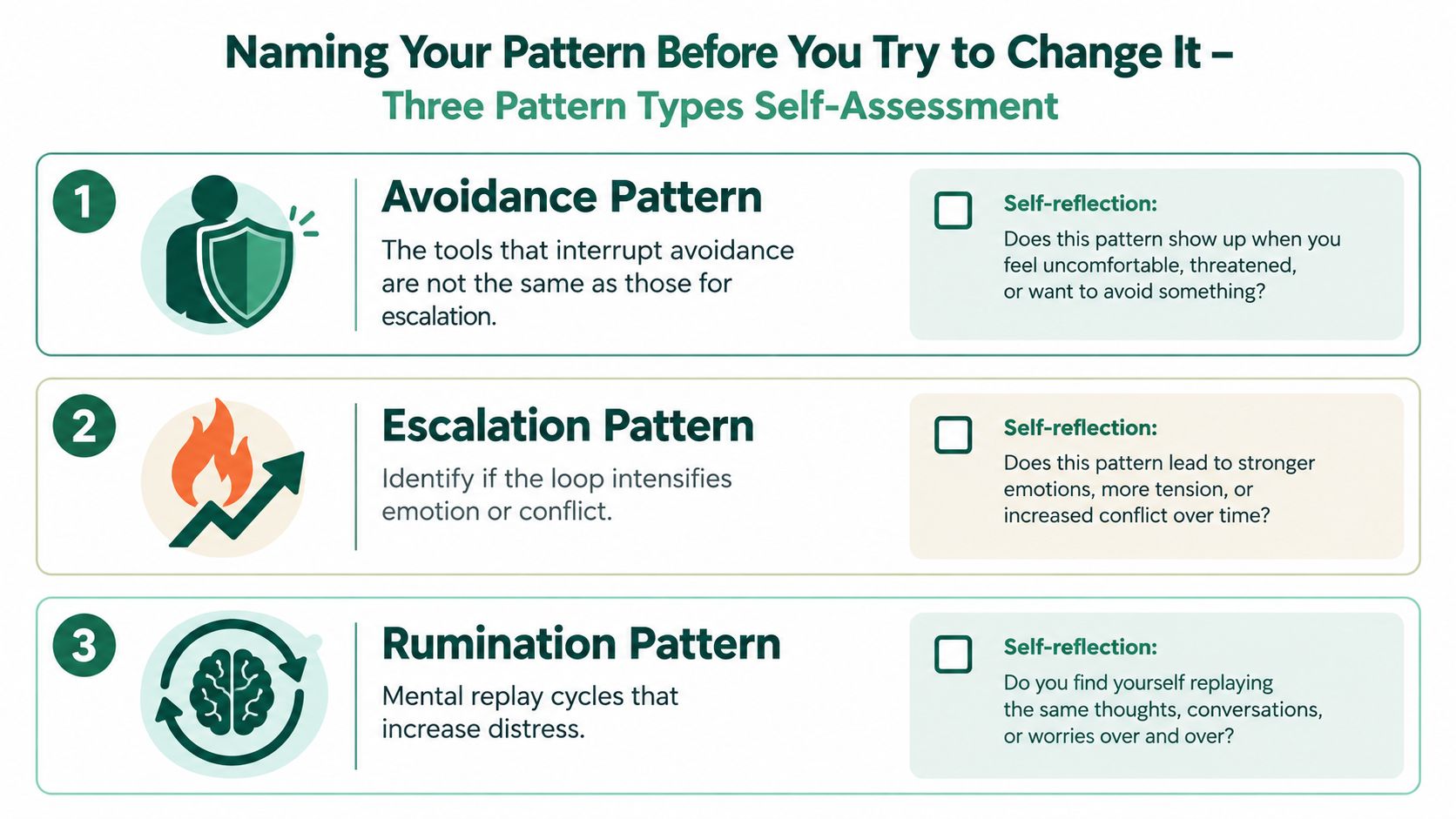
Caption: This self-assessment graphic helps readers distinguish avoidance, escalation, and rumination before choosing an intervention.
Naming Your Pattern Before You Try to Change It
Don't begin with a sweeping goal such as “I won't get triggered anymore.” Begin by identifying the kind of loop you're dealing with. Avoidance requires a different interruption than escalation, and a volatile-repair cycle needs more than a promise to communicate better.
Complete the pattern inventory
Take a notes page and record the last three times the pattern appeared. Keep the wording factual. You aren't writing an argument for the prosecution.
For each episode, answer four questions:
What preceded it? Record the observable cue, including time, place, person, message, body sensation, or thought.
What did you do? Name the behavior without softening it or exaggerating it.
What did you get during the next ten minutes? Look for relief, control, distance, reassurance, stimulation, or escape.
What happened afterward? Note the emotional, relational, or practical cost.
Then compare the entries. An avoidance pattern may involve withdrawing, postponing, overworking, numbing, or people-pleasing to exit discomfort. An escalation pattern may include raising your voice, sarcasm, door-slamming, accusations, or bringing up old scores. A volatile-repair pattern moves through a recognizable sequence: blow up, over-apologize, reconnect intensely, then repeat.
Use a working label, not an identity
Write the dominant type at the top of the page. Treat it as a working hypothesis for the next ninety days, not a permanent description of who you are. That distinction keeps the work honest while protecting you from turning psychological language into another form of self-attack.
If two patterns seem equally strong, choose the one that appears earliest in the sequence. The first interruption point is often more manageable than trying to control the entire cycle once it has gathered momentum. Someone who escalates after feeling ignored may need to work first with the unanswered-message cue, not with the argument that follows.
Journaling can make this inventory more useful because writing slows the sequence enough to reveal details you miss in the moment. A structured resource on journaling for mental health can offer additional ways to use written reflection without turning it into endless rumination.
Skipping this step is one of the most common reasons self-help stalls. If you don't know whether you're avoiding, escalating, or replaying, you may choose a tool that reinforces the loop. Name the pattern first, then anchor the replacement plan to that label.
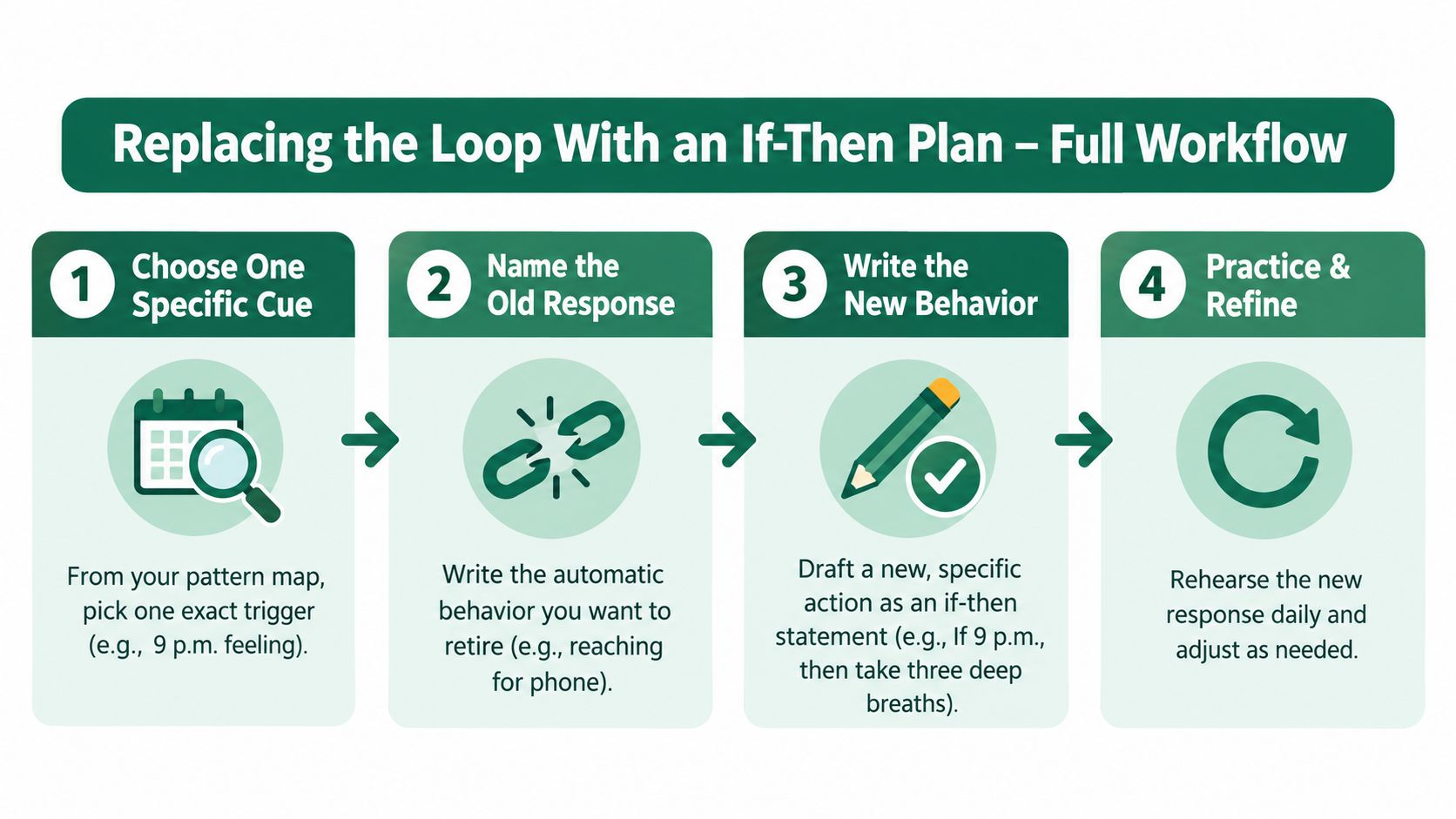
Caption: This workflow shows how to move from one specific cue to a written replacement behavior and ongoing practice.
Replacing the Loop With an If-Then Plan
A vague intention leaves too much work for the exact moment when you're distressed. An if-then plan removes some of that decision-making in advance. Research on implementation intentions found that a specified replacement response can overrule an established habit, although effects aren't universal and depend partly on intention stability and self-efficacy. Evidence on implementation intentions and habit overrule
Use the inventory from the previous section and choose one cue. Not the entire relationship. Not every evening. Choose the moment you can recognize clearly.
Build the plan in four moves
Choose one specific cue. “When I'm anxious” is too broad. “When I send a vulnerable text and don't receive a reply” gives you something observable.
Name the old response. Write the behavior you want to retire. In this example, it might be checking your partner's phone, sending repeated messages, or creating a confrontation to force reassurance.
Write one new behavior. Make it visible and small. “I will regulate” isn't an action. “I will put both feet on the floor, exhale slowly, and say one grounding sentence” is.
Choose the place and timing. Decide where the replacement will happen and what follows it. A plan becomes easier to use when you don't need to invent its setting under pressure.
Consider this script:
If my partner hasn't replied and I feel the urge to check their phone, then I will put the phone on the table, take a slow exhale for about ninety seconds, and say, “An unanswered text is uncomfortable, not conclusive.” Afterward, I will check whether I need information, reassurance, or a pause before choosing my next action.
The replacement doesn't promise that your fear is irrational. It creates a small space between fear and intrusion. If the action is too large, shrink it until you can repeat it for five days before expecting it to feel rewarding or natural.
Rehearse before the crisis
Write the plan down. Read it once when calm, and rehearse the body position and words you will use. Then review what happened after each attempt. Did the cue arrive too late for you to notice? Was the replacement too demanding? Did another person intensify the situation?
Pattern change is a medium-term process. A 2024 systematic review and meta-analysis of 20 studies involving 2,601 participants found median habit-formation times of 59 to 66 days, mean times ranging from 106 to 154 days, and individual variability from 4 to 335 days. The review rejected the popular idea that habits reliably form in 21 days and concluded that many behaviors take roughly 2 to 5 months to become automatic. 2024 systematic review and meta-analysis of habit formation
Your first goal is not automatic calm. It's practicing a different response often enough that the alternative becomes more available.
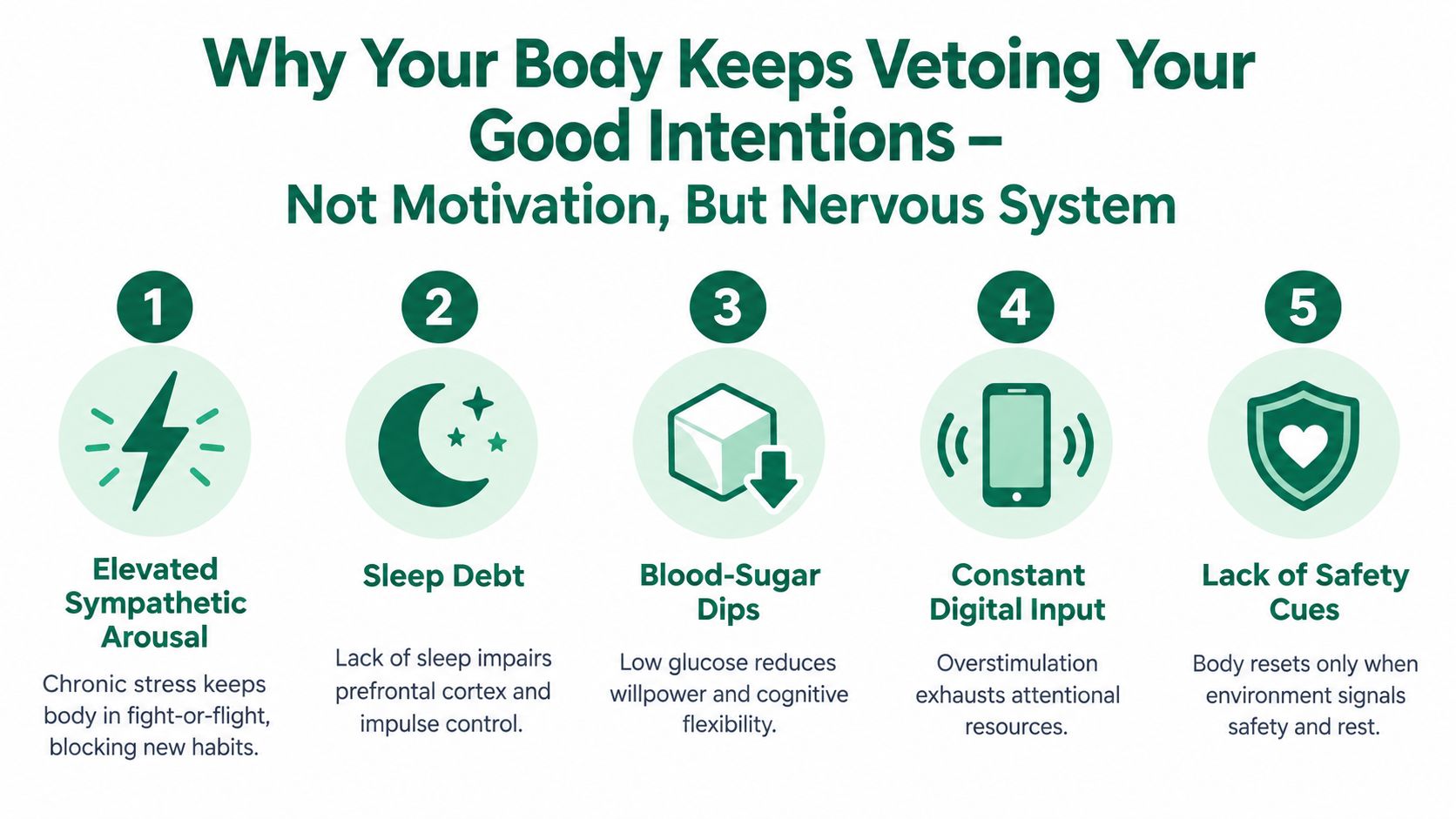
Caption: This infographic highlights physical and environmental conditions that can make an old response easier to access than a new one.
For depression-related withdrawal, pair the written plan with gradual activity rather than waiting to feel motivated. The principles described in behavioral activation for depression can help you choose actions that support movement, connection, and routine.
Why Your Body Keeps Vetoing Your Good Intentions
Many failed attempts at pattern change aren't failures of insight. You understand what happened, you know what you want to do differently, and then your body reaches for the old response before the plan becomes usable. A high-arousal body narrows choice. It prioritizes immediate protection, relief, or control over a long-term intention.
Stress load matters. Sleep disruption, hunger, relentless digital input, and an environment that feels unsafe can all reduce the space available for reflection. This doesn't mean biology determines your behavior. It means your plan needs physical and contextual support.
Add support before you add pressure
Try three adjustments alongside the if-then plan:
Use a brief physiological pause: Before acting on the cue, keep your feet on the floor and take a slow, extended exhale. The aim isn't to force calm. It's to create enough space to notice the next choice.
Protect a regular sleep window: Sleep affects attention, impulse control, and emotional flexibility. If your plan repeatedly fails late at night, move difficult conversations and high-stakes decisions to a time when you can think more clearly.
Pace relational conversations: When both people are activated, continuing often adds fuel rather than clarity. Agree to pause and return after enough time for regulation, with a specific return point rather than an indefinite disappearance.
A common mistake is to treat regulation as a way to avoid the issue. Regulation should make contact more skillful, not erase accountability. You still need to discuss the unanswered message, unequal workload, financial strain, or broken agreement. You don't need to solve it while your body is preparing for attack or escape.
A useful test: If your plan works when calm but disappears under stress, adjust the conditions before judging your character.
Recent couple-functioning research describes emotion-regulation flexibility as relevant to conflict cycles, with longitudinal data from 320 couples linking greater flexibility with shorter conflict cycles and lower conflict intensity. Research on emotion-regulation flexibility in couples That finding supports a practical conclusion: learn to change pace, intensity, and strategy as the moment changes.
This is why nervous-system support belongs inside pattern work, not in a separate category reserved for people who are “too emotional.” A nervous system regulation therapy resource can help you think more precisely about the connection between arousal, context, and behavior.
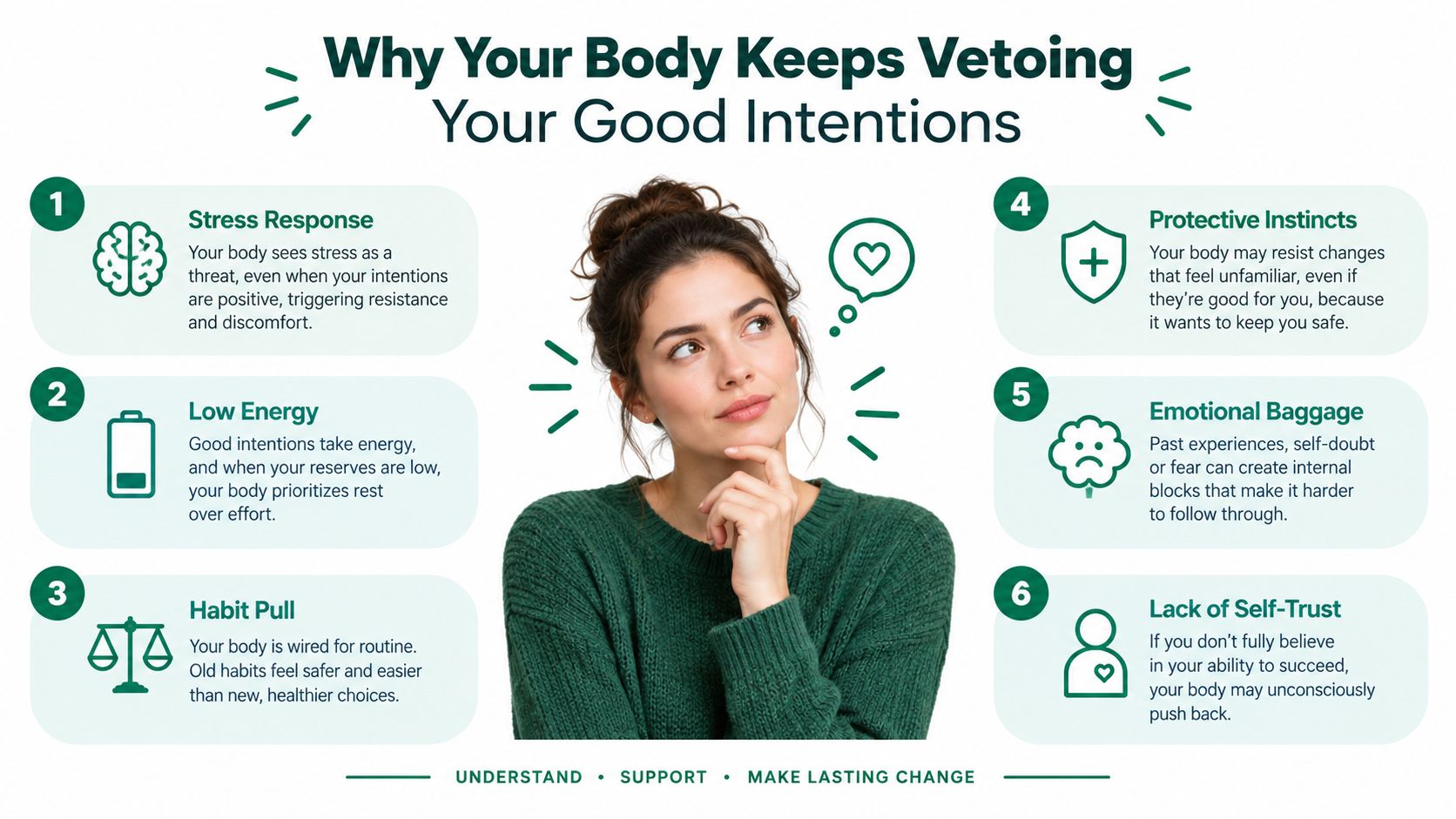
Caption: This visual summarizes common reasons a new intention may be overridden by stress, fatigue, stimulation, or insufficient safety.
Breaking Relational Patterns With Someone Else
In couples work, I often see a familiar sequence. One partner notices distance and asks repeated questions, hoping for reassurance. The other experiences the questions as pressure, gives shorter answers, and eventually withdraws. The first partner pursues harder because the withdrawal confirms the fear. Both people then point to the other's behavior as the beginning.
The cycle is the problem, but each person still has responsibility for their contribution. The pursuer can name the vulnerable feeling beneath the demand instead of increasing pressure. The withdrawer can request a pause without disappearing and return within a mutually agreed window.
Change the signal in real time
The pursuer might replace, “Why are you acting like this? Do you even care?” with:
“I'm feeling scared and disconnected, and I'm tempted to keep asking questions. I want reassurance, but I don't want to pressure you. Can we talk after we both settle?”
The withdrawer needs a concrete return, not a vague promise to discuss it later:
“I care about this conversation. I'm too activated to do it well right now. I need a pause, and I'll come back after I have settled.”
The exact length of the pause should be agreed upon when both people are calm. A timeout without a return signal can feel like abandonment. A return signal without enough space can keep both people activated. The goal is not to create a perfect script. It's to replace pursuit and disappearance with clear contact, a defined pause, and a reliable return.
Repair the rupture without rewriting history
After the argument, repair should include more than “I'm sorry.” Each person can name the action they took, the effect it had, and the replacement they intend to practice. Avoid turning repair into a courtroom presentation of every prior offense.
A useful repair might sound like this: “I raised my voice when I felt dismissed. That made it harder for you to stay present. Next time, I'll name that I'm scared and ask for a pause before continuing.” The other partner might say, “I walked away without telling you when I'd return. That increased your fear. Next time, I'll state the pause and come back at the agreed time.”
Relationship patterns are shaped by practical pressures as well as emotion. Research on marital conflict identifies recurring concerns involving communication, housework allocation, resource sufficiency, and sexuality, so a couple may need to change an arrangement, not merely improve a sentence. Research on recurring marital-conflict domains
For more language around recurring cycles, unhealthy relationship patterns can help you identify the interaction rather than assigning the entire problem to one partner. The core rule is simple: both people must agree on the new signal and the new timeout length. One person can't create a stable relational pattern alone.
When Self-Help Stops Working and Therapy Becomes the Next Step
Self-guided work can change awareness, basic regulation, and the wording of a replacement plan. It may not be enough when the same cycle continues despite accurate identification, when emotional flooding overrides every if-then plan, or when the relationship loop repeatedly triggers anxiety or depressive symptoms.
Pay attention to these signs:
The pattern intensifies under examination: Looking closely brings up trauma-shaped reactions rather than useful information.
The plan disappears every time: You can write the replacement while calm, but can't access it during the cue.
The consequences are expanding: The loop affects sleep, work, intimacy, parenting, safety, or your ability to function.
Repair remains temporary: You apologize and reconnect, but the same rupture returns without meaningful change.
Therapy adds a trained relationship and a method for working with material that may be difficult to process alone. Depending on your needs, that may include attachment-focused work, EMDR, somatic processing, individual treatment for anxiety or depression, or dyadic approaches such as Emotionally Focused Couples Therapy. A trauma-informed clinician can help you explore these responses without forcing disclosure faster than your system can manage. Learn about working with a trauma-informed therapist
At our St. Petersburg practice, an initial appointment focuses on your current concerns, the pattern's history, relevant symptoms, goals, and whether the therapeutic fit feels workable. Session cadence is discussed according to need, and progress can be reviewed at four, eight, and twelve weeks using your reported symptoms, behavior changes, relational experiences, and ability to recover after activation.
Try this tonight: place both feet flat on the floor, take a slow physiological sigh for about ninety seconds, and say one sentence naming what you want instead of the old pattern. For example, “I want to pause and speak with honesty,” or “I want to stay present without checking.” If the loop has become too powerful to interrupt alone, booking a consultation is a disciplined next step, not a last resort.
Be Your Best Self & Thrive Counseling, PLLC offers individual and couples counseling in St. Petersburg for anxiety, depression, trauma, stress, and relationship patterns that keep repeating. Visit Be Your Best Self & Thrive Counseling, PLLC to explore a free initial consultation and discuss a practical, whole-person plan for changing what happens next.