
Signs of ADD in Adults: How to Recognize Them
More than half of U.S. adults with a current ADHD diagnosis were first diagnosed in adulthood, according to the CDC's report on adult ADHD. Specifically, 55.9% were first diagnosed at age 18 or older. If you've spent years wondering why everyday responsibilities take so much effort, late recognition isn't unusual.
The signs of ADD in adults aren't always visible hyperactivity. Sometimes the revealing pattern is inconsistency: you handle a demanding project but can't begin a routine email, or appear organized only because you spend your evenings catching up. These experiences deserve attention, but signs alone can't tell you whether the explanation is ADHD, anxiety, exhaustion, or something else.
Signs of ADD in Adults at a Glance
ADD is an older term commonly used for ADHD with mainly inattentive symptoms. It isn't a separate adult diagnosis with different assessment rules. The National Institute of Mental Health's ADHD overview describes ADHD as persistent inattention, hyperactivity, and/or impulsivity that interferes with functioning.
In 2023, an estimated 15.5 million U.S. adults, or 6.0% of the adult population, had a current ADHD diagnosis, according to the U.S. National Center for Health Statistics report. Adult ADHD is therefore a relevant possibility to investigate, not an unusual explanation reserved for people who struggled visibly in school.
Common adult ADD signs by area
Sign area | What it looks like in adult life | Often mistaken for |
|---|---|---|
Cognitive | Loses the thread mid-conversation or rereads the same paragraph several times | Not paying attention or not caring |
Cognitive | Starts many tasks and finishes few, with projects left half-done | Laziness or lack of ambition |
Behavioral | Chronic lateness, missed bills and forgotten appointments | Being unreliable or disrespectful |
Behavioral | Procrastinates until deadline pressure forces action | Poor motivation or a work ethic problem |
Emotional | Frustration over small tasks and irritability when interrupted | Stress or a short temper |
Emotional | Ongoing overwhelm and shame about unfinished responsibilities | Depression or a personal failing |
Internal | Mind keeps racing, hard to switch off or settle at night | Anxiety or overthinking |
Read the table as a way to identify experiences worth discussing, not as a diagnostic scorecard. The final column describes interpretations people may make, not explanations that an assessment should automatically dismiss.
Look at consequences, not character judgments
Say you forget a bill even though you have the money to pay it. The useful question isn't whether you're responsible enough. It's whether you repeatedly lose track of obligations despite intending to meet them, and what happens when you try to prevent that.
Likewise, becoming frustrated with an unfinished chore doesn't establish ADHD. Emotional strain and nighttime mental activity are particularly nonspecific, so they need context rather than automatic attribution.
Practical rule: Record what happened, what you were trying to do, and what the difficulty affected. A concrete example is more useful than calling yourself lazy or scattered.
An isolated lapse means little. Clinicians look for a recurring, lasting pattern that disrupts life across environments, rather than distraction during an unusually stressful week. You don't need to identify with every example to ask for help.
Why Adult ADD Looks Different from Childhood ADHD
The familiar picture of ADHD is someone who can't sit still. Adults may instead experience internal restlessness, subtle fidgeting, or a persistent urge to move on to something else. Visible activity isn't the only way hyperactivity can appear.
CHADD's guidance on diagnosing ADHD in adults includes pronounced adult restlessness, interrupting, excessive talking, and difficulty waiting alongside inattentive symptoms. Someone can sit through a meeting while struggling intensely to stay engaged or resist interrupting.

Adult restlessness can feel like a busy, unsettled mind even when someone appears physically still.
Success can conceal the effort required
The more useful question may be whether you can regulate attention reliably, not whether you can ever concentrate. An interesting project may hold your attention for hours, while an ambiguous form remains untouched. Intense focus in one situation doesn't settle what's happening in another.
Clinical education material from the American Academy of Family Physicians discusses compensation and delayed recognition, including inattentive and internalizing presentations in women. Perfectionism, overpreparation, urgency, and intense effort can make difficulties less obvious, including in people who performed well academically.
Consider a nurse who double-checks every detail before leaving home but still runs late because getting ready becomes an elaborate checking routine. Or consider a founder who works long hours developing products but repeatedly misses invoices. These are hypothetical examples, not evidence that either person has ADHD.
Being capable of excellent work doesn't tell you how much hidden effort it takes to maintain everyday responsibilities.
Look for a developmental thread
Several symptoms must have been present before age 12, according to CHADD's diagnostic guidance. Report cards, school notes, and recollections from people who knew you then can help establish that history, even if nobody recognized ADHD at the time.
If the terminology is confusing, our explanation of ADD versus ADHD clarifies the names. What matters clinically isn't whether you match a childhood stereotype, but whether your history and current difficulties fit the condition.
How Executive Dysfunction Shows Up Day to Day
Executive functioning refers to the mental skills you use to organize, begin, and carry out actions. Executive dysfunction can help explain the gap between knowing what needs doing and doing it. It isn't a measure of intelligence or how much you care.
A review of executive functioning in adults with ADHD describes executive-function difficulties in approximately 30%–73% of adults with ADHD, including problems with planning, time management, working memory, initiation, and persistence. The range also underscores that these difficulties aren't identical in every person.
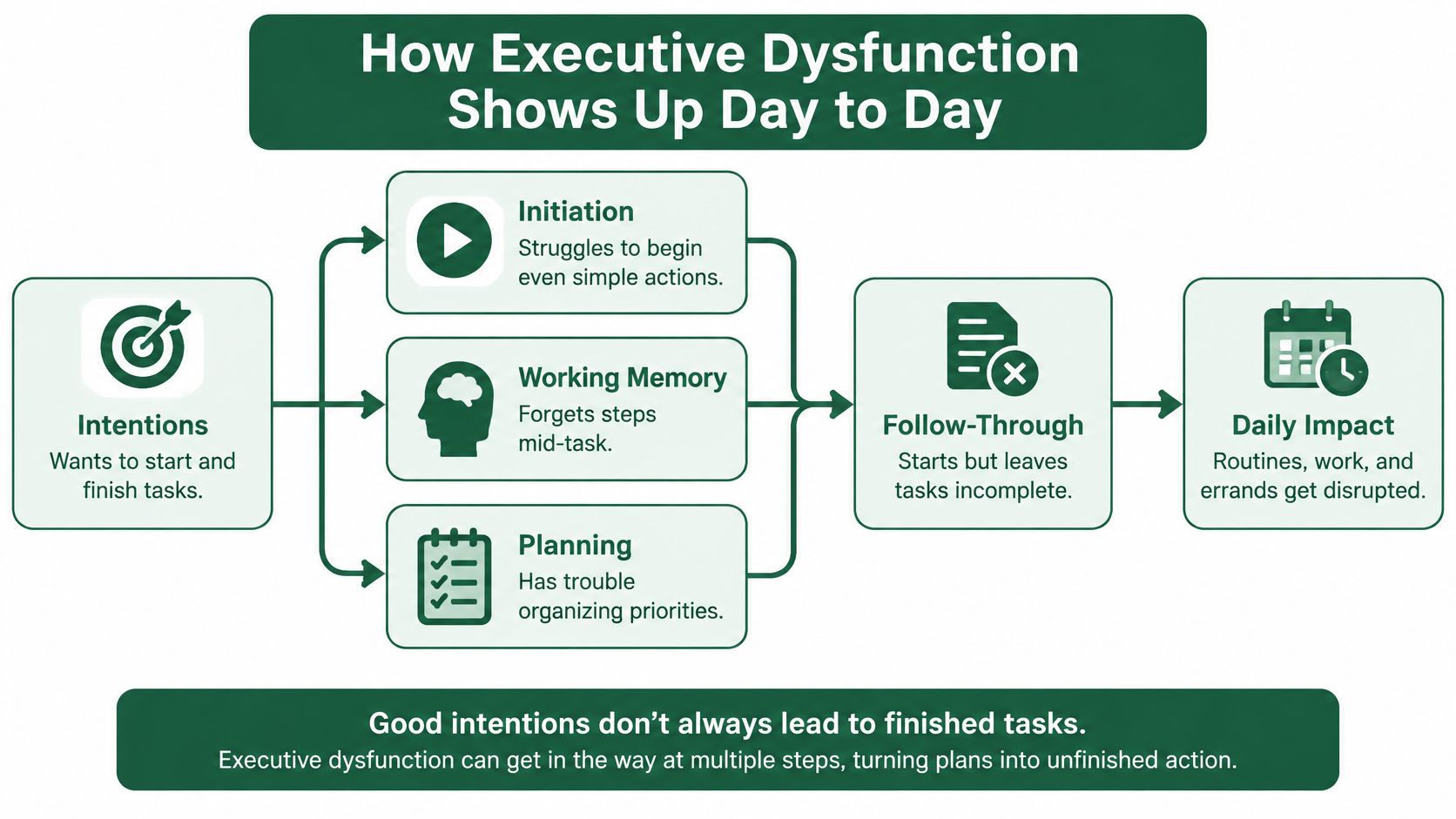
Intentions can break down during initiation, working memory, planning, or follow-through, disrupting work, errands, and household routines.
How an ordinary task becomes a crisis
You underestimate the task. Preparing an expense claim seems straightforward, so you leave it until later. You haven't accounted for locating receipts or checking unfamiliar instructions.
You begin, switch between documents, and lose your place. Working memory, the ability to hold information in mind while using it, becomes especially relevant when the task has several steps.
Because the activity feels unrewarding or confusing, you postpone returning to it. Other unfinished obligations make choosing a starting point harder.
Deadline pressure finally prompts action. You rush, make avoidable errors, and feel ashamed afterward. That emotional aftermath can make the next attempt more stressful.
This sequence is useful to describe because each point needs a different response. A visible checklist addresses lost steps; a scheduled starting cue addresses initiation. Extending the deadline may not address either difficulty.
Questions that reveal the breakdown
These aren't diagnostic tests. Use them to identify examples for a conversation:
Weekly planning: Can you turn commitments into a workable schedule?
Bills: Do you remember obligations without repeated rescue efforts?
Task switching: Can you stop one activity and start the next?
Spoken instructions: Which steps disappear before you act?
Emotional reactions: What happens when someone interrupts you?
Routine completion: Which tasks remain unfinished without reminders?
Persistent difficulties across these activities warrant evaluation. New or episodic changes also deserve attention, but shouldn't automatically be labeled ADHD.
Our adult ADHD coping strategies offer a starting point for daily structure. If you encounter Optimal Native's resource on supplements for executive function support, treat it as information to discuss with a clinician or pharmacist, not evidence that supplements diagnose or treat ADHD.
For now, write down three recent occasions when a plan broke down. Note what you intended, where you got stuck, and what happened instead.
Telling ADD Apart from Anxiety, Depression and Burnout
Condition | Shared sign | Clue that points toward ADD |
|---|---|---|
Anxiety | Trouble concentrating and restlessness | Attention problems are present even when worry is low, and began in childhood |
Depression | Low energy, poor focus and forgetfulness | Lifelong pattern rather than a change that started with a low mood episode |
Burnout | Exhaustion, procrastination and forgetfulness | Symptoms persist after rest and a lighter workload |
Poor sleep | Fatigue, memory lapses and impulsive choices | Symptoms remain after sleep is treated and improved |
Trauma-related stress | Distractibility and emotional reactivity | Attention problems are present outside trauma triggers and across settings |
Substance use | Inattention and disorganization | Symptoms existed before use and do not track with intoxication or withdrawal |
These are clues for an assessment, not rules that establish a diagnosis. Concentration problems, fatigue, forgetfulness, and emotional reactivity can have several causes, and those causes can coexist.
A clinical review of adult ADHD and overlapping conditions indicates that about two-thirds of people with ADHD have co-occurring disorders, including anxiety, depression, and sleep problems. Finding one explanation therefore doesn't necessarily exclude another.
What the overlap feels like
With anxiety, worry can occupy the attention you need for a conversation or task. Ask whether concentration is difficult only while you're anticipating danger, or also when you feel relatively calm.
With depression, a change from your usual functioning matters. A lifelong pattern and a concentration problem that began during a low-mood episode require different clinical questions.
Burnout makes ordinary demands feel unmanageable. Persistent difficulty after reducing demands is worth investigating, but recovery isn't an instant diagnostic experiment; our guide to ADHD and burnout recovery explores that overlap.
With poor sleep, daytime fatigue can affect attention, memory, and impulse control. Sleep needs assessment in its own right rather than being treated as a minor lifestyle detail.
Trauma-related stress can make it difficult to stay present, especially around reminders of threatening experiences. A clinician needs to understand triggers and timing without assuming every distracted moment has the same cause.
With substance use, the sequence matters: what difficulties existed beforehand, and what changes during use, intoxication, or withdrawal? Be candid about alcohol, cannabis, stimulants, and other substances so the assessment reflects your actual circumstances.
Questions that help organize uncertainty
Self-report questionnaires can flag difficulties, but overlapping symptoms can make the results hard to interpret. Anxiety-related inattention and the effects of chronic sleep loss are reasons not to treat an online score as a final answer.
Childhood: Were related difficulties present while growing up?
Lower stress: What remains when pressure eases?
Better sleep: Which problems continue after sleep improves?
Different settings: Do similar difficulties occur outside work?
Mood changes: What persists when low mood lifts?
Increased recognition may include historically missed ADHD as well as cases where attention problems are attributed to ADHD too quickly. Current evidence doesn't establish how much each contributes.
Are my symptoms ADD, burnout, anxiety, trauma, poor sleep, or a combination?
You don't have to answer that alone before seeking care.
How a Professional Assessment Confirms ADD
A professional assessment connects symptoms with developmental history, functional impairment, and alternative explanations. A licensed clinician, such as a psychiatrist or psychologist, can provide a formal evaluation within their scope of practice. A counselor can help you organize concerns and arrange referrals when needed.
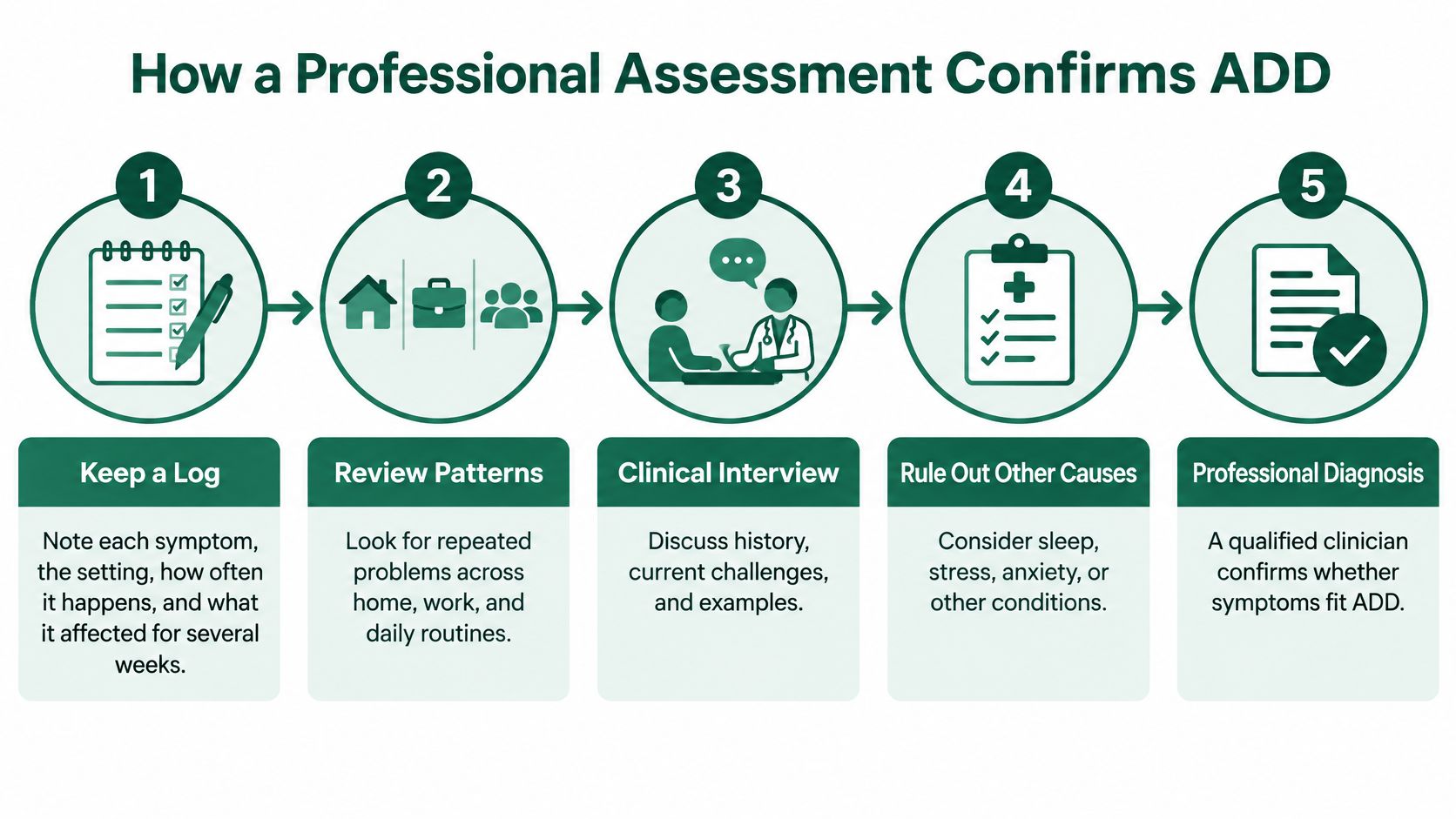
Assessment moves from documenting patterns to a clinical interview, consideration of other causes, and a professional diagnostic decision.
Prepare evidence that reflects daily life
Keep a symptom log for several weeks. Record the situation, what happened, how often it happens, and the consequence, such as a missed deadline or late payment. The CDC's adult ADHD guidance supports bringing specific examples and considering frequency, context, and consequences rather than relying on a general impression.
Gather your developmental history. Ask parents, older relatives, or other people who knew you growing up about recurring difficulties, and locate school records if available. If records or relatives aren't available, tell the clinician rather than assuming an assessment is impossible.
Complete the clinical interview and rating scales. A clinician may use a standardized questionnaire such as the Adult ADHD Self-Report Scale to organize reported symptoms. Answer based on your ordinary functioning, including the supports you need, rather than your best day or worst day.
Check whether the full diagnostic requirements are met. For people older than 16, evaluation generally looks for at least five symptoms within the inattentive and/or hyperactive-impulsive domains, persisting for at least six months, occurring in two or more settings, and causing functional impairment, according to the National Institute of Mental Health's diagnostic guidance. The clinician determines the presentation; combining unrelated items into a personal score isn't enough.
Review other possible causes. Discuss sleep disorders, medical conditions, medication effects, and substance use. Bring a medication and supplement list so the clinician can consider anything that might affect attention, energy, or sleep.
Document impairment and discuss co-occurring conditions. Explain the practical effects on employment, household responsibilities, finances, or relationships, not just whether a symptom feels familiar. Include what anxiety, low mood, or other concerns add to the picture so the eventual care plan addresses more than a label.
What to bring to the appointment
Bring your log, a short personal history, relevant records, and concrete examples. A useful example describes a sequence: you opened an important message, meant to respond after checking something, forgot it, and missed a consequential deadline.
You can also bring questions about the evaluation process, including who will complete it and how findings will be discussed. Our explanation of how long a psychological evaluation can take can help you prepare for that conversation without assuming every assessment follows the same schedule.
Treatment Options and Your Next Step
Option | What it targets | Main limits |
|---|---|---|
Medication, stimulant or non-stimulant | Core inattention and impulsivity | Needs a prescriber, side-effect review, and monitoring |
ADHD coaching and skills training | Planning, task initiation, and routines | Requires practice, time, and consistency |
Cognitive behavioral therapy for adults | Procrastination, negative self-talk, and anxiety overlap | Doesn't directly replace treatment for core attention symptoms |
Workplace and home accommodations | Deadlines, task structure, and reminders | Requires employer or household cooperation |
Holistic counseling | Stress load, emotional regulation, sleep, and self-compassion | Evidence is more limited; works alongside diagnosis and medical care |
Treatment should match your difficulties and goals, rather than follow a single package. In 2023, approximately one-third of U.S. adults with ADHD took stimulant medication, according to the CDC's adult ADHD treatment report. Prescribers may also consider non-stimulant options and monitor benefits, side effects, and other health concerns.
Combine supports by the problem they address
Medication and practical skills work have different roles. A prescriber may help address core symptoms, while coaching or structured skills training helps translate intentions into a usable routine. For example, improving attention doesn't automatically create a system for processing invoices.
Cognitive behavioral therapy can address avoidance, discouraging assumptions, and the anxiety surrounding difficult tasks. Instead of treating every delayed task as evidence of personal failure, you can identify the obstacle and choose a specific action. Our overview of therapy for adults with ADHD describes counseling support in more detail.
Accommodations change the conditions around a task. Written instructions, fewer interruptions, a visible deadline, and agreed household reminders can reduce unnecessary demands on memory and organization. The goal is a dependable system, not a more elaborate system you won't use.
Where holistic counseling fits
Counseling may include nervous-system regulation skills, gentle breathwork, mindfulness, sleep and lifestyle changes, self-compassion, and exploration of purpose or meaning. These approaches can make space for the stress of managing daily demands and the emotional effects of longstanding struggles.
Research on these methods as ADHD treatments is more limited than on medication and structured skills training. They belong alongside appropriate assessment and medical care, not in place of them. A calming practice may help you approach an overwhelming task, but feeling calmer doesn't establish whether you have ADHD.
Choose outcomes you can observe: opening bills before they become urgent, recovering from interruptions, or discussing household responsibilities without escalating conflict. Review whether the chosen support helps those goals, rather than judging progress only by whether you feel productive.
Don't stop prescribed medication without talking to your prescriber. If side effects or doubts arise, use them to guide a medication review.
Make the first conversation concrete
Bring your log and examples to a primary care doctor or clinician who evaluates adult ADHD. Ask whether a full assessment is appropriate and explain which daily difficulties matter most.
Ask what other explanations were considered and how sleep, mood, medical causes, medication effects, and substance use were checked.
Choose support by goal. Seek a qualified clinician for diagnosis and medication decisions, and counseling for daily-life skills, emotional patterns, relationships, and stress.
At Be Your Best Self & Thrive Counseling, our focus areas include ADHD, anxiety, depression, stress, and burnout. Rochelle Young's listed areas include ADHD, anxiety/panic, depression, self-esteem, grief and loss, life transitions, people-pleasing, and boundaries; our supportive guidance helps clients understand their needs and goals, develop nervous-system regulation skills, and build healthier relationships. The counselor is licensed as a mental health counselor in Florida and is a member of the American Counseling Association (ACA).
Be Your Best Self & Thrive Counseling, PLLC offers individualized counseling for adults navigating ADHD-related difficulties, anxiety, stress, and burnout, with a free initial consultation to explore fit and goals. Write down your top three examples of where daily life is getting stuck, then visit Be Your Best Self & Thrive Counseling, PLLC to book a first conversation this week.