
Add or ADHD in Adults: A Clear Guide to the Real Difference
You're staring at a half-finished project late at night, mentally replaying the tasks you forgot, the message you interrupted, and the appointment you nearly missed. You may be wondering whether this is ordinary stress, burnout, anxiety, or something connected to the old search term ADD.
That question makes sense, but the answer usually isn't found by choosing between two labels. ADD is an older term for what clinicians now call attention-deficit/hyperactivity disorder, or ADHD. Adult ADHD can involve inattention without obvious physical hyperactivity, and coping strategies can conceal the difficulty for years.
Why the Add or ADHD Question Matters for Adults
Many adults begin searching for “add or ADHD” after recognizing a lifelong pattern rather than one isolated symptom. You may work hard, care a great deal, and understand exactly what needs to happen, yet still struggle to start, organize, finish, or remember routine tasks. The gap between intention and follow-through can create shame, especially when other people interpret it as carelessness.
That emotional burden deserves attention alongside the diagnostic question. Persistent criticism, missed opportunities, and inconsistent performance can affect confidence over time, and understanding the connection between ADHD and low self-esteem can help put that experience into context.
The terminology matters because it shapes what you look for. Searching only for visible hyperactivity may cause you to miss internal restlessness, mental clutter, time-management problems, emotional impulsivity, or the exhausting effort of compensating. A person who appears organized may be relying on elaborate reminders, perfectionism, over-preparation, or people-pleasing to prevent mistakes.
A useful question to ask
Instead of asking, “Do I look like the stereotype?” ask:
Is this pattern persistent? Has it appeared across different stages of life?
Does it affect functioning? Does it interfere with work, relationships, routines, sleep, or safety?
Does it occur in more than one setting? ADHD isn't limited to one difficult job or one stressful season.
Could something else explain it? Anxiety, depression, trauma, sleep problems, burnout, and substance-use risk can overlap with attention difficulties.
The rest of this guide builds a practical vocabulary for those questions. It clarifies the shift from ADD to ADHD, translates symptoms into adult experiences, explains masking and overlapping conditions, describes evaluation in the Tampa Bay area, and considers treatment when medication is helpful, unavailable, unwanted, or only part of the answer.
The Evolution From Add to ADHD
The simplest answer to “ADD or ADHD” is that ADD is no longer the current diagnostic name. The recognized diagnosis is attention-deficit/hyperactivity disorder, or ADHD, a condition involving persistent inattention and/or hyperactivity and impulsivity that interferes with functioning in at least two settings, such as home, school, or work. The National Institute of Mental Health's overview of ADHD describes the current terminology and symptom patterns.
Think of the change like updating a map. The surroundings did not suddenly change when the label changed. The newer name gives clinicians a way to describe several ways the same condition can present, including people whose main difficulties involve attention and organization rather than obvious physical activity.
Three current presentations
Predominantly inattentive presentation involves difficulty sustaining attention, organizing tasks, managing time, remembering details, completing projects, and resisting distraction. An adult may look quiet and cooperative while internally losing track of instructions or mentally drifting during a meeting.
Predominantly hyperactive-impulsive presentation involves restlessness, excessive talking, interrupting, difficulty waiting, and acting before considering consequences. Hyperactivity may be physical, but adults can also experience it as an internal motor that rarely settles.
Combined presentation includes clinically significant patterns of both inattention and hyperactive-impulsive symptoms.
The term “presentation” matters because symptoms can look different across people and across life stages. A child who once ran around a classroom may become an adult who feels trapped in long meetings, taps constantly, talks over colleagues, or changes tasks whenever boredom appears. Another adult may never have seemed physically restless but may have spent years losing belongings, missing deadlines, and relying on last-minute pressure.
A helpful translation: “Inattentive” doesn't mean unintelligent or uncaring. “Hyperactive” doesn't always mean visibly energetic. The clinical words describe patterns, not character.
How Adult Symptoms Actually Show Up Day to Day
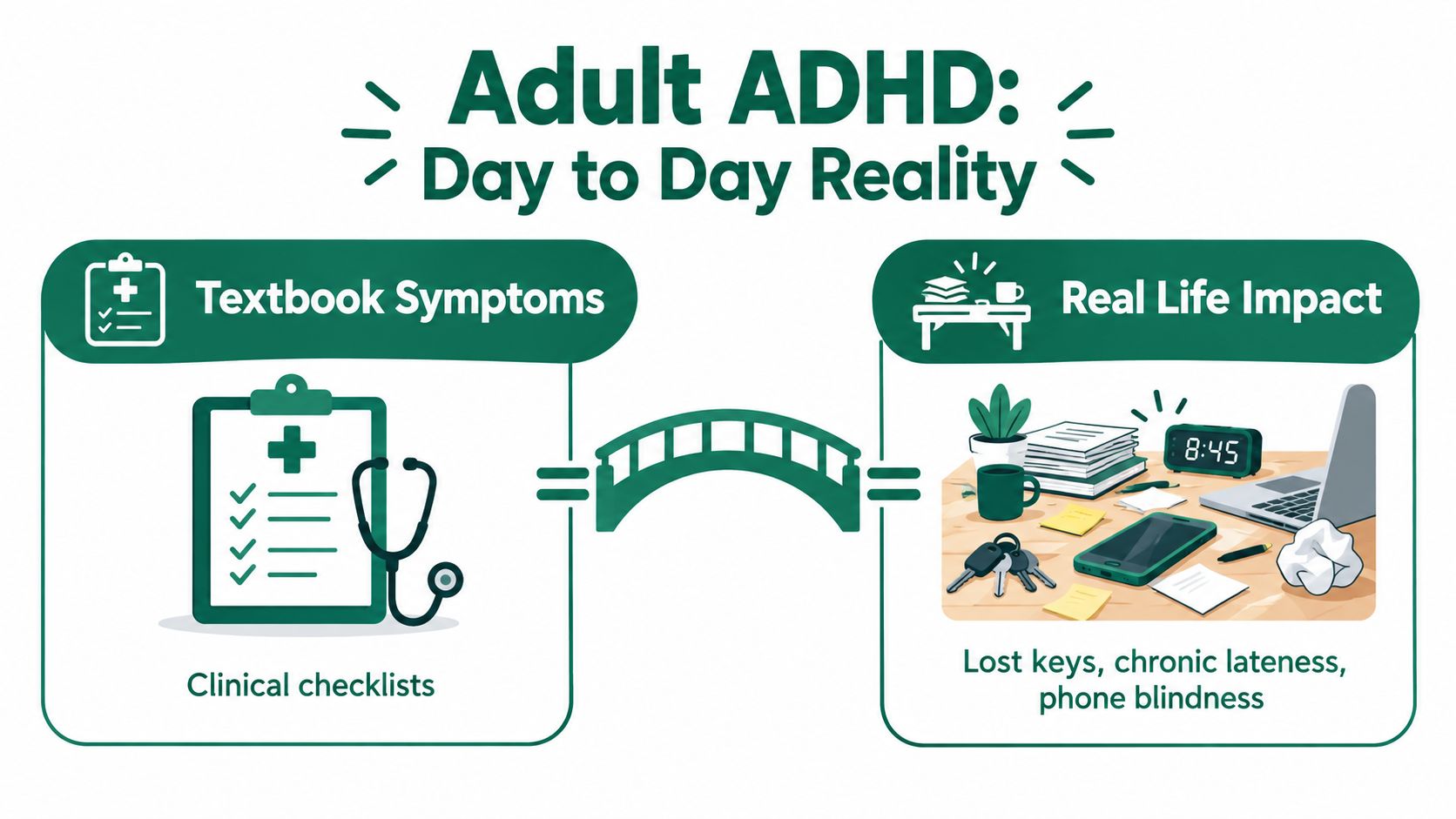
Maya begins Monday with good intentions. She opens her laptop to finish one report, notices an unanswered email, searches for a document, remembers a bill, and starts reorganizing a folder. By evening, she has touched several tasks but completed none. Her keys are missing, her phone is somewhere in the house, and she rereads the same paragraph without absorbing it.
That picture fits the inattentive side of adult ADHD, but it isn't a diagnosis by itself. Adults may also experience chronic lateness, forgotten appointments, unfinished projects, lost items, difficulty following multi-step instructions, or mental fog during long meetings.
The restless side can be quieter than expected
Jordan rarely leaves meetings, but his foot keeps moving under the desk. During Zoom calls, he paces, checks other tabs, and interrupts because the thought feels as though it will disappear if he waits. He may choose immediate relief, such as scrolling or abandoning a difficult task, even while caring about the long-term consequence.
Hyperactive-impulsive patterns can include tapping, pacing, excessive talking, blurting responses, interrupting, difficulty waiting, and rapid decisions. Some adults experience this as inner agitation rather than outward movement.
Many people have a mixed picture. They might lose track of paperwork, then act impulsively when pressure builds. The important question is whether these patterns are persistent, occur across settings, and create meaningful impairment.
Masking changes what other people see
A high-achieving adult may arrive early because they leave home excessively early. They may over-prepare for every meeting, keep multiple reminder systems, apologize quickly, or say yes to everyone to avoid disappointing them. These strategies can protect performance while consuming enormous energy.
Masking can also hide symptoms from the person using it. If the system works only through perfectionism and panic, the outside result may look organized while the internal experience feels chaotic. Reading about forgetfulness as a possible ADHD symptom can help you identify patterns, but recognition still needs to be followed by a professional assessment.
Why ADHD Rarely Travels Alone in Adults
Adult attention difficulties rarely exist in a neat compartment. Anxiety can produce racing thoughts, avoidance, and difficulty concentrating. Depression can reduce motivation and working memory. Trauma responses can bring alertness, dissociation, or emotional reactivity. Sleep problems and burnout can make even familiar tasks feel impossible.
The overlap creates a common trap. A person may spend years managing anxiety through control, checking, and over-preparation, while an unrecognized attention pattern keeps generating missed deadlines and unfinished responsibilities. Another person may receive support for ADHD but continue struggling because untreated trauma, depression, or sleep disruption is still affecting daily functioning.
A good evaluation doesn't force every difficulty into one diagnosis. It asks how the pieces interact.
Substance-use risk also belongs in the conversation, not as a judgment but as part of safe care. Some adults use substances to quiet restlessness, sustain attention, escape shame, or sleep after an overstimulating day. A clinician needs this information to plan responsibly and distinguish coping from a separate condition requiring support.
Hormonal and life-stage changes can alter the visibility of symptoms. Perimenopause, postpartum shifts, a major career transition, caregiving, or a move into a less structured work environment may expose difficulties that were previously contained by routines or external demands. These changes don't prove ADHD, and they don't rule it out. They signal the need to examine the timeline carefully.
For a broader clinical map of overlapping conditions, the adult ADHD comorbidity overview from Premiere Education offers useful context. The practical takeaway is whole-person assessment. Treating anxiety alone may leave task initiation untouched, while focusing only on attention may miss grief, trauma, exhaustion, or relationship distress.
What a Real Adult ADHD Evaluation Looks Like
A thoughtful evaluation is more than checking boxes on an online questionnaire. It usually begins with a detailed clinical interview about current symptoms, childhood behavior, education, work, relationships, routines, health, sleep, mood, trauma, and substance use. The clinician is trying to understand both the pattern and its impact.
Screening is a starting point
A screening questionnaire can flag possible ADHD traits. It can't confirm the diagnosis. A diagnostic assessment considers whether symptoms are persistent, began during childhood, occur across settings, cause impairment, and aren't better explained by another condition.
Childhood history matters because ADHD is a neurodevelopmental condition. Adults may gather report cards, old evaluations, family observations, or memories of disorganization, daydreaming, impulsivity, restlessness, forgotten homework, or chronic underperformance relative to ability. A parent, sibling, teacher, or another person who knew you as a child may provide helpful context, although adults don't always have complete records or supportive observers.

Finding an evaluation in Tampa Bay
Adults in St. Petersburg and the broader Tampa Bay area can begin with a primary care physician, psychiatrist, psychologist, or specialized ADHD clinic. Ask directly whether the provider evaluates adults, how they assess childhood onset, whether they consider anxiety and trauma, and whether they coordinate with a prescriber when needed.
Insurance questions matter. Before scheduling, ask whether the provider is in-network, whether diagnostic testing has separate coverage, what records to bring, and whether medication management is available through the same practice. Billing and administrative systems can differ across specialties, so resources describing neurology RCM services may help explain why provider offices ask detailed insurance and documentation questions, even though an ADHD evaluation itself may be completed by a mental-health professional.
Prepare a short timeline rather than trying to remember everything in the appointment. Write down examples from work, home, relationships, finances, driving, sleep, and school. Include the strategies that keep you functioning, because the effort required to compensate is clinically relevant. For additional adult-focused education, you can review understanding ADHD in adults.
Treatment Beyond the Prescription Pad
Medication and counseling address different parts of adult ADHD impairment. The NICE recommendations for ADHD identify lisdexamfetamine or methylphenidate as first-line pharmacological options for adults when significant impairment continues after environmental modifications are implemented and reviewed.
The CDC reported that approximately one-third of adults with ADHD took stimulant medication during the preceding year, and about 71.5% of those medication users experienced difficulty filling a prescription because the medication was unavailable. These figures come from nationally representative U.S. data and illustrate why treatment planning needs more than a simple “take medication” message. Source: CDC adult ADHD analysis.
What medication can and cannot do
Medication may reduce core symptom severity for adults who meet diagnostic criteria. A qualified prescriber should monitor benefits, side effects, sleep, appetite, mood, cardiovascular considerations, adherence, and the fit between symptom relief and actual functioning. NICE recommends at least annual review of treatment and whether medication should continue.
Medication doesn't automatically teach a person how to repair a conflict, design a workable workload, break down a complex project, or recover from years of shame. Those needs make psychotherapy and skills-based support valuable. Cognitive-behavioral approaches can target planning, prioritization, procrastination, emotional regulation, communication, and relapse prevention.
A flexible care plan
A stepped-care plan may combine:
Environmental supports: External reminders, written instructions, reduced-distraction workspaces, task decomposition, and predictable weekly reviews.
Counseling: Skills practice for routines, emotional impulsivity, self-compassion, relationship repair, and sustainable follow-through.
Medical monitoring: Prescriber follow-up when medication is used, with attention to both effectiveness and tolerability.
Alternative pathways: Non-pharmacological treatment when medication isn't wanted, isn't tolerated, is difficult to access, or doesn't address the full pattern of impairment.
ADHD therapy for adults can support this practical work without replacing formal diagnosis, prescribing, or medical monitoring. The central aim isn't perfect productivity. It's more reliable functioning and a life that feels less governed by panic, avoidance, and recovery from preventable chaos.
Practical Tools You Can Start Using This Week
You don't need a complete life overhaul to test whether external structure helps. ADHD-related difficulties often become worse when the brain has to remember time, sequence, priorities, and transitions internally. Move those demands into the environment.
Make time visible
Time blindness feels like “I have plenty of time” followed suddenly by “I'm late.” Use a visual timer during work blocks, set a smartphone alarm for transitions, and put time blocks directly into a calendar. Create an alarm for leaving, not only for the appointment. A calendar entry that says “prepare to leave” is more useful than one that records only the destination.
For long tasks, write the finish condition. “Work on taxes” is vague. “Open the account, download the statement, and place it in the tax folder” gives the brain a visible starting point.
Lower the activation energy
Use a two-minute start rule. Open the document, place the materials on the table, or write the first sentence. Starting is the target, not completing the entire project.
Body doubling can help. Work beside another person, use a virtual coworking session, or ask someone to remain on a call while each of you completes a task. Break a project into small actions that can be checked off, such as “find the form,” “complete the first page,” and “save the file.”
Protect emotional and physical capacity
When feelings rise, name them before responding. “I feel rejected,” “I feel overloaded,” or “I feel rushed” creates a pause between emotion and action. In close relationships, written agreements can reduce ambiguity. Decide how either person will request a pause, when the conversation will resume, and which practical issue needs attention first.
Sleep stabilization is equally practical. Keep a consistent wind-down cue, reduce stimulating tasks close to bedtime, and place tomorrow's essentials where you'll see them. The ADHD coping strategies for adults can provide more ideas, but choose only one or two tools this week. A complicated system can become another unfinished project.
Clearing Common Myths and Finding Your Next Step
Myth one: ADHD is only a childhood condition. Current U.S. data show that 15.5 million adults, or 6.0% of adults, reported a current ADHD diagnosis in 2023, and 55.9% received their diagnosis at age 18 or older. Source: CDC adult ADHD data. Adult diagnosis is real, although the U.S. estimate is based on self-reported diagnosis and isn't a global prevalence rate.
Myth two: Hyperactivity must be obvious. Adults may experience internal restlessness, constant mental activity, pacing, tapping, excessive talking, or difficulty waiting. Others primarily experience inattention and organization problems.
Myth three: High-achieving adults can't have ADHD. Achievement can coexist with severe impairment, especially when a person relies on over-preparation, perfectionism, urgency, or people-pleasing. Coping strategies may hide the difficulty without removing it.
Myth four: Medication is the only real treatment. Medication can be useful, but counseling, environmental changes, sleep support, relationship work, and skills training address areas medication may not solve. Treatment should reflect the person's goals, health, preferences, access, and co-occurring conditions.
A positive screening result isn't a diagnosis. It is also not meaningless. It can be a reasonable prompt to seek an evaluation, particularly when symptoms are persistent, began early in life, appear in more than one setting, and interfere with functioning. A clinician should also consider anxiety, depression, trauma, sleep problems, burnout, hormonal changes, and substance-use risk.
Late recognition can bring relief and grief at the same time. You may feel validated by a new explanation while mourning years spent blaming yourself. Couples may need to renegotiate expectations, communication, chores, finances, and repair after conflict. A therapist experienced with neurodivergent adults and couples can help translate insight into agreements and daily practices.
In Tampa Bay, start with a primary care provider or an adult ADHD evaluator, then ask prospective therapists how they work with ADHD, anxiety, trauma, burnout, and relationships. A free initial consultation at a practice with a well-rounded approach can help clarify whether the provider's approach and scope fit your goals.
Be Your Best Self & Thrive Counseling, PLLC offers individual and couples counseling for adults navigating ADHD-related patterns alongside anxiety, depression, trauma, stress, or life transitions, with practical support for routines, emotional regulation, and communication. Visit Be Your Best Self & Thrive Counseling, PLLC to learn about services in the St. Petersburg and Tampa Bay area and request a free initial consultation.