
Therapy Cancellation Policy Guide for Clients and Practices
You're staring at your phone, trying to decide whether to cancel today's therapy appointment. Your child is sick, your workday changed, or anxiety has made leaving home feel impossible. At the same time, you're worried about a fee, disappointing your therapist, or damaging the relationship. A clear therapy cancellation policy should reduce that uncertainty, not add to it.
Introduction to Therapy Cancellation Policies That Protect Care
A cancellation policy explains what happens when a client needs to change, miss, or reschedule an appointment. A thoughtful policy also does something deeper. It protects the continuity of care by making expectations visible before a stressful moment arrives.
For clients, clarity means knowing how to cancel, when notice is required, whether a fee may apply, and what happens after a missed session. For therapists, clarity protects reserved clinical time and makes responses more consistent. Neither person has to negotiate the rules while emotions are running high.
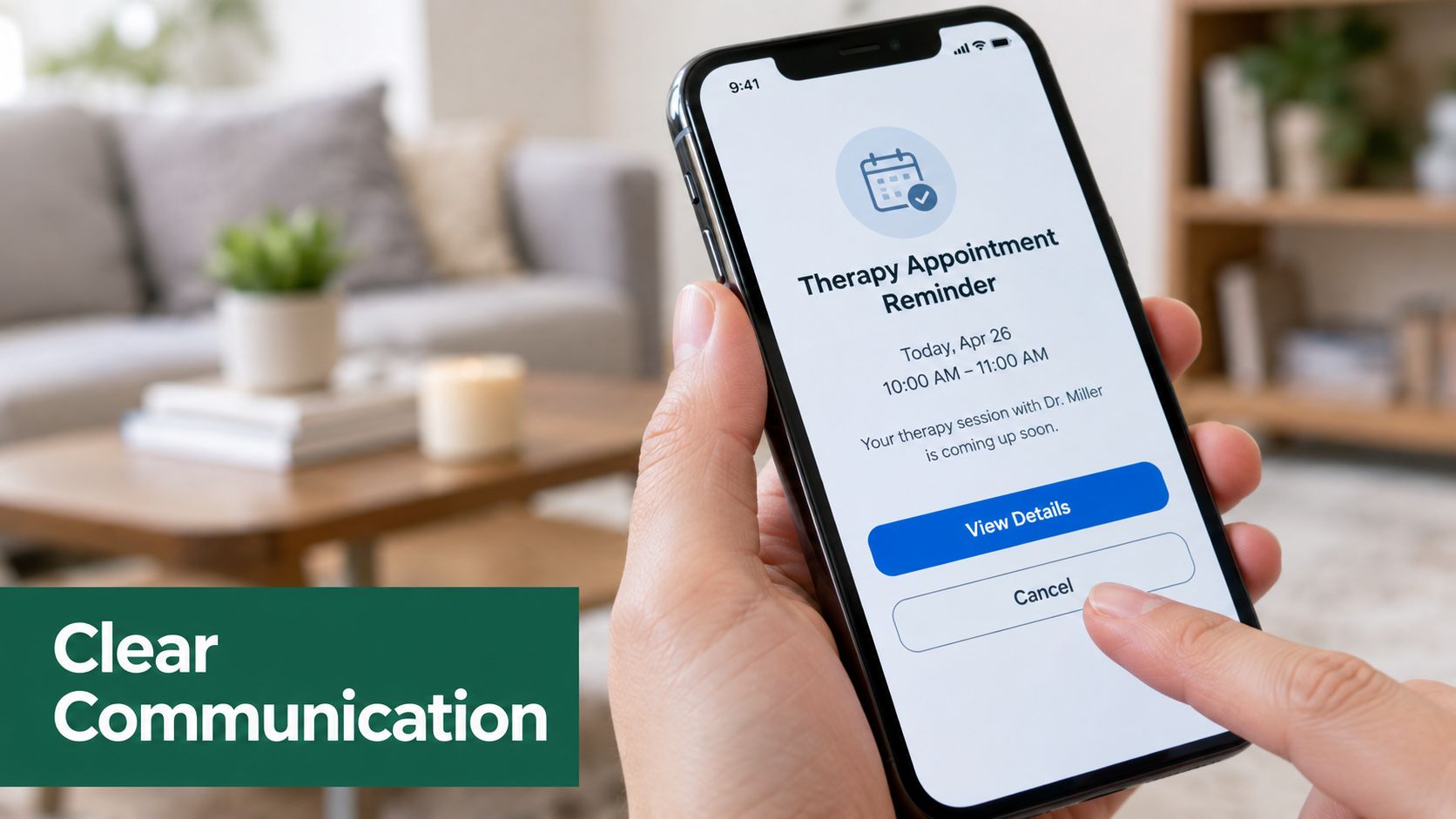
Caption: An appointment reminder can give clients a practical opportunity to review their plans and communicate changes early.
A client might send a message saying, “I'm sorry, I can't make it today,” and assume the therapist will move the appointment. The therapist, however, may have held that time exclusively and may not be able to offer it to someone else at short notice. A written policy gives both people a shared reference point.
At Be Your Best Self & Thrive Counseling, a policy can support the same values found in trauma-informed care, including transparency, collaboration, and respect for a client's circumstances. That doesn't mean every late cancellation is free, and it doesn't mean every fee should be enforced without reflection. It means the practice explains the boundary plainly and applies it with care.
Florida clients and clinicians also benefit from discussing practical questions early. Does a text count as notice? Is a video-session failure treated like an in-person absence? What happens if the therapist is late? This guide addresses those questions, then offers policy elements, fee approaches, and scripts that practices can adapt.
A supportive boundary: Clients deserve to know what to expect, and therapists deserve a workable structure for protecting the time reserved for care.
What a Therapy Cancellation Policy Is and How It Works
A therapy appointment reserves a specific time for one client. The therapist prepares for that session and may be unable to offer the opening to someone else at short notice. A therapy cancellation policy explains how much notice gives the practice a fair chance to refill the time, and what happens when notice comes later. Framed this way, the policy supports continuity of care and relationship safety rather than serving only as a fee notice.
Policies commonly distinguish three situations:
Advance cancellation: The client communicates outside the late-cancellation window. The practice may reschedule without a missed-session fee, according to its written terms.
Late cancellation: The client cancels within the stated notice period. Many policies use 24 to 48 hours, as described in Blueprint's policy guidance.
No-show: The client does not attend and does not provide the required communication. One implementation example defines a no-show as failing to arrive within 15 minutes of the scheduled start, while treating cancellations inside 24 hours as late cancellations, according to the same mental-health policy template.
The written policy should state when the notice clock starts and which time zone applies. “Cancel by Tuesday” leaves room for confusion. “Notice must be received at least 24 hours before the scheduled appointment” is clearer. It should also identify valid methods, such as voicemail, text, email, or a portal message.
Telehealth deserves equally plain instructions. The policy can explain when attendance begins, what to do if the platform fails, and whether the client should call, text, or wait for therapist outreach. Applying the same general fee rules to telehealth and in-person sessions supports parity. A temporary switch between formats may preserve continuity when clinically and practically appropriate.
Fairness also includes the therapist's responsibility. If the therapist is late or technology prevents the session, the practice should explain whether the appointment will be extended, rescheduled, or credited. Clients using a sliding scale may need a clearly stated grace process for unexpected hardship, with decisions made consistently rather than case by case without guidance.
Before a first session, clients can review guidance for preparing for a first therapy session, including questions about scheduling and cancellation expectations.
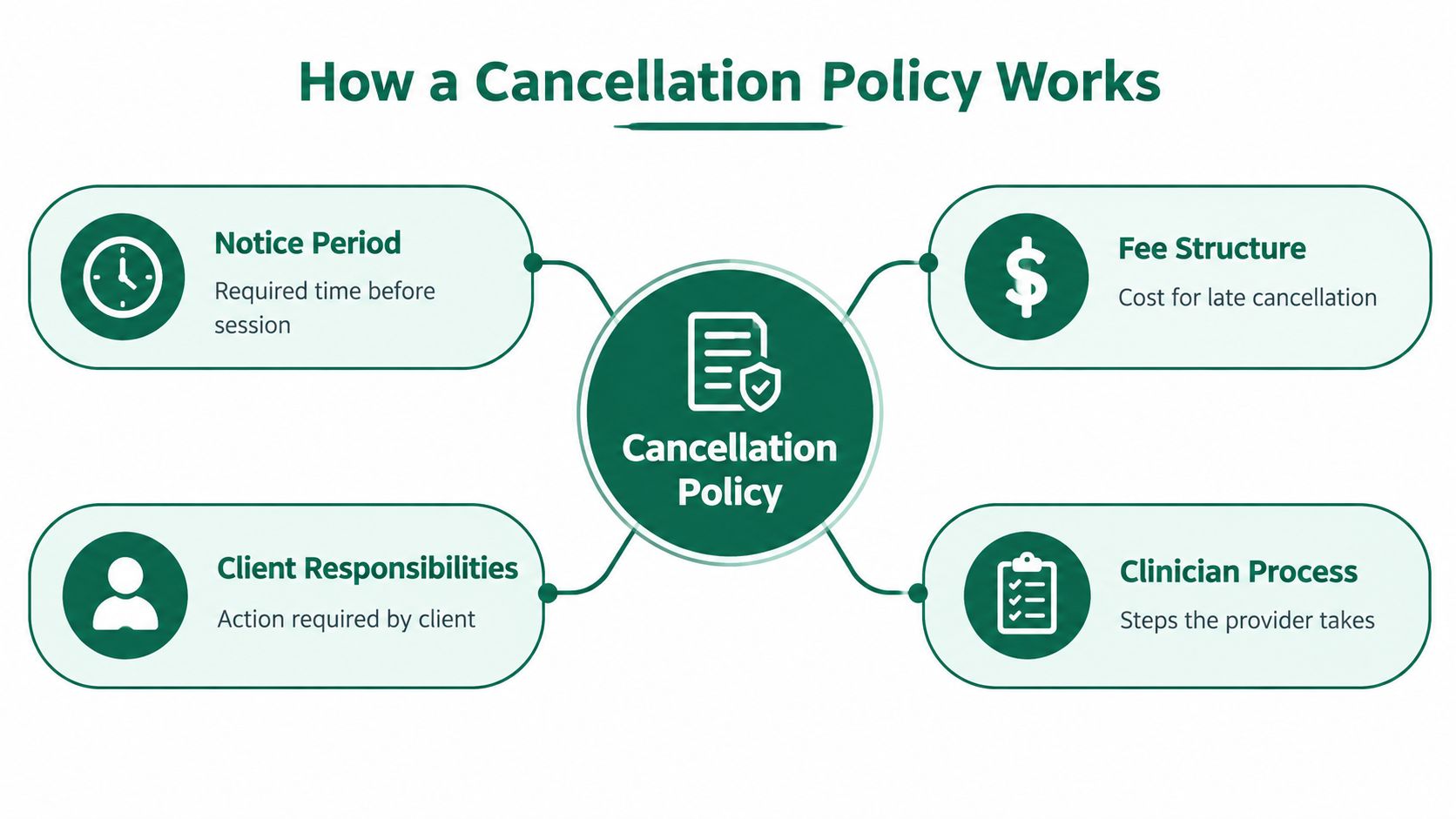
Caption: A cancellation policy connects notice periods, fee structure, client responsibilities, and the clinician's follow-up process.
Why Cancellation Policies Matter for Clients Clinicians and Access
A client misses an appointment after a stressful morning, then hesitates to contact the therapist because they expect blame or a fee. A clear cancellation policy gives that person a way back into care while protecting the time reserved for the session. It works like a shared map: clients know what to do, and clinicians can respond consistently.
Missed appointments can interrupt therapeutic momentum, delay support for someone waiting for an opening, and leave the practice with unused clinical time. A national survey of outpatient physical therapy in 2015 found a mean no-show rate of 10.4% ± 7.43 across participating U.S. care settings. Missed-appointment rates were lower when practices combined several reminder methods with a required 24-hour cancellation notice, reporting 6.07% ± 4.59 compared with 13.80% ± 9.66 for phone-call reminders alone, according to the University of Nevada, Las Vegas dissertation record. The findings support clear notice expectations and more than one reminder channel.
Behavioral-health practices may face a heavier operational burden. A benchmark summary reports that therapy and psychiatry no-shows can reach 30% to 40% of scheduled sessions, with private-practice therapy averaging about 35% and substance-use treatment reaching up to 50%, according to behavioral-health missed-session benchmarks. These figures do not explain why someone missed care, so they should guide planning rather than label clients. Attendance systems work best when they address barriers without shame.
The clinical cost of uncertainty
A missed session may reflect transportation problems, caregiving, work demands, financial pressure, fear, or emotional overwhelm. A strict response can make returning harder, especially when the policy was difficult to find or a fee came as a surprise. Clear options, including valid cancellation methods and a defined process for unexpected hardship, reduce that uncertainty.
Clinicians also carry real obligations. The therapist may have declined another appointment, arranged childcare, prepared clinical material, or remained available for a telehealth visit. A sustainable boundary helps the clinician keep offering care instead of absorbing every disruption privately. Applying the general policy fairly across in-person and telehealth sessions also protects continuity when a temporary format change is clinically and practically appropriate.
Relationship safety: A fee should never be the entire conversation. The therapist should also check whether the client is safe, wants to continue, and needs help making future attendance more workable.
A study of mental-health clinics found a 9.5% no-show rate and an additional 10.7% cancellation rate, meaning more than one in five scheduled visits were lost, as reported in the mental-health clinic attendance study. The access question is broader than whether a practice can charge a fee. Fair enforcement should leave room for a documented grace process, including for sliding-scale clients facing unexpected hardship, while therapist lateness or technology problems should lead to a clear extension, rescheduling, or credit process.
For more context, barriers to mental-health treatment explains why attendance difficulties cannot be reduced to motivation alone.
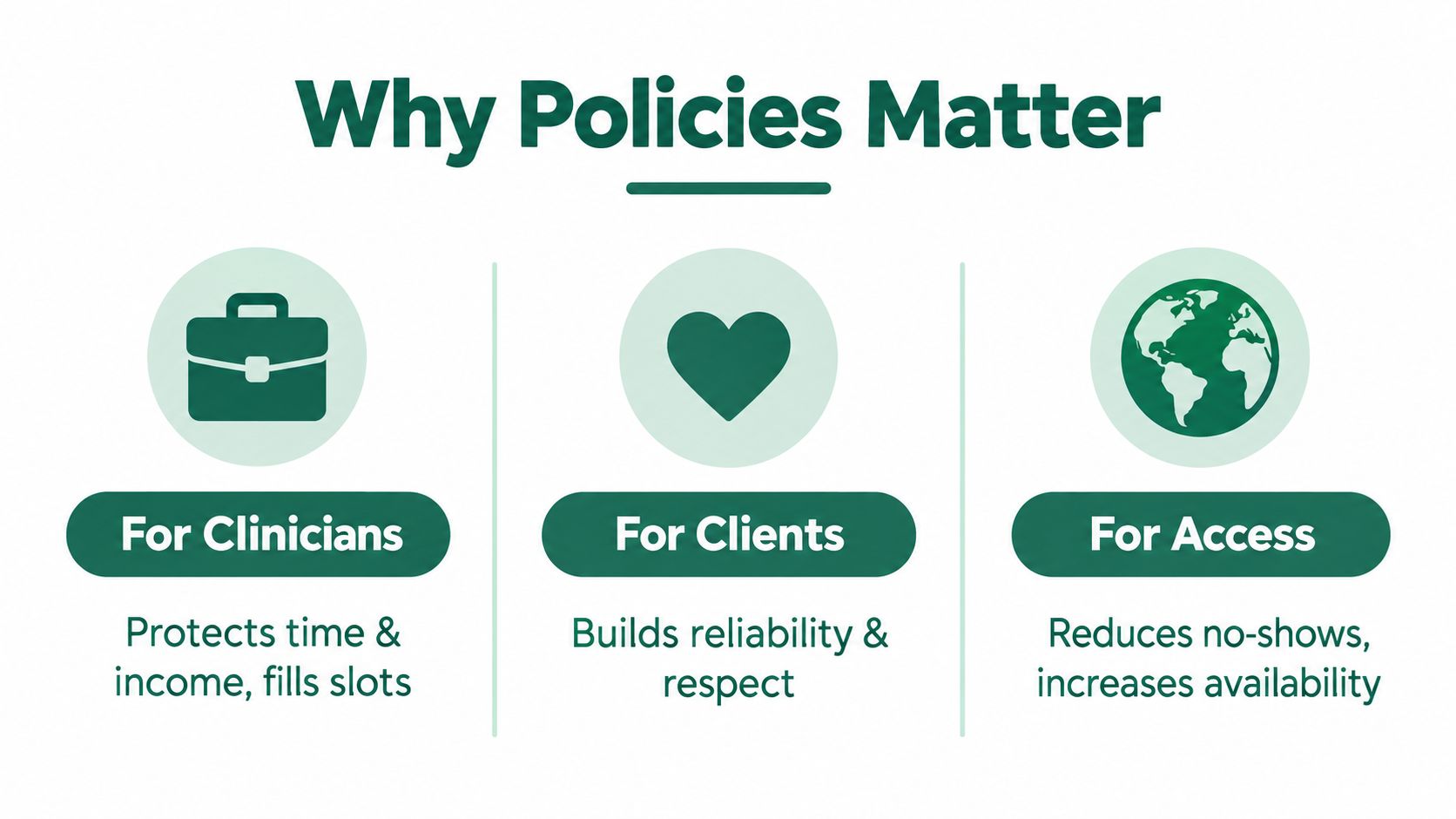
Caption: A clear policy can support clinicians, clients, and broader access to behavioral healthcare.
Essential Elements Every Therapy Cancellation Policy Should Include
A client who needs to cancel should not have to search for the “right” answer while already feeling stressed. A clear policy works like a shared map: clients know how to communicate, clinicians can apply the same standards, and both have a defined path for emergencies or access barriers.
Start with timing and definitions
State the notice window in plain language. A policy should distinguish advance cancellations, late cancellations, and no-shows. Many practices set the late-cancellation period at 24 to 48 hours, consistent with Blueprint's implementation guidance.
Define each term with an example. Explain what happens when a client is running late, how long the therapist will wait, and when a late arrival becomes a missed session. Replace vague wording such as “reasonable notice” with a specific explanation of what counts.
Make valid communication methods explicit
List every accepted way to cancel or request a change:
Phone: State whether voicemail is sufficient and which number clients should call.
Text: Explain whether a message to the practice number counts as formal notice.
Email: Provide the correct address and explain how after-hours messages are timestamped.
Client portal: State whether submissions are monitored outside office hours.
In-session notice: Clarify whether clients may arrange a change during a current appointment.
The method should be easy to identify. If the portal, phone line, or video platform fails, tell clients what backup method to use and how the practice will document the attempt.
Explain fees, grace, and exceptions
Identify whether the practice charges a flat professional services fee, a full-session fee, or another amount. The charge should be disclosed during informed consent and described as a professional services fee rather than a clinical charge, consistent with the American Psychological Association policy summary.
Explain emergency exemptions, illness-related guidance, grace periods, and the process for requesting consideration. A sliding-scale client might receive a first-miss waiver, a courtesy cancellation, or another accommodation if the practice offers one. State that option before a crisis occurs, so asking for help does not feel like negotiating under pressure.
Fairness also requires a therapist-side standard. If the clinician is late, the policy should explain whether the session will be extended, rescheduled, or adjusted without charging the client. Telehealth and in-person appointments should follow the same cancellation rules unless a clear clinical or technical reason requires a different process.
Cover payment, privacy, and records
State when payment is due, how it is collected, and whether insurance or public benefits cover missed-session fees. Clients should not assume that a missed-session fee is reimbursable because therapy is covered. Practices handling deposits, retainers, or advance payments can review accounting for advance payments Florida from Bookkeeping and Accounting of Florida Inc.
Store the policy, acknowledgment, and any exception documentation with appropriate safeguards. Guidance on HIPAA privacy policies can help practices protect information about attendance, payment, and clinical care.
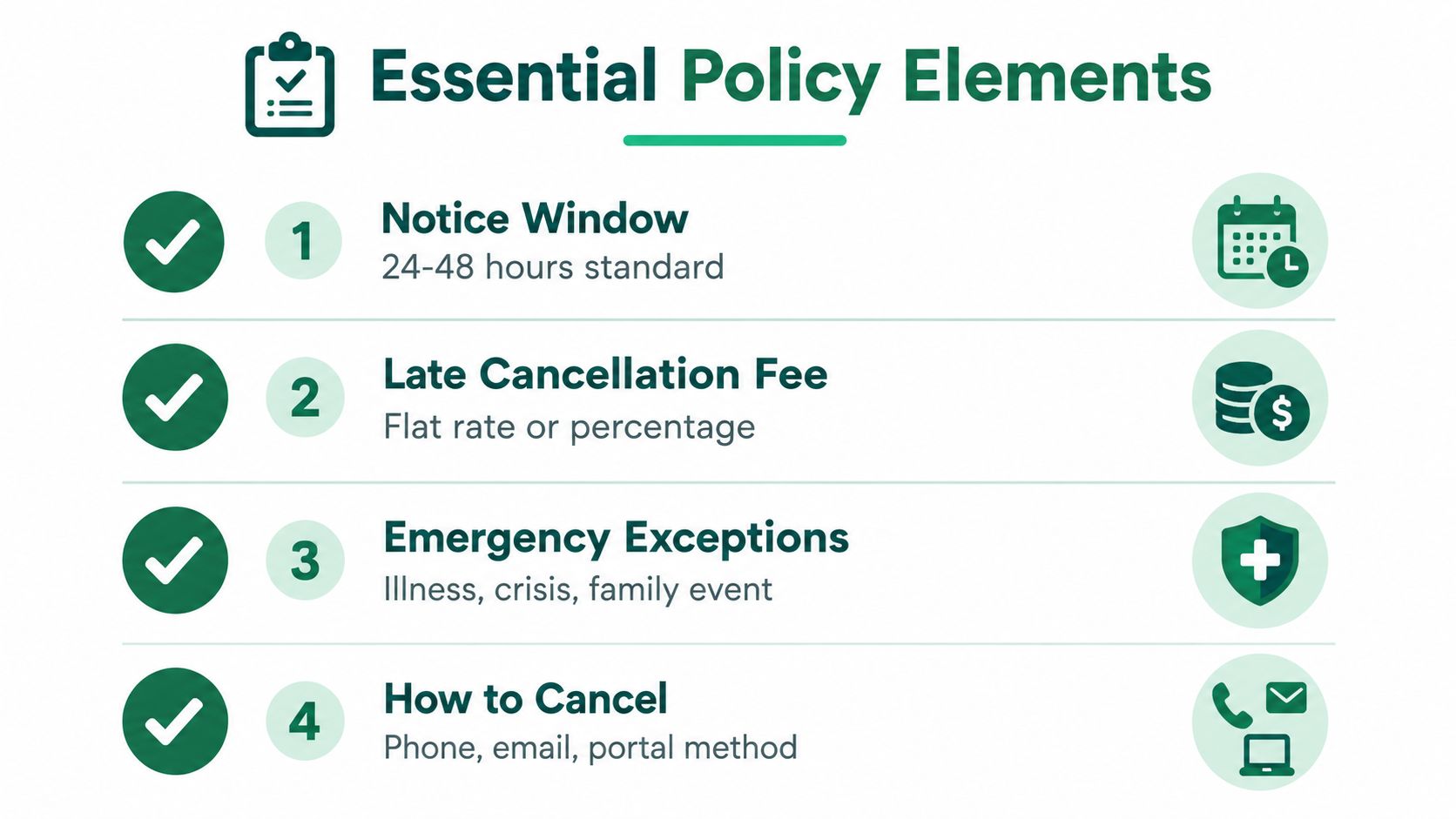
Caption: A complete policy identifies notice timing, fees, exceptions, and the accepted ways to cancel.
Understanding Fees Grace Periods and Enforcement Options
A missed-session fee should protect reserved clinical time while preserving the relationship that makes care possible. A private-pay practice, a sliding-scale clinic, and a practice serving clients through insurance may need different approaches. The fairest policy explains the rule, the available grace, and what happens next.
Fee amounts should be stated during informed consent and reviewed alongside payer requirements. The behavioral-health fee benchmarks offer market examples, not universal requirements. Clients may also ask whether a missed-session fee is reimbursable. The policy should answer that question plainly rather than assuming insurance or public benefits will cover it.
Compare the choices
Policy Model | Fee Approach | Enforcement Style |
|---|---|---|
Firm standard | Full-session fee for late cancellations and no-shows | Applied consistently after the stated window |
Flexible first miss | First missed session may be waived | Outreach and problem-solving before charging |
Sliding-scale accommodation | Reduced or waived fee may be considered | Circumstances reviewed using a defined process |
Tiered response | Fee follows repeated or unresolved misses | First miss prompts contact, later misses prompt stronger action |
Access-preserving option | Fee may be avoided when an eligible telehealth switch occurs | Client contacts the practice as soon as possible |
A grace period works like a buffer around a difficult day. It can account for a sudden illness, a family emergency, or a client who contacts the practice quickly to request a telehealth change. Sliding-scale clients may need a defined reduced-fee or waiver process, so compassion does not depend on whether a person feels comfortable asking for an exception.
The policy should also state which cancellation methods count, such as phone, voicemail, text, email, or a client portal. A booking system can send reminders, record messages, and offer rescheduling. TOOLii's guide to clinic booking apps may help clinicians compare those tools, though software cannot replace a clear and caring conversation.
Guidance from Blueprint's therapy cancellation recommendations supports layered reminders at 48 to 72 hours and again within 24 hours, with a consistent response after missed visits. A reminder gives clients a chance to correct a calendar mistake. It does not erase the agreed attendance expectation.
Clients may also need help understanding billing records. The explanation of what a superbill for therapy clarifies why a missed-session fee can be treated differently from a reimbursable therapy service. Clear wording reduces surprises and makes enforcement feel like a known boundary, rather than a sudden penalty.
Sample Templates and Scripts for Communicating Your Policy
A policy works best when clients hear the same message in the intake paperwork, appointment reminders, and follow-up conversations. Use direct language, avoid blame, and make the next action obvious.
Intake policy language
Appointment changes: Please contact the practice as soon as you know you can't attend. Cancellations received at least 24 hours before the scheduled session are treated as advance cancellations. Cancellations received inside that window are late cancellations, and missed appointments without required communication are no-shows. Late cancellations and no-shows may result in a professional services fee described in this agreement.
A practice can replace the notice period with its chosen standard, then add accepted methods:
You may cancel by phone, voicemail, text, email, or client portal. If you're unsure whether your message went through, please use a second method or contact the office. The same attendance and fee expectations apply to in-person and telehealth sessions, unless the therapist confirms another arrangement.
Reminder message
This is a reminder of your therapy appointment on [date] at [time]. If you need to change the appointment, please contact us as soon as possible using [approved method]. If you're having trouble attending in person, ask whether a telehealth option is available.
That last sentence creates an access option without promising that every appointment can be converted. The therapist can then assess privacy, technology, clinical appropriateness, and scheduling needs.
After a missed appointment
I missed you at today's scheduled session and hope you're safe. Please reply when you can to let me know whether you'd like to continue and whether you need help finding a workable appointment time. Under the policy you reviewed during intake, today's absence is recorded as a [late cancellation/no-show], and the applicable professional services fee is [fee or policy reference].
A therapist who is late can use equally clear language:
I'm sorry I'm running behind today. You can choose to begin when I'm available, reschedule without a cancellation fee, or discuss another option that works for you.
Document the policy acknowledgment, the notice received, the category assigned, any exception, and the follow-up offered. Practices creating intake materials may also find pre-built templates for contracts from AurenWell useful as a starting point, while still adapting the language to their clinical, privacy, and Florida practice requirements.
Creating a Fair and Sustainable Policy for Your Practice
A strong therapy cancellation policy holds two truths at once. The therapist's reserved time has value, and the client's life may include barriers that make attendance unpredictable. Treating either truth as the whole story creates a policy that feels either unsustainable or unsafe.
The clearest policies share several features:
They're disclosed early: Clients review the policy before treatment begins and have a chance to ask questions.
They use defined categories: Advance cancellations, late cancellations, and no-shows aren't left to guesswork.
They treat telehealth fairly: The policy explains whether remote and in-person appointments follow the same rules.
They name exceptions: Emergency circumstances, illness, access barriers, and sliding-scale considerations have a stated process.
They guide repair: After a missed session, outreach addresses safety, continuation, and practical scheduling, not only payment.
For clients in St. Petersburg, Tampa Bay, and throughout Florida, Be Your Best Self & Thrive Counseling, PLLC can discuss how scheduling expectations fit alongside individual, couples, and counseling. A free initial consultation can help clarify fit, goals, appointment format, and the practice's approach to continuity of care.
Clinicians can audit their policy by asking a simple question: “Could a stressed client understand what to do without guessing?” If the answer is no, revise the language, test the cancellation channels, and review how exceptions are documented. Boundaries don't weaken a therapeutic relationship when people understand them. They create a dependable container in which care can continue.
If you're seeking compassionate support for anxiety, depression, trauma, stress, life transitions, or relationship concerns, visit Be Your Best Self & Thrive Counseling, PLLC to explore counseling options in St. Petersburg and the Tampa Bay area. You can request a free initial consultation and discuss practical questions about appointments, telehealth, and cancellation expectations before beginning care.