
Why Is Trauma Therapy So Hard and How to Cope
You may want to heal, yet still find yourself staring at the clock before therapy, wondering whether to cancel. Perhaps you feel exhausted after each appointment, emotionally raw for the rest of the day, or frustrated because you understand what you want to change but can't seem to move forward. If you're asking, “Why is trauma therapy so hard?”, the answer isn't that you're weak, unmotivated, or resistant.
Trauma therapy asks a person to approach experiences, sensations, beliefs, and relationship patterns that once felt impossible to survive. It also takes place within real-world systems, with scheduling pressures, financial concerns, limited provider access, and varying levels of clinician training. Your difficulty deserves to be understood as a whole-person and whole-system experience, not reduced to a character flaw.
The Reality of Facing Your Deepest Wounds
Consider someone named Maya. She spends days hoping for her next counseling session because she wants relief from nightmares, tension, and the feeling that danger is always nearby. Then, on the morning of the appointment, her stomach tightens. She thinks about canceling, tells herself she should be stronger, and wonders whether discussing the past will make everything worse.
Maya still attends. During the session, she shares something important, becomes quiet, and leaves feeling drained. The next day, she may notice irritability, sadness, or a strong desire to avoid anything connected to therapy. None of this proves that she's failing. It shows that the work has reached material her mind and body have learned to protect her from.
Many people expect trauma therapy to feel like a steady climb toward relief. In practice, healing can include hesitation, emotional fatigue, numbness, anger, grief, and periods when progress is difficult to recognize. You might show up consistently while still feeling stuck. You might understand that an event is over while your body continues to react as though it's happening now.
The wish to heal and the wish to escape
The conflict can feel confusing. One part of you wants to tell the truth and build a safer life. Another part wants to shut down, change the subject, miss the appointment, or stay busy enough not to feel anything. That conflict is common because avoidance once served a protective purpose. It helped you get through moments when full emotional awareness would have been too much.
A trauma-informed therapist doesn't interpret every pause as unwillingness. A pause can communicate that the pace is too fast, that trust needs more time, or that your coping resources need attention before deeper processing continues. Seeking a provider who understands that distinction is an important part of trauma counseling.
Feeling overwhelmed by trauma therapy doesn't mean you're doing it wrong. It means the work deserves care, pacing, and collaboration.
The first useful shift is to replace self-criticism with curiosity. Instead of asking, “Why can't I handle this?” try asking, “What is my system protecting me from right now?” That question creates room for compassion and gives you information you can bring into the therapy room.
How Your Brain and Body Resist Revisiting Pain
Trauma can make the past feel present. A sound, smell, facial expression, conflict, or body sensation may activate a response before you've had time to reason through what's happening. In that moment, your system may treat a reminder as a current threat rather than a memory connected to something that has ended.
Therapy can activate the same protective pattern. When you approach a traumatic memory, your body may become tense, your attention may scatter, or you may feel an urgent need to leave. Some people become angry or restless. Others freeze, please everyone around them, go numb, or feel detached from the room. These responses are often described as fight, flight, freeze, or fawn, and they're attempts to create safety when your system detects danger.

Caption: A woman notices intense body sensations while reflecting on trauma in a therapy setting.
Why logic may not be enough
You may know intellectually that you're sitting in a therapist's office and that the event is over. Your body may still respond with a racing heart, tight chest, shaking, nausea, or shutdown. That mismatch can feel frightening, but it doesn't mean you're being dramatic. Physical reactions to trauma reminders are real, and dissociation can make it harder to remain connected to the present while discussing painful material.
A helpful analogy is a smoke alarm that learned to respond to any hint of smoke. The alarm isn't trying to punish you. It's trying to prevent another emergency. The problem is that it may now react to burnt toast, a candle, or a memory as though the entire house is on fire. Therapy gradually helps you notice the alarm without allowing it to control every decision.
This doesn't mean you must force yourself to relive everything. Effective trauma work requires enough present-moment safety to approach difficult material and return to stability. Grounding, orienting to the room, slowing the conversation, noticing physical sensations, and naming what you need can help you stay connected. Resources on body-focused mental health practices may also help you think about how physical signals fit into your overall care.
Protection can look like a problem
A blank mind, sudden sleepiness, sarcasm, anger, or an impulse to reassure the therapist may seem inconvenient during treatment. From a survival perspective, each response may have made sense at an earlier time. Your body learned patterns that helped you endure overwhelming circumstances, even if those patterns now interfere with closeness, reflection, or change.
The task isn't to attack these responses. It's to understand them, build alternatives, and practice returning to the present. A skilled therapist watches for signs that you're moving beyond what you can process safely and adjusts the pace rather than treating distress as a test of commitment.
The Heavy Toll of Avoidance and Emotional Shame
Avoidance often brings immediate relief. You don't discuss the memory, so your tension drops. You don't answer the message, enter the location, or name the feeling, so you can get through the day. The difficulty is that short-term relief can teach your brain that avoidance prevented danger, making the fear harder to approach later.
Shame adds another layer. Fear says, “Something bad may happen.” Shame says, “Something is wrong with me.” A person carrying shame may hide details, minimize what occurred, protect other people from discomfort, or assume the therapist will judge them. They may believe they should already be over it, especially if others have told them to move on.
Why leaving can feel easier
Trauma-focused treatment requires sustained engagement with memories, bodily reactions, and avoidance patterns. That level of engagement can feel intolerable before it becomes useful. A 2020 meta-analysis of 116 studies found a pooled dropout rate of 16% from psychological therapies for PTSD, with dropout at 18% for trauma-focused treatment compared with 14% for treatment without a trauma focus. The findings also showed substantial variation between studies, with heterogeneity reported as I² = 77.3% (meta-analysis of psychological therapies for PTSD).
Other reviews show that completion can be even harder outside tightly controlled research settings. A 2025 review reported average dropout of about 20% across PTSD treatments, while a separate meta-analysis of military and veteran populations found 25.6% overall dropout. In that analysis, dropout reached 40.1% for cognitive processing therapy and 34.7% for prolonged exposure therapy (review of PTSD treatment dropout).
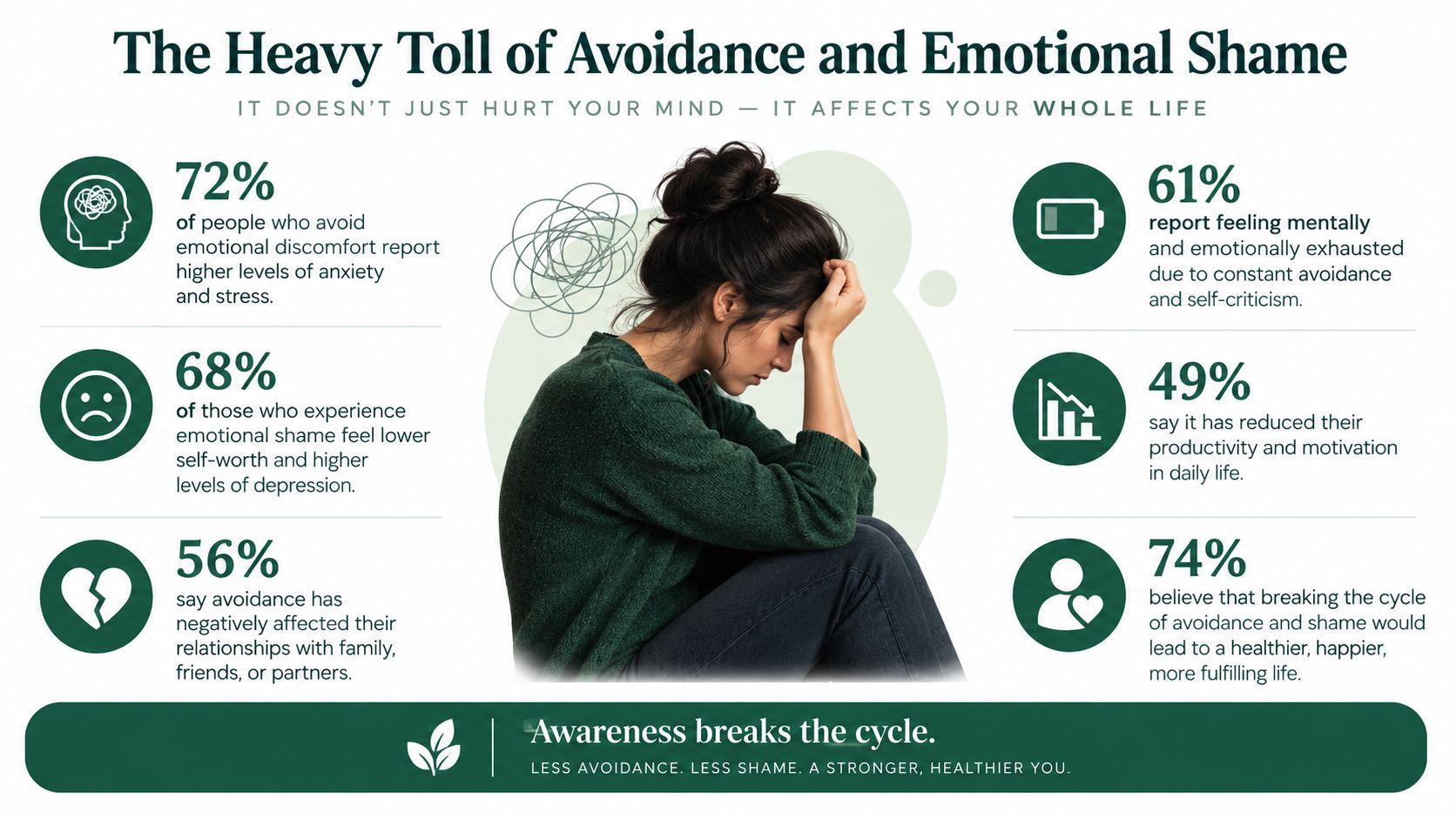
Caption: An infographic shows how avoidance and shame can affect emotional wellbeing, daily functioning, and relationships.
These numbers don't predict what you'll do. They show that difficulty completing trauma therapy is a documented clinical challenge, not evidence that one person lacks courage. The same research context also matters emotionally: many people experience intense distress and consider stopping, yet continue and later describe the difficulty as necessary for improvement.
Moving beyond blame
The most compassionate interpretation is neither “you should push through no matter what” nor “any discomfort means therapy is harmful.” Some discomfort can accompany meaningful work, while overwhelming or persistent destabilization may signal that the pace, method, support, or provider fit needs attention.
Shame becomes less powerful when you can say what's happening without having to defend it. Support for self-esteem and shame-related concerns can complement trauma treatment by helping you separate responsibility for survival responses from responsibility for choosing how to heal now.
Hidden Friction in Access and Clinical Delivery
Trauma therapy can be hard before the session begins. A weekly appointment may conflict with work, caregiving, transportation, school, or changing energy levels. Coverage rules can interrupt continuity, and office logistics can make an already vulnerable person spend significant effort arranging care. If you're exhausted, hypervigilant, or managing several responsibilities, a small scheduling problem can become the reason you stop attending.
Recent APA guidance encourages clinicians to consider the treatment setting, time demands, and patient resources when planning PTSD care. Qualitative work from 2024 and 2025 also identified scheduling, coverage, office logistics, weak therapeutic alliance, and uncertainty about whether treatment was helping as reasons people disengaged (APA guidance on treating PTSD and trauma).
Ask which problem you're actually facing
Not every struggle comes from the trauma-processing method itself. Try separating the possibilities:
Emotional intensity: You feel flooded, numb, or activated when difficult material comes up.
Practical friction: The appointment time, location, cost, coverage, or technology makes regular attendance difficult.
Relationship strain: You don't feel believed, respected, understood, or able to say no.
Treatment mismatch: The approach doesn't fit your goals, current stability, learning style, or readiness.
Provider limitations: The therapist may lack confidence, specialized training, or capacity to offer the treatment being discussed.
Online care may reduce some travel and scheduling barriers, although it won't solve every access concern. A practical overview such as this online counselling guide for Canada can help readers think through questions about format, privacy, technology, and how remote support may fit their circumstances.
Clinicians face barriers too
Therapists can struggle to deliver trauma-focused care when they're undertrained, uncertain about when exposure is appropriate, burdened by competing demands, or emotionally affected by repeated trauma work. ISTSS briefing materials identify clinician burnout, limited confidence, competing responsibilities, and uncertainty about evidence-based interventions as barriers to delivery (ISTSS briefing paper on trauma treatment).
That doesn't excuse poor care. It explains why finding an appropriate provider can take persistence. You can ask what trauma approaches the clinician has training in, how they handle dissociation or overwhelm, how they decide when to begin processing, and what they do when a client needs to slow down. A clear answer should include collaboration rather than pressure.
Comparing Evidence-Based Approaches and Somatic Tools
No single trauma method suits everyone. Cognitive Processing Therapy, or CPT, helps people examine beliefs and meanings that developed after trauma. Prolonged Exposure, or PE, uses planned and repeated engagement with trauma memories and avoided situations. Trauma-focused cognitive behavioral therapy can combine attention to thoughts, emotions, behavior, and exposure.
These approaches have strong evidence, but their intensity can create real barriers to completion. A review found that exposure-based therapies produced significantly greater symptom reductions than supportive counseling, relaxation training, and treatment as usual, including treatment involving pharmacotherapy. Comparative research hasn't shown one major trauma-focused approach to consistently outperform the others (review of exposure-based therapies for PTSD).
Somatic tools may help a client notice physical sensations, orient to the present, settle after activation, and build a larger capacity for emotional experience. They can be used alongside cognitive treatment rather than as a replacement for every established approach. Independent review literature doesn't support claims that body-based treatments are universally superior to CBT, and some newer methods remain preliminary rather than proven (review of popular trauma narratives and treatment claims.
A practical comparison
Modality | Primary Focus | Why It Can Feel Hard | Best Suited For |
|---|---|---|---|
Cognitive Processing Therapy | Trauma-related beliefs and interpretations | Challenging guilt, shame, and rigid conclusions can feel threatening | People ready to examine how trauma shaped their understanding of themselves and the world |
Prolonged Exposure | Trauma memories and avoided situations | Repeated contact with feared material requires preparation and sustained participation | People who want a structured exposure-based approach with careful clinical guidance |
Trauma-focused CBT | Thoughts, emotions, behaviors, and trauma responses | Several areas may need attention at once | People who benefit from an integrated cognitive and behavioral framework |
Somatic tools | Physical sensations, grounding, and present-moment regulation | Body awareness can initially increase contact with sensations that feel unfamiliar or unsafe | People who need support staying present before or during deeper processing |
Skills-based support | Distress tolerance, emotional regulation, and daily coping | Practicing skills between sessions requires repetition during ordinary stress | People who need stabilization, structure, or additional support alongside trauma processing |
Yoga-informed practices may be useful for some people as an adjunct to therapy, particularly when approached gently and adapted to individual comfort. Exploring yoga therapy doesn't mean abandoning evidence-based PTSD care. It means discussing whether movement, breath, attention, or body awareness could support your broader treatment plan.
Strategies for Pacing and Communicating With Your Therapist
You don't have to choose between forcing yourself through therapy and quitting completely. A sustainable approach uses titration, meaning you touch difficult material in manageable amounts and then return to grounding, orientation, or another stabilizing activity. Your therapist should help you decide what amount of contact is workable.
Use a clear pacing plan
Before processing begins, agree on how you'll signal that you need to slow down. You might raise a hand, name a color, look toward a specific object, or use a simple phrase. Practice returning to the room by identifying what you see, feeling your feet on the floor, and noticing the date and location.
You can also say:
“I'm becoming overwhelmed, and I need a pause.”
“Can we spend more time on coping skills before we continue?”
“I can discuss this part, but I'm not ready to describe the details.”
“I'm feeling disconnected. Can you help me orient to the room?”
“The pace feels too fast for me. I want to create a different plan.”
These statements aren't interruptions. They're clinical information. They help your therapist understand your current capacity and make the work more collaborative.
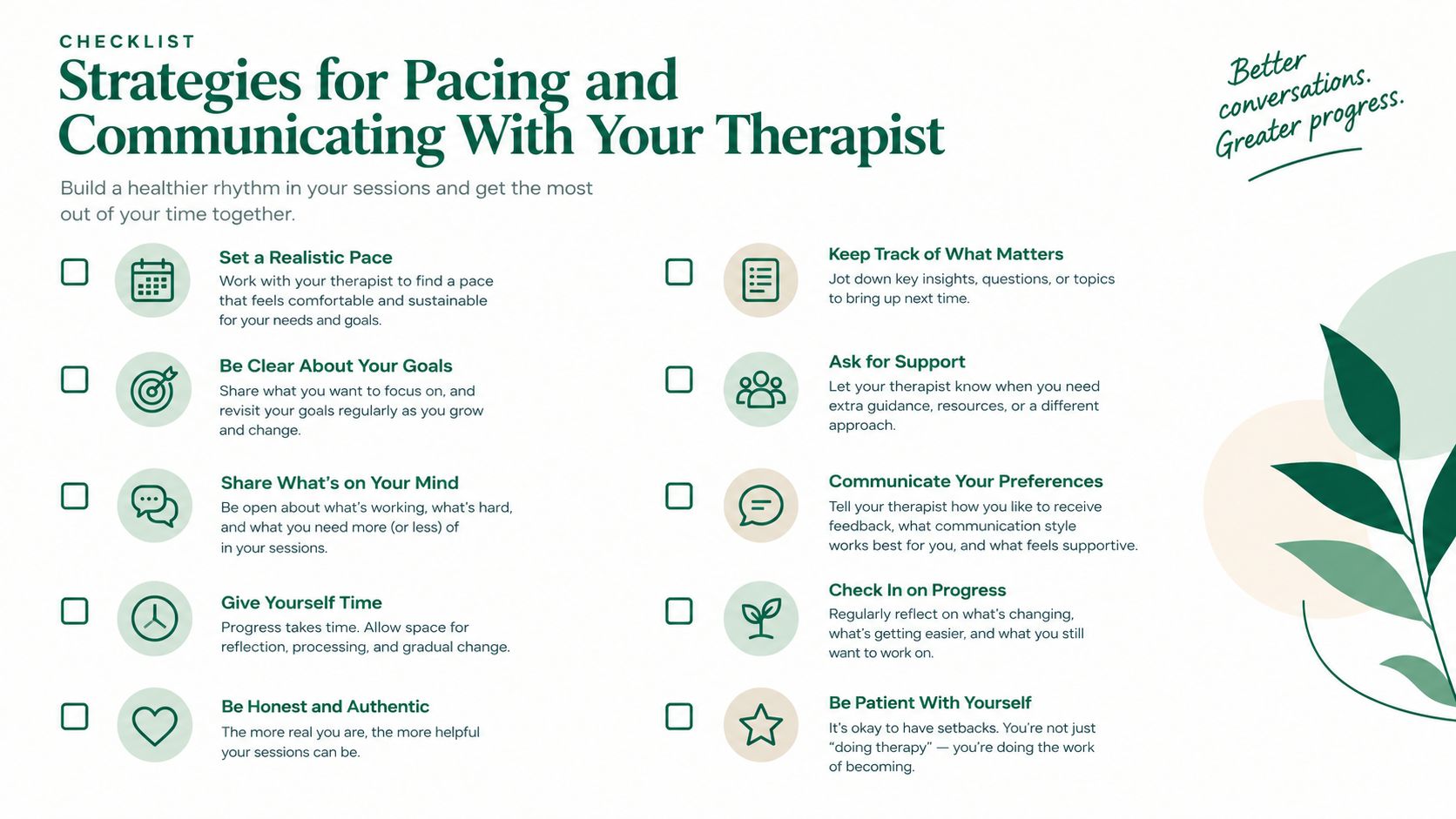
Caption: A checklist offers practical ways to communicate needs and maintain a manageable pace during trauma therapy.
Build support between appointments
Keep the days after therapy as predictable as possible when you can. Plan food, hydration, rest, gentle movement, and contact with a trusted person. A brief journal entry can track what activated you, what helped, and what you want your therapist to know, without requiring you to analyze every detail.
A reflective journal resource may give you ideas for recording sensations, boundaries, questions, and small signs of progress. Bring your notes to sessions, but don't turn journaling into another demand you must perform perfectly.
If therapy repeatedly leaves you unable to function, unable to remain oriented, or afraid to speak candidly, tell your therapist directly. You can also seek a second opinion or discuss a different modality. A trauma-informed practice such as Be Your Best Self & Thrive Counseling, PLLC can help clients explore trauma counseling, body-based support, and practical regulation tools through an initial conversation about fit and goals.
Redefining Progress and Knowing When to Pivot
Progress may look smaller and quieter than you expected. You attend an appointment even though you wanted to cancel. You notice a trigger before reacting. You set a boundary, sleep a little better, ask for a pause, or tell the truth about what isn't working. These moments show increased awareness and choice, even when symptoms haven't disappeared.
Difficulty alone doesn't mean you should stop. But persistent destabilization, pressure to disclose more than you consent to, repeated invalidation, or a lack of a workable treatment plan deserves attention. Changing the pace, trying another approach, or finding a new provider can be an act of self-advocacy.
Trauma therapy isn't a test of endurance. It's a process of building enough safety, trust, understanding, and flexibility to live with more freedom in the present. You're allowed to take the next step slowly, ask informed questions, and expect care that treats your responses as meaningful rather than defective.
If trauma therapy feels overwhelming, Be Your Best Self & Thrive Counseling, PLLC offers compassionate counseling for trauma, anxiety, stress, and patterns that keep you feeling stuck, with attention to practical tools and whole-person care. Visit Be Your Best Self & Thrive Counseling, PLLC to learn about services and explore a free initial consultation focused on your goals and treatment fit.