
How to Stop People Pleasing and Reclaim Yourself
You agree to cover a colleague's shift, listen to a friend's crisis after an exhausting day, and accept a family plan you never wanted. Then you sit in your car, depleted and resentful, wondering why being “nice” keeps leaving you disconnected from yourself. People pleasing can look like kindness while costing you energy, honesty, and identity.
Learning how to stop people pleasing isn't about becoming cold, selfish, or unavailable. It's about distinguishing genuine generosity from fear-driven compliance, then practicing boundaries in a way that respects both your needs and other people's rights.
Understanding Why You Can't Say No
Consider a familiar pattern. Someone asks whether you can take on one more responsibility. Before you check your calendar, energy, or desire, you say yes. The other person sounds relieved, and you feel a brief release because the feared conflict hasn't happened. Later, exhaustion and resentment arrive, followed by self-criticism for agreeing again.
That sequence is an anxiety-maintenance loop. You automatically agree, experience short-term relief, then develop resentment or exhaustion. Those uncomfortable feelings reinforce the belief that honest preferences are dangerous, so the next request receives another automatic yes. A practical way to interrupt the loop is to pause before responding and observe what your agreement is trying to prevent, as described in the clinical research on anxiety-focused cognitive behavioral treatment.
Kindness and self-abandonment aren't the same
Healthy generosity includes choice. You help because you want to, have the capacity, or consider the request consistent with your values. Approval-driven self-abandonment feels different. You agree while wishing you could refuse, monitor the other person's mood, and treat their comfort as more important than your wellbeing.
A caregiver may lovingly support a relative while still saying, “I can visit Saturday, not tonight.” A people-pleasing caregiver may drop essential rest, work, or medical care to avoid disappointing that relative. The behavior can look similar from the outside, but the internal experience reveals the difference: choice creates steadiness, while fear-driven compliance creates pressure and resentment.
Practical rule: Discomfort after setting a boundary doesn't prove the boundary is wrong. It may show that your nervous system is adjusting to a different behavior.
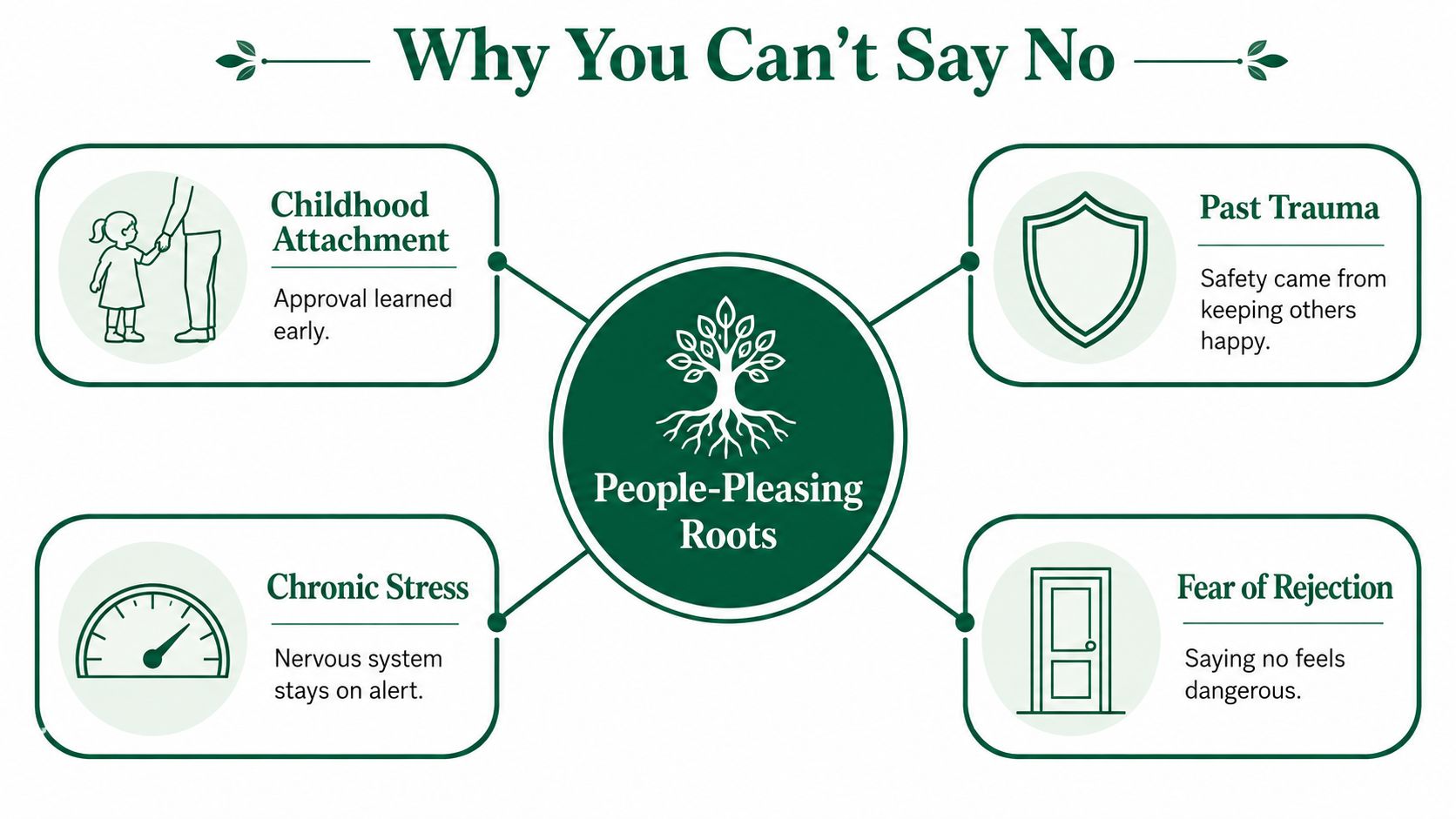
Past experiences can make directness feel risky. A child who learned that connection depended on being agreeable may become highly attentive to other people's moods. Someone who lived through relational instability may discover that appeasing others reduced immediate tension. Chronic stress can keep attention focused outward, searching for the next problem to solve instead of asking, “What do I want?”
These responses deserve understanding, not shame. They may once have helped you preserve safety or belonging. But a strategy that helped in one environment can become restrictive in adult relationships, especially when it prevents honest consent.
Start noticing your own loop in ordinary situations. The reflection on always saying yes can help you identify where automatic agreement is replacing an authentic decision. You don't need to confront everyone at once. The first change is recognizing the moment when your mouth says yes before you have checked in with yourself.
The Root Causes Behind Chronic Approval-Seeking
People pleasing rarely comes from poor communication alone. It often combines learned beliefs, fear of rejection, emotional vigilance, and a fragile sense of self-trust. Treating it as a character flaw creates more shame, while treating it only as a boundary problem can miss the anxiety or identity loss underneath.
Attachment experiences can shape assumptions such as, “My needs create problems,” or, “I have to stay easy to love.” These beliefs don't prove that a person has a particular attachment style, and they shouldn't be used for self-diagnosis. They do offer useful questions: Do you expect closeness to disappear when you disagree? Do you seek reassurance after expressing a preference? Do you feel responsible for repairing another person's disappointment?
Trauma and prolonged stress can add another layer. You may scan facial expressions, tone, or silence for signs of danger and then change your behavior before anyone has asked you to. That vigilance can be especially intense in relationships where disagreement previously led to punishment, withdrawal, or humiliation. It's also important not to overstate causality. People pleasing can be associated with anxiety or reduced wellbeing, but it doesn't establish that the pattern causes an anxiety disorder or that every agreeable person needs treatment.
Use self-assessment without turning it into a diagnosis
Write about the last request you accepted despite reluctance. Ask yourself:
Immediate thought: What did you predict would happen if you refused?
Emotional signal: Did you feel guilt, fear, shame, or responsibility for the other person's feelings?
Body response: Did you tense, rush, go numb, or lose contact with your preference?
Identity question: What would you choose if being liked were not part of the decision?
Relationship context: Is this person generally able to tolerate your limits, or do they punish disagreement?
Your answers help identify the starting point. Fear of rejection may call for gradual assertiveness practice. Exhaustion and resentment may require workload changes and recovery. Difficulty identifying any preference may point toward values and identity work. Panic, dissociation, coercion, or danger require a slower approach with professional support.
Self-compassion is a technically useful countermeasure to the shame and self-criticism that often drive approval-seeking. A review of randomized controlled trials found a small immediate reduction in anxiety, with an effect size of SMD = 0.36 and a 95% confidence interval of 0.16 to 0.55, while follow-up anxiety effects weren't statistically significant overall, with SMD = 0.13 and a 95% confidence interval from −0.08 to 0.34 (review of self-compassion interventions). Another meta-analysis in that review reported moderate effects for self-compassion, stress, depression, and anxiety. These are intervention benchmarks, not promises for an individual, and the studies weren't specifically trials of people pleasing.
The most useful interpretation is practical: replace the inner accusation, “Why am I like this?” with curiosity about what the behavior protects. Then choose a skill that fits the problem. The guidance on overcoming codependency patterns can support that distinction without reducing every caring relationship to pathology.
A Four-Step Behavioral Protocol for Saying No
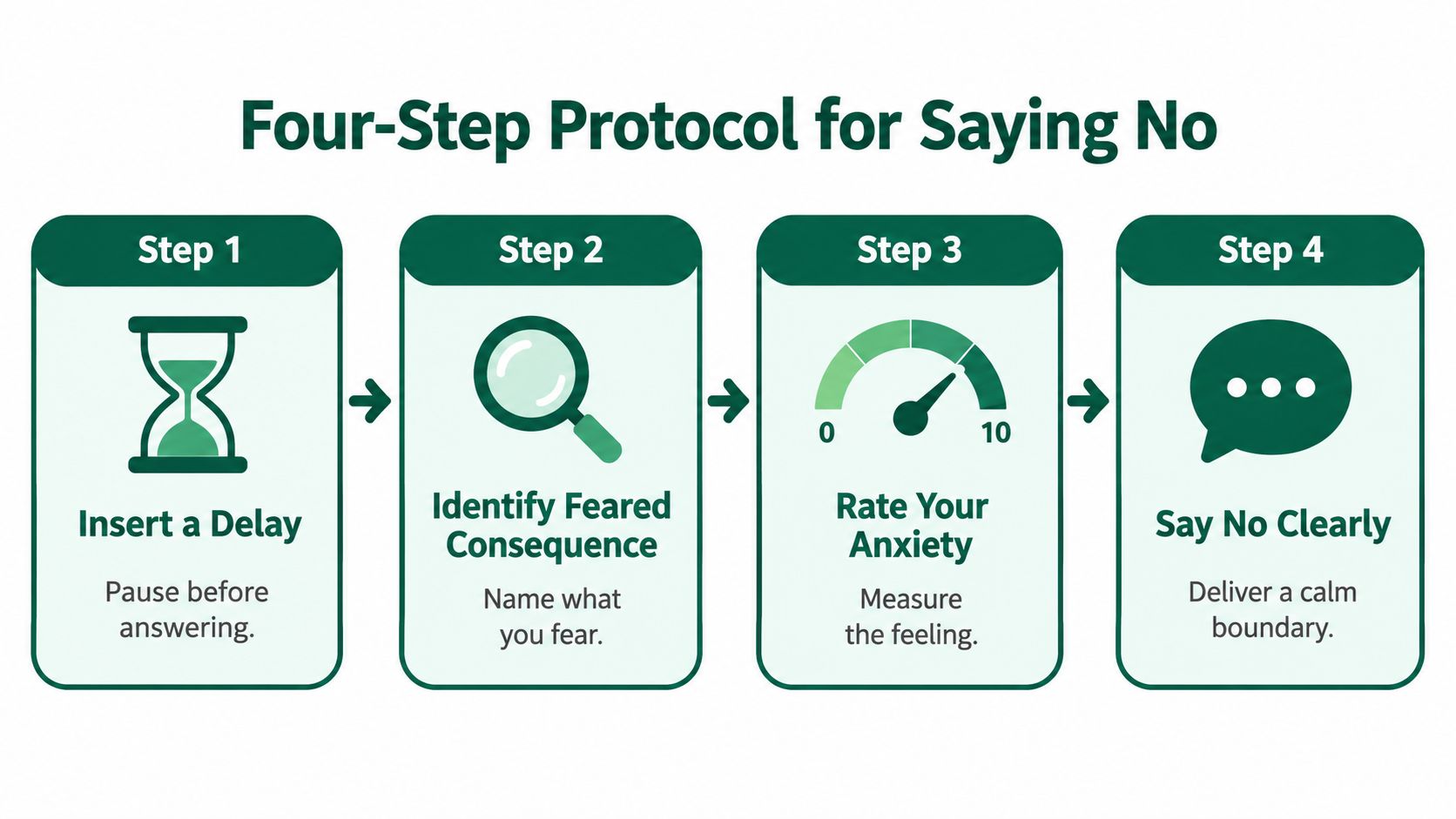
Boundary work becomes easier when you stop treating confidence as a prerequisite. You can act while anxious, gather new evidence, and let confidence develop afterward. Use the following protocol for small requests first, then apply it to situations with greater emotional weight.
Step one inserts space
Don't answer immediately. Say, “I need to check my schedule and get back to you,” or, “Let me think about what I can realistically take on.” A delay interrupts the automatic agreement and gives your preferences time to become noticeable.
The pause also protects the other person from a dishonest commitment. A clear answer later is more respectful than an enthusiastic yes followed by avoidance, resentment, or cancellation.
Step two identifies the feared consequence
Write the specific outcome you fear. Is it rejection, conflict, criticism, being called selfish, losing an opportunity, or making someone angry? Avoid a vague statement such as “They'll hate me.” Name the prediction in observable terms: “My supervisor will think I'm unreliable,” or, “My friend will stop inviting me.”
This step separates the request from the story your anxiety adds to it. You can then decide whether the risk is ordinary disappointment, a meaningful professional consequence, or a genuine safety concern.
Step three rates anxiety and makes a prediction
Rate your anxiety from 0 to 100, then record what you expect to happen if you decline. After the conversation, record what occurred and whether the feared consequence happened. The point isn't to force anxiety to disappear. It's to learn that discomfort can rise and fall without reassurance, overexplaining, or compliance.
Try the practice with progressively harder requests. A small social preference might come first, followed by a work request, a family expectation, and then a boundary in a relationship where you routinely overfunction.
Step four gives a brief response
Your response should match your actual capacity. Try:
Work: “I can't take on another project this week.”
Family: “I'm not available for a visit tonight.”
Friendship: “I care about you, and I don't have capacity for a long call today.”
Limited help: “I can't take this on, but I can help for 20 minutes.”
Renegotiation: “I can't meet that deadline. I can send it by Friday.”
A boundary doesn't require a courtroom argument. Common pitfalls include overexplaining, apologizing repeatedly, offering an unwanted alternative, or treating the other person's disappointment as evidence that you made the wrong choice. If the conversation feels delicate, this resource on how to navigate difficult talks offers additional communication context.
“I can be caring without being available for everything.”
Keep a simple record of at least 10 requests over two weeks. Note whether you delayed, gave an honest response, rated anxiety before and after, and whether the predicted consequence occurred. This behavioral consistency matters more than sounding perfectly confident. The practical guidance on setting healthy boundaries can help you adapt the wording to work, family, and intimate relationships.
Regulating Your Nervous System and Building Self-Compassion
A boundary is harder to maintain when your body interprets another person's disappointment as an emergency. Regulation doesn't mean convincing yourself that nothing matters. It means staying present long enough to choose a response instead of letting fear choose for you.
Begin with a brief grounding practice. Look around and name five things you can see, four things you can feel, three things you can hear, two things you can smell, and one thing you can taste. Keep both feet on the floor, lengthen your exhale without forcing it, and relax your jaw. If counting makes you more anxious, use sensory language instead: “The chair supports me. The room is quiet. My hands are warm.”

Pair compassion with an observable action
Use this three-part reset immediately after you set a limit:
Name the experience: “This is fear of disappointing them.”
Normalize the response: “Many people feel threatened when they change an old relational habit.”
Choose supportive language: “I can be caring without being available for everything.”
Then take one concrete action. Decline the request, renegotiate a deadline, leave the conversation, or ask someone trustworthy for reciprocal support. Self-compassion becomes avoidance when it only reassures you while the boundary remains unsaid.
A helpful daily practice is to place one hand on your chest and one on your abdomen while breathing comfortably. On the inhale, notice the urge to fix the other person's feelings. On the exhale, repeat, “Their disappointment is information, not an instruction.” Another useful phrase is, “My capacity matters even when someone wants more.”
A restorative environment can support reflection, but a retreat or wellness trip won't substitute for practicing consent in ordinary relationships. For broader context on why people seek intentional restorative travel, you can read why wellness travelers choose Tulum. The lasting change comes from bringing that steadiness back to the next email, phone call, and family request.
Review your behavior weekly. Ask whether each response reflected your values, capacity, and consent, rather than the other person's emotional reaction. The practical guidance on regulating your nervous system can help you build a repeatable routine for moments when guilt surges.
Navigating Relapses and Knowing When to Seek Help
Relapse prevention matters because your relationships may react when your behavior changes. Someone who benefited from your constant availability may complain, pressure you, or describe your boundary as selfish. Their reaction is meaningful information about the relationship, but it isn't automatic proof that you've done something wrong.
Expect an adjustment period. After you say no, don't rush to repair ordinary disappointment with a reversal. Re-read your original reason, regulate your body, and wait before sending a second message. If you did overcommit, correct the behavior without attacking yourself: “I agreed too quickly. I'm not able to follow through, and I need to change the plan.”
A setback is data, not a verdict. Look at what happened immediately before the automatic yes, what you feared, and what support would make the next response more honest.
Conflict can signal growth when both people remain free to speak, negotiate, and choose. Coercion, retaliation, threats, discrimination, stalking, or physical danger are different. In those situations, don't use exposure-style practice or a firm confrontation as a test of courage. Prioritize safety planning and qualified professional support.
Seek counseling when saying no triggers panic, dissociation, overwhelming shame, or an inability to function. Support can also help when you can't identify your own preferences, repeatedly return to unsafe relationships, or feel trapped by burnout and resentment. A therapist can assess whether anxiety treatment, trauma-focused work, values clarification, relationship counseling, or practical workload changes fit your situation.
When choosing a therapist, ask about experience with boundaries, trauma, anxiety, attachment, and the populations you belong to. Ask how sessions become practical between appointments and whether the therapist can adapt direct communication exercises to your cultural, family, professional, or safety context. Be Your Best Self & Thrive Counseling, PLLC offers individual and couples counseling in St. Petersburg with an evidence-informed, mind-body-spirit approach to anxiety, trauma, stress, and stuck relational patterns. You can also use the reflection on breaking a pattern to identify the moment where a familiar response takes over.
Your Path to Authentic Connection and Self-Worth
Stopping people-pleasing is a chain of small returns to yourself. Every time you pause before agreeing, you strengthen self-trust and make room for relationships that can tolerate honesty. That shift matters. Constant approval-seeking drains the body, blurs identity, and leaves people connected to your compliance instead of your actual thoughts, limits, and desires.
Start with one request today. Slow your nervous system, delay your answer, name the feared consequence, rate your anxiety, and respond from your actual capacity. You are practicing consent, not perfection. Be Your Best Self & Thrive Counseling, PLLC offers individual and couples counseling for anxiety, trauma, stress, burnout, and people-pleasing patterns. Visit Be Your Best Self & Thrive Counseling, PLLC to explore services and request a free initial consultation about your goals.