
Therapy for Communication Problems: A Practical Guide
You're sitting beside your partner, discussing something ordinary, such as plans, chores, or money. Within minutes, one of you is speaking faster, the other is defending a point that wasn't quite made, and both people are remembering older arguments. Eventually, one partner goes quiet or leaves the room. The practical question remains unanswered, but the emotional distance is larger.
Therapy for communication problems can help when conversations repeatedly produce escalation, withdrawal, or confusion instead of understanding. The purpose isn't to teach one person to “talk correctly.” It's to understand the interaction between two people, identify the cycle keeping them stuck, and practice a different response with support.
When Everyday Conversation Stops Working
A couple may begin with a small concern. One person says, “Could you help more with dinner?” The other hears criticism and replies, “Nothing I do is ever enough.” The first person becomes more specific, then more forceful. The second person looks at a phone, stops answering, or walks away. Later, both describe the same event differently. One remembers pleading for help. The other remembers being attacked.
Neither description has to be false. Each partner may be reporting a different experience of the same conversation. Communication breaks down when words carry threat, shame, pressure, or sensory overload, even when the original request was reasonable.
Practical rule: Treat the recurring interaction as the problem before treating either partner as the problem.
A stuck cycle often has a recognizable shape. One partner pursues an answer, reassurance, or emotional response. The other withdraws to reduce pressure. The withdrawal increases urgency, so the first partner pursues harder. Both people may be trying to protect the relationship, yet their protective strategies make contact more difficult.
This is why another self-help book may not be enough. Reading about active listening is different from using it when your body is tense, your partner sounds dismissive, and an old grievance has just been mentioned. Therapy creates a structured setting where a clinician can slow the exchange, identify the sequence, and help both partners practice repair while the pattern is happening.
Evidence supports that structured approach. A meta-analysis of 58 studies, 40 unique samples, and 2,092 couples found a large improvement in relationship satisfaction from before to after evidence-based couple therapy, with Hedges' g = 1.12. Couples on a wait list showed no statistically significant improvement, with Hedges' g = 0.12. The PubMed meta-analysis also describes gains across communication, emotional intimacy, and partner behavior.
Therapy isn't a last resort reserved for couples who are nearly finished. It can be a time-limited process for recurring conflict, emotional disconnection, or conversations that never reach resolution. A useful overview of communication problems in relationships can help you name what's happening before you schedule an appointment.

Signs That Communication Has Become a Pattern
Normal friction usually has movement. You may disagree, become irritated, and still return to the subject, understand something new, or offer an apology. A treatable communication pattern feels different because the same sequence keeps producing the same result, even when both people intend to do better.
Look for behavior rather than labels. “We're toxic” is less useful than “I interrupt when I feel misunderstood, my partner raises their voice, and then neither of us returns to the subject.”
Watch the sequence, not only the topic
Common signs include:
Escalating tone: A discussion becomes louder, faster, sharper, or more absolute before either person has answered the original concern.
Interruption: One partner cuts in to correct details, defend intent, or prevent the other person from finishing.
Withdrawal: Someone stops responding, leaves, changes the subject, or becomes unreachable without agreeing to return.
Repeated grievances: The conversation repeatedly returns to old evidence that the other person cannot be trusted, cared for, or understood.
Pursuit and withdrawal: One person demands engagement while the other seeks distance, creating more pressure on both sides.
Missing repair: After the argument, the couple resumes daily life without acknowledging the injury, clarifying what happened, or making a plan.
A quiet relationship can have serious communication problems too. Partners may discuss schedules and errands while avoiding vulnerability, affection, disappointment, or future decisions. Silence may reduce immediate tension, but it doesn't resolve the issue that caused the silence.
Track what happens for two weeks
Keep a brief, private record rather than writing a detailed emotional history. Note:
What started the conversation.
The first observable sign of escalation or shutdown.
Whether either person interrupted, criticized, defended, or withdrew.
How the conversation ended.
Whether someone attempted repair.
How long it took to feel connected or functional again.
The purpose isn't to build a case against your partner. It's to identify the loop a therapist will need to understand. If you see the same pattern across different topics, or if conflict repeatedly ends without repair, professional support is reasonable.
Safety changes the decision. Fear, threats, intimidation, coercive control, physical violence, or retaliation for speaking openly aren't ordinary communication differences. A therapist should assess safety before using joint communication exercises.
Evidence-Informed Approaches for Couples
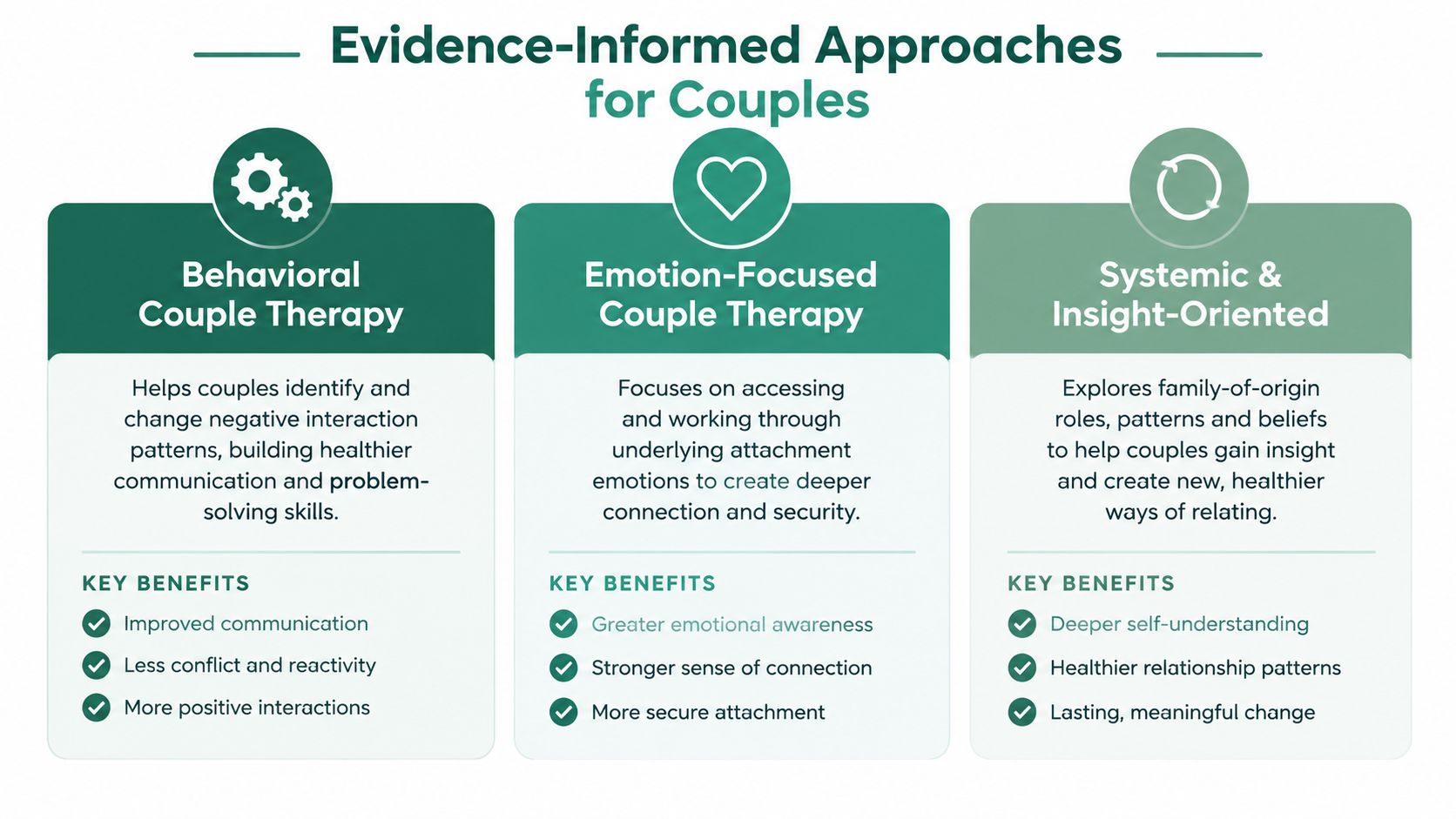
Couples rarely argue from the same internal starting point. One nervous system may read a delayed reply as rejection, while the other reads repeated questions as pressure. Therapy works best when it treats this mismatch as a pattern to understand, rather than evidence that either partner is defective. Different models focus on behavior, emotion, family systems, meaning, or combinations of these areas. A skilled clinician explains the reasoning behind an approach and adapts it to the couple's interaction, trauma history, preferences, and safety needs.
Behavioral couple therapy
Behavioral therapy focuses on what partners do before, during, and after difficult conversations. A therapist may help replace criticism with a specific request, increase helpful behavior, practice listening, and interrupt exchanges that tend to escalate. This approach often suits couples who want concrete exercises and goals they can observe in daily life.
Cognitive-behavioral couple therapy also examines interpretation. A partner who hears “Can we talk later?” as rejection may respond to the meaning attached to those words, not only to the words themselves. Therapy tests that assumption while changing the behaviors that keep the conflict going. Its strength is clarity and practice. Its limitation is that behavior change may not address deeper fear or grief on its own.
Emotion-focused couple therapy
Emotion-focused work examines the vulnerable feelings beneath protest, anger, or distance. A demand for reassurance may protect fear of abandonment. A shutdown may protect shame, helplessness, or fear that continued engagement will make matters worse.
The therapist helps each partner express those underlying experiences in a form the other person can hear. This can fit couples who understand the facts of an argument yet remain emotionally unreachable. Learn more about emotionally focused therapy before asking a clinician how this model might apply to your relationship. The approach can create meaningful emotional change, though it may feel intense for partners who first need stabilization and predictable boundaries.
Systemic and insight-oriented work
Systemic therapy examines the wider relationship context. Family-of-origin roles, cultural expectations, earlier relationships, power arrangements, and unspoken rules can shape present conflict. One partner may have learned that anger brings attention, while the other learned that silence reduces danger.
Insight-oriented work helps explain why a familiar pattern remains compelling even when both partners dislike it. Deeper exploration may feel less immediately practical than a communication exercise. Many clinicians combine insight with behavioral practice so understanding leads to different action.
Evidence does not support treating one traditional model as universally superior. A review of couple therapy research reports that traditional and cognitive-behavioral approaches can be similarly effective for reducing couple distress, allowing treatment choices to reflect client needs and the mechanisms involved. The review in the Journal of Family Therapy also describes systemic and behavioral or emotion-focused interventions as commonly time-limited, with practice and follow-up supporting continued gains.
Trauma-informed care can accompany any of these models. If a partner becomes overwhelmed, dissociates, panics, or feels unsafe during conflict, treatment may begin with pacing, consent, grounding, and predictable boundaries. A therapist should not treat emotional intensity as proof of commitment or push disclosure faster than a client can tolerate. For neurodivergent couples, the same principle may mean adapting sensory demands, processing time, and communication formats rather than treating difference as resistance.
Skills You Learn in Communication Therapy
Good therapy turns abstract advice into actions you can recognize in your mouth, body, and timing. The skill isn't merely knowing that listening matters. It's knowing what to say when your first impulse is to correct, defend, or disappear.
Listen for meaning
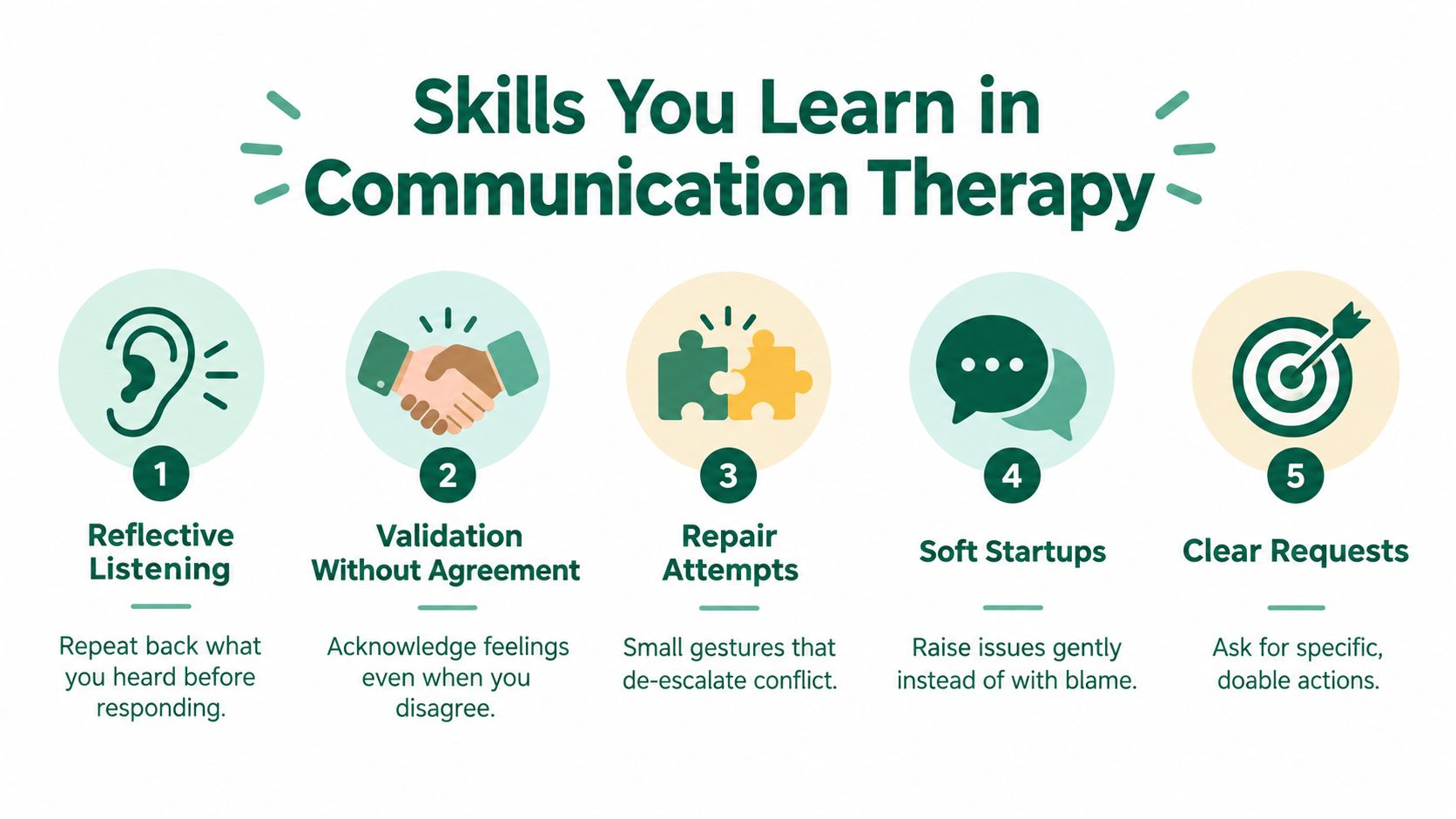
Reflective listening means you summarize what you believe you heard before presenting your own position.
“You're saying the last-minute changes make you feel alone with the responsibility. Did I get that right?”
The speaker can correct the summary. The listener isn't surrendering their view or agreeing with every conclusion. They're showing that understanding comes before rebuttal. More examples appear in this guide to active listening techniques.
Validate without agreeing
Validation recognizes that a feeling makes sense from the other person's perspective. “I can see why that felt dismissive” doesn't mean “I intended to dismiss you,” and it doesn't mean every accusation is accurate. It communicates that the emotional impact deserves attention.
Use repair early
A repair attempt interrupts the slide toward contempt, defensiveness, or shutdown. It might sound like, “I'm getting defensive, and I want to try that again,” or “We're both moving too quickly. Can we pause?”
Small repairs work best before either partner is fully flooded. They don't erase the original concern. They create enough safety to continue discussing it.
Start softly and ask clearly
A soft startup names an experience and a specific request rather than opening with a character judgment. Compare “You never help” with “I'm overloaded by the evening routine. Could you handle cleanup tonight and choose another task for tomorrow?”
Clear requests reduce guessing. The request should be specific enough that the other person can answer yes, no, or propose an alternative.
Pause with a return plan
A time-out is useful only when it regulates rather than abandons. Say what you need, state when you'll reconnect, and use the pause to settle your body rather than rehearse your argument. If conversations become overwhelming, notice clenched muscles, rapid speech, blankness, or the urge to flee. Problem-solving works better after both people can attend and respond.
Practice one skill at a time at home. Couples therapy provides feedback, helps identify when a technique is being used defensively, and measures whether the new response survives a real disagreement.
Communication Differences in Neurodivergent Couples
Not every communication problem is a failure to listen, regulate, or show empathy. Sometimes two people are using different systems for processing information, reading intent, managing sensory input, and deciding when a conversation feels complete.
The double empathy perspective questions the assumption that one person lacks a social skill while the other communicates normally. An autistic partner may prefer direct language and time to process. A non-autistic partner may rely more on tone, implication, or rapid emotional exchange. An ADHD partner may care greatly while struggling with working memory, task transitions, or sustained attention. A highly sensitive person may need reduced stimulation before they can discuss a difficult subject.
These differences don't excuse hurtful behavior. They do change the clinical question from “Who needs to communicate correctly?” to “What shared system would let both people understand and respond?”
Redesign the shared system
Useful adjustments may include:
Direct language: Replace hints with explicit requests, such as “I need reassurance,” rather than expecting a partner to infer the need.
Written support: Use a message, shared note, or visual agenda when spoken conversations move too quickly.
Pacing: Agree that one partner can take processing time without treating the pause as rejection.
Sensory accommodation: Reduce background noise, harsh lighting, interruptions, or physical proximity when overload affects attention.
Repair timing: Decide whether reconnection should happen immediately, after a short pause, or through a written first step.
These tools aren't accommodations for only one person. They can give both partners a clearer path through a conversation. Therapy for neurodivergent couples should explore mutual translation rather than pressuring one partner to mask.
A clinician should also distinguish difference from harm. Literal language, delayed processing, sensory shutdown, forgetfulness, or a need for solitude isn't the same as intimidation, humiliation, coercion, threats, or deliberate punishment. Safety assessment comes first, especially when one partner cannot disagree freely or fears what will happen after the session.
The most helpful treatment may not teach one person to sound more conventional. It may build a bilingual relationship, where both partners learn how the other person signals attention, distress, uncertainty, affection, and readiness to repair.
What the Course of Therapy Looks Like
A first appointment usually gathers history, clarifies goals, and observes how each partner describes the problem. The therapist may ask what happens before conflict, how each person responds, what they have tried, and whether either partner feels unsafe. The clinician should also explain confidentiality, session structure, and how individual concerns will be handled within couple work.
Treatment usually develops through overlapping phases:
Assessment: Identify the interaction cycle, relevant history, strengths, and safety needs.
Goal setting: Choose observable aims, such as fewer interruptions, clearer requests, or more consistent repair.
Skill practice: Rehearse listening, validation, time-outs, and problem-solving in session.
Pattern work: Examine emotional, systemic, behavioral, trauma-related, or neurodivergent factors that keep the cycle going.
Maintenance: Prepare for triggers, future stress, warning signs, and follow-up support.
A review of couple therapy describes systemic, behavioral, and emotion-focused treatment as typically involving approximately 20 sessions over six months, with an estimated benefit for 60–80% of distressed couples. Approximately half of couples maintain treatment gains at two-year follow-up. These figures come from the couple therapy review, and they describe broad treatment patterns, not a promise for any individual couple.
Phase | Typical Timing | What It Targets |
|---|---|---|
Assessment | Early treatment | Safety, history, goals, and recurring interaction cycle |
Skill building | Early to middle treatment | Listening, validation, requests, pauses, and repair |
Deeper pattern work | Middle treatment | Emotional responses, beliefs, family roles, trauma, or processing differences |
Generalization | Middle to later treatment | Using skills during ordinary disagreements outside sessions |
Relapse prevention | Later treatment | Warning signs, maintenance routines, and future support |
Progress needs more than “we feel better.” Repeated relationship-satisfaction measures can be paired with observable behaviors, including interruption, escalation, validation, withdrawal, and successful repair. These measures show whether a new response is becoming usable during ordinary stress, not only in the therapist's office.
If one partner is reluctant, begin by discussing your own goals rather than presenting therapy as a verdict. Individual therapy may offer support while you assess whether joint sessions can happen safely and productively.
In-Person, Telehealth, and Hybrid Options
The best format is the one you can attend consistently, privately, and safely. In-person sessions may make it easier to notice posture, facial expression, pacing, and the physical atmosphere between partners. They may also create travel, mobility, childcare, work, sensory, or cost barriers.
Video therapy can reduce travel and allow partners to use familiar supports, but privacy at home isn't guaranteed. Internet reliability, digital fatigue, camera discomfort, and difficulty reading subtle nonverbal cues can affect the work. Telephone sessions remove the visual layer and may suit clients who process better without eye contact, though the therapist has less access to visible signs of overwhelm.
Asynchronous messaging can help someone organize thoughts before a session or communicate during a processing pause. It shouldn't automatically replace live assessment when the couple needs real-time observation, crisis evaluation, or active de-escalation. A hybrid plan may combine formats according to the goal and each partner's access needs.
The barriers are substantial. A 2025 study of people seeking communication-disorder care found that 51.2% lacked personal transportation, 41.2% reported difficulty commuting, and 40.6% had delayed treatment because of limited provider access. The systematic review of telehealth speech-language services found outcomes broadly similar to face-to-face care in the conditions studied, while noting limited evidence for quality of life, satisfaction, and economic outcomes.
Ask about encrypted platforms, privacy expectations, disability access, language support, backup plans, and what happens if a partner becomes overwhelmed off camera. You can also compare practical factors in this guide to online versus in-person therapy.
Choosing a Therapist and Taking the Next Step
Choose a therapist who can explain both what they do and why they do it. Look for appropriate licensure, experience with couples, familiarity with the communication patterns you're facing, and training that supports trauma-informed and neurodivergent-affirming care when relevant.
Use an initial consultation as an interview. Ask:
How do you assess safety before beginning joint communication work?
Which couples therapy models do you use, and how do you choose among them?
How will we practice skills rather than only discuss feelings?
How do you adapt sessions for ADHD, autism, sensory needs, or different processing speeds?
How will we measure progress?
What happens if one partner wants to continue and the other doesn't?
Pay attention to the therapist's response. A good fit doesn't require instant comfort, but you should feel respected, understood, and able to ask direct questions. Be cautious if a clinician assigns blame immediately, treats one communication style as universally correct, dismisses accessibility needs, promises a guaranteed outcome, or ignores intimidation and coercion.
For adults and couples in St. Petersburg and the Tampa Bay area, Be Your Best Self & Thrive Counseling, PLLC offers individual and couples or marriage counseling addressing communication, conflict, trauma, stress, and relational patterns. The practice also works with neurodivergent clients and provides a free initial consultation to discuss fit and goals.
If recurring arguments, shutdown, or emotional distance are affecting your relationship, schedule a free initial consultation with Be Your Best Self & Thrive Counseling, PLLC to discuss couples or individual support. Bring one communication pattern you want to change, and ask how therapy can make conversations safer, clearer, and more workable.