
Trauma Recovery Therapy: A Complete Client Guide
You may be wondering whether therapy is worth starting when you've already spent years getting through the day. Maybe a sound, a conflict, or an unexpected reminder still leaves you on edge. Or perhaps you can't point to one clear event, but you know that something in your past continues to shape how safe you feel in your body and relationships.
Trauma recovery therapy isn't a demand to relive everything or follow a single prescribed method. It's a collaborative process that can combine structured, evidence-informed treatment with attention to pacing, physical responses, relationships, and personal meaning. Understanding what the main approaches do, what treatment may involve, and how to choose a clinician can help you take a next step without needing to have every answer first.
When Considering Trauma Recovery Therapy Feels Like a Big Step
A person might spend months thinking, “I should be able to handle this by now,” before looking for a therapist. They may have built routines around avoiding reminders, keeping the peace, or staying busy. Those strategies can help someone get through difficult stretches, but when they keep interfering with relationships, sleep, work, or a sense of ease, getting support can be a reasonable next step.
Starting doesn't mean you have to tell your whole story at the first appointment. A good clinician will ask what feels manageable, explain the options, and work with you to set priorities. You can begin with what's affecting daily life now, even if your history feels confusing or hard to describe.
What you can expect from a collaborative process
Trauma recovery therapy is individualized because people differ in what happened, how long the effects have lasted, what support they have, and what they want from treatment. One person may want help with panic and avoidance. Another may be trying to feel more present in close relationships or understand why their body reacts strongly to situations they consciously know are safe.
An approach can include attention to thoughts, feelings, bodily sensations, relationships, and spiritual or personal values. That doesn't mean every practice has the same evidence for treating PTSD. It means a clinician can take your whole experience seriously while being clear about which methods have the strongest direct support for trauma symptoms.
A practical starting point: You don't need to choose a therapy method before meeting a therapist. Start by describing what you want help with and asking how the clinician would work with you.
In the pages that follow, the key distinction is between moving at a pace that feels safe and avoiding all difficult material indefinitely. Trauma-focused work can be challenging, but it should be collaborative, explained in advance, and adjusted to your needs. You're allowed to ask questions, request a pause, or say that an approach doesn't feel right.
What Trauma Recovery Therapy Actually Is
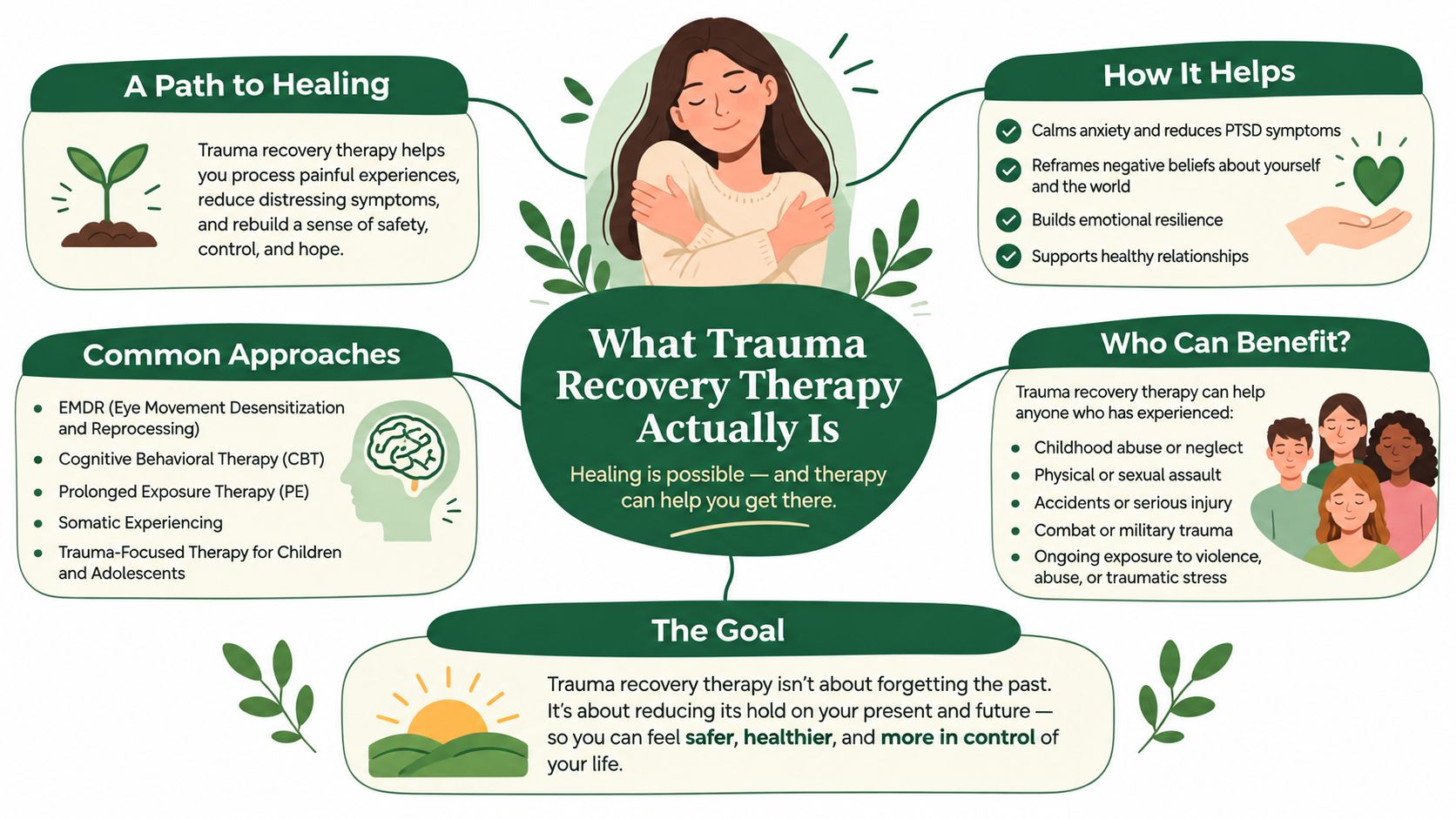
Trauma can be understood as the lasting effects of an experience that overwhelmed someone's ability to feel safe, in control, or supported. It may affect how a person responds to reminders, relates to other people, interprets danger, or notices sensations in the body. Those responses aren't proof of weakness. They can reflect survival patterns that once helped, even when they no longer fit the present.
Exposure to trauma and PTSD are not the same thing. The World Health Organization estimates that about 70% of people worldwide experience a potentially traumatic event during their lifetime, while around 5.6% develop PTSD afterward. PTSD prevalence is higher among people exposed to war and violent conflict, estimated at 15.3%, and WHO reports that up to 40% of people with PTSD recover within a year. These figures describe populations, not an individual's likely outcome or timeline. The WHO overview of PTSD also highlights a major access gap: only about one in four people with PTSD in low- and middle-income countries report seeking any form of treatment.
From surviving to processing
Trauma recovery therapy is more structured than venting or receiving advice. A therapist assesses your concerns and goals, builds a shared understanding of how trauma affects you, and considers whether and when trauma-focused treatment makes sense. The process may include learning ways to manage distress, working with trauma-related thoughts or memories, and applying new skills in everyday life.
The purpose isn't to erase memory. It's to reduce the hold that painful experiences have on your present and help you respond with more choice. Some people notice emotional or physical reactions such as tension, numbness, trouble settling, or feeling distant from others. A clinician can help you observe these patterns without assuming that one symptom automatically means PTSD.
For a young person and their family trying to understand age-appropriate support, trauma therapy for teens offers a useful point of reference. Whatever the client's age, effective care should make room for questions, preferences, and the individual context of the trauma.
The Main Evidence-Informed Therapy Methods
Trauma-focused therapies don't all work in the same way. Some focus on trauma-related beliefs, some address avoidance through planned practice, and others use structured memory processing. The U.S. Department of Veterans Affairs and Department of Defense recommend Prolonged Exposure (PE), Cognitive Processing Therapy (CPT), and Eye Movement Desensitization and Reprocessing (EMDR) over medication for PTSD in their 2023 guideline. These are specific clinical approaches, not interchangeable labels for general supportive counseling. The VA's overview of trauma-focused therapies describes them as having the strongest evidence from clinical trials.
Trauma-focused cognitive behavioral therapy (TF-CBT) uses cognitive and behavioral tools to address trauma symptoms, with components adapted to the client and context. It can help people examine patterns in thoughts, feelings, and behavior rather than treating distress as something to endure.
CPT focuses on trauma-related appraisals, such as guilt, shame, overestimating danger, or feeling that control has been permanently lost. PE uses structured, repeated contact with trauma memories and avoided situations to help reduce avoidance and conditioned fear. PE involves planned practice, so readiness and the ability to manage distress between sessions matter.
EMDR uses a structured treatment sequence that includes identifying target memories and using bilateral stimulation, commonly eye movements, during memory processing. The NICE guideline describes psychoeducation, distress-management skills, target-memory work, and self-calming and flashback-management strategies as parts of EMDR treatment. NICE recommendations for PTSD also state that EMDR and adult trauma-focused CBT are generally delivered over 8 to 12 sessions, with more when clinically indicated.
Method | Core Mechanism | Typical Length | Best Fit For |
|---|---|---|---|
Trauma-focused CBT | Works with trauma-related thoughts, emotions, and behaviors | Varies by protocol and clinical need | People seeking structured cognitive and behavioral skills |
CPT | Examines and revises trauma-related beliefs and appraisals | Set by the treatment plan | People troubled by guilt, shame, danger beliefs, or loss of control |
PE | Uses planned contact with memories and avoided situations | Set by the treatment plan | People ready to address avoidance through structured practice |
EMDR | Processes target memories using bilateral stimulation | NICE generally describes 8 to 12 sessions for adult EMDR, with additional sessions when indicated | People who prefer a structured memory-processing approach |
No method is universally best. A review comparing trauma-focused approaches found that available evidence generally doesn't establish one as superior for everyone; the same review reported that, in one meta-analysis, the average patient receiving PE performed better on PTSD symptoms than 86% of patients in control conditions. The review of trauma-focused psychotherapies is useful context, not a promise about an individual outcome. If anxiety is also part of what you're navigating, a clinical guide to anxiety relief may help you think about broader coping support. You can also explore how EMDR therapy works before asking a clinician whether it fits your needs.
How Nervous-System and Mind-Body-Spirit Work Fit In
A client might be able to discuss a painful memory while noticing that their body is becoming tense, detached, or overwhelmed. That's one reason some clinicians include grounding, breath awareness, movement, mindfulness, or other somatic practices. These techniques can help clients notice what's happening in the moment and practice returning attention to the present.
These supports can complement trauma-focused psychotherapy, but they aren't automatically substitutes for it. A calming exercise may make it easier to stay engaged in treatment; it doesn't necessarily address persistent trauma memories, beliefs, or avoidance on its own. A clinician should explain whether a body-based practice is being used to support regulation, as part of a broader treatment plan, or as a primary intervention, and should be candid about the evidence behind it.
Complementary practices and their limits
In a supportive setting, treatment can also make space for identity, relationships, culture, spirituality, and the meaning a person makes of what happened. These concerns matter, especially when trauma has affected someone's sense of self or their connection with others. They can guide goals and help the work feel relevant rather than standardized.
At the same time, it's important to distinguish evidence-informed support from claims that a newer approach is proven to outperform established therapies. The VA and Department of Defense guideline identifies PE, CPT, and EMDR as recommended individual trauma-focused treatments. Its full clinical practice guideline notes that these approaches have different mechanisms and should be selected with the client's needs and preferences in mind. A clinician may use complementary practices alongside them without presenting every practice as an equivalent PTSD treatment.
A useful way to think about integration is that regulation supports the work, while trauma-focused treatment addresses the material maintaining distress. Your therapist can help you decide whether a grounding strategy is useful, whether a session needs to slow down, or whether a different approach is worth considering. For a plain-language explanation of the window of tolerance, consider how your capacity to stay present may change with stress, support, and the specific topic being discussed.
What a Typical Course of Treatment Looks Like
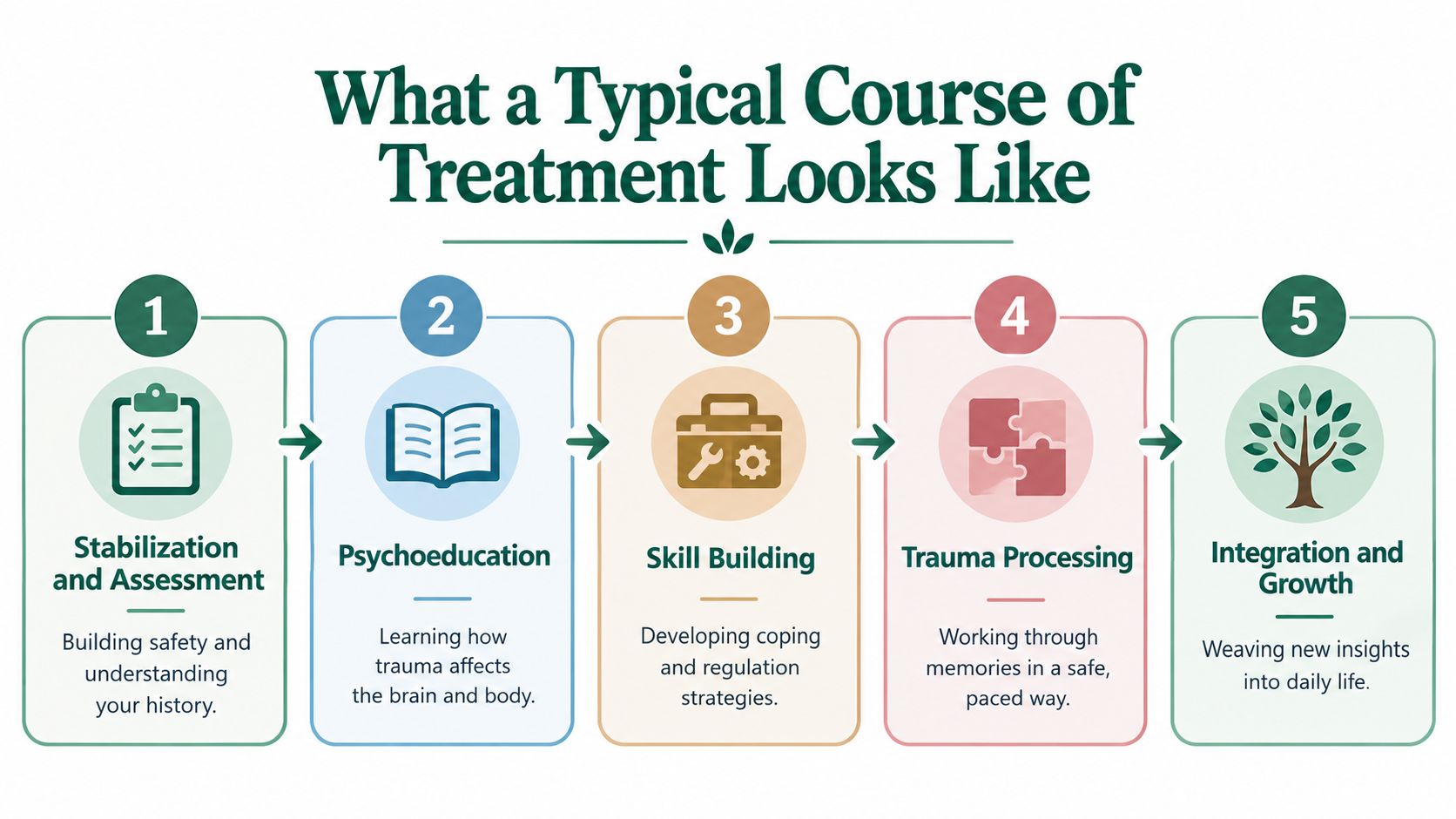
Therapy often begins with an assessment, not a demand for detailed disclosure. A clinician may ask what brought you in, what feels difficult now, what helps you cope, and what you hope will change. You can tell them when you're unsure or don't yet have words for an experience.
The plan may then move through psychoeducation and skill building before, or alongside, trauma processing. A therapist might help you recognize triggers, try grounding strategies, identify trauma-related beliefs, or decide what makes a session feel manageable. The sequence isn't identical for everyone, and complex histories or other clinical needs may call for additional time.
Progress is more than a diagnosis
A treatment plan should connect the clinical method to the outcomes that matter in your life. You might track whether reminders feel less disruptive, whether you can return to a task after becoming distressed, or whether relationships feel less shaped by fear. Symptom check-ins, functional goals, and your feedback can all help you and your therapist decide whether the plan is working.
NICE says adult trauma-focused CBT and EMDR are generally delivered over 8 to 12 sessions, with additional sessions when clinically indicated, including after multiple traumas. That's a guideline for typical delivery, not a guarantee that someone will finish within that span or feel fully recovered by then. For more on how long trauma therapy may take, remember that the right duration depends on clinical needs and the chosen approach.
Ask before you begin: “How will we decide when I'm ready to work on trauma memories, and what can I do if a session becomes overwhelming?”
A clinician should be able to explain how they'll monitor your experience and adjust the plan. Feeling pushed to disclose details before you understand the process is a reason to pause and talk about consent and pacing.
How to Choose the Right Therapist for You
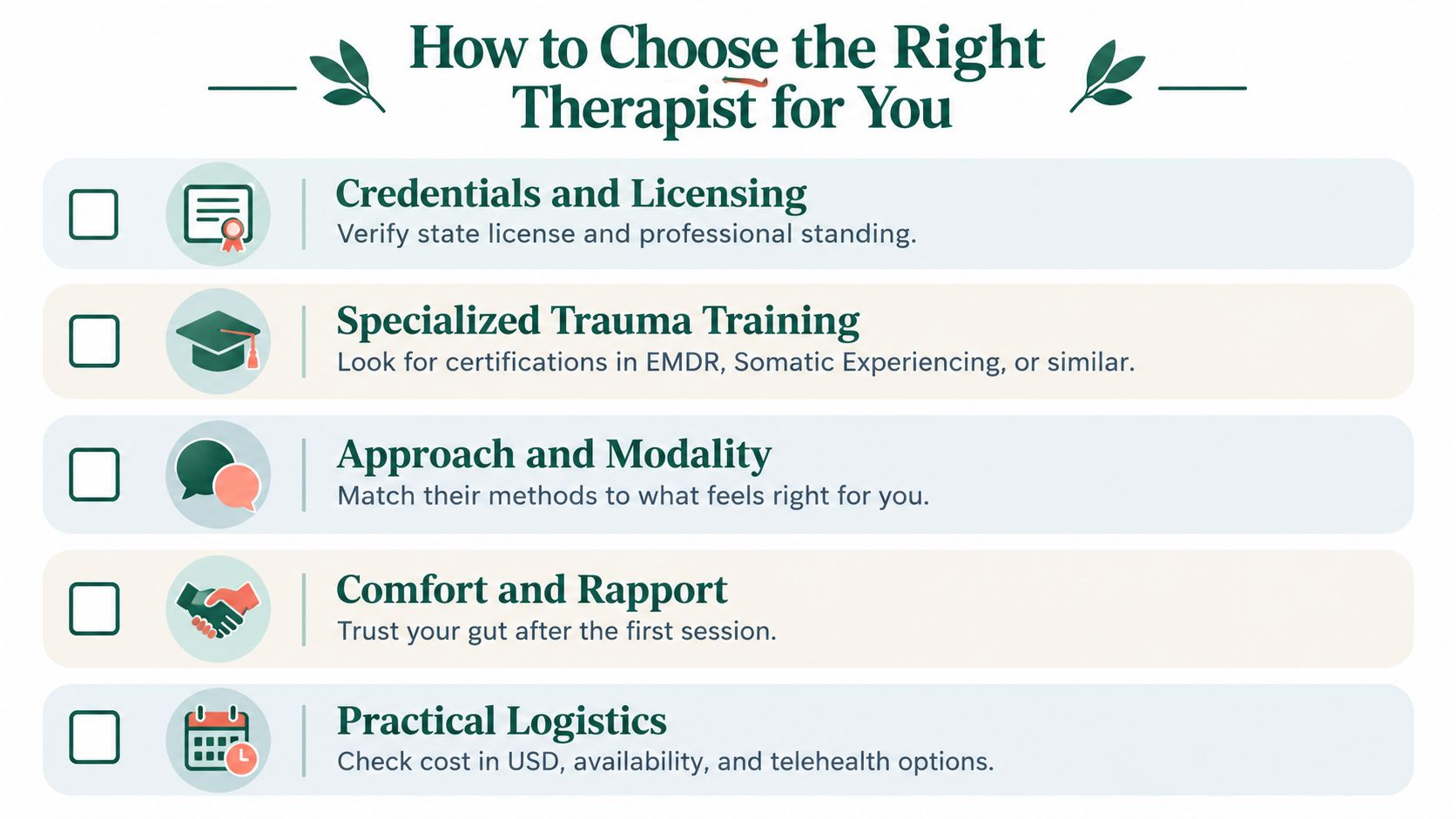
Start with the basics: verify that a clinician is appropriately licensed where they practice, then ask about their experience treating the concerns you want help with. Specialized training in a method such as EMDR or CPT can be relevant, but a credential alone doesn't tell you how someone will respond to your needs. Ask how they choose an approach and how they adapt it when a client feels overwhelmed or dissociated.
Questions worth asking in a consultation
Approach: Which trauma-focused methods do you use, and how do you decide what fits a client?
Pacing: How do you assess readiness for trauma processing, and how do clients signal that they need to slow down?
Progress: What changes will we track beyond PTSD symptoms?
Fit: Can we discuss body-based, relational, cultural, or spiritual concerns without treating them as replacements for evidence-based care?
Practical details: What are your fees, availability, and telehealth options, and do you accept my insurance or provide documentation for reimbursement?
A useful consultation should leave you feeling able to ask questions, not pressured to make a commitment. You don't have to feel instantly comfortable discussing trauma, but the therapist should listen respectfully, explain their reasoning, and take your boundaries seriously. For a fuller picture of what to look for in a trauma-informed therapist, focus on how the clinician handles choice and collaboration as well as their training.
Green flags include clear explanations, respect for your pace, and willingness to discuss alternatives. Red flags include promises of a guaranteed outcome, pressure to disclose before you're ready, or claims that one technique is right for everyone. If you're looking for whole-person care in the St. Petersburg area, Be Your Best Self & Thrive Counseling, PLLC offers counseling grounded in trauma-informed and mind-body-spirit care. Compare any practice's approach with your priorities, and use an initial conversation to see whether the fit feels right.
Common Misconceptions About Trauma Therapy
Misconception: Therapy means recounting every detail. In practice, trauma-focused work should be collaborative, and treatment choices and pacing should be discussed with you. You can ask what a method involves before agreeing to try it.
Misconception: One intense session can resolve everything. A moving or cathartic experience can matter, but it doesn't guarantee lasting change. Treatment usually involves a plan, attention to your response, and practice applying what you learn outside sessions.
Misconception: Body-based work alone always resolves PTSD. Grounding, movement, mindfulness, or breathwork may support regulation and self-awareness, but a clinician should distinguish these adjuncts from therapies with direct evidence for treating PTSD symptoms.
Misconception: Progress must look dramatic. Sometimes it means recognizing a trigger sooner, setting a boundary, or recovering more steadily after distress. Those changes can be worth noticing even when difficult feelings remain.
Trauma-informed care means treating safety, choice, collaboration, and your lived experience as essential, not optional extras. If the process feels hard, that doesn't automatically mean it isn't working; it does mean you and your therapist should discuss what's happening and whether to adjust the pace or approach. This perspective also informs why trauma therapy can feel difficult.
Frequently Asked Questions From New Clients
How soon might I feel better? There isn't one reliable timeline for everyone. Talk with your therapist about the changes you want to notice and review them together as treatment progresses.
What if my current therapist doesn't feel like the right fit? Tell them what isn't working if you feel comfortable doing so, and ask whether they can adjust the approach or refer you to someone with different training. You're allowed to seek another clinician.
Can I do therapy while taking psychiatric medication? Medication and therapy can be considered together. Discuss your treatment with your prescriber and therapist so they can coordinate around your needs; don't change medication without speaking with the prescribing clinician.
What if my history is complex or hard to explain? You don't need a complete narrative to begin. You can start with what you're experiencing now, and work with a clinician to decide what feels safe to explore.
If you're in St. Petersburg or the Tampa Bay area, explore the free initial consultation and counseling options at Be Your Best Self & Thrive Counseling, PLLC. The practice offers individualized, evidence-informed support that can include trauma-informed, mind-body-spirit care, giving you a chance to discuss your goals and ask about fit before deciding on next steps.