
Conflict Resolution Framework: A Complete Guide
Two people sit at the kitchen table after a long day. One starts talking faster and louder. The other goes quiet, stares at a glass, then reaches for a phone. Within minutes, they're no longer discussing dishes, money, or whose turn it was to text the school. They're reacting to each other's reactions.
That's where many readers are when they look for a conflict resolution framework. They don't need another clever phrase to memorize. They need a way to stay present when their chest tightens, their jaw locks, or their mind goes blank.
Most guides focus on what to say. That matters. But the words usually fail when the body is already in alarm. A useful framework has to make room for both. It has to help you organize the conversation and settle yourself enough for the conversation to happen at all.
When Conflict Shows Up Before Words Do
At 8:17 p.m., Maya says, “You said you'd help tonight.”
Jon hears criticism before he hears the sentence. His shoulders rise. Her stomach drops when he looks away. She talks more sharply. He gets quieter. Ten minutes later, they're standing in the same room, but neither feels reached.
What Your Body Is Doing First
This part gets misunderstood all the time. People think conflict starts with attitude, tone, or poor communication. Often it starts earlier. The body detects strain and prepares for defense before a thoughtful sentence ever arrives.
You might notice:
Jaw tightening: Your body is bracing.
A hollow stomach feeling: Something in you senses danger or loss.
Heat in the face or chest: You're mobilizing to protect yourself.
An urge to leave, shut down, or appease: Your system is trying to keep you safe.
That doesn't mean you're broken. It doesn't mean your relationship is doomed. It means your internal alarm has taken the wheel.
Why The Same Fight Keeps Repeating
Many recurring arguments aren't fueled by the surface topic alone. They're shaped by old relational learning. One person learned that conflict means attack. Another learned that silence means abandonment. So a simple disagreement about laundry, lateness, or spending quickly becomes a much larger bodily event.
You can love someone and still lose access to your best self when your system is overloaded.
That's why repeated conflict is so exhausting. You try to solve the content, but your body is busy surviving the pattern. If you've been curious about body-based approaches, this plain-language piece on understanding nervous-system responses in relationships may help name what you've been feeling, even if the language around it has felt intimidating.
A good conflict resolution framework works better when it respects this reality. It doesn't demand perfect composure. It gives your body something to do, so your words have a chance.
What a Conflict Resolution Framework Actually Is
A conflict resolution framework is a predictable set of principles and steps that turns a chaotic argument into a workable conversation. It gives you structure when emotion is high and clarity is low.
It isn't a trick for getting your way. It isn't a script for proving you're the reasonable one. And it won't remove disagreement from human relationships. What it can do is make conflict less random, less explosive, and more repairable.
Here's the visual version of the process we'll use.
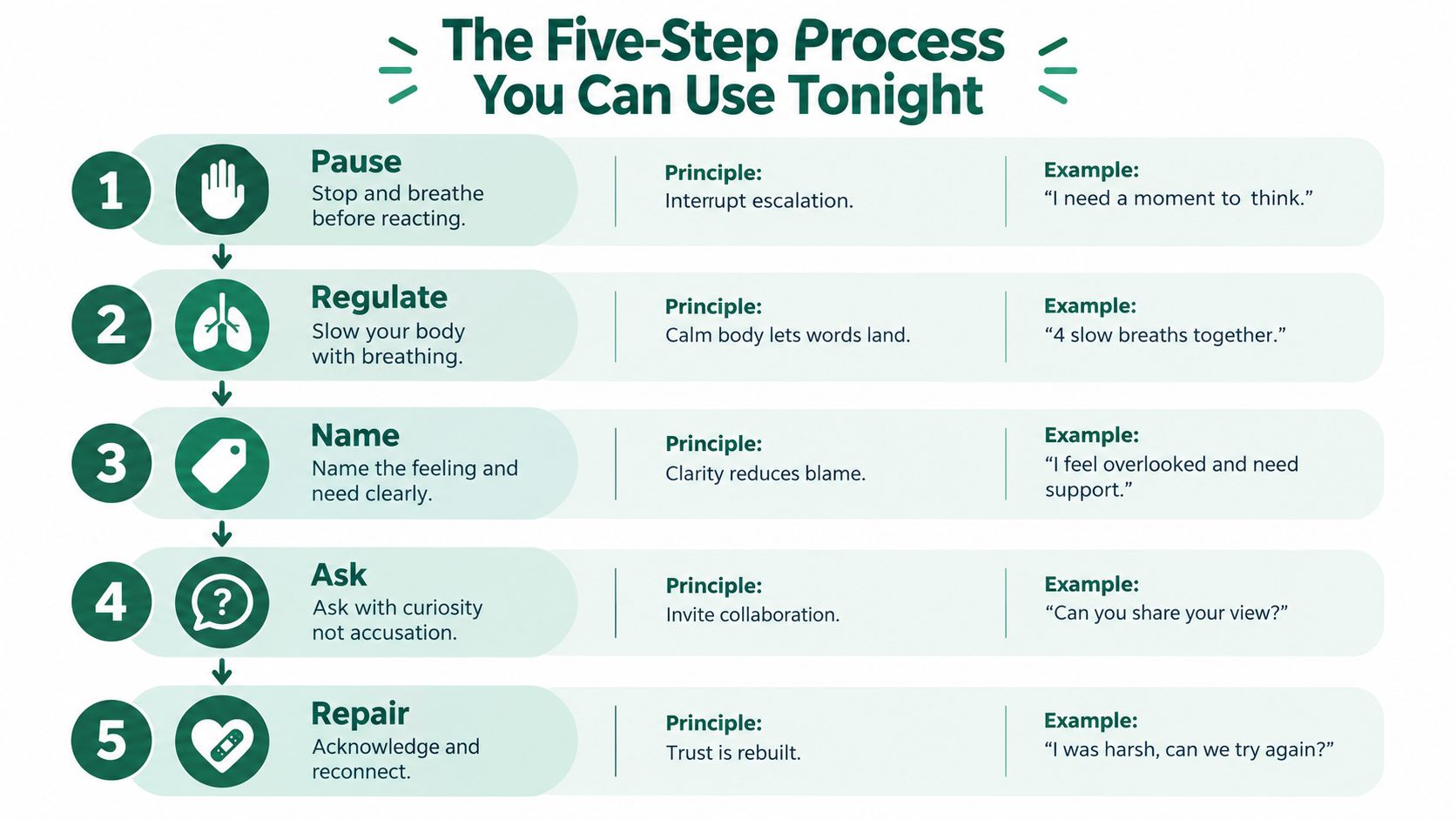
Caption: A five-step conflict resolution framework that moves from pause to repair, with simple examples you can use in real conversations.
The Core Principles That Hold It Together
Some principles matter more than fancy wording.
Safety: People don't listen well when they feel cornered. Example: “I want to talk about this, and I don't want to do it by attacking each other.”
Regulation: A calmer body helps language land. Example: “Give me two minutes to breathe so I can answer.”
Curiosity before correction: Understanding works better than accusation. Example: “Help me understand what this meant to you.”
Shared responsibility: Even when fault isn't equal, each person usually has a part to examine. Example: “I don't like how you spoke to me, and I can also see I came in already sharp.”
Repair over perfection: The goal isn't a flawless conversation. It's restoring connection after strain. Example: “That came out harsh. Let me try again.”
What It Is Not
Some confusion clears up quickly when you name what this framework doesn't do.
It's not a winning strategy. If your goal is victory, the other person will feel it.
It's not formal mediation. Mediation is a structured third-party process. In broader workplace and institutional summaries, mediation is often reported to resolve disputes in about 70% to 80% of cases, with some programs reporting 80% to 100% agreement rates when disputes are referred to mediation, as summarized in the research discussed in this mediation and dispute-resolution review.
It's not therapy. Therapy can help when conflict keeps touching old wounds, power imbalances, or shutdown patterns you can't shift on your own.
A practical framework also needs to fit the setting. Research on conflict approaches shows there isn't one universal tactic that works everywhere. A realist review of 25 foundational studies found recurring pathways such as power, influence, legitimacy, and trust, which means outcomes depend on matching the approach to the context rather than forcing one style onto every problem, as outlined in this context-mechanism-outcome review of conflict interventions.
The Five-Step Process You Can Use Tonight
If you want something simple enough to remember in a hard moment, use this sequence: Pause, Regulate, Name, Ask, Repair. You won't do it perfectly. That's fine. The value is in giving the conversation shape.
Here's a companion visual for the body side of the process.
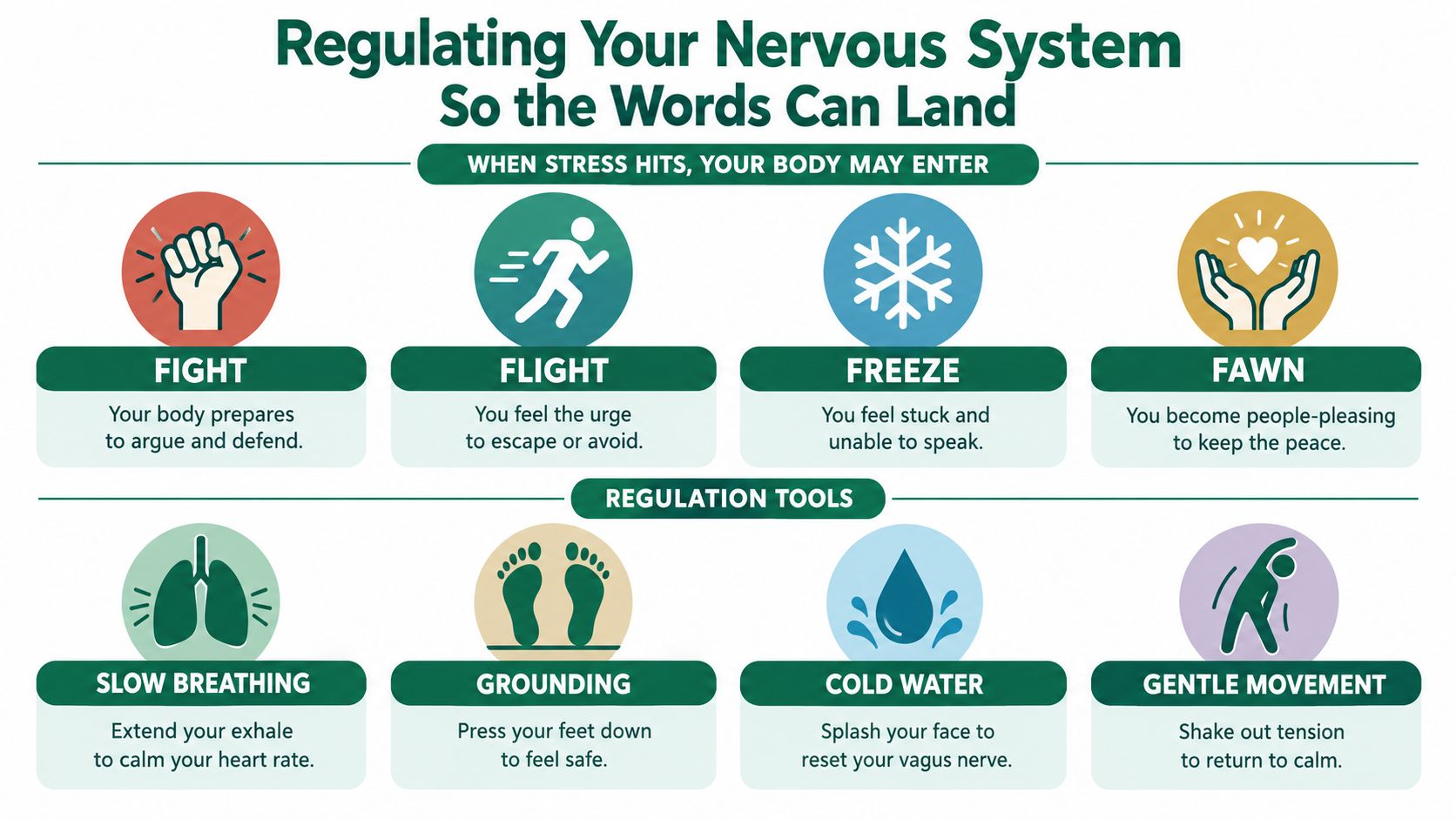
Caption: Common stress responses in conflict, plus four simple tools that can help your body settle enough for a real conversation.
A Household Example
Let's use a familiar fight. One partner feels they carry too much of the housework. The other feels criticized no matter what they do.
Pause
Stop the automatic next sentence.
Pause doesn't mean storming off or giving the silent treatment. It means interrupting escalation before it gathers speed. You might say, “I want to answer this well, and I need a minute.”
Regulate
Do something small and physical before you explain.
Put both feet on the floor. Loosen your hands. Take a slower exhale than inhale. If you need more tools, these de-escalation techniques for heated moments can help when a conversation is already starting to slip.
Name
Say what's happening without turning it into a character indictment.
Instead of “You never help,” try, “I'm feeling overwhelmed and alone with the house stuff.” Clear naming reduces guesswork. It also lowers the urge in the other person to defend against exaggeration.
Practical rule: Name your experience, not the other person's motives.
Ask
Invite their perspective.
This is the step many people skip because they assume they already know the answer. Try, “What's happening for you when I bring this up?” or “What do you hear me asking for?”
That question changes the shape of the room. It signals collaboration instead of prosecution.
Repair
Repair is any sincere move that rebuilds trust after strain.
It might sound like, “I rolled my eyes, and that wasn't fair.” It might be a hand on the table, a softer tone, or returning at the agreed time after a pause. Repair matters because conflict isn't damaging only when people disagree. It becomes damaging when ruptures pile up with no return.
Keep The Steps Flexible
Real conversations aren't tidy. Sometimes repair comes first. Sometimes the pause happens after a clumsy start. Sometimes naming the issue has to wait until the next morning.
Still, the order helps. It gives you a path back when both of you feel scrambled. In practical settings, structured conflict approaches keep proving their value. Peace research has also shown that conflict resolution outcomes vary sharply by goal and intervention type, from 6.45% under a strict full-settlement measure to 26.74% in another long-term success measure, while one more liberal ceasefire dataset reported 97% of agreements never failing, according to this study on mediation, peacekeeping, and conflict outcomes. The takeaway for everyday relationships is simple. Frameworks work best when you know what you're trying to do. Stop harm, create understanding, or build lasting repair.
Regulating Your Nervous System So The Words Can Land
By the time many arguments sound irrational, the body is already in a protective state. You might push harder, leave the room, go blank, or agree too quickly just to end the discomfort. None of those responses make you weak. They make you human.
This image captures the communication moments where regulation matters most.
Caption: Three hard moments in conflict conversations, with sample language that supports openness, steadiness, and repair.
Four Simple Regulation Moves
You do not need a long ritual. You need a brief interruption that gives your thinking brain a chance to rejoin the room.
Paced breathing: Try a slow inhale and a longer exhale. Some people like box breathing. Others prefer a simple count that doesn't feel performative. What you'll usually notice is a little more space between feeling and reaction.
Grounding through feet and hands: Press your feet into the floor. Feel the chair under you. Unclench your fingers. This gives the body direct sensory information that you're here, now, and not trapped in the old story.
Orienting: Let your eyes move slowly around the room. Find the lamp, window, doorway, plant, or mug. That gentle scanning often reduces the tunnel vision that shows up during conflict.
A micro-pause: Before answering, wait briefly. Even a short pause can keep you from saying the one sentence that turns a hard conversation into a painful one.
What Regulation Is Actually For
Regulation isn't suppression. It isn't pretending you're calm when you're not. It's creating enough internal steadiness that the next sentence comes from intention rather than reflex.
When your body settles even slightly, your voice usually changes before your words do.
If you want a deeper set of exercises, this guide on how to regulate your nervous system in daily life offers practical ways to build the skill outside the heat of conflict, which makes it easier to access during conflict.
A broader systems lens matters here too. Dispute system design, often shortened to DSD, is defined as the applied art and science of designing ways to prevent, manage, and resolve streams of disputes instead of handling each case one by one, as described in this foundational dispute system design article. In ordinary life, that means don't wait for every argument to become an emergency. Build in pause rituals, return times, decision rules, and agreements about how you'll talk when things get tense.
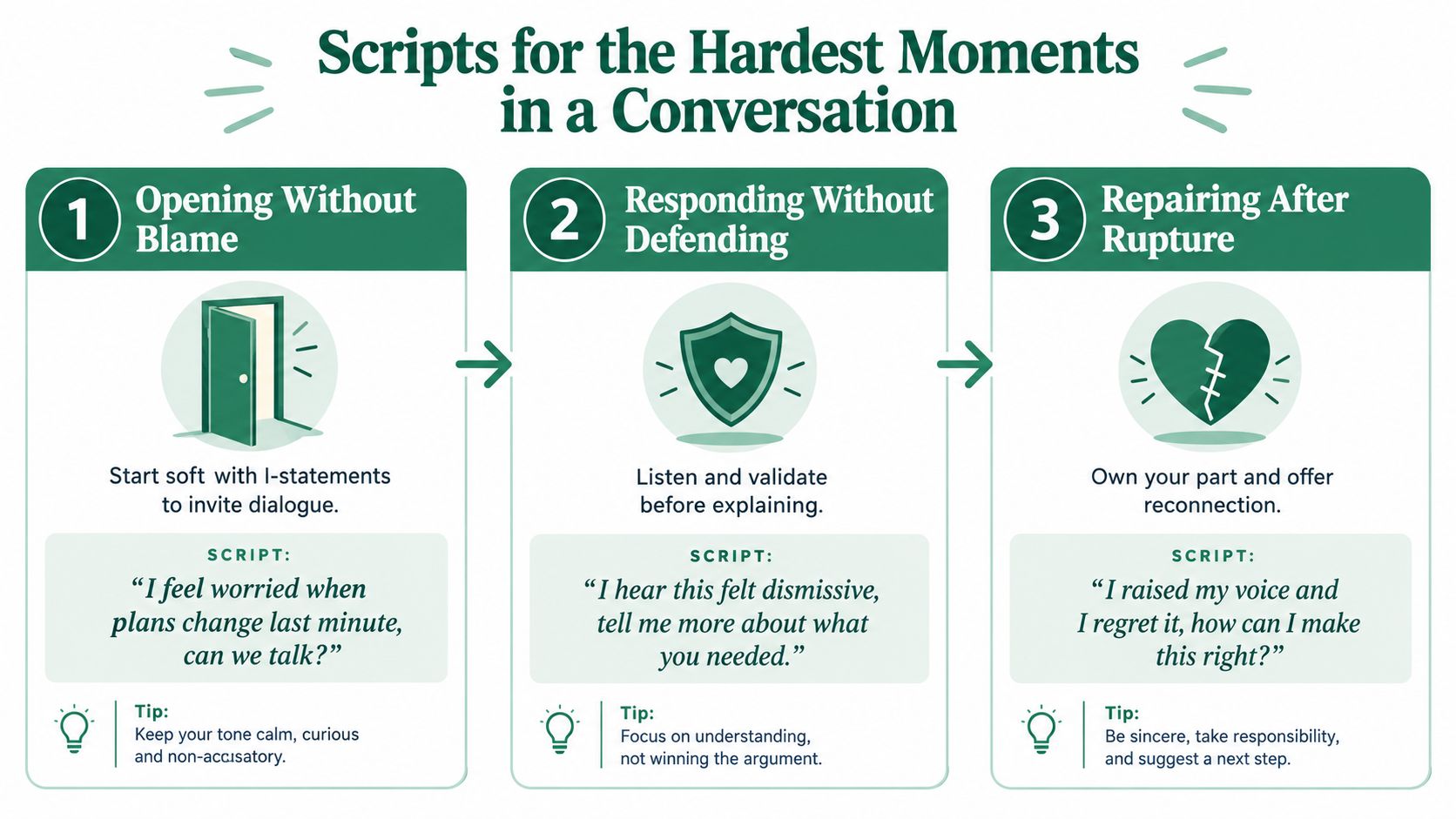
Scripts For The Hardest Moments In A Conversation
A script won't save a conversation by itself. But it can keep you from reaching for the phrases that inflame everything. Think of scripts as scaffolding. You use them until your steadier voice comes back online.
Here's a simple visual guide you can borrow from.
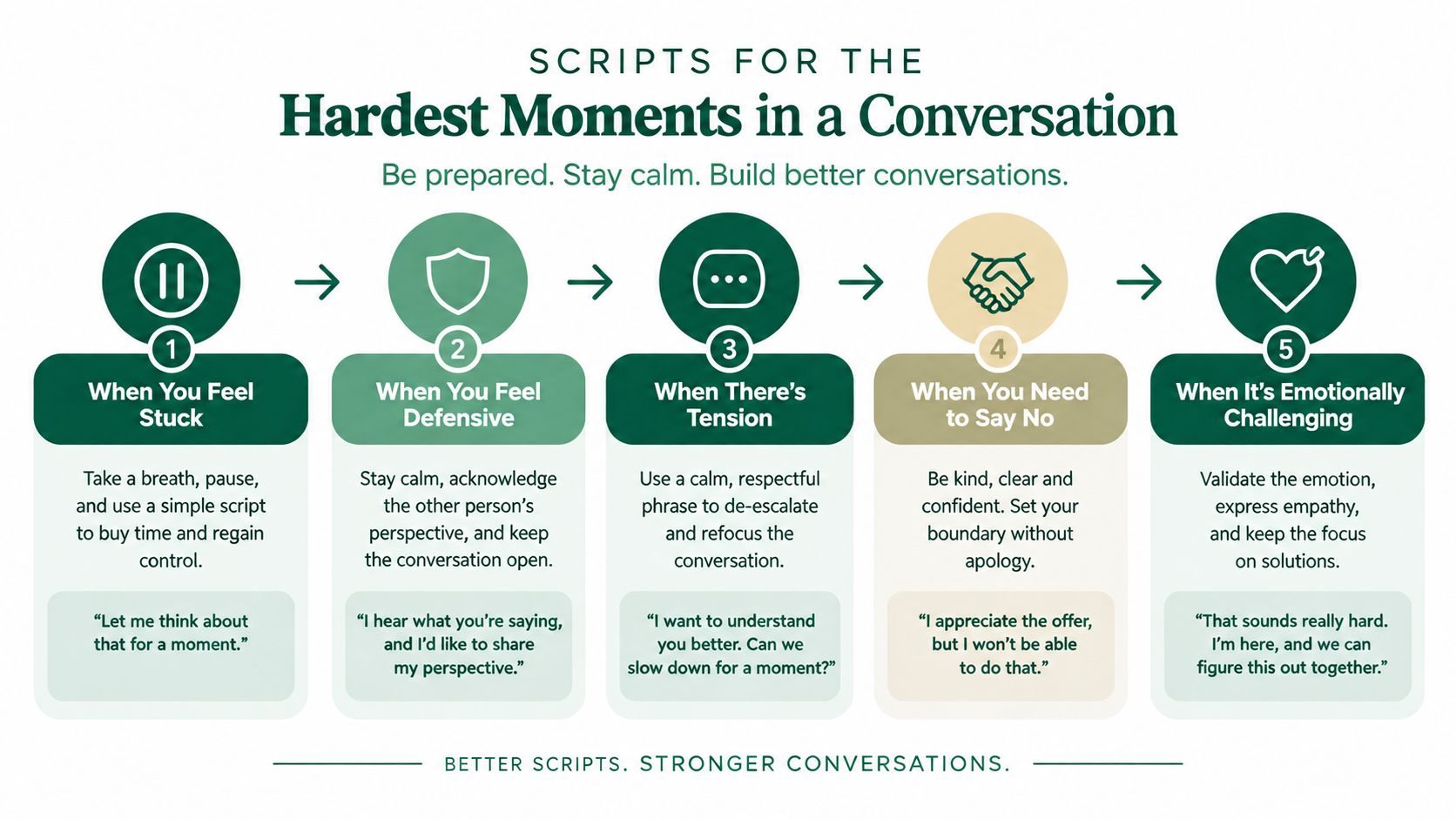
Caption: Ready-to-use scripts for opening a hard talk, responding without immediate defense, and repairing after a rupture.
Opening A Hard Talk Without Blame
Lena wants to say, “You never listen.” She stops herself and tries again.
“I feel talked over when I'm interrupted, and I want to finish one thought before we respond to each other.”
That sentence does a few quiet things. It lowers accusation. It gives the listener something specific to respond to. It also tends to soften the body of the person hearing it. The shoulders drop a little. Eye contact becomes more possible.
Responding To Criticism Without Defending
Marcus hears, “You didn't show up for me last night,” and his first impulse is a courtroom speech. Instead, he says, “I can hear that you felt alone. Tell me more about what you needed from me.”
That doesn't mean he agrees with every detail. It means he's resisting the urge to protect himself before he understands the impact. If this is hard for you, work on it alongside healthy boundary setting in close relationships. Boundaries and listening belong together. One helps you stay open. The other helps you stay intact.
“I hear this landed badly. I want to understand before I explain.”
Repairing After A Rupture
The fastest repair is often the most honest one.
“I raised my voice. I regret that. You didn't deserve the tone I used. Can we start that part over?”
Notice what this does not include. It doesn't contain “but.” It doesn't sneak in a counterattack. It doesn't make your apology dependent on their reaction.
Let The Script Sound Like You
Use your own words. If a phrase feels stiff in your mouth, change it. A useful script is one you can say while upset, not one that looks elegant on a worksheet.
Tone matters as much as wording. Timing matters too. A beautiful sentence delivered while rolling your eyes will still land as threat.
Adapting The Framework To Couples, Families, And Work
The same conflict resolution framework can travel across settings, but it shouldn't sound identical in every room. A couple arguing in a kitchen needs something different from a manager handling tension in a meeting. The shape stays the same. The delivery changes.
Research on mediation scholarship points to this exact problem. A 2026 synthesis of 395 mediation articles found the field fragmented across six design questions, often studied in isolation rather than as one integrated system, as discussed in this synthesis on mediation design and blind spots. In plain language, context matters more than many frameworks admit.
The Same Framework, Different Delivery
For couples, the most important adjustment is usually speed of repair. Don't wait until the next crisis review to acknowledge a sharp tone or missed bid for connection. Small repairs keep resentment from hardening.
For families, hierarchy matters. A parent still sets limits. A child or teen still deserves regulation and respect. “I'm not changing the boundary, and I am going to say it more calmly” is very different from winning by force.
For workplaces, the goal often shifts from emotional resolution to functional agreement. You may not leave feeling understood. You may leave with a clear next step, a decision rule, and less friction.
For neurodivergent partners or family members, pacing matters. More processing time, written follow-up, lower sensory load, and less pressure for eye contact can make the framework far more usable.
Step | Couples | Family | Workplace | Neurodivergent Partner |
|---|---|---|---|---|
Pause | Take a brief break with a return time | Parent models stopping before lecturing | Suggest a short reset before responding in the meeting | Allow silent processing before expecting words |
Regulate | Soften voice, breathe, sit down | Help everyone settle before discussing consequences | Lower intensity and move to concrete language | Reduce sensory strain and support body-based grounding |
Name | State hurt, fear, or overwhelm clearly | Name the issue without shaming roles | Describe impact on task, timeline, or collaboration | Use literal language and avoid implied meaning |
Ask | Invite their experience, not just facts | Ask age-appropriate questions | Ask for perspective and preferred solution | Offer verbal or written response options |
Repair | Reconnect early with apology or affection | Repair while holding the boundary | Clarify next steps and acknowledge friction | Confirm understanding and give extra time to re-engage |
When Generic Advice Falls Flat
Families often need more than “communicate better.” If that's your world right now, this piece on family conflict resolution that actually works gives grounded examples that fit real households better than vague advice.
And if couple patterns keep looping, structured support can help you slow the exchange enough to hear each other differently. Some people use journaling, some use coaching, and some use guided exercises like these couples counseling exercises for better communication.
Bringing It All Together And When To Ask For Support
When conflict starts moving fast, don't try to remember twenty ideas. Keep one small sequence on your phone or in your head.
A Simple Order To Return To
Pause before you answer. Not forever. Just long enough to interrupt the reflex.
Regulate your body. Breathe, ground, orient, or wait briefly.
Name the dynamic. Say what's happening for you without turning it into blame.
Ask instead of assume. Curiosity opens doors that certainty slams shut.
Repair early. Don't save repair for a formal postmortem.
If you want one self-check, ask: Can I stay present enough to listen and speak without attacking, disappearing, or collapsing? If the answer is no, the next wise move is regulation, not more talking.
Signs You May Need More Than A Home Framework
Sometimes a conflict resolution framework helps immediately. Sometimes it reveals that the pattern is deeper than communication skill alone.
Consider extra support when:
Escalation keeps repeating: You reset for a few hours, then snap back into the same cycle.
Shutdown lasts a long time: One or both of you stays unreachable well beyond the conversation.
Past trauma gets stirred up: Present conflict keeps activating pain that feels much older than the topic.
Safety is a concern: Fear, intimidation, coercion, or any form of harm changes the kind of help that's needed.
You're stuck despite effort: You've practiced, apologized, revisited, and still can't get traction.
Different support fits different needs. Couples therapy can help when two people need a structured room for slowing down, clarifying patterns, and practicing repair. Individual trauma-informed counseling may fit when conflict reliably floods one person beyond what a shared conversation can hold. Brief coaching can help when the issue is skill-building, accountability, or preparing for specific hard talks.
One more emerging question is worth naming. New research has begun exploring hybrid AI-human conflict tools. A 2025 review reported 23% higher resolution rates in workplace disputes for hybrid AI-human systems than either approach alone, while also reporting algorithmic bias in 37% of cases and an explainability gap in recommendations, according to this review of AI-assisted conflict resolution systems. That matters because efficiency isn't enough. Fairness, transparency, and human judgment still matter when relationships and power are involved.
Repair is a skill. It isn't a personality trait some lucky people were born with. You can practice it, miss it, return to it, and get steadier over time.
Be Your Best Self & Thrive Counseling, PLLC offers individual and couples counseling with a trauma-informed focus that fits exactly this kind of work: slowing conflict down, understanding the body's role, and building practical repair skills you can use in daily life. If you want support turning these ideas into lived practice, visit Be Your Best Self & Thrive Counseling, PLLC.